http://dx.doi.org/10.4236/am.2016.76047
Uncertainty Relations for Some Central
Potentials in N-Dimensional Space
Sami M. AL-Jaber
Department of Physics, An-Najah National University, Nablus, Palestine
Received 16 December 2016; accepted 21 March 2016; published 24 March 2016
Copyright © 2016 by authors and Scientific Research Publishing Inc.
This work is licensed under the Creative Commons Attribution International License (CC BY).
http://creativecommons.org/licenses/by/4.0/
Abstract
We study the uncertainty relation for three quantum systems in the N-dimensional space by using the virial theorem (VT). It is shown that this relation depends on the energy spectrum of the sys-tem as well as on the space dimension N. It is pointed out that the form of lower bound of the in-equality, which is governed by the ground state, depends on the system and on the space dimen-sion N. A comparison between our result for the lower bound and recent results, based on infor-mation-theoretic approach, is pointed out. We examine and analyze these derived uncertainties for different angular momenta with a special attention made for the large N limit.
Keywords
Heisenberg Uncertainty Relation, Central Potentials in N-Dimensions, Confined Particle, Hydrogen Atom, Harmonic Oscillator
1. Introduction
ob-servables. Recently, Fujikawa [6] proposed a universally valid uncertainty relation which incorporated both the intrinsic quantum fluctuations and measurement effects. There has been a continual interest in utilizing HUP in different settings. For example, it has been used in the study of central potentials [7]-[11] and others consider its connection to geometry [12] [13]. Furthermore, it has been generalized to describe a minimal length as a minim-al uncertainty in position measurement [14]-[18] through the modification of Heisenberg commutation relation into a generalized form. The existence of a minimal length has long been suggested in quantum gravity and string theory [19]-[24], and has been proposed to describe, as an effective theory, non-point like particles like hadrons, quasi-particles or collective excitations [25]. In its original formulation, HUP is expressed in terms of variances of position and momentum of a particle. Such variances do not necessarily exist, and if they do, they describe the quantum probability distribution relative to a specific point of the probability domain. Therefore, various alternative formulations have been suggested by the use of information-theoretic uncertainty measures like the Shannon entropy [26] [27], Renyi entropies [28] [29], Tsallis entropies [30], entropic moments [31] [32] and Fisher information [32]-[36]. During the past years, the generalization of three dimensional quantum prob-lems to higher space dimensions receives a considerable development in theoretical and mathematical physics. For example, the central potentials, as hydrogen-like atoms [37]-[42] and harmonic oscillators [43]-[46] are be-ing used as prototypes for other purposes in N-dimensional physics. Furthermore, the confined harmonic oscil-lator [45] and the confined hydrogen atom [47] have been discussed. The purpose of the present paper is to de- rive and discuss the uncertainty product 2 2
r P for three quantum systems in N-dimensional space: the
harmonic oscillator, the hydrogen atom, and a confined particle in an impenetrable symmetrical spherical well. The lower bound for this product is analyzed and compared with other previous results that have been obtained by other methods. Our method is based on the virial theorem applied to the harmonic oscillator and the hydrogen atom systems to obtain the uncertainty product, while for the spherical well, the zeros of spherical Bessel func-tions are used for finding numerical results for the uncertainty product. Over the last years, the virial theorem technique has been employed in the study of physical quantities [48] [49]. Interesting features for the lower bound are discussed with a special attention explored for the large space dimension limit for the spherical well system. The organization of the paper is as follows: In section 2, we outline theoretical background. Then, we evaluate the uncertainty product for the harmonic oscillator quantum system in Section 3, for the hydrogen atom in Section 4, and for the spherical well in Section 5. We present conclusions and discussion of our work in Section 6.
2. Theoretical Background
The quantum mechanical state of a particle in the N-dimensional space with a central potential V r
( )
is go-verned by Schrödinger equation (setting =m=1)( ) ( )
( )
2
1
2 N V r ψ r Eψ r
− ∇ + =
(1)
where ∇2N is the Laplacian operator on N
R and is given by [50]
2
2 1 1
2
N N
N r r
r r r
− ∂ − ∂ Λ
∇ = +
∂ ∂ (2)
with Λ2
is a partial differential operator which depends on the angular coordinates
(
θ θ θ1, 2, 3,,θN−1) (
= ΩN−1)
as
(
)
(
)
(
)
1
1 1
2
2
1 1
1 sin
sin i N
N i
N i
i
i i
i i
j j θ
θ
θ θ
θ
+ −
− − −
= −
=
∂ ∂
Λ =
∂ ∂
∑
∏
, (3)and satisfies [50]
{ }
(
) (
)
{ }(
)
2
1 1
,m N 2 ,m N
Y − N Y −
Λ Ω = + − Ω , (4)
(
,m m m1, 2 3,,mN−2)
with the condition ≥m1≥m2≥≥ mN−2 ≥0. The separation of variables yields theradial part of Schrödinger equation that satisfies
(
)
( ) ( )
( )
22 2
2
1 d 1 d
,
2d 2 d 2
N N
V r R r ER r
r r
r r
+ −
− − − + + =
(5)
which, by letting
( )
( )
1 2
N
u r r R r
−
= , becomes
(
)
( ) ( )
( )
22 2
1 1 d
2 d 2
L L
V r u r Eu r
r r
+
− + + =
. (6)
The above equation is the analogue to the one-dimensional Schrödinger equation with the grand orbital angu-lar momentum, L given by
3 2
N
L= + − (7)
It is straight forward to write Equation (6) as
( ) ( )
( )
22 1 d
2 dr Veff r u r Eu r
− + =
, (8)
where the effective potential, Veff
( )
r is given by( )
( )
(
2) (
)(
2)
2 3 1
2 8
eff
N N N
V r V r
r r
+ − − −
= + +
. (9)
It is worth to note, as seen from Equation (7), the isomorphism between the space dimension N and the orbital angular momentum ℓ, which means that an orbital angular momentum
(
+1)
in space dimension N is equiva-lent to an orbital angular momentum ℓ in a space dimension(
N+2)
. It is interesting to realize, as seen from Equation (9), that a particle is subject to two additional forces besides the force due to the external potential( )
V r : The centrifugal force coming from the angular momentum term ( first term in brackets of Equation (9)) and a quantum fictitious force associated with the quantum-centrifugal potential (second term in brackets of Equation (9)) which has a purely dimensional origin. This potential is attractive for N=2 and repulsive for
4
N≥ .
3. Isotropic Harmonic Oscillator in
N
-Dimensions
The potential for a harmonic oscillator is given by( )
1 2 2 2V r = ω r (10)
The virial theorem states that
2 T = r⋅ ∇V , (11)
where T is the kinetic energy and the average is taken over an energy eigenstate of the system. The substitution of Equation (10) into Equation (11) gives
1
2 nN
T = V = E , (12)
where the energy eigenvalues, EnN are given by [45], with
(
=1)
2
2 2
nN r
N N
E =ω n + + =ωn+
. (13)
Using T = P2 2 with m=1, and with the help of Equations (12) and (13), we get 2
2 2 2
1 1
2 2 4 nN
P
r E
and thus the uncertainty product is
2
2 2
2
N P r =n+
, (14) which obviously increases with both the quantum number n and the space dimension N. It is observed that the above product does not depend on the strength of the potential. The lower bound corresponds for the ground state
(
n=0)
and therefore, one may write the inequality for the uncertainty product, namely2 2 2
4
N
P r ≥ , (15)
which saturates (equality is achieved) for nodeless harmonic oscillator wave function (ground state). Our results in Equation’s (14) and (15) are the same as those obtained by means of the Fisher’s information entropies [32] [33], by Stamp’s principle [51] and by Shannon’s entropy [26]. Our method is more straight forward and simpler. The lower bound in Equation (15) reduces to the three-dimensional one, namely 9/4. Furthermore, our result in Equation (14) shows that the lower bound of the uncertainty product (for the ground state) in N-dimension is the
same as the lower bound of the 3 2
th
N−
excited state in the three-dimensional space. In addition, the uncer- tainty product for a state with angular momentum
(
+1)
in N-dimension has the same value as that for a state with angular momentum ℓ in a space dimension(
N+2)
.4. The Hydrogen Atom in
N
Dimensions
In this case, the potential is the coulomb potential,( )
20 4π e V r r ε
= − (16)
The application of the virial theorem gives V = −2 T and using H =EnN = T + V yields
nN
T = −E and V =2EnN. Therefore,
2 2
2
0 2
2 4π nN
P e
E r
ε = − .
The energy eigenvalues for the eigenstates of a hydrogen atom in N dimensions are given by [37]
2 2 1 1 2 3 2 nN E a N n = − − +
, (17)
where a is Bohr radius. Therefore, 2
P is readily obtained,
2 2 2 1 1 2 2 3 2 nN
P T E
a N n = = − = − +
. (18)
In order to find the average of the moments of position of different powers we use Kramer’s relation in N- dimensions [52]
(
)
1(
)
2 2 2 22
1
2 1 2 2
4 3
2
s s s
s s
r s a r N s a r
N n − − + − + + + − − − +
(19)
The successive application of the above relation for s=0,1, 2 and after some algebra we get
(
)
{
}
2 2
2
2
2 3 5 3 1 3 2 2 7
2 2 2 4
a N N
r = n+ − n+ − − +N− −
The above relation and Equation (18) yield the uncertainty product for position and momentum;
(
)
{
}
2
2
2 2 1 20 3 3 2 2 7
8 2
N
r P = n+ − − +N− −
(21)
It is clear to notice that the uncertainty product increases as the quantum number n increases and decreases as the orbital angular momentum ℓ increases. One can easily verify that the uncertainty product increases as the space dimension increases.
The lower bound of the above uncertainty is achieved by setting n=1 and =0, which means for ground state, with the result
(
)
2 2 1
1 4
r P = N N+ (21)
In what follows, we will consider the uncertainty product given in Equation (20) for some special cases: 1) For the three-dimensional case (N=3), our result reduces to a previous reported result [48], namely
(
)
(
)
2 2 1 2
5 1 3 1
2
r P = n + − + . (22)
2) For any state n with ℓ has its maximum value
(
n−1)
, the uncertainty product takes the form(
)
2 2 1 3
1
2 2
N r P = n+ −N n+ −
(23)
In this case, the uncertainty product has its minimum value since ℓ has its maximum value, which means the certainty has its highest value. This result is a natural consequence of the quantum centrifugal potential which tries to repel the particle away from the nucleus. In fact, it was pointed out by AL-Jaber [37] that the radial probability density has its maximum value when the orbital angular momentum has its maximum value
(
n−1)
. This implies that the particle is more localized at this value of angular momentum and therefore the certainty is higher or the uncertainty is lower.3) For any state n with =0, the uncertainty product takes the form,
(
)
(
)(
)
2 2 1 1
5 3 5 4
2 2
r P = n n+ − +N N− N−
, (24)
which corresponds to the maximum value of the uncertainty product, since ℓ has its minimum value. One may expect this result in the light of what we mentioned in the previous case.
4) The large space dimension limit: For large N, Equation (21) gives us the result
2 2 2
4
N
r P = , (25)
which is equal to the lower bound for the ground state of the harmonic oscillator in N-dimensions as we found in the previous section. This clearly shows that in the large N limit the lower bound for any state becomes saturated and equals to that of the ground state lower bound of the harmonic oscillator.
5) The uncertainty product difference between a state with
(
n,=0)
and(
n,= −n 1)
. This is achieved by subtracting Equation (23) from Equation (24) with the result(
)(
)
2 2 2 2
, 0 , 1
3
1 3
2
n n n
r P r P n n N
= − = − = − + −
(26)
The above equation gives, for a given state n, the uncertainty product difference between minimum and maximum angular momenta for that state. This difference increases with both n, and N. This shows how much the particle becomes delocalized due to maximum orbital angular momentum.
6) Spherically symmetric infinite potential well
( )
0 r aV r
r a
≤ = ∞ >
(27) The substitution of the above potential into Equation (6) and letting K2=2E
, gives
(
)
22 2 2
2 d
1 0
d
u
r K r L L u
r + − + = , (28)
whose solution is the spherical Bessel function of order L, (the second solution has been dropped out since it di-verges at the origin) and thus, the radial wave function is
( )
(3N)2( )
L L
R r =A r − j Kr . (29)
where AL is a normalization constant. The allowed energies can be obtained by requiring jL
( )
Ka =0, and thusnL nL
K =χ a, with χnL being the th
n zero of the spherical Bessel function of order 3 2
N L= + −
. The
successive zeros of jL depend on the order L, which depends on both ℓ and N. Therefore, the energies depend on ℓ and N, so that
2 2 2 n N n N E a χ =
. (30)
The integer n is the principal quantum number, which is the number of the root of spherical Bessel function in order of increasing magnitude. Since P2 =2 T =2E
, we get 2 2 2 n N P a χ
= (31)
On the other hand, the average value, r2
is given by
( )
2 2 4 2
0
2 2
0 2
d N d
a a
r =A
∫
u r r=A∫
r j Kr r (32)Following Grypeos [48], we get
(
)(
)
2 2
2
2 3 2 1
1
3 2 nL
L L a r χ + − = +
, (33)
which, upon the substitution for L from Equation (7), becomes
(
)
(
)
2 2
2
4 2 4
1 1
3 2 n N
N N N
a r χ + − + − = +
. (34)
The uncertainty product is now readily obtained using Equations (31) and (34), namely
(
)
(
)
{
}
2 2 1 2 1
4 2 4
3 n N 2
r P = χ + + −N +N N−
. (35)
Again, the uncertainty product increases with both ℓ and N. The lower bound limit corresponds to ground state, =0, and the first zero of spherical Bessel function of order
(
N−3 2)
. In this case, we have( )
(
)
2 2 2
3 2
1 1
4
3 N 2
r P = χ − + N N−
. (36)
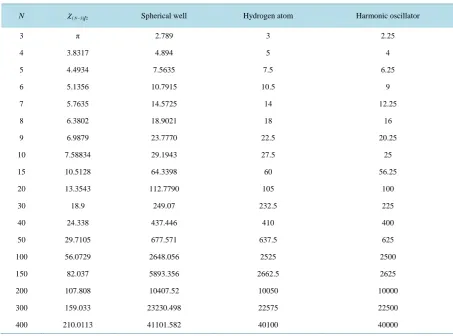
The above result shows that the uncertainty product increases with space dimension N, but is independent of the size of the well. It is instructive to calculate the above lower limit for different values of space dimension and compare its values with those for the harmonic oscillator and the hydrogen atom. This is shown in Table 1.
Table 1. Lower bound for the uncertainty product for the spherical well, harmonic oscillator, and the hydrogen atom as func-tion of space dimension N.
N χ(N−3 2) Spherical well Hydrogen atom Harmonic oscillator
3 π 2.789 3 2.25
4 3.8317 4.894 5 4
5 4.4934 7.5635 7.5 6.25
6 5.1356 10.7915 10.5 9
7 5.7635 14.5725 14 12.25
8 6.3802 18.9021 18 16
9 6.9879 23.7770 22.5 20.25
10 7.58834 29.1943 27.5 25
15 10.5128 64.3398 60 56.25
20 13.3543 112.7790 105 100
30 18.9 249.07 232.5 225
40 24.338 437.446 410 400
50 29.7105 677.571 637.5 625
100 56.0729 2648.056 2525 2500
150 82.037 5893.356 2662.5 2625
200 107.808 10407.52 10050 10000
300 159.033 23230.498 22575 22500
400 210.0113 41101.582 40100 40000
It is interesting to check the large N limit of the lower bound of these systems: For the hydrogen atom, the lower bound behaves as N2 4 which coincides with that of the harmonic oscillator. For the spherical well, the limit of the first zero for high order of jν is ν. In our case, this limit is just N 2 and therefore, Equation (36) gives a limit of N2 4, which is again the lower bound of the harmonic oscillator. We conclude that, in large N
limit, both the hydrogen atom and the spherical well have lower bound values that converge to the same value which is equal to the lower bound of the harmonic oscillator. Therefore, the lower bound of the uncertainty product for those systems saturate in the large space dimension limit.
5. Conclusion
In this paper, we have derived the uncertainty product for position and momentum for harmonic oscillator, hy-drogen atom, and spherically symmetric infinite well in N-dimensional space. We have found that this product depends on the orbital angular momentum and space dimension but independent of the strength of the potential. Our derivation relies on the virial theorem and Kramer’s relation for the harmonic oscillator and the hydrogen atom. Our results for the lower bound of the uncertainty product for each of the three systems agree with re-ported results for the three dimensional case. An interesting feature of our results is that in the large space di-mension limit, the lower bound of the product for the hydrogen atom and the spherical well converge to that for the harmonic oscillator, namely N2 4, which means that the product saturate (for the ground state) in the large
N limit. We have examined some features of the uncertainty product: For the harmonic oscillator, we have found
that the lower limit of the product in N-dimensions has the same value as that for the 3 2
th
N−
same as that for a state with angular momentum ℓ in
(
N+2)
dimensions. For the hydrogen atom, we have found that the lower bound of the uncertainty product has the value N N(
+1 4)
, which reduces to 3 in the three dimensional space. In addition, the lower bound decreases as ℓ increases, and reaches its lowest value when ℓ gets to its maximum value,(
n−1)
. This is expected since the radial probability distribution function is maximum at the maximum value of angular momentum, and thus the particle is expected to be more localized. Furthermore, we have derived the difference between the lower bounds for a state with =0 and another with1
n
= −
. This difference gives how much the particle becomes localized as the angular momentum increases from its lowest value to its maximum one. For the spherical infinite well, the lower bound is calculated by find-ing the first zero of spherical Bessel function of order
(
N−3 2)
. Due to the increase of the values of the zeros with the increase of the order of spherical functions, the lower bound of the product increases with the space dimension, N. It is observed that the value of the first zero approaches N 2 in the large N limit, and therefore, the lower bound becomes saturated with a value N2 4. Numerical values of the lower bound for the three sys-tems are calculated and presented in Table 1.References
[1] Price, W.C. and Chissick, S.S. (1997) The Uncertainty Principle and Foundations of Quantum Mechanics. Wiley, New York.
[2] Neilson, M.A. and Chuang, I.L. (2000) Quantum Computation and Quantum Information. Cambridge University Press, Cambridge.
[3] Heisenberg, W. (1927)Über den anschaulichen Inhalt der quantentheoretischen Kinematik und Mechanik. Zeitschrift für Physik, 43, 172-198. http://dx.doi.org/10.1007/BF01397280
[4] Kennard, E.H. (1927) Zur Quantenmechanik einfacher Bewegungstypen. Zeitschrift für Physik, 44, 326-352. http://dx.doi.org/10.1007/BF01391200
[5] Robertson, H.P. (1929)The Uncertainty Principle. Physical Review, 34, 163. http://dx.doi.org/10.1103/PhysRev.34.163
[6] Kujikawa, K. (2012)Universally valid Heisenberg Uncertainty Relation. Physical Review A, 85, Article ID: 062117. http://dx.doi.org/10.1103/PhysRevA.85.062117
[7] Kuo, C.D. (2005)The Uncertainties in Radial Position and Radial Momentum of an Electron in the Non-Relativistic Hydrogen-Like Atom. Annals of Physics, 316, 431-439. http://dx.doi.org/10.1016/j.aop.2004.09.005
[8] Chen, C.-Y., You, Y., Lu, F.-L. and Dong, S.-H. (2013)The Position-Momentum Uncertainty Relations for a Pöschl- Teller Type Potential and Its Squeezed Phenomena. Physics Letters A, 377, 1070-1075.
http://dx.doi.org/10.1016/j.physleta.2013.02.043
[9] Rudnicki, L. (2012) Heisenberg Uncertainty Relations for Position and Momentum beyond Central Potentials. Physical Review A, 85, Article ID: 022112.
[10] Bracher, C. (2011)Uncertainty Relations for Angular Momentum Eigenstates in Two and Three Spatial Dimensions.
American Journal of Physics, 79, 313. http://dx.doi.org/10.1119/1.3534840
[11] Patil, S.H. and Sen, K.D. (2007)Uncertainty Relations for Modified Isotropic Harmonic Oscillator and Coulomb Po-tentials. Physics Letters A, 362, 109-114. http://dx.doi.org/10.1016/j.physleta.2006.11.045
[12] Kryukov, A. (2007) Geometric Derivation of Quantum Uncertainty. Physics Letters A, 370, 419-422. http://dx.doi.org/10.1016/j.physleta.2007.09.038
[13] Anastopoulos, C. and Savvidou, N. (2003)The Role of Phase Space Geometry in Heisenberg’s Uncertainty Relation.
Annals of Physics, 308, 329-353. http://dx.doi.org/10.1016/S0003-4916(03)00145-3
[14] Akhoury, R. and Yao, V.P. (2003)Minimal Length Uncertainty Relation and the Hydrogen Spectrum. Physics Letters B, 572, 37-42. http://dx.doi.org/10.1016/j.physletb.2003.07.084
[15] Pedram, P. (2012)A Higher Order GUP with Minimal Length Uncertainty and Maximal Momentum II: Applications.
Physics Letters B, 718, 638-645. http://dx.doi.org/10.1016/j.physletb.2012.10.059
[16] Pedram, P. (2012) Nonperturbative Effects of the Minimal Length Uncertainty on the Relativistic Quantum Mechanics.
Physics Letters B, 710, 478-485. http://dx.doi.org/10.1016/j.physletb.2012.03.015
[17] Sprenger, M., Nicolini, P. and Bleicher, M. (2012)Physics on the Smallest Scales: An Introduction to Minimal Length Phenomenology. European Journal of Physics, 33, 853. http://dx.doi.org/10.1088/0143-0807/33/4/853
[19] Maggiore, M. (1994)Quantum Groups, Gravity, and the Generalized Uncertainty Principle. Physics Review D, 49, 5182. http://dx.doi.org/10.1103/PhysRevD.49.5182
[20] Maggiore, M. (1993) A Generalized Uncertainty Principle in Quantum Gravity. Physics Letters B, 304, 65-69. http://dx.doi.org/10.1016/0370-2693(93)91401-8
[21] Garay, L.J. (1995)Quantum Gravity and Minimum Length. International Journal of Modern Physics A, 10, 145-165. http://dx.doi.org/10.1142/S0217751X95000085
[22] Majumder, B. (2011)Quantum Black Hole and the Modified Uncertainty Principle. Physics Letters B, 701, 384-387. http://dx.doi.org/10.1016/j.physletb.2011.05.076
[23] Amati, D., Gialfaloni, M. and Veneziano, G. (1989)Can Spacetime Be Probed Below the String Size? Physics Letters B, 216, 41-47. http://dx.doi.org/10.1016/0370-2693(89)91366-X
[24] Hossenfelder, S. (2013)Minimal Length Scale Scenarios for Quantum Gravity. Living Reviews in Relativity, 16, 2. http://dx.doi.org/10.12942/lrr-2013-2
[25] Brau, F. (1999)Minimal Length Uncertainty Relation and the Hydrogen Atom. Journal of Physics A: Mathematical and General, 32, 7691-7696. http://dx.doi.org/10.1088/0305-4470/32/44/308
[26] Bialynicki-Birula, I. and Mycielski, J. (1975) Uncertainty Relations for Information Entropy in Wave Mechanics.
Communications in Mathematical Physics, 44, 129-132. http://dx.doi.org/10.1007/BF01608825
[27] Rudnicki, L., Sanchez-Moreno, P. and Dehesa, J.S. (2012) The Shannon-Entropy-Based Uncertainty Relation for D-Dimensional Central Potentials. Journal of Physics A: Mathematical and Theoretical, 45, Article ID: 225303. http://dx.doi.org/10.1088/1751-8113/45/22/225303
[28] Zozor, S. and Vigant, C. (2007)On Classes of Non-Gaussian Asymptotic Minimizers in Entropic Uncertainty Prin-ciples. Physica A, 375, 499-517. http://dx.doi.org/10.1016/j.physa.2006.09.019
[29] Zozor, S., Portesi, M. and Vigant, C. (2008)Some Extensions of the Uncertainty Principle. Physica A, 387, 4800-4808. http://dx.doi.org/10.1016/j.physa.2008.04.010
[30] Rajagobal, A.K. (1995)The Sobolev Inequality and the Tsallis Entropic Uncertainty Relation. Physics Letters A, 205, 32-36. http://dx.doi.org/10.1016/0375-9601(95)00500-3
[31] Massen, H. and Uffink, J.B.M. (1988) Generalized Entropic Uncertainty Relations. Physical Review Letters, 60, 1103-1106. http://dx.doi.org/10.1103/PhysRevLett.60.1103
[32] Toranzo, I.V., Lopez-Rosa, S., Esquivel, R.O. and Dehesa, J.S. (2015)Heisenberg-Like and Fisher-Information-Based Uncertainty Relations for N-Electron d-Dimensional Systems. Physical Review A, 91, Article ID: 062122.
http://dx.doi.org/10.1103/PhysRevA.91.062122
[33] Sánchez-Moreno, P., González, R. and Dehesa, J.S. (2006)Improvement of the Heisenberg and Fisher-Information- Based Uncertainty Relations for D-Dimensional Central Potentials. New Journal of Physics, 8, 330.
http://dx.doi.org/10.1088/1367-2630/8/12/330
[34] Romero, E., Sánchez, P. and Dehesa, J.S. (2006)Uncertainty Relation for Fisher Information of D-Dimensional Sin-gle-Particle Systems with Central Potentials. Journal of Mathematical Physics, 47, Article ID: 103504.
http://dx.doi.org/10.1063/1.2357998
[35] Hamilton, L.P. and Mosna, R.A. (2010) Fisher Information and Kinetic Energy Functionals: A Dequantization Ap-proach. Journal of Computational and Applied Mathematics, 233, 1542-1547.
http://dx.doi.org/10.1016/j.cam.2009.02.087
[36] Gibilisco, P., Imparato, D. and Isola, T. (2007)Uncertainty Principle and Quantum Fisher Information. II. Journal of Mathematical Physics, 48, Article ID: 072109. http://dx.doi.org/10.1063/1.2748210
[37] AL-Jaber, S.M. (1998)Hydrogen Atom in N Dimensions. International Journal of Theoretical Physics, 37, 1289-1298. http://dx.doi.org/10.1023/A:1026679921970
[38] AL-Jaber, S.M. (2002) Ground-State Energy of the N-Dimensional Two-Electron Atoms. IL Nuovo Cimento B116, No.5 (2001), 593.
[39] Kirchberg, A., Lange, J.D. and Wiph, A. (2003)Algebraic Solution of the Supersymmetric Hydrogen Atom in d Di-mensions. Annals of Physics, 3003, 359-388. http://dx.doi.org/10.1016/S0003-4916(03)00003-4
[40] Nouri, S. (1999) Generalized Coherent States for the d-Dimensional Coulomb Problem. Physical Review A, 60, 1702-1705. http://dx.doi.org/10.1103/PhysRevA.60.1702
[41] AL-Jaber, S.M. and Lombard, R.J. (2005)Connection between the Spectrum and the Moments of the Ground-State Density in N-Dimensional Space. Journal of Physics A: Mathematical and General, 38, 4637-4644.
http://dx.doi.org/10.1088/0305-4470/38/21/009
Method. Romanian Journal of Physics, 58, 247-259.
[43] Demirlap, E. (2005) Bound States of n-Dimensional Harmonic Oscillator Decorated with Dirac Delta Functions.
Journal of Physics A: Mathematical and General, 38, 4783-4794. http://dx.doi.org/10.1088/0305-4470/38/22/003 [44] Ghosh, S. and Majhi, B.R. (2008)Crypto-Harmonic Oscillator in Higher Dimensions: Classical and Quantum Aspects.
Journal of Physics A: Mathematical and Theoretical, 41, Article ID: 065306. http://dx.doi.org/10.1088/1751-8113/41/6/065306
[45] AL-Jaber, S.M. (2008)A Confined N-Dimensional Harmonic Oscillator. International Journal of Theoretical Physics,
47, 1853-1864.
[46] Montgomery, H.E., Gampoy, G. and Aquino, N. (2010)The Confined N-Dimensional Harmonic Oscillator Revisited.
Physica Scripta, 81, Article ID: 045010. http://dx.doi.org/10.1088/0031-8949/81/04/045010
[47] Shaqqor, M.A. and AL-Jaber, S.M. (2009)A Confined Hydrogen Atom in Higher Space Dimensions. International Journal of Theoretical Physics, 48, 2462-2472. http://dx.doi.org/10.1007/s10773-009-0041-y
[48] Grypeos, M.E., Koutroulos, C.G., Oyewumi, K.J. and Petridou, T.A. (2004)The HVT Technique and the “Uncertainty” Relation for Central Potentials. Journal of Physics A: Mathematical and General, 37, 7895-7908.
http://dx.doi.org/10.1088/0305-4470/37/32/005
[49] Grypeos, M.E., Koutroulos, C.G., Oyewumi, K.J. and Petridou, T.A. (2002)The HVT Technique and the Treatment of Two Basic Inequalities. Journal of Physics A: Mathematical and General, 35, 2223-2228.
http://dx.doi.org/10.1088/0305-4470/35/9/312
[50] Avery, J. (2000) Hyperspherical Harmonics and Generalized Sturmians. Kluwer, Dordrecht.
[51] Romera, E. (2002)Stam’s Principle D-Dimensional Uncertainty-Like Relationships and Some Atomic Properties. Mo-lecular Physics, 100, 3325-3329. http://dx.doi.org/10.1080/00268970210148778