Munich Personal RePEc Archive
Status, endogenous reference standards,
and the growth-inequality relation: A
note
Tournemaine, frederic and Tsoukis, Chris
Scool of Economics, University of the Thai Chamber of Commerce,
Department of Economics, London Metropolitan University
11 September 2008
Online at
https://mpra.ub.uni-muenchen.de/10420/
Status, endogenous reference standards, and the
growth-inequality relation: A note
Frederic Tournemaine
∗School of Economics
University of Chicago-UTCC Research Center
University of the Thai Chamber of Commerce
Christopher Tsoukis
†Department of Economics, London Metropolitan University
Abstract
We develop an endogenous growth model with heterogeneous agents who care about their status in society. Following the social psychology literature, we formalise the idea that the reference standard to which people compare themselves is a choice variable. In such a framework, we analyse the determinants of the choice of the reference standard and their effects on growth and distribution. We show that low skilled individuals can end up with a higher level of income than high skilled individuals if their level of ambition is high enough. This is because what matters for the choice of reference standard and inequality is the combination of skills and ambitions of individuals. Moreover, as skills and ambitions affect positively growth, wefind that growth and inequalities can be either negatively or positively correlated.
JEL Classification: O41.
Keywords: reference standard, relative position, inequality, growth.
∗Address: 126/1 Vibhavadee-Rangsit Road, Dindaeng, Bangkok, 10400, Thailand. Fax: +66 (0)2692
3168; E-mail: [email protected]
†Address: Dept. of Economics, London Metropolitan University, 84 Moorgate, London EC2M 6SQ,
1
Introduction
The idea that individuals derive utility not only from their level of consumption but also from their relative position in society is by now well established and supported by em-pirical evidence (Clark and Oswald, 1996; Maurer and Meier, 2008). Among the issues investigated in the literature are the impact of such social comparisons relations on
eco-nomic growth (Corneo and Jeanne, 1997; Rauscher, 1997; Futagami and Shibata, 1998; Fisher and Hof, 2000; Tournemaine and Tsoukis, 2008a), education (Fershtman, Murphy and Weiss, 1996), fertility (Tournemaine, 2008), and distribution (Pham, 2005; Tsoukis, 2007; Tournemaine and Tsoukis, 2008b, 2008c).
The formalization of individuals’ positional concern usually consists of assuming that individuals’ social status is determined by their level of wealth, consumption or education relative to a reference standard which is taken to be, for simplicity, the arithmetic average in the economy. There is however no reason to think that the reference standard, or target,
to which individuals compare themselves is the average itself or/and that this reference
standard is the same for all individuals: different individuals may weigh differently their
own and others’ performances. This argument finds some support in social psychology
where it is argued that individuals play an active role in the choice of their reference
standards (see e.g. Diener and Fujita, 1997). As explained in detail by Falk and Knell
(2004), individuals face a trade-off between two kinds of goal in choosing their reference
standards. First, the goal of “self-enhancement” whereby people prefer to compare
them-selves to low achievers to get the illusion of a high status, though this is not necessarily the case in reality. Second, the goals of “self-achievement” that can be interpreted as a sign of motivation as individuals seek for high goals and compare themselves with high achievers.
In this paper, we seek to formalise the above ideas in considering that the reference standard to which individuals compare themselves is a choice variable. We have sought
to capture the ”self-achievement” motive via the inducement to effort that status-seeking
generates; this comes from both the status effect on utility and its effect in the disutility of
labour (on which more shortly). The ”self-enhancement” effect, on the other hand, induces
an endogenous growth model. To the growing literature on the macroeconomic effects of ”keeping up with the Joneses”, social comparisons and status, we add three elements: Firstly, the endogenous reference standards and aspirations (see also Tournemaine and
Tsoukis, 2008c); we also add the fact that status may affect the disutility of labour,
on the basis that ”status jobs” induce more work effort among people (Falk and Knell,
2004; Tournemaine and Tsoukis, 2008b). Furthermore, to analyse the determinants of the choice of reference standards and raise the important issue of inequality and growth, we introduce heterogeneity among individuals. While heterogeneity in skills is a standard
way to generate income inequality, heterogeneity in the valuation of social comparisons is
introduced to capture the idea that individuals may have different levels of ambition (as
in Tournemaine and Tsoukis, 2008b). Formally, we assume that heterogeneity stems both from innate skills and the valuation of social comparisons. These are novel elements in
the analysis of status, or social comparisons, as is, a fortiori, the combined introduction
of all three. The latter two (status-affected effort and idiosyncratic status motivation) are
related to the endogenous references standards, or targets, indeed they underpin them in ways that will become clearer below, so that the choice of (endogenous) reference
standards is the focal point of the paper. Thus, our contribution in this paper is twofold:
first, to introduce endogenous reference standards combined with associated aspects of
status; and second, to investigate their effects on growth, distribution, and in particular,
on the vexed issue of the relationship between the two.
One would effectively expect that ambitious individuals are more motivated than the
ordinary man, set up higher reference standards, and devote more time to working activ-ities to achieve their goals. Therefore, one would conjecture that the valuation of social
comparisons affects not only the choice of reference standard (status) but also inequality
and long-run growth. The results we get go in this direction. We demonstrate that low skilled individuals can end up with a higher level of income than high skilled individuals
if their ambitions are sufficiently high. This is because the crucial factor affecting the
choice of reference standard of individuals and the resulting degree of inequality is the
relative combination of skills and ambitions. Moreover, as both skills and ambition affect
positively growth, we show that growth and inequality can be positively or negatively
correlated, a result which fits with the lack of consensus of the literature on this matter.
2. We characterise the equilibrium and examine its key properties in Section 3 and 4, respectvely. We conclude in Section 5.
2
Model
We consider a closed economy where time is continuous and denoted by t : t ∈ [0,∞).
There is a mass [0,1] of infinitely-lived individuals divided into two groups of identical
individuals denoted by i, i = 1,2. Group 1 has size β and group 2 has size 1−β. Each
individual is initially endowed with ki0 > 0 units of capital (wealth) at date zero and T
units of labour-time. She produces an output,yit,which can be consumed,cit, or invested
to give new units of capital,kit.Assuming that each unit of output devoted to investments
yields one new unit of capital, we have:
yit=cit+
•
kit. (1)
Following Romer (1986), the technology for output is given by
yit =Ai(kit)α(ktlit)1−α, (2)
where 0 < α < 1, Ai > 0 is a time-invariant productivity parameter specific to
indi-viduals of group i, lit is the amount of time devoted to the production of output and
kt ≡ (k1t)β(k2t)(1−β) is the geometric average stock of capital (learning by investing).
Technology (2) captures the idea that individuals benefit from a different level of
tech-nology or have different innate skills, Ai. Without loss of generality, we assume that
A1 ≥A2.
Individuals derive utility from their level of consumption and social comparison. They incur disutility through working time spent in the production of output. Social
com-parisons are made via the ratio of the level of consumption, cit, to a specific reference
standard, cit, given by:
cit=γitct, (3)
where ct = (c1t)β(c2t)(1−β) is the geometric average level of consumption and γit > 0 is
a strictly positive scalar. In the specification of the reference standard (3), the novelty
standard to which individuals compare themselves is not necessarily given by the average
level of consumption in the economy: in contrast with the standard literature, γit is
not necessarily set equal to one. Second, this reference standard is actively chosen by
individuals as γit is a choice variable. The reference standard (3), though endogenous,
depends on the average level of consumption, that is on people’s overall performances.
Thereby, parameter γit regulates the importance of this average for social comparisons.
Formally, a low value ofγit means that individuals choose a low reference standard which
may give them the feeling of a high status. In contrast, a high value of γit reduces the
perception of status by individuals which can be seen as a sign of a high motivation.
Preferences of individual i are represented by
Ui =
∞
Z
0
[lncit+ηiΨ(cit/cit)−δ(lit)Ψ(cit/cit)]e−ρtdt, (4)
where ρ > 0 is the rate of time preference, δ > 0 is a parameter accounting for the
marginal disutility of work, Ψ(•), which is strictly increasing and concave, is the social
comparison function andηi is an agent-specific preference parameter measuring
individu-als’ idiosyncratic attitude to status motivation or social comparison, with 0< ηi < δT to
ensure the existence of an interior solution in the steady state. Accordingly, as mentioned,
heterogeneity stems from the idiosyncratic status-related motivation as well idiosyncratic
innate productivity. As will be seen, cit is positively related to ηi.Ceteris paribus ηi can
be interpreted as a proxy for individuals’ ambition.
As mentioned, the reference standard, cit, is chosen so as to accomplish the goals of
“self-enhancement” and “self-improvement”. The utility function (4) captures this feature
in thatcit,has both negative and positive effects. While the negative effect manifests itself
in a standard way through the reduction of status’ perception, the positive effect manifests
itself through the reduction of the disutility of work as suggested by Falk and Knell (2004),
Tournemaine and Tsoukis (2008b): high goals give more motivation to individuals who then can feel less tired to work.
The fact that the function Ψ(cit/cit) is used to account for both the positive and
negative effects of the reference standard must be seen as a way to simplify computations
Corneo and Jeanne (1997), Futagami and Shibata (1998) and set: Ψ µc it cit ¶ = µc it cit ¶φ , (5)
where 0< φ≤1.
3
Equilibrium
Each individual chooses consumption, labor, reference standard and wealth to maximize (4) subject to (1) and (2). In solving this problem, we assume that individuals take the
consumption levels c1t and c2t as given: ∂cit/∂cit = 0, for i = 1,2. That is, we consider
that individuals are so small that the change of consumption of any of them does not
affect the reference standard chosen by individuali.
After manipulation, the current-value Hamiltonian of this problem for individual i is
CV H = lncit +ηi(cit/cit)φ− δ(lit) (cit/cit)φ +λit[Ai(kit)α(ktlit)1−α −cit], where λit is
the co-state variable associated with (1). Thefirst order conditions are ∂CV H/∂cit = 0,
∂CV H/∂lit = 0, ∂CV H/∂γit = 0 and ∂CV H/∂kit = −
•
λit + λitρ. The transversality
condition is lim
t→∞λitkite
−ρt = 0. Rearranging thefirst order conditions, we get:
1
cit
"
1 +φ(ηi−δlit)
µ
cit
cit
¶φ#
=λit, (6)
δlit=ηi, (7)
(1−α)yit
litcit
=δ µ cit cit ¶φ , (8) αyit kit + • λit λit
=ρ. (9)
In the rest of the paper we restrict attention to the steady-state. In this case the growth rate of variables must be common across agents otherwise someone would end up owning the whole of the economy asymptotically (see e.g. Barro and Sala-i-Martin, 2004, ch. 3). As a result, all the key ratios, like relative consumption between groups,
variables. We denote by g the common growth rate of capital, consumption and output. Simple manipulation of (1)-(9) allows us to characterise the steady-state equilibrium. Results are summarised in Proposition 1. Their analysis is gathered in Section 4.
Proposition 1 The amount of labour, li, allocated to output production is given by:
li =
ηi
δ . (10)
Individual’s i social status is given by:
cit
cit
=
½
(1−α) (g+ρ)
ηi[(1−α)g+ρ]
¾1/φ
. (11)
The common rate of growth, g, and the relative amounts of capital, consumption and income, k1t/k2t, c1t/c2t, y1t/y2t,verify:
g = α(A1)
β
(A2)(1−β)(η1)(1−α)β(η2)(1−α)(1−β)
δ1−α −ρ, (12)
k1t
k2t
= c1t
c2t
= y1t
y2t
= η1
η2
µ
A1 A2
¶ 1 1−α
. (13)
The weights, γ1, γ2, chosen by individuals are given by:
γ1 =
µ
c1t
c2t
¶(1−β)½
η1[(1−α)g+ρ] (1−α) (g+ρ)
¾1/φ
. (14)
γ2 =
µ
c1t
c2t
¶−β½
η2[(1−α)g+ρ] (1−α) (g+ρ)
¾1/φ
. (15)
Proof. Labour supply follows directly from (7). Combining (1), (2), (8), (9) and (10)
yields (11). Combining (1), (2) and (9) leads to equations (12) and (13). Using (3), (11) and (13), we get (14) and (15).
4
Choice of reference standard, inequality and growth
4.1
Steady-state under symmetry
Before turning to the examination of the model under heterogeneity, it is instructive
A2 = A and η1 = η2 = η, individuals share both the same technology and valuation of
social comparison. Thereby, individuals have the same ability and willingness to produce, to consume and to save. Moreover, as the sources of heterogeneity have vanished, the reference standard to which individuals compare themselves turns out to be the same.
Though, equations (14) and (15) show that in general individuals do not set the average
level of consumption as a reference standard: γ1 = γ2 =γ can be greater or lower than
one. Whether γ >1 orγ <1 depends on individuals’ characteristics. We have:
Proposition 2 Higher values of the social comparison parameter, η, rate of time
prefer-ences, ρ, and marginal disutility of working,δ, favour upward comparisons while a higher level of skills, A, is likely to favour downward comparisons.
The fact that people have mainly upward comparisons was suggested years ago by
Duesenberry (1949) and confirmed empirically by Bowles and Park (2005). This paper,
then, provides a possible explanation for this fact. Whether social comparisons are made in an upward or downward manner depends on the balance between the goals of “self
enhancement” and “self achievement”, i.e. on how individuals’ characteristics affect the
balance between these two kinds of goals.
Intuitively, as a higher value ofη means a greater level of ambition, individuals set up
higher reference standards: a greater motivation to work turns the trade-offbetween the
goals of “self enhancement” and “self achievement” towards the “self achievement” ones.
In the case of a greater rate of time preferences, ρ, individuals become more impatient.
They incur a reduction in the subjective valuation of the utility derived in the future relative to the valuation of the current utility. Hence, we would expect individuals to
spend more resources on fulfilling current needs, whereby individuals reduce their savings
to increase their present consumption. This in turn leads to an increase of their reference
standards. As regards to a higher marginal disutility of work,δ, the reason is simply that
individuals are more willing to set up higher reference standards in order to reduce their
disutility from working. Finally, a higher level of skills, A, allows individuals to perform
better in that they achieve higher levels of income, capital and consumption. Ceteris
4.2
Steady-state under heterogeneity
We now analyse the steady-state under heterogeneity in skills and valuation of social
com-parisons (i.e. ambition). The crucial question here is whether the original skills inequality
is amplified or attenuated by individuals’ level of ambition and how the combination of
these two sources of heterogeneity are transmitted to economic growth.
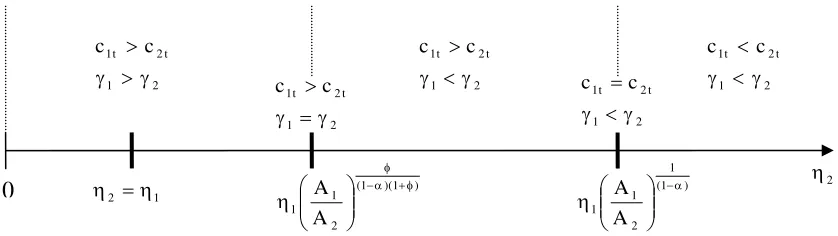
Figure 1 represents the set of possible outcomes of our model for the choice of reference
standard and the relative level of consumption of individuals as a function ofη2 for given
values ofA1, A2, η1 and under the assumption A1 > A2.
Insert Figure 1 Here
From Figure 1, three kinds of outcomes are possible. First, ifη2 < η1(A1/A2)(1−α)(1+φ φ),
individuals of group 1 set up higher reference standards and end up with a higher level
of capital, consumption and income than individuals of group 2. Note that if η2 < η1
individuals of group2have the feeling that they achieve a higher status than individuals of
group2:c1t/c1t < c2t/c2t(see equation (11)), whereby we may argue that for individuals of
group2“[b]etter befirst in a village than second in a town”. The reason is that the
trade-offbetween the goals of “self enhancement” and “self achievement” turns out towards the
“self achievement” ones for individuals of group 1 and towards the “self enhancement”
ones for individuals of group 2. While individuals of group 1 reduce their disutility from
work through high consumption targets, individuals of group 2 prefer to derive utility
from the feeling of a high status. If, however, individuals of group 2 are more ambitious
(η2 > η1) the above trade-offs are reversed and it results a higher status for individuals of group 1: c1t/c1t> c2t/c2t.
Second, if η2 ∈ [η1(A1/A2)
φ
(1−α)(1+φ) ;η
1(A1/A2)
1
(1−α)], individuals of group 2 set up
higher reference standards than those chosen by individuals of group 1 (γ2 > γ1). This
dampens inequalities due to innate skills: individuals of group 2 compensate partially
their lack of productivity (A1 > A2) through a greater amount of hours worked: l2 > l1.
Finally, if η2 > η1(A1/A2)
1
(1−α) , the level of ambition of individuals of group 2 is high
enough to reverse the gap of inequalities initially due to innate skills.
(A1)β(A2)(1−β), and average valuation of social comparison,(η1)
β
(η2) (1−β)
(see equation (12)), we have:
Proposition 3 Growth and inequality can be negatively or positively correlated.
The noteworthy feature about Proposition 3 is that its result fits with the lack of
consensus found in the literature. For instance, Persson and Tabellini (1994) present
cross-country evidence of a negative effect of inequality on growth. In contrast, Partridge
(1997) concludes that greater inequality is associated with greater growth. Other studies,
finally, argue that changes in income and changes in inequality are unrelated (Deninger
and Squire, 1996; Chen and Ravallion, 1997).
Thus, in addition to reconciling these views, the present framework provides a more balanced perspective which relies on a simple argument. The relationship between growth and inequality is ambiguous because capital accumulation which gives the pace of
eco-nomic growth depends on the absolute levels of skills and ambition of people (skills aff
ect-ing directly production of output and social comparison actect-ing indirectly through labour supply), whereas the degree of inequality between individuals is the outcome of the rel-ative combination of these two factors. That is, whether inequality is greater or lower
due to changes in relative skills or/and ambition of individuals, the effects on economic
growth are always positive.
5
Conclusion
We have developed a simple growth model with heterogeneous individuals who care about
social comparisons. The core contribution is that social comparisons are made in an endogenous manner as individuals choose the reference standards to which they compare
themselves. We have highlighted the effects of heterogeneity from skills and valuation of
social comparison (ambition) on the choice of reference standard, inequality and growth.
6
References
Barro, R. J., Sala-i-Martin, X., 2004. Economic Growth, 2nd edition, MIT press. Bowles S., Park T. (2005) Emulation, Inequality, and Work Hours: Was Thorsten
Veblen Right? Economic Journal, 115, pp. 397-412.
Chen S., Ravallion M. (1997) What Can New Survey Data Tell Us about Recent
Changes in Distribution and Poverty?, The World Bank Economic Review, 11, pp.
357-382.
Clark, A.E., Oswald, A.J., 1996. Satisfaction and comparison income, Journal of
Public Economics, 61, pp. 359-381.
Corneo G., Jeanne O. (1997) On relative wealth effects and the optimality of growth,
Economics letters, 54, pp. 87-92.
Deninger K., L. Squire (1996) A New Data Set Measuring Income Inequality, The
World Bank Economic Review, 10, pp. 565-591.
Diener E., Fujita, F. (1997), Social Comparison and Subjective Well-being, in B. P. Buunk and R. Gibbons (eds.), Health, Coping and Well-being: Perspectives from Social Comparison Theory, Lawrence Erlbaum Associates, Inc., Mahwah, NJ, 329—357.
Duesenberry J. (1949) Income, Saving, and the Theory of Consumer Behavior, Cam-bridge: Harvard University Press.
Falk A., M. Knell (2004) Choosing the Joneses: Endogenous Goals and Reference
Standards, Scandinavian Journal of Economics, 106 (3), pp. 417-435.
Fershtman C., K.M. Murphy, Y. Weiss (1996) Social Status, Education and Growth,
Journal of Political Economy, 104, pp. 108-132.
Fisher W.H., Hof F.X. (2000) Relative consumption, economic growth and taxation,
Journal of Economics, 73, pp. 241-262.
Futagami K., Shibata A. (1998) Keeping one step ahead of the Joneses: Status, the
distribution of wealth, and long run growth, Journal of Economic Behavior &
Organiza-tion, 36, pp. 109-126.
Maurer J, A Meier (2008) Smooth it Like the Joneses? Estimating Peer-Group Effects
in Intertemporal Consumption Choice, The Economic Journal, 118, pp. 454-476.
Eco-nomic Review, 87, pp. 1019-1032.
Persson T. and G. Tabellini (1994), Is inequality harmful for growth? American
Economic Review, 84, pp. 600-621.
Pham T. K.C. (2005) Economic growth and Status-seeking through personal Wealth,
European Journal of Political Economy, 21, pp. 404-427.
Rauscher M. (1997) Conspicuous consumption, economic growth and taxation,Journal
of Economics, 66, pp. 35-42.
Romer P. (1986) Increasing Returns and Long-run Growth, Journal of Political
Econ-omy, 94, pp. 1002-1037.
Tournemaine F. (2008) Social aspirations and choice of fertility: why can status motive
reduce per-capita growth?, Journal of Population Economics 21, pp. 49-66.
Tournemaine F., C. Tsoukis (2008a) Relative Consumption, Relative Wealth and
Growth, Economics Letters, 100, pp. 314-316.
Tournemaine F., C. Tsoukis (2008b) Status Jobs, Human Capital and Growth: the
effects of heterogeneity, Oxford Economic papers, forthcoming
Tournemaine F., C. Tsoukis (2008c) Gain versus pain from status and ambition:
Ef-fects on growth and inequality, mimeo.
Tsoukis C. (2007) Keeping up with the Joneses, Growth, and Distribution. Scottish
Figure 1 : Inequality and choice of reference standard 0 2 1 t 2 t 1 c c γ > γ > 2 1 t 2 t 1 c c γ < γ > 2 1 t 2 t 1 c c γ < γ < 2 1 t 2 t 1 c c γ < γ = 2 1 t 2 t 1 c c γ = γ > 2 η ) 1 ( 1 2 1 1 A A −α
⎟⎟ ⎠ ⎞ ⎜⎜ ⎝ ⎛ η ) 1 )( 1 ( 2 1 1 A
A −α +φ φ ⎟⎟ ⎠ ⎞ ⎜⎜ ⎝ ⎛ η 1 2 =η