• No results found

Developments in signal processing for computerised diagnosis in clinical neurophysiology

N/A
N/A
Protected

Academic year: 2020

Share "Developments in signal processing for computerised diagnosis in clinical neurophysiology"

Copied!
376
0
0

Loading.... (view fulltext now)

Full text

(1)

Developments in signal processing for computerised

diagnosis in clinical neurophysiology

SAATCHI, Mohammad Reza

Available from Sheffield Hallam University Research Archive (SHURA) at: http://shura.shu.ac.uk/14384/

This document is the author deposited version. You are advised to consult the publisher's version if you wish to cite from it.

Published version

SAATCHI, Mohammad Reza (1992). Developments in signal processing for computerised diagnosis in clinical neurophysiology. Doctoral, Sheffield City Polytechnic.

Copyright and re-use policy

See http://shura.shu.ac.uk/information.html

(2)

DEVELOPMENTS IN SIGNAL PROCESSING

FOR COMPUTERISED DIAGNOSIS IN

CLINICAL NEUROPHYSIOLOGY

MOHAMMAD REZA SAATCHI

A thesis is submitted in partial fulfilment of the

reguirements of the Council for National Academic

Awards for the Degree of Doctor of Philosophy

March 1992

Division of Electronic Engineerin..g

School of Engineerinz InformatlOn Teclinology

Sheffield City Polytechnic

in collaboration with the

Department of Clinical Neurophysiology

Plymouth Hospital

(3)

Developments in Signal Processing for Computerised Diagnosis in Clinical Neurophysiology

M.R. Saatchl

Abstract

The aim of this study was to apply si,nal processing techniques to a potential known as the contingent negative vanation (CNV) in order to aid detection of schizophrenia, Parkinson's disease (PO) and Huntington's Disease (lID). A data recording system was constructed and used to obtain data from 20 schizophrenic patients, 16 PO patients, 21 -at-risk- of HD patients, 11 HD patients and 43 normal control subjects. The data included the CNV, electro-oculograms (required for the preprocessing of the CNV) and the subjects reaction times to an acoustic stimulus. The CNV waveforms were initially preprocessed. This reduced the effects of background electroencephalogram and ocular artefact potentials.

The CNV waveforms were then processed using a method which involved the discrete Fourier transform (OFf) and discriminant analysis. This method

developed from the work of Martin Nichols and Michael Coelho. It was possible to successfully identify the majoril¥ of the patients using this method. In order to reduce the complexity of patients' Identification a different method of CNV signal processing was considered. This involved obtaining the CNV features in the time domain and using them in neural networks. This method was as effective as the method which used OFf and discriminant analysis in identifying the patients. To

establish whether HO could presymptomatically be detected In the at-risk of HD

group, the CNV was analysed using principal component analysis (PCA) and Ward's clustering method. This resulted in identification of 7 patients who were suggested would develop HO. The subjects' reaction times were also analysed. This indicated that the reaction times of schizophrenic, PO, HO and some at-risk of HD patients were significantly different from the reaction times of their normal control subjects.

(4)

Declaration

I hereby declare that whilst registered as a candidate for the degree of the Doctor

of Philosophy with the Council for National Academic Awards I have not been

registered for any other qualification of the CNAA or any other examination body.

3

Signed

(5)

Courses Attended

Lectures in Signal Processing (Intended for Final Year B.Sc. Hons. Students),

October 1988 - February 1989.

Lectures in Multivariate Methods (Intended for Polytechnic Graduate

Diploma/M.Sc. Students), October 1988 - March 1989.

The List of Publications

Saatchi, R. and Jervis, B.W., (1989), "A PC-based instrument for recording

CNVs", Proceedings of the EEG Society Scientific Meeting, Aston University,

Birmingham.

Jervis, B.W. and Saatchi, R., (1990), "An integrated system for process control and the acquisition, storage, and processing of data", lEE Colloquium on

PC-Based Instrumentation", Digest No: 1990/025, London.

Saatchi, R., Jervis, B.W., Allen, E.M., Hudson, N.R, Oke, S. and Grimsley,

M., (1991), "Computerised diagnosis of schizophrenia, Huntington's disease

and Parkinson's disease in man using the contingent negative variation (CNV)" ,

Proceedings of the Physiological Society, Communication 52, The University of

Sheffield, Sheffield.

Jervis, B.W., Saatchi, M.R., Allen,

E.,

Hudson, N. and Oke, S.,

(1991), "An

investigation of presymptomatic diagnosis of Huntington's disease using the

contingent negative variation", Proceedings of the British Society for Clinical

Neurophysiology Annual General Meeting", The Royal London Hospital, London.

(6)

Saatchi, M.R. and Jervis, B.W., (1991), -PC-based integrated system developed to diagnose specific brain disorders-, Computing and Control Engineering Journal, Vo1.2, No.2, 61-68.

Jervis, B.W., Saatchi, M.R., Allen, E.M., Hudson, N. and Oke, S., (1992), -Application of artificial neural networks to the identification of schizophrenic patients based on the contingent negative variation-, Proceedings of the British Society for Clinical Neurophysiology Scientific Meeting, Oxford.

Jervis, B.W., Saatchi, M.R., Lacey, A., Papadourakis, G.M., Roberts, T., Allen, E.M., Hudson, N.R. and Oke, S., (1992), -The application of unsupervised artificial neural networks to the sub-classification of subjects at-risk of Huntington's disease-, lEE Colloquim on Intelligent Decision Support Systems and Medicine-, lEE, Savoy place, London.

The following is accepted and is in the process of publication

Jervis, B.W., Saatchi, M.R., Allen, E.M., Hudson, N., Oke, S. and Grimsley, M., (1992), -A pilot study of the computerised differentiation of Huntington's disease, schizophrenia, and Parkinson's disease patients using the contingent negative variation-, Medical and Biological Engineering and Computing.

(7)

Conferences Attended

lEE colloquium on "The application of artificial intelligence techniques to signal

processing", lEE Savoy Place, London, 1989.

The Electrophysiologica1 Technologists' Association Meeting, (also gave a talk in this meeting, title: "Analysis of the CNV waveform for diagnosis of

schizophrenia, Huntington's disease and Parkinson's disease", Royal Devon and

Exeter Hospital, 1990.

(8)

Contents

Abstract Declaration Courses Attended The List or Publications Conferences Attended Contents

Glossary

Page Number

List or Diagrams

2 3 4 4 6 7 13 15

Chapter 1 Summary 19

1.1 Identification of Schizophrenic, Parkinson's Disease and Huntington's Disease Patients by Frequency Analysis and Discriminant Analysis

of the CNV 19

1.2 Identification of Schizophrenic, Parkinson's Disease and Huntington's Disease Patients by Using the CNV Time Domain Features in Neural

Networks 20

1.3 Presymptomatic Detection of Huntington's Disease and Identification of Schizophrenic, Parkinson's Disease and Huntington's Disease

Patients by Applying Principal Component "1 Analysis and Cluster Analysis to the CNV

-1.4 Reaction Times Analysis of Schizophrenic, Parkinson's Disease, Huntington's Disease and

At-Risk of Huntington's Disease Patients 22

1.5 Overall Remarks 23

References 24

Chapter 2 Introduction 26

2.1 Description of the Disorders Included in this

S~y

n

2.1.1 Schizophrenia

2.1.2 Parkinson's Disease

2.1.3 Huntington's Disease

7

27

28

(9)

2.2

Description of Electroencephalogram and

Event-Related Potentials 34

2.2.1

Description of the Contingent Negative

Variation 37

2.3

Review of the Relevant Studies in Event-Related

Potentials 51

2.3.1

Event-Related Potentials in Schizophrenic

Patients 51

2.3.2

Event-Related Potentials in Parkinson's

Disease Patients 52

2.3.3

Event-Related Potentials in Huntington's

Disease Patients 52

2.4 The Possible Effects of Medication on Event-Related

Potentials 54

2.S

Conclusion 54

References 56

Chapter 3 Description of the Instrumentation System 67

3.1

The Instrumentation Input Stage 67

3.2

High-Pass Filter Section 69

3.3

Second Stage Amplification Section 71

3.4

Low-Pass Filtering Section 74

3.S

Sample and Hold Section 78

3.6

Multiplexing .Section 79

3.7

Third Stage Amplification and Signal Digitisation

Method 79

3.8

Thtal Gain Provided by Each Channel 86

3.9

The Timing Circuit 97

3.10

Acoustic Stimuli Generator 94

3.10.1

Click Generator 95

3.10.2

Thne Generator 95

3.10.3

Audio Power Amplifier 98

(10)

3.11 Circuit to Detect Erroneous CNV Trials

98

3.12 Operator Switch and System LED 102

3.13 Digital Interfacing 102

3.14 Data Storage Requirement 108

3.15 Data Storage Facility 108

3.16 Hardware Thsting 108

References 113

Chapter 4 Description of the Data Recording Software 115

4.1 Description of the Pascal Program Section 115

4.2.1 Description of the Assembly Language Section 116

4.2.2 Description of the Interrupt Service Routine

Section 124

References 127

ChapterS Data Recording Procedure 128

References 135

Chapter 6 Contingent Negative Variation Preprocessing

Method 136

6.1 Mean Level Removal 136

6.2 Baseline Correction 136

6.3 Digital Low-Pass Filtering 137

6.4 Ocular Artefact Removal 138

6.S

Description of the Preprocessed Plots 140

References 147

Chapter 7 IdentifICation of Schizophrenic, Parkinson's Disease and Huntington's Disease Patients by Frequency Analysis and Discriminant Analysis of the CNV 149

7.1 Generation of Variables 151

7.1.1 Description of the Statistical Thsts Applied to the CNV Harmonic Frequency

Components 152

(11)

7.1.2

Nearest and Furthest Mean Amplitude Test

153

7.1.3

Pre- and Post-Stimulus Mean Amplitude

Difference Test

153

7.1.4

The Rayleigh Test of Circular Variance

153

7.1.5

The Modified Rayleigh Test of Circular

Variance 154

7.2

Variable Reduction Procedure ISS

7.2.1

Normal Distribution Test ISS

7.2.2

T-test 156

7.2.3

Stepwise Discriminant Analysis

156

7.3

Discriminant Analysis

157

7.4

Results and Discussion

159

7.5

Conclusion 167

References 168

Chapter 8 Identification of Schizophrenic, Parkinson's Disease and Huntington's Disease Patients by Using the CNV Time Domain Features in Neural

Networks 170

8.1

Theoretical Analysis of Neural Networks 172

8.2

I Time Domain Feature Extraction Method Applied

to the CNV 178

8.3

Procedure for Obtaining the Results 180

8.4

Discussion 197

8.5

Conclusion 198

References 199

Chapter 9 Presymptomatic Detection of Huntington's Disease and Identification Schizophrenic, Parkinson's Disease and Huntington's Disease Patients by Applying Principal Component

Analysis and Cluster Analysis to the CNV 202

9.1 The Theory of Principal Component Analysis 203

9.2

Theoretical Analysis of Clustering 206

9.3

Experimental Procedure 208

(12)

9.4 Results and Discussion

9.4.1 Schizophrenia

9.4.2 Parkinson' s Disease

9.4.3 Huntington' s Disease

9.4.4 At-Risk of Huntington's Disease

9.S

CNV Amplitude Analysis of the At-Risk of Huntington's Disease Patients

9.6 Conclusion

References

Chapter 10 Reaction Times Analysis of Schizophrenic, Parkinson's Disease, Huntington's Disease and

214

214

214

214

218

218

112

223

At-Risk of Huntington's Disease Patients

226

10.1 The Method of Analysis and Results

10.2 Discussion

10.3 Conclusion

References

Chapter 11 Comparison of the Methods Used to Identify Schizophrenic, Parkinson's Disease and

227

232

233

134

Huntington's Disease Patients 23S

Chapter

12

Further Studies 236

Reference

Chapter

13

Conclusion

Acknowledgements

Appendices

A

B

Listing of Data Recording Programs

List of Patients' Medication

C Listing of the Program Used to Preprocess

and Average the CNV Wclveforms and to Convert

the Data Recordings for Transfer to the

(13)

Mainframe Computer

D Listing of the Program Used to Obtain CNV Features From the Inter-Stimulus Interval Section

of the CNV 51

E Procedure to Compute Correlation Matrix 53 F Listing of the Programs Used to Carry Out Cluster

~~~ ~

Fl Cluster Analysis of Schizophrenic patients and Normal Control Subjects 55 F2 Cluster Analysis of Parkinson's Disease

Patients and Normal Control Subjects 56 F3 Cluster Analysis of Huntington's Disease

Patients and Normal Control Subjects 56 F4 Cluster Analysis of At-Risk of Huntington's

Disease Patients and Normal Control

Subjects 57

G Listing of the Program Used to Obtain the CNV

Amplitudes 58

H Documentation 60

HI Documentation for Chapter 7 H2 Documentation for Chapter 8 H3 Documentation for Chapter 9 H4 Documentation for Chapter 10

References Published Papers

12

60

61

61

62

63

(14)

Glossary

AID Analogue to Digital Convertor AEP Auditory Evoked Potential

AR At-Risk

CNV Contingent Negative Variation

cr

Computed Thmography

DA Discriminant Analysis DF Degrees of Freedom

DFf Discrete Fourier Transform DOS Disk Operating System

DSM Diagnostic and Statistical Manual of Mental Disorders BCG Electrocardiogram

EEG Electroencephalogram

BOG Electro-oculogram EP Evoked Potential ERP Event-Related Potential FFT Fast Fourier Transform FIR Finite Impulse Response HEX Hexadecimal

He Huntington's Chorea HD Huntington's Disease fiR Infinite Impulse Response lSI Inter-Stimulus Interval ISR Interrupt Service Routine

m

Inter-Trial Interval

LED Light Emitting Diode

MRI Magnetic Resonance Imaging OA Ocular Artefact

(15)

P Probability

PC Personal Computer

PCA Principal Component Analysis

PD Parkinson's Disease

PET Positron Emission Tomography

PGA Programmable Gain Amplifier

PGR Psychogalvanic Response

PINV Post-Imperative Negative Variation

PPI Programmable Peripheral Interface

RAM Random Access Memory

SAS Statistical Analysis Systems

SDA Stepwise Discriminant Analysis

SEP Somatosensory Evoked Potentials

S/H Sample and Hold

STD Standard Deviation

VCVS Voltage-Controlled Voltage Source

VEP Visual Evoked Potential

WD Window Detector

(16)

List of Diagrams 2.1 2.2 2.3 2.4

2.5

2.6 2.7 2.8 2.9 2.10 2.11 2.12 2.13 2.14 2.15 2.16

The ventricles of the brain. (a) An anterior view,

(b) a lateral view.

Sections through the cerebrum and diencephalon. (a) A coronal section, (b) a transverse section.

The locations of the hippocampus and parahippocampal gyrus in the brain.

The location of the substantia nigra in the brain.

The locations of the globus pallidus and striatum in the brain.

A schematic drawing of a preprocessed averaged CNV. The CNV response in a normal subject.

The CNV response in a schizophrenic patient. The CNV response in a Parkinson's disease patient. The CNV response in a Huntington's disease patient. The CNV response in an -at-risk- of Huntington's disease patient.

The preprocessed averaged CNV response in a normal subject.

The preprocessed averaged CNV response in a schizophrenic patient. Page Number 29 30 31 33 35 39 40 41 42 43 44 45 46

The preprocessed averaged CNV response in a Parkinson's

disease patient. 47

The preprocessed averaged CNV response in a Huntington's

disease patient. 48

The preprocessed averaged CNV response in an at-risk of

Huntington's disease patient. 49

2.17 The PINV in a Parkinson's disease patient. 50

3.1 The set-up of the instrumentation system during a data

recording session. 68

3.2 Instrumentation system input stage. 70

(17)

3.3 The sections of the instrumentation system following the

input stage.

72

3.4 Instrumentation amplifier circuit.

73

3.5 The method used to identify highest aliasing frequency

component.

7S

3.6 Low-pass filter circuit. 77

3.7 Sample and hold circuit.

80

3.8 Multiplexer circuit.

81

3.9 Block diagram of the window detector.

83

3.10 Window detector circuit. 84

3.11 The effect of varying signal magnitude on the window

detector output.

8S

3.12 Timing circuit block diagram.

88

3.13a First part of the timing circuit.

89

3.13b Second part of the timing circuit. 90

3.14 Sample and hold timing diagram.

92

3.15 Click generator circuit. 96

3.16 Thne generator circuit. 97

3.17 Audio power amplifier circuit. 99

3.18 Circuit to detect erroneous CNV responses.

100

3.19 Timing diagram for the circuit to detect erroneous CNV

responses.

101

3.20 Operator switch circuit.

103

3.21 Instrumentation system LED circuit.

104

3.22 Interconnection between the PPI device and the

vero-board.

106

3.23 PPI device address decoder.

107

3.24 Set-up used to obtain the phase and frequency responses.

110

3.25 Phase response of the instrumentation system.

111

3.26 Frequency response of the instrumentation

system.

112

(18)

4.1

Flow chart describing the operations of the assembly

language program.

117-119

4.2

Flow chart describing the operations of the interrupt

service routine.

125

5.1

DC silver-silver chloride electrode.

131

5.2

The positions of EOG electrodes.

133

6.1

Digital low-pass fllter frequency response (fo =7.5Hz).

139

6.2

Vertical left EOG.

141

6.3

Vertical right EOG.

142

6.4

Horizontal Left EOG.

143

6.5

Horizontal right EOG.

144

6.6

A CNV trial before preprocessing.

145

6.7 A CNV trial after preprocessing.

146

8.1

A node in a neural network.

173

8.2

The sigmoid transfer function.

174

8.3

A multilayer neural network.

175

8.4

The effect of moving average window during CNV

feature extraction.

181-182

(a) Before the application of the method,

181

(b) After the application of the method.

182

8.S

The CNV sections from which the discriminatory

features were obtained.

183

9.1

Representation of between- and within-cluster variation.

204

9.2

The dendrogram for identification of the schizophrenic

patients.

215

9.3

The dendrogram for identification of the Parkinson's

disease patients.

216

9.4

The dendrogram for identification of the Huntington's

disease patients.

217

9.5

The dendrogram for identification of the at-risk of

Huntington's disease patients.

219

(19)

12.1 The preprocessed averaged CNV response in a manic depressive patient.

18

(20)

Chapter 1 Summary

An instrumentation system was constructed and was used to record the data from 20 schizophrenic, 16 Parkinson's disease (PO), 11 Huntington's disease, 21

-at-risk- (AR) of HD patients and 43 normal control subjects. In order to improve the signal (ie. the contingent negative variation, CNV) to noise (ie. the background

EEG activity and ocular artefact) ratio, the CNV waveforms were preprocessed

using a method developed by Nichols [1982] and Coelho [1988]. The preprocessed

CNV responses were then analysed by: i) using the Fourier transform and

discriminant analysis, ii) using the CNV time domain features in neural networks and iii) applying principal component analysis and cluster analysis. The reaction times of the subjects to an acoustic stimulus were also analysed.

1.1 Identification of Schizophrenic, Parkinson's Disease and Huntington's Disease Patients by Frequency Analysis and Discriminant Analysis of the

CNV

This method involved applying the discrete Fourier transform (OfT) to pre- and post-stimulus sections of the CNV waveforms and then applying four statistical

tests to the resulting harmonic frequency components of the pre- and post-stimulus spectra. The four statistical tests were originally designed by Nichols [1982] to

detect phase and amplitude changes in CNV spectra. This process produced a set

of variables. A variable subset which best identified the patients was selected and

then used in a discriminant analysis program. A leave-one-out method was used to

ensure the data included during the calibration phase of the discriminant analysis

program were not used during the test phase. The method successfully identified

the majority of schizophrenic, PO and HD patients from normal subjects and it

was useful in distinguishing between the patients from the above three categories.

The performance of the discriminant analysis was best when distinguishing between

the HO patients and normal subjects (ie. 100 %). This indicated that perhaps the

(21)

effects of HD on the CNV is more severe than the effects of schizophrenia and PD

on the CNV. The success rates obtained when distinguishing the patients from

their normal control subjects were higher than the success rates obtained when distinguishing between the patients from different categories. This might be

because some of the CNV abnormalities in schizophrenia, PD and HD overlap.

1.2 Identification of Schizophrenic, Parkinson's Disease and Huntington's Disease Patients by Usin& the CNV Time Domain Features in Neural Networks

Neural networks were applied to the CNV waveforms of the schizophrenic, PD and HD patients and their normal control subjects. The CNV features (variables)

used were obtained by averaging every four consecutive sample values from a

CNV section 512ms prior to the imperative-stimulus. This generated 16 CNV features. As the time taken for the CNV to return to its baseline has been shown to

be important in identifying patients with disorders such as schizophrenia, PD and

HD (see chapter 2) a seventeenth feature which reflected this effect was also

included. The patients from each category and their normal control subjects were

divided into two groups. The CNV responses from the first group were used for

training the neural networks and the CNV responses from the second group were

used to test the effectiveness of the neural networks. The effect of changing the number of nodes in the hidden layer(s) of the neural networks was investigated.

The neural networks successfully identified the schizophrenic, PD, and HD patients

from normal subjects. They performed best when distinguishing between the HD patients and normal subjects (ie. 100% success rate). This was in line with the

results obtained from the other two methods of patients I differentiation.

(22)

1.3 Presymptomatic Detection of Huntington's Disease and Identification of Schizophrenic, Parkinson's Disease and Huntington's Disease Patients by Applying Principal Component Analysis and Cluster Analysis to the CNV

The presymptomatic identification of lID patients is valuable as it can help the individuals AR of lID decide whether they should have children. Discriminant

analysis was not suitable for presymptomatic identification of lID patients as it

was based on a supervised learning method. The clustering method is an

unsupervised learning method and therefore was used for this purpose. The

procedure for CNV feature extraction was the same as that used for the neural network method. The CNV features were transformed using principal component analysis.

Initially principal component analysis and clustering were used to distinguish between schizophrenic, PD and HD patients and normal subjects. Application of principal component analysis and cluster analysis resulted in the identification of

the majority of schizophrenic, HD and PD patients. In line with the other two methods of patients' differentiation this method was most effective in identifying

the HD patients.

The principal component analysis and cluster analysis were then applied to CNV

responses of 21 AR of HD patients and their normal control subjects. Seven AR of

HD patients were identified as -abnormal- and it was suggested that they would develop HD. The remaining 14 AR ofHD patients were identified as -normal-AR of HD patients.

A Two-tailed t-test was used to examine the CNV amplitudes in the abnormal AR of HD patients, normal AR of HD patients and their normal control subjects. The

CNV amplitudes of abnormal AR of HD patients and their normal control subjects were significantly different (p<O.OOI, df=12). The CNV amplitudes of normal

(23)

AR of HD patients were not significantly different from those of their normal

control subjects.

The CNV amplitude analysis of the AR of HD patients also indicated that the

changes in the CNV responses of HD patients appeared prior to the onset of HD. This finding is in agreement with the studies of ]osiassen et ale [1982], Oepen et

ale [1982], ]osiassen et ale [1984], Noth et ale [1984], Hennerici et ale [1985] and

Hamberg et al. [1986] when other event-related potentials (ERPs) were analysed

in AR of HD patients (refer to chapter 2 for detail).

1.4 Reaction Times Analysis of Schizophrenic, Parkinson's Disease, Huntington's Disease and At-Risk of Huntington's Disease Patients

During the data recordings, 32 reaction times were recorded for each subject. The reaction times were averaged and used in a two-tailed t-test. It was found that the reaction times of schizophrenic, PO and HD patients were significantly different from the reaction times of their normal control subjects (p<O.OOI).

The reaction times of the AR of HD patients were not significantly different from

the reaction times of their normal subjects. A similar result was obtained when the

reaction times of the AR of HD patients who were identified as WnormalW in

chapter 9 were compared with their normal control subjects. But when the reaction times of the wabnormalw AR of HD patients were compared with the reaction times

of their normal control subjects, they were significantly different (p<O.05,

df=12).

In several studies it has been shown that the reaction time tends to be shorter following a large CNV and longer following a low amplitude CNV [Thcce, 1972].

As the mean CNV amplitude of the abnormal AR of HD patient group was about

(24)

113 of that in the normal control group, this prolongation of the reaction

times in the abnormal AR of HO patients was in agreement with findings related

to the relationship between the CNV amplitude and the reaction time.

1.5 Overall Remarks

In this study three different methods were successfully used to differentiate schizophrenic, PO and HD patients. The results indicated that all three methods

were valuable in identifying these patients. The patient differentiation method

which involved the use of the discrete Fourier transform and discriminant analysis

was the most complex method. Neural networks were used in order to fmd an effective but less complicated method of identifying the patients. The application

of principal component analysis and clustering resulted in the identification of 7

abnormal AR OF HD patients. The reaction times in the subjects were also

analysed and it was found that the reaction times of schizophrenic, PO, HD and

abnormal AR of HD were significantly different from the reaction times of their

normal control subjects.

(25)

References

Coelho, M., (1988), -Analysis of the CNV waveform in the time and frequency domains-, MPhil. thesis, Department of Electrical and Electronic Engineering, Sheffield City Polytechnic, Sheffield.

Hennerici, M., Homberg, V. and Lange, H.W., (1985), -Evoked potentials in patients with Huntington's disease and their offspring.

n.

Visual evoked

potentials-, Electroencephalography and Clinical Neurophysiology, 62: 167-176.

Homberg, V., Hefter, H., Granseyer, G., Strauss, W., Lange, H. and Hennerici, M., (1986), -Event-related potentials in patients with Huntington's disease and relatives at risk in relation to detailed psychometry·, Electroencephalography and Clinical Neurophysiology, 63:552-569.

Josiassen, R.C., Shagass, C., Mancall, E.L. and Roemer, R.A., (1982), -Somatosensory evoked potentials in Huntington's disease-,

Electroencephalography and Clinical Neurophysiology, 54:483-493.

Josiassen, R.C., Shagass, C., Mancall, E.L. and Roemer, R.A., (1984), -Auditory and visual evoked potentials in Huntington's disease-,

Electroencephalography and Clinical Neurophysiology, 57: 113-118.

Nichols, M.J., (1982), -An investigation of the contingent negative variation using signal processing methods·, Ph.D. thesis, Department of communication

Engineering, Plymouth Polytechnic, Plymouth.

Noth, J., Engel, L., Friedemann, H.H. and Lange H.W., (1984), -Evoked potentials in patients with Huntington's disease and their offspring. I. Somatosensory evoked potentials-, Electroencephalography and Clinical

(26)

Neurophysiology, 59:134-141.

Oepen, G., Doerr, M. and Thoden, U., (1982), -Huntington's disease: Alterations

of visual and somatosensory cortical evoked potentials in patients and offspring- ,

In Courjon, I., Mauguiere, F., and Revol, M. (Eds.), -Clinical applications of

evoked potentials in neurology-, Raven Press, New York, 141-147.

Tecce, 1.1., (1972), -Contingent negative variation (CNV) and psychological

processes in man-, Psychological Bulletin., Vol.77, No.2, 73-103.

(27)

Chapter 2 Introduction

This project was a continuation of previous studies [Nichols, 1982] [Coelho,

1988]. Nichols [1982] recorded the contingent negative variation (CNV)

waveforms of 8 Huntington's Disease (HD) patients and 6 normal subjects and

devised a CNV preprocessing procedure. The preprocessing is necessary in order

to retrieve the CNV from background noise sources (the CNV preprocessing is

described in chapter 6). He then investigated the composition of the CNV by using

signal processing and statistical methods. Coelho [1988] enhanced the Nichols'

eNV preprocessing method. He also applied signal processing and statistical

techniques to the data recorded by Nichols [1982] in order to differentiate between HD patients and normal subjects (see chapter 7 for detail). The main problem with

the patients' identification method used by Coelho [1988] was that it required very

complicated and time consuming analysis of the CNV.

For this project the aim was to construct a data recording system and use it to

record the CNV waveforms of HD, Wat-riskw (AR) of HD, Parkinson's Disease

(PD), schizophrenic patients, and their age and sex matched normal control

subjects. Then preprocess the CNV waveforms. It was intended to initially use the

patient identification method employed by Coelho [1988] and differentiate between

HD, PD, schizophrenic and normal subjects. Then develop another less

complicated method of identifying the patients. Presymptomatic detection of HD

patients is important as it could be used as a mean of reducing the number of

individuals with that disorder. Therefore, it was planned to investigate whether

HO could be presymptomatically diagnosed using the CNV.

The reason for using the CNV to identify HD, PO and schizophrenic patients is

that although these disorders could be related to some specific symptoms and

pathological changes, it can sometimes be difficult for a neurophysiologist or

psychiatrist to distinguish between them. This is because some of the symptoms

(28)

and pathological changes observed in the patients with these disorders can be

similar.

In this chapter the symptoms and the brain structural changes observed in schizophrenic, PO and HD patients are discussed. A description of the

electroencephalogram (BEG), event-related potentials (ERPs) and the CNV is

provided, and the relevant studies in ERPs in schizophrenia, PO, HD and AR of

HD are reviewed.

1.1 Description of the Disorders Included in this Study 1.1.1 Schizophrenia

The symptoms associated with schizophrenia can be grouped into -type 1- and -type 2- [Crow and Johnstone, 1987]. Type 1 includes psychotic symptoms which

are generally referred to as -positive- because they cause abnormality by their

presence ego hallucinations and delusions. Type 2 includes symptoms which are

generally referred to as -negative- because a normal function is missing.

Symptoms such as poverty of speech, lack of self-care and anergia are considered

(

as negative symptoms. The symptoms observed in a schizophrenic patient could be

mainly positive, negative, or they can be a mixture. The positive and negative

symptoms can be observed at different times in the course of the illness, or sometimes concurrently. Untreated schizophrenia tends to be progressive (with some exceptions) and may reach a state of irreversible defect [Miller, 1989].

There are some indications of a general increase in cerebral activity in some stages

of schizophrenia. For example, an increased power in certain frequency bands of

the brain's electrical activity has been observed in early stages of schizophrenia

[Mukunda, 1986]. There are two possible causes for this excess neural activity. It

may be due to excess connectivity in the forebrain, or in crucial parts of it

(29)

[Nasrallah et aI., 1986], or it may be as a result of neurochemical imbalances with

respect to the neurotransmitters which control signal gain in the forebrain [Wong et aI., 1987]. Ben-Ari [1985] reported that the endogenous release of excitory

transmitters led to the brain cell destruction, therefore suggesting that if the

activity of neurons becomes too excessive, it might lead to their destruction.

Several structural brain abnormalities have been observed in schizophrenic patients [Ron and Harvey, 1990]. The commonest were enlargement of the lateral and

third ventricles (see Figures (2.1) and (2.2» and cortical atrophy [Revely, 1985]

[Weinberger et aI., 1983]. There is also evidence for a reduction in volume of the hippocampus (see Figure (2.3» in schizophrenic patients [Falkai and Bogerts,

1986]. Young et aI. [1991] using magnetic resonance imaging (MRI) found that the parahippocampal gyrus (see Figure (2.3» was smaller on the left side in 31 schizophrenic patients but not in 33 age and sex matched normal control subjects.

They reported that in schizophrenic patients, ventricular enlargement and cerebral

atrophy were significantly related to severity of the symptoms. Some investigators

found a distinct relationship between the structural brain abnormalities and

positive and negative symptoms in patients with schizophrenia. Marks and Luchins

[1990] provided a review of some of these reports.

The identification of patients with schizophrenia has been based on monitoring the symptoms and observation of the structural brain abnormalities related to the

disorder.

2.1.2 Parkimon's Disease

PD was originally described by James Parkinson [1817]. PD is a progressive

neurologic disorder. Its main clinical symptoms are: i) body tremors at rest. The

tremors mainly affect a limb or limbs but they may also be observed in other areas

such as jaw and lips, ii) muscle rigidity. This may cause stiffness and muscle

(30)

Lateral ventricle

Interventricular_~_-r­

foramen

Third ventricle

Cerebral aqueduct ---l~~::---'''''';:=~

Fourth ventricle---'~fffJm_~

I -Ll-_ _ _ __ _ TO central canal

of spinal cord

leral ventricle

aqueduct

Third ventricle ~~~~~---Fourth ventricle

To central canal _ _ _ _ _ _ _ -+---1kl

of spinal cord (b)

Figure 2.1 The ventricles of the brain. (a) An anterior view,

(b) a lateral view (this Figure was obtained from Fox [1990]).

(31)

Longotudonal hSS<le Cerebral cortex

Baoal gangha

Basal gangI,a

caudate nudeus

Claustn.m ---ff-U~+ilj

{ Putamen

Lent,l""" Globus

nudeu-' pal.,."S

Head of caudal. nucteus

Ctauswm - - -- __ _

Lenol"""

nucleuS

FiJ,ur" 2.2 Sections hro gh tne cerebrum an.j 1iencephalon.

(a) A coronal section, (b) a transverse sec Lon ( his figure W3S

ob alned from fox [1990]).

)0

VoIhtte matter

of oereorvm

Antera hom of 'Iteral yentnCle

Ttwd venloel,

"'Ienor hom 01

(32)

UJ ... IM,.I /or"ix M"";II.,It4I_i< "0"

M.MU/.'t,,...,,.,.,

,,",,

Fi".". ...

.//oroi .•

S"I.

IIr".i,..Ii,

~y./

/o,,.b,

Ci,.,.,/.'t ,y'w, .,.J (,,.,.,/.,,..

f(""",.""w.

Dtft'." ,,,,.,,

JUWII'W'"

"ilt.,,,. .,.d

1.1tfi ,wJi.el

"'I"

S"tw,..

/HI/.",d;.,,,.

(,up,,,,0,,,,,,,, ... ,41 "".,"')

A,.",io, ".,rltO,

K"wp ./

,It./"",w,

A,.,nior

,o",,,,",,u,,

p",tI,,,,,./lto/

?/t" " '/ '~ f t( I,.'W' ,

'/'(t '/<~ 7 co:::< (~rtO"''''/J'u,,,' ",,'u.)

PrthifJfJO<o".fJol ",uJ,.,..,,.,

Pa,oI/tlao, "

.".

' " (!.,_i.

' " C("."1(.I.".o0,,.,.."111 . '.'/.,0,,)

U"'UI

.l"')1Idal.id body

1'.,0h"i>o<."'fJo/l)~w, .110".,11.,), bod,·

Figure 2.3 The

gyrus in the brain

locations of the hippocampus and parahippocampal

[image:32.809.36.624.92.470.2]
(33)

discomfort, iii) slowness of active movements (such as rising from a chair) and iv)

postural instability. This can cause patients to fall. A number of secondary clinical

symptoms such as dementia and depression may also be observed in some PO

patients.

The cause of PO is unknown. The studies in progress to identify its cause include

a search for an environmental toxin [Stern and Hurtig, 1988]. PO is characterised

pathologically by: i) degeneration of the dopaminergic neurons from the

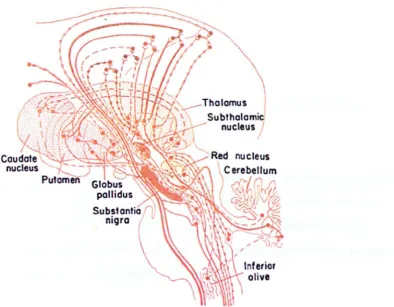
substantia nigra [BeMett, 1988]. The substantia nigra (see Figure (2.4» is a small

nucleus considered a part of the basal ganglia. The anatomy of the basal ganglia is

complex and their details poorly known. The basal ganglia are composed of

neuron cell bodies located deep within the white matter of the cerebrum and they

form part the neural pathway that controls motor function [McKenzie et al., 1984]

and ii) the appearance of Lewy bodies in the substantia nigra [Gibb, 1987].

Lewy bodies consist of structurally altered ftlaments, in part derived from

neurofilament. There is no defmitivc laboratory test for diagnosing PO, therefore,

its diagnosis has been based on a careful study of the patients' medical history and

thorough physical and neurological examination [Vernon, 1989].

2.1.3 Huntin&ton's Disease

HD is a fatal hereditary disorder of the central nervous system [Hayden, 1981].

The age of onset of the disease varies widely but usually it is during the third and

fourth decades of life. Its clinical symptoms include progressive motor

abnormalities (typically involuntary movement called chorea), intellectual

deterioration and in most cases psychiatric disturbance. The average life span after the onset of the disease is between 15 and 20 years. The disease is inherited

through a defective gene localised to the short arm of chromosome 4 [Gusella et

al., 1983]. An offspring of an affected parent can have a 50% chance of receiving the defective gene. Studies using computed tomography (CT) and positron

(34)

Caudate nucleus

Putam

:..---Thalamus

\ Subtholamid

\ nucleus

J

Figure 2.4 The location of the substantia nigra in the brain (this

Figure was obtained from Guyton [1977J).

[image:34.534.91.486.249.556.2]
(35)

emission tomography (PET) show neuropathological changes in several parts of the brains of HD patients. The affected areas include the globus pallidus (see

Figure (2.5» and frontal cortex [Hayden, 1981] [Adams et al., 1984], but the

brunt of the changes (typically severe neuronal loss) are in the striatum

[Mazziotta, 1989]. The striatum (see Figure (2.5» is part of the basal ganglia and

is referred to two masses of nuclei called the caudate nucleus and putamen.

Several nerve pathways pass from the cerebral cortex (particularly the so-called

"pre-motor areas") to the striatum.

As there is no defmitive test for diagnosing HD, therefore, its diagnosis has been

based on a positive family history (ie. if the patients have affected parents),

indications of progressive motor disability and psychiatric disturbance, and

observation of relevant structural abnormalities of the brain using PET and cr

scans.

A genetic presymptomatic test for individuals AR of HD is possible but it excludes

some AR of HD patients. This is because the marker used in the test does not

detect the gene itself and therefore testing is only possible if suitable family

members are available so that the affected chromosome can be identified [Jackson,

1987] [Harper et al., 1988] [Mirsa et al., 1988].

2.2 Description of Electroencephalogram and Event-Related Potentials

The electroencephalogram (BEG) is the name given to electrical activity of the

brain. The first reported observation of BEG was made by a British physiologist called Richard Caton. He studied the brains of rabbits and monkeys and reported:

"the external surface of the (brain's) grey matter is usually positive in relation to

the surface of the section through it. Feeble currents of varying direction pass

through the multiplier when the electrodes are placed on two points on the external

surface (of the brain), or one electrode on the grey matter, and one on the surface

(36)

Basal ganglia -+:j~~~Ic-'r::::~

Globus pallidus - _ - /

Brain stem - - _ . /

Sims/SChenk

Figure 2.5 The locations of the globus pallidus and striatum in the

brain (this figure was obtained from Fox [1990]).

[image:36.534.52.481.263.572.2]
(37)

of the skuU" [Caton, 1875]. Berger's [1929] discovery that BEG could be

recorded from the intact scalp led to the development of modem .

electroencephalography in man. The BEG provides information about underlying

or ongoing brain functioning.

ERPs are potential changes in BEG that occur in association with an eliciting

event. In some articles the term evoked potential (EP) is used instead of ERP. In this thesis both terms are used and they are considered synonymous. There are

several types of ERPs (Cooper et al. [1980] have provided a review of ERPs).

They include auditory evoked potentials (AEPs), visual evoked potential (VEPs)

and somatosensory evoked potentials (SEPs).

SEPs are usually elicited by stimulating the left or right median nerves at the wrist

with brief (O.lms duration) electrical pulses. The stimulator for eliciting VEPs

may be a strobe flash or a checkerboard flash. The AEPs are elicited by clicks or

tones presented to one or both ears. The early components (up to lOOms) of the

ERPs are determined mainly by the nature of the evoking stimulus, while the

following components (after lOOms) reflect more the cognitive processes. The

widely reported cognitive BPs are the CNV, post-imperative negative variation (PINV), Bereitschafts (readiness) potential, Nl00 and P300. The letters "N" and

"P" describe the polarities of the waves, ie. "P" represents a positive wave and

"N" represents a negative wave. The number following the polarity letter indicates

the wave's approximate peak latency. For example, NlOO is a negative wave that reaches its maximum amplitude at about lOOms after the onset of the evoking

stimulus.

The amplitude of NlOO is dependent on factors such as expectedness of the

stimulus and the attention paid to it. The P300 is a positive wave that reaches its

peak between 300 and 500ms after the onset of the eliciting stimulus. 1b evoke the

(38)

P300 in AEPs, the patient is requested to detect an infrequently occurring tone

burst from a background sequence of another tone which has a different pitch. The

P300 may reflect the ability of the individuals to process information

[Baribeau-Braun et al., 1983]. The Bereitschafts potential is generated as a result of a voluntary motor response and it may reflect preparatory activity in the

supplementary motor area of the cortex [Dick et al., 1989]. The CNV is described

in detail in the next section. The PINY is closely related to the CNV and is also

described in the next section.

2.2.1 Description of the Contingent Negative Variation

The CNV was first described by Walter et ale [1964]. Since then it has been

described in a number of articles. Recently McCallum [1988] and Tecce and

Cattanach [1987] have provided a review of the nature of the CNV. The CNV is a

negative shift in BEG as compared to the potential of the electrical reference

electrode. Commonly electrodes placed on linked earlobes are used as the

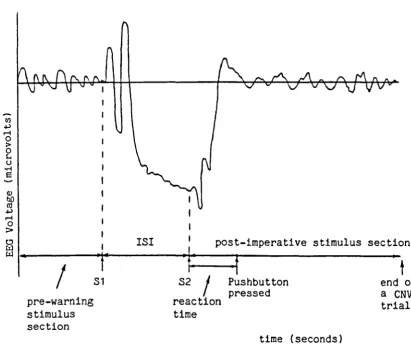
reference. The elicitation of the CNV involves presentation of a warning

stimulus, SI (eg. a click) to warn the subject of the upcoming imperative stimulus,

S2 (this can be a tone). The subject is requested to respond to the imperative

stimulus by performing a motor function, ego by pressing a push-button to

terminate the tone.

The CNV is susceptible to contaminations, mainly by ocular artefact potentials.

The causes of the ocular artefact potentials are eye movements and blinks and they

are described in chapter (6). The CNV is also usually obscured by the background

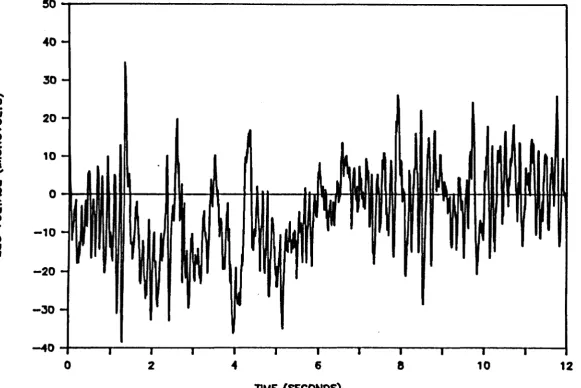
BEG. The CNV therefore, has to be preprocessed prior to analysis. The

preprocessing method used was developed by Nichols [1982] and Coelho [1988]

and it is described in chapter (6).

(39)

A schematic drawing of a preprocessed averaged CNV is shown in Figure (2.6). Figures (2.7)-(2.11) show the CNV response in a normal subject, a schizophrenic patient, a PO patient, an HD patient and an AR of HD patient respectively. Figures (2.12)-(2.16) show the preprocessed averaged (over 8 trials) CNV responses in the above subjects. The negative shift follows the onset of the warning stimulus and it normally returns to its original baseline rapidly after the subject response to the imperative stimulus. In some cases the CNV takes an abnormally longer time to return to its original baseline. The negative potential which appears as a continuation of the CNV following the imperative stimulus is known as the post-imperative negative variation (pINY). Figure (2.17) shows the PINV in a PO patient.

The CNV was reported to have an early and a late component [Rohrbaugh et al., 1976] [Rohrbaugh and Gaillard, 1983]. The early component develops in

response to the warning stimulus, its magnitude is maximum over the frontal cortex, and it is dependent on the characteristics of the warning stimulus (eg. duration and modality) [Rohrbaugh and Gaillard, 1983]. The late component is believed to be related to preparation for motor response and it has a more central distribution over areas of the cortex Rohrbaugh et al. [1976]. The physiology of the CNV is complex and is not completely understood. The CNV has been suggested to originate from the frontal and central areas of the cortex. Some sub-cortical areas of the brain such as the caudate nucleus of the thalamus were also believed to have a role in its production [Thcce, 1972] [Cohen, 1974].

The CNV was used for the identification of patients with schizophrenia, PO and HD because: i) the main source of the CNV (ie. the frontal cortex) is an affected area in schizophrenia, PO and HO [Goldman-Rakic, 1987], ii) several studies have indicated that the CNV was altered in patients with any of these disorders (see section 2.3 for detail) and iii) the CNV is considered to be a measure of the

(40)

CI)

~

r-f

o > o

t..

U

OM

e

<l>

b() ro

~

r-f

o >

o lSI I post-imperative stimulus section

~,·&---~·t~·---·~t:---~f---t

I

S1 S2

I

Pushbutton end of

pressed a CNV

pre-warning stimulus section

reaction trial

time

time (seconds)

Figure 2.6 A Schematic drawing of a preprocessed averaged CNV waveform.

[image:40.534.70.482.199.548.2]
(41)

~o

40

30

-

IIJ

~ 20

~

fa:

10

U

2

-

III

0

~

~

0

;.t

g

-10

0

1:1

-20

-30

-40

-2 0

t t

51 S2

4 6

TINE (SECONDS)

8

Figure 2.7 The CNV response in a normal subject.

[image:41.809.97.683.53.457.2]
(42)

so

40

30

-

~

20

~

e:

u 10

2

-

III

~

~

0

...a

;.J

g

-10

()

W

-20

-30

-40

0 2 4 6 8 10 12

11NE (SECONDS)

[image:42.809.103.684.55.442.2]
(43)

~

40

30

,...

en

~ 20

~

e:

0 10

:i

-~ IIJ

I\)

~

0

:.J

0

>

-10

()

1:1

-20

-30

-40

0 2 4 6 8 10 12

l1NE (SECONDS)

(44)

50

40

30

""

~

20

~

~

U 10

5

-~ bJ

\i.J

~

0

~

g

-10 0

1:1

-20

-30

-40

0 2 4 6 IS 10 12

TIME (SECONDS)

(45)

so

40

30

-

."

~ 20

~

e:

u 10

-:J

-~ 1&1

~

~

0

;.J

~

-10

0

e:

-20

-30

-40

0 2 4 S 8 10 12

TIME (SECONDS)

(46)

8

6

..

2

-

~

0 0

~

u

-

E -2

-

~ at 0 -4

VI ~

0

> -6

()

t:t

-8

-10

-12

-14

0 2

..

6 8

time (seconds)

Figure 2.12 The preprocessed averaged CNV response in a normal subject.

(47)

14

12

-10

-8

-,...

6

~

0

-~

u 4

-E

2

""

~ at

m

.,

0

~

~

-"

0 -2

IH

--4

--6

--8

--10

o

-"

J

.I

~

r

I I I I

2

"

~

.1

"

~

I I

6

time (seconds)

~

I

~

a

I

~

~

I I

8

Figure 2.13 The preprocessed averaged CNV response in a Schizophrenic patient.

I

N

AI

~

~

r

I

I

I

I I

(48)

-

~

0

~

u

E

-~

~

CJI

'"

~

0 >

0

1:1

8

6

..

2

0

-2

-4

-6

-8

-10

-12

-14

0 2

..

6 8

time (nconds)

Figure 2.14 The preprocessed averaged CNV response in a Parkinson's disease patient~

[image:48.809.74.696.53.451.2]
(49)

-

~

0

e

u

E

~

-en

UI 0

~

~

m

8

6

4

2

0

-2

-4

-6

-8

-10

-12

-14

.

0 2 4 6

time (seconds)

8

Figure 2.15 The preprocessed averaged CNV response in a Huntingon's disease patient.

(50)

~

~

0 ~

'-~

E

-~

\0

.,.

a

~

0

,.

"

IS

8

6

4

2

0

-2

-4

-6

-8

-10

-12

-14

0 2 4 6 8 10

time (sec onds)

Figure 2.16 The preprocessed averaged CNV response in an at-risk of Huntington's disease patient.

(51)

-

~

0

~

u

E

'-'

0-VI

.,

0

~

~

m

10~---~

5

0

-5

-10

-15

-20

-25

-~~I~---~~---~~---~~---~

o

2 4 6

time (nconds)

8 10

Figure 2.17 The PINV in a Parkinson's disease patient.

(52)

brain-behaviour functions

rreece,

1972].

2.3 Review of the Relevant Studies In Event-Related Potentials

There have been numerous applications of ERPs in the medical field. Chiappa

[1990] and Picton [1988] have provided a review of some of their applications.

Although only the eNV was used in this study, whenever appropriate, the results of other relevant ERPs studies in schizophrenia, PO and HD

are

also included.

2.3.1 Event-Related Potentia~ In Schizophrenic Patients

The P300 amplitude has been reported to be significantly reduced in schizophrenic patients [Roth et al. 1980] [pfefferbaum et

at.

1984] [Barrett et

at.

1986]

[Blackwood et al. 1987] [Romani et al. 1987] [pfefferbaum et al. 1989] [Wclrd et

al. 1991]. A prolonged P300 latency has been reported by Pfefferbaum et

at.

[1984], Blackwood et

at.

[1987] and Romani et al. [1987].

P50 is a positive wave occurring 50ms after the onset of an auditory stimulus

(such as a click). In an experiment Wclldo et

at.

[1988] presented a series of pairs of clicks to 13 schizophrenic patients and 32 normal subjects (each click pair

generated two P50 waves). They reported that in normal subjects, the P50 wave

generated as a result of the second stimulus was diminished compared with the P50 generated as a result of the first stimulus. This phenomenon was not observed in schizophrenic patients. Other alterations of auditory ERPs in schizophrenic

patients include a reduced NlOO amplitude (\\aIdo et

at.,

1988] and a reduced

P200 amplitude [Shenton et al., 1989].

Several studies have reported that the amplitude of the CNV in schizophrenic patients was significantly reduced compared with normal control subjects

[Abraham et al., 1976] rrimsit-Berthier et al., 1984].

More recently, Abraham

[1989] confirmed this finding by comparing the CNV amplitudes of 29

(53)

schizophrenic patients and 52 normal control subjects. Several studies have shown

the presence of longer than normal PINY in the majority of schizophrenic patients [Roth, 1977] [Dubrovsky and Dongier, 1976] and there has also been evidence of

abnormal PINY in schizophrenic children [Strandburg et al., 1984].

2.3.2 Event-Related PotentiaJs in Parkinson's Disease Patients

The P200 and P300 components of auditory and the PIOO component of visual

ERPs in 20 PO patients and 20 normal control subjects were studied by Hansch et

al. [1982]. They reported that in the case of PO patients the latencies of both the P200 and P300 components were significantly increased and the amplitude of the

PIOO component was significantly increased. Goodin and Aminoff [1986] analysed

the N200 and P300 components of AEPs in 13 PO patients and 40 normal control subjects and reported a significant prolongation in the latencies of the N200 and P300 components in the PO patients. The amplitude of the VEP in 9 PO patients was reported to be significantly different from that of 12 age-matched normal control subjects [Calzetti et al., 1990]. 'Thchibana et al. [1988] studied the SEPs in

PO patients and their normal subjects and found that the latency of the N20

component in the PO patients was significantly abnormal.

Oick et al. [1989] studied the Bereitschafts potential in 14 PO patients and 12 age-matched normal control subjects and reported that the amplitudes of the early components of the Bereitschafts potential were smaller in the PO patients.

McCallum et al. [1970] observed a general reduction in the CNV amplitude in PO

patients. This fmding was later confmned by Cohen [1974].

2.3.3 Event-Related Potentials in Huntinaton's Disease Patients

The SEPs in HD patients and AR of HD patients were investigated and compared with those of normal control subjects in several studies. An increase in latency

(54)

[Oepen et al., 1982] [Iosiassen et al., 1982] and a reduction in amplitude [Noth et

al., 1984] [Ehle et al., 1984] [Bollen et al., 1985] [Abbruzzese et al., 1990] of

some SEP components were generally observed in HD patients. Iosiassen et al.

[1982] and Noth et al. [1984] also reported that some AR of HD patients

exhibited amplitude reduction in their SEPs similar to that observed in HD patients, although the reduction tended to be smaller in the AR of HD patients.

Oepen et al. [1982], Iosiassen et al. [1984] and Hennerici et ale [1985] have

reported that the VEPs components in HD patients and some AR of HD patients

were significantly reduced.

The auditory evoked potentials (AEPs) in 21 HD patients and 21 normal control

subjects were analysed by Iosiassen et ale [1984]. They reported the amplitudes of

the AEPs components in HD patients were generally reduced.

Rosenberg et al. [1985] compared the P300 components of both auditory and

visual ERPs in 13 HD patients with those in normal subjects. Nine HD patients had abnormal auditory P300 latencies and 10 HD patients had abnormal visual

P300 latencies. Goodin and Aminoff [1985] analysed the latencies of the N200 and

P300 components of AEPs in 13 HD patients and 40 normal control subjects.

They found a significant prolongation in the latency of both the

moo

and PJOO

components in HD patients compared with those of normal control subjects.

Hamberg et ale [1986] studied the

P2oo, moo

and P300 components of AEPs in

30 HD patients, 40 AR of HD patients and 60 normal control subjects. They reported that the latencies of the

P2oo,

N200 and (especially) P300 components

were prolonged in the majority of HD patients and to a lesser extend in AR of HD

patients.

Jervis et ale [1984] and [1989] reported that statistically significant differences

(55)

existed between the amplitude of some CNV harmonic frequency components in 8

HO patients and those of 6 normal subjects (an account of these studies is included in chapter 7).

Josiassen et al. [1988] studied the SBPs, YEPs and AEPs in 22 individuals AR of HD and reported that the generalised reduction in the amplitude of BPs in AR of HD patients was not due to emotional symptoms associated with knowledge of AR

status. They suggested that the amplitude changes might reflect early and subtle

changes of an organic nature.

2.4 The Possible Effects or Medication on Event-Related Potentials

Some of the patients included in this study were on medication related to their disorders. The possible effects of medication on ERPs have been investigated in

several studies. Josiassen et ale [1984] reported that medication might further

reduce the already lower than normal amplitude in the auditory and visual BPs in

HD patients. Blackwood et ale [1987] found that the latency of the P300

component in auditory ERPs obtained from un medicated schizophrenic patients

was significantly prolonged and remained unchanged after a long term follow up

of the patients on medication. They also reported that the amplitude of the P300

component was reduced in schizophrenic patients not on medication and remained

reduced following neuroleptic drug treatment. Wcud et ale [1991] reported a

reduced P300 amplitude in un medicated schizophrenic patients. The amplitude and latency of YEPs in un medicated PO patients compared to normal subjects were

also significantly different according to Calzetti et al. [1990].

2.5 Conclusion

The articles reviewed in this chapter indicate schizophrenia, PD and HD cause

structural brain abnormalities and some changes in the ERPs. The CNV was

(56)

described and the reasons for selecting this potential for detecting schizophrenia,

PD and HD were discussed.

(57)

References

Abbruzzese, G., Dall'Agata, D., Morena, M., Reni, L. and Favale, E., (1990),

" Abnormalities of parietal and prerolandic somatosensory evoked potentials in

Huntington's disease", Electroencephalography and Clinical Neurophysiology,

77:340-346.

Abraham, P., McCallum, W.C. and Gourlay, J., (1976), "The

eNV

and its

relation to specific psychiatric syndromes", In McCallum, W.e. and Knott, J.R.

(Eds.), "The responsive brain: the proceedings of the third international congress

on event-related slow potentials of the brain" , John Wright and Sons Ltd.,

144-148.

Abraham, P., (1989), "Two measures of mental illness: contingent negative

variation and spiral after-effect", Compo Biochem. Physiol., Vol. 93A, No.1,

291-293.

Adams, J.H., Corsellis, I.A.N. and Duchen, L.W. (Eds.), (1984),

"Neuropathology", New York, John Wiley and Sons.

Baribeau-Braun, J., Picton, T.W. and Gosselin, J., (1983), "Schizophrenia: a

neurophysiological evaluation of abnormal processing", Science, 219:874-876.

Barrett, K., McCallum, W.C. and Pocock, P.V., (1986), "Brain indicators of altered attention and information processing in schizophrenic patients" , British

Journal of Psychiatry, 148:414-420.

Ben-Ari, Y., (1985), "Limbic seizure and brain damage produced by kainic acid: mechanisms and relevance to human temporal lobe epilepsy", Neuroscience,

14:375-403.

(58)

Bennett, J.P., (1988), -Biochemical pathology and pharmacology of Parkinson's disease-, In Stem, M.B. and Hurtig H.I. (Eds.), -The comprehensive

management of Parkinson's disease-, PMA Publishing Corp., 63-76.

Berger, H., (1929), -Uber das Elektrenkephalogramm des Menschen-, Archlv fur Psychiatrie and Nervenkrankheiten, 87:527-570.

Blackwood, D.R.H., Whalley, L.J., Christie, I.E., Blackburn, I.M., St Clair, D.M. and McInnes, A., (1987), -Changes in auditory P3 event-related potential in schizophrenia and depression-, British Journal of Psychiatry, 150:154-160.

Bollen, E.L., Arts, R.l, Roos, R.A., Van Der Velde, B.A. and Buruma, O.J., (1985), -Somatosensory evoked potentials in Huntington's chorea-,

Electroencephalography and Clinical Neurophysiology, 62:235-240.

Calzetti, S., Franchi, A., Thratufolo, G. and Groppi, E., (1990), -Simultaneous

(

VEP and PERG investigations in early Parkinson's disease·, Journal of Neurology, Neurosurgery, and Psychiatry, 53: 114-117.

Caton, R., (1875), ·The electric current of the brain·, British Medical Ioumal, 2:278.

Chiappa, K.H., (1990), "Evoked potentials in clinical medicine·, Raven Press, New York.

Coelho, M., (1988), "Analysis of the CNV waveform in the time and frequency domains-, MPhil. thesis, Department of Electrical and Electronic Engineering,

Figure

Figure 2 . 3 The gyrus in the brain
Figure 2. 4 The location of the substantia nigra in the brain (this Figure was obtained from Guyton [1977J)
Figure 2.5 The locations of the globus pallidus and striatum in the brain (this figure was obtained from Fox [1990])
Figure 2.6 A Schematic drawing of a preprocessed averaged CNV waveform.
+7

References

Related documents

Notably, TMB and PD-L1 expression demonstrated total independence among several tumor types for which PD-1/PD-L1 inhibitor therapy is effective and widely used in the clinical care

Fig.8 shows that the greater channel distortion parameters(or the eigenvalues spread degrees) is, the slower convergence rate the NLMS adaptive filter will have, and

By means of the second-order theory of the open resonator and field matching method, a reliable dielectric measurement theory of the open resonator for non-planar objects is

Department of Mathematics Education, The Research Institute of Natural Sciences, College of Education, Gyeongsang National University, Chinju 660-701, Korea. E-mail

By using the iterative schemes proposed by Moudafi [], Iemoto and Takahashi [] stud- ied the approximation of common fixed points of nonexpansive mappings and nonspread-

It was found in the present study that compared to normal individuals, patients with adrenal and pituitary insufficiency did not have the capacity to raise their blood sugar

The lack of significant changes in EMG amplitude of the quadriceps muscle ob- served after eccentric exercise at 25˚ of hip flexion can also indicate that eccentric ex-

With this in mind, we propose a provably secure SSH instantiation (SSH-$NPC) that uses randomized CBC mode for the underlying encryption scheme and that requires that encoded