Munich Personal RePEc Archive
Range-Based Models in Estimating
Value-at-Risk (VaR)
Mapa, Dennis and Beronilla, Nikkin
School of Economics, University of the Philippine Diliman, School of
Statistics University of the Philippines Diliman
2008
Online at
https://mpra.ub.uni-muenchen.de/21223/
Range-Based Models in Estimating Value-at-Risk (VaR) Nikkin L. Beronilla1 and Dennis S. Mapa2
ABSTRACT
This paper introduces new methods of estimating Value-at-Risk (VaR) using Range-Based GARCH (General Autoregressive Conditional Heteroskedasticity) models. These models, which could be either based on the Parkinson Range or Garman-Klasss Range, are applied to 10 stock market indices of selected countries in the Asia-Pacific Region. The results are compared using the traditional methods such as the econometric method based on the ARMA-GARCH models and RiskMetricsTM. The performance of the different models is assessed using the out-of-sample VaR forecasts. Series of likelihood ratio (LR) tests namely: LR of unconditional coverage (LRuc), LR of independence (LRind), and LR of conditional coverage (LRcc) are performed for comparison. The result of the assessment shows that the model based on the Parkinson Range GARCH (1,1) with Student’s t distribution is the best performing model on the 10 stock market indices. It has a failure rate, defined as the percentage of actual return that is smaller than the one-step-ahead VaR forecast, of zero in 9 out 10 stock market indices. The finding of this paper is that Range-Based GARCH Models are good alternatives in modeling volatility and in estimating VaR.
Key Words: Value-at-Risk (VaR), Parkinson Range, Garman-Klasss Range, Range-Based GARCH (General Autoregressive Conditional Heteroskedasticity)
1
Research Associate, Institute for Popular Democracy, and graduate of M.A. Economics and Master of Statistics (MOS) in the University of the Philippines, Diliman, Quezon City. Email address: [email protected], [email protected].
2
1. Introduction
The need to manage risk has been highlighted in the 1990’s by the large losses
reported by some financial institutions (Jorion, 2000). For example, in February 1993,
Japan’s Showa Shell Sekiyu oil company lost $1.58 billions from speculating on
exchange rates (Holton, 2003). In December 1994, California’s Orange County
announced its losses totaling $1.8 billions from repos and other transactions (Jorion,
2000). And in February 1995, Nick Leeson, a trader from Britain’s Barings PLC, lost
$1.33 billions from unauthorized Nikkei futures trading (Jorion, 2000).
The examples above and other publicized losses in the 1990’s have demonstrated the
need to control risk. In order to control risk, there should be a way on how to measure
it. Measuring risk is tricky because it is not observable, but financial analysts have
found a way to quantify it. One method in quantifying risk is the Value-at-Risk
(VaR). It is the most popular method and has been adopted by financial institutions
like the JP Morgan and Goldman Sachs, and regulators like the Basel Committee on
Banking Supervision.
The Basel Committee on Banking Supervision (or Basel Committee) is an
international body formed to formulate recommendations on how to regulate banks.
Its recent recommendation released in 2004, called the Basel II Accord, is a move to
control risk by requiring the banks to hold capital proportional to risks. One of the
risks included in the Basel II accord is the market risk which is estimated based on the
VaR framework1. The exact methodology of estimating VaR is flexible. It could be based on the standardized procedure proposed by the Basel Committee or based on
the banks proprietary VaR measure as approve by the regulators of the implementing
country (i.e., central banks). Aside from managing risk, VaR is needed in the banking
sector to comply with the regulatory requirement of the Basel II Accord.
The Value-at-Risk (VaR) is defined as the amount the market value of an asset (or a
portfolio of assets) could decline over a certain period under normal market
conditions at a specified probability (Tsay, 2005). More formally (following Bao, Lee
and Saltoglu (2006)), let r1, r2, …,rT be the financial return series and suppose that {rt}
t t t t t
t
h
u
r
=
μ
+
ε
=
μ
+
1/2 (1)where
μ
t=
E
[
r
t|
I
t−1]
is the conditional mean, is theconditional variance and
]
|
[
2 −1=
t tt
E
I
h
ε
2 / 1
t t t
h
u
=
ε
has a conditional distribution function F(ut). TheVaR with a given tail probability α ∈ (0,1), denoted by VaRα, is defined as the
conditional quantile,
(
α)
=
α
Φ
VaR
(2)The VaRα can be estimated by inverting the distribution function, Φ(.),
( )
1/2 1(
)
1
α
μ
α
α
=
Φ
−=
+
h
F
−VaR
t t (3)In estimating VaR, we need to specify
μ
t,
h
tand
F
( )
u
t .There are many methods that can be used to estimate the VaR. The popular methods
are the RiskMetricsTM and econometric procedures based on the Autoregressive Moving Average (ARMA) models to specify µt and the Generalized Autoregressive
Conditional Heteroskedasticity (GARCH) models to specify ht.
This paper proposes new methods in estimating VaR using the range of the prices of
assets. Two Range-based models, the Parkinson Range (using the highest and lowest
prices) and the Garman-Klass Range (using the highest, lowest, opening and closing
prices), are used to estimate the time varying volatility needed in estimating
VaR.
)
(
h
t1/2The remainder of the paper is organized as follows: section 2 discusses the
ARMA-GARCH and the RiskMetricsTM approaches in estimating VaR. The ranged-based models are introduced in section 3 while section 4 discusses the methods of assessing
the VaR forecasts, using series of Likelihood Ratio tests. Section 5 presents the results
2. RiskMetricsTM and Econometric Approaches to VaR Estimation
RiskMetrics
A method in calculating VaR that it is widely used by practitioners is the
RiskMetricsTM (Giot and Laurent, 2003). The method was developed by JP Morgan (Morgan and Reuters, 1996) and the VaR is defined as,
)
(
1 2 / 1α
μ
α
=
+
h
F
−VaR
t t (4)where F(.) is the standard normal distribution (example: F-1(0.01))=2.326 and F -1
(0.05))=1.645), µt = 0 and the conditional variance ht is defined as an Integrated
GARCH (IGARCH) with fixed parameters given by,
2 1 1
0
.
06
94
.
0
−+
−=
t tt
h
r
h
(5)RiskMetricsTM can be easily implemented in a spreadsheet program since the values of the parameters are fixed.
ARMA-GARCH Models
The ARMA-GARCH model is one of the existing methods to estimate VaR. This
approach utilizes two models: one for the conditional mean specification (µt) and the
other for the conditional variance specification (ht) of the return error series. The
mean equation can be defined from the class of models under the AutoRegressive
Moving Average (example:ARMA(1,1)), while the variance specification, usually
follows the generalized AutoRegressive Conditional Heteroskedasticity (GARCH
(1,1)) model (Bollerslev, 1986). A typical ARMA (1,1)-GARCH(1,1) model is
defined as, 2 1 1 1 0 1 1 1 1 1
)
,
0
(
~
−+
+
=
+
+
+
=
− − − t t t t t t t t th
h
h
WN
where
r
c
r
ε
α
β
α
ε
ε
ε
θ
φ
(6)Other specifications of the variance equation (ht) were later developed to capture
developed to capture the quadratic leverage effect (Glosten, Jagannathan and Runkle,
1993). Nelson (1991), on the other hand, developed the Exponential GARCH process
to capture the exponential leverage effect.
3. Range-Based Models for VaR Estimation
An alternative method of estimating volatility is to use the Range-Based GARCH
model. It is similar to GARCH model for the conditional variance but makes use of
the daily opening, closing, high and low values of assets which are readily available.
These intra-daily prices are used to compute the daily volatility of returns directly.
The GARCH model is then applied to the range to estimate the time-varying
conditional variance (ht). Mapa (2003) made use of the Range-Based GARCH model
to forecast volatility of the daily Peso-Dollar exchange rates and showed that the
Range-Based GARCH models performed better than their GARCH counterparts using
inter-daily returns.
Following Mapa (2003), the Range-Based GARCH model is specified as:
∑
∑
= = −
+
+
=
q −j
p
i
i t i j
t
R
t j1 1
μ
β
α
ω
μ
(7)where
R
t=
μ
tε
t and( )
21 ~ 1,
| t t
t I iid φ
ε − .
The time varying parameter µt is the conditional standard deviation which is modeled
directly from the proxy volatility of an asset Rt.
There are two types of proxy volatility, Rt, which will enter into the Range-Based
GARCH model: the Parkinson Range (Parkinson;1980) and the Garman-Klass Range
(Garman and Klass; 1980). The Parkinson Range of an asset is defined as,
( )
( )
(
)
( )
2 log 4log
log t t 2
Pt
L H
R = − , (8)
The Garman-Klass Range is an extension of Parkinson Range where the information
about opening, pt-1, and closing, pt, prices are incorporated as follows:
2
1 2
log 39 . 0 log
5 .
0 ⎟⎟
⎠ ⎞ ⎜⎜
⎝ ⎛ − ⎟⎟ ⎠ ⎞ ⎜⎜
⎝ ⎛ =
− t
t
t t GKt
p p L
H
R . (9)
Mapa (2003) showed that the parameters of the Range-Based GARCH models from
equation (7) can be estimated using the quasi-maximum likelihood estimation
(QMLE) procedure which produces consistent estimators that are asymptotically
distributed as normal.
4. Assessing the VaR Forecast – Likelihood Ratio Tests
The different models to estimate VaR can be assessed, through backtesting, by
comparing the forecasted VaR with the actual loss on a portfolio. If the forecasted
VaR is smaller than the actual loss, this phenomenon is termed as a VaR violation.
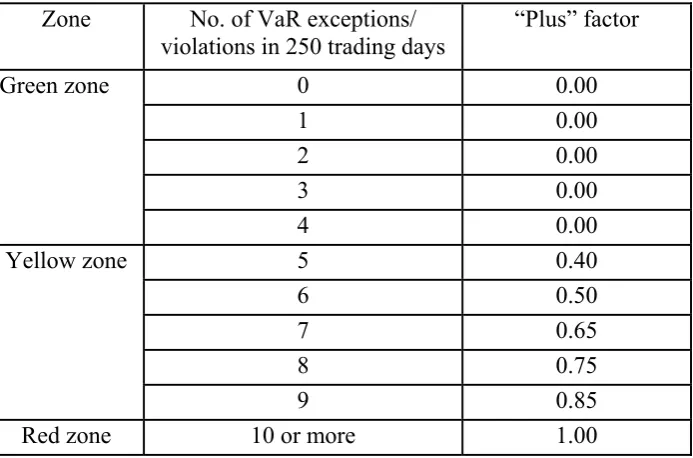
The Basel Committee, as contained in the Basel II Accord, has developed a guideline
in interpreting the number of violations given 250 observations or approximately one
year of daily data. If one computes for a 99%VaR and the number of violations is 4 or
below, the model is in the “green light” zone and incurs no penalty. If the violations
are 5 to 9, the model is in the “yellow” zone, but if the violations are 10 or more
(roughly 3.6% failure rate) the model is in the “red” zone. If the model is in the
“yellow” or “red” zone, the financial institution would incur a penalty.
Under Bangko Sentral ng Pilipinas (BSP) circular 360, “each bank must meet, on a
daily basis, a capital risk charge expressed as the higher of (i) last trading day’s VaR
number or (ii) an average of the daily VaR measures on each of the preceding 60
trading days multiplied by a multiplication factor. The multiplication factor shall be
set by the BSP on the basis of its assessment of the quality of the bank’s risk
management system subject to an absolute minimum of k = 3. Banks will be required
to add to this factor a “plus” directly related to the ex-post performance of the model
(to be determined on a quarterly basis), thereby introducing a built-in positive
incentive to maintain the predictive quality of the model. The plus will range from 0
actual/hypothetical loss exceeds the VaR measure) for the past 250 trading days of the
reference quarter.”2
The risk charge (RC) for day t is given by,
]
60
1
,
[
60
1 1
∑
= −
−
=
i
i t t
t
Max
VaR
k
VaR
RC
(10)Depending on the number of VaR violations or exceptions for 250 days, Table 1
below provides the penalty scheme, ranging from 0 to 1, that will be added to the
minimum of 3 that sums up to k in equation (10). If the method used in estimating the
daily VaR produces a large number of VaR violations, the bank incurs a larger risk
[image:8.595.95.442.362.591.2]charge since k in equation (10) increases to a maximum of 4 (under the “red zone”).
Table 1. Penalty Scheme for the number of VaR violations in a 99%VaR
Zone No. of VaR exceptions/
violations in 250 trading days
“Plus” factor
0 0.00 1 0.00 2 0.00 3 0.00 Green zone
4 0.00 5 0.40 6 0.50 7 0.65 8 0.75 Yellow zone
9 0.85
Red zone 10 or more 1.00
Likelihood Ratio (LR) Tests
The model can also be assessed using a series of Likelihood Ratio (LR) tests if the
VaR violation exceeds zero (Christoffersen, 1998). There are three LR tests available
in assessing the performance of the different models: (1) LR of unconditional
coverage (LRuc), (2) LR of independence (LRind), and (3) LR of conditional coverage
(LRcc). These tests provide us with information related to the possible
a. Likelihood Ratio test for Unconditional Coverage (LRuc)
The LR test statistic for the unconditional coverage is used to test if the proportion of
VaR violations (also known as the empirical failure rate) is equal to the pre-specified
level α (equal to 1% for a 99% VaR). Mathematically the empirical failure rate, π1, can be estimated by,
( )
(
)
T
T
VaR
r
I
T
T t t t 1 1 11
ˆ
=
∑
<
=
=
α
π
(11)where T is the total number of out-of-sample observations and I
()
. is the indicatorvariable which is equal to one if there is VaR violation and zero otherwise and T1 is
the number of VaR violations.
The empirical failure rate is then tested if it is equal to the pre-specified level,
α
π
1=
0
:
H
against the alternative hypotheses,H
1:
π
1>
α
. The decision rulewhether to reject or accept the null hypothesis, H0, is based on LRuc test statistic (Jorion, 2000) and is given by,
(
)
⎥
⎥
⎥
⎥
⎦
⎤
⎢
⎢
⎢
⎢
⎣
⎡
−
⎟
⎠
⎞
⎜
⎝
⎛
⎟
⎠
⎞
⎜
⎝
⎛ −
=
− − 1 1 1 1*
1
*
1
log
*
2
1 1 T T T T T T ucT
T
T
T
LR
α
α
(12)It can be shown that LRuc is asymptotically distributed as chi-square with 1 degree of
freedom.
A model that rejects the H0 of the LRuc is considered as an inferior model since the
empirical failure rate π1 is greater than the pre-specified VaR level α. However,
accepting H0 does not necessarily mean that the model is correctly specified since it is possible for the failure rate to be within the pre-specified level α but the series of VaR violations are not independent of each other. This phenomenon is known as clustered
happened in just one week). According to Christoffersen and Pelletier (2003), a model
with clustered VaR violations is indicative of a mis-specified model
b. Likelihood Ratio test of Independence (LRind)
If the null hypothesis in the LRuc test (
H
0:
π
1=
α
) is not rejected, the model is then assessed using a second test known as the LR test of independence (LRind). Thetest will tell us whether the proportion of the clustered VaR violations is equal to
proportion of the independent VaR violations.
Let Tij be defined as the number of days in which state j occurred in one day while
state i occurred in the previous day. Thus, T00 is the number days without VaR
exception that is preceded by a day without VaR exception, T10 is the number of days
without VaR exception that is preceded by a day with VaR violation, T11 is the
number of consecutive 2 days with VaR violations and T01 is the number of days with
VaR violation that is preceded by day without a VaR violation.
Define the following,
11 10 00 01 11 01 10 11 11 1 00 01 01 0
,
T
T
T
T
T
T
T
T
T
T
T
T
+
+
+
+
=
+
=
+
=
π
π
π
(13)Here, π0 is equal to the proportion of VaR violations preceded by non-VaR violation
and π1 is equal to the proportion of two consecutive VaR violations. In the LRind test
we are interested in the hypothesis
H
0:
π
0=
π
1 against the alternativehypothesis
H
1:
π
0≠
π
1.The test statistic for the LRind test is due to Christoffersen (1998) and is defined in
Jorion (2001) as,
(
)
(
)
(
)
⎥
⎥
⎦
⎤
⎢
⎢
⎣
⎡
−
−
−
=
+ + 11 01 10 00 11 10 01 00ˆ
ˆ
1
ˆ
ˆ
1
ˆ
ˆ
1
log
*
2
0 0 1 1T T T T T T T T ind
LR
π
π
π
π
π
π
. (14)
A model that rejects the H0 of the LRind test indicates that the VaR violations are not independent (or are clustering). Clustering of VaR violations is a matter of great
concern since this can lead to problems for the banks (or any financial institution). On
the other hand, a model that accepts the H0 in the LRind test needs to be tested again to determine if the model is correctly specified, since it is possible that the proportion of
the independent violations (π0) or clustered VaR violations (π1) is higher than the
pre-specified failure rate, α.
c. Likelihood Ratio test of Conditional Coverage (LRcc)
Assuming that the VaR violations are independent, the third test to be performed is
the LR test of conditional coverage, LRcc. The LRcc test has the null hypothesis,
α
π
π
0=
1=
0
:
H
, which states that given the VaR violations are independent,1 0
π
π
=
, they are equal to the pre-specified failure rate, α. The alternativehypothesis is that at least one of the πs is not equal to α. If the null hypothesis of LRcc
test is not rejected, it is indicative that the model is correctly specified. The test
statistic for the LRcc is the sum of the test statistics for the LRuc and LRind and is
distributed asymptotically as chi-square with 2 degrees of freedom.
ind uc
cc
LR
LR
LR
=
+
(15)5. Results and Discussion
This study used 10 stock market indices in the Asia-Pacific Region: Australia, China,
Hong Kong, Indonesia, Japan, Korea, Malaysia, the Philippines, Singapore and
Taiwan. The data consist of daily observations from July 2, 1997 to March 18, 2005.
The number of actual observations varies among the stock market indices because of
the differences in the number of trading holidays. The number of observations is in
the vicinity of 1,900 observations for each country. The first 80% observations or
from July 2, 1997 to September 2, 2003 is used for model estimation while the
remaining 20% observations (September 3, 2003 to March 18, 2005) is used for
out-of-sample forecast evaluation. The models used to compare VaR forecasts are the
RiskMetrics, several ARMA-GARCH type of models and the Range-Based GARCH
Among the selected models, the best model is the Parkinson-GARCH(1,1) with
Student’s t distribution since it is able to forecast correctly all the losses (i.e., no VaR
violation) in 9 out of 10 stock indices (see Table 2). The second best model is
AR(1)-TARCH(2,1) with Student's t distribution followed by the
Garman-Klass-GARCH(1,1) with Student’s t distribution.
Table 2. Summary of the VaR violations of ten stock market indices
AR(1)-ARCH(1), Normal Distribution AR(1)-TARCH(2,1),
Student's t Distribution
Park-GARCH(1,1)
Student’s t Distribution *
GK-GARCH(1,1)
Student's t Distribution * RiskMetricsTM Number o f Ou t-o f-Sample Obs ervations
VaR Violat
ion
Failure Ra
te (
%
)
VaR Violat
ion
Failure Ra
te (
%
)
VaR Violat
ion
Failure Ra
te (
%
)
VaR Violat
ion
Failure Ra
te (
%
)
VaR Violat
ion
Failure Ra
te (
%
)
Australia 394 0 0.00 0 0.00 0 0.00 0 0.00 51 12.94
China 371 1 0.27 0 0.00 0 0.00 0 0.00 128 34.50
Hong
Kong 383 2 0.52 0 0.00 0 0.00 0 0.00 1 0.26
Indonesia 372 2 0.54 0 0.00 0 0.00 1 0.27 1 0.27
Japan 376 4 1.06 0 0.00 0 0.00 0 0.00 7 1.86
Korea 380 1 0.26 2 0.53 0 0.00 0 0.00 3 0.79
Malaysia 378 0 0.00 0 0.00 0 0.00 0 0.00 28 7.41
Philippine
s 383 1 0.26 0 0.00 0 0.00 1 0.26 6 1.57
Singapore 390 0 0.00 0 0.00 0 0.00 0 0.00 22 5.64
Taiwan 382 3 0.79 1 0.26 1 0.26 1 0.26 7 1.83
*Using fixed degrees of freedom equal to 5 as suggested by Tsay (2001).
On the other hand, the worst performing VaR methodology is the RiskMetricsTM where the forecasts in the ten stock market indices have VaR violations. Using the
Basel II definition, the bank will incur a penalty charge using RiskMetricsTM on stock indices in Australia, China, Malaysia, and Singapore because the failure rates are in
the “red” zone (e.g., 3.6% or greater). If the bank is using the selected
ARMA-GARCH and Range-Based ARMA-GARCH models it will not incur a penalty charge since all
VaR violations, if any, are within the “green” zone.
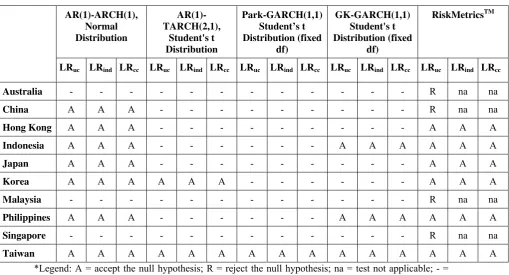
In stock indices where there is at least 1 VaR violation, the models were subjected to
the series of likelihood ratio tests. The results of the LR tests are summarized in Table
three LR tests (i.e., accepted the null hypothesis). The results of the LR tests suggest
that the number of VaR violations of the ARMA-GARCH and Range-Based GARCH
models are within the specified failure rate of 1% (using the LRuc test), moreover the
resulting violations do not exhibit clustered violations or are independent of each
other (based on LRind test) and finally, the VaR violations (clustered and
[image:13.595.56.566.227.502.2]non-clustered) are within the specified failure rate α = 0.01 (LRcc test).
Table 3. Summary of Likelihood Ratio tests of ten stock market indices*
AR(1)-ARCH(1), Normal Distribution
AR(1)-TARCH(2,1),
Student's t Distribution
Park-GARCH(1,1) Student’s t Distribution (fixed
df)
GK-GARCH(1,1) Student's t Distribution (fixed
df)
RiskMetricsTM
LRuc LRind LRcc LRuc LRind LRcc LRuc LRind LRcc LRuc LRind LRcc LRuc LRind LRcc
Australia - - - R na na
China A A A - - - R na na
Hong Kong A A A - - - A A A
Indonesia A A A - - - A A A A A A
Japan A A A - - - A A A
Korea A A A A A A - - - A A A
Malaysia - - - R na na
Philippines A A A - - - A A A A A A
Singapore - - - R na na
Taiwan A A A A A A A A A A A A A A A
*Legend: A = accept the null hypothesis; R = reject the null hypothesis; na = test not applicable; - = cell indicates the test is undefined because the VaR violation is zero.
** Likelihood Ratio (LR) tests: LRuc = LR test of unconditional coverage, LRind = LR test of
independence, LRcc = LR test of conditional coverage. All LR tests are based on 95% confidence
interval.
In the case of RiskMetricsTM, however, the VaR violations in some stock indices are too high that the null hypothesis of the LR test of unconditional coverage (empirical
failure rate is 0.01) is rejected. The performance of RiskMetricsTM will produce higher capital charges in the four indices: Australia, China, Malaysia, and Singapore
Regardless of the specification of the model (GARCH, EGARCH, TARCH),
econometric models based on the Student's t distribution tend to forecast VaR
correctly (i.e., zero VaR violations) as shown in Table 4. This result is consistent with
distribution. The reason is that VaR forecast are usually larger because Student's t
[image:14.595.86.525.148.439.2]distribution has fatter tails than the normal distribution.
Table 4. Number of times there is zero VaR violation in 10 stock market indices.
ARMA-GARCH model Normal Distribution Student's t Distribution
AR (1)-ARCH (1) 3 out of 10 8 out of 10
AR (1)-GARCH (1,1) 1 out of 10 7 out of 10
AR (1)-GARCH (2,1) 1 out of 10 7 out of 10
AR (1)-GARCH (1,2) 1 out of 10 7 out of 10
AR (1)-GARCH (2,2) 1 out of 10 7 out of 10
AR (1)-TARCH (1,1) 0 out of 10 7 out of 10
AR (1)-TARCH (2,1) 0 out of 10 8 out of 10
AR (1)-TARCH (1,2) 0 out of 10 7 out of 10
AR (1)-TARCH (2,2) 0 out of 10 7 out of 10
AR (1)-EGARCH (1,1) 0 out of 10 6 out of 10
AR (1)-EGARCH (2,1) 0 out of 10 6 out of 10
AR (1)-EGARCH (1,2) 0 out of 10 6 out of 10
AR (1)-EGARCH (2,2) 0 out of 10 6 out of 10
PARKINSON-GARCH (1,1) 0 out of 10 9 out of 10 GARMAN-KLASS-GARCH (1,1) 0 out of 10 7 out of 10
6. Conclusion
This paper introduces a relatively simple yet efficient way of modeling volatility
needed in estimating VaR using the Range-Based GARCH models. Two Range-based
models were introduced, the Parkinson Range-GARCH and the Garman-Klass
GARCH models. The empirical analysis, using 10 stock market indices in the Asia
Pacific region, showed that these models are promising based on their out-of-sample
performance. In particular, the Parkinson Range-GARCH model was able to produce
VaR estimates with zero violation in 9 out of 10 stock market indices. This paper has
shown that indeed Range-Based GARCH models are good alternative in modeling
ACKNOWLEDGEMENT
The authors are grateful to Dr. Lisa Grace S. Bersales, Dr. Joselito Magadia, Mr. Greg A. Vargas III and the participants of the seminar held at the School of Statistics, University of the Philippines and participants at the 4th Singapore Econometric Group Meeting held at the Singapore Management University (SMU) for their helpful comments and suggestions. The usual disclaimer applies.
REFERENCES
Bao, Y., Lee, T., and Saltoglu, B. (2006), “Evaluating Predictive Performance of Value-at-Risk Models in Emerging Markets: A Reality Check,” Journal of Forecasting, 25:101-128.
Bollen B. and B. Inder (2003), “A Comparison of Estimators Daily Realised Volatility,” Finance Letters, 1: 29-34.
Bollerslev, T. (1986), “Generalized Autoregressive Conditional Heteroskedasticity,”
Journal of Econometrics, 31: 307-327.
Box G. and G. Jenkins (1984), “Time Series Analysis: Forecasting and Control,” 2nd ed. San Francisco: Holden Day.
Christoffersen P. (1998), “Evaluating Interval Forecast,” International Economic Review, 3 (4): 841-862.
Engle, R. F. (1982), “Autoregressive Conditional Heteroscedasticity with Estimates of the Variance of U.K .Inflation,” Econometrica, 50: 987-1008.
Garman, M.B. and Klasss, M.J. (1980). On the estimation of security price volatilities from historical data. Journal of Business 53: 67-78.
Giot P. and S. Laurent (2003), “Value-at-Risk for and short trading positions,”
Journal of Applied Econometrics, 18: 641-664.
Glosten L. R., R. Jagannathan and D. Runkle (1993), “On the relation between the expected value and the volatility of the nominal excess return on stocks,” Journal of Finance, 48: 1779-1801.
Jorion P. (2001), “Value at Risk: the new benchmark for managing financial risk,” McGraw-Hill USA.
Morgan J. P., and Reuters (1996), “RiskMetricsTM – Technical Document,” ebook, 4th edition.
Parkinson, M. (1980), “The Extreme Value Method for Estimating the Variance of the Rate of Return”, Journal of Business, 53, 61-65.
Nelson D. (1991), “Conditional heteroskedasticity in asset returns a new approach,”
Econometrica, 59: 347-370.
Tsay R. (2005), “Analysis of Financial Time Series,” John Wiley & Sons; 2nd edition.
1
Duffie and Singleton (2003) argues that VaR “captures only one aspect of market risk and is too narrowly defined to be used on its own as a sufficient measure of capital adequacy.” Moreover, Artzner et al (1999) showed that VaR does not satisfy the sub-additive property of the risk measure resulting to a serious limitations when aggregating risk.
2