Technology (IJRASET)
Advancing Informing Frameworks for Secure Part
Based Messaging
G. Shivakanth
Assistant Professor, Department of CSE, CMR College of Engineering & Technology, Kompally village, Medchal
Abstract: Distributed computing has been developing widely, including various clients on the administration it gives. Cloud based email is one of administrations gave by distributed computing number of clients developing yearly premise. Distributed computing confronts concerning issue of security and protection for the most part taking into account its workplace. Personality verification is one solid technique in cloud environment to recognize clients asking for cloud administrations, at present client confirmation in distributed computing is in view of the qualifications controlled by the client generally username & secret key. On the other hand, this strategy has weakness of being traded off by illegitimate clients when clients' passwords have been uncovered or broken. The paper proposes a more secure structure, i.e the two-component confirmation which validates by obliging the username/secret word combine likewise needs a second element to totally give access. The second figure is app put away clients' brilliant gadgets. Username & secret word/apps technique will keep on allowing clients to set up passwords for their records, it will make an irregular obligatory code to be entered through app on advanced mobile phone gadgets thus keep protection of cloud messages. Testing has been finished with help of python system environment. Contrasting with late related proposed plans, our proposed plan has point of interest of high unbreakable security highlight with low executed cost.
Keywords: app, multifactor authentication, biometric authentication, illegitimate users, cloud emails, identity authentication, python programming, des algorithm
I. INTRODUCTION
Technology (IJRASET)
cracked problem. This paper proposes how to identify legitimate users using a two factor authentication (password/App) method.
II. LITERATURE REVIEW
Insights given in [5] demonstrates that clients are mindful of the cloud based messages protection, up to 83% respondents are mindful that their messages are put away in the cloud, 85% respondents feel their sends are not sheltered (still defenseless) in the cloud, 58% associations plan to move a huge segment of their IT to the cloud inside of couple of years. Clearly these numbers stress cloud based messages administration still has a mountain to move with a specific end goal to fulfill clients on security point of view. As of not long ago numerous papers gave their examination time to address information protection in distributed computing, not very many papers have introduced arrangement on the cloud based email security and its security issue [6, 7]. Ahmad-Reza Sadeghi, et al., in [8] propose a system including encryption to be connected on cloud stage. The thought is great yet it is done at Cloud administration supplier, it doesn't have anything to do with client himself/herself, clients won't feel as sheltered as though strategy had included them, there have been inquiry raised about if administration suppliers would perform encryption as guaranteed, suppose it is possible that the encryption is not done appropriately. Then again insights in [9] demonstrates that in 2012, 90% of advanced cell proprietors get to the same email account on portable and desktop, this suggests that greater part of email proprietors have PDAs with web access accessible. At present there is a two variable verification technique honed in web managing an account frameworks conveyed to cloud email validation. The validation includes a client to sign in the framework utilizing his/her username & secret word and give code sent by instant message to his/her cell phone as second variable.
There isn't a contention about the viability of the system; be that as it may it increments numerous other drawback certainties if put by and by for cloud messages. It needs client to give a telephone number to validation to cloud supplier, sending instant message builds expenses, administration may not be secured when taking a stab at getting to email where versatile telecom is not secured for instance in an outside nation. What's more subsequent to giving without end the telephone number, client could be focused by spam calls/recognizable proof data stolen once got in hands of malignant assailants. Another concern is if the SIM card is lost, honest to goodness client will be confined to utilize own email, and watchword recover could be more muddled. The thought of getting App innovation email validation will help overcome issues raised, will serve most noteworthy number of individuals.
Application more often than not remains for application that keeps running on PCs so as to perform an exact assignment specifically for the client. PC applications keep running on framework programming, App ordinarily won't need telephone numbers to perform capacity it needs to give, it obliges a gadget with an application introduced on a right working framework, with right username & secret word. This adds another layer to the record security with the goal that programmers will have troublesome time in getting to cloud messages regardless of the possibility that they may have username & secret key. Cell phone normally utilize Android and iOS working framework. Google and Apple give numerous sorts of App programming's to encourage clients on their day by day utilization. Improvement of clients utilizing Smartphone should be misused and put by and by to help securing cloud messages.
III. PROPOSED SCHEME
This section describes cloud design, where two-factor authentication structure is proposed. The proposed cloud structure has two major advantages as follows.
The goal of proposed scheme is to maintain data privacy although user’s password might be compromised. Proposed scheme involves a compulsory pass code read from user’s cell phone App. Once the App is developed, it would be used by a great number of users hence reduce working rate at the side of cloud provider.
Many users will be able to use proposed authentication method without barrier as most of them possess smart phone/tablets. Cell phone technology is improving nowadays so that 80% [10] worldwide population have mobile phones, that makes it 5 billion mobile phones in which 1.08 billion are smart phones and the number is set to increase in coming days. The use of proposed algorithm requires user to activate cloud email App on his/her cell phone. Steps indicating how to accomplish activation are given below:
A. Create account
B. Is account created? If yes continue to next step; if no go back to first step
C. Input username & password in the App, with a security code given by cloud provider
D. Activate App
Technology (IJRASET)
operates on plaintext blocks of a given size (64-bits) and returns cipher text blocks of the same size. Thus DES results in a permutation among the 2 to the 64th power possible arrangements of 64 bits, each of which may be either 0 or 1. The App needs to maintain the following characteristics:
1) Connectivity: the App gets coding numbers for authentication only when the handheld device is online. It shouldn't show any numbers unless email access & connectivity is required by user. Convenience: this App is user-friendly with a relatively small storage space occupied by application itself.
2) Standardization: the App should have ability to operate on mostly used operating system of smart devices to ensure it serves many users as it should.
3) Security: the App has ability to read handheld devices MAC address in order to differentiate them. MAC address is then stored in database in encrypted form. Authentication coding numbers sent to/ from handheld device must also be encrypted using DES algorithm.
4) Scalability: allowing users to manipulate their email security settings; including removing device not needed or adding a newly bought device. It should give user ability to report loss device for cancelation, and password retrieval.
F. Proposed Scheme
Work Flow After the App has been activated user will go through credential authentication as follows:
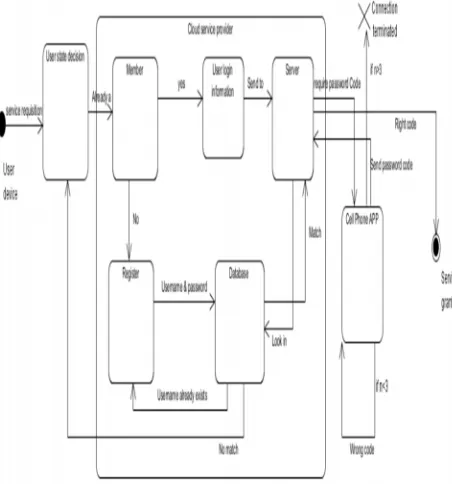
Stage 1: User X requests for service (The first state is illustrated by user making service requisition to cloud service provider server. This could be done through computer, tablet or cell phone);
Stage 2: Cloud provider verifies if user is already a member of its services If YES-> user is asked to provide username and its corresponding password If NO-> user is asked to register and pay for any service fee required (could be free). After registration user will be given (can choose) a username and will be asked to provide password for this username, this information will be stored in cloud database for future reference. Note that cloud service provider will make sure that the username does not exist in its previous stored usernames, if existed an error prompt will show up asking user to pick another username. After registration go to next step Stage 3: Upon log in the email account; user must have been registered already; at least must have a username. Let M defines a function determining if user is a subscriber of cloud service. If exists the result is equal to 1 if false the result is equal to -1.
Stage 4: User is asked to provide credentials (pair of username/password). Let username be u ; password be p
Stage 5: Let pass code provided by the App be A; pass code entered by user be Au, A is sent to device with MAC address h; if A
comes from device with different MAC address h, access will be denied.
Let 0n are an incrementing recurrence number counting how many times pass code is being entered.
Authentication process in python programming is as follows:
Technology (IJRASET)
password2=raw_input('Please enter your password:') login={username2:password2}
if username2 in authentication. Keys(): //// Stage 3 password3=authentication [username2]
if password2==password3: ///// Stage 4 print''
print ‘username and password match'
print("Now enter a digital code from you Cell App") n=0 while(n<3):
import random import math
A =int(math.pow(10,6)*random.random()) if A<100000:
continue
print'Please enter the following 6 digit code numbers:%s'% A ////Stage 5 Aµ =int(raw_input("Enter code:"))
n=n+1
if (Aµ == A ): print "Log in is completed"
Print' Login successful:' break
if (n==3):
print “Exceeded log in chances access is denied"
else: print 'Your username and password provided don\'t match' else:
print''
print ‘Username doesn\'t exist please register'
[image:5.612.195.421.445.687.2]Proposed method schematic is as illustrated in below figure
Technology (IJRASET)
IV. PERFORMANCE EVALUATIONThe following is the table consisting of results extracted from Python programming. The program initiates proposed scheme Username/password with second factor which is code sent to cellphone & tablet through App. Initially it asks user to register, login & enter random code provided by machine, it creates a list in database to recall username & corresponding passwords. At authentication phase a username is entered with a corresponding password, if they do not match; access to email will be denied, if username & password match; then user is asked to input a six digit code with 3 chances in case s/he mistyped one of the code. If user tries 3 times without entering the correct code access will be denied. Table 1 illustrates results extracted from a database of 100 users registered in database by doing 10 different attempts to log in using different username & passwords. The time unit in below table is seconds. The average time it takes computer to verify if pair of username & password is a match
is s 5 102 .32201 . The average time to verify the code and get it right is 7.80635768 s
It is worth mentioning that the time given in this table it is when a user gives credentials at a normal speed as a human (do not type username and come back 3 minutes later to input password). We conclude that authentication time at normal speed can be done in 10 seconds for 100 users in database. By assuming that a hacker had already known the username and password let us examine what are chances of guessing code sent to App. In this method we ask a user to type a number of six digit code. From probability we know that six digit numbers in total are 900000 numbers (100 000-999999). Probability of one number to be the code is -6 101 .11 ; hacker has probability of 0 .00000111 to guess right the number which is relatively small. In addition storage space used is relatively small; the file holding 100 usernames with corresponding passwords is a 4KB file. Below is table when the program is run whereas there are 200 users in database.
From results perspective it is obvious that time spent on identification is barely changing, time is almost same; the file holding 200 usernames with corresponding passwords is 8KB file, which is 2 times larger than the previous one. By calculations suppose that if there were 200 million users in the database the file would be 1GB .This 400 MB 400000 KB storage is really acceptable to hold credentials of all users comparing to nowadays computer storage capacity.
V. COMPARISON & BENEFIT OVER RELATED WORK
Technology (IJRASET)
method. Voiceprint-Biometric Template Design and Authentication method in [2], anonymous Password Authentication Scheme by using digital signature and fingerprint method [3].
In [4] Face Recognition System (FRS) on Cloud Computing for User Authentication is also given. Methods mentioned above are effective in terms of authenticating users; they rely on people physiology characteristics which cannot be common to anyone. These characteristics are hard to forge and steal therefore they have ability of restricting password guessing; protect credentials to be compromised as a result promise security of data stored in cloud. Specialized instruments to extract physiology samples (fingerprint; palm; voice, face) are required by mentioned techniques; their compatibility is little more complicated to be put in practice in order so serve many users, from this view biometric machines are not universal.
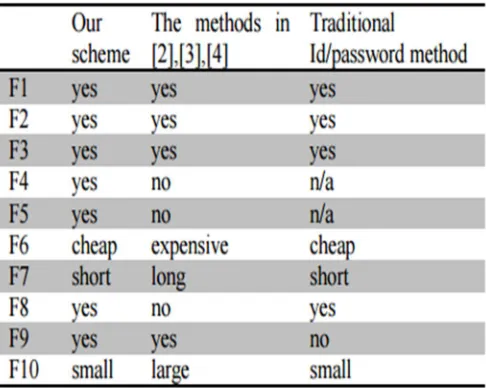
[image:7.612.185.428.523.717.2]Our proposed scheme has advantage of letting user remain anonymous while accessing cloud service while it also lets user to select preferable password, even if password can be accidentally revealed account will still be safe because of second factor put in place. Second factor is sent on user portable device through App with less or probably no cost. User will be able to manage devices used to receive a second factor; second factor is very hard to guess nor break and it is unknown neither to cloud service provider nor user self. According to experiment done through python; authentication time is very short (less than 10 seconds overall). Comparing to traditional Id: password authentication method our proposed scheme has advantage of high unbreakable security feature with low implement cost. TABLE 3 describes security features cloud based email can provide. Those features include self-select password/ user being anonymous while trying accessing email, credential storage, more importantly if it is unbreakable and can serve many users worldwide.
Table 3: Security Features
Technology (IJRASET)
VI. CONCLUSIONAfter activation of App, smart devices are being used to receive code. These devices have their unique characteristic to identify them a MAC address. Hacker may know the device user possesses but it is highly unlikely the hacker will know its MAC address, let it alone be able to falsify MAC address. As long as hacker does not physically steal device he/she will have no chance of accessing other users’ emails. A big bonus is that statistics show that many people are using smart devices with internet thus our method can serve them. From results exploited from python with simple probability calculations, it is obvious that it will be less likely to guess random code. If the number of digits increases probability of guessing the code will diminish, on the other hand time verification after testing is very reasonable; it does not keep user waiting to confirm credentials. We took a close look at storage space of users’ credentials which is relatively small. Space can be saved and allow other server storage to be used on other matters. As conclusion it is clear that authentication will be at least accurate and fast, it involves user himself/herself. It is user-friendly; users are familiar with the first step of input username and password so it wouldn’t require additional training.
REFERENCES
[1] J. Hurwitz, R. Bloor, M. Kaufman and F. Halper, “Cloud Computing For Dummies”, Wiley Publishing, Inc, (2010), pp. 8
[2] H.-H. Zhu, Q.-H. He, H.-H. Zhu, H. Tang and W.-H Cao, “Voiceprint-Biometric Template Design and Authentication Based on Cloud Computing Security”, International Conference on Cloud and Service Computing, (2011).
[3] A. A. Yassin, H. Jin, A. Ibrahim and D. Zou, “Anonymous Password Authentication Scheme by using digital signature and fingerprint in cloud computing”, Second International Conference on Cloud and Green Computing, (2012).
[4] A. A. Pawle and V. P. Pawar, “Face Recognition System (FRS) on Cloud Computing for User Authentication”, International Journal of Soft Computing and Engineering (IJSCE) ISSN, vol. 3, Issue 4, (2013) September, pp. 2231-2307.
[5] T. Ayodele, “Information Intelligence, Infonetmedia Portsmouth, United Kingdom, Dennis Adeegbe IFREC IFREC, Osaka, Japan “Cloud Based Emails Boundaries and Vulnerabilities” Science and Information Conference, (2013) October 7-9, London, UK.
[6] M. Willett and R. V. Solms, “A Framework for Assuring the Conformance of Cloud-based Email”, the 8th International Conference for Internet Technology and Secured Transactions, (2013).
[7] A. Joyia, A. Ghafoor, M. Sajjad and M. Q. Choudhary, “Secure and Privacy Enhanced Email System as a Cloud Service”, IEEE, (2013).
[8] A.-R. Sadeghi, T. Schneider and M. W. H. Görtz, “Institute for IT-Security, Ruhr-University Bochum, Germany”, Token-Based Cloud Computing* Secure Outsourcing of Data and Arbitrary Computations with Lower Latency” Trust and Trustworthy Computing Lecture Notes in Computer Science, vol. 6101, (2010), pp. 417-429.
[9] (2014) February 5, http://www.emailmonday.com/mobile-email-usage-statistics.
[10] (2012) October, http://www.onbile.com/info/how-many-people-use-smartphones-in-the-world/.