A Review on Artificial Intelligence Techniques
Applied in End Milling Process
Manjeet singh#1, Dinesh Kumar*2,
#
PG student,* Assistant Professor at Department of Mechanical Engineering, JCDM College of Engineering,Sirsa
Abstract— in today’s fast changing scenario in manufacturing industries, End milling machining is an operation which produces variety of shapes and surfaces with varying surface roughness. The application of effective optimization techniques in metal cutting process is essential for a manufacturing to increase the quality of a product and to cost minimization. So In this paper Artificial intelligence machining techniques are presented which can be successfully applied in monitoring of machining processes, machining process modelling, prediction and optimization of various process parameters etc. The most often used techniques are artificial neural networks, fuzzy logic, adaptive neuro fuzzy interference systems, genetic algorithms, and others. In the paper is given recommended application of Artificial Intelligence techniques applied in End Milling are presented.
Keywords—End Milling, artificial intelligence techniques, I. INTRODUCTION
The main objective of modern industries is to manufacture those products which are superior in quality low in and cost take less time in manufacturing. The selection of optimal cutting parameters is a very important issue for every machining process in order to enhance the quality of machining products and reduce the machining costs [1]. Milling is one of the operations which produce several shapes with varying surface roughness value. In milling, a predetermined amount of material is removed from the work piece at a relatively slow rate of movement or feed by a milling cutter rotating at a comparatively high speed. Basically, milling cutter can be divided into 3 groups viz., Peripheral milling, Face milling and End milling.. (fig.1).
Fig.1 Types of Milling
The End milling process is widely used in industry because of its versatility and effectiveness. The end mill has edges in the side surface and the bottom surface [2].
The final surface roughness might be considered as the sum of two independent effects:
The ideal surface roughness is a result of the geometry of tool and feed rate
The natural surface roughness is a result of the irregularities in the cutting operation.[3][4]
setup required parameters to reach to the best surface finishing qualities. In recent years the trends are toward modelling of machining processes using artificial intelligence due to the advanced computing capability. Researchers have used various intelligent techniques, including neural network, fuzzy logic, neuro-fuzzy, ANFIS, etc., for the prediction of machining parameters and to enhance manufacturing automation. [7]. Indrajit Mukherjee and Pradip Kumar Ray critically reviewed the existing and frequently used techniques for optimization to metal cutting processes.
The authors categorize
(i) Input-output and in-process parameter relationship optimization (fig.2)
(ii) Determination of optimal cutting conditions (fig.2.) [8]
[image:3.612.314.543.372.494.2]AI tools can be used for prediction of the performance parameters of machining as well as for the optimization of the process. In this paper, application of major AI techniques to various machining processes is discussed with merits and demerits.
[image:3.612.43.300.388.463.2]Fig.2 Input-output and in-process parameter relationship optimization
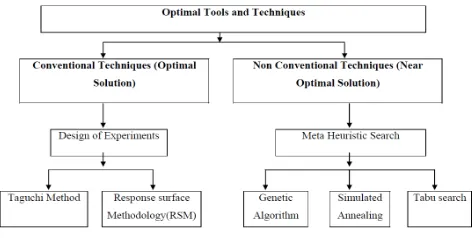
Fig.3 Optimal Tools and Techniques
II. ARTIFICIAL INTELLIGENCE TECHNIQUES
AI tools can be used for prediction of the performance parameters of machining as well as for the optimization of the process. In this paper, application of major AI techniques to various machining processes is discussed.
ARTIFICIAL NEURAL NETWORKS
ANN are simplified mathematical models of human brain function, artificial neural network is attempted imitation of biological neural networks. Similar to its biological counterpart, an ANN has each processing element (the neuron) receiving inputs from the other elements, the inputs are weighted and added, the result is then transformed (by a transfer function) into the output. The transfer function may be a step, sigmoid, or hyperbolic tangent function, among others. [9]. One of the most common neural network architecture is a network with three layers.
Fig. 4 Neural Networks
[image:3.612.49.286.522.641.2]called learning or training. An ANN may have either a recurrent or non recurrent structure. A recurrent network is a feedback network (fig. 5) in which the network calculates its outputs based on the inputs and feeds them back to modify the inputs. For a stable recurrent network, this process normally produces smaller and smaller output changes until the output become constant. If this process would not end, the network is unstable and is known as a chaotic system .To create a stable network, the weight matrix must be symmetrical with zeros on its main diagonal [5]. Moreover, the outputs may be fed back to middle layers to adjust the weights, similar to unsupervised learning. As for the non recurrent networks (fig.6), data will flow in one direction, from input layer to output layer without any feedback loop: they are also called feed forward networks. [9].
Fig.5 Recurrent Network Structure
Fig.6 5 Nonrecurrent Network Structure
Since the first neural model by McCulloch and Pitts (1943). One of the first engineering applications was reported by Minsky and Papert developing perceptrons in 1969. Rumelhart and McClelland [2] published a two-volume book
on explorations in the microstructure of cognition. Liu and Wang [4] also propose a back propagation (BP) ANN for on-line modeling of the milling system. [11]. Kovač, P., Rodić, D., Pucovski, V., Mankova, I., Savkovic, B., Gostimirović, M. [10] compared two Artificial Neural Networks based on a cost function and best network was selected on basic of efficiency and accuracy and concluded that In back-propagation networks, the use of a single hidden layer showed to work sufficiently well for the process in consideration. However, it is shown that radial basis network is superior to back-propagation network in predicting the milling forces, when evaluated in terms of a cost function that combines costs of experiments with accuracy .Jie Ren shie [12] conducted End milling on commercial grades of high purity graphite ISO-680 from TOYO Japan and concluded that ANN yielded better performance than traditional methods such as the Taguchi and Design of experiments (DOE).
Jignesh G. Parmar , Prof.Alpesh Makwana [13] investigated the end milling of M.S material up to 30 HRC with carbide tool by varying feed, speed and depth of cut and the surface roughness was measured using Mitutoyo Surface Roughness and concluded The average prediction error for data set is found to be 3.5% and maximum prediction error is 8.743766%
FUZZY SET THEORY-BASED MODELLING
Fig.7. Design of fuzzy system
The basic structure of a FIS consists of three conceptual components: a rule base, which contains a selection of fuzzy rules; a database which defines the membership functions (MF) used in the fuzzy rules; and a reasoning mechanism, which performs the inference procedure upon the rules to derive an output.(fig.7) There are three types of fuzzy inference systems in wide use: Mamdani-type, Sugeno and Tsukamoto-type. [15]
These three types of inference systems vary somewhat in the way outputs are determined. Design of fuzzy logic system is divided into three phases:
1. Define a fuzzy variable.
2. Set of all fuzzy subsets of variables with appropriate membership functions.
3. Form fuzzy rules.
A fuzzy set is also defined mathematically by assigning to each possible individual in the universe of discourse a value representing its grade of membership in the fuzzy set. This grade corresponds to the degree to which that individual is similar or compatible with the concept represented by the fuzzy set. Thus, individuals may belong in the fuzzy set to a greater or lesser degree as indicated by a larger or smaller membership grade. Fuzzy logic deals with issues such as forming impressions and reasoning on a semantic or linguistic level. The fuzzy set also plays an important role in input-output and in-process parameter relationship modelling.[10] Y. C. Shin, S. J. Oh and S. C. Coker studied the vibration data generated by an accelerometer were used to predict the surface roughness by using neural fuzzy optimize technique.[3]
Kovac et.al. used FL to predict the surface roughness and compare with regression analysis in face milling process.
Cutting speed, feed rate, depth of cut and flank wear were considered as input parameters. The FL was modelled using gausian membership functions. Although fuzzy model is a bit complicated to develop than regression model (need of experience and knowledge). The adequacy of the model is checked and is found to be adequate at 94% confidence level and the model can be used for predicting the surface roughness in machining of carbon steel. [10]
Clodeinir Ronei Peres worked on end-milling process optimization through combining analytic and fuzzy techniques and concluded that it provides an understanding of the behaviour of this hierarchical concept. Also, we were led by the goal of controlling the process while making it possible to analyse its status on-line. [16]
ADAPTIVE NEURO-FUZZY INFERENCE SYSTEM
Adaptive neuro-fuzzy inference system is a fuzzy inference system implemented in the framework of an adaptive neural network. By using a hybrid learning procedure, ANFIS can construct an input-output mapping based on both human-knowledge as fuzzy if-then rules and approximate membership functions from the stipulated input-output data pairs for neural network training. This procedure of developing a FIS using the framework of adaptive neural network is called an adaptive neuro fuzzy inference system (ANFIS). The entire system architecture consists of five layer, namely, the fuzzy layer and total output layer. Five network layers are used by ANFIS to perform the following fuzzy inference steps: (i) input fuzzification, (ii) fuzzy set database construction, (iii) fuzzy rule base construction, (iv) decision making, and (v) output defuzzification. ANFIS is more powerful than the simple fuzzy logic algorithm and neural networks.[10][16]
There are two methods that ANFIS learning employs for updating membership function parameters: 1) back propagation for all parameters (a steepest descent method), and 2) a hybrid method consisting of back propagation for the parameters associated with the input membership and least squares estimation for the parameters associated with the output membership functions. As a result, the training error decreases, at least locally, throughout the learning process. It applies the least-squares method to identify the consequent parameters that define the coefficients of each output equation in the Sugeno-type fuzzy rule base. The training process continues till the desired number of training steps (epochs) or the desired root mean square error (RMSE) between the desired and the generated output is achieved. This study uses a hybrid learning algorithm, to identify premise and consequent parameters of first order Takagi-Sugeno type fuzzy system for predicting surface roughness in ball end milling.[8][17]Ship Peng Lo used ANFIS to predict the surface roughness in end milling process. Spindle speed, feed rate, and depth of cut were considered as input parameters. The ANFIS was modeled using triangular and trapezoidal membership functions. The average error of prediction of surface roughness for triangular membership function was found lower, around 4%.Wen-Hsien applied ANFIS to determine the most suitable membership function by directly minimizing the root-mean –squared-error performance criterion and results shown that the optimal prediction of error by ANFIS is 4.06% which outperforms the optimal errors 4.65% and 4.17% obtained. [18] Md. Shahriar applied Adaptive Neuro-Fuzzy Inference System, Artificial Neural Network and Response Surface Methodology to predict the surface roughness during ball end milling operation. The ANFIS model could predict the surface roughness for training data with MAPE of 0.003014% whereas ANN model could predict the surface roughness for training data with 0.0314% error and RSM could predict with MAPE of 27.72%. In case of test dataset it seems that ANFIS model is worse than ANN and even RSM model. But prediction results for surface roughness are more accurate in ANFIS model if training data are considered [17]
GENETIC ALGORITHMS (GA)
Genetic algorithm (GA), a global optimization method Jang et al. (1997) to find the solutions through the evolution of a set of chromosomes .GA mimics the process of natural evolution by incorporating the “survival of the fittest” philosophy. In GA, a point in search space (binary or decimal numbers) is known as chromosome. A set of chromosomes is called
population. [3]A population is operated by three fundamental operations:
1. Reproduction (to replace the population with large number of good strings having high fitness values)
2. Crossover (for producing new chromosomes by combining the various pairs of chromosomes in the population),
3. Mutation (for slight random modification of chromosomes)[10]
Fig.9 Structure of genetic algorithm
III. CONCLUSIONS
In this paper, a review of neural networks techniques in End Milling for machining performance monitoring is presented .Neural network model is used for modelling machining process. Like modelling of surface quality prediction of machining performance.
The effectiveness of Fuzzy models is only within the range in fuzzy logic it is necessary to define the membership function for each set of rules which form and combination appear with too many solutions. Implementation of fuzzy logic for this purpose can be applied successfully.
Fuzzy sets combination of fuzzy sets and neural networks have been used for prediction of turning, milling and grinding. Fuzzy set based methods are especially advantageous when the expert knowledge is available.
GA have been used in machining are for optimizing the internal parameters of neural networks, fuzzy sets, and neuro fuzzy systems and for machining optimization. The best strategy is to use a combination of fuzzy and neural network for performance prediction and optimization tool like GA for optimization
REFERENCES
1. F. Cus and U. Zuperl,(2009) “Particle Swarm Intelligence Based Optimization of High Speed End-Milling”, Archives of Computational Materials Science and Surface Engineering, vol. 1, no. 3, (2009), pp. 148-154.
2. Şeref Aykut ,(2011)” Surface Roughness Prediction in Machining Castamide Material Using ANN”Acta Polytechnica Hungarica Vol. 8, No. 2, 2011
3. Mahesh. G.,(2012)” A Review of Optimization Techniques, Effect of Process Parameter with Reference to Vibration in End Milling Processes”European Journal of Scientific Research ISSN 1450-216X Vol.76 No.2 (2012), pp.226-239
4. Boothroyd,G and Knight, W, (1989). ‘Fundamentals of Machining and Machine Tools’, 2 nd ed.,Marcel Dekker Inc, New York.
5. M. S. Lou, J. C. Chen and C. M. Li,(1999) “Surface roughness prediction technique for CNC end-milling”, Journal of Industrial Technology, vol. 15, no. 1, (1999), pp. 1-6.
6. Md. Shahriar Jahan Hossain and Dr. Nafis Ahmad,(2012)” Artificial Intelligence Based Surface Roughness Prediction Modelling for Three Dimensional End Milling” International Journal of Advanced Science and Technology Vol. 45, August, 2012
7. Ş. Aykut & M. Bozdemir (2012),” Optimization of surface roughness in end milling Castamide” Int J Adv Manuf Technol (2012) 62:495–
503.
8. Indrajit Mukherjee and Pradip Kumar Ray. (2006). ‘A review of optimization techniques in metal cutting processes’, Computers & Industrial Engineering, Vol. 50, pp.15–34
9. Eldon Y. Li ,(1994)”Artificial neural networks and their business applications” Information & Management 27 (1994) 303-313
10. Kovač, P., Rodić, D., Pucovski, V., Mankova, I., Savkovic, B., Gostimirović, M.,(2012)” a review of artificial inteligence approaches applied in inteligent processes” journal of Production Engineering, Vol.15 (2012), Number 1
11. Jorge F. Briceno, Hazim El-Mounayri , Snehasis Mukhopadhyay (2002)” Selecting an artificial neural network for efficient modeling and accurate simulation of the milling process” International Journal of Machine Tools & Manufacture 42 (2002) 663–674
12. Jie-Ren Shie,(2007)”Optimization of Dry Machining Parameters for High-Purity Graphite in End-Milling Process by Artificial Neural Networks: A Case Study”Materials and Manufacturing Processes, 21: 838–845,2006Copyright © Taylor & Francis Group, LLC ISSN: 1042-6914 print/1532-2475 online DOI: 10.1080/03602550600728257
13. Jignesh G. Parmar , Prof.Alpesh Makwana ,(2012)” Prediction of surface roughness for end milling process using Artificial Neural Network”Vol.2, Issue.3, May-June 2012 pp-1006-1013 ISSN: 2249-6645 www. International Journal of Modern Engineering Research (IJMER)
14. Lotfi A. Zadeh. (1965). ‘Fuzzy sets’, Information Control, Vol.8, pp.338–353
15. Sivarao, P. B. (2009). Mamdani fuzzy inference system modeling to predict surface roughness in laser machining.International Journal of Intelligent Information Technology Application, 2(1), 12–18.
16. Clodeinir Ronei Peres , Rodolfo Elias Haber Guerra , Rodolfo Haber Haber , Angel Alique , Salvador Ros (1999) “Fuzzy model and hierarchical fuzzy control integration: an approach for milling process optimization” Computers in Industry 39 _1999. 199–207
17. Md. Shahriar Jahan Hossain and Dr. Nafis Ahmad (2012),” Artificial Intelligence Based Surface Roughness Prediction Modeling for Three Dimensional End Milling” International Journal of Advanced Science and Technology Vol. 45, August, 2012
18. Wen-Hsien Hoa, Jinn-Tsong Tsai b, Bor-Tsuen Lin c, Jyh-Horng Chou ,” Adaptive network-based fuzzy inference system for prediction of surface roughness in end milling process using hybrid Taguchi-genetic learning algorithm