Technology (IJRASET)
Secure Outsourced Comparison Scheme for
Partitioned Databases
Neethu Rosiline1, T Sivakumar2, Sreedarsa K. S3
1
PG Student, Maharaja Institute of Technology, Coimbatore 2
M.E.(CSE), Professor, Maharaja Institute Of Technology, Coimbatore 3
PG Student, Maharaja Institute of Technology, Coimbatore
Abstract: In different applications that uses cloud, studies a range of data analysis techniques. The most popular data analysis techniques were association rule mining and frequent itemset mining. In this paper we focus on outsourced comparison scheme for partitioned databases. This paper mainly concern about data security. It prevents accessing of shared data among different users. We provide homomorphic encryption scheme and a comparison scheme for data privacy. Association rule mining can be used for effectively getting data from portioned databases. Resource consumption can be reduced by the usage of cloud servers for data and computing.
Index Terms- Association rule mining, frequent itemset mining, outsourced comparison scheme.
I. INTRODUCTION
In a centralized database raw data is mined centrally by classic frequent item set mining and association rule mining algorithms,[13,14].In this privacy is not considered. Due to an enlarged understanding of the significance of data privacy, a number of privacy-preserving mining solutions have been proposed in recent times. In this there are different data owners’ aims to study association rule or frequent item sets from their joint data. However, the data owners are not willing to send their raw data to a central site due to privacy concerns. If each data owner has one or more rows (i.e. transactions) in the joint database, we say that the database is horizontally partitioned [1]. If each data owner has one or more columns in the joint database, the database is considered vertically partitioned [2]. This paper focuses on vertically partitioned databases. Vertically partitioned databases are helpful for market basket analysis [8] health care [9], web usage mining [10] and bioinformatics [11].
For example, different businesses, such as a fashion designer and a luxury watch designer, sell different products to the same community. These businesses collaborate to mine customer buying patterns from the joint database. A transaction of the database contains the products that a customer had bought from one or more of the participating businesses, and attributes such as the customer credit card number and date of purchase are used as TIDs. Therefore, each of the businesses (i.e. data owners) will own some transaction partitions in the joint database. However, these businesses may not wish to disclose such data, which include trade secrets (e.g. there may be other competing businesses sharing the same joint database) and customer privacy (e.g. due to regulations in existing privacy regime). Therefore, a privacy-preserving mining solution must be applied. Other use cases can also be found in areas such as automotive safety and national security.
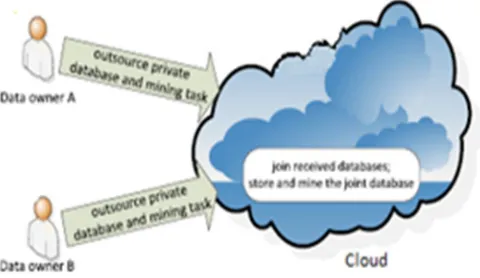
Figure1 Overall diagram
A. System Details
Technology (IJRASET)
Figure 2 Privacy-preserving outsourced association rule mining.
a) Proposed homomorphic encryption scheme: Homomorphic encryption scheme allows one or more plaintext operations (e.g addition and multiplication) to be carried out on the cipher texts. If the addition operation is allowed, then the scheme is known as additive homomorphic encryption [7]. Existing homomorphic encryption schemes are generally asymmetric. In this paper, we propose a symmetric homomorphic encryption scheme (using only modular additions and multiplications), which is significantly more efficient than asymmetric schemes.
b) Proposed Secure Outsourced Comparison Scheme: The proposed secure comparison scheme is based on the symmetric homomorphic encryption scheme[7]. In our privacy-preserving data mining solutions, data owners require the cloud to compare supports/confidences with thresholds. However, both supports and confidences must be kept secret from the cloud and data owners, while the comparison results must be kept secret from the cloud.
c) Privacy-preserving outsourced association rule mining: Privacy-preserving outsourced association rule mining (fig 2) solution based on predicate encryption [6]. This solution is flexible to chosen-plaintext attacks on encrypted items, but it is vulnerable to frequency analysis attacks. Applying this solution to vertically partitioned databases will also result in the leakage of the exact supports to data owners.
II. SYSTEM ARCHITECTURE
and Cloud Upload Module, Mining and Verifying Result Module and Decryption Module. The data owners can work along with the details of modules mentioned below,
A. Authentication Module
1) Login validation of owner.
2) Registration.
3) File upload.
4) User Activation.
B. Encryption One Module
1) Encryption one by User A.
C. Encryption and Cloud Upload Module
1) Encryption two by User B.
2) Merging with first encrypt.
3) Cloud Upload.
D. Mining and Verifying Result Module
1) Mining data from cloud.
2) Verifying result.
E. Decryption Module
1) Decrypt.
2) Design Goals
The goals of our secure outsourced comparison scheme for partitioned databases are as follows:
a) Privacy. Data owners get small information regarding databases of other data owners. Each raw transaction details of users were concealed. And mining result should be verified by the cloud.
b) Efficiency. The data owners have different keys for encryption, encrypted files were merged and uploaded and with both data owner keys only we can decrypt the data. This process may be time consuming but an efficient one.
III. RESULTS
[image:5.612.172.441.497.711.2]Technology (IJRASET)
[image:6.612.160.510.47.576.2]Figure 5: Registration page
Figure 6: Contact Cloud and payment page
Figure 7: User profile page
IV. FUTUREWORK
An efficient homomorphic encryption scheme and a secure outsourced comparison scheme were presented in this paper. Both schemes have possible usage in other secure computation applications, such as secure data aggregation [15]. Signifying the service of the proposed homomorphic encryption scheme and outsourced comparison scheme in other settings will be the focus of future research.
In the first pass, the algorithm counts occurrence of items (attribute-value pairs) in the dataset, and stores them to 'header table'. In the second pass, it builds the FP-tree structure by inserting instances. Items in each instance have to be sorted by descending order of their frequency in the dataset, so that the tree can be processed quickly. Items in each instance that do not meet minimum coverage threshold are discarded.
results were merged and verified by the cloud can be uploaded. The uploaded data can be decrypted by different data owners with their own key.
REFERENCES
[1] M. Kantarcioglu and C. Clifton, “Privacy-preserving distributed mining of association rules on horizontally partitioned data,” IEEE Trans. Knowl. Data Eng., vol. 16, no. 9, pp. 1026–1037, Sep. 2004.
[2] B. Rozenberg and E. Gudes, “Association rules mining in vertically partitioned databases,” Data Knowl. Eng., vol. 59, no. 2, pp. 378–396,2006.International Journal of Computer Engineering and Applications, Volume 8, Issue 1, oct 2014.
[3] F. Giannotti, L. V. S. Lakshmanan, A. Monreale, D. Pedreschi and H. Wang, "Privacy-preserving mining of association rules from outsourced transaction databases", IEEE Syst. J., vol. 7, no. 3, pp. 385-395, 2013.
[4] B. Dong, R. Liu and H. Wang, "Result integrity verification of outsourced frequent itemset mining",Proc. 27th Annu. IFIP WG Conf. Data Appl. Secur. Privacy (DBSec), pp. 258-265,
[5] R. Liu and H. Wang, "Result integrity verification of outsourced privacy preserving frequent itemset mining", Proc. SIAM Int. Conf. Data Mining, pp. 244-252, [6] v F. Giannotti, L. V. S. Lakshmanan, A. Monreale, D. Pedreschi, and W. Wang, “Privacy-preserving data mining from outsourced databases,” in Proc. CPDP,
2011, pp. 411–426.
[7] Iram Ahmad and Archana Khandekar “Homomorphic Encryption Method Applied to Cloud Computing” International Journal of Information & Computation Technology. ISSN 0974-2239 Volume 4, Number 15 (2014), pp. 1519-1530 © International Research Publications House.
[8] T. Brijs, G. Swinnen, K. Vanhoof, and G. Wets, “Using association rules for product assortment decisions: A case study,” in Proc. SIGKDD, 1999, pp. 254– 260.
[9] S. E. Brossette, A. P. Sprague, J. M. Hardin, K. B. Waites, W. T. Jones, and S. A. Moser, “Association rules and data mining in hospital infection control and public health surveillance,” J. Amer. Med. Inform. Assoc., vol. 5, no. 4, pp. 373–381, 1998.
[10] B. Mobasher, H. Dai, T. Luo, and M. Nakagawa, “Effective personalization based on association rule discovery from Web usage data,” in Proc. WIDM, 2001, pp. 9–15.
[11] C. Creighton and S. Hanash, “Mining gene expression databases for association rules,” Bioinformatics, vol. 19, no. 1, pp. 79–86, 2003. [12] X. Yin and J. Han, “CPAR: Classification based on predictive association rules,” in Proc. SIAM SDM, 2003, pp. 1–5.
[13] R. Agrawal and R. Srikant, “Fast algorithms for mining association rules,” in Proc. VLDB, 1994, pp. 1–13.
[14] M. J. Zaki, “Scalable algorithms for association mining,” IEEE Trans.Knowl. Data Eng., vol. 12, no. 3, pp. 372–390, May/Jun. 2000.