5
IX
September 2017
Improved Fuzzy Leach Protocol for Node Mobility
in WSN
Jaspreet Kaur1, Dr. Jyotsna Sengupta2 Punjabi University, Patiala
Abstract: In order to minimize the energy consumption within the wireless sensor networks, the clustering technique is applied. Within every cluster, a cluster head is chosen. The data that is gathered by the node is sent to the respective cluster head in the cluster. An enhanced MOFCA protocol is proposed in this paper which resolves the major issue of energy consumption in these networks. The various aspects such as the density of the node, energy left, mobility of the node and various other parameters have been introduced in this fuzzy clustering algorithm. MATLAB is used here for providing simulations. The comparison of MOFCA and improved MOFCA is also done in this paper. It is seen through the simulation results that the performance is enhanced with the utilization of improved MOFCA.
I. INTRODUCTION
Within a wireless sensor network, there are numerous nodes spread across an area for monitoring the surroundings present. There is a sensor hub present within the network that comprises of sensors, actuators, memory, and a processor and facilitates communication amongst the nodes. The wireless mode of communication is utilized for transmitting the data across the sensor nodes with the help of radio frequencies, infrared etc. and does not include any wired connections within it. A random fashion is set across the nodes and the messages are transferred which thus provides an ad-hoc network environment within the networks [1]. Instead of the single sensor hubs placed within the network, the distributing sensing allows the sensing nodes to be positioned neared to each other. For locating the nodes in a prominent manner, proper sensing methodologies are to be utilized in cases where locations are not easy to be defined. Numerous sensor nodes are utilized here for the identification of various environmental problems arising within the surroundings of the network. There is no framework provided for the energy or communication within the surroundings that are to be monitored. There is limited amount of energy to be consumed and data to be transferred within the wireless channel. There are large numbers of sensor nodes present within the architectural design of the sensor networks [2]. The communication of sensor nodes is done through the sensor field across which the information related to their surroundings is transferred to each other. The data transmission can be easily done with the help of these nodes. There are limited computational constraints to be provided for reducing the overall cost of the networks. Within the devices, the sensing abilities are to be provided. The applications in which the human cannot reach physically include the sensor nodes. This provides the sensor hub to be involved for providing such facilities. The battery power is utilized for deploying these nodes in locations where humans are not able to present. However, the battery life is limited for all such batteries. The usage of power should be in a proper manner such that there is no depletion of energy resources and the lifetime of the node increases. The sensor nodes are closed once they are not of any use within the network [3]. There is a need to implement the clustering methods for saving energy within the WSNs. Each node present within the network can be divided into various groups known as the clusters as per the network organization. There is a cluster head for each cluster and the other nodes are completely different from that cluster. There are two levels within the clustering process. The higher level holds the cluster heads and the lower level comprises of the nodes. It is necessary to validate all the important conditions that are needed for forming clusters within the clustering algorithms. Various parameters are important for the establishment of clustering process within the WSNs [4]. The generation of clusters is done in a proper manner through these parameters.
LEACH protocol: There are many techniques that are used in clustering these are LEACH, and many more improved forms of LEACH like E- LEACH, LEACH-SM, multi-hop-LEACH, ENCM and so on. LEACH protocol contains two phases:
Cluster set up phase: It is displayed by each node whether to select the cluster head for the specific round or not. A random number between 0 and 1 is chosen for each node to make a decision [5]. There is value of threshold setup here and in any case if the value of the node is less than the threshold value, the node is chosen to be the cluster head for that particular round in that network.
energy efficient a novel technique has been evolved. An efficient method which gathers data considering the energy consumption as a parameter in the network is known as clustering technique. The gathered data is transmitted to a cluster head to which the node belongs within the clustered networks. Once the data is gathered by the cluster-head amongst all the member nodes, the gathered data is forwarded to the base station. The transmitted data can be in a compressed of uncompressed form. Through the cluster heads, the data is transmitted within the multi-hop network scenario. Due to the huge inter-cluster dependency, the cluster-heads that are near to the sink deplete at much faster rate within such networks. This complete issue is named as hotspots problem. There are numerous unequal clustering methods being proposed for solving this issue. There are small sized clusters created by the unequal clustering methods when they are moving towards the sink. This helps in reducing the intra-cluster dependency within the network. Due to the modification in the area of node deployment, the energy-hole problem also arises here.
II. LITERATURE REVIEW
Arun K. Somani, et al. [7], proposed in this paper that the clustering in wireless sensor networks can be done with the help of a distributed, light weight, scalable clustering computation. There are extremely exact clustering algorithms provided by the sensors that are sent randomly within the environment. The cluster head can convey to the base station through an overlay network and intermediates node in the middle. They examined that the performance of clustering calculation by using simulation. Results demonstrate that not very many nodes are not ready to join a cluster or remain orphan, numerous are secluded because of random deployment and communication range limitation.
Ebin Deni Raj [8], proposed in this paper that the cluster head Gateway Switch Routing protocol (CGSR) uses the hierarchical network topology. Each node is placed within the clusters accordingly. There are various algorithms that utilize advance power consumption for selecting the cluster head within the WSNs. A density and distance based cluster head is examined along with the many other mentioned algorithms. The simulation results derived propose the comparisons of all such algorithms. The results provided show the various proposed algorithms have their own limitations and a new calculation known as EDR LEACH is also proposed.
Vinay Kumar, et al. [9], proposed in this paper that the lifetime of the sensor network can be increased with the help of various enhancements made within the WSNs. A path that is chosen for transmitting the data across the network is selected on such basis that the energy consumption is to be the least. An efficient usage of the constrained resources is done by the sensor nodes within the hierarchical wireless sensor networks created by the clusters. Within the WSNs the energy efficient clustering algorithms are put forth. The related LEACH work is provided in this paper and the simulations results are compared.
Limin Meng, et al. [10], proposed in this paper that energy utilization is the most prominent factor within the wireless sensor networks. An energy aware QoS routing algorithm is proposed in this paper which provides best-effort traffic within the network. This proposed algorithm enhances the first order energy consumption model with the help of dynamic clustering.
The multi-objective programming model is built in order to support the QoS of the network. The proposed algorithm has provided robust and effective results in comparison to the other algorithms as per the simulation results.
Fan Xiangning et.al [11] proposed in this paper a detailed study on the LEACH protocol. There have been various enhancements made within the energy-LEACH and multi-hop LEACH protocols. The communication mode within the multi-hop LEACH protocol is enhanced from single hp to multi-hop within the cluster head and sink. Amongst the LEACH protocols, the energy-LEACH and multi-hop energy-LEACH protocols have proven to be more efficient as per the results achieved by the simulation results. For the purpose of acquiring data from the network, the LEACH protocol has provided better results.
Bilal Abhu et.al proposed [12] in this paper the LEACH-SM protocol. An ideal energy-saving is provided by this protocol for controlling the spare selections within the networks.
The spare selection stage is added to the LEACH with the help of drain SM. There are comparisons made related to the energy consumption and WSN lifetime of both the protocols. The experimental results show that the proposed method has provided enhancements within the previous proposed works.
III. RESEARCH METHODOLOGY
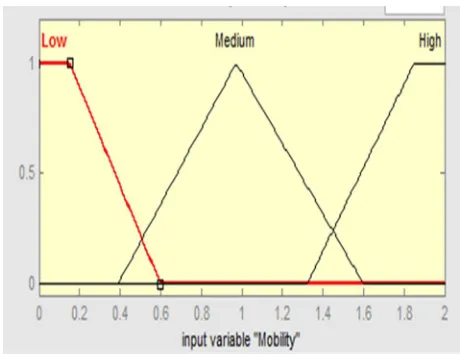
Fig. 1: Fuzzy set defining the fuzzy input variable Mobility
As shown in figure 1, the input variable that is presented by the fuzzy set is depicted. The mobility of the sensor node is the secondary fuzzy input variable given. There are three types of linguistic variables which are low, medium as well as high. For the purpose of minimizing energy consumption within the network, the novel mobility parameter is added to the existing MOFCA protocol.
IV. EXPERIMENTAL RESULTS
[image:4.612.191.421.74.251.2]In this section, the simulation of MOFCA and improved MOFCA is done to obtain the results of both protocols. The sensor nodes are deployed randomly in the fixed area. The cluster heads in the network are selected using the LEACH protocol. The cluster heads in the network is the 10 % from the total number of nodes in the networks. The numbers of nodes taken for simulation are 100 sensor nodes.
Fig 2: Energy Comparison
0 50 100 150 200 250 300 350 400
0.02 0.04 0.06 0.08 0.1
N
u
m
b
er
o
f
R
o
u
n
d
s
Initial Energy
Energy Consumption
MOFCA
is been analyzed that improvement MOFCA perform batter in terms of number of rounds for the dead nodes.
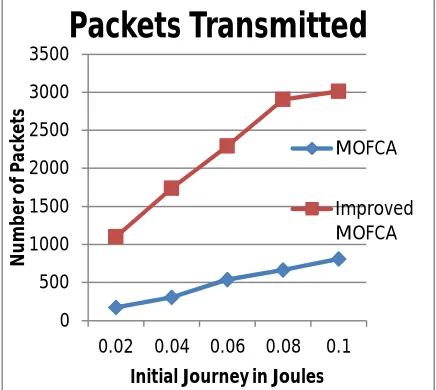
Fig 3: Packet Transmitted Comparison
As shown in figure 3, the performance of proposed MOFCA protocol is compared with existing MOFCA protocol and it is been analyzed that more number of packets get transmitted in the proposed protocol as compared to existing protocol.
V. CONCLUSION
An improved MOFCA is proposed in this paper which is basically a fuzzy clustering algorithm. It is basically a multi-objective fuzzy clustering algorithm. Various parameters are involved within this algorithm which ensures that the previous problems are resolved. It is seen as per the simulation results achieved that on various initial energy values, half of the nodes are considered to be dead. Various comparisons are made and it is seen that the number of packets transmitted to base station are more in the proposed protocol.
REFERENCES
[1] Gouvy, N., Hamouda, E., Mitton, N., & Zorbas, D. (2013, April). Energy efficient multi-flow routing in mobile Sensor Networks. In Wireless Communications and Networking Conference (WCNC), 2013 IEEE (pp. 1968-1973). IEEE.
[2] Kaur, K., & Kumari, N. Evaluation and Analysis of Active RFID Protocol in Wireless Sensor Networks.
[3] Jiang, L., Bing Fang, & Li. (May, 2013) Energy optimized approach based on clustering routing protocol for wireless sensor networks. CCD Conference. IEZ [4] Wang, Y., & Guo, S. (2013, August). Optimized energy-latency cooperative transmission in duty-cycled wireless sensor networks. In Mechatronics and
Automation (ICMA), 2013 IEEE International Conference on (pp. 185-190). IEEE.
[5] Zhang, D., Li, G., Zheng, K., Ming, X., & Pan, Z. H. (2014). An Energy-Balanced Routing Method Based on Forward-Aware Factor for Wireless Sensor Networks. Industrial Informatics, IEEE Transactions on, 10(1), 766-773.
[6] Gouvy, N., Hamouda, E., Mitton, N., & Zorbas, D. (2013, April). Energy efficient multi-flow routing in mobile Sensor Networks. In Wireless Communications and Networking Conference (WCNC), 2013 IEEE (pp. 1968-1973). IEEE.
[7] Somani, A. K., Kher, S., Speck, P., & Chen, J. (2006). Distributed dynamic clustering algorithm in uneven distributed wireless sensor network. Technical Reports [DCNL-ON-2006-005], Iowa State University
[8] Raj, E. D. (2012). An Efficient Cluster Head Selection Algorithm for Wireless Sensor Networks–Edrleach. IOSR Journal of Computer Engineering (IOSRJCE), 2(2), 39-44.
[9] Kumar, V., Jain, S., & Tiwari, S. (2011). Energy efficient clustering algorithms in wireless sensor networks: A survey. IJCSI International Journal of Computer Science Issues, 8(5).
[10] Ahmadi, E., Sabaei, M., & Ahmadi, M. H. (2011). A New Adaptive Method for Target Tracking in Wireless Sensor Networks. International Journal of Computer Applications, 22(9), 21-29.
[11] Xiangning, F & Yulin, S.(2007).Improvement on LEACH Protocol of Wireless Sensor Network.International Conference on Sensor Technologies and Applications.(pp. 260 -264), IEEE
[12] Bakr, B. A., & Lilien, L. (2011, June). A quantitative comparison of energy consumption and WSN lifetime for LEACH and LEACH-SM. In Distributed Computing Systems Workshops (ICDCSW), 2011 31st International Conference on (pp. 182-191). IEEE
0 500 1000 1500 2000 2500 3000 3500
0.02 0.04 0.06 0.08 0.1
N u m b e r o f P a ck et s
Initial Journey in Joules
Packets Transmitted
MOFCA