5
IX
September 2017
1308
©IJRASET (UGC Approved Journal): All Rights are Reserved
A Study on the Extraction Process of Wrightia
Tinctoria and Evaluation of Its Antimicrobial
Activity
Dr. S. Lakshmi Manokari 1,Ms.N.Charanya Meenu 2
1
Associate Professor and Head i/c, 2Research Scholar, Department of Textiles and Apparel Design, Periyar University, Salem
Abstract: Response Surface Methodology (RSM) with Central Composite Design (CCD) is performed in the present study under different experiment runs varying the weight of the Wrightia tinctoria leaf powder. Aqueous, ethanol and ethyl acetate extracts are derived from Wrightia tinctoria plant leaf powder using Soxhlet apparatus under various experimental conditions. Antimicrobial activity of the plant extracts are investigated using agar disc diffusion method.
Keywords: Response Surface Methodology, Central Composite Design, Experiment Runs, Wrightia tinctoria, Soxhlet Apparatus
I. INTRODUCTION
Medicinal plants are a source of great economic value all over the world. Nature has given us a very rich botanical wealth and large number of diverse types of plants is grown in different parts of the country. Ayurveda, Unani and Siddha are systematically used nearly 1500 plants in indigenous system of medicine. Medicinal plants are the oldest existing complete medical system in the world. Use of herbal medicines in Asia represents a long history of human interactions with the environment. Plants used for traditional medicine contain a wide range of substances that can be used to treat chronic as well as communicable diseases (Saleh et.al., 2009).
Uses of medicinal plants in the industrialized societies have been traced from the extraction and development of several drugs and chemotherapeutic drugs from these plants as well as from traditionally used rural herbal remedies (Sharma et.al., 2010). Wrightia tinctoria (Syn. Pala indigo plant) of Apocyanaceae family is widely used in skin diseases, liver disorders and broad spectrum biological activities (Kirtikar and Basu, 1981).
The plant is used to treat seizures, wounds, leukemia, gynecological disorders, toothache, headache, dandruff, diarrhea and skin disorders like psoriasis, eczema, scabies etc. Wrightia tinctoria has found its way into unani formulation called Hab-e-Jund which is being used to treat febrile convulsions and also is being proposed for the treatment of generalized tonic-clonic seizure and absence seizure (Koneru et.al., 2009). The whole plant or its specific parts (bark, leaf, seed and root) are known to have medicinal properties and have a long history of use by indigenous communities in India (Nadkami, 1976). A range of techniques, varying in cost and level of complexity, may be used for extraction of plant material. Methods of Soxhlet extraction can be classified as continuous or discontinuous.
In continuous methods (e.g., percolation and soxhlet extraction), solvent flows through the plant material continuously. In the case of discontinuous methods, the solvent is added and removed in batches (Sarkar et.al., 2006). The statistical approach to experimental design is necessary if we wish to draw meaningful conclusions from the data. When the problem involves data that are subject to experimental errors, statistical methods are the only objective approach to analysis (Montgomery, 2017). DOE refers to the process of planning, designing and analysing the experiment so that valid and objective conclusions can be drawn effectively and efficiently. In order to draw statistically sound conclusions from the experiment, it is necessary to integrate simple and powerful statistical methods into the experimental design methodology (Antony, 2014).
In the present study, Design of Experiments (DOE) is employed using the Design Expert- Stat Ease software for improving the quality of the extract.
1309
©IJRASET (UGC Approved Journal): All Rights are Reserved
II. MATERIALSANDMETHODS
A. Plants and Chemicals
Wrightia tinctoria leaves are used to make the plant extract. The plant is selected for the following reasons; Cost effectiveness, Ease and Availability, Medicinal Properties, Less toxic, Energy efficient and Ecofriendly nature.
B. Taxonomic Classification
Botanical name: Wrightia tinctoria R.Br.
Family - Apocynaceae
Kingdom - Plantae
Genus -Wrightia
Species - tinctoria
The solvents used for extraction are water, ethanol and ethyl acetate. Double distilled water is used for the experiments. All the chemicals were purchased from Precision scientific chemicals, Coimbatore and are of analytical grade and are used without further purification.
C. Microorganisms and Growth Conditions
The test strains, Gram negative bacteria Escherichia Coli and Gram positive bacteria Methicillin Resistant Staphylococcus aureus are obtained from the Department of Microbiology, Periyar University, Salem. These bacterial strains are cultured and these representative microorganisms are used to evaluate the antimicrobial activity of the extract.
D. Identification of Plant Sample
During the period of flowering and vegetative phase, sample of Wrightia tinctoria parts consisting of leaves, stem, flower buds are collected for getting authentication. By comparing the collected specimen with that of a known identity available in the herbarium of Botanical Survey of India, TNAU Campus, Coimbatore, the taxonomic identity of the plant is confirmed.
E. Collection of Plant Sample
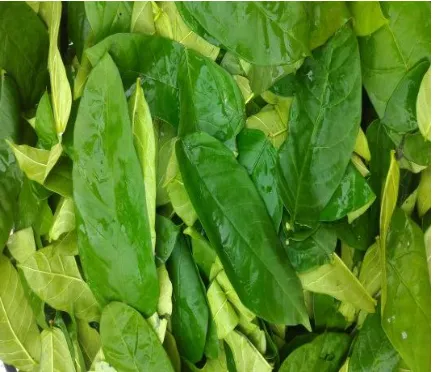
[image:3.612.199.416.403.589.2]Fresh and healthy leaves are collected from the agricultural field near Erode in the month of February.
Fig. 1. Collected leaves
F. Preparation of Leaf Powder
The collected leaves are washed thoroughly twice with running tap water followed by double distilled water to remove all debris and other contaminated organic contents. They are kept away from direct sunlight to avoid destruction of active compounds. They are shade dried for 20 days to remove the water from the surface of the leaves and then ground into a fine powder using domestic blender. The powder is refrigerated in an airtight container for further use.
G. Extraction Method
1310
[image:4.612.182.432.73.239.2]©IJRASET (UGC Approved Journal): All Rights are Reserved
Fig. 2.Soxhlet extractor
H. Extraction Procedure
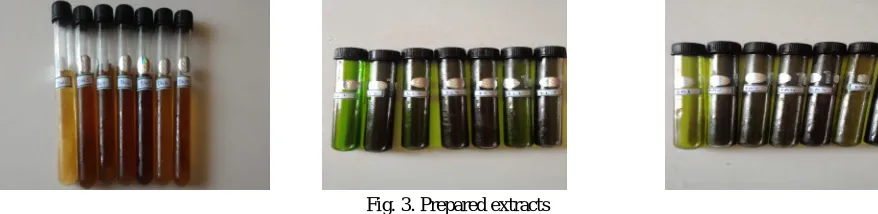
The Wrightia tinctoria leaf powder to be extracted in taken in the required quantity as per the experimental runs and loaded in a thimble made from filter paper. Then the thimble is placed inside the extractor and the required solvent in 200 ml is taken in the conical flask which is placed about the heating element. When the apparatus is turned on, the vapour from the solvent travels through the distillation arm and then through the thimble. The thimble is surrounded by the warm solvent which makes the powder to get dissolved in it. When the solvent is full in that area, then it gets automatically emptied to the conical flask placed at the bottom. The cycle is repeated until the solvent becomes colourless. The extracted solvent is taken and placed in a rotary evaporator. Here the solvent is evaporated and the dry crude extract is transferred to the vial for the next activity.
Fig. 3. Prepared extracts
I. Experimental Runs- Design Expert Software
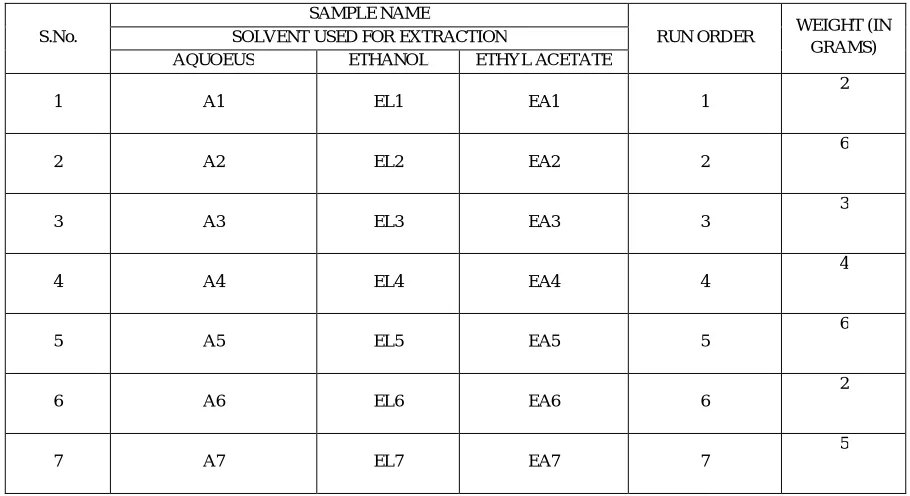
Design Expert software is used for calculating the number of runs for extraction. Design–Expert is a statistical software package from Stat-Ease Inc. that is specifically dedicated to performing design of experiments (DOE). Central composite design is selected under response surface model. Response surface methodology(RSM) of single factor i.e. Concentration of plant powder is taken for the study and employed against four responses and the experiment is carried out in 7 runs. Effect of the concentration of plant powder against the responses (Time taken for extraction, final weight of the solvent, number of cycles and yield (%)) are recorded along with antimicrobial activity.
J. Yield of the Extract
The yield of the extracts is calculated by using the formula
Total mass of extract
Total extract yield (%) = --- × 100 Total mass of sample
K. Antimicrobial Activity
[image:4.612.77.516.355.462.2]1311
[image:5.612.78.533.96.344.2]©IJRASET (UGC Approved Journal): All Rights are Reserved L. Nomenclature of the Samples
Table 1: Nomenclature of The Samples And Experimental Runs
S.No.
SAMPLE NAME
RUN ORDER WEIGHT (IN
GRAMS) SOLVENT USED FOR EXTRACTION
AQUOEUS ETHANOL ETHYL ACETATE
1 A1 EL1 EA1 1
2
2 A2 EL2 EA2 2
6
3 A3 EL3 EA3 3
3
4 A4 EL4 EA4 4
4
5 A5 EL5 EA5 5
6
6 A6 EL6 EA6 6
2
7 A7 EL7 EA7 7
5
III.RESULTSANDDISCUSSION
A. Preparation of Plant Extract- Time Taken
Table 2 Preparation Of Plant Extract- Time Taken
S.No. Samples Run Order Concentration of plant
powder (grams)
Time taken for extraction (minutes)
1
A1
1 2
107
EL1 85
EA1 49
2
A2
2 6
212
EL2 181
EA2 82
3
A3
3 3
157
EL3 117
EA3 61
4
A4
4 4
154
EL4 209
EA4 80
5
A5
5 6
160
EL5 160
EA5 65
6
A6
6 2
84
EL6 116
EA6 63
7
A7
7 5
159
EL7 149
1312
[image:6.612.147.495.74.271.2]©IJRASET (UGC Approved Journal): All Rights are Reserved
Fig 4. Concentration of plant powder Vs Time – Aqueous, Ethanol and Ethyl acetate extracts- Design Expert Software
It is clear from the table that majority of samples in 6g concentrations has taken maximum time for extraction whereas majority of samples in 2g concentrations has taken minimum time for extraction. It is also proved from the runs that time increases as the weight of the plant powder increase. It is found that A2 sample (6g concentration), EL4 sample(4g concentration) and EA7 sample (5g concentration)has taken a maximum time of 212 minutes, 209 minutes and 87 minutes respectively among Aqueous, ethanol and ethyl acetate solvents used for extraction. The graphs from the software also proved there is a positive correlation of 0.847, 0.706 and 0.674 found between concentration of plant powder and time taken for extraction using aqueous, ethanol and ethyl acetate solvents respectively.
B. Preparation of Plant Extract- Number of Cycles
TABLE 3 PREPARATION OF PLANT EXTRACT- NUMBER OF CYCLES
S.No. Samples Run Order Concentration of plant
powder (grams)
No. of cycles
1
A1
1 2
7
EL1 12
EA1 3
2
A2
2 6
7
EL2 11
EA2 7
3
A3
3 3
5
EL3 16
EA3 7
4
A4
4 4
6
EL4 9
EA4 9
5
A5
5 6
8
EL5 6
EA5 9
6
A6
6 2
7
EL6 5
EA6 3
7
A7
7 5
4
EL7 10
[image:6.612.97.516.429.731.2]1313
©IJRASET (UGC Approved Journal): All Rights are Reserved
Fig. 5. Concentration of plant powder Vs Number of cycles – Aqueous and Ethyl acetate extracts- Design Expert Software
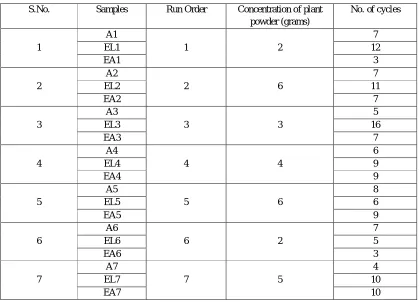
The results showed that the weight of the plant powder didn’t impart any influence on the number of cycles in extraction using aqueous and ethanol solvents. It is found that the extraction using ethanol has taken maximum number of cycles compared to the others. There is a positive correlation of 0.070 and 0.776 found between concentration of plant powder and number of cycles for extraction using aqueous and ethyl acetate solvents.
C. Preparation of Plant Extract- Final Weight of the Extract
TABLE 4 PREPARATION OF PLANT EXTRACT- FINAL WEIGHT OF THE EXTRACT
S.No. Samples Run Order Concentration of
plant powder (grams)
Initial weight (ml)
Final weight (ml)
1
A1
1 2
200
155
EL1 185
EA1 180
2
A2
2 6
136
EL2 180
EA2 160
3
A3
3 3
160
EL3 182
EA3 170
4
A4
4 4
175
EL4 185
EA4 170
5
A5
5 6
163
EL5 170
EA5 176
6
A6
6 2
185
EL6 179
EA6 170
7
A7
7 5
162
EL7 178
EA7 168
1314
©IJRASET (UGC Approved Journal): All Rights are Reserved
TABLE 5 PREPARATION OF PLANT EXTRACT-YIELD OF THE EXTRACT
S.No. Samples Run Order Concentration of plant powder
(grams)
Yield (%)
1
A1
1 2
77.5
EL1 92
EA1 90
2
A2
2 6
68
EL2 90
EA2 80
3
A3
3 3
80
EL3 91
EA3 85
4
A4
4 4
87.5
EL4 92
EA4 85
5
A5
5 6
81.5
EL5 85
EA5 88
6
A6
6 2
92.5
EL6 89.5
EA6 85
7
A7
7 5
81
EL7 89
EA7 84
It is found that the samples extracted using ethanol showed good yield compared to the others. It is found that A6 sample (2g concentration), EL1 (2g concentration) & EL4 (4g concentration) samples and EA1 sample (2g concentration) has showed maximum yield of 92.5 %, 92% and 90% respectively.
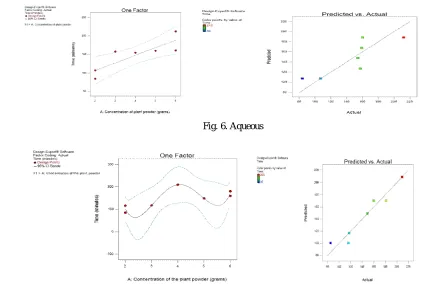
E. Preparation of Aqueous Plant Extract-One Factor Graph and Predicted Vs Actual Graph
[image:8.612.108.503.92.367.2]
Fig. 6. Aqueous
[image:8.612.109.506.93.367.2] [image:8.612.78.503.435.719.2]1315
[image:9.612.96.498.149.470.2]©IJRASET (UGC Approved Journal): All Rights are Reserved
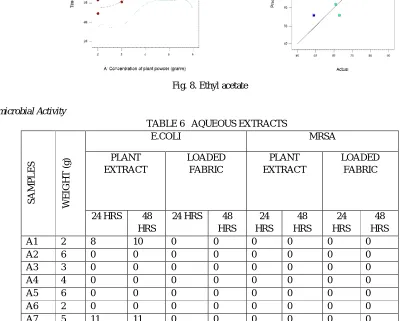
Fig. 8. Ethyl acetate
F. Antimicrobial Activity
TABLE 6 AQUEOUS EXTRACTS
S A MP L E S W E IG H T ( g )
E.COLI MRSA
PLANT EXTRACT LOADED FABRIC PLANT EXTRACT LOADED FABRIC
24 HRS 48
HRS
24 HRS 48
HRS 24 HRS 48 HRS 24 HRS 48 HRS
A1 2 8 10 0 0 0 0 0 0
A2 6 0 0 0 0 0 0 0 0
A3 3 0 0 0 0 0 0 0 0
A4 4 0 0 0 0 0 0 0 0
A5 6 0 0 0 0 0 0 0 0
A6 2 0 0 0 0 0 0 0 0
A7 5 11 11 0 0 0 0 0 0
The antimicrobial activity against E-coli was found only in A1(2g concentration) and A7 (5g concentration) plant extracts with 10mm and 11mm (after 48 hours) zone of inhibition respectively. It is clear that no other samples showed antimicrobial activity against both the bacteria in both plant extracts and loaded fabrics.
TABLE 7 ETHANOLIC EXTRACTS
S A MP L E S W E IG H T ( g
) E.COLI MRSA
PLANT EXTRACT LOADED FABRIC PLANT EXTRACT LOADED FABRIC
24 HRS 48
HRS
24 HRS 48
HRS 24 HRS 48 HRS 24 HRS 48 HRS
EL1 2 0 0 0 1 0 0 0 1
EL2 6 0 5 7 18 0 9 7 22
EL3 3 0 2 0 6 0 1 0 5
EL4 4 0 3 0 8 0 1 0 7
EL5 6 0 6 9 17 0 11 9 25
EL6 2 0 0 0 3 0 0 0 3
EL7 5 0 4 0 6 0 4 0 6
1316
©IJRASET (UGC Approved Journal): All Rights are Reserved
S
A
MP
L
E
S
W
E
IG
H
T
(
g
)
E.COLI MRSA
PLANT EXTRACT
LOADED FABRIC
PLANT EXTRACT
LOADED FABRIC
24 HRS 48
HRS
24 HRS 48
HRS 24 HRS
48 HRS
24 HRS
48 HRS
EA1 2 0 0 0 0 0 0 0 0
EA2 6 0 1 3 7 0 5 7 18
EA3 3 0 0 0 6 0 0 0 4
EA4 4 0 0 0 7 0 0 0 6
EA5 6 0 3 5 9 0 5 6 14
EA6 2 0 0 0 3 0 0 0 0
EA7 5 0 0 0 6 0 2 0 3
It is found that EA2 and EA5 samples (6g concentration) exhibit larger diameter of zone of inhibition in both the plant extracts and loaded fabrics against both the bacterial strains.
IV.CONCLUSION
The results of the present investigation showed the detailed procedure for the extraction of Wrightia tinctoria leaf extract, a plant that shelters greater medicinal potential along with the experimental runs carried out for extraction. The study explored the results with respect to the variation in the weight of the plant powder. It is found that the ethanolic leaf extracts of Wrightia tinctoria have good antimicrobial activity against E.Coli and MRSA followed by ethyl acetate and aqueous leaf extracts. The results are found to be good in all the aspects in the higher concentration of the plant powder (6g).
REFERENCES
[1] Saleh AI, Mohammad Al-Dosari S, Abdul M, Alsheikh M, Maged Abdel-Kader S. Evaluation of the Hepatoprotective Effect of Fumaria parviflora and
Momordica balsamina from Saudi Folk Medicine Against Experimentally Induced Liver Injury in Rats. Res J Med Plants; 3(1):Pp.9-15, 2009.
[2] Abhimanyu Sharma; Asmita Gupta; Sakshi Singh; Amla Batra, J. Chem. Pharm. Res., 2(5):Pp.327-333,2010.
[3] K. R. Kirtikar and R. D. Basu, Indian Medicinal Plants, 2nd Ed., Dehradun, International Book Distributors, Pp. 2187-2188,1981.
[4] Koneru A, Satyanrayana S, Mukkanti K, Khan KA and Kumar KP. Protective activity of hab-e-jund a unani formulation against convulsions in mice.
Pharmacologyonline., 3:Pp. 724-731, 2009.
[5] Nadkarni KM. Indian materia medica. Bombay: Popular Prakashan; P. 1296, 1976.
[6] Satyajit D.Sarkar, Zahid Latif, Alexander I.Gray, Natural products isolation, II edition, Humana press, Totowa, New Jersey, Pp.33, 327, 2006.
[7] Douglas C.Montgomery , Design and Analysis of Experiments, Ninth Edition, John Wiley and Sons,P.11, 2017.