Post-print version: Au-Yong, C. P., Ali, A. S., & Ahmad, F. (2016). Relationship between Predetermined Maintenance Interval and Maintenance Performance. Applied Mechanics and Materials, 845, 305-310.
http://www.scientific.net/AMM.845.305
Relationship between Predetermined Maintenance Interval and
Maintenance Performance
Cheong Peng Au-Yong
a *,
Azlan Shah Ali
band Faizah Ahmad
cFaculty of Built Environment, University of Malaya, 50603 Kuala Lumpur, Malaysia
a
[email protected], [email protected], [email protected]
Keywords: scheduled maintenance; preventive maintenance; maintenance interval; maintenance performance
Abstract. Currently, lack of preventive measure is the problem that implicates poor maintenance outcome. Scheduled maintenance is claimed as a maintenance strategy to tackle the problem. However, the effectiveness of scheduled maintenance can be greatly influenced by the length of predetermined maintenance interval. Thus, this paper aims to study the relationship between length of predetermined maintenance interval and maintenance performance. The literature review identifies the length of predetermined maintenance interval as an importance characteristic of scheduled maintenance strategy. A quantitative approach is adopted and carried out through questionnaire survey. Subsequently, descriptive analysis and correlation analysis are used to analyse the collected data. Then, research result demonstrates that the length of predetermined maintenance interval is significantly correlated to the maintenance performance. The length of predetermined maintenance interval must be considered in maintenance planning and execution. The research recommends continuous monitoring or regular inspection of building systems and components to identify their condition and update the length of predetermined maintenance interval regularly. Consequently, the effective maintenance execution helps to avoid systems failure occurs and optimises maintenance performance.
Introduction
In Malaysia, ineffective planning of maintenance strategies and low service quality are the issues of poor maintenance management [1,2]. Public always neglects the importance of building maintenance as a result of the massive costs required for maintenance operations [3]. Many of the buildings implement reactive maintenance strategy, which perform repair works only after failure occurs. Indeed, lack of knowledge about the maintenance strategies, inadequate performance standard, lack of building performance monitoring data, as well as failure to provide appropriate advice on design and planning based on overall performance are the factors that lead to the issues.
Explicitly, lack of preventive measure is currently the problem that implicates poor maintenance outcome. Whereby, numerous researches introduced and recommended the scheduled maintenance as a strategy to tackle the issues [4-6]. However, the effectiveness of the maintenance strategy can be jeopardised by the inappropriate or inaccurate routine of inspection and maintenance [7-10]. Long interval between the maintenance tasks leads to the growing of deterioration rate and hence affects the efficiency of building and its systems [11]. Oppositely, often interruption of the building system or temporary disabling the system for part replacement and system testing may affect the normal operation of the system. [12,13]. Therefore, this paper seeks to study the relationship between length of predetermined maintenance interval and maintenance performance.
Predetermined Interval for Maintenance
estimated [12]. Then, the fixed maintenance interval to replace or overhaul parts or components is established to achieve minimal maintenance expenditure while maximum the performance.
The interval of maintenance activities is vital, as inappropriate predetermined maintenance interval affects the maintenance outcome. Whereby, scheduled maintenance requires an intrusion of the system [12,13]. It can only be back into operation upon completion of the maintenance. In some cases, often intrusion of the components may affect the effectiveness of the system. Moreover, Narayan [16] revealed that unavailable or delayed action to perform maintenance task at the right time may cause further damages to the system components. It is necessary to apply appropriate preventive maintenance treatments at the right time to extend service life of the components [17]. However, Yang [18] argued that the scheduled maintenance programs might not be able to avoid the risk of failure from occurring in system components before the fixed replacement time. This problem occurs due to unknown condition of the system components.
Direct maintenance cost will increase with a tight maintenance interval; while downtime and remedial cost due to system breakdown may be expensive with a loose maintenance interval [19,20]. According to Bahrami, et al. [21], if scheduled maintenance activity is performed rarely, downtime due to sudden breakdown will increase. On the other hand, if scheduled maintenance work is performed too frequently, downtime due to maintenance interruptions will increase. Moghaddam and Usher [22] further explained that frequent maintenance or replacement enhances the reliability of a system, but it is costly at the same time. Thus, it is advisable to obtain an optimal maintenance interval that minimises the cost of maintenance tasks [23].
A balance between direct maintenance cost and downtime maintenance cost is necessary to be obtained, as it influences the expenditure on building maintenance. Meanwhile, a compromise between the downtime due to maintenance interruptions and sudden breakdown is required [21]. In order to achieve the balance and resolve the problem of under-maintaining or over-maintaining of systems, an adequate maintenance interval must be identified and performed [8]. For example,
Pascual, et al. [24] demonstrated the maintenance interval as one of the variables in decision making model to enhance maintenance performance and maximise profit of core business.
Maintenance Performance
Amaratunga and Baldry [25] stated that the development of performance measurement in management is to improve quality and service, as well as meeting cost parameters. Measurement of maintenance performance is an assessment that helps to identify the pros and cons of the maintenance activities. Besides that, the result of performance measurement indicates the effectiveness of existing strategy. Subsequently, the management team is able to plan and make appropriate decision for future maintenance strategy.
The measurement of performance indicates the level of success or failure in terms of schedule, cost and functionality [26,27]. Groote [28] further explained that the measurement of maintenance performance should not only focus on quantifiable aspect, but the quality of maintenance works as well. Salonen and Deleryd [29] also argued that maintenance management should not only consider about the cost and budget, impact of poor quality would cost even more in most circumstances. Thus, maintenance performance is indicated by time, cost and quality [30,31]. This study measures the maintenance performance in terms of the following:
(a) Time variance for maintenance work (b) Cost variance for maintenance work (c) System breakdown rate
(d) Number of complaints received
Research Methodology
respondents who have been or are currently involved in building maintenance management in Klang Valley, Malaysia. Meanwhile, the respondents were required to answer questions based on their experience or involvement in maintenance management for high-rise office buildings. The buildings must have a minimum of seven storeys, which is defined as high-rise building under Uniform Building By-Laws 1984, because the high-rise buildings are usually equipped with more complex systems like HVAC system, lift system, and fire fighting system. In addition, the research studied on those buildings that were more than two years old because the maintenance requirements of new buildings are different from the older buildings. Generally, the maintenance tasks to be implemented for a new building are less compared to old building [32]. Questionnaire survey necessitates a minimum response rate of 30 percent to produce reliable and convincing results [33]. In this research, a total of 300 questionnaires were distributed to the building manager, building executive and supervisor, technician and other maintenance personnel within Klang Valley. Out of 113 responses, 101 were complete and valid for the analysis. The remaining 12 questionnaires were incomplete or invalid for some reasons. Therefore, a response rate of 38 percent was achieved. The demographic profile of respondents is shown in Table 1. 83 percent of the respondents were building managers, executives, and supervisors. They have considerable expertise in the planning and implementation of the maintenance strategy. Commonly, they understand the importance of the criteria of building technicians through organising, coordinating, supervising, and monitoring the technicians in maintenance execution. In addition, 85 percent of the respondents have more than five years working experience in maintenance management (see Table 2). Thus, the collected data were deemed reliable.
Table 1: Demographic profile of the respondents
Position Percentage (N = 101)
Building manager 50
Building executive/ supervisor 33
Building technician 10
Others 7
Table 2: Working experience of the respondents
Working Experience Percentage (N=101)
<6 years 15
6-10 years 49
11-15 years 19
>15 years 17
Findings and Discussion
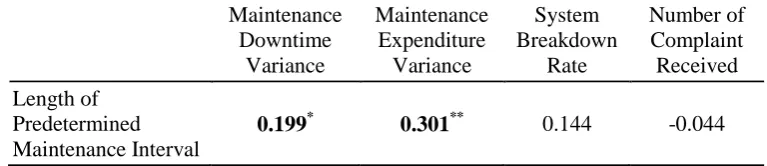
In this research, an associative test using Spearman rank correlation coefficient analysis establishes the relationship between the length of predetermined maintenance interval and maintenance performance as shown in Table 3. This study expects significant relationship between the length of predetermined maintenance interval and maintenance performance in the analysis outcome.
Table 3: Correlation matrix between the length of predetermined maintenance interval and maintenance performance
Maintenance Downtime
Variance
Maintenance Expenditure Variance
System Breakdown
Rate
Number of Complaint Received Length of
Predetermined Maintenance Interval
0.199* 0.301** 0.144 -0.044
**
. Correlation is significant at the 0.01 level (2-tailed)
*
[image:3.595.104.488.687.770.2]
In the associative test, null hypothesis is rejected at significance level of 0.05. In other words, the probability of error in rejecting the null hypothesis is 5 percent. The null (H0) and alternative (H1)
hypothesis are stated as follow:
H0 – There is no significant correlation between the length of predetermined maintenance
interval and maintenance performance.
H1 – There is significant correlation between the length of predetermined maintenance
interval and maintenance performance.
According to the correlation analysis result shown in Table 3, the length of predetermined maintenance interval is significantly correlated with:
Maintenance downtime variance
Maintenance expenditure variance
The length of predetermined maintenance interval is found to be significantly correlated to the maintenance downtime variance at correlation coefficient of 0.199 (p < 0.05). The analysis result supports the statement of Bahrami, et al. [21], pointing out that if scheduled maintenance is performed rarely, downtime due to sudden breakdown will increase. In fact, the length of fixed maintenance interval must be optimal to ensure that there are no over intrusions to the building systems due to frequent maintenance works, or unwanted failure due to the delay on execution of maintenance works.
Furthermore, the length of fixed maintenance interval is significantly correlated to the maintenance expenditure variance, with correlation coefficient 0.301 (p < 0.01). The correlation analysis result is in line with the statement of Narayan [16], which proved that delay or failure to perform maintenance work at the right time may implicate further damages or defects to the system components. Thus, additional repair and replacement costs are required to restore the system back to its acceptable operation standard. Nevertheless, optimal maintenance interval must be achieved. Although frequent maintenance is able to enhance the quality of a system, it is costly at the same time [22].
Therefore, the result rejects the null hypothesis and accepts the alternative hypothesis. The length of predetermined maintenance interval is a vital aspect to be considered in scheduled maintenance. Planning of accurate predetermined maintenance interval ensures the parts of building systems to be replaced and repaired on time, so that the conditions of building systems stay above the acceptable standard and operate effectively to support the building purpose.
Since Yang [18] argued that the scheduled maintenance programs might not be able to avoid the risk of failure from occurring in system components before the fixed replacement time, advanced preventive action needs to be taken. Continuous monitoring or regular inspection is a proactive recommendation to identify the condition of building systems and components timely [34]. It ensures the planning of accurate maintenance interval prior to failure [35]. Consequently, it improves the effectiveness of scheduled maintenance strategy.
Although the objective of this study is achieved, it is believed that there are more factors influencing the maintenance performance such as the quality of spare parts, knowledge and skill of maintenance personnel. Consequently, further explorative study is required to determine the significant factors that influencing the performance.
Conclusion
and components. For example, the maintenance personnel should frequently review the length of predetermined maintenance interval based on the monitoring or inspection outputs. The recommendation may further enhance the effectiveness of scheduled maintenance by updating the maintenance interval to avoid failures of the building systems and components occur.
References
[1] S.N. Kamaruzzaman, E.M.A. Zawawi, Development of Facilities Management in Malaysia, Journal of Facilities Management 8 (1) (2010) 75-81.
[2] N. Ruslan, Campus Facilities Management Experience, National Asset and Facilities Management (NAFAM) Convention, National Asset and Facility Management Development, 13 August, Kuala Lumpur, Malaysia, 2007.
[3] O.A. Lateef, Building Maintenance Management in Malaysia, Journal of Building Appraisal 4 (3) (2008) 207-214.
[4] C.P. Au-Yong, A.S. Ali, F. Ahmad, Office Building Maintenance: Cost Prediction Model, Gradevinar 65 (9) (2013) 803-809.
[5] I. Flores-Colen, J. De Brito, A Systematic Approach for Maintenance Budgeting of Buildings Facades Based on Predictive and Preventive Strategies, Construction and Building Materials 24 (9) (2010) 1718-1729.
[6] A.M. Forster, B. Kayan, Maintenance for Historic Buildings: A Current Perspective, Structural Survey 27 (3) (2009) 210-229.
[7] D.J. Edward, G.D. Holt, F.C. Harris, Predictive Maintenance Techniques and Their Relevance to Construction Plant, Journal of Quality in Maintenance Engineering 4 (1) (1998) 25-37.
[8] M.C. Eti, S.O.T. Ogaji, S.D. Probert, Development and Implementation of Preventive-Maintenance Practices in Nigerian Industries, Applied Energy 83 (10) (2006) 1163-1179.
[9] A.A. Irigaray, E. Gilabert, Ubiquitous Computing for Dynamic Condition-Based Maintenance, Journal of Quality in Maintenance Engineering 15 (2) (2009) 151-166.
[10] S. Wu, D. Clements-Croome, V. Fairey, B. Albany, J. Sidhu, D. Desmond, K. Neale, Reliability in the Whole Life Cycle of Building Systems, Engineering, Construction and Architectural Management 13 (2) (2006) 136-153.
[11] P.V. Paulo, F. Branco, J. de Brito, BuildingsLife: a building management system, Structure and Infrastructure Engineering 10 (3) (2014) 388-397.
[12] L. Swanson, Linking Maintenance Strategies to Performance, International Journal of Production Economics 70 (2001) 237-244.
[13] A.H.C. Tsang, Condition-Based Maintenance: Tools and Decision Making Journal of Quality in Maintenance Engineering 1 (3) (1995) 3-17.
[14] A.K.S. Jardine, D. Lin, D. Banjevic, A Review on Machinery Diagnostic and Prognostics Implementing Condition-Based Maintenance, Mechanical Systems and Signal Processing 20 (2006) 1483-1510.
[15] L. Mann, A. Saxena, G.M. Knapp, Statistical-Based or Condition-Based Preventive Maintenance?, Journal of Quality in Maintenance Engineering 1 (1) (1995) 46-59.
[16] V. Narayan, Effective Maintenance Management: Risk and Reliability Strategies for Optimizing Performance, Industrial Press Inc, New York, 2003.
[17] D.-H. Chen, D.-F. Lin, H.-L. Luo, Effectiveness of Preventative Maintenance Treatments Using Fourteen SPS-3 Sites in Texas, Journal of Performance of Constructed Facilities 17 (3) (2003) 136-143.
[18] S.K. Yang, A Condition-Based Preventive Maintenance Arrangement for Thermal Power Plants, Electric Power Systems Research 72 (2004) 49-62.
[19] C. Chareonsuk, N. Nagarur, M.T. Tabycanon, A Multicriteria Approach to the Selection of Preventive Maintenance Intervals, International Journal of Production Economics 49 (1) (1997) 55-64.
[21] G.K. Bahrami, J.W.H. Price, J. Mathew, The Constant-Interval Replacement Model for Preventive Maintenance: A New Perspective, International Journal of Quality & Reliability Management 17 (8) (1999) 822-838.
[22] K.S. Moghaddam, J.S. Usher, Optimal Preventive Maintenance and Replacement Schedules with Variable Improvement Factor, Journal of Quality in Maintenance Engineering 16 (3) (2010) 271-287.
[23] D. Pandey, M.S. Kulkarni, P. Vrat, A Model for Optimal Maintenance Interval Incorporating the Cost of Rejections in Manufacturing, Journal of Advances in Management Research 7 (2) (2010) 219-232.
[24] R. Pascual, V. Meruane, P.A. Rey, On the Effect of Downtime Costs and Budget Constraint on Preventive and Replacement Policies, Reliability Engineering & System Safety 93 (1) (2008) 144-151.
[25] D. Amaratunga, D. Baldry, Moving from Performance Measurement to Performance Management, Facilities 20 (5/6) (2002) 217-223.
[26] J. Johnson, Choas: The Dollar Drain of IT Project Failures, Application Development Trend 2 (1995) 41-47.
[27] A.C. Sidwell, Project Management: Dynamics and Performance, Journal of Construction Management and Economics 8 (1990) 159-178.
[28] P.D. Groote, Maintenance Performance Analysis: A Practical Approach, Journal of Quality in Maintenance Engineering 1 (2) (1995) 4-24.
[29] A. Salonen, M. Deleryd, Cost of Poor Maintenance: A Concept for Maintenance Performance Improvement, Journal of Quality in Maintenance Engineering 17 (1) (2011) 63-73.
[30] A.S. Ali, Cost Decision Making in Building Maintenance Practice in Malaysia, Journal of Facilities Management 7 (4) (2009) 298-306.
[31] E.W.M. Lam, A.P.C. Chan, D.W.M. Chan, Benchmarking Success of Building Maintenance Projects, Facilities 28 (5/6) (2010) 290-305.
[32] N.E.M. Nik Mat, Performance Measurement of Office Buildings Maintenance Management, Unpublished Dissertation, University of Malaya, 2009.
[33] M. Hoxley, Questionnaire Design and Factor Analysis, in: A. Knight, L. Ruddock (Eds.), Advanced Research Methods in the Built Environment, Blackwell Publishing Ltd, Oxford, 2008. [34] C.P. Au-Yong, A.S. Ali, F. Ahmad, Prediction Cost Maintenance Model of Office Building Based on Condition-Based Maintenance, Eksploatacja i Niezawodnosc - Maintenance and Reliability 16 (2) (2014) 319-324.