Using GSM to Detect Fault in Microcontroller
Based Power Transformer
Nweke Chisom. B1, Iroegbu Chibuisi2, Ogechikanma Ihekweaba3, Ifenkwe Clement. E4
134
Department of Computer Engineering Michael Okpara University of Agriculture, Umudike, Abia state, Nigeria. 2
Department of Electrical/Electronics Engineering Michael Okpara University of Agriculture, Umudike, Abia state, Nigeria.
Abstract- Regular monitoring of the condition of transformer is not only economical, but also adds to increased reliability. In the past, maintenance of transformers was done based on a pre-determined schedule. With the advancement of communication technology now it is possible to receive fault information of transformer through GSM technology. This paper presents the implementation of Global Systems for Mobile Communication (GSM) in detecting fault in microcontroller based power transformer. The design was achieved with microcontroller and other integrated circuit. The microcontroller thus monitors the phases of the distribution lines from the transformer for power failure, over-voltage, under-voltage and total power outage. At fault detection, the system will automatically send a notification message to the power station management, about the conditions of the transformer, its location and the transformer site code for easy location and quick response for possible power restoration. Keywords: GSM, Microcontroller, Power, Transformer
I. INTRODUCTION
These days, apart from supporting voice calls Global Systems for Mobile Communication (GSM) can be used to send text messages as well as multimedia messages (that may contain pictures, graphics, animations, etc) [1].It can also be used in monitoring and detecting faults in power transformers especially in developing countries like Nigeria where incessant power outage has being the order of the day. Consumers of electricity in Nigeria, faces serious challenges of unavailability of these basic commodity [2]. At times, the problem is always from the transformer. A transformer is a static device that transfers electrical energy from one circuit to another by electromagnetic induction without the change in frequency. The transformer, which can link circuits with different voltages, has been instrumental in enabling universal use of the alternating current system for transmission and distribution of electrical energy. Various components of power system, like generators, transmission line, distribution networks and finally the loads, can be operated at their most suited voltage levels. Fault of a distribution line transformer may leave thousands of homes without, water, heating and lighting and light.
There are different levels of faults in a transformer; the internal fault is equally divided into two, the internal short circuit faults and internal incipient faults. The internal short circuit faults are meanly caused by turn-to-turn short circuits or turn-to-earth short circuits in the transformer windings. The internal incipient fault develops over time as the insulators of the transformer deteriorate. The factors capable of causing transformer failure and accelerated deterioration are as follows; operating environment, load current, short circuits, lightening and switching surges, operating environment which could be, temperature, wind, rain, pollution, vibration effect, sound and material fatigue etc. Presently, failed transformers have to be reported by people from that community to a local office of the electric power distribution company to ensure restoration of the failed transformer which may take whole lots of time.
Sequel to the importance of transformer, it becomes imperative to develop a system that will notify the power station management about a power failure on a transformer in a particular area and the possible fault or condition of the transformer for quick restoration of power in the area.
microcontroller, comparators, Schmitt trigger inverter gate and GSM module. The microcontroller monitors the conditions of the input voltage from the comparator. The comparators checks for availability of voltages from the transformer phases and equally compare the voltage to determine the actual voltage level. The output of the comparator is then feed into the Schmitt trigger inverter to produce pure digital output for the microcontroller. The global System for Mobile Communication (GSM) module sends out message to the personnel when a decision is taking by the microcontroller.
II. DESIGN METHODOLOGY
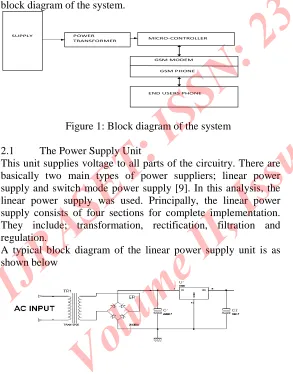
[image:3.612.19.312.317.691.2]The system consists of a Power supply, Power transformer, Micro-controller, GSM Modem and Phone. Figure1 shows the block diagram of the system.
Figure 1: Block diagram of the system
2.1 The Power Supply Unit
This unit supplies voltage to all parts of the circuitry. There are basically two main types of power suppliers; linear power supply and switch mode power supply [9]. In this analysis, the linear power supply was used. Principally, the linear power supply consists of four sections for complete implementation. They include; transformation, rectification, filtration and regulation.
A typical block diagram of the linear power supply unit is as shown below
Figure 2: The Power Supply Unit
2.2 The Microcontroller
Microcontrollers are computers that are designed to carry out a specific function. They are embedded in other computer or machine. They carry out their functions by taking inputs from the devices they are incorporated into. They have the ability of turning the appliances ON and OFF based on the SMS sent to the phone connected to the microcontroller [4].
In this design, a PIC16F877A micro-controller is employed. It comes in a 40-pin dual in-line package (DIP) with internal peripherals. The 40 pins make it easier to use the peripherals as the functions are spread out over the pins. Figure 2 shows the PIC16F877A pin diagram.
Figure3: Micro-controller
2.3 GSM Module
Global system for mobile communication (GSM) is a digital mobile telephony system. GSM digitizes and compresses data, then sends it down through a channel with two other streams of user data, each in its own time slot. The GSM module communicates with the microcontroller through Universal asynchronous receiver and transmitter (UART) or universal synchronous asynchronous receiver transmitter (USART). To communicate over UART or USART, we just need three basic signals which are namely, RXD (receive), TXD (transmit), GND (common ground) [5]. The (TxD serial port) of microcontroller is connected with (TxD) of the GSM Modem while receive signal of microcontroller (RxD serial port) is connected with receive signal (RxD) of serial interface of GSM Modem. GSM uses cellular networks, which means that mobile phones connect to it by searching for cells in the instantaneous MICRO-CONTROLLER
GSM MODEM
SUPPLY POWER
TRANSFORMER
environs. GSM networks operate within the range of 900 MHz to 1800 MHz bands. Some countries in the Africa (including Nigeria) use the 850 MHz and 1900 MHz bands because the 900 and 1800 MHz frequency bands were already allocated [6].
III. SYSTEM HARDWARE DESIGN AND DEVELOPMENT
The microcontroller checks for the voltage sensor outputs status and compares the voltage levels for over-voltage and under-voltage to take decisions when not in conformity to the defined status in the microcontroller program. The decision includes sending an appropriate message of the power transformer conditions through GSM, including the power transformer location, transformer number or ID, the problem. Eg (Michael Okpara University of Agriculture Umudike, power transformer 2, phase 3 has dropped).
Figure4: Circuit diagram of the System
3.1. Principle of Operation of the Designed Circuit.
The main 220 ac voltage source is connected to the transformer which steps down the 220v to 12 ac volts. But a DC volt is
required; hence the need for rectification and a bridge diode used. The output of the bridge diode is connected to a capacitor to remove the ripples in the signal. The stable 12v is connected to the DC terminals of all the 10 relays which require the minimum of 9v for its electromagnet to be energized and the same 12v is also connected to a regulator that produces a constant output of 5v for the microcontroller. The microcontroller is programmed to trigger the relay into the action based on its output i.e. either low or high. The programming event was such that the microcontroller reads the SMS from the phone; if the command specify ON for a particular device the microcontroller will give a high output for the relay switching the device and if the acknowledgement is high the microcontroller will send message about the status of the microcontroller output to the phone that sends message to the phone connected to the microcontroller. These command SMS alert personnel of the system of a fault. For an example, Michael okpara University of Agriculture umudike, power transformer 2, phase 3 has dropped.
IV. SYSTEM SOFTWARE DEVELOPMENT
The software algorithm approach of this system development is in a way that the system continuously monitors all the transformer phases through the voltage sensor unit. The system takes decisions if the any of the inputs of the voltage sensor unit, changes state. Assembly language program was used in this system design, this is because of the reliability, fastness, and memory saving, it was assembled using MIDE –ASM51 [7].
V. CONCLUSION
In this paper, we have been able to discuss on how to use GSM to monitor and detect faults in a power transformer. The system provides an alternative and easy means of getting early information on the status of a power transformer for fault detection and total system shutdown or failure for quick response and possible power restoration.
REFERENCES
[1] Kamal,N.,Ismail,S. S. Abd-ElKader, H. and Sharaf, M.,
Communication System” International Journal of Engineering and Advanced Technology (IJEAT), Volume 2.
[2] Ugwu, H. U. And Nwankwojike, B. N, Ogbonnaya E. J and
Ekoi, E. J. 2012, “Energy and Economic losses due to constant power outages in Nigeria”, Nigerian
Journal of Technology, Vol. 31, No. 2, 181 –188.
[3]Malik, S. H. K., Aihab, K. and Erum, S. (2009). SMS Based Wireless Home Appliance Control System (HACS) for Automating Appliances and Security. Issues in Informing Science and Information Technology, 6, 887-894.
[4] Orukpe, P. E. and Adesemowo A, 2012, “Digital control of external devices through the parallel port of a computer using Visual basic, Nigerian Journal of
Technology, Vol. 31, No. 3, pp. 261 –267.
[5] Scourias, J. 1997. “Overview of the Global System for
Mobile Communications”. October 1997.
http://ccnga.uwaterloo.ca/~jscouria/ GSM/index.html.
[6] Pauko, R.R. 2001. Business Data Communication and Networking, Third Edition. Prentice Hall: New York. 365-369.
[7] Leibfried, T, “Online monitors keep transformers in
service”, Computer Applications in Power, IEEE, Volume:11
Issue: 3 , July 1998 Page(s):36 -42.
AUTHORS
Nweke Chisom B. received his B.Sc. degree in Computer Science from
Michael Okpara University of Agriculture, (MOUAU) Umudike, Abia State Nigeria in 2012. His research interests are in the fields of Electronics Design and Embedded Systems, Computer Programming, Microcontroller based System, and Computer Maintenance etc
Iroegbu Chibuisi received his B.Eng. degree in Electrical and Electronics Engineering from Michael Okpara University of Agriculture, (MOUAU) Umudike, Abia State Nigeria in 2010, and currently a Master of Engineering degree scholar in the department of Electronics and Communication Engineering, Michael Okpara University of Agriculture, (MOUAU) Umudike, Abia State Nigeria. He is a member of
International Association of Engineers. His research interests are in the fields of wireless sensor networks, Electronic and Communication Systems design, Security system design, Expert systems and Artificial Intelligence, Design of Microcontroller based systems, Channel coding etc.
Engr. (Mrs) Ogechi Ihekweaba is a lecturer in the department of Computer Engineering, Michael Okpara University Of Agriculture Umudike, Abia State, Nigeria. She holds a Bachelor degree (B.Eng) in Computer Science &
Engineering, a Master’s degree (M.Eng) in Computer
Engineering and also at the verge of completing a Doctorate degree (PhD) in Computer Engineering. Her area of specialization is network security and computational intelligence. She is a COREN registered Engineer and has several publications.