Study on Compressed Stabilized Sand Block
Prof. Milind M. Darade1 , Mr. Shivnath R. Jangid2
1
Assistant Professor, Dept.Of Civil Engg. Dr. D.Y. Patil SOET Pune, Maharashtra, India
2
M.E student Dr. D.Y. Patil SOET Pune,Maharashtra, India
Abstract :The Present Study is deals with the manufacturing and testing of CSSB block as compare to regular clay brick. These blocks are generally manufacture by using different stabilizer and Here the soil will be mixed with suitable proportion of stabilizer such as cement and gypsum. This blocks are made by mixing different proportion of desert sand, stone dust, cement and gypsum as binder material. The percentages of Desert Sand varies from 60%, 65%, 70%, 75%, 80%, 85%, 90%, that of stone dust as 5%, 7.5%, 10%, 12.5%, 15%, 20%, and 25%, cement 5%, 7.5%, 10%, 12.5%, 15%, 20% and gypsum 5%, 10%, 15%, 17.5%, 20%. After mixing all the above mixture and manufacturing block it moves on next step that is tests for Shape and size, Physical Properties, Hardness Test, Soundness Test, Presence of Soluble Salt, Water absorption, Compression and Cost comparison. Its results that the uniform rectangular shape of block size 230X100X75 mm, with density(1835 Kg/cm3), more hard and sound with negligible efflorescence. The average water absorption of brick is 18.61%.The compressive strength of block for Gypsum brick is varies from 1.9 to 4.1Mpa with effective cost Rs. 2.5 to 11 And for Cement brick is 2.8 to 9.6 Mpa with effective cost of Rs. 1.1 to 6.5 As no need of burning the block should be environment friendly. The wastage of material should be negligible as compare to the clay block.
Key Words: Brick by using Desert Sand, Brick by using Stabilizer, CSSB..
I. INTRODUCTION
Sand is an ancient building material that had been used in various works in different ways around the world since thousands of years. A large part of the world’s rural population still lives in earth block buildings. But earth building is not a phenomenon only of the developing world. Many developed countries like France, Australia, and many other European as well as Asian countries, a remarkable percentage (55%) of rural population still prefer to live in earthen buildings (10Kabiraj, Mandal, 2012). structures with sand or locally available raw material will helps in use of natural resources and keep surrounding pollution free. They need less energy to locate at their proper place. Earth buildings avoid deforestation and pollution, and can achieve low energy costs throughout their lifetime in the initial manufacture and construction, in their use as homes, and eventually in their recycling back to the earth. Earth is more time-consuming than conventional design and construction, but for those who are providing their own labour, the time involved in earth construction may be less significant than the money cost of modern materials. But these materials are also good for aesthetically.
A. Compressed Stabilized Sand Block (CSEB)
In daily Construction work, the word brick or block is considered as same terminology. The definition of block Varies according to the country but British Standard BS 3921: 1985 Clay brick defines a brick as “a masonry unit not exceeding 337.5 mm in length, 225 mm in thickness (refer Lateral to as width in one of the standard) or 112.5 mm in height”. But we are going to used the block size as 230mm in length, 100mm in width and 75mm in thickness. CDI (2Compressed Earth Blocks, 1998) defined compressed earth block as “masonry elements principally made of raw earth, which are small in size and which have regular and verified characteristic obtained by the static or dynamic compression of earth in a humid state followed by immediate remoulding”. Even give lighter definition for brick and block as a small masonry unit, lift able with one hand and a large masonry unit lift able with two hands, for the latter. The soil, raw or stabilized, for a compressed sand block is slightly moistened, poured into a steel press (with or without stabilizer) and then compressed either with a manual or motorized press (15M. Zami 2007).
II. SELECTION OF MATERIAL
A. Selection of Soil and stabilizer
construction and broaden potential for its application. So we required a soil which has less water absorption and plasticity. Due to this the there is less shrinkage and swelling in block. Stabilizer used for this brick is Cement and Gypsum
III. PLAN OF PROJECT WORK
A. Collection of Literature
This is important step in project work which provides us over all view of work. Literature includes thesis, books, investigation reports, and research papers. This is helpful in selecting proper type of soil according to its property required for making block and to find out different stabilizer which is good for different types of soil. This also helps to select the machine type and size of block. These literatures are collected from internet, books, seminar reports & project reports.
B. Selection of Material
By considering all the important properties of materials for manufacturing of blocks the materials was selected. Desert sand, Stone dust, Cement and gypsum are consider as raw material for manufacturing of Compressed Stabilized Sand Block.
C. Collection of Material
1) The Desert sand is taken from Road side of local district in Rajasthan. 2) Stone dust is cheaply available material in quarries.
3) Cement is also available from any local shop. 4) Gypsum is purchased from local shop.
D. Machine
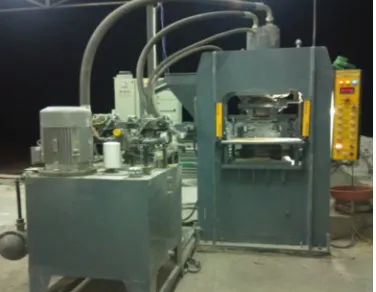
[image:3.612.204.392.424.570.2]Many machines and manufacturing procedure of different block are examined at different places in Jalgaon city and nearby area, like Khotenagar, V- sector and F- sector of MIDC, Turkheda. Out of these, a Hydraulic pressure of MN Bricks Industries, serve no 68, near Bhagirath cotton mill, Turkheda, Jalgaon was chosen. This machine can impart pressure of 3 tons and manufacture one block at a time. The machine is an indigenous type, made by PERFECT hydraulic machine company. This is semi-automatic machine having speed of production of block from 3000 in a 8 hr ship.
Fig. 1 Hydraulic Compression Machine
E. Mixing and Batching
In batching process the content of stabilizer are varied from 5% to 20% with stone dust vary from 5 to 25%. This block is kept as proportion of Desert Sand-Stone Dust-Cement (Type A) and Desert Sand-Stone Dust-Gypsum (Type B). This all materials according to their proportions are kept in bag and utilize at time of dry mixing process.
F. Tasting
G. Drying
After making block, it place in shed for drying process because crack are take place on block. This crack arises due to rapid loss of water from block and quick shrinkage.
H. Testing
The CSEB bricks prepared in factory were brought to laboratory for testing of Shape and size, Physical Properties, Hardness Test, Soundness Test, Presence of Soluble Salt, Water absorption, Compression strength (IS Code 1725-1984). Every proportion had Six bricks out of which three were tested for compressive strength in Compression Testing Machine (CTM) and Remaining Shape and size, Physical Properties, Hardness Test, Soundness Test, Presence of Soluble Salt and water absorption test. The specimen was placed in CTM with flat faces horizontal and dry sand filled face facing upwards between two 3 ply plywood sheets each of 3 mm thickness and carefully centered between plates of the testing machine. Load was applied axially at a uniform rate of 14 N/mm (140 Kg/cm2) per minute till failure occurs and the maximum load at failure was noted. The load at failure was the maximum load at which the specimen failed to produce any further increase in the indicator reading on the testing machine.
IV. PROCEDURE OF CASTING BLOCK
A. Batching
The batching is defined as calculation of amount Weighting and initial blending of raw materials prior to forming operation is known as Batching.
1) Desert Sand, Stone Dust and Cement: Sample
number
Desert Sand(%) Stone Dust(%)
Cement (%) Sample Number
Desert Sand(%)
Stone Dust(%)
Cement (%)
1 90 5 5 7 75 15 10
2 85 7.5 7.5 8 70 15 15
3 80 10 10 9 70 20 10
4 75 12.5 12.5 10 65 20 15
5 70 15 15 11 65 25 10
[image:4.612.114.492.553.677.2]6 60 20 20 12 60 25 15
Table No 1.Various Proportions of Desert Sand with same Proportion of Stone Dust and Cement.
As discussed in above percentage of Stone Dust and Cement are varied from 5% -20% of total weight of mixture for one block. If percentage various above 20% Then it becomes Costly also if we reduce percentage of cement and stone dust it reduces the strength of sand block. In this batch the proportion of different stabilizer (Cement) and filler (Stone Dust) are going to changed. This will be done for the reduction of cost by reducing the percentage of cement in mixture. The percentage of Stone dust is varied from 10% to 25% and Cement from 10% to 15%.
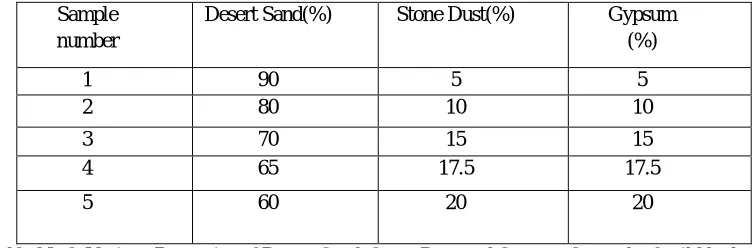
2) Desert Sand, Stone Dust and Gypsum (B): As same the percentage of gypsum should not be more than 20% because it increases the cost of production of block.
Sample number
Desert Sand(%) Stone Dust(%) Gypsum (%)
1 90 5 5
2 80 10 10
3 70 15 15
4 65 17.5 17.5
5 60 20 20
Table No 3. Various Properties of Desert Sand, Stone Dust and Gypsum Strength of soil block.
bricks manufactured in Jalgaon industries was studied for their compressive strength.
B. Wet Mixing
It is most essential procedure for proper casting and homogeneous shape of block. It is much better to add little water directly or by sprinkling at time of mixing. Then after mix the mixture with suitable tool such as spades, hoe or shovels on hard surface. A little more water is added and whole mixture is turned over and over again. The procedure is repeated till advisable quantity of water is added for wet mixing. Wet mixing is easy in case of mixture of Desert sand, stone dust cement and gypsum because they are non-cohesive material. Hand mixing is also preferred of less quantity of mixture, but for large quantity to obtained homogeneous mixture machine or pan mixing is used. When Gypsum is used as stabilizer, it is suitable to allow the mix to stand for a short period before moulding for better moisture of soil particles with water. However When Cement is used as stabilizer then it is suitable to mould the mix as soon as possible because it gain its strength after wetting by water and it will result poor quality bricks if it sets.
C. Casting
Following are consideration which takes into account while production of compressed stabilized Sand block. 1) Amount and type of stabilizer 2) Type of soil and suitability for production 3) Building standard for quality of brick The procedure of casting is discussed 3.6 Wet mix is compressed by using hydraulic press machine and blocks obtained are kept for drying to gain strength.
Fig.3 Casting of block in Hydraulic Compression Machine and Sample
V. RESULTS AND DISCUSSION
In general sense, a “brick” is standard sized weight bearing building unit. The size, shape and Weight plays significant role in building structure.For efficiency handling and lying, bricks must be made by small and less weighted. As per IS the length of the bricks should be twice the width so that thy allow bricks to be laid bonded in structure which increase stability and strength.The correct bricks for a job can be selected from a choice of colour, surface texture, shape & size, hardness, efflorescence, density, weight, absorption etc.
A. Size and Shape
Following are some geometrical properties which were examined and result obtain are shown below
1) Comparison Between Length Of Different Bricks:-As per IS 1725-1982, Length of convection brick should be 190mm
Chart 1: Average length of Different Brick
0 100 200 300
Gypsum Cement Clay Brick
Length
Types Of Brick Length In mm
Burnt Convection brick 190
BCS +Stone Dust+ Cement 230
[image:6.612.195.416.76.180.2]BCS + Stone Dust + Gypsum 230
Table No.5Length Of Different Bricks
From above result, it is clear that length of CSSB bricks is 230mm which is more than that of convectional burnt bricks 190mm. The increase in length helps in faster construction. If the length of bricks is large number of bricks required for the construction work will be less and the structure will be cost effective.
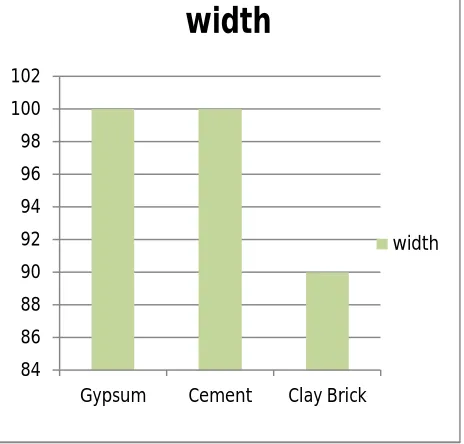
2) Comparison between Width of different Bricks:-As per IS 1725-1982 width of convectional bricks should have 90mm
Chart no. 2Average width of different Brick
Types Of Brick Width In mm
Burnt Convection brick 90
BCS +Stone Dust+ Cement 100
[image:6.612.182.414.255.477.2]BCS + Stone Dust + Gypsum 100
Table No.6Width of Different Bricks
It is seen from graph that bricks made of Brunt clay has less Width of 90mm and bricks made of Desert sand + stone dust + Cement and gypsum has high Width i.e. 100mm. hence it can be concluded that the manufactured CSSB bricks has large width than that of convectional bricks. If the width of bricks is increase the width of wall will increase which will result in good thermal comfort for structure sound proof structure.
84 86 88 90 92 94 96 98 100 102
Gypsum Cement Clay Brick
width
3) Comparison between Height of Different Bricks:-As per IS code 1725-1982 Height of convectional bricks should have 90mm.
Chart No.3Average height of Different Brick
Types Of Brick Height In mm
Burnt Convection brick 60
BCS +Stone Dust+ Cement 75
[image:7.612.130.478.405.740.2]BCS + Stone Dust + Gypsum 75
Table no. 7Height of different brick
B. Physical Properties of Block
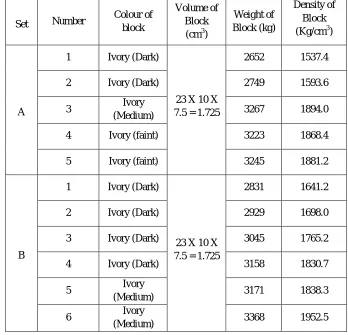
This properties, generally includes colour, volume, weight and density of block. That is the aesthetic appearance of block.
Set Number Colour of block
Volume of Block (cm3)
Weight of Block (kg)
Density of Block (Kg/cm3)
A
1 Ivory (Dark)
23 X 10 X 7.5 = 1.725
2652 1537.4
2 Ivory (Dark) 2749 1593.6
3 Ivory
(Medium) 3267 1894.0
4 Ivory (faint) 3223 1868.4
5 Ivory (faint) 3245 1881.2
B
1 Ivory (Dark)
23 X 10 X 7.5 = 1.725
2831 1641.2
2 Ivory (Dark) 2929 1698.0
3 Ivory (Dark) 3045 1765.2
4 Ivory (Dark) 3158 1830.7
5 Ivory
(Medium) 3171 1838.3
6 Ivory
(Medium) 3368 1952.5
0 20 40 60 80
Gypsum Cement Clay Brick
Height
7 Ivory
(Medium) 3156 1830.0
8 Ivory
(Medium) 3183 1845.2
9 Ivory (faint) 3193 1851.0
10 Ivory (faint) 3473 2013.3
11 Ivory (faint) 3637 2108.4
[image:8.612.135.477.77.238.2]12 Ivory (faint) 3536 2050.0
Table no.8Physical Properties of Block
C. Hardness Test on Block
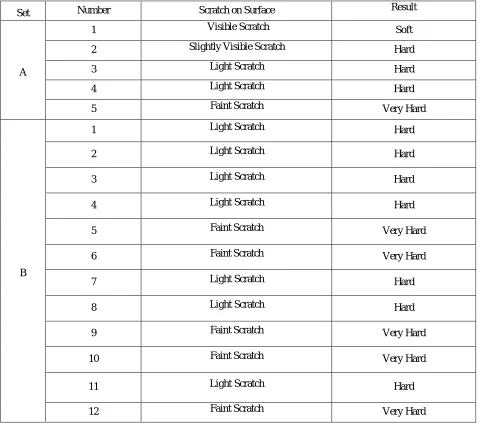
In this test, a scratch is made on brick surface with the help of a finger nail. If no impression is left on the surface, the brick is sufficiently hard.
Set Number Scratch on Surface Result
A
1 Visible Scratch Soft
2 Slightly Visible Scratch Hard
3 Light Scratch Hard
4 Light Scratch Hard
5 Faint Scratch Very Hard
B
1 Light Scratch Hard
2 Light Scratch Hard
3 Light Scratch Hard
4 Light Scratch Hard
5 Faint Scratch Very Hard
6 Faint Scratch Very Hard
7 Light Scratch Hard
8 Light Scratch Hard
9 Faint Scratch Very Hard
10 Faint Scratch Very Hard
11 Light Scratch Hard
12 Faint Scratch Very Hard
[image:8.612.68.548.300.724.2]D. Soundness Test on Block
In this test, the two bricks are taken and they are struck with each other. The bricks should not break and it produced clear ringing sound. Hence the block manufacture should be sound.
E. Presence of Soluble Salts
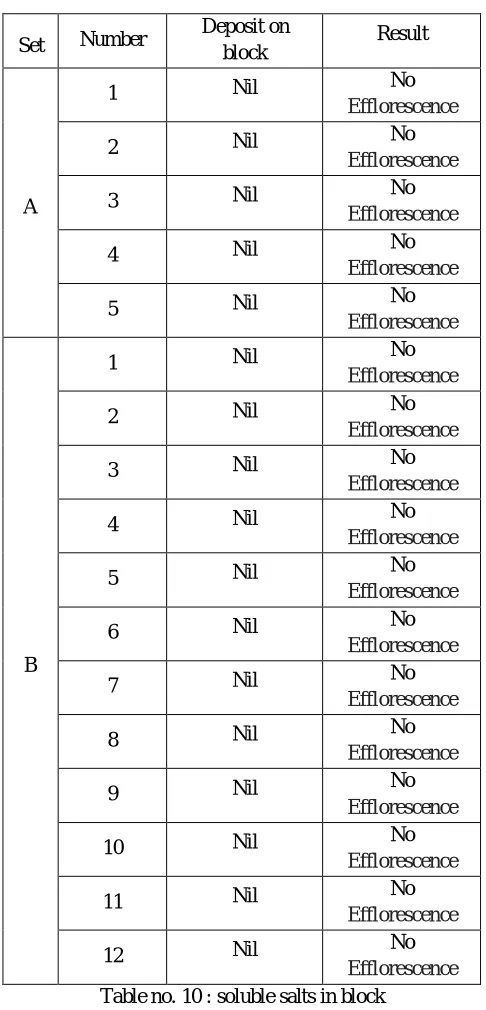
[image:9.612.185.428.158.663.2]The soluble salts, if present in cause efflorescence in brick work. For finding out the presence of soluble salts in a brick, it is immersed in water for 24 hours.
Table no. 10: soluble salts in block
Hence there is no any white or grey patch on block so the efflorescence is not present or blocks are free from salts.
F. Water Absorption Test
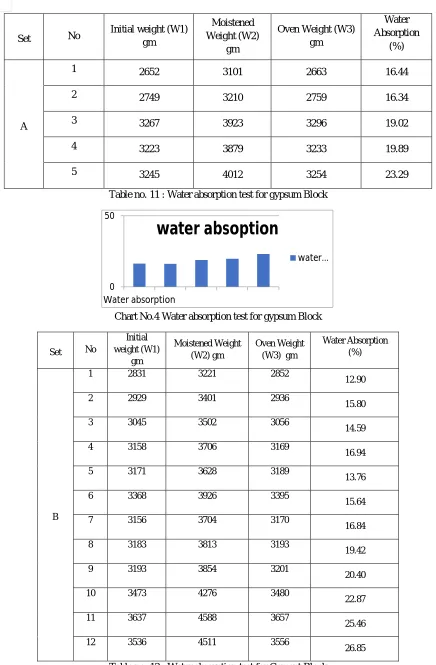
A brick is taken and it is weighed dry. It is then immersed in water for a period of 16 hours. It is weighed again and the difference in weight indicates the amount of water absorbed by the brick. It should not in exceed 20 per cent of weight of dry brick.
Set Number
Deposit on
block Result
A
1 Nil No
Efflorescence
2 Nil No
Efflorescence
3 Nil No
Efflorescence
4 Nil No
Efflorescence
5 Nil No
Efflorescence
B
1 Nil No
Efflorescence
2 Nil No
Efflorescence
3 Nil No
Efflorescence
4 Nil No
Efflorescence
5 Nil No
Efflorescence
6 Nil No
Efflorescence
7 Nil No
Efflorescence
8 Nil No
Efflorescence
9 Nil No
Efflorescence
10 Nil No
Efflorescence
11 Nil No
Efflorescence
12 Nil No
Set No
Initial weight (W1) gm
Moistened Weight (W2)
gm
Oven Weight (W3) gm
Water Absorption
(%)
A
1 2652 3101 2663 16.44
2 2749 3210 2759 16.34
3 3267 3923 3296 19.02
4 3223 3879 3233 19.89
5 3245 4012 3254 23.29
Table no. 11 : Water absorption test for gypsum Block
Chart No.4Water absorption test for gypsum Block
Set No
Initial weight (W1) gm Moistened Weight (W2) gm Oven Weight (W3) gm
Water Absorption (%)
B
1 2831 3221 2852
12.90
2 2929 3401 2936
15.80
3 3045 3502 3056
14.59
4 3158 3706 3169
16.94
5 3171 3628 3189
13.76
6 3368 3926 3395
15.64
7 3156 3704 3170
16.84
8 3183 3813 3193
19.42
9 3193 3854 3201
20.40
10 3473 4276 3480
22.87
11 3637 4588 3657
25.46
12 3536 4511 3556
[image:10.612.88.524.64.729.2]26.85
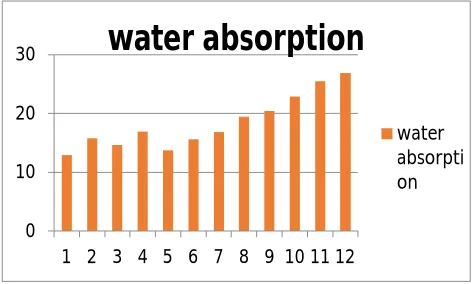
Table no. 12 : Water absorption test for Cement Block
0 50
Water absorption
water absoption
Chart No.5 Water absorption test for Cement Block
G. Compressive Strength Test
The crushing strength of a clay brick is found out by placing it in a compression testing machine. It is pressed till it breaks. As per BIS: 1077-1957, the minimum crushing or compressive strength of bricks is 3.50 N/mm2. The bricks with crushing strength of 7 to 10 N/mm2 are graded as A.
Set Number Load Carried by Block (Kn)
Compressive strength (Mpa)
A
1 81.6 2.3
2 65.8 1.9
3 159.9 4.6
4 364.8 10.6
[image:11.612.188.425.77.219.2]5 144.3 4.1
Table no. 13: Compressive strength of Gypsum Block
Chart No.6 Compressive strength of Gypsum Block
0 10 20 30
1 2 3 4 5 6 7 8 9 10 11 12
water absorption
water absorpti on
0 2 4 6 8 10 12
1 2 3 4 5
compressive strenght
Set Number Load Carried by Block (Kn)
Compressive strength (Mpa)
B
1 88.3 2.5
2 111.3 3.2
3 331 9.6
4 306.13 8.8
5 278.3 8
6 142.6 4.1
7 194.8 5.6
8 215.68 6.2
9 240.03 6.9
10 271.34 7.8
11 300.1 8.6
[image:12.612.191.418.571.692.2]12 288.7 8.3
Table no. 14 : Compressive strength of Cement Block
Chart no 7. Compressive strength of Cement Block
H. Cost Comparison
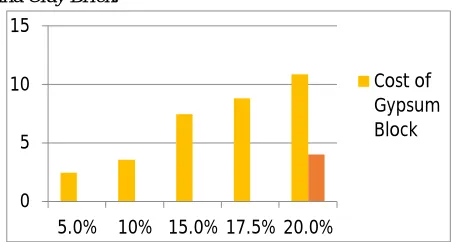
The cost of this block is compared with the conventional clay burnt brick. 1) Compression between Gypsum and Clay Brick:
Chart No.8Cost comparission of gypsum and Clay Brick
0 5 10 15
1 2 3 4 5 6 7 8 9 10 11 12
Compressive strength (Mpa)
Compr essive streng th…
0 5 10 15
5.0% 10% 15.0% 17.5% 20.0%
In this the cost of block is calculated acording to the material used in manufacturing of block. This also depends on the amount of stabilizer used in different sample of bock. As we increses the amount of stabilizer the cost of brick is going to be incresed. The cost of Clay Brick is about 4 Rs per Brick and the CSSB block are economical till the percentage of Gypsum and stone dust is 5% and then after it goes above 4Rs as shown in table.
Types Of Brick Percentage Cost in Rupee
Clay brick --- 4
BCS + Stone
Dust + Gypsum
5 2.453
10 3.575
15 7.44
17.5 8.8
[image:13.612.200.412.130.273.2]20 10.87
Table No 15.Cost of Gypsum and Clay Brick
2) Compression between Cement and Clay Brick:
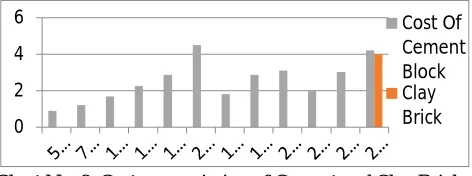
Chart No. 8 Cost comparission of Cement and Clay Brick
In this the cost of block is calculated as it is in cement block. This also depends on the amount of cement used in different sample of bock. As we increses the amount of cement the cost of block is going to be incresed. The cost of Clay Brick is about 4 Rs per Brick and the CSSB block are economical till the percentage of cement and stone dust is 15% and then after it goes above 4 Rs as shown in table.
Types Of Brick Cement Percentage Cost in Rupee
Clay brick --- 4
Desert sand + Stone Dust +
Cement
5% 0.9
7.5% 1.21
10% 1.67
12.5% 2.26
15% 2.87
20% 4.49
10% 1.82
15% 2.86
15% 3.09
10% 2.00
10% 3.02
15% 4.21
Table No 16.Cost of Cement and Clay Brick
0 2 4
6 Cost Of
[image:13.612.188.424.312.400.2]VI. CONCLUSION
The present study was conducted verify the potential of CSSBl. The following conclusion is drawn based on the current investigation:
A. Materials are collected and cost per Kg is calculated.
B. The block of different percentage of stabilizer is manufactured. C. The test results are as follows.
Sr.no. Type of Test Type A Type B
1 Shape Test 230X100X75 230X100X75
2 Physical Test Moderate Density High Density
3 Harness Test Hard Hard
4 Soundness Test Good Good
5 Presence of Sol. Salts Nil Nil
6 Water absorption 19% 18.46%
[image:14.612.104.512.163.327.2]7 Comp. strength 10.6 9.6
Table no. 17: Test Results
D. Water Absorption and Compressive Test & Cost of Block
Type Water abs Comp. strength Cost / Block
Gypsum 19.89 10.6 8.8
Cement 14.59 9.6 1.67
Table no. 18 : Cost results of block
E. As no need of burning the block should be environment friendly.
F. The wastage of material should be negligible as compare to the clay block.
Finally, it concludes that the shape of block will be sharp edge and large size than regular block. The block will be structurally sound, hard and efflorescence is zero. The brick is economical and the wastage of material during manufacturing is negligible. The CSSB is uneconomical after some extent although, such blocks will gives better aesthetic appearance and eco-friendly material
VII. ACKNOWLEDGEMENT
First and foremost, I would like to thank my guide Prof. Milind Darade sir for his guidance and support. I feel grateful for the constant support and guidance extended by him, in completing this project report. Through our many discussions, they helped me to form and solidify ideas.
REFERENCES
[1] ASTM D559-44 Wetting and Drying Test of Compacted Soil- Cement Mixture’ Journal of civil engineering, Bangladesh vol. CE 30,page No.13,2002. [2] Hubert Guillaud, Thierry Jaffory, Pascal Odul, ‘Comprresed stabilized Earth Block: Manual of Design & Construction, vol. II, pg. no. 10, 1985. [3] Indian Standard, specification for ‘ Soil- cement blocks used in general building construction,’ Indian Standards Institution, New Delhi 1725,1960. [4] John Morris and Quintin Booysen, ‘ Earth Construction in africa’ proceedings : Strategies for a sustainable built Environment, Pretoria, 23-25, 2000. [5] Kabiraj.K., Mandal.U.K. ‘ Experimental investigation and feasibility study on stabilized compacted earth block using local resources’ IJCSE vol. 2, p.g.
no. 838, 2012.
[6] K.J. Osinubi, M.A. Oyelakin and A.O. Eberemu ‘ improvement of black cotton soil with ordinary Portland cement- Locust Bean Waste ash blend’ vol. 16, 2011.
[7] Kevan Aurbrey Heathcote ‘An investigation into the Erodibility of earth wall units’ p.g. no. 13, 2002.
[8] M. Sharif Zami & dr. Angela Lee ‘Contemporary earth construction in Urban housing- stabilized or Unstabilized’ School of built environment, university of Salford, U.K. 2007.
[image:14.612.100.508.359.416.2]