Technology (IJRASET)
©IJRASET: All Rights are Reserved
410
On The Contradictory Values of Stresses in the
Area of Contact of Two Parallel Rollers
German Zhuravlev1, Yuri Drobotov2, Andrey Piskunov3
1,2,3
Institute of Mathematics, Mechanics and Computer Sciences named after I. I. Vorovich, Southern Federal University
Abstract— The paper provides explanation of contradiction between the results obtained with analytical and numerical methods for the problem of the maximal shear stresses and their depth in the area of contact of two parallel circular cylinders (rollers). It is claimed that the aforementioned contradiction is usually unreasonably connected with imperfection of the numerical method in theory and practice of contact calculations. It is proved in the analytical way as well as in the numerical one that the main reason for the contradiction to exist is significant misstatement of the role of the curvature of the contact elements by the solutions within the limits of the classical theory.
Keywords— Contact mechanics, curvature, shear stress, elastic cylinder, the depth of the maximal shear stress, finite element
method.
I. INTRODUCTION
It is highly important to increase accuracy of contact calculations for the needs of research work as well as for mechanical engineering. This is why investigation of the reasons for various contradictions between the classical theory and the practice of contact mechanics to exist is truly necessary. The manifestation of the contradiction per se should be interpreted as a signal for detailed exploration of the veritable reason.
Such a methodologically true approach can lead to significant clarification of the contact calculations. For example, the comparative evaluation [1] of the contradictory (and having been considered earlier as the unexplainable ones) results of involute gears’ testing promoted consideration of the curvature of contact elements as a factor, which being poorly considered by the classical theory has led to the contradictions between the latter and experimental data as well as with numerical computations. As a result, an exponential formula has been obtained and approbated to characterize the level of the non-classical influence of the contact elements’ curvature on the stressed state of complex-shaped contact units.
The comparative evaluation [1] has laid the foundation for detecting significant reserves of contact strength of the involute gears and for improving the kinematical principles of gears in general. Thus, for example, highly effective world leading level systems of toothed engagement has been developed [2]. In addition, an effective way for improving contact calculations has been proposed in [1]. It is based on clarifying the effect of contact elements’ curvature, including consideration of the contact area’s localization and the form of the bodies brought into contact.
Particular emphasis is placed in [1] on reasonability of estimating accuracy of the classical solutions (taking into account the curvature of the contact elements) not only while dealing with the contact problems for complex-shaped bodies, but also in the simplest case of the plane problem for bodies of canonical shapes. It is also very popular to attribute arising contradictions (corresponding results are considered, for example, in the paper [3]) to the errors of the numerical method – and the idea to be put forward is that such an approach is unreasonable. This fact is proven [4 – 9] – a rigorous analytical proof is provided in [4, 5, 7, 9] (while a numerical one is in [6, 8]) as a result of investigation of various parameters of the stress-strain state of elastic parallel circular cylinders (rollers) brought into contact.
II. CONTRADICTIONPROBLEM
A. Problem Statement
The principal problem to be considered here is to compare the results of different verifications of the classical solution: a typical one [3] and a set of verifications [4 – 9] within the limits of developing the approach of [1].
The papers [3] and [4 – 9] have much in common. Thus, all of them are devoted to the analysis of the classical analytical solution for the problem of the maximal shear stresses (and their location) in the area of the contact of two steel circular parallel rollers. The papers contain comparison of the results of the Hertz – Belyaev theory with the solution, obtained with the finite element method (FEM). It would not be inappropriate to remark, that Hertz never solved the problem considered in [3] and [6, 7], but M. N. Belyaev’s having solved it in [10] was, actually, the solution known as the classical one. The steel cylinders, which are investigated in the aforementioned papers, are nearly equivalent, i.e. the Young’s modulus E 2 105
Technology (IJRASET)
©IJRASET: All Rights are Reserved
411
ratios considered are almost equal: 0, 3 for [3] and 0, 28 for [6, 7]. Finally, the comparison of the results obtained with FEM is almost similar in [3] and [6, 7].
However, the purposes, research methods and evaluation of the results in [3] and in the papers [6, 7] are fundamentally different. While there are incorrect results of the classical method in [3], the conclusion, opposite to the true one, is unreasonably provided, i.e. it is claimed that the numerical method is incorrect. FEM surely implies certain difficulties in creating an authentic model [13]. But, in fact, there are no reasonable arguments for the alternative solution to be closer to the exact one – at least until all of the aspects, those are needed to be taken into account in numerical simulations, are considered with mathematical precision. Otherwise there is no actually any verification at all. The development of the analytical non-contact method [7] of evaluating the Hertz – Belyaev theory began with elaborating and analyzing the high-precision analytical method [4, 5] for investigating the value of approach of two parallel cylinders’ axes due to the contact. To evaluate the dependence on the radii of the cylinders and the width of the contact area without using the Boussinesq – Cerutti solution, the exact Nikoloz Muskhelishvili solution [14] of the problem of compressing a single cylinder with oppositely directed forces was assumed. The Hertz law of the contact pressure was excluded from the evaluation, so there were possibilities for fully matching the Hertz problem (the conditions of loading) and concentrating the verification on the stress-strain state [4, 7] without simplifying the classical problems with regard to using the Boussinesq – Cerutti solution where the cylinder was substituted with a half-space. To assume the Hertz law of the contact load, the principle of superposition of forces was used.
Relative values max max
z
and max
h b
(where max is the maximal shear stress, while hmax is the depth of max) in the area of the
contact of the elastic circular cylinders are commonly considered to be independent on the curvature of the bodies in contact. They
are also commonly considered to be completely defined with only one parameter b
a of the form of the contact area (Table
Hereinafter a and b are, respectively, the lengths of the major and minor axes of the elliptical contact area, zmax is the maximal contact stress.
The solutions of the Hertz contact problems, as well as the Boussinesq – Cerutti solution assuming substitution of the cylinder with a half-space, are fundamental for the theory [10 – 12]. Table I represents Belyaev’s relations, which are commonly considered to be universal ones [10 – 12]. Also, there are the determining values of the maximal shear stresses and their depth [10 – 12] for the cases of point loading [11, 12] and line loading [10] contact in the Table I. However, Table I is similar to the data of [15] in the informative way, as a typo from the paper [10], which has been repeated by many authors, is excluded (max 0,304zmax for line
loading contact instead of the right value max0,300zmax).
TABLEI
CLASSICAL EVALUATION OF THE MAXIMAL SHEAR STRESSES AND THEIR DEPTH IN THE CONTACT AREA OF ELASTIC CIRCULAR
CYLINDERS
Relations Point loading contact Line loading contact b
a
1 0,95 0,8 0,6 0,2 0,1 0
max
max z
0,31 0,31 0,31 0,32 0,32 0,31 0,300
max
h b
0,50 0,50 0,55 0,62 0,75 0,77 0,786
The difference between the classical results and ones which are obtained in [7] are considered within the present paper on the example of the solution of the plane problem, corresponding to the point loading contact.
B. Analysis
As the relation b 0
Technology (IJRASET)
©IJRASET: All Rights are Reserved
412
the point loading contact, this problem is demonstrative for the analysis of the role of Rc and b.
The research [7] is carried out for the contact of two cylinders – the investigated one with varying its radius Rc and some basic one
of radius Rb const. The values r1, 1, r2 and 2 (Fig. 1) for any calculation point
x y;
are 1 sinp c
L R ; Lp2 Rc
1 cos
; Lpp 2Rccos; Lp3 LppLp2; 1 1 2 arctan p p x L z L ; 2 1
3 arctan p p x L L z
; 1 1
1 sin p x L r
; r2
xLp1
2 Lp3x
2.Fig 1. The investigated cylinder loaded with oppositely directed forces.
According to the solution [7] of the problem of the Hertz contact pressure’s effect on the cylinder, the expressions, respectively, for the normal stresses acting parallel to the axes Ox and Oz (Fig. 1) and for the shear stresses can be written as following:
2 2
1 1 2 2
1 2
sin cos sin cos
2 2 b b c H x p R L d r r
;
3 3 1 2 1 2 cos cos 2 2 b b c H z p R L d r r
;
2 21 1 2 2
1 2
sin cos sin cos
2 b b c H R d r r
,where b is the central angle of the sector of the radius Rc, covering an arc of length bH; H
is pressure, which corresponds tothe Hertz law H
Rc
. When applying these formulas to calculate the shear stresses at points on the z axis (Fig. 1), themaximum shear stresses can be calculated by the following formula [7]:
2
z x
.
There is a comparative analysis shown in Fig. 2, 3 and in the Tables 2, 3 of the results obtained in [7]. Their correspondence to the
classical solution (Table 1) is confirmed only for the parameters, which are approximately bounded with H 2 10 4
c
b
R
. As an
Technology (IJRASET)
©IJRASET: All Rights are Reserved
413
The dependence of deviation of the maximal shear stresses and their location (regarding commonly considered values
max 0,300 zmax
and hmax 0, 786bH) on the relation H
c
b
R (Table III). It is shown in Table III that
H
c
b
R is the criterial parameter
for evaluating the role of Rc for any value of the latter.
Hereinafter let max max z
, % be the deviation of max max
z
from 0,300 and max H h b
, % be the deviation of max
H
h
b
from 0,786. It is
shown in Table II, that for any radius of the base cylinder the values of max max
z
and max
H
h
b
are not constant while the radius of the
investigated cylinder vary.
TABLEII
MAXIMAL SHEAR STRESSES AND THEIR DEPTH IN THE INVESTIGATED CYLINDER LOADED WITH CONTACT PRESSURE
PLANE PROBLEM,zmax =5500МPA
b
R , mm Rc, mm H c b R max max z max H h b max max z
, % max H h b , %
1 0,01 0,1 0,322 0,815 7,5 3,7
0,1 0,092 0,320 0,812 6,8 3,3 1 0,051 0,311 0,799 3,7 1,7 10 0,009 0,302 0,789 0,7 0,3 50 0,002 0,300 0,787 0,2 0,1 100 0,001 0,300 0,787 0,2 0,1 500 0,0002 0,300 0,786 0,1 0 1000 0,0001 0,300 0,786 0,1 0 10 0,01 0,101 0,323 0,815 7,5 3,7
0,1 0,1 0,322 0,815 7,5 3,65 1 0,092 0,320 0,812 6,8 3,3 10 0,051 0,311 0,799 3,7 1,7 50 0,017 0,304 0,791 1,3 0,6 100 0,009 0,302 0,789 0,7 0,3 500 0,002 0,301 0,787 0,2 0,1 1000 0,001 0,300 0,786 0,2 0,1 100 0,01 0,101 0,323 0,815 7,5 3,7 0,1 0,101 0,323 0,815 7,5 3,7
1 0,1 0,322 0,815 7,5 3,7
10 0,092 0,320 0,812 6,8 3,3 50 0,068 0,315 0,804 5,0 2,3 100 0,051 0,311 0,799 3,7 1,7 500 0,017 0,304 0,791 1,3 0,6 1000 0,009 0,302 0,789 0,7 0,3
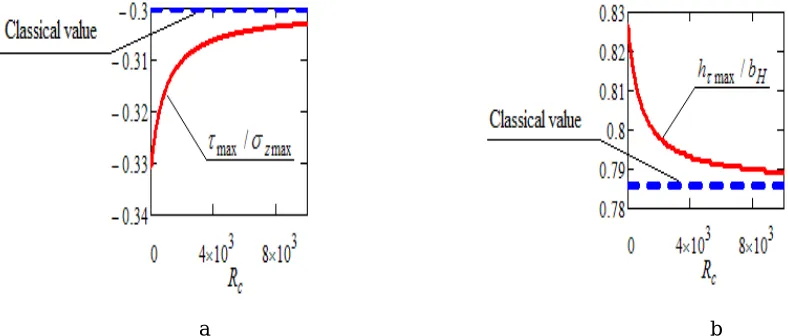
The results of calculations, shown as an example in Fig. 2 and 3, demonstrate that max max
z
and max
H
h
b
are not constant while Rc vary,
and the values of deviation of max max
z
and max
H
h
b
from the data of Table I satisfy the following tendencies:
max max
z
and max
H
h
b
are constant while H c
b
Technology (IJRASET)
©IJRASET: All Rights are Reserved
414
max max
z
and max
H
h
b
as well as the level of their deviation from the classical solution [10] increase while H c
b
R does.
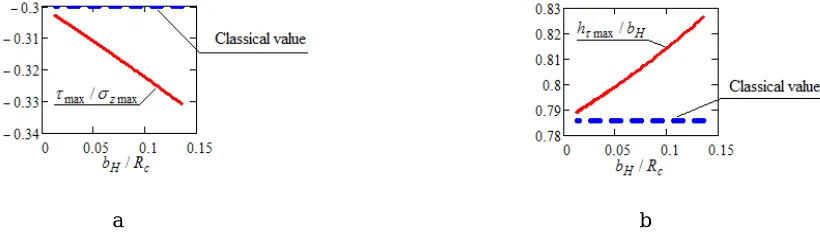
The plots in Fig. 2 – 4 demonstrate relations between the deviations of max max
z
and max
H
h
b
from the radius Rc of the investigated
cylinder (Fig. 2), from the of maximal contact stresses zmax (Fig. 3) and from the parameter
H
c
b
R (Fig. 4). Thus, while 0,14
H
c
b
R ,
the classical solution provides reduction of the values max (up to 10,6%) and hmax (up to 5,3%).
Meanwhile, the dependence of max on Rc in the limits of the plane problem (bH /a0) is significantly stronger than the
traditionally universal one of max only on the form of the contact area throughout the range of the plane and space problems
parameters (bH /a0...1).
TABLEIII
MAXIMAL SHEAR STRESSES AND THEIR DEPTH IN THE INVESTIGATED CYLINDER LOADED WITH THE HERTZ CONTACT PRESSURE
PLANE PROBLEM, Rb =10
9
MM
c
R , mm H c
b R
max z
, MPa max max z max H h b max max z
,% max H h b ,%
107 0,0002 11 0,300 0,786 0,1 0
0,02 1086 0,304 0,791 1,5 0,7
0,06 3258 0,313 0,802 4,4 2,0
0,08 4345 0,318 0,808 5,9 2,8
0,10 5431 0,322 0,814 7,4 3,6
0,12 6517 0,327 0,821 9,0 4,4
0,14 7603 0,332 0,828 10,6 5,3 105 0,0002 11 0,300 0,786 0,1 0
0,02 1085 0,304 0,791 1,5 0,7
0,06 3256 0,313 0,802 4,4 2,0
0,08 4341 0,318 0,808 5,9 2,8
0,10 5426 0,322 0,814 7,4 3,6
0,12 6511 0,327 0,821 9,0 4,4
0,14 7596 0,332 0,828 10,6 5,3 103 0,0002 11 0,300 0,786 0,1 0
0,02 1085 0,304 0,791 1,5 0,7
0,06 3255 0,313 0,802 4,4 2,0
0,08 4340 0,318 0,808 5,9 2,8
0,10 5425 0,322 0,814 7,4 3,6
0,12 6510 0,327 0,821 9,0 4,4
0,14 7595 0,332 0,828 10,6 5,3 10 0,0002 11 0,300 0,786 0,1 0
0,02 1085 0,304 0,791 1,5 0,7
0,06 3255 0,313 0,802 4,4 2,0
0,08 4340 0,318 0,808 5,9 2,8
0,10 5425 0,322 0,814 7,4 3,6
0,12 6510 0,327 0,821 9,0 4,4
Technology (IJRASET)
©IJRASET: All Rights are Reserved
415
The conclusion [3] about incorrectness of the numerical method (or, rather, about inerrancy of the classical one) could be considered as an oddity, unless such situations wouldn’t be typical in the modern theory and practice of contact calculations. Thus, the explanation of the contradiction between the results of contact calculations by appealing to incorrectness of experiments (which is carried out with numerical methods or with testing of natural samples) often is unreasonable. In other cases, on the contrast, the results of numerical simulations for a simplified model, which compensates the factors of the manifestation of the contact elements’ curvature, are used to prove the classical solution.
III.CONCLUSION
A. The analysis of the results of contact calculations for elastic circular parallel cylinders, obtained in [3] with the classical and numerical methods, is carried out. It is concluded that the proposition of [3] about incorrectness of the numerical method is unreasonable.
B. It is claimed that in fact the numerical simulations described in [3] are sufficiently accurate and are unreasonably considered as incorrect ones. That’s why a researcher can be misinformed with respect to understatement of evaluation of the numerical method, while the fact of the incorrectness of the classical solution remains hidden.
C. The veritable reason of the contradictions between the results obtained with the classical (analytical) method and with the numerical ones is universal applying the Boissinesq – Cerutti solution and modelling one of the bodies in contact with a half-space.
D. It is demonstrated by the analysis of plane stressed state of an elastic cylinder loaded with contact pressure, that the maximal shear stresses and their depth are significantly dependent on the radius of the cylinder and the width of the contact area.
E. It is proved that the traditional conception about dependence of the maximal shear stresses and their depth only on the form of the contact area as well as about the equality of these values for two rollers with unequal radii are not universal. They are true for a specific case and applicable only for bodies with large radii of curvatures and/or small contact stresses. The maximum of the relative values of shear stresses in the cylinder of a lesser radius is greater than one in the cylinder of a greater radius, but the point of the maximum is deeper in relative dimension for the cylinder of a lesser radius.
F. The excess of the maximal shear stress in relation to one obtained with the classical solution grows while the relation increases up to 10,6% within the limits of the parameters considered.
G. The excess of the depth of the maximal shear stresses in relation to one obtained with the classical solution grows up to 5,3% within the limits of the parameters considered.
H. The parameter, which characterizes the level of distorting the effect of the bodies’ curvatures on the maximal shear stresses and their depth by the classical solution, is defined. Reduction of the parameter implies monotonous reduction of the maximal shear stresses and their depth to asymptotic approximation to the classical constant 0,300 and 0,786 respectively.
[image:7.612.88.482.502.670.2]
a b
Technology (IJRASET)
©IJRASET: All Rights are Reserved
416
[image:8.612.71.508.39.191.2]
a b
Fig. 3. The maximal shear stresses (a) and their depth (b) in dependence on the maximal contact stresses
a b
Fig. 4. The values of the maximal shear stresses (a) and of their depth (b) in dependence on H c
b R
IV.ACKNOWLEDGMENT
The research is carried out under support of Southern Federal University (№213.01.-2014/03ВГ).
REFERENCES
[1] Zhuravlev G. A. “Conditions of Teeth Tribocontact and Ways of Improving Gear Pairs” Journal of Friction and Wear, New York, USA.–Vol.20.–N2.–
1999.–pp.57-69.
[2] Zhuravlev G. A. “Patent Application RST/RU2005/000367.” July 05, 2005.
[3] Purushothaman P., Thankachan P. ”Hertz Contact Stress Analysis and Validation Using Finite element Analysis” International Journal for Research in
Applied Science & Engineering Technology (IJRASeT)” V. 2, Issue XI, Nov. 2014 – P.531-538.
[4] Zhuravlev G.A., Karpenko V.A. “Sblizhenie uprugih tel, modeliruemyh krugovymi cilindrami,” Tehnika mashinostroeniya, 2000, №6 (28), s. 51-55.
[5] Zhuravlev G. A. “Fizicheskoe obyasnenie protivorechivosti ocenok kontaktnogo sblizheniya uprugih parallelnyh krugovyh cilindrov,” Materialy
Mezhdunarodnoy konferencii “XVIII sessiya Mezhdunarodnoy shkoly po modelyam mehaniki sploshnoy sredy” ed. acad. N.F. Morozova. – Saratov: Izd-vo Saratovskogo un-ta, 2007. – S. 127-129.
[6] Zhuravlev G.A., Tvarilidze O.V., Grebenyuk A.A. “K opredeleniyu sblizheniya osey uprugih parallelnyh krugovyh cilindrov konechnoy dliny pri ih szhatii,”
Trudy VIII Mezhdunarodnoy konferencii «Sovremennye problemy mehaniki sploshnoy sredy», g.Rostov-na-Donu, 2003, T.2. S. 77-80.
[7] Zhuravlev G.A., Azarov A.D., Babenko I.S. “K opredeleniyu glubinnyh napryazheniy v oblasti kontakta uprugih cilindrov” Izv. vuzov. Severo-Kavkazskiy
region. Estestv. Nauki. 2013. № 1 (173). S. 26-30.
[8] Azarov A.D., Zhuravlev G.A., Piskunov A.S. “Sravnitelnyj analiz analiticheskogo i chislennogo metodov resheniya ploskoy zadachi o kontakte uprugih
cilindrov” in Mezhdunarodnyj nauchnyj zhurnal “Innovacionnaya nauka”, Ufa: Aeterna. 2015. № 1-2. C. 5-13.
[9] Azarov A.D., Zhuravlev G.A., Babenko I.S. “Analiz vliyaniya krivizny kontaktiruyushhih uprugih cilindrov na ih napryazhennoe sostoyanie,” Izv. vuzov.
Sev.-Kavk. region. Estestv. nauki. 2013. № 2 (174). S. 21-26.
[10] Belyaev N.M. “K voprosu o mestnyh napryazheniyah v svyazi s soprotivleniem relsov smyatiyu,” Trudy po teorii uprugosti i plastichnosti M.: GITTL,1957.
C. 215–260.
[11] Gladkiy S.L., Stepanov N.A., Yasnickiy L.N. Intellektualnoe modelirovanie fizicheskih problem, ed. .L. N. Yasnickogo. - M.-Izhevsk: NIC "Regulyarnaya i
haoticheskaya dinamika", Institut kompyuternyh issledovaniy, 2006. - 200 s.
[12] Kovalskiy B.S. Raschet detaley na mestnoe szhatie, Harkov: HVKIU, 1967. 222 S.
[13] Mushelishvili N.I. Nekotorye osnovnye zadachi matematicheskoy teorii uprugosti, M.: Nauka, Glavnaya redakciya fiziko-matematicheskoy literatury, 1966.
[image:8.612.126.536.226.343.2]