Technology (IJRASET)
Pedal Powered Refrigerator
Hardik R. Mehta
Department of Mechanical Engineering, Indus University, India
Abstract---The refrigerator works by creating a vacuum in a system of 2 chambers to drive a thermodynamic reaction (boiling of methanol) at room temperature. The lowering in vapor pressure of the methanol drives the methanol to boil. In order to do this, the methanol must capture heat from a system (the inside of the refrigerator). After only about 10 min of pedaling, the valve to the vacuum pump can be shut off, and the zeolite container line opened. Zeolite are common absorbers based on aluminum silicates and will swell up to 30% its mass with water. The zeolite then absorbs the vapor produced by the boiling of the methanol, and in order for the liquid methanol to remain in equilibrium with the vapor phase; it must continue to boil (for up to a day). In general, one can achieve constant temperatures of 0-6 Celsius for 1 day with only 10min of pedaling. Now this is a real way to cool for cheap. Even ice cubes can be made and one advantage of this system is that the hotter it is outside, the more cold you can generate.
Keywords: Pedal Powered Refrigerator, Zeolite, Vacuum Refrigerator, Methanol
I. INTRODUCTION
The PEDAL POWERED ZEOLITE VACUUM REFRIGARATOR project was the development and the introduction of a new type of technology for the refrigeration systems based on the innovative zeolite/(vacuum) principle. The advantage of this new and environmental friendly cooling system is the use of natural elements (no refrigeration gas required). Moreover, the new refrigerators offer an increased mobility due to their independency from the power grid. The goal behind the project was the development of alternative systems that are complementary to the actual refrigeration systems, such as the compressor system and carbon dioxide snow.. The new refrigeration system developed by Domestic generates cooling capacity by using two natural elements (instead of cooling gases): Zeolite and vacuum. Zeolite is a mineral that has the property to adsorb vacuum vapor while releasing heat at the same time. It represents an interesting element to store energy and to transform it in heating or cooling agents. Due to its capacity of working independently from the power source for a specific period of time, the new technology suits mostly for the transport of food and other perishables. It could also be used in the medical field (transport of vaccines etc.). The energy stored in the zeolite elements is used to keep the desired temperature in the refrigerators during the transport time. During the implementation of the project, Domestic has built several transport and medical containers using zeolite/vacuum technology, demonstrating that the new system is environmentally friendly and technically viable. Due to increased energy consumption, compared with the conventional refrigerators during the regeneration phased, the Zeolite systems are economically feasible under specific circumstances.
II. WORKING
Initially vacuum is created in adsorbent (zeolite) unit using vacuum pump.
Valve connecting vacuum pump & evaporator chamber is opened and that of adsorbent container is kept closed.
Vacuum is generated in the evaporator chamber containing adsorbate (methanol), with help of vacuum generating system. This reduces the partial pressure of methanol, as a result phase transformation takes place from liquid to vapor state Heat utilized in the phase transformation is extracted from the evaporated chamber.
Now the compressor valve is closed and that of zeolite evaporator is opened, this makes the passage for zeolite to absorb the vaporized particles over its surface area, viz. Physical adsorption phenomena.
On completion of above five steps a slight depression of temperature is observed over the surface evaporator chamber. By repeating the whole cycle for number of times we can obtain considerable cooling effect in the cooling unit.
Technology (IJRASET)
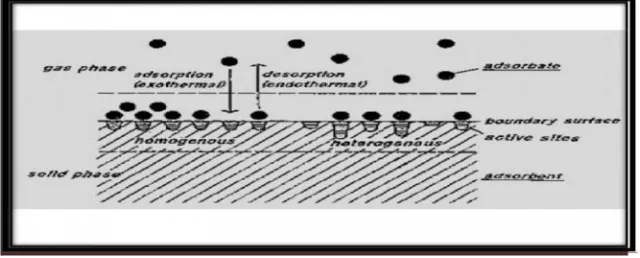
adsorbent and methanol can be treated as refrigerant. This process creates a film of the adsorbate (methanol) on the surface of the adsorbent (zeolite).
[image:3.612.165.485.109.238.2]
Fig. 2.1 A diagram explaining the adsorption phenomenon
[image:3.612.159.479.280.368.2]
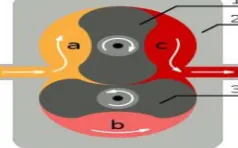
Fig. 2.2 Working of Sorption System
A. The adsorption / desorption cycle with zeolite and water
1) Adsorption:
Fig. 2.3 Adsorption
If such a process takes place in an air-free vessel, the adsorption of vapor from a water surface in the evaporation vessel occurs with such intensity that the rest of the water cools dramatically and freezes to ice due to the extreme cold of the evaporation process. This ice can then be used for cooling and air-conditioning while, at the same time, the heat released in the zeolite can be used for heating purposes. If, in addition, there is a valve between the two vessels, the generation of cold or heat can be interrupted for any length of time without loss of energy.
Technology (IJRASET)
Fig. 2.4: Working Model
III. EXPERIMENTAL SETUP
Bicycle: - It is required for pedaling and to drive the vacuum pump. Vacuum Pump: - It is required to create vacuum in cooling unit. Zeolite: - Used as absorber.
Zeolite Container: - To store the zeolite powder.
Cooling Unit: - It contains the material which we required for cooling purpose. Valve: - To control the supply of methanol and vacuum generated.
Refrigerator Body: - To keep cold the space cooled. Methanol:-Used as refrigerant.
A. vacuum pump
Vacuum pump is a device that removes gas molecules from a sealed volume in order to leave behind a partial vacuum.
[image:4.612.235.354.610.684.2]The first vacuum pump was invented in 1650 by Otto von Guericke, and was preceded by the suction pump, which dates to antiquity.
Technology (IJRASET)
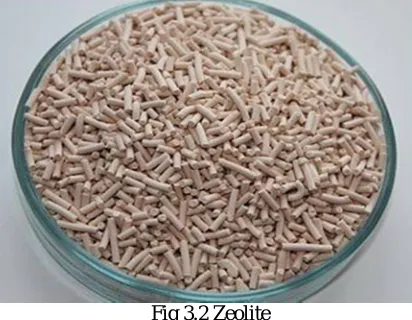
[image:5.612.193.399.137.297.2]Zeolite is a porous crystalline alumino silicate salt represented by the following formula: xM2/no.AL2O3.SIO2.zH2O .Thus, adsorption is the adhesion of atoms, ions or molecules from a gas, liquid or dissolved solid to a surface. In the designed refrigerator, zeolite is the adsorbent and methanol can be treated as refrigerant. This process creates a film of the adsorbate (methanol) on the surface of the zeolite.
Fig 3.2 Zeolite
C. Cooling unit
Zeolite-based probiotic filtration has gained a strong following over recent years and rightly so. By utilizing the nutrient processing traits of selective bacteria strains as well as a substrate facilitative to their metabolic needs, Zeolite-based probiotic filtration effectively creates Ultra Low Nutrient (ULN) conditions that most closely mimic reef environments. Vertex™ Rx-Z Reactors make bringing the advantages of this methodology home to your reef easier than ever.
Fig.3.3. Cooling Unit
D. Valve
A valve is a device that regulates, directs or controls the flow of a fluid (gases, liquids, fluidized solids, or slurries) by opening, closing, or partially obstructing various passageways. Valves are technically valves fittings, but are usually discussed as a separate category. In an open valve, fluid flows in a direction from higher pressure to lower pressure.
E. Refrigerator body
Technology (IJRASET)
At the end of the desorption phase, the internal zeolite temperature is at an optimum temperature of over 200 °C. The exterior temperature is only 100-120 °C. As a result, even without extensive insulation, heat losses are limited to approx. 10-15% of the input energy. The adsorption heat is released automatically, without requiring any control system, directly
F. Methanol
Methanol, also known as methyl alcohol, wood alcohol, wood naphtha or wood spirits, is a chemical with formula CH3OH (often abbreviated MeOH). It is the simplest alcohol, and is a light, volatile, colorless, flammable, and liquid with a distinctive odor that is very similar to but slightly sweeter than ethanol (drinking alcohol). At room temperature it is a polar liquid.
Methanol is produced naturally in the anaerobic metabolism of many varieties of bacteria, and is ubiquitous in the environment. As a result, there is a small fraction of methanol vapor in the atmosphere. Over the course of several days, atmospheric
methanol is oxidized with the help of sunlight to carbon dioxide and water.
IV. RESULTS & DISCUSSION
All tests like vibration test , regenerative test, temperature inside the container appears in a normal range. In order to separate zeolite and methanol after few cycles, Heat is required in the zeolite chamber. The vacuum provided in the chamber is sufficient for evaporation of methanol due to higher R.P.M produced by bicycle. The refrigerator is inexpensive and easily manufactured. It does not require fossil fuels for its functioning. The refrigeration effect is produced with simple equipment. The cost of the apparatus is negligible compared to the advantages offered. The refrigeration effect increases with increases in surrounding temperature.
REFERENCES
[1] A textbook of refrigeration and Air Conditioning by R.S. khurmi& J.k. Gupta 5 th edition , 2006 .
[2] Heat and Mass Transfer By M.M Rathore 7 th edition Vol. 5 , 2008 [3] http://www.learnengineering.org/2014/04/working-of-Refrigerator.html
[4] http://web.mit.edu/2.972/www/reports/compression_refrigeration_system/compression_refrigeration_system.html [5] primary-refrigerant by Wilson, David Gordon 30 Aug 2013
[6] Understanding Pedal Power on www.autonopedia.org 09 oct. 2014