Technology (IJRASET)
Marker Based Augmented Reality Application in
Education: Teaching and Learning
Gayathri D1, Om Kumar S2, Sunitha Ram C3
1,3
Research Scholar, CSE Department, SCSVMV University 2
Associate Professor, ECE Department, SCSVMV University
Abstract- Augmented Reality [AR] can create a new era when information and knowledge implemented in an interesting way in education. Augmented Reality has great potentials in education, more specifically in learning. This interesting technology can be implemented in education for better learning with high efficiency in school, colleges and business. Using this technology with its relevant tool students can learn and even build content with what they studied or understood on their subject contents. Innovative way of teaching and learning is made possible when augmented reality is used as an application and student’s higher order thinking capabilities can be increased when they experience augmented reality application. This paper describes how marker based AR application can be used for both teaching and learning and how marker processed as an image while visualized with its audio and video as 3D object. Finally, this paper concludes that AR is useful for exploring study materials and marker based AR will contribute to progress in education.
Key Words: Augmented Reality, Teaching and Learning, 3D, Marker based AR applications
I. INTRODUCTION
Augmented Reality (AR) is a live, direct or indirect, view of a physical, real-world environment whose elements are augmented by computer-generated sensory input such as text, image, sound, video, graphics, and GPS data [1]. Augmented Reality (AR) was first revealed in the 1960s, but only recently have technologies emerged that can be used to easily deploy AR applications to many users [3].The continuum between the virtual and the real world is Augmented Reality, which provides new way of teaching and learning. Although AR is one of the most emerging technologies in education now a day’s [5].But the value of AR remain unclear in the education field.
Fig.1 AR as mixed reality[3]
An Augmented reality technology is also called simulated or mixed reality which creates combined view for the user. This user’s view consists of real scene and a computer generated scene with additional information about the object or a location. Since Augmented Reality is a perception domain technology ,AR adds layers of digital information like videos, photos, sounds and 3D virtual content using camera and sensors in a smart phone or tablet and generates a composite view of the user that is the combination of the real scene viewed by the user and a virtual scene generated by the device.
The actual problem in teaching and learning or the both in education field is increasingly diverse. But the AR technology dramatically shifts the location and timing of teaching and learning in education. This paper describes how marker can be used for teaching by the tutors and how students use markers by their own and learn from the marker which improves self learning too. The aim of this paper is to explore how marker based application are used in education specially for studying materials both by instructors and students. Virtual 3D objects generated by a computer contains an image or video or text or some graphics are augmented with real world. Situated learning theory posits that all learning takes place within a specific context and the quality of the learning is a result of interactions among the people, places, objects, processes, and culture within and relative to that given context [7].
objects where those studying and teaching material will be augmented on the marker by the marker based augmented reality system and finally said as 3D object. The virtual 3D object is presented in the real world by sensing the virtual object by a camera through the device. The users cannot directly detect or hardly identified with their own senses[6].Marker based applications requires marker that is generated by the marker based system ,later on the marker contents are augmented.
II. AUGMENTED REALITY IN EDUCATION
A. Definition of Augmented Reality in Education
AR has a strong potential to provide both powerful contextual, on-site learning experience and serendipitous exploration and discovery of the connected nature of information in the real world[8].Augmented Reality applications can complement a standard curriculum in education. Augmented reality technology also permits learning via remote collaboration, in which students and instructors not at the same physical location can share a common virtual learning environment populated by virtual objects and learning materials which are interacted with each other. This is an ample scope in education for enhancing the learning/teaching experiences by providing more realistic information with the use of 2D/3D graphics and animated models.
[image:3.612.189.381.265.431.2]
Fig 2 AR in Education
B. Types of Augmented Reality
There are two type of augmented reality [3].
1) Marker based: Different forms of augmented reality markers are considered as images which can be detected only by a camera and AR software as a digitized virtual contents that are available on the scene [9].
Fig 3. Marker Based
[image:3.612.225.396.517.673.2]Technology (IJRASET)
[image:4.612.220.394.86.216.2]
Fig 4. Marker less AR
III. MARKER BASED AR APPLICATION
A. Augmenting information on the marker
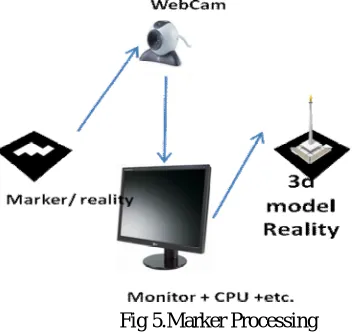
Marker is a black and white squares , using a computer application random markers are generated by the system. Later image ,text, sound video and some graphics even 3d interactive objects are augmented on the marker by Marker based application .In education from the teaching materials like text, graphics, video and audio can be superimposed or augmented on the marker. Finally augmented markers are collected and ID is assigned on each marker and stored in a Database with its relevant corner and four edge x,y,z, value. .
Fig 5.Marker Processing
B. Tracking and Rendering from marker
1) Camera: The marker is placed in front of the camera and it captures video and sends it to the computer. Marker based Application system software on the computer searches through each video frame from camera feed.
2) Acquire the marker Module: This module captures the marker with its four edges by differentiation black and white color.
3) Marker conversion & Image Processing Module: These binary images are processed using an image processing technique to detect the AR Marker. Marker is detected to find the position and orientation of four sides of black shaded region. The Symbol inside the marker is matched with templates in memory.
4) Circular matching is carried out between tracking DB and with Marker. Position and Orientation of a marker is relatively finds with camera and calculates The marker will not be facing exactly perpendicular to the optical axis and the x- and y-axes will not coincide with the pan and tilt axis. Therefore, we have to estimate these unknown rotations from all measured poses and the pan-tilt angles. These unknown rotations can be described by a pre and post multiplication of the calculated rotation matrix Rmeas for each measurement, resulting in a calibrated rotation Rcalib for each measurement:
Rcalib = R l Rmeas Rr
[image:4.612.197.373.329.496.2]calculated from the magnetic field sensors. Therefore, when we place the markers such that under normal movements only the heading determines the viewing angle to the marker, errors are less noticeable
Fig 6.Marker based Application block diagram
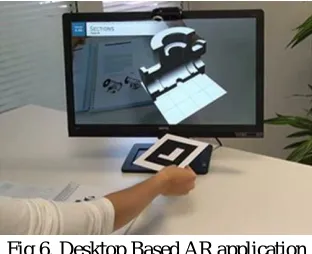
Fig 6. Desktop Based AR application
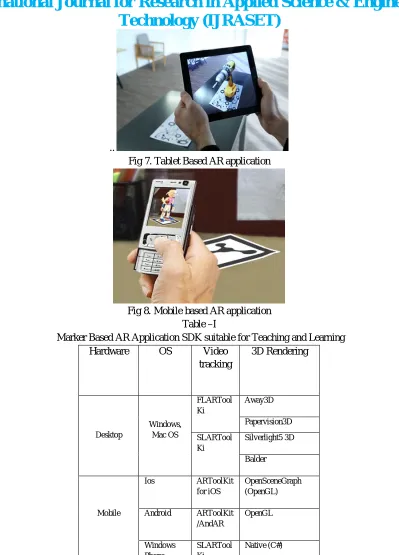
Finally augmented digital contents are available and displayed on the device screen which the marker based application is used which is shown in Fig 6. The other forms of devices which is using the marker and Marker Based Application is tablet based which is shown in Fig 7 and as the latest demanding device is smartphone which is meant for learning can also use this marker and Marker based Application for learning and teaching is shown in Fig 8.The basic SDK requirement for using this Marker Based Application in both desktop al well as mobile is being listed in Table I .
Camera
Acquire the marker image
Marker is converted into Binary image and black marker frame is identified
Compare & match Marker 3D
in DB, position & orientation
Tracker Database
Render 3D objec ts in video frame and display the augmented content
Yes no
[image:5.612.228.384.515.642.2]Technology (IJRASET)
[image:6.612.107.506.47.602.2]..
[image:6.612.218.396.79.369.2]Fig 7. Tablet Based AR application
Fig 8. Mobile based AR application Table –I
Marker Based AR Application SDK suitable for Teaching and Learning
Hardware OS Video
tracking 3D Rendering Desktop Windows, Mac OS FLARTool Ki Away3D Papervision3D SLARTool Ki Silverlight5 3D Balder Mobile
Ios ARToolKit
for iOS
OpenSceneGraph (OpenGL)
Android ARToolKit
/AndAR OpenGL Windows Phone SLARTool Ki Native (C#)
[image:6.612.183.433.384.612.2]This paper describes Augmented Reality (AR), how it applies in education and tells the potential value of using this technology in teaching and learning. Marker based application is low cost and easiest way to use this in education both by the instructor and students. Teaching through Marker based AR provides high potential impact on the future of education in technical fields. While AR offers new learning opportunities, it also creates new challenges for educators [4]
REFERENCES
[1] http://mashable.com/category/augmented-reality/
[2] Wu,H.K.,Lee,S.,Chang,H.-Y.,Liang,J.-C.:Current Status, Opportunities and Challenges of Augmented Reality in Education.Computer & Education 62,41-49(2013).
[3] Marker Based Augmented Reality Using Android OS. By Mr. Raviraj S. Patkar, Pune University- ISSN-2277128X, Volume 3, Issue 5,May 2013.
[4] Matt Dunleavy, Chris Dede (2013) “Augmented Reality Teaching and Learning” In J.M. Spector, M.D Merrill, J. Elen, & M.J. Bishop (Eds.), The Handbook of Research for Educational Communications and Technology (4th ed.). New York: SpringerReference
[5] Johnson ,L,Levine,A.,Smith,R.,Stone,S,: The 2010 Horizon Report New Media Consortium
[6] MAlinka Ivanova & Georgi Ivanov“Enhancement of Learning and Teaching in Computer Graphics Through Marker Augmented Reality Technolog” in IJNCAA, The society of Digital Information and Wireless Communications -2011 ISSN-2220-9085
[7] Brown, J. S., Collins, A., & Duguid. (1989). Situated cognition and the culture of learning. Educational Researcher, 18(1), 32-42.
[8] Johnson ,L.,Levine,A.,Smith,R.,&Stone,s.(2010).Simple Augmented Reality .The 2010 Horizon Report ,21-24.Austin,TX:The New Media Constium. [9] http://www.arined.org/
[10] Sanni Siltanen “Theory and applications of marker-based augmented reality” ISBN 978-951-38-7450-6 (URL: http://www.vtt.fi/publications/index.jsp) ISSN 2242-1203 (URL:http://www.vtt.fi/publications/index.jsp) Copyright © VTT 2012
[11] Azuma, R.T., A Survey of Augmented Reality. Presence: Teleoperators and Virtual Environments 6, 4 (Aug 1997), 355–385, 1997.