International Journal of Emerging Technology and Advanced Engineering
Website: www.ijetae.com (ISSN 2250-2459, ISO 9001:2008 Certified Journal, Volume 9, Issue 1, January 2019)
62
Optimal Overhead Energy Efficient Algorithm of Leach
Protocol in Wireless Sensor Networks
Muhammad Khurram
1, Dr. Sellappan Palaniappan
2, Dr.Syed Imran Ali
31,2
Malaysia University of Science and Technology, Petaling Jaya, Malaysia.
3Nizwa College of Technology, Sultanate of Oman.
Abstract--Future world will consist of smart devices that would basically dependent upon the sensory data from real world environments. In this way, inevitability of large scale remote sensors and IoT is unyielding in future. Wireless sensor nodes have limited resources, which comprised of spatially dispersed remote sensing nodes, which have some constrained issues among them the consumption of the power is the most significant one. WSN consumes hundreds to thousand times more energy in transmission of data as compared to the execution of instructions. The applications of the WSN are in wide spread fields, e.g. Military battle field, detection of forest fire, medical, and smart home/ city automations. So a big challenge for researchers for a large scale WSNs during the collection of data is the minimal amount of energy utilization. Lot of techniques used to diminish the utilization of energy in data gathering. Among all, small size data packets is one of the important aspect to conserve the energy, because sensor node dissipates less amount of power for information processing as compared to communication among the nodes. Reduce energy consumption and decreases the system delay is the prime target of cluster based sensor networks. For micro-sensor networks LEACH is a cluster based protocol which accomplishes low power, expandable routing and reasonable access of media for sensing nodes. Data collection with usage of a dynamic clustering method is possiblein different round. In every round, new set of clusters with different nodes comes into existence. The basic concept of LEACH is optimal set of CH according to the total nodes present in the network and the uniform dissemination of energy utilization among network nodes. This rest of the paper is organized as follows: Section I contains Introduction, Section II discussion about distributed clustering algorithms, Section III energy consumption in data collection rounds, Section IV proposed overhead energy calculation, Section V discussion about simulation model, Section VI performance analysis and results, Section VII Conclusion is based on the observation ofboth analysis and simulation.
Keywords-- WSN, TDMA, CSMA, LEACH
I. INTRODUCTION
Wireless Sensor Network (WSN) is a type of adhoc network. It contains thousandsof sensing devices called sensors. These sensing nodes are ready for detecting distinctive activities either environmental or physical activities.
International Journal of Emerging Technology and Advanced Engineering
Website: www.ijetae.com (ISSN 2250-2459, ISO 9001:2008 Certified Journal, Volume 9, Issue 1, January 2019)
63
In a long distance transmission of data along the routing path the energy of a sensing node consumes; Routing protocol formed an efficient route that will have a significant effect on the energy consumption (A. Sivagami, K. Pavai, D. Sridharan, & S. A. V. S. Murty, 2010). So the main goal for the WSN is to design a low power protocol which consumes an optimal energy during the transmissions (B. Faltings, J. Li, and R. Jurca, 2012).II. DISTRIBUTED CLUSTERING ALGORITHMS
Distributed clustering algorithms is the most widely known algorithms because the data is stored and disseminate from different locations. LEACH is the basic foundation of the proposed cluster based protocol. In LEACH the data transmission rounds are comprises into two stages: a) Setting up the cluster phaseb) Data transmission and aggregation phase. Each sensor nodes usually synchronized by clocks so that these nodes know the starting of a new clock cycle in each round i.e called the starting of a new round. Without negotiating with other nodes the selection of CHs is done independently by the sensor nodes themselves.
T(n) = k / 1-k x (rmode(i/k)) for n ϵ G Eq. 1
0 otherwise
All sensor nodes want to become CH this happens at the beginning of each round(r) and the set of senors that have not become a CH in the past 1/k rounds this all depends on the required percentage of CHs in the network.Each node generate a random number at the start of each round which is compare with a threshold vlaue R(n).
On sensor node n if the random number generated is less than R(n), then n becomes CH for the current round. each node is calculates its own threshold value R(n), which is mention in equation number 1.C is the set of previous CHs they were selected in last 1/k. CSMA protocol is used to broadcast the status of the all selected CHs. During this process all non-cluster head nodes receivers must keep ON to hear this announcement (] H. Yuan, Y. Liu, and J. Yu, 2011).The remaining nodes select their CHs after hearing the CH announcement.
TDMA schedule is given by every CH to its cluster members after clusters are formed. Cluster node is permitted to send its data to its CH because of the TDMA schedule mechanism. Significant power savings are happen due to the TDMA schedule mechanism, the sensor nodes turn ON only when they have permission to transmit (K. Khamforoosh & H. Khamforoush, 2009). Selection and rotation of CHs in LEACH protocol give an equal opportunity to all nodes to become a CH.
III. ENERGY CONSUMPTION IN DATA COLLECTION
ROUNDS
LEACH is an acronym for low energy adaptive clustering hierarchy. LEACH divides communication process in different rounds, every round includes: i) initiate the setup Phase, ii) A stable and steady state phase and iii) sink phase for data transmission. These phases are shown in Fig. 1. Now the commencement of a new cycle or the start of a new round we are supposed to have that the sensor nodes are to be synchronized with clock. So the LEACH is our basic protocol which estimates the amount of energy utilizes in cluster setups in dynamic cluster based WSNs.
Fig.1: Setup Phase of LEACH
A. Setup Phase
1. During the setup phase the computational energy is consumed. In dynamic cluster based protocols the selection criteria may differ in different protocols. a)What is the node energy level at the time of selection? b)Previously how many times this node has been selected
as a CH.
c)Random variable is also used to randomize the selection, besides the above two criteria’s.
2.CHs remain in idle listening modes.
3.All CHs receives an acknowledgement from the sink. 4.All elected CHs broadcast to advertise their
International Journal of Emerging Technology and Advanced Engineering
Website: www.ijetae.com (ISSN 2250-2459, ISO 9001:2008 Certified Journal, Volume 9, Issue 1, January 2019)
64
5. Nodes associated to CH based on their signal strength.They can estimate their nearest CH based on this signal, hence as a CH choose the nearest one.
B. Steady State Phase
1.Closest CH receives the replies before association with these nodes.
2. CHs broadcast all acknowledgements. Each associated node is to allot time slots through TDMA schedule.
[image:3.612.111.508.227.294.2]3. In these assigned time slots the data transmission is happen between sensor nodes and CHs. Each frame is made of N data slots as shown in Fig. 2.
Fig. 2: Steady State Phase and Data Transmission Phase
C. Data Transmission to Sink Phase
1.In this phase a computational energy is consumed. All CH aggregate the received data.
2.Aggregated data forwarded from all CH to sink.
First two phases are considered as an overhead and the power utilization in these phases treated as overhead energy (OHE).
D. Overhead Energy Calculation
The following are the equations 3.1 to 3.4 that describe the basic energy model which is use to evaluate the power utilization in various phases of transmission of control and data messages.
ETrans = Eelec x n + Ep-mp x n x d2 (3.1)
ETrans = Eelec x n + Etp x n x d4 (3.2)
ERecv = Eelec x n (3.3)
EIdle = β x Eelec x n (3.4)
Where,
ETrans:utilization of the energy for n bits
transmission.
ERecv: utilization of energy during the reception of
data.
Eidle: utilization of energy during in idle listening
phase.
Eelec: utilization of energy for receiving or
transmitting a 1-bit data. Unit is J/b.
Ep-amp: utilization of energy for free space model
in power amplifier. Unit is J/b/m2.
Etp: utilization of energy of power amplifier. Unit
is J/b/m4.
N: total bits transferred from transmitter to receiver.
Β: ratio between the reception and idle listening energy mode.
D: distance between transmitter and receiver.
IV. PARAMETERS OF OVERHEAD ENERGY COMPUTATION
Overhead energy utilization was carefully calculated in each step of each round by considering the data and control packets sent.In the cluster setup phase the percentage and the level of energy is being utilize which is calculated for networks size and number of nodes. The power dissipation of nodes during the transmissionconsidering the transmission ranges which means the distance between the transmitter and receiver and the size of data bits that can be seen in equations 3.1 to 3.4.In a free space model the direct line of sight is considered and two ray ground propagation model consider ground refracted signals. Usually free space model is used if the distance is not greater than a threshold distance dcrossover. The dcrossover, here is taken as 85 meters (G. Ran, H. Zhang, & S. Gong, 2010). Equation 3.1 for transmission state in two way ground propagation model and equation 3.2 energy equation is for transmission state in free-state model and equations 3.3 and 3.4 are used for the reception and idle states respectively. Transmission ranges means the distance between transmitter and receiver.
dmax= maximum Cluster head (CH) distance. dANtoCH =Distance of node to its Cluster Head (CH) dCHtoSink=Distance of Cluster Head (CH) to the sink.
International Journal of Emerging Technology and Advanced Engineering
Website: www.ijetae.com (ISSN 2250-2459, ISO 9001:2008 Certified Journal, Volume 9, Issue 1, January 2019)
65
The communication between the rest of the nodes and the cluster heads are happen by using the non-persistent CSMA, during the contention period. For better throughput use a 1-persistent CSMA was chosen it gives the better performance as compared to non-persistence CSMA.For non-persistent CSMA ais the throughput which shown in the following equation:
∝ = Nc x e (-∝xNc)
/ Nc x (1 + 2a) + e (-∝ x Nc)
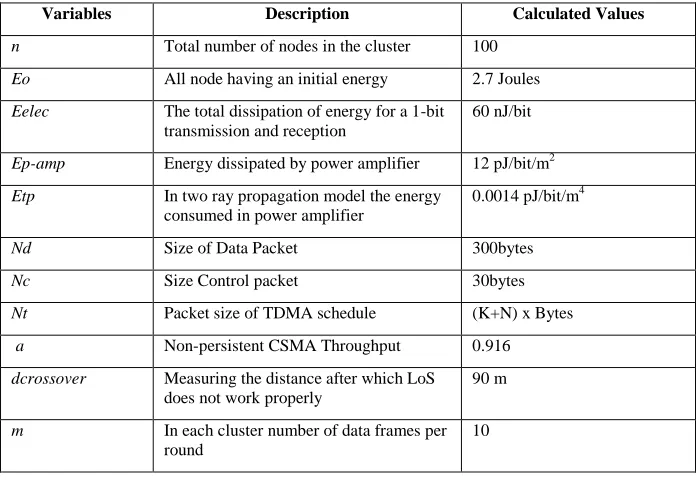
Here,a is the ratio of transmission delay and propagation delay, taken as 0.001. Forcontrol packet size of 30 Bytes, αis 0.916. Different commercial transceivers radio parameters are available on internet [16].In this simulation, Eelec is 60 nJ/bit and for Ep-amp and Etp is 12pJ/bit/m2 and 0.0014pJ/bit/m4 respectively [12]. Initial energy Eo given to eachnode is taken as 2.7 Joules. βis 0.6 which is the ratio of energies in between in reception and idle listening mode.
V. SIMULATION MODEL
Here we present and discuss the results obtained from the simulation which could be based upon a simulation model that uses a method for calculating the overhead energy.
We prepare an energy model for the dynamic cluster selection in wireless sensor networks (WSN) in MATLAB. Initially we consider a 50, 100 and 150 nodes with area sizes of 100m2, 200m2 and 300m2 respectively.
Assumptions are made as follows:
1. Nodes are randomly deployed in a static order 2. Initially all nodes having equal energy.
3. Transmitting node depending upon the power level of the received signal. Receiving nodes can evaluate the distance between them.
4. According the distance between the nodes the radio powers of the nodes are adjusted properly.
[image:4.612.132.480.475.715.2]After considering these assumptions we can calculate the overhead energy on network lifetime through with the simulation in MATLAB. The cluster head percentage value find it optimally with multiple parameters,for example number of nodes deployed in the cluster, size of a network or area, and the percentage of cluster heads. We could define the network energy and the network lifetime on the basis of when the first node was dead in the network. The variables are used in simulations which are summarized in Table 5.1. Two MAC modes namely non-persistent CSMA (for broadcasting the advertisements)and TDMA (To transfer the data packets) are considered. During the contention periodthe communication between all other nodes and the cluster-head is achieved by usingnon-persistent CSMA.Retransmitted packet collisions are lesser in non-persistent CSMA(M. Abazeed, N. Faisal, S. Zubair, & A. Ali, 2013).
Table 5.1
Variables Description Calculated Values
n Total number of nodes in the cluster 100
Eo All node having an initial energy 2.7 Joules
Eelec The total dissipation of energy for a 1-bit
transmission and reception
60 nJ/bit
Ep-amp Energy dissipated by power amplifier 12 pJ/bit/m2
Etp In two ray propagation model the energy consumed in power amplifier
0.0014 pJ/bit/m4
Nd Size of Data Packet 300bytes
Nc Size Control packet 30bytes
Nt Packet size of TDMA schedule (K+N) x Bytes
a Non-persistent CSMA Throughput 0.916
dcrossover Measuring the distance after which LoS
does not work properly
90 m
m In each cluster number of data frames per round
International Journal of Emerging Technology and Advanced Engineering
Website: www.ijetae.com (ISSN 2250-2459, ISO 9001:2008 Certified Journal, Volume 9, Issue 1, January 2019)
66
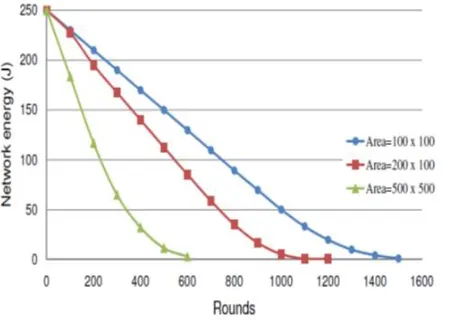
VI. RESULTS AND FINDINGS [image:5.612.333.565.118.296.2]First we have to analyze the effect of different area sizes on the network and calculating energy utilization, then calculating the amount of overhead energy calculation in WSN.Network life time decreases if we increases the area of a network with initial energy Eo=2.7 Joules for the same number of nodes, Fig.3 and 4 shows the relationship among those entities.The transmit energy of each node depends on the distance between the transmitter and receiver which shown in equations 3.3 and 3.4, therefore the lifetime of the network reduced if the size of the network expands resulting it also consumes more energy. Fig.3 and 4comparing the results which shows that the nodes start expiring the raise the level of network energy also starts reducing. No energy being utilize because throughout the network the transmission of data is not being done successfully. Also for area of 50 x 50m2 the rate of expiration of nodes are steadyand slow as compared to two other cases where network area is taken as 100 x 100m2and 150x150m2. Through simulation, we have obtained the amount of Overhead energy (OHE)utilization. Then the result of the overhead energy on network lifetime is taken under consideration. In this case the optimal value of a CH percentage is 5 to 10 percent.
[image:5.612.55.287.425.585.2]Fig. 3: Network Energy versus Rounds
Fig.4: Dead Nodes versus Round
Here we propose a modification to the cluster head selection criteria to reduce the energy usage in micro sensor networks, this we are motivated from the original LEACH and LEACH-C and other improvement protocols (C. P. Waltenegus Dargie, 2010).
VII. CONCLUSION
International Journal of Emerging Technology and Advanced Engineering
Website: www.ijetae.com (ISSN 2250-2459, ISO 9001:2008 Certified Journal, Volume 9, Issue 1, January 2019)
67
Therefore if we design a low power algorithm for cluster setup phase to decrease the transmission of control packets which considerably increases the network life time for dynamic cluster based networks.REFERENCES
[1] W. B. Heinzelman. (2000). Application-specific protocol architectures for wireless net-works:" Ph.D. dissertation, Massachusetts Institute of Technology.
[2] M. Liu, J. Cao, G. Chen, & X. Wang, (2009). An energy-aware routing protocol in wireless sensor networks," Sensors, vol. 9, no. 1, pp. 445-462.
[3] O. Younis & S. Fahmy, \Heed: a hybrid, energy-efficient, distributed clustering approach for ad hoc sensor networks," Mobile Computing, IEEE Transactions on, vol. 3, no. 4, pp. 366-379, Dec 2004. [4] R. N. Enam, S. Misbahuddin, & M. Imam. (2012). Energy Efficient
Round Rotation method for a random cluster based WSN," in Collaboration Technologies and Systems (CTS), 2012 International Conference on, 2012, pp. 157-163.
[5] P. Saini & A. K. Sharma. (2010). Energy efficient scheme for clustering protocol prolonging the lifetime of heterogeneous wireless sensor networks, International Journal of Computer Applications, vol. 6, no. 2, pp. 30-36, Sept 2010, published by Foundation of Computer Science.
[6] X. Fan and Y. Song (2007). Improvement on leach protocol of wireless sensor network, The International Conference on Sensor Technologies and Applications, 2007,pp. 260-264.
[7] H. Yuan, Y. Liu, and J. Yu (2011). A new energy-efficient unequal clustering algorithm for wireless sensor networks," in Computer Science and Automation Engineering (CSAE), IEEE International Conference on, vol. 1, pp. 431-434.
[8] B. Faltings, J. Li, and R. Jurca (2012), Eliciting truthful measurements from a community of sensors, in Internet of Things (IOT), 2012 3rd International Conference on the, 2012, pp. 47-54. [9] O. Incel, A. Ghosh, B. Krishnam achari, & K. Chintalapudi (2012).
Fast data collection in tree-based wireless sensor networks," Mobile Computing, IEEE Transactions on, vol. 11, no. 1.
[10] M. Abazeed, N. Faisal, S. Zubair, & A. Ali (2013). Routing protocols for wireless multimedia sensor network: A survey," Journal of Sensors, Hindawi, vol. 2013, p. 11.
[11] C. P. Waltenegus Dargie, Fundamentals of Wireless Sensor Networks: Theory and Practice, D. X. S. Shen, Ed. John Wiley & Sons, Ltd., 2010.
[12] W. R. Heinzelman, J. Kulik, & H. Balakrishnan (1999). Adaptive protocols for information dissemination in wireless sensor networks, in Proceedings of the 5thAnnual ACM/IEEE International Conference on Mobile Computing and Networking, MobiCom '99. [13] A. Sivagami, K. Pavai, D. Sridharan, & S. A. V. S. Murty (2010).
Energy and link quality based routing for data gathering tree in wireless sensor networks under tiny os - 2.x," CERN, Tech. Rep. arXiv :1005. 1739.
[14] J. Li & H. GAO (2008). Research advances in wireless sensor networks, Journal of Computer Research and Advances, vol. 45, no. 1, pp. 1–15.
[15] K. Khamforoosh and H. Khamforoush (2009). A new routing algorithm for energy reduction in wireless sensor networks, in Proceedings of the 2nd IEEE International Conference on Computer Science and Information Technology (ICCSIT ’09), pp.505–509. [16] G. Ran, H. Zhang, & S. Gong (2010). Improving on LEACH
protocol of wireless sensor networks using fuzzy logic,” Journal of Information and Computational Science, vol. 7, no. 3, pp. 767–775.
AUTHORS
Mr. Muhammad Khurram, Ph.D Scholar, BS, MS (Computer Engineering) From Sir Syed University of Engineering & Technology,Lecturer, Engineering Department, Nizwa College of Technology, Sultanate of Oman. Email: [email protected].
Prof. Dr. Sellappan Palaniappan, Dean of School of Science and Engineering at Malaysia University of Science and Technology (MUST)
Email: [email protected]
Dr. Syed Imran Ali,
Lecturer, Engineering Department, Nizwa College of Technology, Sultanate of Oman.
Email:[email protected]