International Journal of Emerging Technology and Advanced Engineering
Website: www.ijetae.com (ISSN 2250-2459, ISO 9001:2008 Certified Journal, Volume 7, Issue 8, August 2017)
239
A Comparative Analysis of Proactive and Reactive Routing
Protocols over NS3 in VANET
Pramod Kumar Joshi
1, Dr. Ashish Kumar Gupta
21Research Scholar, IFTM University Moradabad, India 2Professor, ITS Engineering College, Greater Noida, India
Abstract-There is a massive use of vehicles now days. Due to this road safety is a major concern for the society. Vehicular Ad-Hoc Network (VANET) is a wireless ad hoc network formed by moving vehicles with each other or with the road side units (RSU). The network is formed to transfer safety and Infotainment messages between nodes (Vehicles and RSU). That means the nodes share different kind of information such as safety information for the prevention of road accidents, traffic related information such as traffic jams and entertainment service information. Message transfer is the responsibility of the routing protocol in the network. Routing of data in VANET is a challenging area due to fast speed of nodes and dynamic topology. VANET is a subset of MANET where some features are distinct. The protocols can be categorised in proactive and reactive protocols based on topology. The performance of these routing protocols can vary with the change in different parameters such as vehicle speed, traffic conditions and node density. In this paper we have analysed the performance of protocols such as OLSR, AODV and DSDV has been tested in terms of packet delivery and end to end delay under TCP connection using NS3 simulator.
Keywords- VANET, NS3, OLSR, AODV, DSDV
I. INTRODUCTION
The Vehicular Ad-Hoc Network is formed by moving vehicles such as cars, buses, trucks and road side units to share information related to safety and Infotainment. It is assumes that these nodes have the required resources to from the network. VANET makes it possible for the nodes to applications like safety [1], traffic congestion and other infotainment services. As unlike MANET the vehicles in VANET moves in a predefined restricted mobility path [2].
VANET is an emerging technology for the betterment of ITS (Intelligent Transportation System). ITS is utilizing the modern wireless technology to improve the quality of service by which we can reduce road accidents, traffic congestion and increase the level of comfort for driver and passengers.[3,4,5].
The VANET communication is Vehicle to Vehicle (V2V) with the help of On-Board-Units (OBU) and Vehicle to Infrastructure (V2I) communication that takes place between OBU and Road Side Unit (RSU) installed at roadside.
VANET has some characteristics as fast movement of nodes, frequent topology change, unrestricted power supply and huge processing capability [6].
In this paper the performance analysis of the topology based routing protocols such as DSDV (proactive) and DSR AND AODV (reactive) with different metrics are presented. As it is very tough to do a research over the real time network and at the same time implementation cost is quite high. So the simulator helps to test the scenario with low cost and time. There are n numbers of network simulator available in modern time with different features and facilities. Some of the them are as NS2, NS3, OMNET++, OPNET AND JSIM. We are using NS3 for the research purpose.
The research work is organised as section II represent VANET Architecture, section III describes about Network Simulators. In section IV Classifications of routing protocols is given. Section V represents Literature review. Section VI is simulation with NS3 and in section VII Simulation Result Analysis and finally in section VIII concludes the research.
II. VANETARCHITECTURE
The architecture of VANET can be categorised in three different categories: pure cellular/WLAN, pure Ad-Hoc and hybrid [7]. It can be further categorised into V2I (Vehicle to Infrastructure) ,V2V (Vehicle to Vehicle) and Hybrid (V2V and V2I). V2I is a communication that occurs between OBU on vehicle to RSU installed at road side, whereas V2V communication occurs between OBU of the peer vehicle. As shown in the figure 2.
International Journal of Emerging Technology and Advanced Engineering
Website: www.ijetae.com (ISSN 2250-2459, ISO 9001:2008 Certified Journal, Volume 7, Issue 8, August 2017)
240
There is another communication shown in the figure known as Infrastructure to infrastructure (I2I) communication that useses a different wireless technology and is not a part of VANET. VANET is enhanced with Global Positioning System (GPS), that provides position, speed and road layout which are significant parameters.[3,8,9].As it’s very tough and expensive to install RSU through the entire road, Vehicle to Vehicle and multi Hop communication is a better solution and cost effective solution for information sharing between nodes. However this may lead to new challenges such as rapid changing network topology, speed of the nodes, routing support for the multi hop communication [10, 11, 12].
III. NETWORK SIMULATORS
The VANET simulator software’s can be divides into 3 broad categories that is there are some software by which we can generate or prepare the path or the moving models of the nodes there are known as Mobility path Generators, by this we can generate vehicle path, traffic light, road signs, no of lanes and no of vehicle etc. The output generated by the mobility generators can be passes to the network simulators for further processing. The next category is the network simulators, the network simulators mainly focuses on the packet movement, topology and channel used between source and destination. They may include mobility generators in the package.
FIG.2NETWORK SIMULATOR SOFTWARE’S STACK
The VANET Simulator sometimes also known as Hybrid Simulator combines the functions of Mobility Generators and Network Simulators in a single software for better performance [3]. In this work we have used NS3 for the research purpose.
IV. CLASSIFICATION OF ROUTING PROTOCOLS FOR
VANET
The fast moving nodes in VANET makes the design of the routing protocols very challenging.
The routing protocols are responsible for the communication between the moving nodes as per the routes mentioned in their routing tables or as discovered by them. The VANET routing protocols can be divided into many categories based on Topology, Position, and Broadcast etc. These protocols can be classified as shown in figure no 3.
FIG.3VANETROUTING PROTOCOLS
Topology based routing utilise the link’s information available within the network for sending the data from source to destination [13]. It can be further subdivided into three categories namely Proactive Routing, Reactive Routing and Hybrid Routing. The proactive routing protocols are generally based on shortest path information. It keeps the information about all the connected nodes in form of a table [14]. It further shares this information with their neighbouring nodes whenever there is any change in the network topology. The techniques implemented in proactive routing ire Link State Routing (OLSR) and Distance Vector Routing (DSDV). The Destination Sequence Distance Vector Routing (DSDV) uses distance vector shortest path algorithm to provide loop free single path to the destination node. The Reactive routing protocols are designed to overcome the overhead of Proactive routing protocols and this is done by maintaining only those routes which are currently active [13]. It discovers a route only when it is required. The Hybrid routing protocol is a combination of the characteristics of both proactive and reactive routing protocols. It makes the routing more efficient. Mostly these protocols are zone based which divides the network into zones so that it can be maintained easily [13]. In this paper we try to compare the performance of the popular routing protocols as (AODV, OLSR, and DSDV).
A. AODV
Ad Hoc On Demand Distance Vector Routing (AODV) is a reactive routing protocol which discovers the route on as and when required bases. Route discovery is done by sending RREQ (Route Request) packet to its neighbouring nodes. On receiving a RREQ each node maintains a reverse route path for the source node in its routing table.
VANET ROUTING PROTOCOLS
TOPOLOGY BASED
PROACTIVE
DSDV OLSR FSR
REACTIVE
AODV DSR TORA HYBRID
POSITION BASED
International Journal of Emerging Technology and Advanced Engineering
Website: www.ijetae.com (ISSN 2250-2459, ISO 9001:2008 Certified Journal, Volume 7, Issue 8, August 2017)
241
It is known as backward learning. The broadcast of the RREQ continues till it reaches the destination. The destination sends a Route Reply Packet (RREP) to the source using backward path. In this process all the intermediate nodes keeps the information of the path. The link failure information is given by Route Error Message (RERR). The advantage of the AODV protocol is that is has less overhead of maintaining routes as it maintains the routing table only when it is required and the disadvantage is that it’s route discovery delay is high.B. OLSR
Optimised Link State Routing (OLSR) is a protocol that maintains the routing information by sending link state information. If there is any change in the topology every node sends information to selective nodes by this each node gets the information only once [14].
C. DSDV
Destination Sequence Distance Vector (DSDV) is a table based proactive routing protocol that makes its routing decision based on the routing table available with each node [15]. It sends a periodic broadcast to maintain its routes on regular basis. The advantage of DSDV is that it is simple and has no latency as it obtains the path directly from the table and the disadvantage is the overhead due to periodic update that consumes bandwidth and processing.
V. LITERATURE REVIEW
Good amount of research is done by researchers to test the performance of various routing protocols in different environment. The performance of the protocols depends on the various factors such as protocols, the traffic scenario, traffic density and the devices those are being used for the communication.
In [16] a simulation using realistic VANET traces has been performed and it shows that the performance is highly dependent or governed by the mobility model. The research is done using 802.11b wireless network technology.
In [17] a performance analysis of MANET routing protocols in urban scenario as per their proposed mythology and it shows that LAR shows better result in comparison to others.
The authors in [18] compared the performance of routing protocols for VANET. The simulation is done on NS3. The result shows that OLSR performs to be the best in terms of highest PDR and lowest PLR for every node.
In [19] the authors compared the performance of MANET routing protocols (ADV, DSR, and GOD) for highway and city scenario. The study shows that ADV is best for highway scenario while GOD is more suitable for city scenario. They have used 802.11b wireless technology and simple road scenario.
VI. SIMULATION WITH NS3
A mobility model was generated in NS3 for the testing of the testing of performance of some of the VANET protocols. The parameters those are used to test the protocols are shown in the following table.
TABLE –I
Simulation Result Analysis and Conclusion
Parametres
Values
Network Simulator
ns-3.26
Map Model
Urban
Number of Vehicles
20 TO 100
Routing Protocols
AODV OLSR and
DSDV
Transport Protocols
UDP
Packet Size
512 Bytes
Transmission Rates 1 Packet Per Second
Simulation Area
2500 * 2500
Simuation Time 120 Seconds
Velocity
12m/s TO 20m/s
Wifi Standards IEEE802 11P
Performance analysis of routing protocols AODV, OLSR and DSDV for VANET is done in NS3 as per the specification in table1. The results of the simulated study are as follows
.
A. PDR
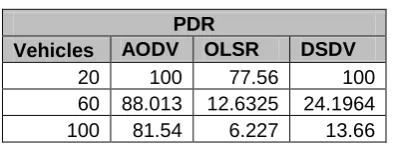
The calculation of Packet delivery Ratio (PDR) can be done as the ratio between the delivered packets at destination and packet generated at source. Table II displays the PDR ratio of the various protocols and fig. IV displays the graph.
Table II PACKET DELIVERY RATIO
PDR
Vehicles AODV OLSR DSDV
[image:3.595.318.546.308.509.2] [image:3.595.334.531.663.735.2]International Journal of Emerging Technology and Advanced Engineering
Website: www.ijetae.com (ISSN 2250-2459, ISO 9001:2008 Certified Journal, Volume 7, Issue 8, August 2017)
242
FIG.4PERFORMANCE GRAPH OF PDR FOR 20,60 AND 100 VEHICLES
B. DELAY
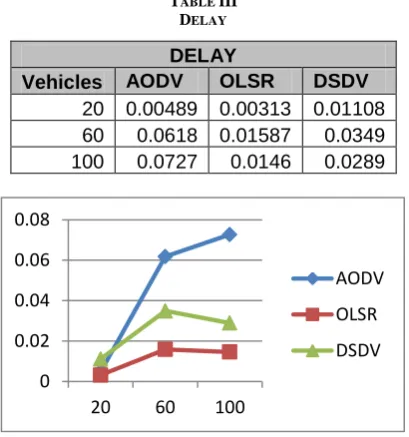
Delay is the time taken between transmission of a packet from source and arrival of the same packet at the destination. It includes buffering time, queuing time and delay in propagation.
TABLE III DELAY
DELAY
Vehicles AODV OLSR DSDV
20 0.00489 0.00313 0.01108 60 0.0618 0.01587 0.0349 100 0.0727 0.0146 0.0289
FIG.5PERFORMANCE GRAPH OF DELAY FOR 20,60 AND 100
VEHICLES
C. Throughput
[image:4.595.321.537.124.299.2]Throughput can be defined as the sum of bits received successfully by all the communicating nodes. Table IV displays throughput of the various protocols compared in VANET scenario and fig. VI displays the graph of throughput.
Table IV THROUGHPUT
THROUGHPUT
Vehicles AODV OLSR DSDV
20 4052 3062 4050 60 20818 1181 3429 100 45842 514.6 2435
Fig. 6 PERFORMANCE GRAPH OF THROUGHPUT FOR 20,60 AND 100
VEHICLES
VII. CONCLUSION AND FUTURE WORK
This research paper analysed the performance of AODV, OLSR AND DSDV routing protocols in Vehicular Ad-hoc Network using the metrics using NS3 simulator. It is observed that no one single routing protocol will suite all the requirement of VANET but AODV is performing better than the other protocols in most of the cases. In future, the work will be extended to evaluate the performance of more routing protocols using more scenarios and with traffic light and in urban and highway roads.
REFERENCES
[1] Yang X, Liu J, Vaidya N, Zhao F. A vehicle-to-vehicle communication protocol for cooperative collision warning. In: The IEEE First Annual International Conference on Mobile and Ubiquitous Systems:Networking and Services(MOBIQUITOUS 2004), Boston, Massachusetts, USA, 2004:p. 114-123.
[2] Bernsen J, Manivannan D. Unicast routing protocols for vehicular ad hoc networks: A critical comparison and classification.Pervasive and Mobile Computing, 2009; 5:1-18.
[3] Khaled Salah, Barakat Pravin Maratha, Tarek R. Sheltami Performance Study of MANET Routing Protocols in VANET, RESEARCH ARTICLE - COMPUTER ENGINEERING AND COMPUTER SCIENCE, Arab J Sci Eng Springer 2016
[4] Dimitrakopoulos, G.; Demestichas, P.: Intelligent transportation systems. Veh. Technol. Mag. IEEE 5, 77–84 (2010)
[5] Hai, N.D.; Phuc, N.T.; Khue, D.; Hai, T.H.T.; Vu, P.T.; Nam, H.:Improving utilization of GPS data for urban traffic applications. Int. J. Internet Broadcast. Commun. 7, 6–9 (2015).
[6] Faezipour,M.; Nourani, M.; Saeed, A.; Addepalli, S.: Progress and challenges in intelligent vehicle area networks. Commun.ACM 55,90– 100 (2012).
[7] Kevin C. Lee, Uichin Lee, Mario Gerla : Survey of Routing Protocols in Vehicular Ad Hoc Networks. Published in the United States of America by Information Science Reference (an imprint of IGI Global) Copyright © 2010, IGI Global
[8] Mittal,M.: A study of live video streaming over highway vehicular ad hoc networks. Int. J. Comput. Appl. 1, 86–90 (2010)
[9] Vineeth, N.;Guruprasad,H.:Asurvey on the techniques enhancing video streaming in VANETs. Int. J. Comput. Network.Wirel. Mob.Commun. (IJCNWMC), ISSN, pp. 2250–1568, (2013)
0 20 40 60 80 100 120
20 60 100
AODV
OLSR
DSDV
0 0.02 0.04 0.06 0.08
20 60 100
AODV
OLSR
DSDV
0 10000 20000 30000 40000 50000
20 60 100
AODV
OLSR
[image:4.595.67.266.144.269.2] [image:4.595.62.267.362.581.2] [image:4.595.67.263.698.779.2]International Journal of Emerging Technology and Advanced Engineering
Website: www.ijetae.com (ISSN 2250-2459, ISO 9001:2008 Certified Journal, Volume 7, Issue 8, August 2017)
243
[10] Vineeth, N.;Guruprasad,H.:Asurvey on the techniques enhancingvideo streaming in VANETs. Int. J. Comput. Network.Wirel. Mob.Commun. (IJCNWMC), ISSN, pp. 2250–1568, (2013) [11] Martinez, F.J.; Toh, C.K.; Cano, J.C.; Calafate, C.T.; Manzoni, P.:A
survey and comparative study of simulators for vehicular ad hoc networks (VANETs).Wirel. Commun. Mob. Comput. 11, 813–828 (2011)
[12] Wang, S.-Y.; Lin, C.-C.: NCTUns 6.0: a simulator for advanced wireless vehicular network research. In: 2010 IEEE 71st Vehicular Technology Conference (VTC 2010-Spring), pp. 1–2 (2010) [13] M. Mauve, A. Widmer, and H. Hartenstein, ―A survey on
positionbased routing in mobile ad hoc networks,‖ Network, IEEE, vol. 15, no. 6, pp. 30 - 39, Nov/Dec 2001.
[14] M. Abolhasan, T. Wysocki and E. Dutkiewicz, ―A review of routing protocols for mobile ad hoc networks‖, Ad Hoc Networks 2 , 2004 , pp. 1–22.
[15] Jian-Qiang, W.; Chen-Wen, W.: A novel opportunistic routing protocol applied to vehicular ad hoc networks. In: 2010 5th international Conference on Computer Science and Education (ICCSE), pp. 1005–1009 (2010)
[16] Naumov,V.; Baumann, R.;Gross, T.:An evaluation of inter-vehicle ad hoc networks based on realistic vehicular traces. In: Proceedings of the 7th ACM International Symposium on Mobile Ad Hoc Networking and Computing, pp. 108–119 (2006).
[17] García-Campos, J.; Reina, D.;Toral, S.; Bessis, N.;Barrero, F.; Asimakopoulou,E.; et al.: Performance evaluation of reactive routing protocols for VANETs in urban scenarios following good simulation practices. In: 2015 9th International Conference on Innovative Mobile and Internet Services in Ubiquitous Computing (IMIS), pp. 1–8 (2015).
[18] Tushar Singh Chouhan, Rajvardhan Somraj Deshmukh, “Analysis of DSDV, OLSR and AODV Routing Protocols in VANETS Scenario: Using NS3”, IEEE, International Conference on Computational Intelligence and Communication Networks, 2015.