International Journal of Emerging Technology and Advanced Engineering
Website: www.ijetae.com (ISSN 2250-2459, ISO 9001:2008 Certified Journal, Volume 7, Issue 11, November 2017)
297
Performance Analysis of IPv4 to IPv6 Transition in Wireless
Networks
Elferjani Chambo
11Advanced Security Systems, Department of Postgraduated Studies, Singidunum University, Belgrade, Serbia
Abstract—Today wireless networks take an important role
in the life of people which through they can use and share the information by easy ways especially in public places such as coffeehouses, conferences, and airports, by connecting access point (AP) with computers, mobiles, and smart devices. This development in the wireless communication technology systems and internet revolution, with this development all internet users such as laptops, mobiles and PDAS want to use a services of the high quality ,that demands and desires of users put us in permanently challenge.
Keywords— wireless networks, communication technology,
IPv4, IPv6, transition.
I. THE OVERVIEW TO IPV4TO IPV6TRANSTION
Internet Protocol Version 4
IPv4 is the fourth version of the internet protocols and has been achieved in 1980, it is popular and the most widely used till now, which use to delivery data from the source to the destination over different kinds of interconnected networks. The Internet Protocol is one of the major protocols in TCP/IP and the length address of the IPv4 is 32-bit, IPv4 has header that consist of many fields.
Internet Protocol Version 6
Internet Protocol version 6 (IPv6 and also known asIPng) has been existing since 1997 which developed by the IETF (Internet Engineering Task Force) and was officially start used in 2004 when ICANN added IPv6 addresses to its DNS. The length address of IPv6 is much larger than the length address of IPv4, which IPv6 has 128-bit and IPv4 has 32-bit, and the main reason behind adopting IPv6 is the exhaustion of available IPv4 address space, and also to provide many other features.IPv6 has header that consist of many fields.
While internet protocol version 4 (ipv4) is limited to 32-bit address and front the unexpected growth of the internet users due to the evolution of Internet and wireless communication technology systems .the internet protocol version 6 has achieved to provide enough of addresses for the foreseeable future with limited 128-bit address.
The transition or migration from IPv4 to IPv6 has already started, since in some countries using ipv6 by varying degrees and some of internet websites used ipv6 to delivery data such as Google, Facebook and YouTube. But before launching IPv6 the network infrastructure should be upgraded in order to support services and software to enable these two protocols to communicate with each other to deliver the data in the different interconnected networks, some transition mechanism is needed to enable these communicate. Internet Engineering Task Force (IETF) has proposed three transition mechanisms are as below:
Dual Stack.
Tunneling
Translation
A performance evaluation and security for transition mechanism can help by guiding network administrators and researchers in their selection of the best transition technology for their environment.
II. INTRODUCTION TO APPLIED STUDY
With unexpected developments, the Internet has succeeded in invalid IPv4 years. Many solutions have been
given to solve this problem. One of the most popular
solutions for translating network addresses (NAT) [1], where viruses4 and internal computers are "licensed" by the NAT server on the Internet. However, this is not a good solution because NAT consumers do not have to depend solely on the end.
Another solution to this problem is using Microsoft Protocol 6 (IPv6) [2]. This new IP version has 128-bit addresses, and IPv4 ends at 32 addresses. Additionally, IPv6 has incorporated more traffic, integration, security, movement, and network development. Additionally, many existing operating systems support iPv6.
It is not possible to switch from IPv4 to IPv6 short time. As a result, IPv4 and IPv6 are available at a time of change.
Numerous issues, including costs, support IPv6
International Journal of Emerging Technology and Advanced Engineering
Website: www.ijetae.com (ISSN 2250-2459, ISO 9001:2008 Certified Journal, Volume 7, Issue 11, November 2017)
298
Therefore, IPv6 pre-installed is a small island of IPv6 on the IPv4 Sea and some converting patterns are enabled to use two protocols.There are three types of flexibility: second stack, translators and travel modes. Both stack devices are IPv4 and IPv6 simultaneously, allowing connection with both versions. The purpose of translating converts IPv6 pack to IPv4 packages and, in contrast, connects between hosts with different IP responses. The main idea of technology research is only using IPv6-protocol for IPv6. In this case, IPv6 packages are installed on IPv4 packages to switch to IPv4 networks. Similarly, computer technology reverses, ie the IPv4 connection is the network of IPv6. However, this last example is not reluctant to use because IPv4 is a high policy.
It is important to know which one is appropriate in some cases because there are different ways to travel. In this article we suggest three assessment methods: SATAP, 6to4, and NAT64. Their performance is similar to natural IPv4 and IPv6 location. We use the Disaster Relief Equipment (OWD) and comparative analysis of the standards and effects of different approaches.
The remainder of this booklet is described below. Section II examines the related circumstances. Section III briefly describes the process of moving motion so that we can learn. Information about our trials and vehicle production equipment is provided in Chapter IV. The comparison of the analysis of outcomes contained in section V is carried out. Finally, Section VI summarizes the future and the future.
III. TRANSITION MECHANISMS
The Linnel systems allow remote IPv6 locations to interact with IPv4 only on the network. These methods provide full IPv6 connection to the actual IPv4 network to provide IPv6. High quality standards add IPv4 packages to IP 4 IPv4 packet number and add protocol number. Similarly, packs packages can use IPv4 networks to access IPv6 addresses. In another strong connection, the solution (IPv4 paper document on Pet6 packet) is rejected (we have been released from the IPv6 Packet IPv6 package) at the second level.
On the other hand, conversion methods turn the IPv6 pack into IPv4 packages, and in consequence. When the IPv4 converter receives IPv4 packet in the IPv6 area, header IPv4 has been deleted and used in the creation of the IPv6 head. The same process is similar when you import an IPv6 pack from IPv6 to the IPv4 interpreter.
In this search, we have selected NAT64 for transport and 6to4 and NAT64 modes for translation. Because we have chosen this technology, we have a number of applications, and many programs can be downloaded from the Internet and by engineers. The famous translation process spent with the translation of the Network Translation Protocol (NAT-PT) [36], thus excluded from this study.
A. ISATAP
Tuning Protocoling Addressing Protocol (ISATAP) [37] Tunneling Tuning Mode that allows IPv4-based network host hosts to integrate with remote IPv6 devices.
The ISATAP address is made up of 24-bit EEE UI (00-00-5E at a specific IPv4 address and 02-(00-00-5E on IPv4 public address), and 8-bit hex value 0xFE made by EUI-64 format, and node IP-4 IP address can be found. In this way, the node creates an internal address of the city center, allowing it to reach other ISATAP isodas in that inner area. The ISATAP engine specifies that the multicast is not available on the IPv4 network, so it can identify possible routers. ISATAP hosted the navigation key, manually configured or using the DNS query, oratap.company.com (domain domain company.com). Computers for a router IPv4 address can handle a router application to obtain a global IPv6 address with the same 64-modified format of EU 64 described above. This allows the ISATAP processor to communicate with the IPv6 Internet.
ISATAP is built on multiple platforms (Windows XP / Vista / 7/8/10, Luxux, etc.)
B. 6to4
6to4 [38] is a tunneling mode for IPv4 addresses for routers to generate IPv6 location. To create an address box, use the 2002 / / 16 start-up of the Internet-based Internet Office (IANA). The 6to4 site can have 280 IPv6 languages for 2002: IPO4Address: / 48 this is done by combining the frontend described in IANA with 32to 6to4 IPv4 address. By sending and receiving a packet at the 6to4 router IPv4 address raised on the IPv6 address, you can make any pack on this address, and allow connection between any 6to4 domains.
International Journal of Emerging Technology and Advanced Engineering
Website: www.ijetae.com (ISSN 2250-2459, ISO 9001:2008 Certified Journal, Volume 7, Issue 11, November 2017)
299
This program enhances any address and the third party upload can be used to fit, integrate and elevate.C. NAT64
NAT64 [40] IP6 is a conversion method that allows users to get IPv4 on servers by converting their IP publications. Two different components are required on NAT64: DNS64 server and NAT64 router. Additionally, this technology requires two IPs. The first plague is the first IPv6 [96] (usually 64: ff9b: / 96) is used to keep IPv4 server servers provided by IPv6 suppliers. Additionally, the specified IPv6 start is also known. Other lakes like the IPv4 pool (at least one IPv4 address) provide IPv4-client on IPv4-IPv4-Internet server. It is also known as IPv4 power. If the IPv6 buyer wants to talk with the server, you will reply to the DNS server (DNS64 server in the case). If the requested server has IPv6 address, the DNS64 server will respond to IP6-related address (AAAA record) and the IPv6 server will be submitted to the IPv6 navigation system. Besides, the DNS64 server will create an IPv6 server representing the IPv4 server by integrating IPv4 address (usually 64: ff9b: <IPv4Address>) and start / 96. Therefore, the IPv6 buyer does not need NAT64 / DNS64. IPv6 package are (IPv6 IPv6 address as an environmental address and DNS64 IPv6 address) in IP64 cases. Next, IPv6 headaches IPv4 address for IPv4 address by using IPv4 address and IPv4 address addressed IPv6 address as targeted for IPv4 address in the second pair. NAT64 router connects access to the flexible converter session (IPv4 to IPv6) for packages. This document is used by the first river packet and is maintained when a connection between the IPv6 and IPv4 server is available.
IV. BENCHMARKING TOOLS AND TESTBEDS
A. Test Method
In this section, we show our comparisons of learning. We also upgrade various technologies for experiments: native IPv4, native IPv6, ISATAP, 6to4 and NAT64.
We have created a change mark by the research team before calculating the OWD [42]. As described [42], the OWD or Round Trip Time (RTT) described in many test features is not reliable because it is based on complicated computers that are difficult to access Microseconds. It is important to get all the notes on one computer.They are based on customer client example / server. In particular, the packet length (IPv4 or IPv6) is set between the server and the server time (defined by the user). You get a stamp time before and after the meter changes. Separate time stamps prevail between timing and receipt, which are categorized by the RTT key route, and therefore OWDs are second.
Product, select Iperf [43] is also based on the example of the sponsor / server. This level sends the route to the sponsor and calculates the number of bits for the second taken. The upper boundary should be determined to ensure that the machine is fulfilling the net to get high performance. Although Iperf can measure TCP output and UDP, the phone only allows UDP to set bandwidth boundaries. So, in our trials, we only evaluate the iDP.
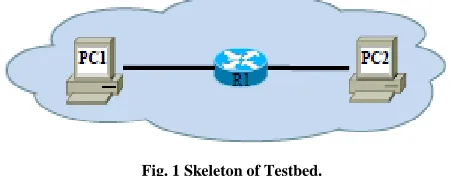
[image:3.612.328.553.360.448.2]Appraisal is performed by sending IPv6 packages (or IPv4 packets that depend on the technology used) between the two computers and the above advanced refinements. High-quality scanners for two PCs (PC1 and PC2) are connected to the two NICs (Network Interface Cards) and other PCs (R1). This view is shown in Figure 1. We used computers with similar features: HP xw4600 for the Intel Core 2 Duo E6750 project with 2.67 GHz and 8 Gb RAM. In the NICs, we have installed Intel PCI Ethernet adapters (Intel PRO / 100 S).
Fig. 1 Skeleton of Testbed.
Create four partitions on disk hard disk (PC1, PC2 and R1) and install the following operating systems: Debian 7.0.8 (Wheezy), Windows 7, Windows 8 and Windows 64, 64-bit versions. We chose their own programs for their popularity and stay. In any research, we work in the same way to work on three computers and test the effectiveness of technological change in this operating system.
Each test is performed on Ethernet and Fast Ethernet technology. All the tests are repeatedly 10 to 20 times at
the same time. The result is the
average test each.
Packetsare shipped as UDP and / or TCP transport systems. We varied the values for the UDP and TCP payload as specified in the following list: 50, 100, 250, 500, 750, 1000, 1250, 1500, 1750, 2000, 3000, 4000, 5000, 6000, 7000, 8000, 9000, and 10000 bytes.
B. Testbeds
International Journal of Emerging Technology and Advanced Engineering
Website: www.ijetae.com (ISSN 2250-2459, ISO 9001:2008 Certified Journal, Volume 7, Issue 11, November 2017)
[image:4.612.344.556.148.292.2]300
Fig.2 Native IPv4 TestbedGiving IPv4 control to Debian is done by placing a block of sysctl barrier on net.ipv4.conf.all. For Windows, the required IPEnableRouter must be set to 1 in the following system registration process:
HKEY_LOCAL_MACHINE \ SYSTEM \
CurrentControlS and \ Services \ Tcpip \ Parameters The drafting of this command is applied to all IP4 router testing requirements.
[image:4.612.56.279.152.234.2]2)Native IPv6: As the IPv4 test area table, address and router routes and computers are clearly considered as shown in Figure 3
Fig.3 Native IPv6 Testbed
Giving Debian IPv6 is control easier. This is the only problem with placing the main sysctl parameter on net.ipv6.conf.all.server. On Windows, the command is shown in Figure 4 You must log in to the console to allow packaging. Because the router has two NICs, it is necessary to complete two instructions on each interface. These router conferences are used in each table for IPv6 router testing.
Fig.4 Enabling Forwarding in R1 for Native IPv6 (Windows).
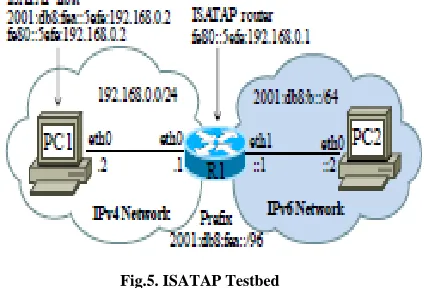
3) ISATAP:Figure 5 shows the ISATAP test stack. For ISATAP Tunnel features, PC1 (ISATAP Host) must have an IPV4 ISAAP address. In our experience, R1 works as an ISATAP driver.
Fig.5. ISATAP Testbed
[image:4.612.54.279.392.455.2]To install ISATAP on Debian, PC1 has built-in stereo. PC1 is used as shown in illustration 6. The ISATAP service works on line 06 and IPv6 addresses are kept fast in line 07. The ISATAP router is set up as shown in illustration 7. The tunnel is used at 01-03, indicating that the end of the tunnel location is connected to 192.168.0.1 IP address. If the ban is adjusted (as a radio) and is used on R1, line 07 is not required on PC1 (Figure 6). In this case, PC1 has read its unique world address in unit.
Fig.6 Configuration of PC1 for ISATAP (Debian)
Fig.7 Configuration of R1 for ISATAP (Debian).
[image:4.612.328.559.408.596.2]International Journal of Emerging Technology and Advanced Engineering
Website: www.ijetae.com (ISSN 2250-2459, ISO 9001:2008 Certified Journal, Volume 7, Issue 11, November 2017)
301
Fig.8 Configuration of PC1 for ISATAP (Windows).Windows Road, R1, is set up with the instructions shown in Note 9. Features 01-02 Displays the IPv4 IP address for ISATAP launcher and instructions. Although IPv4's address is R1, you know ISATAP is now a router.
Later, packet data has been opened
IPv6 in section 03-04
and allows the router to send packages. Guidelines
indicate that you must advertise with the 2001
proposal: db8: fea: / 64 with router 05-06 r1. ISATAP
Consumer Sales
Fig.9 Configuration of R1 for ISATAP (Windows).
4)6to4: The testbed is organized as shown in Figure 10. In this case, R1 IPv4 is router routes and PC1s and PC2s considered as the 6to4 host host / router. That is, PC1 and PC2 can combine both. In IPv6 packages generated by PC1 and PC2, the IPv4 head is added by a computer maker before sending it to the IPv4 network.
Fig.10 6to4 Testbed.
For Debian, PC1 is considered as 6to4 host / router 11. In this case, lines 01-03 build and install a pseudo-interface (called 6to4). PC2 planning is like PC1, without home IPv4 home address (192.168.1.2).
Fig.11 Configuration of PC1 for 6to4 (Debian)
Windows 6to4 is compiled as shown in Exhibit 12. PC1 and PC2 require only line 1 command to enable 6to4.
Fig.12 Configuration of PC1 and PC2 for 6to4 (Windows).
5)NAT64:The NAT64 test plate is described in Figure 13. In this case, PC1 IPv6 is hosting only and PC2 IPv4 alone. Router R1 is responsible for converting headlines to keep communication between communications. Dynamic IPv4 and 192.168.255.0 / 24 2001: db8: ffff: / 96 the first IPv6 button. In this test bar, we only use Debian as an operating system because there is no compatible NAT64 Windows compatible computer. Two NAT64 applications have been submitted to R1D NAT64 [44] and Jool [45].
Fig.13 NAT64 Testbed
International Journal of Emerging Technology and Advanced Engineering
Website: www.ijetae.com (ISSN 2250-2459, ISO 9001:2008 Certified Journal, Volume 7, Issue 11, November 2017)
302
Fig.14 Configuration of R1 for TAYGA (Debian). [image:6.612.64.279.510.602.2]Jool is a Linux support that enables users to work with SIIT (IP invisible IP / ICMP Translation) or NAT64. To do this, Jool has two main modules (jool_siit.ko SIIT and NAT64 jool.ko). In addition, Jool offers two applications for proofreading and querying forms (jool_siit of SIIT and jool for NAT64). We have Jool v3.3.3 from the source code on R1. Figure 15 gives the required instructions to integrate and configure Jool as the NAT64 server. Line 01 sets the head of the head depending on the situation. After that, Jool leaves his main page (line 02) until line 03. Finally, the NAT64 module is used in the memory at the level of 06, to select the correct IPv4 pool and the specified IPv6 key.
Fig.15 Configuration of R1 for Jool (Debian).
V. RESULTS AND ANALYTICAL COMPARISON
In this section, we will show you the results of the OWD and the Implementation Standards in the assessment plans. We begin to provide OWD outcomes, resulting in results.
A. Performance Results for One Way Delay
A tool developed by Velásquez and Gamess [42] was used to measure OWD. Theoretically, the natural IPv4 and native IPv6 OWD represent the sub assembled OWD for each IP version. For cosmic causes, results are only available for TCP Ethernet and UDP and Fast Ethernet for TCP.
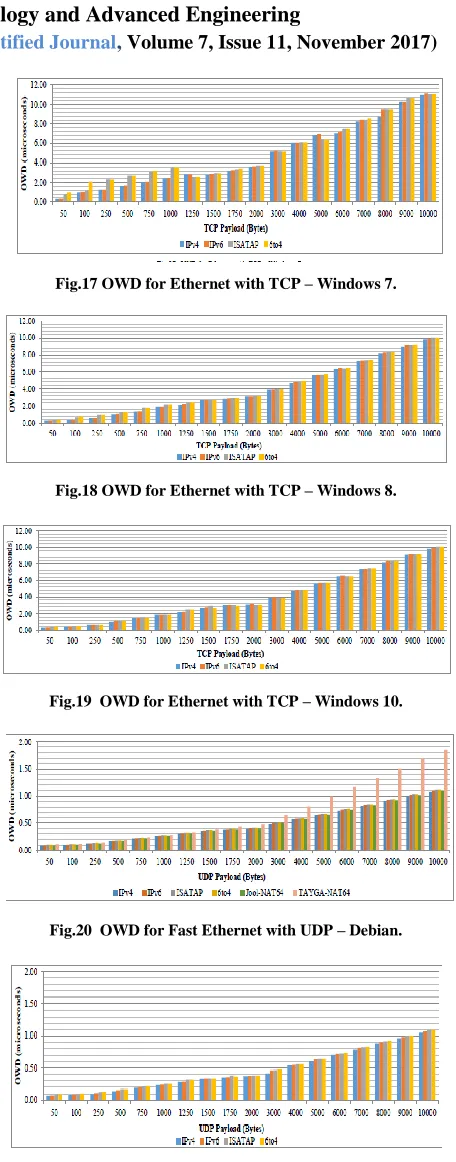
1) Ethernet: Figure 16 shows OWD for Ethernet TCP sections using Debian. Since almost all load loads, ISATAPs and 6to4 have high levels of OWD, because it integrates additional IPv4 into IPv6 packages, which allow long and technical time. If NAT64 in Debon, Jool and TAYGA are equal, the low OWD value for the Jool is small. Although there are almost all cases, NAT64 has OWD under IPv6. This is due to an improved Ethernet computing (10 Mbps) and Ethernet serial (10 Mbps) serialization, so serialization sequence is costly and leads to a higher IPV6 OWD, where the use of two objects using iPv6 and PV4 packet If sequence is required, the IPv6 pack is required about NAT64.
Figure 17 shows OWD for TCP components over Ethernet 4.18 and 4.19 respectively on Windows 7, Windows 8 and Windows 10. Standards behavior is like one of Debian: IPv4 and IPv6 OWD ISATAP less than OWD and less than 6to4. At the operating level, we can see if Windows 8 works best with all operating system volumes.
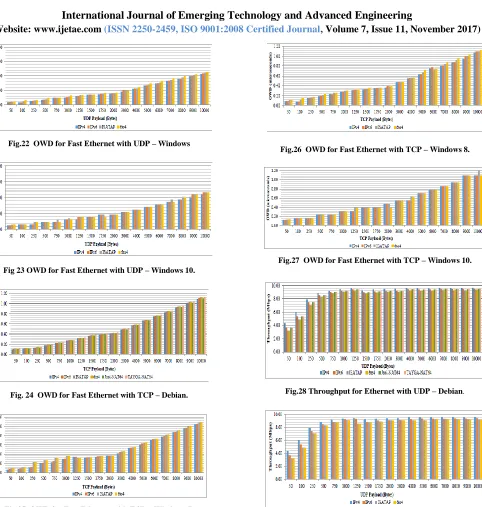
2) Fast Ethernet: The UDP OWD Ratings on Fast Ethernet are shown in Figure 20, 21, 22 and 23 Debian, Windows 7, Windows 8 and Windows 10. IPv4 is for a low OWD area, followed by internal IPv6. ISATAP and 6to4 have OWDs like all load loads, higher than natural IPv4 and IPv6 location. If Debian is NAT64, Jool displays normal behavior. On the other hand, TAYGA has an unexpected OWD fee for shipping by 1750 bytes. There is a small part of the operating system with the UDP OWD.
International Journal of Emerging Technology and Advanced Engineering
Website: www.ijetae.com (ISSN 2250-2459, ISO 9001:2008 Certified Journal, Volume 7, Issue 11, November 2017)
303
B. Performance Results for ThroughputAs described above, how to use Iperf [43]. The conference, natural IPv4 and IPv6 of the rotation area show the maximum boundary on each IP page. It is equipped with Ethernet and Fast Ethernet. The Imperfection boundary referred to in Section IV is limited only to the UDP.
1) Ethernet: Ethernet UDP production standards are described in Examples 28, 29, 30 and 31 respectively in Debian, Windows 7, Windows 8 and Windows 10. As expected, internal IPv4 output displays high resolution, and IPv6 conversion potential. . Then, ISATAP and 6to4 are not compatible with IPV6 and have the same behavior. This method of communication is expected to install IPv4 that provides continuous and scheduled installation of IPv6 packet on IPv4 data. Jool and TAYGA permission on the NAT64 process at Debye are similar to all loads of loads. At the level of operating systems, we can see that the Debian high is almost all the supporting documents.
[image:7.612.331.559.108.689.2]2) Fast Ethernet: Figure 32, Drawings 33, 34 and 35 display UDP programs for Debian, Windows 7, Windows 8 and Windows 10 for Fast Ethernet. As we have seen, the rise in UDP behavioral velocity is a process of learning such as the UDP for Ethernet delivery (see 28, 29 figs, 30 and 31 figs), but twice as much. As you can see, the iP4 of the site works high, and then iPv6's location. Repair techniques (ISATAPs and 6to4) are similar and smaller than IPv4 natural and natural IPv6. At the level of operating systems, such as Ethernet, Debian is higher than any applicable operating system.
Fig.16 OWD for Ethernet with TCP – Debian.
Fig.17 OWD for Ethernet with TCP – Windows 7.
Fig.18 OWD for Ethernet with TCP – Windows 8.
Fig.19 OWD for Ethernet with TCP – Windows 10.
Fig.20 OWD for Fast Ethernet with UDP – Debian.
[image:7.612.63.274.506.609.2]International Journal of Emerging Technology and Advanced Engineering
Website: www.ijetae.com (ISSN 2250-2459, ISO 9001:2008 Certified Journal, Volume 7, Issue 11, November 2017)
304
Fig.22 OWD for Fast Ethernet with UDP – WindowsFig 23 OWD for Fast Ethernet with UDP – Windows 10.
[image:8.612.69.551.100.607.2]Fig. 24 OWD for Fast Ethernet with TCP – Debian.
[image:8.612.329.557.113.611.2]Fig.25 OWD for Fast Ethernet with TCP – Windows 7.
Fig.26 OWD for Fast Ethernet with TCP – Windows 8.
Fig.27 OWD for Fast Ethernet with TCP – Windows 10.
Fig.28 Throughput for Ethernet with UDP – Debian.
International Journal of Emerging Technology and Advanced Engineering
Website: www.ijetae.com (ISSN 2250-2459, ISO 9001:2008 Certified Journal, Volume 7, Issue 11, November 2017)
305
Fig.30. Throughput for Ethernet with UDP – Windows 8.Fig.31 Throughput for Ethernet with UDP – Windows 10.
Fig.32 Throughput for Fast Ethernet with UDP – Debian.
Fig.33 Throughput for Fast Ethernet with UDP – Windows 7.
Fig.34 Throughput for Fast Ethernet with UDP – Windows 8.
Fig.35 Throughput for Fast Ethernet with UDP – Windows 10.
VI. CONCLUSION
In this paper, the assessment units are proposed on the IPv4 of the area, the IPv6 area and the different types of conversion. We have selected ISATAP, 6to4 and NAT64 due to their popularity, their various applications, and many technical applications for change. Ideas are made up of various operating systems: Debian, Windows 7, Windows 8 and Windows 10. We measure the performance of OWD and UDP and TCP.
As one research [6] [26], our research has confirmed that IPv4 environmental assessment plans are better than natural IPv6. This is because the length of IP headsets (20 bytes of IPv4 and IP 40s bytes). Additionally, our experience has shown that ISATAPs and 6to4 networks have the same network connections, allowing network administrators to choose a person who meets their needs or, if necessary, integrate both technologies together. For conversion methods, NAT64 is now a standard facto. Due to the proximity and development of technology, NAT64 is only supported by new producers such as the Cisco Systems. In this article, compare two open software from NAT64 to Jool and TAYGA, Linux. In this case, our consulting managers are using Jones as the performance problems described in Figure 4 are not an active project. The recent TAGA change was released in June 2011 and now looks like a deadly project.
The study in this article is carried out in small areas of assessment to complement the performance of different types of changes in controlled areas. In our next study, we aim to analyze the clear and clear communications. We are interested in developing an experimental model to test the effectiveness of other transformations.
International Journal of Emerging Technology and Advanced Engineering
Website: www.ijetae.com (ISSN 2250-2459, ISO 9001:2008 Certified Journal, Volume 7, Issue 11, November 2017)
306
Under architect router-to-router, tunneling always seems to be an important host-host-host design in all experiments. Another factor is that under Linux, the use of the bandwidth is better than Windows. Interestingly, we make IPv4 bandwidth and RTT (latency) parameters to IPv6 protocols. For this reason, output results are higher than IPv6, due to IPv6 more loads. The features of RTT (lag) applications are smaller than the acceptance standards.REFERENCES
[1] “Introduction to IP Version 6”, published by Microsoft Corporation, published September 2003 and updated February 2006
[2] “IPv6 and the Next Generation Internet Protocol Overview”, Sprint Communications, Inc., 26750 Agoura Road ,Calabasas, CA, 91302 USA
[3] “IPv6 Transition Technologies”, Microsoft Corporation, Published October 2003 and updated October 2005
[4] “The Design and Implementation of an IPv6/IPv4 Network Address andProtocol Translator” ” Department of Computer Science and Engineering,
[5] “The IP specification” was published as RFC 791 in September 1981 and was later ratified as Internet Standard 5
[6] A Conta, S Deering, “Internet Control Message Protocol (ICMPv6) for the Internet Protocol Version 6 (IPv6) Specification” (December 1998), RFC 2463 at http://www.ietf.org/rfc/rfc2463.txt
[7] Amer Nizer Abu Ali, “Comparison Study Between IPv4 & IPv6”, International Journal of Computer Science Issues, 9(3): 314-317, 2012.
[8] APNIC, ARIN and RIPE communities, "http://www.ripe.net," [Online]. Available: http://www.ripe.net/ripe/docs/ripe-545#why_joint_policy. [Accessed 9 April 2012].
[9] Behrouz A. Forouzan, “Business Data Communications”, DeAnza College published year 2003
[10] C Hopps, “Routing IPv6 with IS-IS” (January 2003), at http://www.ietf.org/internet drafts/draft-ietfisis- ipv6-05.txt [11] C Shannon, D Moore, K Claffy, “Characteristics of Fragmented IP
Traffic on Internet Links” (2001), at http://www.caida.org/outreach/papers/2001/Frag/frag.pdf
[12] C. Bouras, P. Ganos and A. Karaliotas, "The Deployment of IPv6 in an IPv4 world and transition strategies," Internet Research: Electronic Networking Applications and Policy, vol. 13, no. 2, pp. 86-93, 2003.
[13] Cisco Documentation “Configuring DHCP Snooping” at http://www.cisco.com/univercd/cc/td/doc/product/lan/cat4000/12_1_ 13/config/dhcp.htm
[14] Cisco Documentation, Cisco Catalyst 4500, “Configuring Dynamic
ARP Inspection” at
http://www.cisco.com/en/US/products/hw/switches/ps4324/products _configuration_guide_chapter09186a 008019d0ca.html
[15] D Johnson, C Perkins, J Arkko, “Mobility Support in IPv6 draft-ietf-mobileip-ipv6-24.txt” (June 30, 2003), at http://www.ietf.org/internet-drafts/draft-ietf-mobileip-ipv6-24.txt [16] D Moore et. al., “Inside the Slammer Worm” at
http://www.caida.org/outreach/papers/2003/sapphire2/
[17] D Senie, “Changing the Default for Directed Broadcasts in Routers” (August 1999), RFC 2644 at http://www.ietf.org/rfc/rfc2644.txt [18] D. York, "www.internetsociety.org," [Online]. Available:
http://www.internetsociety.org/deploy360/blog/2012/01/world-ipv6-launch-on-june-6-2012-
[19] Dan Wing, “Network Address Translation: Extending the Internet Address Space”, IEEE Internet Computing, 14(4): 66-70, 2010, DOI: 10.1109/MIC.2010.96.
[20] Deering, S., and Hinder, ”Internet Protocol, Version 6 (IPv6) Specification.”RFC 2460, December 1998
[21] DOUGLAS E. COMER, “Computer Networks and Internets” ,Fifth Edition , Pearson Education, Inc. Upper Saddle River, New Jersey, 2009.
[22] Emre Durdağı and Ali Buldu, “IPV4/IPV6 security and threat comparisons”, Procedia - Social and Behavioral Sciences, Elsevier, 2(2): 5285-5291, 2010, DOI:10.1016/j.sbspro.2010.03.862. [23] Fred Baker, “IPv4/IPv6 Coexistence and Transition”, IETF Journal,
4(3): 16-17, 2009.
[24] G Malkin, “RIPng Protocol Applicability Statement” (January 1997), RFC 2081 at http://www.ietf.org/rfc/rfc2081.txt
[25] Guoqiang ,Bruno Quoitin and Shi zhou, “Phase Changes in the Evaluation of the IPv4 and IPv6 As-Level Internet Topologies”, Computer Communication Journal, Elsevier B.V., 34(5): 649-657, 2011, DOI:10.1016/j.comcom.2010.06.004.
[26] Hiden. R., and S. Deering, “IP Version 6 Addressing Architecture.” RFC 2373, July 1998
[27] IANA, “Internet Protocol v4 Address Space”
[28] IANA, “IPv6 Top Level Aggregation Identifier Assignments” (July 2003) at
[29] IANA, “Special-Use IPv4 Addresses” (September 2002), RFC 3330 [30] IETF ITRACE Working Group at
http://www.ietf.org/html.charters/OLD/itrace-charter.html
[31] IETF SEND Working Group at http://www.ietf.org/html.charters/send-charter.html
[32] Ioan Raicu “An Empirical Analysis Of Internet Protocol Version 6 (IPv6)” , Wayne State University, Detroit, Michigan, year 2002 [33] Ioan Raicu “IPv6 Performance Results”, cs.wayne.edu [34] IPerf WWW pages http://dast.nlanr.net/Projects/Iperf
[35] ISOC Monthly Newletter June 2011, "www.internetsociety.org,"
[Online]. Available:
http://www.internetsociety.org/articles/successful-world-ipv6-day-demonstrates-globalreadiness- ipv6. [Accessed 27 march 2012]. [36] ISOC Monthly Newsletter June 2011, "www.internetsociety.org,"
[Online]. Available: http://www.internetsociety.org/articles/world-ipv6-day-participation-continues-grow.
[37] J Postel, “Internet Protocol, DARPA Internet Program Protocol Specification” (September 1981), RFC 0791 at http://www.ietf.org/rfc/rfc0791.txt
[38] J. F. Kurose and K. W. Ross, Computer Networking: A Top-Down Approach, Fifth Edition,International Edition, Boston, MA 02116: Pearson Education, Inc., 2009.
International Journal of Emerging Technology and Advanced Engineering
Website: www.ijetae.com (ISSN 2250-2459, ISO 9001:2008 Certified Journal, Volume 7, Issue 11, November 2017)
307
[40] K. Nichols, S. Blake, F. Baker and D. Black, "Definition of theDifferentiated Services Field (DS Field) in the IPv4 and IPv6 Headers," The Internet Society, RFC Editor, RFC 2474, 1998. [41] Kintu Zephernia, “Migrating to IPv6”, KTH Information and
Communication Technology, 2012.
[42] L Dondeti, T Hardjono, B Haberman, “Anycast security requirements” at http://www.securemulticast.org/smug12-Dondeti.PDF
[43] Lisa Phifer, “Measure wireless network performance using testing tool iPerf”, SearchNetworking.com, retrieved on 3/5/2015, http://goo.gl/a6P4eE.
[44] M Baugher, B Weis, T Harjono, H Harney, “Group Domain of Interpretation” (July 2003), RFC 3547 at http://www.ietf.org/rfc/rfc3547.txt
[45] M. Lind, V. Ksinant, S. Park, A. Baudot and P. Savola, "Scenarios and Analysis for Introducing IPv6 into ISP Networks," The Internet Society, RFC Editor, RFC 4029, 2005.
[46] Marcus, A. Goncalves, Kitty Niles “IPv6 Networks”, McGraw-Hill, 1998