
Semantically Aware Hierarchical Bayesian
Network Model for Knowledge Discovery in
Data: An Ontology-based Framework
Hasanein Alharbi
School of Computing, Science and Engineering
University of Salford
Manchester, UK
Submitted in Partial Fulfilment of the
Requirements of the Degree of Doctor of
I
Table of Content
List of Tables ... IV List of Figures ... VI Acknowledgements ... VIII Declaration... IX List of abbreviations ... X Abstract ... XII
Chapter 1 Introduction ... 1
1.1 Problem Statement ... 2
1.2 Research Motivations ... 3
1.3 Research Objectives ... 3
1.4 Research Methodology ... 4
1.5 Thesis Overview ... 8
1.6 Research Limitation ... 8
Chapter 2 Background and Literature Review ... 10
2.1 Data Mining and Knowledge Discovery Process ... 11
2.2 Linked Data (LD), Ontology and the Semantic Web (SW) ... 17
2.3 Traditional Data Mining Versus Semantic Data Mining ... 22
2.4 Ontology-based Data Classification ... 24
2.5 Integrating Ontology and Bayesian Network ... 35
Chapter 3 Fundamental Techniques and the Proposed Model ... 53
3.1 Introduction ... 53
3.2 Gene Ontology ... 53
3.3 Chi-squared Test of Independence ... 58
3.4 Bayesian Network (BN) ... 63
3.5 Hierarchical Bayesian Network (HBN) ... 65
II
3.7 Semantically Aware Hierarchical Bayesian Network (SAHBN) ... 70
3.8 Chapter Summary ... 79
Chapter 4 Empirical Implementations and Experimental Results ... 81
4.1 Introduction ... 81
4.2 Cross-validation ... 82
4.3 Human Ageing Case Studies ... 85
4.3.1 DNA Repair Genes Case Study ... 86
4.3.1.1 Data Set Characteristics and Pre-processing ... 86
4.3.1.2 Experimental Results... 89
4.3.2 Model Organisms Case Study ... 99
4.3.2.1 Data Set Characteristics and Pre-processing ... 99
4.3.2.2 Experimental Results... 101
4.4 Protein Hub Case Study ... 106
4.4.1 Homo Sapiens Protein Hub Data Set ... 106
4.4.1.1 Data Set Characteristics and Pre-processing ... 107
4.4.1.2 Experimental Results... 107
4.5 Results Analysis ... 109
4.6 Discussion ... 113
Chapter 5 Conclusion and Future Directions ... 114
5.1 Review of Research Contributions ... 114
5.2 Future Directions ... 116
Appendix “A” Experimental Results ... 118
6.1 DNA repair gene-PPI dataset experimental results ... 118
6.2 DNA repair gene-Gene2GO (CV = 2.706) dataset experimental results ... 120
6.3 DNA repair gene-Gene2GO (CV=3.841) dataset experimental results ... 126
6.4 C. elegan-Gene2GO (CV = 2.706) dataset experimental results ... 132
6.5 C. elegans-Gene2GO (CV=3.841) dataset experimental results ... 138
IV
List of Tables
Table 2-1 CPT of Lnode Complement [74]... 38
Table 2-2 CPT of LNode Disjoint [74] ... 39
Table 2-3 CPT of LNode Equivalent [74] ... 39
Table 2-4 CPT of LNode Intersection [74] ... 39
Table 2-5 CPT of LNode Union [74] ... 39
Table 3-1 Widely Applied Relations in the GO DAG... 55
Table 3-2 Contingency Table Sample [108]... 59
Table 3-3 Contingency Table with Marginal Values [108] ... 60
Table 3-4 Expected and Chi-squared Values [108] ... 61
Table 3-5 Bayesian Network Variables Possible Values [113] ... 64
Table 3-6 Prior and Posterior Statistics for Beta Distribution with R Success in N Trials [125] ... 70
Table 3-7 Sample of Inconsistent Training Data Set ... 73
Table 3-8 Attribute List with Super-classes ... 76
Table 4-1 Attribute Selection Methods ... 81
Table 4-2 Repair Gene–Gene2GO Data Set Characteristics ... 89
Table 4-3 DNA Repair Gene–PPI Data Set Results Summary ... 90
Table 4-4 DNA Repair Gene–Gene2GO (CV = 2.706) Data Set Result Summary ... 96
Table 4-5 DNA Repair Gene–Gene2GO (CV = 3.841) Data Set Result Summary ... 98
Table 4-6 Model Organisms’ Case Study Data Set Characteristics ... 101
Table 4-7 C.elegans–Gene2GO (CV = 2.706) Data Set Results Summary ... 101
Table 4-8 C.elegans–Gene2GO (CV = 3.841) Data Set Results Summary ... 103
Table 4-9 D.melanogaster–Gene2GO Data Set Results Summary ... 104
Table 4-10 D.melanogaster–Gene2GO Data Set Results Summary ... 105
Table 4-11 Homo Sapiens Protein Hub Data Set Result Summary ... 108
Table 4-12 total results summary ... 109
Table 4-13 Overall Performance Arithmetic Mean Results ... 110
Table 6-1 DNA repair gene-PPI dataset experimental results ... 118
Table 6-2 DNA repair gene-Gene2GO (CV = 2.706) dataset experimental results ... 120
Table 6-3 DNA repair gene-Gene2GO (CV=3.841) dataset experimental results ... 126
Table 6-4 C. elegan–Gene2GO (CV = 2.706) dataset experimental results... 132
Table 6-5 C. elegans-Gene2GO (CV = 3.841) dataset experimental results ... 138
VI
List of Figures
Figure 1-1 Research process in flow chart ... 5
Figure 2-1 Literature Review Structure ... 10
Figure 2-2 Side-by-side comparison of the major existing KDDM models ... 13
Figure 2-3 Taxonomy of data mining methods ... 16
Figure 2-4 The SW reference architecture ... 18
Figure 2-5 Ontology RDF triple relation ... 20
Figure 2-6 RDF/XML Syntax ... 20
Figure 2-7 McGuiness Ontology Spectrum Classification ... 21
Figure 2-8 Ontology development process ... 22
Figure 2-9 The proposed semantic data mining methodology schema ... 23
Figure 2-10 OWL:IntersectionOf ... 37
Figure 2-11 OWL:UnionOf ... 37
Figure 2-12 OWL:complementOf, OWL:equivalentClass, OWL:disjoitnWith ... 38
Figure 2-13 2LBN Structure ... 42
Figure 2-14 The topology of a Bayesian network for medical diagnosis ... 48
Figure 3-1 GO as Graph ... 57
Figure 3-2 Chi-square Distributions for Different Degrees of Freedom ... 59
Figure 3-3 Critical Values of Chi-Squared Distributions ... 62
Figure 3-4 A Bayesian network ... 63
Figure 3-5 a. Nested Representation of the HBN, and b. Tree Representation of the HBN ... 66
Figure 3-6 The HBN Structure of the PlayGolf Example ... 67
Figure 3-7 SAHBN Process Sequence Versus Standard BN Classification Algorithm Process Sequence. ... 71
Figure 3-8 GO Attributes “is-a” Relation ... 74
Figure 3-9 Pseudo Code to Delete Contradicted GO Terms ... 75
Figure 3-10 HBN Structure Example ... 76
Figure 3-11 Pseudo Code for SAHBN Structure Construction Process ... 77
Figure 3-12 The Transitive Nature of the “is-a” Relation ... 77
Figure 3-13 Pruning Process... 78
Figure 3-14 Pseudo Code for SAHBN Structure Pruning Process ... 78
Figure 3-15 Pseudo Code for SAHBN Intermediate Nodes Value Generation Process ... 79
Figure 4-1 Confusion Matrix Structure ... 82
VII
Figure 4-3 DNA Repair Gene Case Study Data Set Creation Process ... 87
Figure 4-4 DNA Repair Gene–PPI Data Set Results Summary ... 90
Figure 4-5 DNA Repair Gene–PPI Data Set First Experiment Results ... 91
Figure 4-6 DNA Repair Gene–PPI Data Set Second Experiment Results ... 91
Figure 4-7 DNA Repair Gene–PPI Data Set Third Experiment Results ... 92
Figure 4-8 DNA Repair Gene–PPI Data Set Fourth Experiment Results ... 92
Figure 4-9 DNA Repair Gene–PPI Data Set Fifth Experiment Results ... 93
Figure 4-10 DNA Repair Gene–PPI Data Set Sixth Experiment Results ... 93
Figure 4-11 DNA Repair Gene–PPI Data Set Seventh Experiment Results ... 94
Figure 4-12 DNA Repair Gene–PPI Data Set Eighth Experiment Results ... 94
Figure 4-13 DNA Repair Gene–PPI Data Set Ninth Experiment Results ... 95
Figure 4-14 DNA Repair Gene–PPI Data Set Tenth Experiment Results ... 95
Figure 4-15 First DNA Repair Gene–PPI Data Set Eleventh Experiment Results ... 96
Figure 4-16 DNA Repair Gene–Gene2GO (CV = 2.706) Data Set Result Summary ... 97
Figure 4-17 DNA Repair Gene–Gene2GO (CV = 3.841) Data Set Results Summary ... 98
Figure 4-18 Model Organisms’ Case Study Data Set Creation Process... 100
Figure 4-19 C.elegans–Gene2GO (CV = 2.706) Data Set Results Summary ... 102
Figure 4-20 C.elegans–Gene2GO (CV = 3.841) Data Set Results Summary ... 104
Figure 4-21 D.melanogaster–Gene2GO (CV = 2.706) Data Set Results Summary ... 105
Figure 4-22 D.melanogaster–Gene2GO Data Set Results Summary ... 106
Figure 4-23 Homo Sapiens Protein Hub Data Set Results Summary ... 108
Figure 4-24 Total Results Summary ... 110
VIII
Acknowledgements
First and foremost, I would like to thank ALLAH ALMIGHTY for giving me the patience and strength to conduct and complete this thesis.
My most profound gratitude goes to my sponsor, The Iraqi government represented by the Ministry of Higher Education and Scientific Research and the Iraqi cultural attaché in London, for their continuing help and support whilst undertaking this research.
It is difficult for me to express adequately my gratitude and appreciation to my parents, brothers, sisters, nephews and nieces, who never ceased praying for me and wishing me every success.
I wold also like to use this opportunity to express my gratitude to my supervisor, Dr. Mohamad Saraee, for his support throughout this research.
The following papers have been published as part of this research. The published papers include some of the content of this thesis.
1. Alharbi, Hasanein, and Mohamad Saraee. “Semantic Aware Bayesian Network Model for Actionable Knowledge Discovery in Linked Data”. Machine Learning and Data Mining in Pattern Recognition. Springer International Publishing, 2016. 143-154.
IX
Declaration
X
List of abbreviations
ALS Airborne Laser Scanner
BN Bayesian Network
BP Biological Process
CC Cellular Component
CDSS Clinical Decision Support System CPG Clinical Practice Guideline CPTs Conditional Probability Tables
CRISP-DM Cross-Industry Standard Process for DM
CVS Concept Vector Space
DAG Directed Acyclic Graph
df Degree of Freedom
DFS Depth First Search
DM Data Mining
FMEA Failure Model and Effect Analysis
FN False Negative
FP False Positive
GO Gene Ontology
GOC Gene Ontology Consortium
HBN Hierarchical Bayesian Network HTTP Hypertext Transfer Protocol ICVS Improved Concept Vector Space IPFP Iterative Proportional Fitting Procedure JPD Joint Probability Distribution
KDD Knowledge Discovery in Database
KNN K Nearest-Neighbour
LD Linked Data
MAP Maximum a Posterior Estimation MEBN Multi-Entity Bayesian Networks
MeSH Medical Section Head
MF Molecular Function
MLE Maximum Likelihood Estimation
XI
OWL Web Ontology Language
PIN Protein Interaction Networks PPI Protein-Protein Interactions RDF Resource Description Framework
RDFS RDF Schema
RF Random Forest
SAHBN Semantically Aware Hierarchical Bayesian Network SPARQL Simple Protocol & RDF Query Language
SVM Support Vector Machine
SW The Semantic Web
TF-IDF Term Frequency-Inverse Document Frequency
TN True Negative
TNM-O Tumour Node Metastasis Ontology
TP True Positive
TPR True Path Rule
UMLS Unified Medical Language System URIs Uniform Resource Identifiers
XII
Abstract
Several mining algorithms have been invented over the course of recent decades. However, many of the invented algorithms are confined to generating frequent patterns and do not illustrate how to act upon them. Hence, many researchers have argued that existing mining algorithms have some limitations with respect to performance and workability.
Quantity and quality are the main limitations of the existing mining algorithms. While quantity states that the generated patterns are abundant, quality indicates that they cannot be integrated into the business domain seamlessly. Consequently, recent research has suggested that the limitations of the existing mining algorithms are the result of treating the mining process as an isolated and autonomous data-driven trial-and-error process and ignoring the domain knowledge. Accordingly, the integration of domain knowledge into the mining process has become the goal of recent data mining algorithms.
Domain knowledge can be represented using various techniques. However, recent research has stated that ontology is the natural way to represent knowledge for data mining use. The structural nature of ontology makes it a very strong candidate for integrating domain knowledge with data mining algorithms. It has been claimed that ontology can play the following roles in the data mining process:
Bridging the semantic gap.
Providing prior knowledge and constraints. Formally representing the DM results.
Despite the fact that a variety of research has used ontology to enrich different tasks in the data mining process, recent research has revealed that the process of developing a framework that systematically consolidates ontology and the mining algorithms in an intelligent mining environment has not been realised. Hence, this thesis proposes an automatic, systematic and flexible framework that integrates the Hierarchical Bayesian Network (HBN) and domain ontology.
XIII The similarity between ontology, the Bayesian Network (BN) and bioinformatics applications establishes a strong connection between these research disciplines. This similarity can be summarised in the following points:
Both ontology and BN have a graphical-based structure.
Biomedical applications are known for their uncertainty. Likewise, BN is a powerful tool for reasoning under uncertainty.
The medical data involved in biomedical applications is comprehensive and ontology is the right model for representing comprehensive data.
Hence, the proposed ontology-based Semantically Aware Hierarchical Bayesian Network (SAHBN) is applied to eight biomedical data sets in the field of predicting the effect of the DNA repair gene in the human ageing process and the identification of hub protein. Consequently, the performance of SAHBN was compared with existing Bayesian-based classification algorithms. Overall, SAHBN demonstrated a very competitive performance. The contribution of this thesis can be summarised in the following points.
Proposed an automatic, systematic and flexible framework to integrate ontology and the HBN. Based on the literature review, and to the best of our knowledge, no such framework has been proposed previously.
The complexity of learning HBN structure from observed data is significant. Hence, the proposed SAHBN model utilized the domain knowledge in the form of ontology to overcome this challenge.
The proposed SAHBN model preserves the advantages of both ontology and Bayesian theory. It integrates the concept of Bayesian uncertainty with the deterministic nature of ontology without extending ontology structure and adding probability-specific properties that violate the ontology standard structure.
The proposed SAHBN utilized the domain knowledge in the form of ontology to define the semantic relationships between the attributes involved in the mining process, guides the HBN structure construction procedure, checks the consistency of the training data set and facilitates the calculation of the associated conditional probability tables (CPTs).
1
Chapter 1
Introduction
The term data mining (DM) is used to refer to methods that aim to extract useful information and knowledge from data. Fayyad et al. defined these methods as the non-trivial process of identifying valid, novel, potentially useful and ultimately understandable patterns in a database [1], [2].
Despite the fact that the ultimate goal of DM algorithms is to identify useful and understandable knowledge from data, many of the existing mining algorithms are confined to generating frequent patterns and do not illustrate how to act upon them. Accordingly, some researchers have argued that existing mining algorithms demonstrate some serious drawbacks with respect to performance and workability [3]–[5].
These drawbacks have affected the extracted knowledge in terms of both quantity and quality. While the former states that the generated patterns are abundant, the latter indicates that they cannot be integrated into the business domain seamlessly [4], [6]. There is some evidence to suggest that these drawbacks have been partially caused as a result of viewing the mining process as data-driven, trial-and-error practices that ignore the domain knowledge [4], [7]. Consequently, DM philosophy has faced a paradigm shift from being a data-centred to a knowledge-centred process that aims to accommodate the domain knowledge in the mining process [5], [8].
Although domain knowledge can be represented through various techniques, recently ontology has played a significant role in the process of knowledge acquisition and representation. The term ontology has different interpretations in different communities. Nevertheless, this thesis has used the interpretation provided by the knowledge engineering community, which defines ontology as “explicit specification of conceptualizations”. In other words, ontology is a simplified, abstract and formal representation of an area of interest, which describes the concepts, entities and relationships that hold among them. Hence, ontology has bundled data and its semantics into one package [9], [10].
The formal structure of ontology makes it a strong candidate for knowledge incorporation on DM algorithms. It is believed that ontology can be intertwined with DM algorithms to perform the following tasks:
Bridging the semantic gap.
2 Formally representing the DM results.
However, the process of developing a framework that systematically consolidates ontology and mining algorithms in an intelligent mining environment remains an open research question [11], [12].
Hence, this thesis studied the potential advantages of consolidating the surrounding knowledge in the form of ontology, and the extant mining algorithms then proposed an automatic, systematic and flexible framework that integrates the Hierarchical Bayesian Network (HBN) and domain ontology. The proposed Semantically Aware Hierarchical Bayesian Network (SAHBN) framework uses gene ontology (GO) to define the semantic relations between the attributes involved in the mining process, guides the BN structure construction process, checks the consistency of the training data set and facilitates calculation of the associated conditional probability tables (CPTs).
Consequently, a data classification model was developed based on the proposed SAHBN framework, and tested using eight real-life data sets in the biomedical domain. Finally, the obtained results were compared with the results of the existing Bayesian-based mining algorithms. In conclusion, the proposed SAHBN framework demonstrated a very competitive performance in comparison to the existing algorithms.
1.1
Problem Statement
It is widely agreed that integration of the domain knowledge in DM algorithms enriches various stages of the knowledge-extraction process. Furthermore, it is believed that ontology is the most appropriate approach to represent the domain knowledge for data mining use because of its structural format [1], [11]–[13]. However, to the best of our knowledge, the challenges associated with ontology and DM algorithm integration have not been solved. For example:
There is no standard framework that systematically integrates ontology and DM algorithms.
Ontology is developed based on description logic and does not accommodate the uncertainty factor that is characteristic of many real-life situations.
3 Hence, this thesis proposes a SAHBN frame to address the above challenges.
1.2
Research Motivations
Many researchers hold the view that domain knowledge can play an important role in the DM process and bridge the gap between business requirements and DM algorithms. Thus, this research is motivated by the following facts:
1. The gap between the output of the current DM algorithms and business requirements. While end-users expect a consistent set of understandable, actionable and usable patterns, the output of the existing mining algorithms is abundant and cannot be integrated into the business domain transparently [8], [14]. 2. The vast proliferation of ontology forms an attractive environment for data mining.
Recently, many domains have constructed an ontology knowledge base that embodies the domain knowledge. Health care is one of the leading sectors to have embraced this concept and used it voraciously [15]–[17].
3. The new philosophy in knowledge representation, coined in the form of linked data (LD), ontology and the Semantic Web (SW), has presented new techniques to couple data with its semantics in one package. Hence, these techniques can be a vital source of external knowledge in various steps of the data mining process [13]. 4. Existing DM algorithms are designed to analyse a domain-specific silo of data.
Hence, they cannot cope with the multidisciplinary nature of LD and ontology. As a result, multidisciplinary knowledge cannot be obtained using the existing DM algorithms [18].
5. The open source nature of ontology releases research in the DM field from the burdens of the strict data access approval process, especially medical data, when data sets are safeguarded by various rules and the police [19].
1.3
Research Objectives
The ultimate aim of this research is to propose an automatic, systematic and flexible framework that analyses and exploits the semantic nature of ontology in the mining process. In fact, there is an absolute necessity and high demand for an ontology-based DM framework in various domains. Accordingly, in order to materialise the aim of this research, the following objectives must be fulfilled.
4 2 Convert the conceptual model of ontology structure into a graphical probabilistic
model, namely, the HBN, which compactly represents the logical relations between concepts in the targeted domain.
3 Use the maximum a posteriori estimation (MAP) parameter estimation techniques to calculate the probabilistic values associated with the targeted domain concepts in such a way that reflects the semantic relationship between them.
4 Evaluate the proposed framework by applying it to various data sets in the biomedical domain and measure its performance using different performance criteria.
The primary research hypothesis is that integration of the domain knowledge in the form of ontology can help to improve the DM algorithms’ performance. Furthermore, exploiting the semantic relation attached to the domain ontology will lead to better DM and KDD processes.
1.4
Research Methodology
Research is defined as the art of scientific investigation, which aims to know the unknown and to gain new knowledge. However, in the academic environment the term “research” is used in a technical sense to refer to the following activities [20].
1. Defining and redefining problems.
2. Formulating hypothesis or suggest solution. 3. Collecting, organising and evaluating data. 4. Finally, testing the original hypothesis.
Page | 5
Page | 6 Having defined what is meant by research and the main steps involved in the research process, the next subsections will discuss the basic types of research.
1. Descriptive versus analytical research
Social science and business research mainly use the descriptive research approach, which includes various types of survey and fact-finding enquiry. The term ex post facto has been used to refer to descriptive research studies when researchers report what has happened or what is happening and have no control over the input variables. On the other hand, the analytical research approach is used to analyse and study existing information and to make a critical evaluation of the available information [20]–[22].
2. Applied versus fundamental research
Research that aims to find the solution to a current problem in society or an industrial/business organisation is called applied research. Meanwhile, research deals with generalisations, and the formulation of a theory is fundamental. For example, research related to natural phenomena or pure mathematics is an example of fundamental research. Likewise, studies concerned with human behaviour are also an example of fundamental research. In contrast, research that investigates whether particular social, economic or political trends may affect the problem facing a certain organisation is an example of applied research [20].
3. Quantitative versus qualitative research
Quantitative research is concerned with an experimental process, which could be measured using certain statistical and mathematical criteria. In contrast, qualitative research deals with phenomena in which quality or kind are involved, for example, when researchers investigate a human behaviour such as why people think or do certain things. How do they feel or what do they think about a particular subject?[20].
4. Conceptual versus empirical research
Page | 7 modify the values to study their effects. It has been argued that empirical research is the most powerful approach to justify a hypothesis under investigation [20]. It is common practice for researchers to use various types of the above research approaches to conduct their research. Likewise, the research presented in this thesis has used a combination of quantitative and empirical research approaches. In fact, the proposed framework was applied to eight real-life data sets, and statistical criteria such as accuracy were used to measure the performance and to compare it with the existing algorithms. Hence, the approach used in this research is in line with quantitative and empirical research approaches. The following steps were followed to identify the research gap and define a hypothesis.
1. Identifying the research gap and highlighting the key concepts that lay out the foundations of the identified gap. This step is derived by the fact that there is wide acceptance that DM is a knowledge-intensive process, which could be further improved by integrating the domain knowledge in the form of ontology. However, no standard framework to integrate ontology and DM algorithms has been proposed yet.
2. Carrying out an in-depth literature review of the state-of-the-art literature, which covers the following topics:
Data mining and knowledge discovery process.
Linked data (LD), ontology and the Semantic Web (SW). Semantic data mining.
Ontology-based data classification methods. Integration ontology and Bayesian Network (BN).
3. Designing and implementing a solution that aims to propose an automatic, systematic and flexible framework to consolidate ontology and HBN in such a way that preserves the advantages of both.
4. Empirical evaluation, including implementation of the proposed model using different real-life data sets. Additionally, the performance of the proposed model was measured using various quality criteria and compared against existing Bayesian-based mining algorithms using the 10-fold cross-validation.
Page | 8
1.5
Thesis Overview
This section summarises the organisation of this thesis. The structure of this thesis is divided into six chapters, as follows:
Chapter 1: Introduction
Chapter 1 gives an introduction to the work presented in this thesis and covers the research motivation, objectives, methodologies and hypothesis.
Chapter 2: Background and Literature Review
Chapter 2 presents the background techniques and reviews the state-of-the-art literature, which covers the following topics:
Data mining and knowledge discovery process;
Linked data (LD), ontology and the Semantic Web (SW);
Semantic data mining;
Ontology-based data classification methods;
Integrating ontology and the Bayesian Network.
Chapter 3: Fundamental Techniques and Proposed Framework
Chapter 3 covers the technical aspects that form the scientific foundations of the proposed framework. Additionally, it presents the steps involved in the development of the proposed Semantically Aware Hierarchical Bayesian Network (SAHBN) framework.
Chapter 4: Empirical Implementation and Experimental Results
Chapter 4 explains the structure of the empirical implementation in terms of the tested data sets and the measured performance criteria. It covers performance quality criteria, data pre-processing, attribute selection methods, implementation of the SAHBN framework and the existing algorithms.
Chapter 5: Conclusions and Future Work
Finally, Chapter 5 concludes the thesis by revisiting the initial research objectives and discussing potential future work.
1.6
Research Limitation
The model proposed in this thesis addressed an important topic of integrating the SW and HBN classifier. However, it yet has the following limitations:
Page | 9 2. Only attributes and their parent’s classes are utilized to construct the structure of
the HBN. Hence, synonyms of attributes are ignored.
3. The calculation of the conditional probability tables relied heavily on the observed data (i.e. A-Box) and does not reflect all semantic relationships between attributes. 4. The description logic sentences associated with the underpinning ontology were
not exploited to elect more semantic knowledge.
Page | 10
Chapter 2
Background and Literature Review
As mentioned in the previous chapter, this thesis investigates the advantages of integrating ontology with an existing data mining algorithm, namely, the Hierarchical Bayesian Network (HBN) classifier. Hence, in order to develop a DM framework that exploits the semantic nature of ontology in the data classification process, the following areas must be studied.
a. Data mining and knowledge discovery process; b. Linked data, ontology and the Semantic Web; c. Semantic data mining;
d. Ontology-based data classification;
e. Integrating ontology and the Bayesian Network.
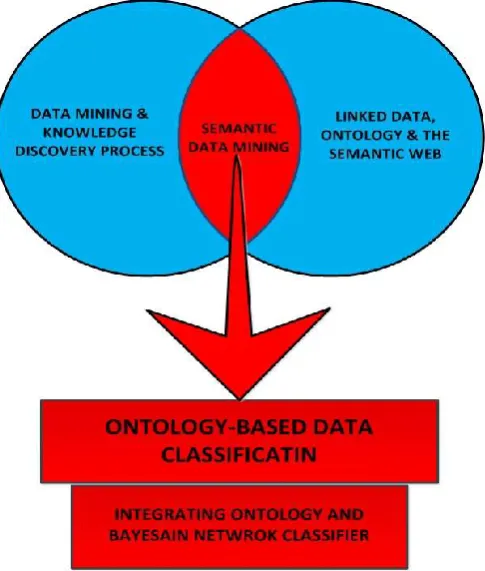
Consequently, the purpose of this chapter is to review the state-of-the-art literature on the above-mentioned topics in such a way that rationalises their connections to the proposed research hypothesis. Figure 2-1 (below) depicts the studied areas and explains the relations between them.
[image:24.595.196.439.411.697.2]Page | 11
2.1
Data Mining and Knowledge Discovery Process
The steady development of modern computers has accumulated enormous amounts of data at a rapid pace. Furthermore, the affordable cost of electronic storage devices has encouraged various organisations to collect data on a daily basis. Consequently, it has been reported that the volume of data is doubled every 20 months. This situation has rightly been described as “data rich but knowledge poor” [18], [23], [24]. Useful examples of sources for data generation may include, but are not limited to, the following:
a. NASA Earth observation satellites generate a terabyte of data every day.
b. The human genome project generates thousands of bytes for several billions of genetic bases.
c. A hundred million customer transactions have been maintained by many companies. d. There are a vast number of automatic recording devices, such as cash machines,
sensors, CCTV recording, Web logs, and many others.
e. Hundreds of millions of websites generate a vast volume of data every day.
f. Hundreds of millions of Facebook and Twitter users are sending and sharing a huge volume of data every day.
It is commonly believed that the availability of a huge amount of data has resulted in an imminent need for tools that can analyse the existing data and generate some useful knowledge. The extracted knowledge could be used in market analysis, fraud detection, customer retention, production control, science exploration, Internet agents, telecommunication and manufacturing, among other things. Hence, in order to respond to this need, the concept of knowledge discovery in database (KDD) was formally introduced at the first KDD workshop in 1989.
KDD is defined as the non-trivial process of identifying valid, novel, potentially useful, and ultimately understandable, patterns in data. The notion of extracting knowledge from data has been investigated under various titles such as data mining, knowledge extraction, information discovery, information harvesting, data archaeology and data pattern processing. However, it is widely agreed that the term KDD is used to refer to a practical, interactive and iterative process, which consists of many steps, coupled with the data mining (DM) process. Although DM is only one step in the KDD process, it is an essential one [1], [23]–[26].
Page | 13
Page | 14 It is evident that some steps are common to all models. The following points give a brief description of the actions taken in each step [23].
a. Developing an understanding of the application domain: this is an opening step in the mining process, which includes analysis of the business domain and understanding the goal of the mining task from the domain experts. Furthermore, an initial decision about the forthcoming activities such as transformation, mining algorithms, representation, and so on, must be taken. However, the mining process is an iterative and interactive process; therefore, when the process is advancing, decisions can always be reviewed.
b. Selecting and creating a data set on which discovery will be performed: the formation of the data that will be used in the KDD process is a crucial step. The quality of the data created in this step will affect the quality of the generated patterns. This step includes the following activities: 1) Identifying what data is available. 2) Collecting extra data if required. 3) Merging the data into one set and identifying the attributes that will be utilised in the KDD process.
c. Pre-processing and cleansing: the main goal of this step is to improve the quality of the targeted data. This step includes the removal of noise or outliers and handling missing data.
d. Data transformation: this step varies from one project to other. It is described as a project-specific activity. However, the essential actions involved in this step include two major tasks. The first task is dimension reduction, such as feature selection, and the second task is attribute transformation, such as discrimination of numerical attributes.
e. Choosing the appropriate Data Mining task: as explained earlier, the goal of the KDD process identified in the initial step affects the later decisions. Consequently, the type of mining algorithm must meet the goals identified in the first step. Generally speaking, there are two types of mining algorithm, namely, prediction and description. The prediction algorithms are also known as supervised algorithms such as classification and regression. Meanwhile, the description algorithms are referred to as unsupervised algorithms such as clustering.
f. Choosing Data Mining algorithm: having defined the goal and type of the KDD
Page | 15
g. Employing the Data Mining algorithm: applying the chosen mining algorithm to
the created data set is at the core of the KDD process. This step may include execution of the mining algorithm many times until the required knowledge is generated.
h. Evaluation: taking into consideration the initial goal identified in the first step, the generated knowledge is evaluated and interpreted. Additionally, it is documented for future use.
i. Using the discovered knowledge: finally, in this step the generated knowledge is integrated into other systems for further actions.
It is a widely held view that the KDD process is multidisciplinary, which requires a combination of tools from various domains such as database and data warehouse technology, statistics, machine learning, high-performance computing, pattern recognition, machine learning, artificial intelligence, knowledge acquisition for expert systems, information retrieval, image and signal processing, visualisation and social science methodologies [25], [28], [29].
Page | 16
Figure 2-3 Taxonomy of data mining methods [30]
Although there is large number of published researches in data mining field, only few of them are applicable in real life applications. In fact, much research has argued that there is a significant imbalance in the data mining field with respect to workability and performance. This situation can be summarised in the following points [4], [5], [7].
a. Algorithm imbalance: many published algorithms versus several really workable ones in the business environment.
b. Pattern imbalance: many patterns mined versus only a small portion of, or no, satisfying business expectations.
c. Decision imbalance: many patterns identified versus effectively very few able to be taken over for business use.
Page | 17 background knowledge into the mining process. In fact, it has been proven that integrating the background knowledge can improve the quality of the generated patterns [32], [33]. In recent years, the emergence of linked data (LD), ontology and the Semantic Web (SW) has played a significant role in the process of knowledge acquisition and representation. Hence, the aim of this thesis is to integrate background knowledge in the form of ontology with the DM algorithm. The proposed framework not only caters for the domain knowledge integration but also facilitates the integration of different silos of data. Therefore, more comprehensive knowledge could be generated in contrast to an area-based data mining approach [4], [7], [16], [18].
2.2
Linked Data (LD), Ontology and the Semantic Web (SW)
The conventional Web has met its objectives as a global document repository that can be easily accessed and consumed by human beings. However, the goal of constructing a document repository that is processed by not only humans but also machines has not been realised. Hence, the SW was introduced as an extension of the current Web, providing the technical capabilities to publish data in a machine-understandable format [34]–[37].
Page | 18
Figure 2-4 The SW reference architecture [41]
Linked data (LD) was introduced by Sir Tim Berners-Lee in 2006 and defined as the set of best practices for publishing and connecting structured data on the Web. These practices are currently known as LD principles. They can be summarised in the following points [42].
a. Uniform resource identifiers (URIs), used to name things.
b. They use Hypertext Transfer Protocol (HTTP) and URIs, so that people can look up names.
c. When someone looks up a URI, they provide useful information, using the standard resource description framework (RDF) and the simple protocol & RDF query language (SPARQL).
d. They include links to other URIs, so that they can discover more things.
Page | 19 RDF is used to represent the defined entities [43]. ]. In fact, RDF is the basic building-block for information representation in the SW.
The structure of the RDF statement is built based on a triple format, that is, subject– predicate–object, which forms a graph-based data model. Furthermore, RDF is enriched by the RDF schema (RDFS for short). RDFS is utilised to define the vocabularies used in a specific RDF data model. It uses a sub-class, sub-property relationship, in addition to domain and range restrictions, to describe the relationship between objects and to identify which property applies to which object. In contrast to RDF and RDFS, the Web Ontology Language (OWL) has added more vocabularies to describe properties and classes, leading to better machine readability of the Web content [42], [44], [45].
The word “ontology” is rooted in philosophy. Philosophers used ontology to refer to the study of the nature of existence. Nevertheless, the concept of ontology has been hijacked by the computer science field and used in a different sense. In computer science literature, ontology is used to provide a shared understanding of domain knowledge and treated as a special kind of information object or computational artefact. It has been defined as “formal, explicit specification of shared conceptualization”. The terms used in the ontology definition could be further explained as follows [9], [36], [37], [46]:
a. Formal indicates that ontology must be machine-readable.
b. Explicit refers to the fact that the types of concept, and the constraints on their use, are explicitly defined.
c. Shared means that the notation captured by ontology must reflect a consensual knowledge that is accepted by a group, and not a private vision of certain individuals.
d. Conceptualisation refers to an abstract model of some phenomenon in the world, having identified the relevant concepts of the phenomenon.
Page | 20
Figure 2-5 Ontology RDF triple relation [44]
According to [44], the structure of ontology is defined as tuple consisting of the following elements: S = (C, R, H, rel, A) [44], where:
C is the set of entities describing the conceptual structure for the targeted system; R is the set of relation types;
H is the set of taxonomy relationship of C;
rel is the set of relationship of C with relation of type R, where rel ⊆C X C; A is the set of description logic sentences.
Furthermore, rel has been further defined as a set of three tuple relations, that is, rel = (s, r, o), which represents the subject–relation–object relationship, where:
s is the subject, which is an element from C; r is the relation, which is an element from R; o is the object, which is an element of C.
To further illustrate the structure of ontology and to gain a better understanding of its basic components, the following example converts the ontology model given in Figure 2-5 (above) into its equivalent RDF statements.
Example: the RDF triples for the ontology model of the publication system (Figure 2-5). hasAuthor(article001,person002).
hasTitle(articale001,”Science of nature). hasName(person002,”John Ken).
The above RDF statements can be serialised in RDF/XML syntax, as shown in Figure 2-6 (below).
Page | 21 It has been reported that ontology can be broadly classified into two categories, namely, lightweight and heavyweight ontologies. The lightweight ontology is mainly concerned with taxonomies and includes concepts, concept taxonomies, and the relationship between concepts and properties that describe concepts. On the other hand, heavyweight ontology addresses the domain in a deeper way and provides more restrictions by adding axioms and constraints to the lightweight ontology. Figure 2-7 (below) categorises ontology based on its structural complexity. It follows a line where ontologies move from lightweight to heavyweight [46], [49].
Figure 2-7 McGuiness Ontology Spectrum Classification [49]
The process of ontology development and management is not a trivial process; nor can it be implemented in a simple way. In fact, the objectives of the constructed ontologies and the development methodology must be critically assessed and closely pursued by the organisation or the individual pushing for their creation. The field that studies the methods and tools for ontology development and maintenance is known as ontology engineering. Ontology engineering refers to the set of activities that deal with the ontology development process, which includes the ontology life cycle, methodologies, tools and languages for building ontologies. It has been advised to implement the following activities during the ontology development process [9], [46].
a. Ontology management activities include scheduling, control and quality assurance. b. Ontology-development-oriented activities are grouped into pre-development,
development and post-development.
c. Ontology support activities include knowledge acquisition, evaluation, integration, merging, alignment, documentation and configuration management.
Page | 22
Figure 2-8 Ontology development process [46]
Having defined what ontology is and explained its structure and how it can be used to represent domain knowledge, the next section discusses the integration of ontology in the DM techniques.
2.3
Traditional Data Mining Versus Semantic Data Mining
As mentioned in the previous section, the KDD and DM processes have been defined as the non-trivial process of identifying valid, novel, potentially useful and ultimately understandable patterns from data. Additionally, it has been believed that KDD is a multidisciplinary process, which requires the integration of various techniques spanning different disciplines such as database and data warehouse technology, statistics, machine learning, high-performance computing, pattern recognition, machine learning, artificial intelligence, knowledge acquisition for expert systems, information retrieval, image and signal processing, visualisation and social science methodologies. Furthermore, many researchers hold the view that the incorporation of domain knowledge with the KDD process enriches the mining process and improves the quality of the generated knowledge [1], [25], [29].
Page | 23 is meant by semantic data mining. It refers to data mining tasks that systematically incorporate domain knowledge, especially formal semantic, into the mining process. The branch of semantic data mining that uses ontology to represent the domain knowledge is called ontology-based semantic data mining, which forms the core of this thesis [11], [13], [50], [51]. Figure 2-9 (below) depicts the schema of the ontology-based semantic data mining methodology, as proposed by Novak et al. [51].
Figure 2-9 The proposed semantic data mining methodology schema [51]
Recent research has suggested that ontology can play various roles in the DM task. For example, [51] exploited the “is-a” hierarchical structure of ontology to prune the pattern search space and obtain efficient search techniques. Meanwhile, [11] reported that using ontology for semi-structured data semantic annotation is an essential step in the semantic data mining process. He claimed that semantic annotation intertwines the data with its semantics. However, the survey conducted by [50] concluded that ontology can contribute to the mining task in three ways:
a. Bridging the semantic gap between the data, application, data mining algorithms and data mining results.
b. Providing data mining algorithms with a priori knowledge, which either guides the mining process or reduces/constrains the search space.
c. Providing a formal way of representing the data mining flow, from data pre-processing to the mining results.
Page | 24
2.4
Ontology-based Data Classification
Ontology has played various roles in the data classification process at different domains. Several studies have reported that text data classification methods have used ontology to represent the semantic aspects of text data and to inject it into the mining process.
For instance, the authors of [52] developed lexical variations and a synonyms ontology to define the logical relation between different words used in customers’ reviews. Hence, even though the online product reviews are written using different words that share the same meaning, they can still be classified using the proposed support vector machine (SVM) augmented by the developed lexical variation ontology. The basic idea is that the weight of a word can be measured based on the weight of its synonym or lexical variant. Thus, if word-1 is a synonym of word-2 and the weight of word-2 has been calculated, then the weight of word-1 can be measured based on the weight of word-2. Similarly, the SAHBN model proposed in this thesis used the “is-a” relation enriched by the true path rule (TPR) to generate the values of the semantically related attributes. Although the authors of [52] claim that their model was tested using 20,000 product reviews for training and 6,000 reviews for testing, and that good classification accuracy was obtained, the key limitation of this approach is that the training data set must be tokenised based on the developed lexical variation ontology, and no evidence has been given to prove that the developed ontology is comprehensive enough to cover all the identified words. Additionally, it has not been discussed what alternative actions can be taken if the identified word does not match any concept class in the developed ontology. In contrast to this approach, our method guarantees that the identified prediction attributes always match a concept class in the used ontology.
Page | 25 discriminatory power. Eventually, they concluded that the support vector machines (SVM) obtained the highest performance.
Despite the various advantages of the work presented by [53], it would have been more interesting if it had utilised the extracted ontological knowledge, not only in the attributes enhancement stage but also in the subsequent stages of the mining process. Hence, the SAHBN model proposed in this thesis was designed to use the ontological knowledge, not only to identify the semantic relations between attributes but also to guide the structure construction of the BN classifier, to check training data consistency and to assist the CPT estimation process.
In a similar way, [54] exploited the “is-a” relation in the domain ontology to extract the ancestors’ concepts. Accordingly, the authors claim that extending the number of the word vector to include semantically extended words generated better results. In fact the authors used ontology not only to identify the semantically related concepts, but also to calculate the weight for each concept and its parents. Likewise, the SAHBN model proposed in this thesis used the “is-a” relation to anticipate the values of the semantically related variables, eventually using these values to calculate the conditional probability tables to quantify the strength of the semantic relation.
The work proposed by [54] was validated using a data set consisting of 952 CT abdomen and 1,128 CT neuron reports, which were classified using the k-nearest-neighbour (KNN) algorithm, with and without integrating the semantic aspect. Consequently, the authors concluded that the semantically extended vector achieved a better performance compared to the non-semantic case.
In slightly different way, [55] used ontology to calculate the weight for the concept vector space (CVS). The authors used ontology and the page-ranking algorithm to calculate the importance of each concept and then form the result as an improved concept vector space (ICVS). In fact, concept weight is an aggregation of the concept’s importance and relevance. The proposed model consists of three steps:
1. Convert the domain ontology into a graph.
2. Calculate the weight of each concept using the page-ranking algorithm. 3. Construct the improved concept vector space (ICVS).
Page | 26 classification algorithms were used to evaluate the performance of the proposed model. Eventually, the authors reported that the semantically improved concept vector space leads to better classification performance in terms of F1 measure compared to the standard concept vector space.
Although this research utilised the structure of ontology to identify the importance of concepts, it main weakness is that only the number of links (i.e. relations) was considered. In other words, all links were given the same importance regardless of their semantic meaning. In contrast to this approach the SAHBN model proposed in this thesis was designed to exploit the implicit semantics of the “is-a” ontological relation.
In the same way, [56] used the Unified Medical Language System (UMLS) ontology to construct a semantically aware classifier. UMLS ontology was used in two different phases, before and after the classifier training stage. In the first phase, before the training stage, the semantic kernel method was used to transfer the traditional bag of words into a bag of concepts. Consequently, the enriching vectors method was applied in the second phase after the training stage and before the prediction stage to overcome the shortage of the lexical matching.
The ultimate aim of Albitar et al.’s [56] research was to investigate the advantages of two semantic enrichment strategies, semantic kernel and enriching vectors, on conceptualised text classification. The authors concluded that the classifier’s performance depends on the semantic similarity measure used in the enrichment and prediction phases. Perhaps the most important advantage of this method is the integration of ontology at two different stages of the mining process, which highlighted the increasing role of ontology. Hence, the SAHBN model proposed in this thesis used ontology, not only to define the relationship between attributes but also to guide the classifier structure construction process and assist in the conditional probability calculation stage.
Page | 27 this extra knowledge to select the most relevant features. A real data set consisting of 18 anonymous records was used to test the proposed model.
Although the testing data set was small, the authors asserted that the proposed approach demonstrated a good performance. However, the authors did not offer a clear explanation about the exact rules and relations extracted from ontology and how they empowered the entity recognition stage.
It is reported that ontology can be used not only in the classifier training and prediction stages, but also in the pre-processing steps, such as dimension reduction, and post-processing steps, such as result interpretations. For example, [58] used the Medical Section Head (MeSH) ontology during the attribute-selection stage to transform a traditional bag of words into a bag of concepts. The produced bag of concepts covers not only the extracted words but also their hyponyms. The authors’ ultimate goal was to reduce the dimension of the vector and enrich its contents. This goal was met in the following ways:
1. Disambiguation mapping strategies were used to map each term onto ontology concepts.
2. Hyponyms were added to enrich the generated vector.
Elberrichi et al. [58] claimed that the proposed ontology-based bag of concepts approach led to a 30% better performance compared to the standard bag of words’ method. Even though natural language disambiguation has a complex nature, since there is no definite interpretation of the meaning of words, the findings of this research reported that ontological semantic knowledge has improved the classification process by using more comprehensive ontology concepts as prediction attributes instead of using simple words. Likewise, the SAHBN model presented in this thesis represented the prediction attributes in the form of ontology concepts. However, unlike the work of Elberrichi et al. [58], our research used ontology not only to represent the prediction attributes but also ontological semantic knowledge to construct the classification model structure and assist the process of quantifying the strength of relations between various concepts.
Page | 28 suggested a significant improvement in the F-measure value (3.5%) and recall (5.25%), on average.
The model proposed by [59] was tested using the most recent 1,000 abstracts of 12 journals in the MEDLINE database. The journals were selected and organised into different groups in such a way as to ensure classification accuracy. Eventually, the C4.5 classification algorithm and cross-validation technique were applied to evaluate the overall performance. However, the research of J. Wanget al. [59] would be more robust if it had included other classification algorithms such as decision trees and support vector machines, among other things. Additionally, one question that needs to be asked is why the authors did not use accuracy to measure the quality of their classification model, relying instead on the precision, recall and F1-measure.
Likewise, [60] reported that using ontology to direct and filter the results obtained by the term frequency-inverse document frequency (tf-idf) classification algorithm led to 3.125% more subjects being correctly classified. The authors used ontology in the second and third stages of the proposed process. A program has been developed to direct the broad classification of results into ontology classes. Consequently, a set of candidate classes for each input document was generated in the second stage. Finally, in the third stage candidate ontology classes were further purified to obtain one ontology class for each input document.
Perhaps the most serious weakness of the work proposed by [60] is that the developed ontology is very limited in terms of size and applicability. Unlike this study, the SAHBN model proposed in this thesis utilised the GO, which is known to be a comprehensive and high-quality source of ontological knowledge. Additionally, the GO is subject to regular maintenance and upgrading by various research groups.
Page | 29 Consequently, various machine learning algorithms were used for each classifier. J48, Naïve Bayes and LibSVM were applied by the subject classifier, and the Linear Regression, LibSVM and SMOreg models were used by the sentiment classifier. Eventually, the proposed model was evaluated using a manually created training data set, and the authors concluded that the developed model accurately classified the text subject into predefined classes and evaluated the emotional expression presented in the text. One major drawback of this approach is that ontology was used to predefine the possible classification classes. Hence, the quality of the classifier is totally dependent upon the quality of the developed ontology. Unlike this approach, our model did not restrict the possible classification classes based on the created ontology concepts.
In contrast to the work presented in [58]–[61], this thesis proposed a model that not only used ontology in the pre-processing or post-processing stages of the classification process but also contributed to the core classification stages, as will be discussed in the third chapter.
It is a commonly held view that the quality of the text classification algorithm relies heavily on a well-classified training corpus. However, in a real-life scenario very often the training corpus is scarce or even not available. Hence, many scholars have proposed the use of background knowledge in the form of ontology as a classifier to eliminate the need for a training data set. This is exemplified in the work undertaken by [62].
The authors of [62] converted the English language Wikipedia to ontology that divides news documents into topics of interest. The main argument of the proposed work was that the semantic similarity between the news text document and a fraction of the developed news ontology could be used for news document classification.
In the first step a group of words extracted from the news text was matched to a set of concepts in the ontology. A disambiguation technique was applied in the second step to identify more accurate entities during the matching process. Furthermore, a sub-graph of the news ontology was extracted after eliminating the less important connections. Finally, the semantic similarity measure between the news document and the news ontology was calculated to identify the class of the news.
Page | 30 authors claimed that the proposed ontology-based news classification methods produced very good results.
Similar to the work presented by [61], the authors of [62] used ontology to predefine the classification classes. Hence, they restricted the application domain of the proposed models into specific cases. Unlike these studies, our approach used semantic knowledge in the form of ontology to enrich the classification process and did not restrict the domain of application.
A more recent example of a similar approach was proposed by [63] when the authors developed ontology in the domain of occupational health and security application in the oil and gas industry. The developed ontology was used as a classifier to detect accidents from unstructured text and to eliminate the need for a training data set.
Page | 31 read the RDF file to create ontology and to check whether or not the test email was spam. In total, 500 test emails were used to evaluate the performance of the proposed model and to compare it with the output of the SVM and Naïve Bayesian classifier.
Consequently, the authors of [64] claimed that their model was more successful than other methods used to detect spam and valid emails. However, a key problem with this approach is that converting a domain-specific database into an ontology using Weka decision trees conflicts with the basic principle of ontology development rules, which state that ontology must reflect a common knowledge that could be shared unambiguously between various domains [9].
In a slightly different way, [65] developed an ontology-based classifier for tumour staging using the tumour-node-metastasis ontology (TNM-O) classification system. The first step in the proposed model is to convert the pathological information into RDF individuals, which matches the concepts presented in the TNM-O ontology. Then, the HermiT description logic reasoner was used to classify the created individuals. A total of 382 entries in the pathological data set was used to test the proposed model and to compare the results with the experts’ decisions. Accordingly, the authors concluded that their model accurately classified all the 382 entries and helped to detect and explain the inconsistencies between the expert and automatic classifications.
Perhaps the most serious drawback of the work presented by [64] and [65] is that the classification was made based on an ontology reasoner that was developed based on description logic. Description logic has been defined as a decidable fragment of first-order logic. In other words, an instance either belongs or doesn’t belong to a concept [66]. Hence, the uncertainty factor has not been taken into consideration, which goes against the nature of many real-life situations, especially in the health-care sector. In contrast to these methods, the model implemented in our thesis overcomes this drawback by integrating ontology and uncertainty in the form of the Hierarchal Bayesian Network (HBN).
Page | 32 The work presented by [67] did not introduce any new bioinformatics techniques or algorithms to discover sequence features. Rather, it enhanced the existing tools used by ontology and proposed an approach to automate the protein classification process. In other words, the structure and reasoning power of ontology were exploited to formally represent the phosphate protein family classification and to automate the assignment of a new protein instance into the phosphatase family.
Accordingly, the proposed model was tested on the human and Aspergillus fumigatus genomes, and the authors claimed that their ontology-based automatic protein classification approach matched and sometimes outperformed the experts’ annotation process. However, this study would have been more interesting if it had included the notion of uncertainty in the reasoning stage and not relied solely on the description logic reasoner.
Another possible example would be the research carried by [68], in which the existing medical ontology was enriched by domain ontologies to represent specific hospital requirements. Ontology played two different roles:
1. Ontology was used to explain the semantic meaning of the time point in the medical data. For example, the time associated with the white blood cell (WBC) count process did not explicitly indicate whether it was the time when the blood sample was taken or when it was analysed in the laboratory. Hence, ontology was used to overcome this challenge.
2. The uncertainty of the prediction was represented in the form of ontology. In the medical domain, the clinical decision support system (CDSS) is designed to help junior or non-expert clinicians to make more informed decisions. Hence, it is necessary to convey the accuracy of the prediction to the medical staff. In this work ontology was used to represent this information. For instance, the probability of a patient with low WBC having sepsis is 17%.
As we have seen, this study used ontology not only to enrich the semantic meaning of the data but also to convey the uncertainty of the information to the end-users. However, it seems that the study focused on the time dimension of the data and overlooked other semantic aspects in the data.
Page | 33 interactions between epileptic symptoms. Thus, the structure of the seizure ontology and the Ck matrix were used to quantify the degree of association between each pair of symptoms. The number of arcs in seizure ontology was used to measure the distance between symptoms. Consequently, the mean for all the matrices was computed and seizure assigned to epileptic type with the minimum distance from the mean.
Consequently, the authors tested the proposed ontology-based classification model using a data set consisting of 129 patients, and compared the results with 7 clinicians with different degrees of expertise; they concluded that their model represented an essential step in performing automatic epilepsy classification and that it helps in the identification of symptoms that are necessary for the classification process. However, the findings of this research would be more useful if a larger data set had been used. Additionally, it seems that the authors only relied on the structure of the developed ontology by utilising the number of arcs to classify the epileptic type. Hence, all arcs were given the same weight, regardless of their semantic meaning.
As indicated previously, ontology has been used in image data classification. Hence, the following part of this section gives examples of ontology-based image data classification. This can be seen in the work presented by [70], in which the authors developed an ontology model to classify the objects in the images collected by the Airborne Laser Scanner (ALS) into various building types, such as “residential/small buildings”, “apartment buildings” and “industrial and factory buildings”.
The first step of the model proposed by [70] sought to extract the features of different building types from text data using the ensemble random forest (RF) algorithm. Then ontology was constructed based on the information generated by the RF algorithm. Finally, the FaCT++ description logic reasoner was used to classify an object in a given image.
![Figure 1-1 Research process in flow chart [20]](https://thumb-us.123doks.com/thumbv2/123dok_us/8682896.875146/19.842.121.752.125.421/figure-research-process-flow-chart.webp)
![Figure 2-3 Taxonomy of data mining methods [30]](https://thumb-us.123doks.com/thumbv2/123dok_us/8682896.875146/30.595.106.535.56.346/figure-taxonomy-of-data-mining-methods.webp)
![Figure 2-4 The SW reference architecture [41]](https://thumb-us.123doks.com/thumbv2/123dok_us/8682896.875146/32.595.102.503.54.483/figure-the-sw-reference-architecture.webp)
![Figure 2-8 Ontology development process [46]](https://thumb-us.123doks.com/thumbv2/123dok_us/8682896.875146/36.595.113.527.58.357/figure-ontology-development-process.webp)
![Figure 2-13 2LBN Structure [83]](https://thumb-us.123doks.com/thumbv2/123dok_us/8682896.875146/56.595.265.400.190.407/figure-lbn-structure.webp)
![Figure 3-1 GO as Graph [105]](https://thumb-us.123doks.com/thumbv2/123dok_us/8682896.875146/71.842.89.779.96.482/figure-go-as-graph.webp)
![Table 3-2 Contingency Table Sample [108]](https://thumb-us.123doks.com/thumbv2/123dok_us/8682896.875146/73.595.157.487.50.315/table-contingency-table-sample.webp)
![Figure 3-3 Critical Values of Chi-Squared Distributions [109]](https://thumb-us.123doks.com/thumbv2/123dok_us/8682896.875146/76.595.137.549.183.751/figure-critical-values-of-squared-distributions.webp)
