Decision and intuition during
organizational change : an evolutionary
critique of dual process theory
Talat, U, Chang, K and Nguyen, B
http://dx.doi.org/10.1108/BL0820170016
Title
Decision and intuition during organizational change : an evolutionary
critique of dual process theory
Authors
Talat, U, Chang, K and Nguyen, B
Type
Article
URL
This version is available at: http://usir.salford.ac.uk/id/eprint/43457/
Published Date
2017
USIR is a digital collection of the research output of the University of Salford. Where copyright
permits, full text material held in the repository is made freely available online and can be read,
downloaded and copied for noncommercial private study or research purposes. Please check the
manuscript for any further copyright restrictions.
Talat, U., Chang, K., & Nguyen, B. (accepted on 6
thAugust 2017). Decision and
intuition during organizational change: An evolutionary critique of dual process theory.
The Bottom Line. (ABI, Scopus, ISSN: 0888-045X)
URL http://emeraldgrouppublishing.com/products/journals/journals.htm?id=bl Publisher Emerald
Purpose: The purpose of this paper is to review intuition in the context of organizational change. We
argue that intuition as a concept requires attention and its formulation is necessary prior to its
application in organizations. The paper provides a critique of Dual Process Theory and highlights
shortcomings in organization theorizing of intuition.
Method: The paper is conceptual and provides in-depth theoretical discussions by drawing from the
literature on decision and intuition in the context of organizational change.
Findings and Analysis: In investigating whether Dual Process Theory is sufficiently clear, we found
ambiguous explanations and arguments. Specifically, the current definition provided by Dane and
Pratt is not clear in terms of its four sections: (1) The consciousness of non-conscious processing, (2)
involving holistic associations, (3) that are produced rapidly, which (4) result in affectively charged
judgments. Finally, we note that the evolutionary perspective is missing and we provide foundational
concepts for such a perspective, including the discussion of information templates, memes and genes,
as argued by research, condition intuition.
Originality and value: The paper finds that an evolutionary perspective develops a picture of intuition
as an adaptive resource. This evolutionary perspective is currently absent in research and we provide
foundational concepts for such a perspective. We propose specific arguments to highlight the
evolutionary perspective.
Introduction
Humans are often agnostic about the kind of logic found in the annals of Mathematics, Physics and
Economics. This is particularly the case for practitioners many of whom immersed in the swim of
organizational dynamics will not use a logical tool to make sense of typical work-day problems. Even
more impactful decisions like promoting a subordinate to further his or her career for instance, are not
commonly based on normative theorizing or logic. Much of the time, practitioners and experts
embroiled in pressured and competitive environments follow their intuitions about situations (Locke,
2015). Similarly, in their private lives logic has little attraction. Typically, a man will not propose
marriage to a woman based on the logical fit derived through calculations about offspring
development and adaptation success. Instead, he would follow his gut feeling. The idea that humans
live through personal reasoning, often in the form of intuitive feelings, has been around since Barnard
(1938) and Selznick (1948) argued for the existence of alogical mental states (i.e. states that do not
wholly reflect normative logic). Recently, in organization research circles renewed interest in the
phenomena of intuition has emerged.
Focus of Paper
There are two broad arguments: first, that intuition is a valuable resource often used by experts
involved in business negotiations. Second, we must be cautious in praising intuition since it is not
suitable in all situations. For organization theorists concerned with these arguments, a fundamental
task involves asking what intuition is (Lieberman, 2000; Evans, 2012; Akinci and Sadler-Smith,
2012). This forms our focus in the current conceptual paper. In the larger scope of things, the
challenge for research involves overcoming a research legacy that portrays workers as rational agents
plagued with intuition and other mental states like emotion. Simultaneously, whether intuition is a
valuable resource or one that is useful in particular environments, represents a concern secondary to
the crucial task of determining what intuition is. The current paper addresses this concern by
i/ critically evaluating the dominant account of intuition offered by Dane and Pratt (2007) and
ii/ by offering an account of intuition during organizational change based on evolution.
The paper is organized as follows: First, the organizational change context is reviewed in terms of its
importance for studying intuition. Second, definitions of intuition are reviewed and Dane and Pratt
(2007) dual process theory definition is presented. The components proposed by Dane and Pratt are
absent in organization theorizing of intuition. The perspective suggests ideas in relation to Dual
process theory.
Why Organizational Change?
Human societies remain continuously in flux through the organizing processes of organizations. The
notion of change is an intrinsic dimension of the organization, which in a sense remains in flux.
However, use of the term organizational change by scholars specifically refers to intended
modifications in human and non-human processes of the organization (Ibarra and Pertiglieri, 2010,
Antonacopoulou and Gabriel, 2001, and Armenakis and Bedeian, 1999). Change management efforts
are reactions to environmental demands and concerns for operational efficiency. About 70% of
change projects fail. Successful change depends to a considerable extent on leadership. The Leader
provides a vision, a direction, and emits security in uncertain conditions of change. He or she provides
unity and often relies on gut feeling or intuition as a source of important decisions, generated in the
context of poor rationalizations, high uncertainty and weak communication (Hensman and Sadler-
Smith, 2011).
Akinci and Sadler-Smith (2012) suggest that organization research should ask what intuition means in
terms of changes in leader behavior. In this regard, organizational change provides an opportunity (i.e.
the dynamic environment) to study changes in leader behavior experienced as intuitive moments of
individual experience in leadership positions. The implementation of organizational change alters
working conditions and cogently stimulates worker behavior including cognitive as well as behavioral
reactions. Senior management pressured by the complexity of experience, often withdraws from
rationalizing behaviors. Instead, overwhelmed, they intuitively grasp a way forward. The point is that
leader rationality is bounded. It is a limited deciphering framework. In the face of complex and
dynamically occurring socio-economic change and related sets of humanly incomputable stimuli,
rational frameworks can fail (see Simon, 1987). When this happens, senior managers in leadership
positions turn to their gut.
In the 1990’s the CEO of Chrysler Bob Lutz made the intuitive decision to invest in the Dodge Viper.
At the time, the investment was a radical change in his behavior that made little sense from logical
perspectives. The vision had come to Bob on a long car drive. He remembers a feeling in his gut
telling him that it would work. In hindsight the Dodge Viper was a great success (Hayashi, 2001). It
was ‘gut feel’ rather than mere rationalization that won for Chrysler. When senior managers leading
organizational change follow their gut, they recognize complementarities in apparently contradictory
forces of change (Sutherland and Smith, 2013: 220). A business solution that seemingly contradicts
feeling the senior manager or leader would myopically circle around the same issues whilst grounded
and constrained in domain specific knowledge and routines (Salas, Rosen and DiazGranados, 2009:
10). For example, a finance CEO tends to see the organization in financial terms based on a repertoire
of experiences. Here, intuition has the power to introduce a fresh perspective that is not crowded out
by regularity of thought and habit, but by some unique combination of perceptions. To escape from
regularity Lutz went on a long car drive leaving behind the regulating confines of his workplace. His
intuition was the breaking and re-integration of conscious patterns of thought. But the converse
situation also seems to work. During change organisations also hire specialists that bring expert
domain-specific knowledge to manage aspects of change. Their schemas offer lessons that have been
learnt through projects with various experiences and environments. Intuitive decisions draw on such
schemas (Hogarth, 2001; Dane and Pratt, 2007) and play a strategic and project level role during
organizational change. In other words, intuition during organizational change is the attainment of
‘other than regular’ thoughts that stand outside rational frameworks of managers. Overall, the
presence of intuition during organizational change is a distinct opportunity for studying this
resourceful phenomenon.
What Intuition is and Dane and Pratt’s Definition
Over the past eight decades the concept of intuition has attracted attention from management scholars
in North America and Europe (see review by Akinci and Sadler-Smith, 2012). Etymologically, the
word intuition comes from the latin word in-tuir. Hodgkinson et al (2008) translate this as the act of
knowing from within. In other words, intuition is the innate tendency that provides actors with
knowledge and business solutions. Most studies assert that intuition is different from logical
reasoning, and at the same time the studies have nothing more to add (Evans, 2010). Historically, the
term intuition has been associated with mystical revelations popularized in folklore and religious
stories in cultures around the world. It is a spiritual and transcendental experience of the individual. It
is a prophetic revelation in primitive belief systems.
Philosophical and scholarly accounts have defined intuition as an immediate apprehension of things
which involves no explicit rationale or deliberation (Wild, 1938, 226; Rorty, 1967:204; Myers, 2002:
128; Dane and Pratt, 2007; Akinci and Sadler-Smith, 2012). In other words, a person suddenly
clenches the answer to a problem, and cannot explain how it came about. For practitioners this
presents an alternative to rational models (Lieberman, 2000; Akinci and Sadler-Smith, 2012). A top
executive at Apple, Tim Cook, remarked in his interview that his decision to join the company was a
gut feeling. His exploration of rational and analytical models had failed him. Similarly, a study
interviewed officers who rated the credibility of loan applicants. It found that hard data analysis was
(2007) contend that intuition emerged to cope with the trade-off in decision theory whereby decision
accuracy and decision speed are inversely related. The hope is that intuitive judgments are both
accurate and timely (Khatri and Ng, 2000).
Related to this, the underlying approach that dominates organization research is the Dual Process
Theory perspective (DPT) of intuition. The perspective emerged and developed from 1960 onwards,
and is closely associated with seminal work by Daniel Kahneman. The core underlying assertion is
the existence of two systems of human reasoning; system 1 and system 2 (Evans, 2012). Over the
years different studies have offered exclusive features of the two systems, but a growing number of
studies agree on some shared features (Akinci and Sadler-Smith, 2012). System 1 is older in
evolutionary terms and it consists of unconscious, rapid, automatic, and high capacity mental
processes. Such processes are interpreted by Smith and Ward as “cognitive schemas that occur
without explicit awareness or deliberate intention, which can be described as implicit cognition
(2012:463). System 2 is relatively recent and consists of conscious, deliberate, and relatively slow
mental processes. An instance where an actor claims to have had an intuition involves both systems.
Implicit cognitive processes occur in system 1 and surface as a judgment that seems to be
automatically integrated within system 2 (Kahneman, 2002). Overall, most of the processing and co-
ordination of memory structures occur underneath conscious awareness. Akinci and Sadler-Smith
(2012) highlight that under the DPT perspective an influential definition is offered by Dane and Pratt
(2007), which has been widely adopted by organization theorists and researchers.
Intuition is a (1) non-conscious process (2) involving
holistic associations (3) that are produced rapidly, which
(4) result in affectively charged judgments (2008: 36).
This definition draws on four themes, which are; the non-conscious domain, the related development
of holistic associations, rapid and automated mental processing, and affective experiences of
individuals. Critically reviewing these themes in context, the sections below expose considerable
challenges. The challenges appear through an evolutionary perspective, in particular the usefulness of
complimentary process of biological evolution; although both have explanatory power. Organizational
change studies are used to further contextualize and exemplify points and arguments.
(1) The Consciousness of Non-Conscious processing
This section critically reviews the pitfalls of non-conscious processing and offers a new way of
thinking about intuition through evolution. Generally, whilst the theme of non-conscious processing
has been widely adopted by scholars of intuition, there remains philosophical uncertainty on this
front. How should this type of processing be interpreted if not a set of invisible assumptions? In a
historical context, the idea of non-conscious processing and structures in relation to intuition can be
traced to the development of psychological types by Carl Gustav Jung, seminal work by Selznick
(1948), the notion of Bounded Rationality by Herbert Simon (1987), work on tacit structures by
Polanyi (1967), through to the Cognitive activation theories that emerged in the late 1970’s and early
1980’s (Bower, 1981; Salkovskis, 1986; Kahneman, 2002). Specifically, Evans (2003: 458) explains
that in the DPT context “Dual-process theories of thinking and reasoning quite literally propose the
presence of two minds in one brain. The stream of consciousness that broadly corresponds to System
2 thinking is massively supplemented by a whole set of autonomous subsystems in System 1 that post
only their final products into consciousness and compete directly for control of our inferences,
decisions and actions.” The passage suggests that whilst a leader consciously experiences the world
through system 2, the driving schema consist of invisible ghosts of system 1 (i.e. the automated sub-
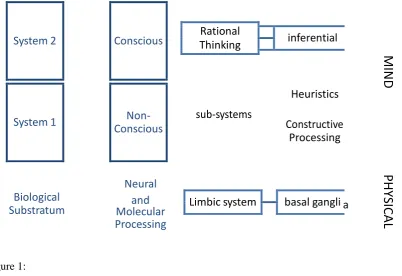
systems of intuition). There are two subsystems: heuristics1 and constructive structures. Figure 1
situates these within system 1 and between system 2 (i.e. conscious rationalizations) and biological
substratum (i.e. Limbic region).
1 A heuristic is defined as a rule of thumb. It is a mental program in system 1, which manifests as an automatic
System 2
System 1
Conscious
Non-
Conscious
Limbic system
basal gangli
M
IN
D
P
HYS
IC
AL
Rational
Thinking
inferential
sub-systems
Heuristics
Constructive
Processing
Biological
Substratum
Neural
and
a
[image:8.595.86.489.69.345.2]Molecular
Processing
Figure 1:
Whilst Dane and Pratt (2007) define non-conscious processing in system 1 by distinguishing it from
rationalizations of system 2, they also implicitly endorse that both systems are conditioned by neural
processing; i.e. in reference to basal ganglia activation - Lieberman (2000). Thus, in the above figure
system 2 works alongside system 1, whilst biological substratum underlines the whole affair. Dane
and Pratt (2007) take stock of evidence from cognitive and neurological psychology. In these
disciplines conceptualizations, definitions, and theory is increasingly being based on interactionist
ontology (Bohl and Van de Boss, 2012). This ontology states that faculties and traits of individuals
are the result of interactions between forces in biology and society. That is, the change leaders
intuition is appearing experience that is emergent through the interaction of forces in biology and
society. However, no philosophical tenet is explicitly stated in Dane and Pratt’s definition. Without a
philosophical interpretation their cross-disciplinary definition is open to the critical question: are
systems 1 and 2 substantiations of mind stuff as assumed by Evans (2003), which in turn are reducible
to physical matter constituting biological substratum conditioned by social experience? If Dane and
Pratt’s definition implicitly endorses interactionism then the further question arises; is system 1 a
purely theoretical model that aides the conceptualization of neural and social impact unexplainable by
system 2 deliberations and conscious inferences? If the answer is yes, then the concept of system 1
through an interactionism lens represents the theoretical modelling of activity originated in the basal
ganglia of the limbic region (Lieberman, 2000) continually conditioned by social experiences and
learning (indicated by arrow in figure 1). Conclusively, it is not a ‘second mind’ as asserted by Evans
extension. It is a useful theoretical assumption nonetheless. Similarly, system 1 has no spatial
extension apart from its neurological substratum. It is useful as a theoretical model.
There has been criticism since the terms system 1 and system 2 were introduced by Stanovich (1999).
It is argued that “Dual-process theories of reasoning exemplify the backwards development from
precise theories to surrogates” (Gigerenzer, 2011:739). It is also argued that the two system
conception lacks conceptual clarity and provides insufficient empirical evidence (Keren and Schul,
2009: 534). In other words, system 1 is not observable, nor experiential, and thus generalizations that
adopt the two minds hypothesis rest on theoretical foundations. In the context of such criticism we
assert that system 1 is a theoretical modelling or set of assertions about what system 2 cannot explain
but requires for its definition. Simultaneously, system 1 is an accounting for behaviors induced by
neural activity and shaped by external stimuli. Several questions remain unanswered and reflect
crucial drawback in conceptualizing intuition, particularly from a cross-disciplinary perspective
employed by Dane and Pratt (2007). Principled by interactionism intuition research has the
opportunity to explore new perspectives offered by the powerful idea of evolution. In their extensive
review of intuition research over the past eight decades Akinci and Sadler-Smith (2012: 117)
recognize that “Evolutionary perspectives are neglected but potentially fruitful avenue of inquiry for
intuition research” applicable in organizations. The evolution perspective is an alternative space for
exploring intuition. A decade earlier in 2006 a special issue in the Journal of Organizational Behavior
highlighted the explanatory power of evolution. Historically from this perspective topics including
leadership, teams structure and culture have received limited attention based on work by Jay (1971)
and Kolodny (1979) and more recently Lawrence and Nohria (2002).
Arguments in such studies emerge from the central idea of biological evolution commonly identified
with Charles Darwin. Following the publication of the Origin of the species over the following
century and a half several interpretations of evolution emerged and influenced theory construction in
biology. This is often denoted as Darwinism. The central idea is modification by descent. This
involves the forces of natural selection acting to influence the modification of genotype and
phenotype parts in species populations. These parts pass through generations and enhance the species-
environment fit (Nicholson and White, 2006: 112). However, the crucial point is that biological
evolution through modification by descent is a special case of a more general principle known as
variation-selection-retention. This principle has been applied to natural and man-made environments
(see Campbell, 1969; and Van den Ven and Poole, 1995 on population changes in social
organizations). The principle states that in a population over time conditions preserve some recurring
patterns or information template. In biology this is the gene that constitutes the information needed for
heredity. There takes place random variation in the template, whereby some traits are selected over
Gene Meme
A template may be retained through generations of heredity across the population, depend on its
adaptation advantages. Underpinning VSR is the interactionism thesis.
The thesis reasonably asserts that trait development is determined through VSR processes acting on
some information templates, like the human gene, which is conditioned and shaped through
interactions in society (Mameli, 2007). We propose that the evolution perspective opens space for
phenomena known as cultural evolution. This offers the meme in Organization research acting
analogous to the gene in biology.
Biology and Psychology Organization Theory and Change
Information Template
Evolution
Variation Selection Retention
Interactionism
Figure 2
Figure 2 illustrates the prospect; interactionism underpins the principle of variation selection retention
that weaves the evolution of an information template. In the case of biology and psychology most
studies take the gene to be the information template. In organization theory the current paper argues
of genes, rather it places them as complimentary endowments of the modern worker. A meme is
defined as a template for cultural transmission of ideas (Dawkins, 1976; Dennet, 1995; Blackmore,
1999; Distin, 2005). A meme can be an idea, belief, stories, rumors, legends, sciences, or behavior
pattern of workers. As such it is the information template that spreads from mind to mind of workers
embroiled amidst change. Just like a gene, a meme is able to replicate and produce copies of itself and
spread in social organizations. Just as genetic evolution is conceived in terms of gene frequencies in a
population, memetic evolution can be conceived in terms of meme frequencies spread across the
organizational landscape (Mameli, 2007:30). The better the fitness of a meme, the stronger are the
chances that it will occur more frequently (i.e. high meme frequency) and vice versa. Meme fitness
strength depends on meme features as well as its consequences. From a memetics perspective an
intuition might be a particular kind of meme (i.e. it is an information template or replicable pattern) of
thought, which deviates from prevailing patterns found in the rational formalisms of practitioners and
researchers. Given that memes with strong fitness and thus high frequency tend to be salient ideas,
intuition in relation to its affectively charged salient content (Sadler-Smith, 2016: 3) qualifies as a
good instantiation of a meme. We propose that intuition as a pattern of thought consisting of highly
salient affective content can be categorized as a meme.
Given, the dual process approach by Dane and Pratt (2007) we run into a split. First, broadly
speaking, the adoption of the meme as the unit of evolution in organizational change is not a divorce
from consideration of biological influence. The evolutionary mind of the individual is both cultural
conditioned and possesses genetic tendencies (Tomasello, 1999; Dennett, 2003; Vugt, 2006). We
adopt the interactionism thesis and propose that intuition can be expressed through evolution by
drawing on the language of biologists or equally those interested in cultural evolution and memes.
However, given that genetic variation and influence is much slower then memetic development
(Atran, 2001: 6), research into organizational change benefits from looking at memes more than from
direct consideration of genetic development. Whilst a meme is meaningful in its everyday influence
and meeting of minds, a gene is meaningful over generational timelines as the causal driver of innate
tendencies. A meme in one sense is epiphenomenal to a gene, whereby the latter is causal (Voland,
2007). Second, the employment of genes and memes in studying organizations splits up the dual
process theory further. Figure 3 illustrates system 1 looking to genes for explanatory power, and
Phenotypic Variation System 1 System 2 Memetic Variation
Figure 3
At an ontological level, Dane and Pratt’s definition is a meme in its own scientific community, but
this is not a concern in the current paper. In so far as system 1 is a non-conscious system,
phenomenally it does not engage memes because there is no personal experience. However, if as we
assert, system 1 is a modelling of neural activation, then the definition sits closer to genetic tendency
and phenotypic behavior indicated in figure 3. Conversely, system 2 as a conscious system that is
experienced. It directly engages, constructs and shares memes, and thus sits closer to the memetic
system of evolution. We propose that this distinction is core for an evolutionary approach.
(2) Involving holistic associations
The definition offered by Dane and Pratt (2007) also adopts the idea of holistic associations (see
Sadler-Smith and Shefy, 2004; Sadler-Smith and Akinci, 2012). Drawing on a host of studies in the
dual process movement, they argue that intuiting (the unconscious processes of intuitive judgment
formation) involves two mental operations a/ linking disparate pieces of information together,
therefore it is associative. And b/ it involves the recognition of patterns, referred to as a holistic grasp
of experience. In this idea there is an implicit assertion that a and b somehow co-operate. In other
words, concepts associatively link in the mind and are apprehended by system 2 (consciousness) as
patterns indicating a holistic phenomenal grasp. Thus, Dane and Pratt (2007) propose the presence of
holistic associations through intuiting. Their assertion about intuiting involves non-conscious mapping
of environmental stimuli onto cognitive structures of employees. There are two types of structures
enable timely response in demanding environments and have evolutionary origins (Vugt, 2006). In
evolutionarily older environments this manifests as fight/flight reactions that are visceral and
relatively less cerebral. On the other hand, there are the more complex data rich structures, which
involve reflection and deeper inferential thinking by practitioners and experts (i.e. constructive
processing). The process of intuiting maps the perceptual stimuli onto such structures and somehow
functions outside the observer’s awareness. Confusingly enough, intuiting implies the lack of any
logical inference binding a with b (i.e. no meaningful rules for inference are posited, since this is
purported to be a non-inferential process of recognizing patterns by linking disparate data – not
inferred causally by some conscious agent). Consequently, there remains poor clarity about how
holistic associations result from what Dane and Pratt (2007) label intuiting. Van Riel and Horvath
(2014: 44) ask “what exactly is the matter of holistic associations, and how do they occur? Do these
holistic associations go beyond linking conceptual entities?” Indeed, clarifying the components that
constitute intuiting, both in terms of their type (i.e. concepts, images, visceral feelings) is a necessary
condition for explaining how intuiting unfolds according to some rules.
In so far as holistic associations do not involve logical inference due to lack of an inferring conscious
agent that can offer deliberations, Van Riel and Horvath (2014) propose the exploration of somatic
conditions to account for rapid non-cognitive responses involved in intuiting. The causal pathways of
these somatic reactions are non-conceptual and remain outside deliberations of system 2. Associations
are conditioned at a somatic level. Such visceral processing seems plausible if system 1 processing is
acknowledged as a hypothetical model used by researchers to understand for instance, neural
activations in the limbic region or pre-frontal cortex centers of the human brain underlying employee
emotion in a change context (Le Doux, 2003). Prospects down this avenue represent a biological
perspective the contributions of which are not yet clear in organization change theorizing in relation to
a capacity such as intuition (Van Riel and Horvath, 2014). From the evolutionary perspective, to look
beyond system 2, and beyond some inferring will, the literature supports and develops distinct ideas
in the context of holistic associations. Here, we argue that system 1 consists of evolutionarily valuable
mechanisms for adaptation. The mechanisms process data in parallel and in combination as a product
of heuristics designed to simplify complex threats in the environment. The first thing to note is that
system 2 (i.e. consciousness) and its role in causally generating or correlating with intuition heuristics,
remains a blind-spot on the research agenda (Keren and Schul, 2009: 534; Kruglanski & Gigerenzer,
2011). This position is exploited by some evolutionary psychologists (Sivertson, 2013) who argue that
free will of system 2 is an illusion. “Natural selection has no foresight, so it cannot select for buffers
that protect the development of a trait [such as intuition] against future kinds of perturbations”
(Mameli, 2007:23). This means that if intuition is a naturally selected behavioral trait, it is not a
consciously planned human development (Searle, 1995: 13-18). The gene determined trait in question
(Cosmides and Tooby, 2000). Intuition is not meaningful in the subjective world of values. It is not a
choice. In fact, in evolutionary psychology terms, system 2 correlates with system 1, and provides the
illusion of a will or choice maker to system 2 (Voland, 2007). The process whereby a trait like
intuition is selected consequently represents a distribution of trait probabilities in a population along
an evolutionary timescale. Therefore, we might perceive holistic associations as psychological
capacities on such a timescale, useful for adaptation, and a mechanical phenomenon, experienced by
system 2, which in retrospect labels it ‘system 1’. That is, system 1 is a working hypothetical model to
make sense of the impact of mechanical datum, represents an argument adopted, for meaningful
debates delivered in system 2.
Second, an evolutionary perspective, does not propose two processing systems (systems 1 and 2)
instead it offers the notion of many psychological mechanisms (Buss, 2005; Van Vugt and Kameda,
2012). The mechanisms are specifically designed to cope with adaptive tasks and problems. In
agreement with Dane and Pratt (2007) evolutionary psychology proposes these mechanisms as ‘if-
then’ rules, namely psychological heuristics. Thus, we find some overlap between Dane and Pratt’s
definition of intuiting and an evolutionary perspective. Intuiting or the formation of holistic
association, from the evolutionary perspective, emphasizes a set of heuristics with an adaptive
function. Third, it seems additionally the case that particular sets of environmental conditions are
likely to involve intuition based behavior by invoking some useful intuiting set of heuristics. Locke
(2015) argues that intuitive judgments by leaders can form when individuals encounter unstructured
problems. Context provides meaning and a range of stimuli (Lasersohn, 2005). An example is a
human resource judgment about swaying opinion in favor of an initiative. This involves no consistent
rules, routines and objective criteria. You just go with your gut. In earlier hominids threats were far
less complex and relatively unstructured. Thus, intuition may well have been present in our ancestors.
Ronay and Vugt (2014) recognize this evolutionary mismatch between ancestral environments and
modern society. Evolutionary psychologists studying intuiting may employ computational methods
for developing interactionist models that represent the interactive generation of intuitive behavior
(McElreath and Henrich, 2007). For instance, a model can be characterized as follows: Let evolution
provide a set of heuristics (S) for intuiting. Thus, S maps onto and functions to resolve a set of
organizational conditions (C) over an event (E), employing relationships (R). Members of S (S1 S2 S3
…….Sn
) over an event E map onto members of C (C1C2 C3……Cn) through relations R that satisfy the
following criteria. First, members of C provide poor information-for-task (C min), which is often the
case in organizational change that involves intuitive responses by individuals in leadership positions.
(C min) invokes internal subset of psychological heuristics (S max) evolutionarily designed to cope with
(C min) conditions. Second, the subset (S max) operates in a nonlinear pattern. Thus, (S max) is a subset
(C min). The members of R include sets of Rn that are likely or probable to be active over a set En of E,
given (C min) and (S max).
The above is an example of the computational approach currently absent from intuition research in
organization theory. In other disciplines, modelling has been dominant in studies of cognitive
mechanisms including learning and reasoning and in fields including Evolutionary Game theory
(Maynard-Smith, 1982) and Evolutionary Computation (De Jong, 2000). In organization change
theorizing, a computational model would address developmental concerns in relation to the
distribution of genes or memes, environmental conditions, and dynamics of behavioral relations in
between, over a given time period. An example is provided by (Henrich and McElreath, 2007) of a
spiral model of behavior that aims to predict how environments impact a person. Generally, the
computational approach employs normative theorizing. Models are limited by a finite set of rules,
states and homogenous data types, which are ideals. The central question is; are computational models
of intuition sufficient for understanding leader intuition during change? Certainly, in so far as the
evolutionary computational approach represents a normative science, it appears sufficient in providing
a range of models designed to gauge how inputs – genetic and memetic – can logically relate with
behavioral outputs. These are prescriptions in organizational scenarios. In an organizational change
context, computational models would represent causal mechanisms, just like they do in psychology
(see Boden, 1988). These mechanisms provide a processual view of the mechanics involved in
behavior, including subjective utilities, estimates of likelihoods of occurrence, and other cognitive
tasks underpinned by a multi-program design, often recognized as higher cognition based on human
biology (O’Reilly, 2006; Sporns, 2014). From an evolutionary perspective, the notion of holistic
associations represents an adaptive function particularly likely in uncertain scenario of organizational
change.
This is because evolution has designed adaptive mechanisms to cope with environmental alarms and
threats (Den Bos and Lind, 2013: 134). Alternative to the computational approach above stands the
qualitative approach, useful in understanding intuition. This is a concern with a phenomenal “what it
is like” experience of intuition (Stoljar, 2016). Phenomenally (i.e. in the world of appearances) we
propose that evolved psychological capacities (i.e. intuition) generate mental models by drawing on a
spectrum of heuristics. Towards one end of the spectrum are behavioral concerns about visceral
survival (i.e. safety, shelter, aggression, reproduction), and toward the other end are concerns about
Visceral Survival Social Survival
Figure 4
Heuristics employed in visceral (i.e. bodily) survival were useful in ancestral human environments.
This includes facial recognition of cues associated with leadership qualities, which provided hominids
with potential for survival on the grasslands of Africa. In modern society, these older heuristics
continue to influence the success of leaders in organizations. For instance, during change employees
attribute trustworthiness to leaders based on facial cues (Penton-Voak et al, 1999; Vugt and Grabo,
2015) and hence offer support or withdraw. These heuristics are situated near the visceral survival end
of our spectrum and they are proposed psychological results of biological evolution (Boudry, Vlerick
and McKay, 2015). On the opposite end of the spectrum sit the social heuristics. These are
cooperative heuristics. Primarily, they accommodate cultural differences and represent internalized
social norms in the form of automated behavioral dispositions exhibiting prosocial behavior (Gesiarz
and Crockett, 2015). Whilst there may be biological hardwiring underlying these, it may be that some
heuristics are socially learnt by exposure to culture (Petersen, 2012).
We hypothesize that intuiting thus involves a mental model generated by combinations of heuristics
(CH) across the proposed spectrum of possible heuristic combinations (Cu). Different organizational
challenges that require specific tasks would influence the combination underlying a mental model that
emerges into consciousness, like a rising iceberg above the waterline, suddenly whole and complete in
appearance. The psychological capacity that combines heuristics in the context of the task required
thus gradually reaches and crosses a threshold of combinations, above which the process of intuiting
becomes an intuition – a leader’s inspirational vision of how everything fits together. Given (CH) is a
subset of (Cu), in a computational model over a given event (E) there might be some combination of
subsets (CH, CH1, CH2) that accounts for intuition mental models. On this front managerial cognition is
a fertile area for further research. Given a mental model underpinning an intuitive choice to manage
people a certain way, research might ask about the nature of categories in mental models and their
inter-relations through heuristics.
During uncertain times, leaders and followers can find themselves frozen with fear (Moran and
Brightman, 2000). Their visceral triggers and their underlying neuro-chemistry tells them to ‘fight or
flee’ the situation, whilst their rational brain centers draw them towards social rules, morals and
risk taking choices in uncertain time. Earlier on the evolutionary timeline heuristics involved in such
behavior directed visceral mobility. Their function was to smoothen out interactions in primitive
communities. Whilst evolutionarily intuiting seems to involve some visceral heuristics useful for
survival, on the other hand, heuristics involved in modern social survival seem more complex by
virtue of the sophisticated tasks and challenges faced by individuals. In the construction of mental
models, heuristics might conflict, compliment, or cancel out the effects of others heuristics
(Abatecola, 2014). This suggests that in part, the ratio of the proposed visceral: social survival
heuristics is moderated by the task at hand. Leaders during organizational change might follow their
gut because the task at hand is not simple and thus not amenable to rational calculations. Perhaps
there is insufficient time and insufficient information available. Certainly, options arrived at post-
rationalization are inferential and thus violate the dual process premise of non-inferential processing.
In change conditions transformational leaders, alongside inspirational stories and myths about their
vision for the organization, encourage employees to be altruistic and position self-interest secondary
to the teams benefit (Marinova, Van Dyne and Moon, 2015). They ask for commitment towards new
practice and tasks. Crucially, the transformational leader must generate such behavior in his or her
own public appearances of altruism. The task is complex; altruism in evolutionary terms was a
visceral type of intuition, it was mobility of the body. In early hominoids it was essential in caring for
each other. They followed that feeling from the gut. Without cognitively complex capacities, a leader
felt the return-benefits of intuition in terms of loyalty and deferral to reject the group in favor for self-
interest (Cosmides and Tooby, 2013; Ostrom, 2014). In modern contexts adopting the task of caring
and supporting others, the affect heuristic suggests that a leader can intuitively employ emotional
expressions of camaraderie and other visceral cues; a candid handshake, the silent affirmative nod of
approval, or the pat on the back. These are system 1 manifestations from sub-programs or heuristics
working together by selecting-through the complexity of the task (Dane and Pratt, 2007).
As the problem faced becomes more and more uncertain and tasks seem too complex, the leader
resorts to intuition by loosening analytical reasoning. If a leader advises the practice of altruism, than
care is needed to intuitively adapt these practices to the change vision. As adaptive behavior (decision
or commitment to re-act), intuiting by the leader involves letting go and breaking free of cognitive
routines of thinking, and immersing into the primal and more visceral behaviors suggested along the
proposed heuristic spectrum. We argue that the as the task becomes more complex and uncertain, the
leader withdraws from his cognitively loaded straight jacket towards more primitive behaviors. He
reconstructs from the bottom up, an alternative intuitively informed solution. What aids this process is
refocused attention away from the organizations ways of doing things and from its bounding
regularities. Given paralysis by analysis, such behavior represents retrieval to automated heuristics
that filter data along the propose spectrum (figure 4). As an adaptive tool, intuition involves moving
Conclusively, the intuiting process underlying leader decision during change conditions represents
frequencies of genes and memes behaving under task moderation and inversely proportional to the
level of task complexity.
(3)That are produced rapidly, which (4) result in affectively charged judgments
Parts 3 and 4 of Dane and Pratt’s definition mean that decisions based on intuition involve i/ very fast
processing of data and ii/ emotional content. This aspect of the definition is concerned largely with
system 1 and the formation and retrieval of emotional content.
i/ The processing is so fast, that system 2 is unaware of it. We contend that this argument by Dane and
Pratt (2007) is epistemologically useful in so far as system 1 rapidity is a hypothesized model or
explanation needed for system 2 to make sense; however ontologically the rapidity of processes is the
effect of biological processing (Van Overwalle and Vandekerckhove, 2013), identifiable within
various organizational situations and scenarios. Dane and Pratt (2007) propose that experts in various
professions have nonconscious cognitive structures that rapidly link with stimuli directly. This
involves intuiting which bypasses system 2 (Dreyfus & Dreyfus, 1986; Klein, 1998, 2003; Prietula &
Simon, 1989; Simon, 1987, 1992, 1996; Simon & Chase, 1973). Thus, the leader intuitively grasps a
holistic solution or picture, served by neural activation in circuit with social surroundings and
conditions. The memory structures that Dane and Pratt (2007) refer to are neurological in nature, not
hypothetical. This poses a serious limit on how system 1 grounds itself in relevant literature from
organization research. However, simultaneously, Anderson and Bower (2014:136) have argued that
biology is too complex. “The level of analysis is just too microscopic to be of any psychological
utility”. The rapidity of system 1 is necessary theorizing rather than methodological experimentation
of biology. This suggests that system 1 and memetic evolution may somehow be abstracted and
linked? We argue that memes evolve and condition rapidity of responses. Given n set of memes in an
organizational space, the employment of a subset n2 by an observer over a time period of change tx
signals rapid awareness of a solution by system 2. This process of rapid awareness, where system 2
suddenly becomes aware does not of necessity imply that system 1 structures were formed over time
tx. Evolutionarily, system 1 meme-content may have formed over a period greater than tx. Over time
tx memes may be selected and consumed by observers rapidly (Phuaphanthong and Bui, 2014).
Memes with low reflective content (i.e. memes with less deliberation involved in system 2) process
faster compared with other memes that involve reflection. Thus, we propose that organization
ii/ The last part of Dane and Pratt’s definition proposes that content involved in intuiting and forming
holistic associations is emotional in nature. This proposition finds support in the work of Kahneman
and Tversky (1979) and Kahneman (2003) who propose that in memory terms the availability
heuristic dictates how a situation is understood. The degree to which memories are available, impacts
the likelihood of forming certain perceptions of the faced environment. It has been established in
research that emotional memories (i.e. memories with emotional content) are more readily available
as fragments of enduring content stored neurology underpinning hypothesized system 1 (LeBar and
Cabeza, 2006). We support Dane and Pratt’s proposition and additional propose that: given -
Proposition A – emotional content involved in intuition requires exploration through an evolutionary
lens. Specifically, emotion in terms of types (basic or complex emotion), need to be recognized in the
context of evolution and its implications for dual process theory of intuition. It is established that
emotion is an evolutionarily older response compared to reason. It is also established that emotion is
categorized as that which is evolutionarily important for physical survival, and more complex
emotions are required for social survival in information rich environments, which were not
encountered by early hominids (Massey, 2001). Certainly, it is worth considering that there are
emotions that are visceral and which had use in early human communities on the plains of Africa
because they provided sensorimotor responses necessary for vending off predators. Here, researchers
would look to biological markers and tendencies. In parallel, there are also emotions that are highly
social in nature. That is, they are learnt within the context of memes battling for survival.
Interestingly, Heath, Bell and Sternberg (2001) propose that there are memes that are consumed for
the emotional pleasure involved in the behavior. A leader’s speech that triggers gossip (i.e. meme
consumption) across the corridors of the organization, by virtue of the emotional pleasure in its
consumption, might thrive. The shared emotional pleasure across followers may provide the leader
with stimulus that characterizes the organizational terrain as positive or negative. A happy workforce
supportive of the leader might subsequently interlock with a biological evolutionary mechanism
(Massey, 2001) designed to hone on types of organizational terrain. We hypothesize in conjunction
with our proposition A; that evolutionary explanations of how emotional content through intuiting is
available, is an example of lucrative research that draws on genetic and memetic evolution. This is
fertile territory for further research.
Additionally, there are two more points of confusion that are present in Dane and Pratt’s exposition
and arguments. First, in considering parts 3 and 4 of the definition we argue that the phrase
“nonconscious cognitive structure” (Dane and Pratt, 2007: 44) used to describe system 1 components
is misleading. Specifically, the term cognitive refers to a process of forming knowledge; there is no
structure in so far as this implies static structures. Rather, a nonconscious cognitive structure is a
mental process that involves pattern recognition by ones attentional gaze (Khilstrom, 1990). Related
schemas, defined by Fiske and Taylor (1991: 98) as “knowledge about a concept or type of stimulus”.
Applied to schemas in system 1, this definition is poor in so far as it adopts the word “knowledge”
which implies a knower, or an “I” concept. Conceptual clarity requires that fundamental terms like
knowledge in discussions of the dual process account of intuition, be sharply defined (see Polayni
(1967) on tacit knowledge). Knowledge here refers to complex psychological phenomena reducible,
but not sufficiently explainable, in terms of neural activation in social contexts.
Second, Dane and Pratt (2007) directly contradict their system 1 definition as an autonomous model.
Specifically, the claim that “Individuals who can bring complex, domain-relevant schemas to bear on
a problem..” implies that “one can bring”; that is, it is not autonomous and involuntary response, but
rather that it is something under control. This poses a severe limitation on their definition; particularly
in so far as concepts are poorly demarcated and prone to confusion for further research.
Concluding Remarks
There are several ideas that provide value in the current paper. First, we propose that Dane and Pratt’s
(2007) account is insufficiently precise and clear. What is system 1? What is the philosophical basis
of system 1? If it cannot be consciously experienced in system 2, since intuiting is largely purported
as outside deliberation, we propose that system 1 is a hypothetical idea that has value because it
enables recognition of system 2 and biology, as distinct experiential domains. Lack of clarity around
this has been somewhat addressed by Sadler-Smith (2016) who recognizes that system 1 and 2 are
metaphors espoused by Evans (2003), however there is far from agreement about this in cognitive
research. For management research to adopt the dualist account of intuition, clarity is needed that
system 1 accounts for those effects that are unaccountable by system 2 and causally related to
observer biology in a social context. It is a hypothetical object. Second, in the dual process approach
there is no further clarity provided about the nature of processes like intuiting and holistic
associations. Mental associations are not causal relations between objects, rather, they are loose
couplings of how we see the world. They are purported as weak explanations of behavior (Kaplan,
Weaver and French, 1990; Morsella, Riddle and Bargh, 2009). Recalling something to mind may lead
to certain other images or physical agitations. However, this is again a poor explanation because there
are no repetitive phenomena. Rather one has a general idea that one observation is associated with
certain behaviours of intuition. One possibility is to employ probability or Bayesian formalisms
(Baetu et al, 2011). The purpose is to determine where there is a mental structure or combination
thereof (i.e. heuristic) that repeats itself and remains recognizable as intuiting or reasoning or emotion
structures. But as Van Riel and Horvath (2014) note, there is no clarity as to the generation and
structure of holistic associations.
We propose that an evolutionary interpretation provides value in making sense of intuition within
organizations. Contemporary organization research poses intuition as a resource for leader and
managerial decisions. Rather than a dualist conception, evolutionary psychology advocates that
intuition like other faculties of mind relies on programs that enable adaptation to environments. In a
change context rife with uncertainty, intuition thus functions as an adaptive resource. We also propose
that memes are more suitable for study by organization theorists compared with genes. This is
because genes are subjected to VSR over evolutionary timescales, whereas genes are more rapid
(Atram, 2001; Cosmides and Tooby, 2013). The operation of VSR on memes is driven by the
emotional value experienced by the leader or follower in change contexts.
Conclusively, we propose that further research should consider evolutionary perspectives to highlight
and explore how VSR operates on a variety of information templates such as the gene or the meme.
Perhaps one can consider the evolution of mental objects (images, concepts, sensory datum forms).
Additionally, relations between objects may be subject to evolution? This remains immensely fertile
territory for further organization research. Our view is that only after intuition has been defined, can it
be contextualised and appraised in terms of its implications for organizations, organizational change,
and leaders.
References
Abatecola, G., 2014. Untangling self-reinforcing processes in managerial decision making. Co-
evolving heuristics?. Management Decision, 52(5), pp.934-949.
Akinci, C. and Sadler‐Smith, E., 2012. Intuition in management research: A historical review. International Journal of Management Reviews, 14(1), pp.104-122.
Atran, S., 2001. The trouble with memes. Human Nature, 12(4), pp.351-381.
Armenakis, A & Bedeian, A., 1999 Organizational Change: A Review of Theory and
Antonacopoulou, E.P. and Gabriel, Y., 2001. Emotion, learning and organizational change:
Towards an integration of psychoanalytic and other perspectives. Journal of Organizational
Change Management, 14(5), pp.435-451.
Baetu, I., Barberia, I., Murphy, R.A. and Baker, A.G., 2011. Maybe this old dinosaur isn’t extinct:
What does Bayesian modeling add to associationism?.Behavioral and Brain Sciences, 34(04),
pp.190-191.
Barnard, C. I. 1938. The functions of the executive. Cambridge, MA: Harvard University Press.
Boden, M.A., 1988. Computer models of mind: Computational approaches in theoretical
psychology. Cambridge University Press.
Bohl, V. and van den Bos, W., 2012. Toward an integrative account of social cognition: marrying
theory of mind and interactionism to study the interplay of Type 1 and Type 2
processes. Frontiers in human neuroscience, 6, p.274.
Boudry, M., Vlerick, M. and McKay, R., 2015. Can evolution get us off the hook? Evaluating the
ecological defence of human rationality.Consciousness and cognition, 33, pp.524-535.
Bower, G. H., 1981. Mood and Memory. American Psychologist, 36, 129-148
Campbell, D. 1969. Variation and selective retention in socio-cultural evolution. General
Systems, 16: 69-85.
Cosmides, L. and Tooby, J., 2000. Evolutionary psychology and the emotions. Handbook of
emotions, 2, pp.91-115.
Cosmides, L. and Tooby, J., 2013. Evolutionary psychology: New perspectives on cognition and
motivation. Psychology, 64.
Den Bos, K.W. and Lind, E.A., 2013. The social psychology of fairness and the regulation of
personal uncertainty. Handbook of the uncertain self, p.122.
Denton, K.K. and Krebs, D.L., 2016. Rational and Emotional Sources of Moral Decision-Making:
Evans, J.S.B., 2003. In two minds: dual-process accounts of reasoning.Trends in cognitive
sciences, 7(10), pp.454-459.
Evans, J.S.B., 2010. Intuition and reasoning: A dual-process perspective.Psychological
Inquiry, 21(4), pp.313-326.
Evans, J. St. B. T. 2012. Dual-process theories of reasoning: Facts and fallacies. In K. Holyoak &
R. G. Morrison (Eds.), The Oxford handbook of thinking and reasoning (pp. 115– 133). New
York, NY: Oxford University Press.
Gęsiarz, F. and Crockett, M.J., 2015. Goal-directed, habitual and Pavlovian prosocial
behavior. Frontiers in behavioral neuroscience, 9.
Hayles, N. K. "Cognition Everywhere: The Rise of the Cognitive Nonconscious and the Costs of
Consciousness." New Literary History 45.2 (2014): 199-220.
Heath, C., Bell, C. and Sternberg, E., 2001. Emotional selection in memes: the case of urban
legends. Journal of personality and social psychology,81(6), p.1028.
Henrich, J. and McElreath, R., 2007. Dual-inheritance theory: the evolution of human cultural
capacities and cultural evolution. In Oxford handbook of evolutionary psychology (pp. 555-570).
Oxford Univ. Pr..
Hodgkinson, G.P., Langan-Fox, J. and Sadler-Smith, E. (2008). Intuition: A fundamental bridging
construct in the behavioural sciences. British Journal of Psychology, 99 (1), pp. 1-27.
Hogarth, R.M. 2001. Educating Intuition, Chicago: The University of Chicago Press.
Hensman, A. and Sadler-Smith, E. (2011). Intuition in banking and finance, European
Management Journal, 29 (1), pp. 51-66.
Henrich, J. and McElreath, R., 2007. Dual-inheritance theory: the evolution of human cultural
capacities and cultural evolution. In Oxford handbook of evolutionary psychology (pp. 555-570).
Oxford Univ. Pr..
Ibarra, H and Petriglieri, J.L (2010) Identity work and play Journal of Organizational change
Kahneman, D., 2003. A perspective on judgment and choice: mapping bounded
rationality. American psychologist, 58(9), p.697.
Kahneman, D., 2002. Maps of bounded rationality: A perspective on intuitive judgment and
choice. Nobel prize lecture, 8, pp.351-401.
Kahneman, D. and Tversky, A., 1979. Prospect theory: An analysis of decision under
risk. Econometrica: Journal of the econometric society, pp.263-291.
Kaplan, S., Weaver, M. and French, R., 1990. Active symbols and internal models: Towards
a cognitive connectionism. AI & SOCIETY, 4(1), pp.51-71.
Keren, G. and Schul, Y., 2009. Two is not always better than one a critical evaluation of two-
system theories. Perspectives on psychological science,4(6), pp.533-550.
Khatri, N., & Ng, H. A. 2000. The role of intuition in strategic decision making. Human
Relations, 53: 57–86.
Kihlstrom, J. F. 1987. The cognitive unconscious. Science, 237: 1445–1452.
Kihlstrom, J.F., 1990. The psychological unconscious. Handbook of personality. Theory and
research, pp.424-442.
Kruglanski, A.W. and Gigerenzer, G., 2011. Intuitive and deliberate judgments are based on
common principles. Psychological review, 118(1), p.97.
Kolodny, H.F., 1979. Evolution to a matrix organization. Academy of Management Review, 4(4),
pp.543-553.
LaBar, K.S. and Cabeza, R., 2006. Cognitive neuroscience of emotional memory. Nature Reviews
Neuroscience, 7(1), pp.54-64.
Lasersohn, P., 2005. Context dependence, disagreement, and predicates of personal
taste. Linguistics and philosophy, 28(6), pp.643-686.
Lawrence, P.R. and Nohria, N., 2002. Driven. Jossey-Bass.
Mameli, M., 2007. Evolution and psychology in philosophical perspective.Oxford handbook of
evolutionary psychology. Oxford University Press, Oxford, pp.21-34.
Marinova, S., Van Dyne, L. and Moon, H., 2015. Are Good Citizens Good Transformational
Leaders as Well? An Employee-Centric Perspective on Transformational Leadership. Group &
Organization Management, 40(1), pp.62-87.
Moran, J.W. and Brightman, B.K., 2000. Leading organizational change.Journal of Workplace
Learning, 12(2), pp.66-74.
Morsella, E., Riddle, T.A. and Bargh, J.A., 2009. Undermining the foundations: Questioning the
basic notions of associationism and mental representation. Behavioral and Brain Sciences, 32(02),
pp.218-219.
Myers, D. G. 2002. Intuition: Its powers and perils. New Haven, CT: Yale University Press.
Michael Polanyi (1967). The Tacit Dimension. London, Routledge & K. Paul.
Nicholson, N. and White, R., 2006. Darwinism—A new paradigm for organizational
behavior?. Journal of Organizational Behavior, 27(2), pp.111-119.
O'Reilly, R.C., 2006. Biologically based computational models of high-level
cognition. science, 314(5796), pp.91-94.
Ostrom, E., 2014. Collective action and the evolution of social norms.Journal of Natural
Resources Policy Research, 6(4), pp.235-252.
Petersen, M.B., 2012. Social welfare as small‐scale help: evolutionary psychology and the deservingness heuristic. American Journal of Political Science, 56(1), pp.1-16.
Phuaphanthong, T. and Bui, T., 2014, January. How Did It Happen? A Memetic Theory of
Interorganizational Information Systems Emergence and Evolution. In 2014 47th Hawaii
International Conference on System Sciences(pp. 4526-4535). IEEE.
Rorty, R. 1967. Intuition. In P. Edwards (Ed.), Encyclopedia of philosophy: 204–212. New York:
Salkovskis, P.M., 1986. The cognitive revolution: new way forward, backward somersault or full
circle?. Behavioural Psychotherapy, 14(04), pp.278-282.
Salas, E., Rosen, M. A. & DiazGranados, D. 2010. Expertise-based intuition and decision making
in organizations. Journal of Management, 36: 941-973.
Selznick, P., 1948. Foundations of the Theory of Organization. American sociological
review, 13(1), pp.25-35.
Sadler-Smith, E. and Shefy, E., 2004, August. Developing Intuition:'Becoming Smarter by
Thinking Less'. In Academy of Management Proceedings (Vol. 2004, No. 1, pp. C1-C6).
Academy of Management.
Sadler-Smith, E., 2016. ‘What happens when you intuit?’: Understanding human resource
practitioners’ subjective experience of intuition through a novel linguistic method. human
relations, p.0018726715602047.
Simon, H.A. (1987). Making management decisions: The role of intuition and emotion. Academy
of Management Executive, 1 (1), pp. 57-64.
Sporns, O., 2014. Contributions and challenges for network models in cognitive
neuroscience. Nature neuroscience, 17(5), pp.652-660.
Sutherland, F., and A.C.T. Smith 2013. “Leadership for the Age of Sustainability: A Dualities
Approach to Organizational Change”. In Organizational Change, Leadership and Ethics: Leading
Organizations Towards Sustainability, eds. R.T. By ad B. Burnes, 216-239. London: Routledge.
Sivertsen, S.S., 2013. Do or don't: Why neuroscience hasn’t settled the question of free will (and a
hint at a different answer).
Stoljar, D., 2016. The Semantics of ‘What it’s like’and the Nature of Consciousness. Mind,
p.fzv179.
van Riel, A.C. and Horváth, C., 2014. Conceptualizing intuition as a mental faculty: Toward a
‘critique of intuitive reason’and a process model of intuition. Handbook of research methods on
Stanovich, K. E. (1999). Who is rational? Studies of individual differences in reasoning. Mahwah,
NJ: Erlbaum
Van de Ven, A.H. and Poole, M.S., 1995. Explaining development and change in
organizations. Academy of management review, 20(3), pp.510-540.
Van Overwalle, F. and Vandekerckhove, M., 2013. Implicit and explicit social mentalizing: dual
processes driven by a shared neural network. Frontiers in human neuroscience, 7, p.560.
Voland, E., 2007. We recognize ourselves as being similar to others: Implications of the “social
brain hypothesis” for the biological evolution of the intuition of freedom. Evolutionary
Psychology, 5(3), p.147470490700500301.
van Vugt, M. and Ronay, R., 2014. The evolutionary psychology of leadership Theory, review,
and roadmap. Organizational Psychology Review,4(1), pp.74-95.
Wild, K. W. 1938. Intuition. Cambridge: Cambridge University Press.
Hayles, N. K. "Cognition Everywhere: The Rise of the Cognitive Nonconscious and the Costs of
Consciousness." New Literary History 45.2 (2014): 199-220. Project MUSE. Web. 14 Aug. 2016.