a n d t r a v el b e h a vio u r a t
d e s ti n a tio n s : p o t e n ti al w a y s t o
a c h i e v e m o r e s u s t a i n a bl e t r a v el
Di c ki n s o n , JE, Fili m o n a u , V, C h e r r e t t , T, D avi e s, N, N o r g a t e , S H ,
S p e e d , C a n d Wi n s t a nl ey, C
h t t p :// dx. d oi.o r g / 1 0 . 1 0 8 0 / 0 9 6 6 9 5 8 2 . 2 0 1 3 . 8 0 2 3 2 8
T i t l e U n d e r s t a n d i n g t e m p o r al r h y t h m s a n d t r a v el b e h a vio u r a t d e s ti n a ti o n s : p o t e n ti al w a y s t o a c h i ev e m o r e s u s t a i n a b l e t r a v el
A u t h o r s Dic ki n s o n , JE, F ili m o n a u , V, C h e r r e t t , T, D avi e s , N, N o r g a t e , S H , S p e e d , C a n d Wi n s t a n l ey, C
Typ e Ar ticl e
U RL T hi s v e r si o n is a v ail a bl e a t :
h t t p :// u sir. s alfo r d . a c . u k /i d/ e p ri n t/ 2 8 5 3 7 /
P u b l i s h e d D a t e 2 0 1 3
U S IR is a d i gi t al c oll e c ti o n of t h e r e s e a r c h o u t p u t of t h e U n iv e r si ty of S alfo r d . W h e r e c o p y ri g h t p e r m i t s , f ull t e x t m a t e r i al h el d i n t h e r e p o si t o r y is m a d e f r e ely a v ail a bl e o nli n e a n d c a n b e r e a d , d o w nl o a d e d a n d c o pi e d fo r n o
n-c o m m e r n-ci al p r iv a t e s t u d y o r r e s e a r n-c h p u r p o s e s . Pl e a s e n-c h e n-c k t h e m a n u s n-c ri p t fo r a n y f u r t h e r c o p y ri g h t r e s t r i c ti o n s .
For Peer Review
Journal: Journal of Sustainable Tourism
Manuscript ID: JOST-1958
Manuscript Type: Special Issue Paper
Keywords: Space-time, Mobile media, Behavioural studies, Place rhythms, Car travel
Abstract:
Rapid technological advancements are enhancing tourists’ space-time capabilities resulting in access to more immediate and personalised information relative to destination travel opportunities. This offers new affordances for travel behaviour. Given that time is traditionally seen as a significant factor shaping travel behaviour and that time frames the tourist experience, this points to a need to examine more closely the temporal issues in a destination travel context. This paper analyses the role played by time in destination based travel behaviour. Data were captured using a diary-photography, diary-interview method with tourists at a rural
destination. In addition, spatial and temporal patterns of participants were captured using a purpose built smartphone app. The analysis indicates a variety of temporal issues influence travel behaviour. Tourists experience tensions with clock-time and encounter multiple competing forms of time that lead to less sustainable travel choices. As our temporal capabilities are extended by mobile media, time is an issue that needs to be taken into account in order to bring about more sustainable mobility.
For Peer Review
1 Temporal rhythms and destination travel behaviour: the potential for sustainable
travel
Abstract
Rapid technological advancements are enhancing tourists’ space-time capabilities
resulting in access to more immediate and personalised information relative to destination
travel opportunities. This offers new affordances for travel behaviour. Given that time is
traditionally seen as a significant factor shaping travel behaviour and that time frames the
tourist experience, this points to a need to examine more closely the temporal issues in a
destination travel context. This paper analyses the role played by time in destination
based travel behaviour. Data were captured using a diary-photography, diary-interview
method with tourists at a rural destination. In addition, spatial and temporal patterns of
participants were captured using a purpose built smartphone app. The analysis indicates a
variety of temporal issues influence travel behaviour. Tourists experience tensions with
clock-time and encounter multiple competing forms of time that lead to less sustainable
travel choices. As our temporal capabilities are extended by mobile media, time is an
issue that needs to be taken into account in order to bring about more sustainable
mobility.
Keywords: space-time, mobile media, behavioural studies, place rhythms, car travel
For Peer Review
2 Travel behaviour is inextricably linked to ‘time’ in diverse ways with implications for
sustainable mobility. At the most basic level, time is linked to travel through the
speed-equals-distance-divided-by-time equation. In this way natural laws govern the distance
people may travel relative to the speed of movement and the time available. With less
time available, distance decreases unless speed is increased. In general, increased travel
speed is associated with higher energy intensity (Poumanyvong, Kaneko, & Dhakal,
2012). Given our current dependence on fossil fuel-based travel modes, this has led to
higher greenhouse gas (GHG) emissions. Similarly, allocating more time to travel
enables travel over a longer distance with greater GHG emissions even if speed is not
increased. If more time to travel is available and there is access to faster modes, this has a
two-fold effect on increasing GHG emissions. However, the time allocated to travel in
our daily lives has remained relatively constant and increased distance is a result of
higher speed (Metz, 2008). Speed has increased in tourism through improved car and
train infrastructure and greater use of aviation, and with it, both distance travelled and
GHG emissions (Gössling, Ceron, Dubois & Hall, 2009). The car and air travel dominate
tourism transport modes (Scott, Peeters, & Gössling, 2010) and together account for 72%
of tourism GHG emissions (United Nations World Tourism Organisation – United
Nations Environment Programme – World Meteorological Organisation, 2008). Though
air travel plays a significant role in the GHG emissions of tourism (Becken 2002), the
focus of this study is on destination-based travel. The destination travel element is largely
overlooked in existing sustainable tourism research (Hunter 2002; La Lopa & Day 2011)
For Peer Review
3 Therefore, subsequent analysis considers land-based travel at a destination, especially car
use.
In the tourist destination context, time is important to the transport demand management
problem. Time related visitation patterns generate peak transport demands through large
numbers of people seeking to be at a specific place within a similar time frame. This has
implications for all transport modes, though car travel presents particular temporal
problems related to congestion and car park resource management (Mallet & McGucking,
2000). Historically, solutions included improvements to road and car park infrastructure,
offering alternatives modes, such as buses or trains, and mechanisms to induce behaviour
change in car users, either to encourage use of alternatives or to avoid peak times. While
there have been some localised success stories (Page, 2005), the overall picture remains
bleak, especially in rural destinations where car travel is a pervasive problem (Connell &
Page, 2008).
Time also plays a role in individual mode choice decisions. The car is perceived to be
convenient and offers individually tailored temporal flexibility (Dickinson & Robbins,
2008). In the tourism context, where trips are less predictable, subject to constant
readjustment due to tourist preferences and often involve trip chaining, the car offers a
unique “time shifting” device (Southerton, Shove & Warde, 2001) that enables users to
spontaneously adjust temporal plans to align with tourist opportunities. In rural
destinations, in particular, there are often few alternatives available, and, where public
For Peer Review
4 congestion. These cumulative temporal concerns favour car use and higher GHG
emissions.
Time is also an important element that frames the tourist experience. Tourism represents
a time to step outside the clock-time routines of day-to-day life (Elsrud, 1998; Richards,
1998; Stein, 2012) and research has explored the multiple temporalities of tourism and
temporal rhythms that characterise destinations (Bærenholdt, Haldrup, Larsen & Urry,
2004; Germann Molz, 2010; Haldrup, 2004). Despite the importance of time in tourism
and to the tourism transport problem, it has rarely been analysed from the perspective of
the individual tourist experience and its role in tourist travel behaviour. Dickinson and
Peeters (2012) suggest a need to better understand the role of time in the sustainable
development of tourism. Tourist responses to time conditions influence travel behaviour
and greater attention needs to be paid to this if we are to offer better insights to policy
makers.
To further highlight the significance of time, mobile media has emerged as a new
socio-technical substrate with ubiquitous capabilities that provide users with much enhanced
space-time knowledge that is increasingly employed in travel contexts (Dickinson, Ghali,
Cherrett, Speed, Davies & Norgate, 2012). As a result, new travel tools, for example,
those utilising real-time travel information, are emerging that have the potential to inform
and guide new behavioural practice. Wajcman (2008, p. 67) suggests such technology not
only saves time but also provides users with a tool to mutually shape new material and
For Peer Review
5 moment to examine temporal concepts in order to inform policy debate and the future
governance of sustainable mobility.
This paper draws on material collected within a wider research study [project name
removed for peer review] that focuses on decision making in travel behaviour by using
social networking principles to create visibility of potential transport options in time and
space. The analysis presented here focuses on research conducted at a campsite in a UK
rural tourism destination that explored a variety of temporal problems with respect to
destination travel. The paper’s aim is to contribute an understanding of the role played by
time in destination based travel behaviour.
Time, tourism and travel behaviour
In clock-time cultures such as north America and western Europe, time is regulated by
the clock and it is difficult to conceptualise time in any other way. Relative to human
existence, clock-time is a recent phenomenon and one that is linked to travel. While time
keeping emerged from the Benedictine monasteries in the fourteenth century (Adam,
1995), it was only during the industrial revolution and the advent of transport structures
that required coordination between different cities and countries that the time systems of
different places became aligned. The result was the adoption of Greenwich Mean Time, a
time standard across the globe (Speed, 2011). Contemporary society is governed by a
variety of time schedules such as shop, office and attraction opening hours. Transport
infrastructures and travel patterns are to a large extent regulated by the clock-time
For Peer Review
6 of a holiday weekend, attraction car parks are busy on a Sunday and train companies,
such as Eurostar, charge peak rates on a Saturday at the start of a holiday period.
Clock-time presents a linear view of time with a precisely defined measurement tool.
This tool provides a mechanism to coordinate activities where people need to periodically
meet. There are, however, challenges to clock-time brought about by socio-technological
adaptations and other more experiential interpretations of time. An increasingly
networked society has found some freedom from the clock-time bonds that once bound
activities to distinct spatial and temporal settings (Couclelis, 2009). This is particularly
evident in post-Fordist work environments where increasingly ubiquitous technology and
global networks are changing working practices. Global communication technology can
bring disparate parties to the immediate present (Klein, 2004; Frändberg, 2008). Castells
(2000) describes this as the “Network Society” and suggest this is leading to a new
paradigm of time that he refers to as “timeless time”. In a similar vein Klein (2004)
describes the blurring of work time and social life time and the disruption of time
continuity as “fragmented time”, while Urry (1994) refers to “instantaneous time”
Dickinson and Peeters (2012) suggest that this more fluid experience of time has the
potential to release tourists from day-to-day temporal and spatial constraints and yield
opportunities for more sustainable tourist travel, though they are not optimistic this path
will emerge.
Our experience of time is not just linear and we are able to experience multiple times
For Peer Review
7 such as “anticipation” and “recollection” (Clawson & Knetsch, 1966) where we are
looking forward to a future experience or remembering a past time (Adam, 1995).
Csikszentmihalyi (2000) has also conceptualised “flow” where we become so immersed
in an activity that we lose sense of time and it passes more quickly. Adam (1995, p. 12)
also draws attention to the “recursiveness of daily existence” as we enact a pattern of
rhythms relative to daylight hours, meal times and other bodily needs. Here clock-time
can be at odds with our bodies as contemporary society no longer modifies activity
patterns relative to winter and summer. Merriman (2012) refers to the geographer’s
obsession with space-time and suggests a focus on the unfolding of events instead. He
highlights that our experience of time is culturally specific and calls for more processual
and relational accounts.
Within tourism, several authors have explored the multiple temporalities of tourism
(Bærenholdt et al., 2004; Germann Molz, 2010; Haldrup, 2004). Destinations exhibit
their own temporal patterns that might be as distinctive as the landscape or architecture.
Germann Molz (2010) suggests tourists actively seek out these different times. For
instance, a destination may represent the past by reflecting a more traditional way of life
(Dickinson and Peeters, 2012) or enable a tourist to recapture some memory of past times
based on repeat visitation (Bærenholdt et al., 2004). Memories of past times are a very
potent temporal force within tourism as they shape the future traveller identity (Hibbert
2013) and inform the information search process (Solomon, Bamossy, Askegaard &
For Peer Review
8 therefore multiple and, in addition to past recollection, tourism involves anticipation of
future activity.
A large degree of tourism is future orientated as tourists not only imagine future holidays
and future activities while staying at a destination, but also undertake a degree of
planning whether this is arranging time off work, booking transport, or checking the
opening hours of an attraction. With respect to this future orientation, contemporary
Westernized clock-time cultures view time as a scarce resource, a commodity to carve up
into scheduled activities (Norgate, 2006). Scheduling tendencies are typical of cultures
known for engaging in “monochromic” behaviours (Lindquist & Kaufman-Scarborough,
2007), where associated social norms prioritize the needs of the individual above the
collective. In day-to-day life this can lead to car dependence since the car provides people
with a “time shifting” device (Southerton et al., 2001) that provides flexibility to deal
with the subjective time pressure associated with meeting a series of scheduled tasks.
Though tourists are arguably less time constrained, there is still much within tourism that
binds tourists to clock-time regimes.
Tourism has been described as “time out” (Elsrud, 1998) which is generally interpreted as
time away from work and the temporal constraints of our day-to-day existence. It is a
chance to step out of our everyday routines (Richards, 1998) and find time for ourselves.
A tourist’s experience of time out is very varied as some choose to do very little while
others pack in more activities than they do at home (Dickinson & Peeters, 2012; Stein,
For Peer Review
9 to ignore the clock-time that governs their home life and enter an “ex tempore” existence
(Kwan, 2007) where activities unfold on an as and when basis. This is, however,
contextual as in many respects clock-time structures tourism just as much as other aspects
of contemporary society. Most holidays have an inevitable time constraint linked to paid
holiday from work and the temporal patterns of attraction opening hours, public transport,
tour operators and meal times schedule the activity options of tourists day to day and
hour by hour. In addition to these external temporal structures, tourists also have internal
temporal concerns about the appropriate amount of time to allocate to activities and the
best time to visit places (Germann Molz, 2010; Haldrup, 2004). This can be a significant
logistical undertaking which Larsen, Urry and Axhausen al (2007) suggest takes on work
like characteristics. Time allocation can generate anxiety (Germann Molz, 2010).
In addition to the temporal problems such as congestion, time also presents travel
opportunities in tourism. Tourists have a much higher degree of flexibility related to both
when they travel and where (Gössling, Scott, Hall, Ceron & Dubois, 2012). Assuming an
awareness of localised traffic problems, tourists are better able to modify behaviour.
However, tourists often lack this local knowledge. Based on congestion it is self-evident
that there is a degree of shared travel pattern among visitors, though this has yet to be
captured and utilised in any meaningful way. Most attempts to coordinate travel and
utilise spare vehicle capacity have been aimed at travel to work. However, there have
been some attempts at travel collaboration through lift schemes mainly targeting young
people. For example, the pan-European carpooling.com, though aimed at short distance
For Peer Review
10 festival operates a lift-share scheme (Greener Festival, 2012) that actively utilises
technology (for example, real-time travel updates and dedicated mobile app) to better
visualise car-share opportunities (Ashden, 2012).
Space-time practices are increasingly modified by mobile media and its location-based
capabilities. For example, “micro-coordination” (Ling, 2004) has become well
established as people are able to re-negotiate meetings on the go through text and mobile
calls. An accomplished micro-coordinator will make relatively few forward plans with
friends, instead choosing to micro manage these relative to their on-going personal
context. New forms of “synchronous mediated communication” (Humphreys, 2010) are
leading some to suggest a new transport paradigm is emerging (Couclelis, 2009)
associated with new forms of anticipation and pace (Lemos, 2010).
This overview illustrates three significant strands of literature that point to time playing
an important role in tourist travel behaviour: time is central to travel demand
management and individual travel mode choices both in tourism and everyday life; time
is conceptually important to tourism and is experienced in multiple ways; and mobile
technology is altering our conceptualisation of space-time travel behaviour. If we are to
affect a change in transport behaviours, understanding how tourists’ perceived and actual
relationships with time impact on decision-making about transport behaviours is
important. This is especially central given the emergence of new space-time practices due
For Peer Review
11 Methodology
The study was interested in the temporal and spatial flow of people, objects, information
and ideas and therefore required the application of mobile methods (Baerenholt et al.,
2004; Buscher & Urry 2009) to capture tourists not only on the move, but also over time.
In other areas of transport research, data have been captured by methods such as
accompanied trips (for example, “walking with”, Sheller & Urry, 2006). However, in a
tourist context, trips are rarely well contained, either spatially or temporally, and involve
a high degree of spontaneity making accompanied trips time consuming, difficult to
organise and potentially intrusive for participants. Therefore alternative methods were
needed that could capture data from participants on the move. Here data were captured
using a one-day participant generated photographic and diary record with a follow up
interview (the diary-photograph, diary-interview method). This approach is similar to that
applied by Line, Jain and Lyons (2010) to explore use of Information Communication
Technology in everyday travel and the diary-photograph, diary-interview method
developed by Latham (2003). The research also sought to understand the spatial and
temporal patterns of participants with data captured using a purpose built smartphone
app, Traverse.
The study was based at a campsite in a rural destination on the UK south coast. Camping
tourism provides a spatially bound community for study, but importantly also accounts
for 17% of the total overnight stays in the EU (EuroStat, 2012).The campsite was
purposefully selected for the wider project. As well as being characteristic of UK
For Peer Review
12 participants and support a variety of interventions over a two year period. The campsite
was medium size relative to campsites in rural destinations in the UK and located on a
bus route, approximately 5km from a seaside town and 1km from coastal walks. A
maximum variation sampling strategy was employed at the campsite to engage with a
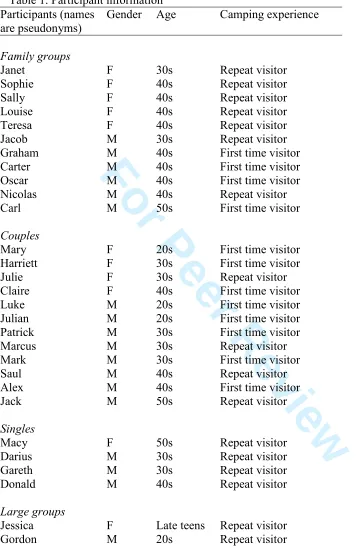
range of tourist types based on observed group and age characteristics (see Table 1).
[Table 1 here]
Given that not all participants would have access to a smartphone for the use of the
Traverse app, iPhones were loaned to participants. Participants were asked to carry the
iPhone and launch the Traverse app whenever they left the campsite, even if this was just
a short trip such as to walk the dog. Traverse was designed to record user location, using
GPS and a time stamp, and, on each use, Traverse requested input of mode of transport.
Data were therefore captured on the spatial location of users over time and by travel
mode. To capture diary material participants were provided with a notebook and pencil to
record notes and the iPhone provided for Traverse enabled capture of photographs.
Participants were asked to reflect on the following in their diaries:
• Routines or repeated patterns.
• The order of events.
• The extent to which activities were planned.
• Rough allocation of time to activities, places, travelling.
• Any activities that were time constrained.
For Peer Review
13 • Whether the participant felt in control of time.
Using this method, interviews should ideally be conducted as close as possible to the
recorded events. In a tourism context it is difficult to arrange specific interview times due
to tourists’ tendency to on-going re-negotiation of activities. Experience showed the best
time to meet participants was the morning following their one-day diary activity.
Interviews took place beside each participant’s tent. Whilst each interview focused on
one participant, the social nature of tourism often resulted in additional contributions
from members of the participant’s immediate party, most commonly from their partner. A
semi-structured interview strategy was used beginning with a narrative approach, in
conjunction with diaries and photos, to explore the temporal sequence and stories of the
day. 29 interviews were conducted during July to September 2012. Each interview was
recorded and interviews lasted around 40 minutes. Given the participant commitment,
each participant received £10 in vouchers to spend at the campsite shop.
The analysis followed two strategies. The first strategy explored individual narrative
structures to understand people’s various movements and the temporal issues that impact
on transport choices. The second strategy involved cross-case thematic analysis to
identify generic concepts.
Findings
Participants found it hard to articulate the temporal nature of their travel. While people
For Peer Review
14 on time, especially in a relatively abstract way. Following the diary instructions and
narrative interview strategy, participants utilised a chronological reporting strategy, that
involved reporting of the events as they unfolded, for example, “I did a walk by the
seaside and I had some shopping to do, then I had lunch there and then I went to several
shops” (Macy). Some respondents included much more specific references to clock-time.
For example: “1 o’clock, we had our lunch there… canoed out at about 3, no, half 2
maybe… we came back at half past 4” (Carter).
Both strategies reference past time in a linear way reflecting the dominant understanding
of time in contemporary society, “this homogeneous and desacralised time has emerged
victorious since it supplied the measure of the time of work” (Lefebvre, 2004, p. 73).
Through a series of probes on the unfolding of time, time planning and time relative to
other people, places and things, the interviews developed more depth to the temporal
understanding. Conceptually the data orientate into three temporal themes: time fluidity;
daily and place related rhythms; and control of time.
Time fluidity
Without exception, participants experienced a degree of fluidity to their day. While some
plans were made, there was little or no sense of having to do something or be somewhere
at a specific time, and planned activities were open to amendment as other opportunities
For Peer Review
15 “we were going to go over to Dancing Ledge and spend the day there but we just
could not be bothered. It was sunny, so we just sat out here and chilled, so till the
early afternoon and then we went out to Dancing Ledge… because we can go along
the flow a bit and change things, to adjust to how things are, then I feel we can
dictate what we want to do and when we want to do it really”
Time fluidity was often organised around a notional ‘must do’ list, however, participants
felt no commitment to ticking off the items as “things may drop off the list” (Sally).
Underlying this was a desire to “go with the flow”, a term used by several participants,
with some reflecting more deeply on this fluid time experience. For Mark it was about
experience time or being in the present:
“Your body tells you everything. When you are hungry, you cannot think of
anything else, when you need to go to the toilet, you cannot think of anything else,
it is part of nature, is it not? You have got your own body clock and it tells you
what to do, if you just listen to it, then it tells you what, you know, what you need.
It is just about turning the timetable and trying to get rid of it, just letting things
happen naturally… it is all about control and we are trying, sort of, you know,
having experience… in a linear sense, of like going there and seeing that
ta-da-da-da you know. Or you can actually just be and allow everything just to come to you,
which it does, but in a different rhythm, it is not, you know, it is maybe a bit slower
For Peer Review
16 Mark acknowledges that being in the world is a bodily thing that does not always need
on-going cognitive monitoring of what happens next. His body “actively assumes” time
and space (Cresswell, 2003, p. 276).
To articulate what they meant by fluid time, people referred to the structuring of
everyday life and a desire to step away from the need to be somewhere by a certain time
or a need to do so many activities.
“I’m a primary school teacher, so I have to be up relatively early, doing something
at a specific time, it’s just nice to just to be able to take it at your own pace and
relax... it’s nice to just be able to do things that I want to do and eat at the times that
I want to rather than set slots” (Jim)
Clock-time is at odds with the rhythms of our bodies (Adam, 1995) and it is evident in
Jim’s description that he is attempting to re-engage with a more natural rhythm relative to
his body’s needs. As Jim indicates, home life is very structured for most participants
while tourism is very fluid. The accounts represent this tourism time as different to
everyday life and a “time off” (Stein, 2012) that is not determined by others. This is a
particular feature of rural tourism (Sharpley & Jepson, 2011) where time becomes less
restricted and deceleration plays an important role (Matos, 2004). However, subsequent
analysis demonstrates that the participants’ use of time was not always as loose as they
For Peer Review
17 Some participants explicitly linked temporal fluidity with travel mode. Walking and car
travel were dominant modes, both offering individual autonomy and a high degree of
flexibility, albeit with distance constraints relative to walking. Flexibility is a significant
factor in car travel behaviour since users can choose exactly when they want to leave and
alter plans en-route (Anable & Gatersleben, 2005). This flexibility is not afforded by
public transport in rural areas:
“We get the bus from Swanage sometimes, I think the buses are a bit variable, I am
not sure there are that many knocking around and it is quite easy if you have got a
car, it is just easy to drive around” (Gordon)
“we live in London and we’re so used to being able to go to any kind of restaurant
and just not have to worry at all about being able to get public transport back,
whereas obviously in rural areas public transport can be difficult anyway
particularly after nine o’clock, ten o’clock or something.” (Jim)
Here both Gordon and Jim indicate their temporal fluidity may be compromised by
public transport. Gordon, in particular, notes the ease of car use.
Place rhythms
Despite the fluid nature of people’s days and relatively ad-hoc arrangements there was a
daily rhythm and routine. With few exceptions, participants slept late and were in no rush
For Peer Review
18 “The way we always work is if the children are happy, then we have a good
holiday, so yeah, normally we do not have a very early start… when they get up,
they want to play with their friends, so you know, we are quite happy to sit here for
a couple of hours, read, get a bit peace and quiet, you know, this makes a change”
(Sally)
This led to a peak in departures from the campsite around 11am, with few departures
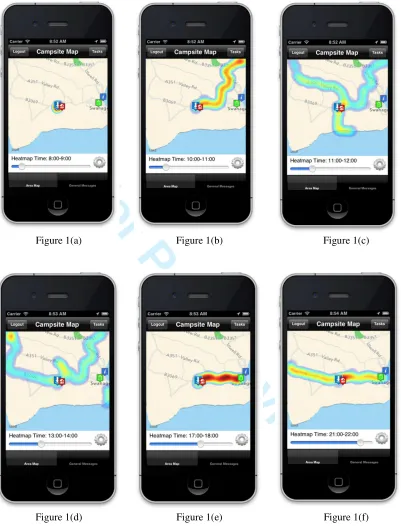
before 10am. This was best captured by the Traverse data, a sub-set of which is presented
in Figure 1. This shows people beginning to leave the campsite between 10.00 and 11.00.
The patterns also begin to coalesce back around the campsite 17.00 to 18.00. Distinctive
temporal and spatial patterns are also evident at places within the destination. For
instance, Figure 1(b) illustrates a morning pattern when people head to a popular beach.
Later in the day people return via the nearest town to the campsite, in order to buy food
(Figure 1(e)). The data also reveals pub visits 21.00 to 22.00 (Figure 1(f)). Therefore,
despite the apparent ad-hoc arrangements, the tourists’ assumed distinctive place related
patterns. These reflect the multiple sustained time-space routines which Edensor
describes as a kind of ‘place-ballet’ (cited by Cresswell, 2003, p. 279).
[Figure 1 here]
Germann Molz (2010) discusses how daily rhythms are both anticipated in tourists’
For Peer Review
19 temporal rhythms of place, a pace (speed and tempo) and flow that is characteristic
(Bærenholdt et al., 2004; Germann Molz, 2010; Haldrup, 2004) and creates a sense of
place which Edensor (2010) likens to a heartbeat. Despite the churn of visitors, the
individual patterns of people, which Hägerstrand observed in his time geography analysis
(Neutens, Schwanen & Witloz, 2011), coalesce with the place into daily rhythms and
flows, that also embrace natural factors, such as the prevailing temperature and weather,
and human factors like special events. Each new visitor adapts to the movements encoded
in the destination (Edensor, 2010) and we can become habitualised to temporal patterns
we are unaware exist (Adam, 1995). These space-time routines, together with the
availability of transport infrastructure, influence the transport choices available to tourists
(Dickinson & Peeters, 2012). Therefore, while tourists have time autonomy, the
absorption of visitors into the flow of place generates destination congestion.
Explanations for this are discussed in the next section. This flow of place, however, also
yields a significant transport opportunity.
Both the temporal routines and the ‘must do’ lists of participants exhibited similarities;
however, there is currently little opportunity to harness this. Given campsites (and many
other forms of tourism accommodation) host a spatially bound community, albeit
temporary in nature, there is scope for travel collaboration. Preliminary analysis suggests
scope for collaboration among visitors to campsites (Reference removed for peer review).
An example of this is illustrated in Figure 2, a storyboard developed with, and for, project
participants to explain concepts. This illustrates how campsite visitors might tap into the
For Peer Review
20 home to avoid a 10km round trip for a forgotten item. This moves away from the
atomised individual to a network of actors who are able to realise space-time
opportunities.
[Figure 2 here]
Control of time
Despite the time fluidity described by participants it was evident that there were a variety
of temporal control elements. There was relatively little planning with respect to tourism
activities on a day-to-day basis and, aside from the notional list of things to do,
participants engaged in fairly minimal planning either the night before or on the actual
morning.
“it was dictated by the weather, so we were choosing whether to do this walk
yesterday or do it today, depending on whether we wanted to do it in the sun or
possibly overcast conditions, so it was literally a decision over breakfast to go”
(Marcus)
Some participants insisted there was no planning what so ever. For example, as Mark
describes, “because things happen by themselves, you do not need to [plan], you know,
you just experience the moment instead of trying to control the moment”. Mark was
For Peer Review
21 Participants reflected on the time demands made by other people, things and places.
Participants took a flexible approach to place and acknowledged that sometimes they
might move on more quickly if the opportunities afforded were exhausted, but more often
participants seemed to find places demanded more of their time. Sophie describes an
unexpected opportunity:
“we hooked into this story-telling and I was thinking it would be half an hour but it
ended up being an hour and twenty minutes which was lovely… we had to continue
and finish it”
Place experience and knowledge gained by word of mouth from local people or other
visitors also played a role. In this way the ‘must do’ list evolves throughout the stay
contingent on experience, actual events and, as discoveries are made, relative to the time
needs of places. Accumulated place experience and knowledge also enable participants to
avoid temporal problems such as attraction crowding or road congestion. Given the
patterns of repeat visitation, some participants had good local knowledge. In addition,
even first time visitors exhibited an intuitive familiarity given their experience in similar
UK destinations. Therefore most participants were very aware that certain attractions
would be crowded under particular conditions.
“if we are going to town, we would go in the morning because we know that in the
For Peer Review
22 where we know it is going to be busy, we avoid business by going in the morning,
by going first thing” (Saul)
“if it was a really hot day, we would possibly go there [a popular beach] later on
because it is a lively beach but, yeah, I did not really like it last year because of
that, the packed in sardines (laughs)” (Harriet)
In the context of round-the-world travel, Germann Molz (2010) discusses how tourists
wish to allocate the right amount of time to place. Participants in this study were relaxed
in their approach which reflects a much greater understanding of the place visited as most
participants were domestic tourists. Given the list of alternative activities, participants
simply made substitutions as appropriate. However, as Saul and Harriet’s quotes
illustrate, participants did have internal temporal concerns about the appropriate time to
visit places reflecting the findings of Germann Molz (2010) and Haldrup (2004).
More overt than the time demands of places were the time demands made by other people
within the participants’ immediate group. For example:
“I think we have to allow a bit more time because it takes longer for eight people to
mobilise and get moving” (Nicholas)
Relationships with other people were one of several factors that were attended to when
For Peer Review
23 to the child’s needs. For example, Louise suggests “if she’s [Louise’s daughter] enjoying
it, I tend to be”. Therefore plans often revolved around children’s meal times, energy
needs (how long they could walk without a break), or attention space (places that would
absorb children’s attention). For instance, Jacob describes accepting time would be spent
on the beach despite poor weather conditions:
“it was horrific, it was really, really blowing a gale on the beach and we said,
regardless of what the weather was like the next day, we were going to go on the
beach anyway because that is what the kids wanted to do”.
The items needed during the stay also influence time planning. For instance, Sally
describes “if we go anywhere, we have got to take enough food” and Janet describes
driving to shops to buy children’s shoes:
“Charlie then declared that the two sets of shoes that we’d packed were causing
him problems and he sort of unleashed this enormous blister, so we called in on the
way back through Swanage, which we had to go through anyway, to pick up some
‘crocs’ for him.”
Planning was also weather related given the outdoor nature of rural tourism and Jim
illustrates why planning is relatively immediate and requires alternative options:
For Peer Review
24 “we’d probably choose like one thing that we really wanted to do and base the day
around that, but then we have in mind that there is other stuff that we may or may
not want to do and particularly dependant on the weather… we tend to have a
couple of like emergency wet-weather plans and then stuff that if it’s a really nice
day, we do that instead.” (Jim)
Travel planning is crucial to reduce uncertainty and enhance tourist satisfaction (Zalatan,
1996) and has been studied from a number of disciplinary angles (Jeng & Fesenmaier,
2002). Research has concentrated on consumer purchasing decisions, intentions and
motives behind the destination, transport mode and holiday activities selection (Wong &
Yeh, 2009). Once tourists have arrived, the travel plans are short term and more fluid
(Stewart & Vogt, 1999) and multiple factors influence planning at the destination (Bansal
& Eiselt, 2004).
Aspects such as weather changes, place related discoveries and things suddenly needed
are ‘incidents in time’, unexpected moments that caused people to re-evaluate their plans.
For example, Mary describes needing to find a bike shop to get parts for her partner’s
bike. This could be conceived as a negative event, however, it was not construed as such
by Mary who took the opportunity to escape the heat (it was an unusually hot day) and
read a book. It was just something that happened and they melded their day around this.
Similarly, most parents acknowledged temporal impacts made by children. Sophie
describes how “it would have been good to know if there was a lift going from the pub to
For Peer Review
25 Being able to maintain fluidity was very important to participants with several drawing
attention to scheduled activities causing a loss of control of time:
“I think there may be a time stress tonight. We were going to try and go to
Weymouth for the opening Olympic ceremony so, we’re thinking traffic’s going to
be [bad]… that could be a stress because of the fact that it is going to be the
fireworks or something at 7 o’clock and we’d quite like to be there to see the
opening ceremony” (Janet)
“you lose control if you start saying I have got to do this and this perhaps” (Mary)
This scheduled time replicates the temporal experience in day-to-day life and is known to
generate a degree of time stress (Roxburgh, 2004). Participants also discussed other
holiday contexts that they would avoid, such as a package holiday, which they associated
with more organised and structured time. “I did not enjoy that so much because I almost
felt I was on a schedule” (Carl)
Participants also described a variety of ‘control points in time’ which sometimes
presented space-time constraints. For example, the campsite shop closes at 7pm or the
last bus leaves at a specific time. Participants were particularly mindful of the need to
For Peer Review
26 “If you go to the beach, say, or go somewhere first and then go late afternoon to get
your shopping, there is nothing in the shop. You have to go in the morning to get
reasonable things but then if you buy it in the morning, with it being hot, you have
not got a lot of places to store things” (Sally)
At home refrigerators and freezers provide “time storage” devices (Southerton et al.,
2001) that have radically altered our shopping patterns (Watkins, 2003). However,
camping brings people back to a more basic relationship with produce and the purchase
of food makes a routine temporal demand. These temporal control points align tourists
with the “everyday time” that is still evident around them as they interact with tourism
employees and local residents (Stein, 2012).
The combination of ‘incidents in time’ and ‘control points in time’ led participants to
make on-going adjustments in present time, responding to a varied set of individually
relevant contextual factors. In this sense participant appeared to adopt a ‘responsive time’
strategy.
Discussion
The tourist day unfolds in relation to the overall rhythms of place, tourists practice and
reinforce these rhythms and the rhythms, in turn, reinforce behaviour. “Because people
act in certain preconscious ways, any given order tends to get re-established and
For Peer Review
27 Cresswell, 2003, p. 277). “Everyday life remains shot through and traversed by great
cosmic and vital rhythms: day and night, the months and the seasons, and still more
precisely biological rhythms. In the everyday, this results in the perpetual interaction of
these rhythms with repetitive processes linked to homogeneous time” (Lefebvre, 2004, p.
73). The individual tourist succumbs to a variety of temporal forces that reinforce travel
behaviour decisions that are not always sustainable. The natural temporal rhythms of
people on holiday add to peak traffic flows. While these are less marked than the peaks
associated with commuting, they exert pressure in a rural environment with limited
infrastructure.
As this analysis illustrates, time fluidity was important to people, but as the interviews
unfolded it was clear that time incidents and control points also influenced travel
behaviour decisions. Opening times of shops and attractions, and scheduled events
determine access to key resources and influence visitor flows. Where time appears short,
visitors resorted to car use even when their intention was to avoid this. Cass, Shove and
Urry (2004) argue that some forms of transport are only possible for those with “time to
spare”. While tourists inherently have more time, incidents and temporal control points
can lead tourists to trade off a quality experience for speed .This is best explained through
the experience of multiple competing forms of time. The idea that time is multiple is not
new (see for example, Adam, 1995; Middleton, 2009), however, it is difficult for people
to conceptualise this. The participants demonstrated the existence of multiple times by
reference to: my time; my child’s time; the food’s time; the attraction’s time; the place
For Peer Review
28 they compete for attention with each individual determining which receives most
attention. “Time is experienced differently by individuals depending on the importance of
the experience” (Jäckel & Wollscheid, 2007, p. 86) and problems arise due to time-space
coordination (Jarvis, 2005; Southerton, 2006). For parents ‘my child’s time’ dominates.
For women in particular, their time sovereignty can be compromised by the time
demands of others (Davies, 2001). The personal experience of these multiple
temporalities will have a strong influence on individual travel needs and behaviour.
The desire to embrace temporal fluidity embeds it with some value and meaning. The
participants’ experiences of time reflect slow travel where taking time out is a positive
feature in which pauses, inactivity and the ability to respond to place encounters is valued
(Dickinson, Lumsdon & Robbins, 2011). Palmer (cited Mullins, 2009) argues that higher
travel speeds negatively affect tourism’s sustainability since learning about unique places
and establishing personal relationships with destinations lie at the heart of sustainable
tourism. However, the car provides flexibility and speed and while participants were keen
to walk, cycle or use public transport, the benefits of the car can outweigh other modes.
The findings highlight a number of temporal situations within a destination area that
interact with place locations in a variety of ways to influence travel behaviour. Within
rural destinations attractions are spatially dispersed and often require visitor travel to
places off main arterial routes and public transport networks. This is largely determined
by natural features and entrepreneurial business opportunities historically developed with
For Peer Review
29 plays a significant role in temporal flows of participants given the outdoor context of
rural tourism. In countries with more stable weather, it will play less of a role, though
there may be predictable weather events, such as late afternoon thunderstorms in
mountain regions, that impact on traffic flows. Short-term planning often reflected
uncertainty about the weather leading to last minute decisions and changes to plans.
While many of these temporal situations would be difficult to address there is scope to
better manage the visitors’ understanding of the local temporal rhythms. Mobile
technology is developing context based systems that are able to deliver unique
personalised information to users referenced to their current location in both space and
time. This idea has been explored with project participants and led to the emergence of a
storyboard (Figure 3) that outlines how a context-based system might deliver relevant
tourist travel advice to enable users to avoid temporal congestion through modified travel
behaviour. The scenario in Figure 3 initially provides the user with advice to avoid
congestion and ultimately, by suggesting an alternative attraction closer to the current
location, avoids a car trip altogether. The ideas described in Figures 2 and 3 are currently
being developed in a collaborative travel app that will be field tested in 2013.
Technological interventions such as this introduce a temporal juxtaposition since many
people choose camping in order to engage with a simpler, ‘past time’, that is devoid of
the technological devices that proliferate in their day-to-day lives. Despite this, many
participants utilised mobile media to organise short-term planning and in this way two
For Peer Review
30 [Figure 3 here]
Conclusion
This paper has argued that temporal issues should not be overlooked in an analysis of
travel behaviour within tourist destination areas. It shows there are a variety of issues that
present challenges for more sustainable travel. Time fluid tourists desire flexible travel
opportunities and this is best achieved through personal modes of transport. While
walking was popular in the rural setting studied, car travel provides a high degree of
convenience to visitors and is perceived to afford flexibility (Anable & Gatersleben,
2005). Despite the desire for fluidity, tourists were absorbed into place rhythms and flows
and thus reproduce congestion and exceed local car park capacity. A variety of temporal
incidents and control points aligned to linear clock-time present a challenge to tourists.
While the desire to go with the flow mediated the direct impact of unexpected incidents,
there was often the need for transport flexibility and speed to achieve objectives. The car
provides a useful time-shifting device that enhances opportunities in this respect.
The analysis draws attention to clock-time tensions embedded in contemporary society as
people see tourism as a space to escape from their usual time bound routines. Clock-time
is a relatively recent phenomenon in human society and other commentators (see for
example, Adam, 1995) have noted that this linear regime, with a series of scheduled
events, is at conflict with a more humanistic approach to time. Transport systems are
rooted in clock-time regimes through the need to coordinate arrivals, departures and
For Peer Review
31 highly valued, though still bound to a variety of external time structures such as facility
opening times. Given the temporal freedom sought by tourists and the opportunity
afforded by car travel, it is not surprising that car travel is so routinely practiced in rural
tourism. Aside from the spatial constraints within rural tourism, time is a significant
barrier to behaviour change from car to other modes of transport that cannot be
overlooked.
Tourists’ temporal freedom is also compromised by a multitude of competing forms of
time. Whilst the concept of multiple times and the possibility that individuals might
experience time in more than one way is widely discussed in the geography and
sociology literature (see for example, Merriman, 2012; Wajcman, 2008), it has rarely
been examined with respect to transport (see Middleton, 2009 for an exception). The
transport literature is increasingly aware that our understanding of time is changing but
has yet to grasp the travel implications of multiple temporal reference frames for
individuals. The analysis presented here demonstrates how participants experience
multiple times, each with attendant demands and some with specific transport needs. In
addition, visitor travel is embodied and derived from rhythms that are absorbed from the
destination, determined by biological routines and altered by other people, place
encounters and the things needed. These rhythms reinforce travel behaviour choices.
Given that we are at a pivotal moment with respect to the emergence of a new
socio-technical substrate, in the form of mobile technology that has significant space-time
For Peer Review
32 to assist in more sustainable forms of travel then we need to better understand the role
played by time. From this exploration of time in tourism destination travel, three key
messages emerge that should influence the design of tourist destination based travel
systems. First, given the desire for temporal fluidity, transport systems need to evolve
beyond clock-time regimes. Tourists seek respite from scheduling demands and tourism
and travel information should seek to better manage this. Second, temporal forces favour
personal modes of transport (car, walk, cycle), especially in rural areas where public
transport is unlikely to provide adequate flexibility. Greater attention therefore needs to
be paid to these modes. In this respect, the car is highly personalised and perceived to
optimise travel fluidity and speed. This is currently unsustainable and, given the poor
success rate of travel behaviour initiatives designed to reduce car dependence, there is a
need for imaginative initiatives. Sustainable travel strategies are needed that adopt a
positive and proactive stance to car travel that realises opportunities to utilise spare
capacity in both public and private vehicles across the transport network. Research is
needed to explore how highly individualised space-time scheduling and vehicle use might
embed more collective strategies. Third, in order to realise network potential,
mechanisms are needed to visualise travel opportunities and constraints in both real-time
and the immediate future based on historic data feeds representing destination rhythms
and routines. New technology has the capacity to reveal highly personalised travel
information to tourists to enable them to access localised space-time opportunities that
For Peer Review
33 Mobile social networking tools are emerging to influence behaviour change in transport
leading to new forms of transport networks that make visible other people, their transport
plans, objects in transit and modes of transport (Davies, Lau, Speed, Cherrett, Dickinson
& Norgate, 2012). Such systems will have implications for the temporal planning of
travel and subsequent travel behaviour. To this end we need to better understand how
time perception and use, which varies across cultural and demographic groups (Adams &
van Eerde, 2010; Spears & Amos, 2012), impacts on sustainable mobility patterns. The
data also raise questions about a more structured time encountered in other tourist
settings that requires further research.
References
Adam, B. (1995). Timewatch: The Social Analysis of Time. Cambridge: Polity Press.
Adams, S.J.M., & van Eerde, W. (2010). Time use in Spain: is polychronicity a cultural
phenomenon? Journal of Managerial Psychology, 25(7), 764 – 776.
Anable, J., & Gatersleben, B. (2005). All work and no play? The role of instrumental and
affective factors in work and leisure journeys by different travel modes.
Transportation Research Part A: Policy and Practice, 39(2–3), 163–181.
Ashden (2012). Liftshare.com, UK. Ashden Case Study. Summary. Retrieved from:
http://www.ashden.org/files/Liftshare%20full%20winner.pdf.
Bærenholdt, J.O., Haldrup, M., Larsen, J. & Urry, J. (2004). Performing Tourist Places.
Aldershot: Ashgate.
Bansal, H., & Eiselt, H.A. (2004). Exploratory research of tourist motivations and
For Peer Review
34 Becken, S. (2002). Analysing international tourist flows to estimate energy use associated
with air travel. Journal of Sustainable Tourism, 10(2), 114–131.
Buscher,M., & Urry, J. (2009). Mobile methods and the empirical. European Journal of
Social Theory,12(1), 99-116.
Cass, N., Shove, E., & Urry, J. (2004). Transport infrastructures: a social-spatial-temporal
model, In D. Southerton, H. Chappells, & B. Van Vliet (Eds.), Sustainable
Consumption: The implications of changing infrastructures of provision (pp.
113-129). Cheltenham: Edward Elgar.
Castells, M. (2000). The rise of the network society, 2nd ed. Oxford: Blackwell.
Clawson, M., & Knetsch, J.L. (1966). Economics of Outdoor Education. Baltimore: The
Johns Hopkin University Press.
Connell, J., & Page, S.J. (2008). Exploring the spatial patterns of car-based tourist travel
in Loch Lomond and Trossachs National Park, Scotland. Tourism Management,
29(3), 561–580.
Couclelis, H. (2009). Rethinking time geography in the information age. Environment
and Planning A, 41, 1556-1575.
Cresswell, T. (2003). Landscape and the obliteration of practice. In K. Anderson, M.
Domosh, S. Pile, N. Thrift (Eds.), Handbook of cultural geography (pp. 269-281).
London: Sage.
Csikszentmihalyi, M. (2002). Flow: The classic work on how to achieve happiness.
For Peer Review
35 Davies, K. (2001). Responsibility and daily life: reflections over timespace. In J. May &
N. Thrift (Eds.), Timespace: geographies of temporality (pp. 133-148). London:
Routledge.
Davies, N., Lau, M., Speed, C., Cherrett, T., Dickinson, J., & Norgate, S.H., (2012). Sixth
Sense Transport: Challenges in Supporting Flexible Time Travel. The 13th
International Workshop on Mobile Computing Systems and Applications, Feb
28-29, San Diego, California. http://www.hotmobile.org/2012/
Dickinson, J.E., Peeters, P. (2012). Time, tourism consumption and sustainable
development. International Journal of Tourism Research, DOI: 10.1002/jtr.1893.
Dickinson, J.E., Ghali, K., Cherrett, T., Speed, C., Davies, N., Norgate, S. (2012).
Tourism and the smartphone app: capabilities, emerging practice and scope in the
travel domain. Current Issues in Tourism. DOI:10.1080/13683500.2012.718323.
Dickinson, J.E., Lumsdon, L., Robbins, D. (2011). Slow travel: issues for tourism and
climate change. Journal of Sustainable Tourism, 19(3), 281-300.
Dickinson, J.E., & Robbins, D. (2008). Representations of tourism transport problems in
a rural destination. Tourism Management, 29, 1110-1121.
Edensor, T. (2010). Introduction: Thinking about Rhythm and Space. In E. Edensor (Ed.),
Geographies of Rhythm: Nature, Place, Mobilities and Bodies (pp. 1-8). Farnham:
Ashgate Publishing Group.
Elsrud, T. (1998). Time creation in traveling: The taking and making of time among
For Peer Review
36 EuroStat (2012). Tourism statistics at regional level. Retrieved from:
http://epp.eurostat.ec.europa.eu/statistics_explained/index.php/Tourism_statistics
_at_regional_level#Camping.
Frändberg, L. (2008). Paths in transnational time-space: representing mobility
biographies of young Swedes. Geografiska Annaler, 90(1), 17–28.
Germann Molz, J. (2010). Performing Global Geographies: Time, Space, Place and Pace
in Narratives of Round-the-World Travel. Tourism Geographies, 12(3), 329-348.
Gössling, S., Ceron, J.P., Dubois, G., & Hall, C.M. (2009) Hypermobile travelers. In S.
Gössling and P. Upham (Ed.), Climate change and aviation. Issues, challenges
and solutions (pp.131-150). Earthscan, London.
Gössling, S., Scott, D., Hall, C.M., Ceron, J.P., & Dubois, G. (2012). Consumer
Behaviour and Demand Response of Tourists to Climate Change. Annals of
Tourism Research, 39(1), 36-58.
Greener Festival (2012). Traffic congestion and travel. Retrieved from:
http://www.agreenerfestival.com/traffic-congestion-travel/.
Haldrup, M. (2004). Laid-Back Mobilities: Second-Home Holidays in Time and Space.
Tourism Geographies, 6(4), 434-454.
Hibbert, J.F., Dickinson, J.E., & Curtin, S. (2013). Understanding the influence of
interpersonal relationships on identity and tourism travel. Anatolia, in press
Humphreys, L. (2010). Mobile social networks and urban public space. New Media and
Society, 12(5), 763-778.
Hunter, C. (2002). Sustainable tourism and the touristic ecological footprint.
For Peer Review
37 Jäckel, M. & Wollscheid, S. (2007). Time is Money and Money Needs Time? A
Secondary Analysis of Time-Budget Data in Germany. Journal of Leisure
Research, 39(1), 86-108.
Jarvis, H. (2005). Moving to London Time Household co-ordination and the
infrastructure of everyday life. Time & Society, 14(1), 133–154.
Jeng, J., & Fesenmaier, D.R. (2002). Conceptualizing the travel decision-making
hierarchy: a review of recent developments. Tourism Analysis, 7(1), 15-32.
Klein, O. (2004). Social Perception of Time, Distance and High-Speed Transportation.
Time & Society, 13(2/3), 245–263.
Kwan. M.-P. (2007). Mobile Communications, Social Networks, and Urban Travel:
Hypertext as a New Metaphor for Conceptualizing Spatial Interaction. The
Professional Geographer, 59(4), 434–446.
La Lopa, J.M. & Day, J. (2011). Pilot Study to Assess the Readiness of the Tourism
Industry in Wales to Change to Sustainable Tourism Business Practices. Journal
of Hospitality and Tourism Management, 18(1), 130-139.
Larson, J., Urry, J., & Axhausen, K.W. (2007). Networks and tourism: mobile social life.
Annals of Tourism Research, 34(1), 244-262.
Latham, A. (2003). Research, performance, and doing human geography: some
reflections on the diary-photograph, diary-interview method. Environment and
Planning A, 35(11), 1993 – 2017.
Lefebvre, H. (2004). Rhythmanalysis: Space, Time, and Everyday Life. London:
For Peer Review
38 Lemos, A. (2010). Post–Mass Media Functions, Locative Media, and Informational
Territories: New Ways of Thinking About Territory, Place, and Mobility in
Contemporary Society. Space and Culture, 13(4), 403–420.
Lindquist, J.D. & Kaufman-Scarborough, C.J. (2007). The polychromic-monochronic
tendency model PMTS scale development and validation. Time & Society, 16,
253-285.
Line, T., Jain, J. & Lyons, G. (2011). The role of ICTS in everyday mobile lives. Journal
of Transport Geography, 19(6), 1490-1499.
Ling, R. (2004). The Mobile Connection: The cell phone’s impact on society. San
Francisco: Morgan Kaufmann.
Mallet, W.J. & McGuckin, N. (2000). Driving to distractions: Recreational trips in
private vehicles. Transportation Research Record, 1719, 267-272.
Matos, R. (2004). Can slow tourism bring new life to alpine regions? In K. Weiermair &
C. Mathies (Eds.), The tourism and leisure industry. Shaping the future (pp.
93-103). Binghamton, NY: Haworth Hospitality Press.
May, J. & Thrift, N. (2001). Introduction. In J. May & N. Thrift (Eds.), Timespace:
geographies of temporality (pp. 1-46). London: Routledge.
Metz, D. (2008). The limits to travel. How far will we go? London: Earthscan.
Merriman, P. (2012). Human geography without time-space. Transactions of the Institute
of British Geographers, 37(1), 13-27.
Middleton, J. (2009). ‘Stepping in time’: walking, time, and space in the city.
For Peer Review
39 Mullins, P.M. (2009). Living Stories of the Landscape: Perception of Place through
Canoeing in Canada's North. Tourism Geographies, 11(2), 233-255.
Neutens, T., Schwanen, T., & Witloz, F. (2011). The Prism of Everyday Life: Towards a
New Research Agenda for Time Geography. Transport Reviews, 31(1), 25-47.
Norgate, S.H. (2006). Beyond 9 to 5: Your Life in Time. London: Weidenfeld & Nicolson.
Page, S. J. (2005). Transport and tourism: Global perspectives (2nd ed.). Harlow:
Pearson.
Poumanyvong, P., Kaneko, S. & Dhakal, S. (2012). Impacts of urbanization on national
transport and road energy use: Evidence from low, middle and high income
countries. Energy Policy, 46, 268-277.
Richards, G. (1998). Time for a holiday? Social rights and international tourism
consumption. Time and Society, 7(1), 145-160.
Roxburgh, S. (2004). There Just Aren’t Enough Hours of the Day: The Mental Health
Consequences of Time Pressure. Journal of Health and Social Behaviour, 45,
115-31.
Scott, D., Peeters, P., & Gössling, S. (2010). Can tourism deliver its aspirational
greenhouse gas emission reduction targets? Journal of Sustainable Tourism,18,
393-408.
Sharpley, R., & Jepson, D. (2011). Rural tourism. A spiritual experience? Annals of
Tourism Research, 38(1), 52–71.
Sheller, M., & Urry, J. (2006). The new mobilities paradigm. Environment and Planning
For Peer Review
40 Solomon, M.R., Bamossy, G., Askegaard, S., Hogg, M.K. (2010). Consumer behaviour:
a European perspective. Harlow: Financial Times/Prentice Hall.
Southerton, D. (2006). Analysing the Temporal Organization of Daily Life: Social
Constraints, Practices and their Allocation. Sociology, 40(3), 435–454.
Southerton, D., Shove, E. & Warde, A. (2001). ‘Harried and Hurried’: time shortage and
the co-ordination of everyday life. Manchester: Centre for Research on Innovation
and Computing, University of Manchester.
Spears, N., & Amos, C. (2012). Revisiting Western time orientations. Journal of
Consumer Behaviour, 11, 189-197.
Speed, C. (2011) Kissing and making up: time, space and locative media. Digital
Creativity, 22(4), 235–246.
Stein, K. (2012). Time Off: The Social Experience of Time on Vacation. Qualitative
Sociology, 35, 335-353.
Stewart, S.I., & Vogt, C.A., (1999). A case-based approach to understanding vacation
planning. Leisure Sciences, 21(2), 79-95.
United Nations World Tourism Organisation – United Nations Environment Programme
– World Meteorological Organisation (2008). Climate change and tourism:
Responding to global challenges. Madrid: UNWTO.
Urry, J. (1994). Time, Leisure and Social Identity. Time and Society, 3(2), 131-149.
Warnken, J., Bradley, M., & Guilding, C., (2004). Exploring methods and practicalities
of conducting sector-wide energy consumption accounting in the tourist
For Peer Review
41 Watkins, H. (2003). Fridge stories: Three geographies of the domestic refrigerator. In M.
Hard, A. Losch & D. Verdicchio (Eds.), Transforming Spaces. The Topological
Turn in Technology Studies. Darmstadt, Germany.
Wong, J. Y., & Yeh, C. (2009). Tourist Hesitation in Destination Decision Making.
Annals of Tourism Research, 36, 6-23.
Zalatan, A. (1996). The determinants of planning time in vacation travel. Tourism
For Peer Review
[image:44.612.81.438.79.637.2]42 Table 1. Participant information
Participants (names are pseudonyms)
Gender Age Camping experience
Family groups
Janet F 30s Repeat visitor Sophie F 40s Repeat visitor Sally F 40s Repeat visitor Louise F 40s Repeat visitor Teresa F 40s Repeat visitor Jacob M 30s Repeat visitor Graham M 40s First time visitor Carter M 40s First time visitor Oscar M 40s First time visitor Nicolas M 40s Repeat visitor Carl M 50s First time visitor
Couples
Mary F 20s First time visitor Harriett F 30s First time visitor Julie F 30s Repeat visitor Claire F 40s First time visitor Luke M 20s First time visitor Julian M 20s First time visitor Patrick M 30s First time visitor Marcus M 30s Repeat visitor Mark M 30s First time visitor
Saul M 40s Repeat visitor
Alex M 40s First time visitor
Jack M 50s Repeat visitor
Singles
Macy F 50s Repeat visitor
Darius M 30s Repeat visitor Gareth M 30s Repeat visitor Donald M 40s Repeat visitor
Large groups