Social Media/ted Practice @ the
Interface
Rhianne JONES
1
Social Media/ted Practice @ the
Interface
Rhianne JONES
School of Humanities, Languages and Social Sciences, Department of
Sociology, The University of Salford, Salford, UK
2
Abstract
This research contributes to the evolving field of New Media Studies through an empirical
examination of social media design in real-time practice at the computer interface. In recent
years questions of technology and design have started to figure more prominently in research
into Social Network Sites (SNSs) but critical analysis of design in practice, at the interface remains under-researched. The interface is becoming an increasingly important analytical
concept in the digital age as it is the space where machine readable code is translated into the
cultural codes which are accessible to the everyday users of digital media technology.
Furthermore, there have been recent calls for an expansion of the traditional media practice
paradigm encouraging practice approaches to media which take seriously the mediating role
of technologies in emergent forms of digital media practice. This thesis carries out empirical
research into social media/ted practice; it critically examines sites and real-time interactions at the interface, to understand the interrelationships between the specific design of platforms
and evolving forms of social media/ted practice. The thesis draws on Media Studies, New
Media Studies, Sociology and Social Studies of Technology to explicate an original
interdisciplinary analytical framework for studying people’s interactions with social media
technologies at the interface. This framework is referred to as the triple articulation ofsocial media/ted practice. The triple articulation of social media/ted practice acknowledges the interplay between the materiality of social media technologies, the cultural coding of social
media technologies and active practice with social media technologies. The term social
media/ted practice has been coined specifically to emphasise the mediating role of technology
in social media use. Using SNSs as a case study the thesis combines critical site analysis with
interviews at the interface which illuminate the interpretive and constructive elements of the
micro-interactions between people and SNSs that underpin related forms of social media/ted
practice. Whilst this thesis is focused on SNSs, the analytical framework has wider
applicability in New Media Studies and media-orientated Sociology. The central argument of
this thesis is that design matters for social media/ted practice. Site-specific ‘micro’
architectures, affordances and algorithmic processes continue to shape social media/ted
practice at the interface. The user-interface works to render aspects of the technology visible,
accessible, meaningful and useful. This thesis calls attention to the user-interface as a key site
for: (1), mediating social practice (2), understanding emerging social trends (3), site
3
Table of Contents
List of Illustrations and Figures ... 7
Chapter 1: An Introduction to the Thesis ... 11
Why Study SNSs @ the Interface? ... 11
1.1 Introduction ... 11
1.2 Digitally Networked Social Life ... 13
1.3 Thesis Overview ... 20
Chapter 2: Digitally Mediated Social Life ... 24
2.1 Chapter Overview ... 24
2.2 Digitally Networked Technologies and Everyday Social Life ... 25
2.3 Web 2.0: The User Takes Centre Stage... 30
2.4 Social Media and Social Network Sites ... 32
2.5 SNS Research: A Thematic Review... 35
2.6 Visually Articulated Networks ... 36
2.7 Identity, Representations and Remediations of the Networked Self ... 39
2.8 User-generated Archives: Privacy and Surveillance ... 44
2.9 Digitally Networked Architectures and Affordances ... 49
2.10 Conclusion: New Directions for Social Media Research ... 54
Chapter 3: Social Media/ted Practice: Towards an Analytical Framework ... 56
3.1 Chapter Overview ... 56
3.2 Elusive Media Technologies... 58
3.3 Theorising Technologically Media/ted Practice: Sociology and Media Studies ... 59
3.4 The Medium Matters for Social Practice ... 65
3.5 Social Studies of Technology: Implications for Theorising Social Media/ted Practice ... 67
3.6 The Social Construction of Technology; Shaping the Medium in Contextual Practice ... 68
3.7 Social Media/ted Practice: Socio-technical Networks and Distributed Agency ... 71
3.8 Codifying Technologies: Implications for Social Media/ted Practice... 73
3.9 Designed Affordances: Implications for Social Media/ted Practice ... 76
3.10 Intentional Design: The Politics of Social Media Technologies ... 78
3.11 Towards a Theory of Social Mediat/ed Practice ... 80
4
Chapter 4: Design in Social Media/ted Practice ... 84
4.1 Chapter Overview ... 84
4.2 Introduction: (Invisible) Design and (Routine) Practice ... 85
4.3 Digital-Material Structures, Digitally Networked Architectures ... 89
4.4. Heterogeneous Actor Networks, Agency in Networked Environments ... 91
4.5 Social Media Contexts: Architectures and Affordances... 96
4.6 Interface Cultures: SNSs as Technologically Mediated Con/texts ... 99
4.7 Social Media Technologies: Design, Representation and Practice ... 105
4.8 Social Media/ted Practice: Interacting with Technologies ... 108
4.9 Conclusions: Social Media Design Matter[s] in Practice ... 109
Chapter 5: Researching Social Media/ted Practice @ the Interface ... 111
5.1 Chapter Overview ... 111
5.2 Introduction to the Research ... 111
5.3 Research Aims and Objectives ... 112
5.4 Why Research Social Media @ the Interface? ... 114
5.5 The Interface as a Research Site for Social Media/ted Practice... 115
5.6 Methodology ... 117
5.7 Social Media/ted Practice: A Qualitative Approach ... 118
5.8 Social Constructivism and Social Media/ted Practice ... 120
5.9 Research Strategy... 122
5.10 Selecting Sites for Analysis ... 125
5.11 Selecting Research Participants ... 126
5.12 Site Analysis @ the Interface ... 127
5.13 Interviews @ the Interface ... 132
5.14 Ethical Considerations ... 138
5.15 Conclusions: Researching @ the Interface ... 141
Chapter 6: Techno-cultural Design @ the Interface ... 142
6.1 Chapter Overview ... 142
6.2 The Interface as a Techno-cultural Text ... 143
6.3 Before There Are Sites, There Are Concepts ... 144
6.4 ‘First we shape our tools, thereafter they shape us’ - McLuhan, 1964... 146
6.5 Design Languages: ... 147
5
6.7 Incentivising Self-presentation and Personal Promotion in Networked Activity ... 155
6.8 Dis-incentivising Disconnection and Disengagement ... 159
6.9 ‘Social’ Content Sharing Versus ‘Unsocial’ Content Management ... 160
6.10 Digital Controls and Automation, Locating Agency ... 166
6.11 Facebook: Registration, Natural Mapping and the Road to Sharing ... 169
6.12 Deletion, Unnatural Mapping and Dis-incentives to Disengage ... 173
6.13 Visible Social Affordances and Obscure Commercial Ecologies ... 176
6.14 Conclusion ... 180
Chapter 7: Social Media/ted Practice: Making Use and Making Sense of SNSs ... 181
7.1 Chapter Overview ... 181
7.2 Social Media Preferences: Facebook and Twitter ... 181
7.3 Social Media Classifications... 183
7.4 The Importance of Device and Context in Shaping Media/ted Practice ... 184
7.5 Social Media Ecologies: Network Competition and Co-activity ... 187
7.6 Motivations for Use: Social Pulls and Social Lock-ins ... 191
7.7 Understanding SNSs: The ‘Social’ Framing of Social Media Technologies... 193
7.8 Making Sense of Facebook and Twitter as Digitally Mediated Networked Spaces ... 195
7.9 Codified Framings: Design Languages in Practice ... 199
7.10 Designing Networks: To Friend or to Follow? That is the Networked Culture ... 205
7.11 Conclusions: Design in Practice ... 210
Chapter 8: Interactions @ the Interface ... 212
8.1 Chapter Overview ... 212
8.2 Learning to Use SNSs, From Registration to Routine ... 213
8.3 Interactional Tours @ the Interface ... 218
8.4 Explorations into the Known: The Routine Nature of SNS Practice ... 218
8.5 Interactivity in Social Media/ted Practice ... 223
8.6 Architectures and Affordances: A User’s View ... 227
8.7 Overt and Covert Opportunities for Inter/action ... 230
8.8 Reading the Social @ Interface Value ... 234
8.9 Participants’ Thoughts on Design ... 236
6
Chapter 9: Beyond the ‘Social’ Affordances @ the Interface ... 241
9.1 Chapter Overview ... 241
9.2 Visualising Networked Activity: The Missing Node in the Network. ... 242
9.3 The Interpersonal Framing of Information Flows ... 244
9.4 Privacy by Design, A User’s View: Binary Versus Granular Control ... 246
9.5 Sharing by Design: Facebook Registration and the Road to Self-disclosure ... 248
9.6 Users’ Understandings of SNSs as Services: Power-Knowledge ... 250
9.7 Trusting Technology and Companies: Perceptions of Responsibilities ... 252
9.8 C/overt Information Ecologies... 254
9.9 Distributed Agency and Asymmetrical Power Relations in Digitally Networked Environments... 259
9.10 Conclusions: The Social Lens in Practice ... 260
Chapter 10: Conclusions ... 262
10.1 Introduction: Key Findings/Contributions ... 262
10.2 Discussion... 262
(1) The Triple Articulation of Social Media/ted Practice ... 262
(2) Researching @ the Interface ... 264
10. 3 Discussion ... 266
10.4 Policy Implications, Design in Practice ... 269
List of Appendices ... 271
Appendix 1: Research Explanation... 272
Appendix 2: Consent Form ... 273
Appendix 3: Pre Interview Questions ... 274
Appendix 4: Micro Architectures and Affordances ... 279
Appendix 5: Participant Profiles ... 284
Appendix 5: Publications, Selected Papers and Invited Talks ... 288
Appendix 6: Glossary of Terms ... 289
7
List of Illustrations and Figures
List of Figures
Chapter 2
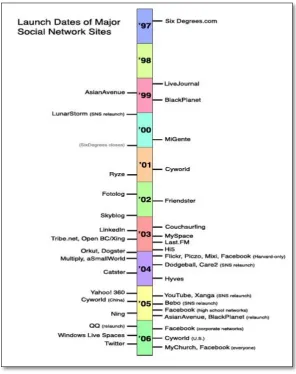
Figure 1: A Timeline of SNSs launch dates, sourced from boyd and Ellison (2007)
Chapter 6
Figure 2: Screenshots of early Facebook and Twitter Welcome pages
Figure 3. Screenshot illustrating the design language on the Facebook Welcome page
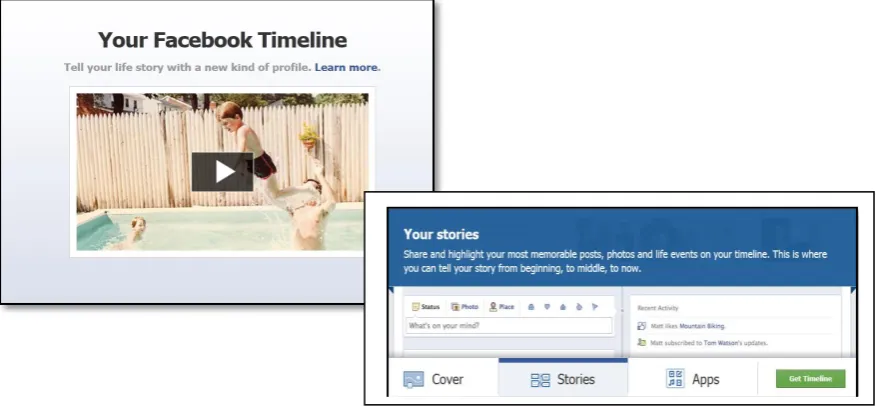
Figure 4: Screenshots illustrating the design language in use when Facebook introduced Timeline
Figure 5: Screenshot of Twitter’s Welcome Page in 2011, illustrating the design language
Figure 6: Screenshot of Twitter’s Welcome Page in 2012, illustrating the design language
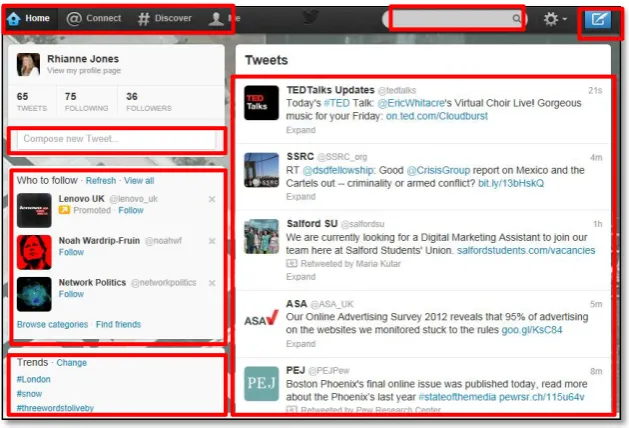
Figure 7: Screenshot of key interactive areas on Twitter’s Homepage
Figure 8: Screenshot of key interactive areas on Twitter’s Discover page
Figure 9: Screenshot of Twitter’s recommendations of people to follow during registration
Figure 10: Screenshot of the Facebook Homepage, highlighting the key interactive areas/features
Figure 11: Screenshot of Facebook Like button and Comment box
Figure 12: Screenshot of prompts to publish personal information in Facebook and the Timeline search
Figure 13: Screenshot of codified prompts in Facebook to publish likes, interests and activities
Figure 14: Screenshot of Twitter ‘Me page’, the outward facing profile information
Figure 15: Screenshot of the controls to open and close chat
Figure 16: Screenshot of warning message that appears when user actions ‘limit old posts’
Figure 17: Screenshot of the location of the control features for followed accounts
Figure 18: Screenshots showing discrete link to privacy/account settings and ‘hidden’ controls to filter
content
Figure 19: Screenshots of access links to the privacy and account settings on Facebook
Figure 20: Screenshot of Facebook’s privacy shortcut with pre-specified questions and pathways to privacy controls
Figure 21: Screenshots of 3 of the 12 available areas which include security/privacy settings
Figure 22: Screenshot of Twitter’s binary private/public settings
Figure 23: Screenshot of the explanation provided to the user about the new message system
8
Figure 25: Screenshot of the Facebook automated ‘seen by’ reminder
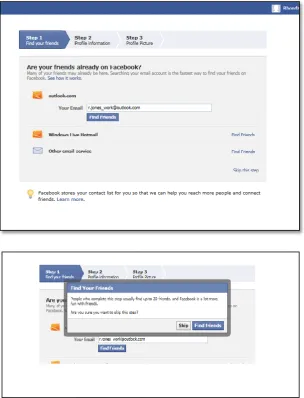
Figure 26: Screenshots of the Facebook registration process
Figure 27: Screenshot of prompts to fill in information on the Facebook Timeline
Figure 28: Screenshots of the registration process on Twitter illustrating the limited request for profile information
Figure 29: Screenshot of the pathway/instructions for deactivating your Facebook account
Figure 30: Screenshot of a dis-incentive to deactivate account stating that friends will miss them
Figure 31: Screenshot of the Facebook deactivated message, informing the user to log back in to reinstate the account
Figure 32: Screenshot of the deactivation pathway on Twitter
Figure 33: Screenshots explaining ‘social features’ to users
Figure 34: Screenshot of a pop-up explanation of how to add details in Facebook
Figure 35: Screenshot of networked spaces not classified as key ‘interactive areas’ on Facebook
Figure 36: Screenshot of more options, located via a drop-down box
Figure 37: Screenshot of links to networked spaces not classifed as key ‘interactive areas’ on Twitter
Chapter 7
Figure 38: Screenshot of the log out image for non-mobile users of Twitter
Figure 39: Screenshot of Facebook’s introduction of the new subscribe feature
Figure 40: Screenshot of Facebook prompt to join Timeline
Figure 41: Screenshot of Twitter’s welcome message
Figure 42: Screenshot of Facebook explanation of the ‘Like’ button in place of the Share button
Figure 43: Screenshot of a sponsored like-based competition and a suggested page
Figure 44: Screenshot of the Facebook help centre, an area not included in the tours
Figure 45: Screenshots documenting an example of the in/visibility of digital controls
Figure 46: Screenshot, explanation of Facebook tags and option to disable
Figure 47: Screenshot of a pop-up explaining the changes to the Facebook messaging service in 2012
Chapter 9
Figure 48: Screenshot of the description of the Like button provided for developers
9
List of Tables
Chapter 5
Table 1: Analysing the user-interface: explication of interface analysis
Table 2: Interview schedule, by theme
Chapter 7
Table 3: Participants’ use of SNS
Chapter 9
Table 4: List of Social Plugins available on Facebook, January 2013
Appendix 4
Tables 1-7: A comparative analysis of the micro-architectures and affordances of Facebook and Twitter
Table 1: An overview of the similarities and differences between Facebook and Twitter
Table 2: Key forms of networked connectivity on Twitter
Table 3: Key Interactive Areas and Features
Table 4: Account settings/controls
Table 5: Primary forms of user-generated Content
Table 6: Networks afforded by Twitter and Facebook - based on site analysis, use and
participant observation
Table 7: Network cultures afforded by Facebook and Twitter - based on site analysis, use and
10
- For Edna and Albert Jones and Sam and Margaret Smith
Acknowledgements
I would like to say a big thank you to my supervisors - Garry Crawford and Ben Light, for
providing me with an open, friendly and creative space to discuss my research and for
supporting me throughout the process. Ben - thank you for your help and encouragement
when preparing for conferences and Garry, your close involvement in the final write-up of the
thesis and your supportive role at challenging points in the research process was greatly
appreciated. I would also like to say a big thank you to all the research participants, who took
the time to talk to me about their use of social media, provided me with access to their
accounts and let me observe their interactions with sites in real-time.
A special thank you to my parents, Maggy - thanks for being a patient listener and proof
reader and Chris - it has been wonderful having someone around who understands the PhD
process to talk things through in between PhD meetings. A special thanks goes to Bron - my
sister, best friend and (lucky for me!) a PhD researcher looking at digital media. I can’t show
you enough gratitude for your close involvement over the last four years, our daily
conversations have helped me elucidate and articulate my ideas. A special mention also goes
to Annie, Zoe and Vicky, who have always been available to discuss research and teaching
over a never-ending glass of wine – you have been a constant source of support.
I would like to end by saying a thank you to the staff at Salford University who have assisted
me along the way including Mary Byrne, Victoria Gosling and Gordon Fletcher and to the
Sociology, Media and Cultural Studies staff at Liverpool John Moores University. Lastly,
11
Chapter 1: An Introduction to the Thesis
Why Study SNSs @ the Interface?
1.1 Introduction
This thesis examines Social Network Sites (SNSs) at the computer-interface in order
to critically analyse the implications of social media design for social media/ted practice. Social media/ted practice is a term intentionally coined by the researcher to capture the
technological aspect of social media practice; practice that is shaped by these sites in the
process of mediation. SNSs are social media technologies delivered as a service, they provide
the specific ‘techno-cultural’ conditions (see Langlois 2009) for the production of a digitally
mediated social context which has the capacity to remediate and represent aspects of social
and cultural life. SNSs provide the conditions for account holders to create a personal profile,
link that profile with other accounts, traverse in-site connections (to varying degrees), (boyd
and Ellison 2007) and interact with user-generated content and feeds. Whilst these sites are
commonly classified as a type of ‘social’ media, it is important to recognise that SNSs are couched in wider forms of networked connectivity, which is why van Dijck (2013) intentionally opts for the term ‘connective’, rather than ‘social’ media.
This thesis examines the implications of design for everyday social media/ted
practice. In theorising the relationship between technologies and social life, the thesis locates ‘practice’ as a key lens. In the social sciences practice commonly refers to routine types of
activity, concerned with regularity of action, social conduct and social order (see Chapters 3
& 4 for further discussion on practice). This thesis specifically examines practices that
involve social media technologies as they typically occur in the context of everyday life. In
line with this, this thesis opts for the term ‘design’ in place of ‘technology’ to emphasise the
distributed forms of human agency that are codified into technological artefacts and systems
in production practices. This thesis defines design in relation to social media, broadly and
conceptually, as all the tactical decisions that are made in the production process, both
technical and symbolic, that come together to configure the users’ experience (Grint and Woolgar 1997). Social media design is examined in this thesis using an original
interdisciplinary analytical framework (See Chapters 3 & 4) and from the particular vantage
12
of design for user-interaction at the interface and in terms of the implications of design for
wider forms of everyday social media/ted practice (further discussion on the specific use of
the term ‘design’ can be found in Chapter 4).
The research addresses a current gap in the social media research agenda, how social
media sites are specifically designed for interaction at the interface and how people actively
encounter and engage with this design, in real-time practice - with the aim of analysing the
implications of design for social media/ted practice. The thesis responds to the limited body
of research critically examining how people understand these technologies as technically and culturally codified spaces and how they routinely navigate these technologies at the computer-interface. In a fast-paced, dynamic and constantly evolving media environment, it is vital to understand the relationship between social media design and practice in order to be
able to fully comprehend digitally mediated forms of social life and cultural expression.
Subsequently, it is important to remember that mediated forms of social practice are
configured out of, the micro-interactions that take place at the interface.
Today’s culture can be described as an interface culture; a culture in which social
interaction and cultural expression is increasingly mediated through digitally networked
technologies. Within this context, the user-interface becomes a key boundary point for
understanding mediated forms of social practice. Not only is the interface the access point to
the digital network but it is the point where machine-readable digital code is transformed into
the ‘cultural codes’ that are accessible to everyday users (Manovich 2001). To understand
current forms of social media/ted practice and their related cultural forms requires critical
examination of the constantly evolving relationship between technologies and social life;
between design and practice. This thesis develops a unique interdisciplinary analytical
framework based on the idea of the triple articulation of social media/ted practice. The triple
articulation of social media/ted practice examines the interrelations between (1), the technical
materiality of sites (2), the symbolic coding of sites and (3), the everyday use of sites (see
Chapters 3, 4 and 5) by analysing how technological materiality is culturally expressed at the
level of the user-interface and how people make sense of and interact with interfaces in
everyday active practice. This thesis uses the term design to refer to platform design and
user-interface design; the key affordances of specific platforms and the strategic decisions that are
made to culturally express functionality and features to potential users. Critical analysis of
13
at the interface has the potential to illuminate important constructive processes that underpin
digitally mediated forms of practice. This approach has the potential to offer fresh insights
into current issues and debates about digital structures, interactivity, participation, and
literacy, as well as information and data-sharing practices, privacy, surveillance and
commerce. As Crawford (2013) reminds us, as interest gathers in the possibilities of ‘big data’, it is important to remember that small data sets continue to provide important
granularity and depth to understanding digitally media/ted practice. Through a case study of
Facebook and Twitter, this thesis explicates the implications of design for practice at the
interface, in order to enhance current understandings of how technical, cultural and social
factors shape evolving forms of social media/ted practice. The thesis sets out to examine the
nature of the relationship between the specific design of sites and related social media use.
The thesis answers the question: what can research into users’ interactions at the interface tell
us about the interrelationships between social media design and social media practice?
1.2 Digitally Networked Social Life
Social and cultural life is bound up with the interplays between technological design,
development, diffusion and appropriation. To cite the title of Latour’s (1991) article; ‘Technology is society made durable’. The on-going diffusion and fast-paced advances in
digitally networked and increasingly mobile computing continues to impact on economic,
social, political and cultural life. The growing importance of digital networks and the
increasing value of information to advanced capitalist societies was expressed in the 1990s
theories such as the ‘information society’ (Webster 1995) and the ‘network society’ (Castells
1996). This called attention to the development of a new phase of capitalism, an era of
post-industrial1, informational, or digital capitalism re-organised around digitally networked
communication infrastructures and the increasing economic value of information (Castells
1996). Theories of the ‘network society’ (van Dijck 1991, Castells 1996) prominently stand
out for explicating the increasingly salient and organising role that digital networks have
come to play in advanced capitalist societies, documenting how they have become embedded
in complex forms of economic and social organisation as well as how they are woven into
day-to-day forms of social and cultural interaction and expression. The proliferation of
network-oriented social theories, including ‘networked individualism’ (Wellman 2003), ‘network cultures’ (Varnelis 2008) ‘network publics’ (Ito 2008, boyd 2011) and ‘networked
1
14
selves’ (Papacharissi 2011) reflect the continued importance of analysing the salient role of
digitally mediated networks to social life.
In the last decade, the development of Web 2.0 coupled with the rise in mobile and ‘locative media’ (Farman 2012) has been a catalyst to the development of a culture of
ubiquitous media; the pervasive integration of digitally networked media into everyday
communication practices. Web 2.0 is a stage of Web development identifiable by a number of
key developments and principles in Web design such as built-in interactivity and the logic of wisdom of the crowd (O’Reilly 2005). Characterised by convergence, Web 2.0 is usefully
thought of as a set of socio-technical arrangements; clusters of technologies, devices,
applications and people which generate the proliferation of networked social spaces and
information flows on the Internet (Castells 2009: 65). Web 2.0 is characterised by a range of
social media technologies, the success of which is premised on their ability to enable digitally
mediated social interaction and harness user-generated content (UGC). SNSs have been at the
centre of Web 2.0 development and provide an important illustration of the salience of
digitally networked technologies for both economic and social life (see Chapters 2 and 4).
The scale of SNSs is evidenced in the fact that some sites now have user-bases comparable to
the population size of entire countries. For example, Facebook has a user-base greater than the
US and UK population combined (Hitwise 2012). As these sites continue to recruit
aggressively, the companies are expanding. YouTube, Facebook and Twitter continue to turn
over competitive annual profits (see van Dijck 2013) earning their place alongside more
established Internet giants like Google and Amazon. Illustrating that SNSs are more than
scalable social ecologies they are also salient commercial ecologies.
There were a number of reasons for choosing SNSs as a case study for this research. In
the UK, SNSs are cited as one of the top online destinations for Internet users, locating them
centrally in digitally mediated life2. In 2008 Ofcom reported that over one fifth of the
population aged 16 or over were regularly using one or more SNSs. In 2011, New Media
Trend Watch reported higher figures, noting that 3 in 4 people in the UK (74%) had an active
Facebook account. This popularity extends globally. Over 200 SNSs have been reported to
exist in the world today (Neilson 2011). Facebook has over one billion registered users drawn
from countries all over the world, aided by a range of language settings and hyperlinked
2
15
translations. This captures the potential of these sites to provide global platforms for
communication. It indicates that at least in principle, SNSs have the potential to be universally
accessible to a global public3. This is a one reason why SNSs attract so much media and
scholarly attention. It is also a key reason why analysing technological design is so important.
Sites are developed in particular contexts but have an international reach. Sites engender
particular modes of Internet sociality which often reflect the particular cultural ideas and
values of the context in which they originate. The culturally encoded values that are
embedded in the technology are often interwoven in cultural contexts, practices and traditions
further afield (see Miller 2011). The rationale for studying SNS was, in part, due to the
popularity of the technology on a global level.
Beyond their popularity, SNSs are a rich area for research because they provide prime
examples of Web 2.0 technologies that capitalise on the affordances of digitally networked
technologies. These affordances emerge out of the technological architecture built on the
properties of code and networks (boyd 2011:24). SNSs are configured out of data that runs
across networks that is (to varying degrees) persistent, scalable, searchable and replicable
(boyd 2011:46-48). Evidence of this can be seen in their unique configuration to digitally
remediate social context and the distinct ways they reconfigure communicative and
content-sharing practices. Sites vary in their appearance and functionality4, but SNSs have a set of
identifiable architectural characteristics that afford certain forms of connectivity, expression
and interaction. As such, SNSs are thought to represent a ‘genre’ of social media5 (boyd and
Ellison 2007) which engender particular forms of social practice6 (a detailed discussion of
particular types of social practice is provided in Chapter 2). ‘Genres’ of social media should
however be treated with caution because these technologies are constantly evolving and the
boundaries between seemingly different ‘genres’ are always in a state of flux. However, this
3
The World Map of Social Networks (2011) gives a strong sense of the on-going importance of regional variations in terms of site preference (discussed in more detail in Chapter 2).
4
The specific design of sites; the nature of networked connections, communicative, expressive and participatory practices supported by sites vary.
5
SNSs have been defined as a genre on the grounds that they: (1), require user subscription (2), allow the creation of personal profiles (3), enable profiles to be linked and (4), allow users to traverse network connections within the site (boyd and Ellison 2007).
6
16
said, there is a growing body of research which provides evidence to suggest that SNSs are
working to stabilise specific ‘social media’ norms, values and forms of mediated practice
(McLaughlin and Vivak 2011, Papacharissi and Easton, forthcoming). Furthermore, SNSs
have been proven to be reflective of wider trends in Internet use. SNSs exemplify popular
trends in emergent forms of networked connectivity, interaction and self-expression. As such,
they epitomise developments in a Web 2.0 era defined by technological, commercial and
cultural convergence (Jenkins 2006). In particular, they can be identified as exemplifying
current trends in nonymous (known, as opposed to unknown) digitally mediated
environments, the growth in mobile Internet access and use (Ling and Donnar 2009), the
expanding applications market and locative Internet technologies (Farman 2012).
Their growing scale and social significance, and their important role in shaping
emergent forms of social practice, provides a strong justification for on-going research into
these sites in their own right. As argued, SNSs have been instrumental in the continuing transition towards ‘networked life’ and the configuration of ‘networked selves’, facilitating
the rise of ‘networked publics’7 (Ito 2008, boyd 2008). SNSs are a key feature of networked
publics because of their distinct capacity to re-mediate, re-organise and re-present spatial
boundaries, which in turn shape how we experience ‘space’ and ‘place’. As boyd (2011)
argues, SNSs aggregate contexts and connections in the physical world into singular digitally networked spaces, effectively ‘collapsing context’ (boyd 2008; 2011). Subsequently, SNSs
illustrate the increasing (indissoluble) interplay between digital and physical environments
and experiences. They illustrate the ways in which digital and physical practices increasingly
interface, reflexively remediating and reconfiguring each another in the process. The growing
use of mobile technologies to access SNSs further illustrates the role they play in
re-configuring people’s understandings of space and place. Furthermore, the recent incorporation
of geo-tagging capabilities in SNSs represents recent design drives to integrate information
about location and place into the interactive and social experiences of users. This has resulted
in SNSs being described as a salient form of ‘locative media’; media aimed at intermeshing
location into communication and interactive forms in everyday life (Farman 2012). SNSs are
fast becoming part of a wider pervasive social computing culture; a digitally networked
7
This was a concept coined by Ito (2008) and later developed by boyd (2011) to describe the digital
17
culture which is increasingly linked to ubiquitous mobile use and the expanding mobile applications (‘app’) market.
SNSs are often said to increase public/audience participation, facilitating new forms of
community and participatory cultures which are characterised by user-generated content and new forms of collaboration. However, it has been argued the role of the ‘active user’, in terms
of their interactive and participatory role, has been overstated (Fuchs 2009; 2012, Lovink
2011). Not only are SNSs important social contexts, they are media technologies with a
materiality that shape everyday life when embedded in social practice. As already suggested
the technological dimensions of SNSs play a key role in shaping mediated forms of practice,
something which is gaining recognition on the research agenda8. However, in addition, many
are commercial services. It is important to remember that many SNSs businesses are
profitable services, owned by big corporations. Successful social media companies, for
example Facebook, are often founded on business models that are heavily, if not entirely,
dependent on the monetisation of user generated content (UGC) to be profitable and
sustainable (Coyte and Plybus 2007, Jarret 2008, Langlois 2009 Andrejevic 2011). These sites
support wider commercial ecologies by monetising user-data and providing digitally mediated
social contexts for commercial organisations to penetrate and operate in. Political economy
approaches to SNSs argue we need to locate these practices in broader socio-political and
economic structures (Fuchs 2011; 2012). As a result ‘participatory’ social media practices are
re/located in the context of neo-liberal capitalism and in relation to new forms of ‘informational’ capital.
The growing Web dominance and commercial profitability of these sites serves as a
reminder of the need for on-going critical investigation into the relationship between design
and use. The engineering of these sites reflects a complex set of social and economic interests. As Langdon Winner (1986) reminds us, all technologies must be considered ‘political’. This
is an important point - if social media technologies are appropriated and integrated into
everyday life they can materialise (and stabilise) distinctive sets of practices, norms and
values (Papacharissi and Easton, forthcoming). Recently, the commercial aspects of SNSs
have received increased attention. Arguably, these issues are now at the forefront of the social
8
18
media research agenda, calling attention to the politics of the technology and the implications
this has for current forms of social media/ted practice. The importance of these questions
cannot be overestimated in the context of widespread neo-liberalism, and in light of the
practical challenges that face Internet regulation. Because of this, social media researchers
cannot simply examine how sites are appropriated by people in everyday life. They must aim
to develop understandings of use which acknowledge the wider economic and political
context in which these sites develop. It is important to examine the complex and intermeshed
reality of the social and commercial ecologies that are mediated by these technologies. Social
media researchers must address the complex, intricate on-going negotiations and oscillations
between both aspects; the participatory and the commercial dimensions of social media.
Looking at design in active practice is one lens through which to examine these complex
negotiations and oscillations.
Ellison et al. (2009) suggested that the very character of our social and cultural lives was being transformed by these technologies, a clear indication of the widespread recognition
of the importance of social media for social, cultural and commercial forms in the 21st
century. SNSs remain a relatively new communication medium in the longer ‘duree’ of
Internet communication. However, this should not detract from their current social
significance; these sites, and related forms of social practice, provide an important lens
through which to illuminate the on-going development of Web 2.0; through which to examine
social, cultural and economic life as it takes form in a digitally networked age. Although the
longer term transformative character of SNSs remains a matter of enquiry, what is clear is that
these sites have already had an impact at the level of the everyday social life (see Chapter 2). They have re-mediated and, in the process, re-configured how many people routinely connect
and interact and engage with one another, through the specific ways that information and
content is produced, accessed, stored, managed, shared and retrieved. This type of technology
is fast becoming a stable and enduring aspect of the media landscape and everyday life for
many people. In a blog discussion by boyd (2010) it was even suggested that these services
could be conceived of as ‘public utilities’. In light of this, and their increasing economic
significance, SNSs remain a significant site of on-going academic enquiry.
A comprehensive and developing body of research into SNSs now exists (see for
example: Albrechslund 2008, Andrejevic 2005, Bodle 2010; 2011, boyd and Heer 2006, boyd
19
2012, Hargittai & Hsieh 2010; Hargittai & Litt 2012. Jarret 2008, Marwick 2005,
Papacharissi and Fernback 2007, Papacharissi, 2009; 2011, Parks 2011, Stutzman 2006,
Zhang 2010; 2011 Zimmerman 2008). However, this thesis makes the argument that further
examination is needed into the complex interrelationships between social media design and
practice, by looking at the role of design in contextual practice at the interface. This would
provide a new angle from which to examine the interplays between company interests,
technologies and social interests. Despite a growing recognition of the shaping role of
technology and the implications of site design for practice, to date, research has tended to
examine ‘technology’ and ‘design’ primarily from the view of the researcher. This involves a
consideration of the nature, and shaping role of design, but not necessarily how these
technologies are encountered and interacted with by people in contextual practice. This thesis
addresses this gap in the literature, described here as ‘design in practice’ through a critical
examination of how people use SNSs in social practice in the context of how they understand and navigate the technologies at the interface as technically and culturally engineered and codified spaces. This thesis examines user-interface design as an important techno-cultural frame; as a particular representation of the technology that has implications for user
interaction and social practice. It locates the interface as a key boundary site; a point at which
to examine and understand how technological affordances and processes are
represented/expressed and interacted with by users. In effect, it examines the interface as a
digital framework for social media/ted practice.
Drawing on insights from Sociology, Media Studies and Social Studies of
Technology, the thesis utilises an original theoretical framework and empirical lens to study
user-interface design as a digital framework that mediates affordances which, in turn,
engenders particular types of social practices. The thesis analyses digital design structures in
terms of: (1), the opportunities for interaction provided and (2), the cultural coding of these
opportunities. In addition, it analyses how people make sense of, interact with and appropriate
social media technologies at the interface in the context of wider social practice. This research
also provides an important platform for participant reflections and views on design and their
20 The thesis is structured around two primary questions:
1. What is the relationship between social media design and social media practice?
2. What can studying interactions at the interface tell us about the interrelationships
between social media design and social media practice?
This was broken down into four further questions (see below), which underpin key areas for
(interrelated) analysis:
How does the design of a SNS technically and symbolically frame practice?
How do users understand and use SNSs as technically and culturally meaningful
technologies?
How do users routinely interact with design at the user-interface?
What role do SNSs play in wider social practice and how does researching design-in practice help us to understand trends in SNS use?
1.3 Thesis Overview
Chapter 2: Digitally Mediated Social Life
This chapter argues that design, at the level of the user-interface (as it would be
encountered by the user) is under-researched. The chapter begins with a critical review of
literature relating to digitally mediated social life. The chapter continues to provide an
historical account of conceptual approaches to Internet sociality and key Web
developments in order to locate SNSs. This is followed by an in-depth review of key
literature on SNSs, organised thematically. The chapter makes the argument that research
into social media/ted practice has over focused on the active choices of the user at the
expense of critical questions about design, the politics of design, and the interactions
between people and SNS. Recent developments in social media research have raised the
profile of these issues but the chapter points to a number of gaps in the research that
21
Chapter 3: Theorising Social Media/ted Practice: Towards an Analytical Framework
This chapter explicates an analytical approach to studying social media/ted practice, which
recognises media technologies as material and symbolic structures that shape practice in
the process of mediation. The chapter argues that mainstream Media Studies and
Sociology have traditionally marginalised research on the materiality of media
technologies; in terms of understanding the role of they play in structuring everyday life.
In particular, the chapter argues that these disciplines have marginalised the interactions between people and technologies. This chapter reviews theories from Social Studies of Technology (SST) to consider how these issues have been addressed elsewhere. Whilst
SST has not always been directly concerned with studying media technology, this thesis
argues that SST offers a range of useful theoretical insights that could benefit the
development of a sociological approach to media/ted practice. In particular, in terms of
recognition of (1), the materiality of technology (2), the social shaping of technology and
(3), the politics of technology. The chapter integrates insights from SST, alongside
insights from Sociology and Media Studies to provide an interdisciplinary analytical
framework to study the triple articulation of social media/ted practice.
Chapter 4: Design and Social Media/ted Practice
This chapter builds on the previous discussion to critically analyse existing literature on
social media design and practice. The chapter builds on the framework explicated in
Chapter 3, focusing on how it can be applied to social media. This chapter provides an introduction to the terms ‘design’ and ‘practice’ and explicates how this thesis
operationalises these terms in this research, before critically reviewing recent literature
that furthers our understandings of the interrelationships between social media design and
practice. The chapter examines the implications of technological design for digital practice
through a discussion of digital architectures and affordances, code, software, algorithms
and interface design. In particular, the chapter advances the argument that the
user-interface is an important representational arena; a symbolic mediator between design
intentions and active use. The chapter argues that further research is needed that looks at
22
Chapter 5: Researching Social Media @ the Interface
This chapter provides a detailed discussion of the research methodology and specific
approach taken. It gives a justification for the (critical) social constructivism adopted, and
the specific methods and techniques developed for studying social media sites and social
media/ted practices at the interface. The chapter explicates the research process, it
documents key decisions made regarding sampling, data collection and data analysis. The
chapter concludes with a discussion on the specific ethical considerations relevant to the
research.
Chapter 6: Social Media Design at the Interface
This chapter answers the research question, how does the design of a SNS work to
technically and symbolically frame practice? The chapter draws on an analytical account
of the architecture and affordances of Facebook and Twitter as discerned by the researcher
at the user-interface (see Appendix 4). This analysis documents the main areas within
site-specific architectures and analyses the key opportunities for technical and social
interaction available to the user. The chapter then reports on the textual configuration of
platforms, the organisation and presentation of technical and social opportunities for
interaction and the cultural coding of technical features. It concludes by discussing the
importance of specific ‘design languages’ embedded in sites and their role in culturally
configuring the technology in particular ways in order to render it meaningful to potential
users.
Chapter 7: Making Use and Making Sense of SNSs
This chapter answers the research question, how do users understand and use sites as
technically and culturally meaningful technologies for interaction? The chapter reports on
how participants make use and make sense of Facebook and Twitter. The chapter
critically analyses how participants understand the sites in relation to their routine use. In
particular, the chapter reports on the overtly social framing of these technologies. The
implications of this are discussed in detail in Chapter 9, where the social framing of SNSs
23
Chapter 8: Interactions @ the Interface
This chapter answers the research question, how do users encounter and interact with
design at the user-interface? It reports on how participants interact with Facebook and
Twitter at the computer-interface, focusing on how participants encounter, and engage
with, technical and social opportunities for interaction. The chapter critically considers
how design structures interplay with interpretive processes at the user-interfaces. It
considers the relationship between design structures and routine interactions to illuminate
how wider routines and social media/ted practice is configured out of the micro
interactions that take place at the interface. It addresses the question, how we can
understand the role of design in shaping practice? And what can studying interactions at
the interface tell us about social media practice?
Chapter 9: Beyond the Social Affordances at the Interface
This chapter argues that the social framing of sites obscures wider forms of commercial
connectivity and activity. It reports on participants’ ‘social’perceptions of the networked
environments. The chapter asserts that the cultural framing of features and visual ordering
of technical features at the interface obscures the commercially-orientated activity. This
chapter illustrates these points through a discussion of the social framing of privacy, participants’ understandings of connective features such as social plug-ins and participants’ understandings of the terms that govern their use of these services. The
chapter considers these issues in relation to the politics of design and digital media
literacies.
Chapter 10: Conclusions and Contributions
The final chapter critically considers the role of design in practice by reflecting back on
the research, explicating key findings and critically discussing the implications of
user-interface design for social media/ted practice. The conclusion addresses the need for
transparency in terms of choice and control in social media design and suggests further
investment in digital literacy initiatives to educate users about key issues in these digitally
24
Chapter 2: Digitally Mediated Social Life
2.1 Chapter Overview
This chapter traces the emergence of SNSs, located in a wider historical review of social life
and the Internet. The chapter begins with a brief review of theoretical approaches to
understanding early forms of Internet sociality, calling attention to the importance of networks
in mediating contemporary forms of social and cultural life. The second half of this chapter
documents the rise of Web 2.0 and considers SNSs as a key Web 2.0 technology. This is
followed by a review of central issues and debates that have shaped the SNS research agenda.
Four key themes are discussed (1), visibly re/mediated networks (2), representations and
re-mediations of identity (3), user-generated content, privacy and surveillance and (4), digital
architectures and affordances. All key themes have been reviewed because they are relevant
for this research. However, the last theme is particularly important because it reflects a recent,
growing interest in design on the wider digital media research agenda. Whilst this chapter
reviews key contributions in this area, the discussion on digital architectures and affordances
is developed in greater detail in Chapter 4. The chapter concludes by arguing that much can
be gained from researching user-interface design, and interactions with design in real-time
practice.
A short disclaimer is needed at this point. This thesis focuses on the role of SNSs in
everyday life; the routine ways in which people are using these sites in everyday social, communicative and expressive practices. As Winner reminds us technologies are ‘woven into the texture of everyday existence’ [...] deeply insinuated into people’s everyday thoughts, perceptions and behaviours’ (Winner 1986: 12). Gardiner (2002: 2) defines everyday life as
the largely taken for granted world that remains clandestine. Approaches to studying everyday
life can and do vary, this thesis is committed to studying everyday life as it is understood and
practiced by people in ordinary contexts, with recognition of the socio-political context in
which it is located and generated (Lefebvre 1991). It is worth stating that this thesis is not
primarily concerned with formal and regulated contexts of use, such as, education, work,
politics and journalism, it is primarily interested in the everyday informal contexts of use, the appropriation of SNSs in the more fluid, contexts of ordinary everyday life. Whilst there is
25
referred to when it is directly relevant to understanding SNSs in everyday contexts and
practices.
2.2 Digitally Networked Technologies and Everyday Social Life
Taken as a whole, the field of Internet and digital media research is a burgeoning
interdisciplinary field with contributions from Computer Sciences, the Humanities, and Social
Sciences. Research in this area reflects a rich and diverse tapestry of ideas, interests and
debates evolving in line with the development of technology: commercialisation, regulation,
privacy, security and data protection, citizenship, democracy, freedom, censorship and digital
inequalities, to name but a few. Whilst earlier research constructed the Internet as a virtual
frontier, engendering new forms of ‘virtual’ communities and providing new
virtual/anonymous spaces for identity play, ‘cyber’ or ‘virtual’ conceptualisations of the
digitally mediated environment have largely given way to the realisation that digitally
networked media is very much part of the everyday. Internet technologies and digital media
are increasingly ubiquitous features of life for many UK residents9, embedded into the fabric
of life at work, at home and on the move. Today, devices such as mobile phones, laptop
computers, MP3 players, and digital cameras are used by people of all ages and backgrounds
to connect to a growing number of Internet services and applications, where they can interact
with friends, family and colleagues, upload, consume and share content, shop and manage
their day-to-day living and finances. Because of this, the evolving focus in Internet research
reflects an increasing concern with both practical and normative questions about how we
design, build, provide access to, use and appropriate these technologies as a society. For
example, policy-makers continue to grapple with questions of digital access, literacy and
Internet regulation. These questions reflect a deepening social concern with the evolving
interrelationships between social life and digitally networked technologies. This being said,
approaches to understanding the role of the Internet in social life have undergone important
shifts over the last two decades, theoretically and empirically, for example, the internet has
gone from being framed as a separate virtual province, to being recognised as an interfacial,
digitally networked space. SNSs are only a fairly recent development in the longer trajectory
of Internet technologies and scholarship about the Internet and social life. Therefore, before
9
26
critically reviewing research in this area, it is necessary to consider how wider theoretical
developments have informed current approaches to digitally mediated network sociality.
This research is interested in the relationship between social media technologies and
people, at the interface, foregrounding the capacity of the technology to remediate social life
in ways that shape it in the process of mediation. However, initial research into
computer-mediated communication (CMC) emerged in the context of developing conceptual framings
about the ‘cyber’ and the ‘virtual’. The Internet was considered to provide new cyber or
virtual spaces for social interaction and cultural experiences, seemingly separate from the
physical world. In the 1990s, terms such as cyberspace, cyber-culture, cyber-identity, virtual reality, virtual communities and virtual selves reflected a prevailing theoretical lens.
Furthermore, associated research was typically characterised by ‘virtual’10 methodologies,
whereby researchers examined issues as they occurred online, rather than in physical spaces
(Hine 2005:51). Sherry Turkle’s (1996) ‘Life on Screen: Identity in the Age of the Internet’
and Howard Rheingold’s (2000) ‘The Virtual Community: Homesteading on the Electronic Frontier’, are notable cases in point. In ‘Life on Screen: Identity in the Age of the Internet’,
Sherry Turkle explored social interaction in Multi-User Domains (MUDs) and constructed a
view of the Internet as an anonymous and disembodied environment which, in turn, provided
the possibility for identity and ‘role play’. Turkle described the de-centred and multiple nature
of identity, echoing many aspects of postmodernist claims, around the same time, about the changing nature of identity in a new ‘post-modern’ era (e.g. Butler 1999 [1990]). However
more recent trends in Internet enabled sociality have been towards personally identifiable
self-presentations (Marwick 2005) in nonymous (personally identifiable) digitally mediated
environments (Ellison et al. 2007). The early conceptualisation of a ‘virtual’ reality failed to attend to the complex ways in which digitally mediated communication was intermeshed with people’s’ lived realities and experiences. As Miller and Slater (2000:4) explain ‘by focusing
on virtuality as the defining feature of many Internet media [...] we start from an assumption
that it is opposed to and disembedded from the real’. As Sundén (2003) reminds us, people
working and playing online sit at the computer interface; they remain embodied and
physically located within the world (ibid). People’s’ mediated self-presentations and social
10
27
interactions are always influenced by their embodied experience (boyd, 2008). People have to ‘type’ (Sudén 2003) or ‘write’ (boyd 2008) themselves into being.
Howard Rheingold’s (2000) The Virtual Community: Homesteading on the Electronic Frontier’ provides another example. Rheingold’s empirical study of the Whole Earth
Electronic Link (WELL), drew attention to the Internet’s capacity to support ‘virtual communities’ - seemingly ‘new’ community formations that congregated in ‘virtual’ spaces.
Rheingold was interested in how Internet technologies were being appropriated by individuals
to connect with people outside their pre-existing social groups, helping to liberate them to
form communities based around shared interests, as opposed to shared geography (Gross 2006). For Rheingold, Internet technologies had the potential to revitalise community and
open up new spaces for the public sphere and democratic life. Although Rheingold drew
attention to new forms of digitally mediated interaction, his research proved to be tied to a
particular time and early expression of Internet use (Castells 2001)11 and, like Turkle’s
research, suffered from the application of a ‘virtual’ theoretical framing. Contemporary applications of ‘community’ to Internet sociality emphasise the re-mediated, the networked,
and the technological dimensions of this mediated social form (Wellman and Gulia 1997,
Wellman 2001). Despite the shortcomings of the virtual community framing, Rheingold’s
emphasis on the emergence of geographically dispersed, interest-driven, digitally media/ted
social formations exhibited foresight in terms of later developments in networked social
media/ted practice. For example, social media sites have been shown to support
geographically dispersed networks, driven by interest-orientated connections (Zhang 2010).
In the main, ‘Virtual’ approaches to Internet sociality proved unsustainable as the
Internet became increasingly integrated into everyday life, aided by the success of the
personal computer, widening Internet access and participation and later, developments
regarding mobile access and use (Castells 2007). As a communication medium, the Internet
was becoming instrumental in people’s’ everyday ‘situated’ lives (Castells 2001, Wellman et al. 2003). At the turn of the century, research by Anderson and Tracy (2001), and Howard, Rainie and Jones (2002) identified email as the most popular use of the Internet, assisting people in their routine communication practices in work-based contexts and helping people to
11
28
keep in touch in everyday social contexts. The Internet was being shown to be part of a wider
communication matrix (Wellman et al. 2003). A decade later and SNSs are some of the most popular Internet sites, illustrating the salience of digitally re/mediated modes of social
interaction. Subsequently, the physicality of everyday use and the specific configurations of
digitally networked social spaces received growing attention (see Miller and Slater 2001,
Wellman and Haythornthwaite 2002). Castells laid important groundwork for this
reconceptualisation of Internet spaces as digitally networked re/mediations. In the first part of
his trilogy ‘The Information Age’, Castells strongly claims that network structures are at the
centre of an expanding capitalist economy based on decentralisation and globalisation. For
Castells, digital networks were becoming the dominant mode of organisation in society; a new
material basis for the performance of activities throughout the social structure. Wellman and
colleagues (2003) argued a similar point on a social level arguing that ‘networks’ were
becoming the dominant mode of social organisation, replacing community as central means of organising interaction.
This increasing centrality of digital networks to social life has been developed in a
range of network-orientated theories, including networked individualism (Wellman et al. 2003), network sociality (Wittel 2001), network communities (Varnelis 2008), and more
recently, networked publics (Ito 2008, boyd 2011). The Internet was shown to be part of a
broader matrix of communication practices (Castells 1996; Wellman & Haythornthwaite
2002, Wellman et al. 2003). This said, the distinctive networked nature of communication practices led Wellman and colleagues (2001, 2003) to suggest that the Internet facilitated a broader social trend towards ‘networked individualism’. For Wellman (2001, 2003)
communities and societies were moving towards networked societies where boundaries would
become more permeable, linkages would switch between multiple networks, and hierarchies
would be flatter and more recursive. In response to this the term ‘networked individualism’
was coined to capture the personalised communities developing under these conditions. Earlier, Andreas Wittel (2001)12 used the term ‘network sociality’ to signal similar changes,
emphasising, like Castells (1996), and Wellman et al. (2003), a more transient, flexible and informational form of social relations and social practices. As Wittel (2001:1) explains:
12
29
‘In network sociality, social relations are not ‘narrational’ but informational; they are not
based on mutual experience or common history, but primarily on an exchange of data and
on ‘catching up’(…) Network sociality consists of fleeting and transient, yet iterative social relations; of ephemeral but intense encounters’
The collective contributions of Castells (2001), Miller and Slater (2001), Wittel (2001),
Wellman et al. (2003) and Wellman and Hogan (2004), provided the basis for an important theoretical shift in approaches to Internet sociality, accentuating the networked nature of social relationships, interactions and social spaces enabled by digitally mediated technologies.
Here sociality is considered to be digitally remediated and reflexively13 constituted through socio-technical networked spaces, couched in wider economic social and cultural contexts.
Recently, the notion of ‘networked publics’ (Ito 2008, boyd 2011) has provided another
variant on theorising digitally networked social formations.
By highlighting the increasing salience of networks to social life and by locating
Internet sociality in wider economic, social and cultural contexts, network approaches to
Internet sociality set the research parameters for the SNS research agenda. Network
conceptualisations of sociality are highly apt when thinking about SNSs. This is because SNS
support a range of network structures, most typically, the ego-centric network; a network
organised around the individual as the central node. Although community is still used to
discuss social forms mediated by SNSs (see Parks 2011, Grudz et al. 2011), it is usually contextualised within a discussion of network structures. For example, boyd (2006) described
MySpace as an ‘imagined14 ego-centric community, acknowledging the envisioned
community element but emphasising the ego-centric networked nature of the social formation.
More recently, the concept of the imagined community has been deployed to describe forms
of network sociality on Twitter (Grudz et al. 2011). The versatility of the network metaphor makes it highly suitable to explain the diverse social forms of connectivity enabled by SNSs.
As Marwick (2005) explains, a network is made up of many communities linked together, or
disparate elements that are linked by a single weak tie. Communities, on the other hand, imply
13
The reflexivity between physical and (digitally) mediated spaces has only intensified over the years in light of developments in mobile Internet access and use (Castells 2007) and locative media (see Farman 2012).
14