Saving face : managing rapport in a
problem based learning group
Robinson, L, Harris, A and Burton, R
http://dx.doi.org/10.1177/1469787415573355
Title
Saving face : managing rapport in a problem based learning group
Authors
Robinson, L, Harris, A and Burton, R
Type
Article
URL
This version is available at: http://usir.salford.ac.uk/31915/
Published Date
2015
USIR is a digital collection of the research output of the University of Salford. Where copyright
permits, full text material held in the repository is made freely available online and can be read,
downloaded and copied for noncommercial private study or research purposes. Please check the
manuscript for any further copyright restrictions.
Page 1 of 14
Saving face: Managing rapport in a Problem Based Learning group
Leslie Robinson, Ann Harris and Rob Burton
Biographical details of authors
Leslie Robinson, Directorate of Radiography, University of Salford, UK. Telephone: 0161 295 23303; Fax: 0161 295 2432; Email: [email protected]
Ann Harris, School of Education and Professional Development, University of Huddersfield, UK.
Email: [email protected]
Rob Burton, School of Human and Health Sciences, University of Huddersfield, UK. Email:
Leslie Robinson, a Senior Lecturer in Diagnostic Radiography at the University of Salford, is a postgraduate programme leader and researcher. Her research interests include the student experience and digital health technologies.
Dr Ann Harris is a Principal Lecturer in Education, University of Huddersfield. She works with undergraduate and postgraduate students, and her research interests include communications, and cultural and critical pedagogy.
Dr Rob Burton Is a Principal Lecturer in Human and Health Sciences, University of Huddersfield. He has worked in Nurse Education for over 20 years. His research interests include learning styles of students.
Abstract
This qualitative study investigated the complex social aspects of communication required for students to participate effectively in Problem Based Learning and explored how these dynamics are managed. The longitudinal study of a group of first year undergraduates examined interactions using Rapport Management (RM) as a framework to analyse communication with regard to the concepts of face, sociality rights and interactional goals. PBL requires students to engage in potentially face-threatening interactions as they discuss subjects of which they have little prior knowledge, placing them in situations that require negotiation using face-saving strategies in order to meet objectives to share their learning with others. The study described within this article focuses on the key role of the PBL chair and shows how failure by the chair to manage rapport effectively can influence the quality of group learning. The findings suggest that educators need to understand the complex interactional demands students have to face in undertaking PBL and support students to overcome these difficulties considering the three bases of rapport management.
Keywords
Problem based learning, facilitation, social constructivism, face, rapport management, communication
Problem Based Learning (PBL)
Page 2 of 14
nominated as ‘chair’ and another is nominated as ‘scribe’, (Wood, 2004). The discussion is facilitated by a tutor who guides students in their PBL roles rather than providing subject-specific knowledge. The PBL tutorial is generally structured according to an agreed problem-solving strategy, such as the Maastricht 7-jump model (Schmidt, 1983) used in the study reported here. Although at a curriculum level models of PBL can vary, ranging from a single module of PBL to a fully integrated PBL programme (Savin-Baden, 2003), one of the defining features of PBL is that the problem is vague and presented at the beginning of the event in order to drive the subsequent learning (Ross, 1997). The intention is that students come to the problem with little pre-existing knowledge, that is, they are unable to discuss the issues related to the problem in an informed way without undertaking further study.
Opinions about the value of the group in terms of its impact on learning have changed. Early PBL researchers believed it existed solely for the elaboration of knowledge to enhance individual learning (Norman, 2001; Eva, 2002). Eva stated that working together is simply a means to an end that may be effective in some situations, and Norman suggested that the element of group work was an incidental feature of PBL. Miflin’s 2004 narrative review concluded that PBL groups should only be used during the early stages of a student’s journey until they become more self-sufficient, because she suggested that learning is essentially an individualistic activity. More recently, however, proponents of sociocultural learning have argued for a deeper understanding of PBL which places the group at the centre of the PBL process; the place where learning is constructed. Harland (2003) used Vygotskyan analogies to describe how the boundaries and edges of new knowledge shared in the PBL group become the group’s Zone of Proximal Development, going on to suggest that learning is so bound up in the social context that different groups studying the same problem will arrive at different learning issues.
Van den Bossche (2006) explored the integration of social and cognitive theories and also argues that the social context influences group learning. He suggests that a group’s mental schema, a joint understanding of cognitive goals, is heavily influenced by the dynamic nature of a developing social system or the ‘emergent states’; which are the social ‘product’ of the group. He also explains that the success of a group can only be ensured where there is psychological safety in which individuals know that their ideas will not be rejected by others. This has been replicated in the context of compulsory education. Barnes and Todd (1977) identified a spectrum of social interactions with two extremes in the learning groups of school children. At one end there were personal clashes and disputes. This was clearly unproductive for collaboration. However, at the other end the groups were so concerned with harmony that they avoided differences of opinion. Mistakes were left unchallenged and the group put the social harmony of the group before their need to develop cognitive strategies. Nelson and Aboud (1985) and Azmitia and Montgomery (1993) showed that groups of learners who were friends rather than acquaintances found it easier to expose their views and to challenge each other. They suggested that this was because the friends knew the conflict was not likely to be detrimental to their friendship. It is thus important to get the social relationship between the group participants right if the tricky process of conflict is to be managed effectively.
Page 3 of 14
An analytical framework which explores the emotional impact of communicative interactions is therefore required if we are to understand how students experience PBL. The concept of ‘face’ is a particularly good fit for this task (Goffman1967). ‘Face’ as a sociological concept is related to notions such as esteem, regard, worth and dignity and is what is claimed or protected by a person in a communicative act. Goffman’s work suggests that face relates to what is ‘approved’ or held in regard and is related to social attributes so what is approved is not only determined by self but influenced by cultural norms. Face is therefore both a social and a dynamic concept in that it is constructed in interaction and is associated with a judgement made by others. However, what is worthy of approval in terms of face is dependent on many contextual factors including the perspective of each individual and the influence of wider culturally-related beliefs. Importantly, for this work, face can be ‘threatened’ when a speaker makes a move which puts themselves or the hearer at risk of ‘face loss’. Such moves are called Face Threatening Acts (FTAs). As identified by Keville et al (2013) students report that they find the experience of working with their peers embarrassing, scary and difficult. Furthermore, through speaking, there is the risk that what is said may offend someone else, and that one or more participants will not speak unless they have ‘the right answer’ as they are mindful of how others will judge them. If we are to better understand how learners communicate as part of a group in PBL, understanding how students manage ‘face threatening acts’ is clearly important. There is a need to look at student-to-student interaction, and therefore it is necessary to select a theory of communication through whose lens this can be viewed. Rapport Management (Spencer-Oatey, 2002) is such a lens.
Rapport Management (RM) theory
Rapport Management (Spencer-Oatey, 2002) is a theory of communication which posits that in order to achieve some interactional goal, interactants (that is, specific speaker(s) and hearer(s) in any conversational occurrence) apply tacit communication strategies, to manage their relationship, giving particular attention to maintaining (or not) their own, or others’, ‘face’ (Goffman, 1967). Rapport Management also considers the influence of contextual factors however including sociality rights and obligations, and interactional goals. In a PBL tutorial context these are clearly different to those experienced in normal conversation.
‘Sociality rights’ are concerned with our perceived entitlements and obligations in relationships with others. Such rights concern two aspects. One, equity in relationships, which is related to a mutual understanding that there should be a balance between ‘autonomy’ versus ‘imposition’ or the degree to which demands on another’s resources are tolerated. Two, association, which clarifies the level of ‘involvement’ versus ‘detachment’ managed in a relationship. In normal conversations, these rights are often unwritten and are heavily influenced by the power and/or social distances that exist between hearer and speaker. In an institutionally-bound context, formal customs and practices often legitimised through rules and regulations further influence communication strategies. So, for instance, the way one requests a favour from one’s friend or family member may be quite different from the way a request is made to a superior or senior colleague in a work context, or to another student. In addition to face and sociality rights is the notion of an ‘interactional goal’ (Spencer-Oatey, 2008) that is, the purpose of the communication. By incorporating interactional goals in Rapport Management, there is an acknowledgement of the importance of task achievement in maintaining relations since failure to achieve an objective or a mismatch between each interactant’s intended goal can cause a breakdown in communication.
Page 4 of 14
For students acting out their roles in PBL, there may be many occasions in which Face Threatening Acts (FTAs) could be experienced, and management of these requires more advanced communicative skills than those upon which individuals usually rely on in everyday conversations. The study therefore aims to use the RM framework and the individual bases of face, sociality rights and interactional goal to understand how students engage in PBL and what the drivers and barriers are which determine how they manage a face threatening act. The research questions which drive this study are therefore: what face-threatening communicative interactions do students encounter in the PBL tutorial; how do students manage these FTAs; and what is the impact of these communication management strategies on learning?
In summary, the literature on PBL groups appears to reflect a general acceptance that group dynamics and quality of learning are interrelated. This is of concern as a number of studies have shown that PBL can be an emotional and uncomfortable social experience. Similar to observations made about school children, it is believed these aspects of social interaction might prevent students engaging in disagreement and conflict. However, just exactly what makes students feel uncomfortable is still unclear. Identifying the cause might help in understanding not only the points at which social interaction is most challenging but how these interactions are managed and the consequential impact on learning. There is a need to explore these challenges in order to uncover how students behave at these critical points in the learning process.
Method
Data collection and data analysis methods
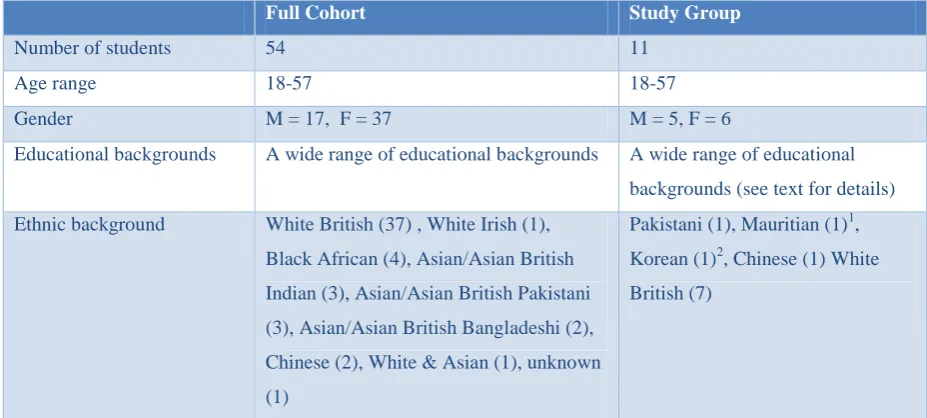
The study took place between October 2007 and May 2008. It involved interviews and observation of one newly formed first year (level 4 QAA) PBL group studying an undergraduate diagnostic radiography course. The group comprised 11 students from a diverse mix of educational, ethnic and social backgrounds. Their ages ranged from 18-57, and there were 6 females and 5 males (see tables 1 and 2).
<<Insert Table 1 here>>
<<Insert Table 2 here>>
Interviews
Students were interviewed twice as a group using a Focus Group Interview (FGI) in November 2007 and May 2008. Students also had Individual Interviews once or twice. Individual Interviews were held in the first week of PBL and in the week following the first FGI. As well as being driven by theoretical sampling, the interview schedule was dictated by practical issues of student availability. Nine out of the 11 students were interviewed twice during the period of the study, 1 student was interviewed once and 1 student was not interviewed at all individually, although she was present for the first group interview.
The purpose of the first interviews was to determine each student’s expectations of PBL and to ensure there was a common understanding of the concept. The second interviews aimed to explore the students’ perspectives of PBL having experienced this for one semester, whether their experiences matched their expectations and what emerging roles they appeared to be developing in the group.
Page 5 of 14
In keeping with a Grounded Theory approach interview schedules were based on reflecting previous responses back to the students for discussion (Glaser and Strauss, 1967).
Audio recordings were used to capture interview data and this was transcribed verbatim. The interviews were loosely structured to elicit narratives about student experiences of PBL. The interview data was explored using a thematic analysis to identify the aspects of PBL that students found difficult and highlight when Face Threatening Acts were likely to occur.
Observational data
This comprised video footage of ten 3-hour weekly PBL tutorials (total 30 hours). A discourse analysis of Face Threatening Acts (FTAs) was undertaken, that is, those interactional activities identified from the interview data as face-threatening. The RM framework was then used to explore how students managed interactions during these FTAs and whether concerns about managing face interfered with the achievement of the learning goal. Nvivo 8 (QSR International) qualitative analysis software was used to manage the data. Interviews and data analysis were conducted by one researcher; the lead author. Ten per cent of transcript data was also reviewed by a second researcher to test the reliability of the coding scheme.
Extracts have been presented using one of two methods. One, for illustrations of interactional data standard conventions for linguistic analysis, described by Sacks et al (1974), have been used so that the reader can appreciate the fine grained detail present at this level of analysis. Such illustrations are presented in normal font. Two, for illustrations of content and themes only, that is, where interactional analysis is not the focus, word for word transcriptions are provided using verbatim subject content but no linguistic transcription conventions. Such illustrations are presented in italic font.
Ethical approval was granted from the University of Huddersfield Research Degrees Committee. Students and staff provided informed consent to be videoed, and for the analysis of their discussions to be published. Students’ names have been changed and care has been taken to avoid the possibility of matching up real identities and pseudonyms by removing names completely where reference is made to identifying, demographic detail.
Results
FTA communicative interactions encountered
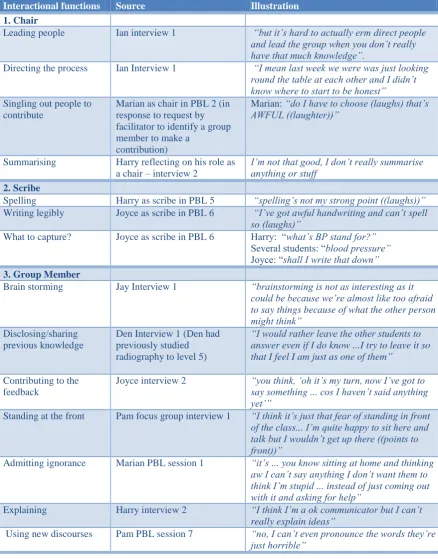
Analysis of this group showed that there were Face Threatening Acts associated with all of the PBL roles: chair, scribe and group member. These are included, with illustrative quotations in table 3. However, for reasons of brevity discussion is confined to the role of chair.
<<Insert Table 3 here>>
Students said they did not enjoy taking the role of chair. This was frequently observed in the video data, for example in this following sequence,
Ian: erm: (0.2) you're chair this week aren't you, Ed (1)
Ed: am I ((laughter))
Laura: did you see his face drop then (.) he was like ((pulls a face))
PBL session 3
Face Threatening Acts (FTAs) associated with Chair’s roleand how these are managed
Page 6 of 14 Singling people out
Chairs often avoided singling people out to contribute. When asked about this Ian said
“I didn’t want to put them on the spot because they couldn’t have said anything to be honest” Ian interview 1
However, when discussing this aspect of the chair’s role in the focus group interviews, students said they appreciated a chairing strategy which singles out other students as this encouraged input, although they admitted to avoiding the strategy themselves,
Marian but the other side of that then (0.5) is if they’re not too sure of what to say and you’ve said right tell us
Emma yeah you’re putting them on the spot aren’t you
Marian yeah and that could put someone in an awkward position as well so
Pam I’d feel a bit tight doin’ it myself ((laughter)) I’d be like oh no I don’t want to tell you to do that
FGI1
Students therefore attended to avoid the Face Threatening Act associated with singling people out preferring to protect other’s face. In avoiding such requests, however, they are contravening their role as chair which is to ensure everyone contributes. As a result, rapport is maintained, but learning may be threatened as not all voices are heard.
The exception to this communicative approach from a chair can be seen in Harry’s behaviour,
1 Harry define osteoporosis, Anne ((others laughing)),
2 (8) ((Anne head down flipping through her papers, smiling)) 3 ((joking asides between Harry and Anne))
4 Marian you’re enjoying it aren’t you= ((to Harry))=
5 Harry =yeah (0.2) cos I I don’t have to say anything ((laughter))
PBL session 6
At line 1, Harry singles Anne out to provide feedback. Anne’s delay in speaking up and her body language shows her face is threatened by being singled out in this way. However, she smiles and makes an inaudible but humorous comment to Harry at line 3 suggesting she accepts the legitimacy of this imposition. Marian’s comment challenges his approach. However, Harry’s response at line 5 suggests he is using his sociality rights as chair person to deflect the face threat to others. In doing this, he upholds his own face as a chair person who is carrying out role obligations and also protecting his face from potential threat. This might be perceived as a strategy which would threaten group rapport, however, when discussing the chair’s role in the focus group the other students perceived Harry’s style to be effective:
Joyce Harry’s done the last couple of er chairs and he’s literally Harry just gone for everyone
Joyce for each object he’s literally pointed at one of us to start (laughter) Anne he’s scary
Harry they just sit there and say nothing Joyce yeah it’s quite clever that
FGI1
Anne’s use of the word ‘scary’ supports the notion that being singled out constitutes a Face Threatening Act. Nevertheless, the students appear to appreciate Harry’s move. This could be due to a number of reasons: i) he is permitted in his role as chair to make such a move which supports the notion that sociality rights influence and legitimise face threat; ii) students appreciate the positive impact on group learning despite the threat to face, and iii) Harry’s approach is one of associative-expressiveness in that he uses humour and laughter in carrying out his actions. This could enhance group rapport by reducing social distance.
Page 7 of 14
Students highlighted that chairs were expected to direct the process but, despite having a written guide to help them through, expressed concern that they did not know how to do this.
“I mean last week we were was just looking round the table at each other and I didn’t know where to start to be honest”
Ian Interview 1
Students were acutely aware of the chair’s obligation to direct the process as there were very few instances of other students stepping in to help out if a chair was struggling. Instead, lengthy silences ensued. On one occasion a student attempted to take over the lead but then corrected himself as shown in the next example from PBL 6. Here, Harry is the chair and Jay wants Harry to move on to the next stage before Harry believes the issues have been fully discussed,
1 Harry anything else 2 (2)
3 Jay that’s it 4 (7)
5 ((Jay looking at Harry as if to say move on, others looking down at their work))
6 Jay °that’s it° (0.2) carry on
7 Harry what about the diagrams (1) the text the radiographs ((smiles and shakes head)) are we on to the next one (0.1) ALREADY ((smiling broadly))
9 Jay () oh go on carry on you do you do the chair person (0.2) °you decide° 10 Harry so you understand (0.1) what’s that as well (pointing to the image on the
screen) PBL session 6
Jay specifically instructs Harry to move on in direct unmitigated speech. Harry responds indirectly and with associative-expressiveness, which includes smiling, but stands his ground that there is more yet to discuss. At line 9, Jay acknowledges that it is not his role to make the decision to move on. Therefore the rule that the chair leads is acknowledged between the two, again showing the importance of sociality rights.
Leading people
Students highlighted that chairs were expected to lead others but expressed concern that they did not know how to do this,
“but it’s hard to actually erm direct people and lead the group when you don’t really have that much knowledge”.
Ian Interview 1
In this function, actions might include stopping individuals dominating, bringing in quieter students, stopping students talking over others and preventing multiple conversations from occurring. To do this, the chair needs to exercise power legitimised by the temporary authority of the position.
On no occasions was this type of leading from the chair witnessed, even though there were occasions of over-talking such that it was difficult to hear what point was being made. Making requests of this nature infringes the sociality rights of the other student to remain unimpeded and by showing them to be acting inappropriately, according to the group’s ground rules it would also lower their self esteem.
Summarising learning
Students acknowledged the importance of summarising at the end of each objective, and that this is the chair’s role as can be seen from this interview with Harry,
Interviewer What did people say about you? Harry I’m good at chairing. What?
Page 8 of 14 Interviewer Why don’t you think it’s true?
Harry I’m not that good, I don’t really summarise anything or stuff. I got people talking that’s all.
Harry interview 2
Harry identifies summarising as an important role for the chair, acknowledging that he did not do this. None of the other students summarised group learning when they were in the role of chair without being prompted by the facilitator either. Even when they were prompted, they often failed to provide a comprehensive summary of the discussion. This suggests that the task itself is challenging and cognitively difficult. Indeed, such a synthesis of information is deemed of the highest order in taxonomies of learning such as Bloom’s (Atherton, 2010). It is possible that such avoidance is to save the chair’s own face from negative judgement which would be a greater potential face threat than flouting their role obligation to summarise.
What is the impact of a Face Threatening Act management on group learning?
The number of silences following a direct request for input is a crude but acknowledged indication of Face Threatening Act avoidance (Nakane, 2006). For this group, the number of silences provides evidence of students avoiding the imposition of face threat (see table 4). Furthermore the number and duration of silences increases between week 1 and week 10 suggesting discomfort does not diminish over time.
<<Insert Table 4 here>>
The danger is that the interactional learning goal remains superficial and safe, despite the rich diversity that is prevalent in the group. Student comments would support this result:
“ it’s a quiet group and very respectful group it is very secure so that’s not really putting you under a lot of pressure in that respect”
Joyce interview 2 and,
“I think everyone co-operates and everybody, just everybody chips in and reinforces what each other’s saying and people do, perhaps they don’t challenge people, but they just perhaps want a further explanation of something”
Ian Interview 2
In summary, the results show that the role of chair is perceived to be the most dominant role in the PBL process. Students reported that the chair is responsible for singling people out to contribute, leading the discussion, directing the process and summarising learning. Students found all these roles face-threatening. Difficulties were associated with threatening the face of others (singling people out to contribute and leading them) and threatening face of self (where they were expected to exhibit procedural and cognitive knowledge and skills).
The student who is chair is faced with a difficult dichotomy. They have an obligation to engage in interactions which, by nature are face-threatening. In carrying out their role obligations they can risk own and others face. However, failure to carry out the role effectively means they threaten own face by flouting their role obligations, and putting learning at risk. Chairs in this group tended to put the face of others before their own role obligations as chair. Thus face issues dominated over sociality obligations. The outcome was superficial learning.
Discussion and conclusion
Page 9 of 14
were many instances of FTA avoidance. For instance, refusal to single people out for contribution (by most of the students in the role of chair) and failure to either correct or direct others. Silence was also employed by speakers to protect their own, and others’ face, and this was evident in the many silences following a general request for contributions.
Superficial learning in PBL has been observed by others (Visschers-Pleijers et al, 2006; Robinson, 2011), explanations for which have included failure of process and erosion of the curriculum (Moust et al 2005) and disruptive individuals (Hendry et al 2003). However, the study reported here suggests superficial learning can also be brought about by the social complexities of managing own and others’ emotions and sensitivities. Others have touched on similar issues such as lack of confidence (Tarlinton et al, 2011) and students being poorly equipped in terms of communication skills (Blue et al 1998; Hmelo-Silver 2004; Tan 2004). However, by using the Rapport Management framework it is possible to understand why confidence and communication are essential tools for students undertaking PBL. For instance, De Boer and Otting’s (2011) assertion that there is some anxiety related to procedural ignorance, whilst also observed the study here, is only of relevance if the students are prepared to undertake the Face Threatening Acts (FTAs) that the process demands. Providing students with the process is important, helping them to tackle the FTAs associated with this, however, is essential.
The following recommendations are provided to help facilitators support students in tackling Face Threatening Acts so that they can engage more easily. They are framed within the three bases; face, sociality rights and interactional goal. Students must be encouraged to feel comfortable with each other. This is because reducing the social distance between interactants reduces the intensity with which face threat is perceived (Spencer-Oatey 2008). This is reflected in other studies (Nelson and Aboud 1985; Azmitia and Montgomery 1993) which showed learners who were friends found it easier to express their views and to challenge each other, confident in the knowledge that conflict for learning would not damage their friendship. However, the increased number of silences over time reported in this study suggests a proactive approach must be taken as leaving groups of learners to socialise may not happen in of itself especially where the group is diverse and therefore less likely to socialise outside the classroom (Robinson 2011). The facilitator therefore needs to build in opportunities for socialisation and consider ways of creating a more relaxed atmosphere (Lycke, 2002; Chauvet and Hofmeyer, 2007).
The results show Face Threatening Acts (FTAs) can be reduced if the person making the face-threatening manoeuvre has a legitimate right to do so. It is therefore important to make obligations and rights explicit and to re-visit these throughout the period of group development. Whilst others have also made recommendations for the use of group ground rules in PBL (Azer, 2008), by linking them to the notion of sociality rights, it shows their importance for permitting face threat. In other words, not only the ‘do not’s’ of PBL but also the ‘do’s’. It should be noted however that whilst ground rules and clearly explicated roles are important, on their own they are insufficient to overcome FTA avoidance. For instance in this group, even though all students acknowledged the obligation of the chair to single others out for contribution, sociality rights were not sufficient to overcome the anxiety associated with threatening another’s face, and this resulted in FTA avoidance. The other two Rapport Management bases must also be considered. Students must agree to prioritise the interactional goal in order to engage in the risk of face-threatening manoeuvres. Achieving the interactional goal requires students to balance the social and cognitive demands of each utterance. Students in this group preferred to maintain harmony and therefore appeared to put greater emphasis on social goals at the expense of learning. It is therefore important that students are made aware of the underlying philosophy of constructivist learning approaches, and not just the mechanics or the stages of PBL, as echoed by others, such as Moust et al (2005).
Page 10 of 14
The role of PBL chair has the potential to cause face threat and further research needs to be undertaken to understand how different groups both diverse and homogeneous tackle such Face Threatening Acts (FTAs) and whether different FTAs emerge. There is also the need to explore the experiences of the facilitator. Whilst others have looked at this, using the Rapport Management framework may provide a more nuanced understanding of the specific aspect of PBL that could be emotionally difficult.
There are challenges for the chair of a tutorial group and, whilst not reported in detail here, the study showed there were similar difficulties for students fulfilling other PBL roles. Failure to recognise these factors and the need to support students in negotiating these complexities may limit the value and significance of learning. For educators utilising PBL, the bases of rapport management can be used as a model for preparing students to take on the specialised roles and to enhance their learning as individuals and members of a social and professional group.
References
Atherton JS (2010) Learning and Teaching; Bloom's taxonomy. Available at
http://www.learningandteaching.info/learning/bloomtax.htm (accessed 10 August 2010). Azer S (2008) Navigating Problem Based Learning. Marrickville, NSW: Churchill Livingstone. Azmitia M and Montgomery R (1993) Friendship, Transactive Dialogues, and the Development of Scientific Reasoning Social Development 2 (3): 202-221.
Barnes, D. and F. Todd (1977). Communication and Learning in Small Groups. London, Routledge and Kegan Paul Ltd.
Barrows, H. S. (1986). A Taxonomy of Problem-Based Learning-Methods. Medical Education 20 (6): 481-486.
Bearn, D. R. and S. M. Chadwick (2011). Problem-based learning in postgraduate dental education: A qualitative evaluation of students' experience of an orthodontic problem-based postgraduate programme. European Journal of Dental Education 14 (1): 26-34.
Blue, A. V., T. D. Stratton, et al. (1998). Students' communication apprehension and its effects on PBL performance. Medical Teacher 20(3): 217-221.
Brown, P. and Levinson, S. (1978). Universals in Language Use: politeness phenomena.
Questions and politeness. E. N. Goody. Cambridge, Cambridge University Press: 57-310.
Chappell, A. (2006). Using the 'Grieving' Process and Learning Journals to Evaluate Students' Responses to Problem-Based Learning in an Undergraduate Geography Curriculum. Journal of Geography in Higher Education 30 (1): 15-31.
Chauvet, S. and A. Hofmeyer (2007). Humor as a facilitative style in problem-based learning environments for nursing students. Nurse Education Today 27 (4): 286-292.
De Boer, M. R. and H. Otting Student's Voice in Problem-based learning: Personal experiences, thoughts and feelings. Journal of Hospitality & Tourism Education 23 (2): 30-40.
Eva, K. W. (2002). Teamwork during education: the whole is not always greater than the sum of its parts. Medical Education 36 (4): 314-316
Glaser, B. A. and A. L. Strauss (1967). The Discovery of Grounded Theory: Strategies for Qualitative Research. New York, Aldine De Gruyter.
Goffman, E. (1967). Interaction Ritual. Essays on Face-to-Face Behaviour. New York, Pantheon. Harland, T. (2003). Vygotsky's Zone of Proximal Development and Problem-based Learning: linking a theoretical concept with practice through action research. Teaching in Higher Education 8 (2): 263-272.
Hendry, G. D., Ryan, G., et al. (2003). Group Problems in Problem-Based Learning. Medical Teacher 25 (6): 609-616.
Hmelo-Silver, C. E. (2004). Problem-based learning: What and how do students learn?
Educational Psychology Review 16 (3): 235-266.
Keville, S., B. Davenport, et al. (2013). A river runs through it: enhancing learning via emotional connectedness. Can problem-based learning facilitate this? Reflective Practice 14 (3): 348-359. Lycke, K. H. (2002). Inside PBL Groups: Observation, Confirmations and Challenges. Education for Health: Change in Learning & Practice V15 (3): 326-334.
Miflin, B. (2004). Small Groups and PBL : are we singing from the same hymn sheet? Medical Teacher 26 (5): 444-450.
Page 11 of 14
Nakane, I. (2006). Silence and politeness in intercultural communication in university seminars.
Journal of Pragmatics 38 (11): 1811-1835.
Nelson, J. and Aboud, F. E. (1985). The Resolution of Social Conflict between Friends. Child Development 56 (4): 1009-1017.
Norman, G. (2001). Holding on to the philosophy and keeping the faith Medical Education 35 (9): 820-821.
QAA. (2008). Frameworks for Higher Education Qualifications. Available at http://www.qaa.ac.uk/academicinfrastructure/FHEQ/default.asp. (accessed 10th January 2009). Robinson (2011) The Influence of cultural Diversity on student learning interactions: a qualitative study of rapport management in an undergraduate Problem Based Learning group Doctorate of Education thesis University of Huddersfield Thesis repository. Available at
http://www.hud.ac.uk/library/info-for/researchers/theuniversityofhuddersfieldrepository.
Ross, B. (1997). Towards a Framework for Problem-based Curricula. The Challenge of Problem-Based Learning. D. Boud and G. Feletti. London, Kogan Page.
Sacks, H., Schegloff, E. A., et al. (1974). A simplistic Systematics for the Organisation of Turn-Taking for Conversation. Language 50 (4): 696-735.
Savin-Baden, M. (2003). Disciplinary differences or modes of curriculum practice? Who promised to deliver what in problem-based learning? Biochemistry and Molecular Biology Education 31 (5): 338-343.
Schmidt, H. G. (1983). Problem-Based Learning - Rationale and Description. Medical Education
17 (1): 11-16.
Spencer-Oatey, H. (2002)."Managing Rapport in Talk: using rapport sensitive incidents to explore the motivational concerns underlying the management of relations. Journal of Pragmatics 34 (5): 529-545.
Spencer-Oatey, H. (2008). Face, (Im)Politeness and Rapport. Culturally speaking; culture, communication and politeness theory, 2d ed. H. Spencer-Oatey. London, Continuum: 11-47. Tan, O. S. (2004). Students' experiences in problem-based learning: three blind mice episode or educational innovation? Innovations in Education and Teaching International 41 (2): 169-184. Tarlinton, R. E., L. Yon, et al. (2011). Confidence as a Barrier to the Use of Problem-Based Learning in Veterinary Undergraduate Students. Journal of Veterinary Medical Education 38 (3): 305-310.
Van den Bossche (2006) Minds in Teams: The influence of social and cognitive factors on team learning. Datawyse, Maastricht Netherlands. Available at http://arno.unimaas.nl/show.cgi?fid=6493
(accessed 12th January 2014).
Visschers-Pleijers, A., Dolmans, D., et al. (2006). Analysis of Verbal Interactions in Tutorial Groups: a process study. Medical Education 40 (2): 129-13.
Page 12 of 14
Full Cohort Study Group
Number of students 54 11
Age range 18-57 18-57
Gender M = 17, F = 37 M = 5, F = 6
Educational backgrounds A wide range of educational backgrounds A wide range of educational
backgrounds (see text for details)
Ethnic background White British (37) , White Irish (1),
Black African (4), Asian/Asian British
Indian (3), Asian/Asian British Pakistani
(3), Asian/Asian British Bangladeshi (2),
Chinese (2), White & Asian (1), unknown
(1)
Pakistani (1), Mauritian (1)1,
Korean (1)2, Chinese (1) White
[image:13.595.65.529.93.302.2]British (7)
Table 1. Comparison of demographics between whole cohort registered on the BSc
(Hons) Diagnostic Radiography programme 2007 and the study group
Qualification Number of students (subject)
A levels 1 (psychology, English, biology)
1 (biology, chemistry, physical education)
BTEC National Diploma 1 (pharmacy)
1 (health studies)
Higher National Diploma 1 (chemistry)
First Degree 1 (software engineering)
1 (health studies and IT)
1 (natural gas engineering – undertaken in the USA)
Higher Degree 1 (systems engineering)
Access to Higher Education 1 (subject not specified)
1 (life science)
[image:13.595.74.523.406.614.2]Page 13 of 14
Table 3. Face-threatening interactions associated with each role in PBL according to the
students in the study
Interactional functions Source Illustration
1. Chair
Leading people Ian interview 1 “but it’s hard to actually erm direct people
and lead the group when you don’t really have that much knowledge”.
Directing the process Ian Interview 1 “I mean last week we were was just looking
round the table at each other and I didn’t know where to start to be honest” Singling out people to
contribute
Marian as chair in PBL 2 (in response to request by facilitator to identify a group member to make a
contribution)
Marian: “do I have to choose (laughs) that’s AWFUL ((laughter))”
Summarising Harry reflecting on his role as
a chair – interview 2
I’m not that good, I don’t really summarise anything or stuff
2. Scribe
Spelling Harry as scribe in PBL 5 “spelling’s not my strong point ((laughs))”
Writing legibly Joyce as scribe in PBL 6 “I’ve got awful handwriting and can’t spell
so (laughs)”
What to capture? Joyce as scribe in PBL 6 Harry: “what’s BP stand for?”
Several students: “blood pressure” Joyce: “shall I write that down” 3. Group Member
Brain storming Jay Interview 1 “brainstorming is not as interesting as it
could be because we’re almost like too afraid to say things because of what the other person might think”
Disclosing/sharing previous knowledge
Den Interview 1 (Den had previously studied radiography to level 5)
“I would rather leave the other students to answer even if I do know ...I try to leave it so that I feel I am just as one of them”
Contributing to the feedback
Joyce interview 2 “you think, ‘oh it’s my turn, now I’ve got to
say something ... cos I haven’t said anything yet’”
Standing at the front Pam focus group interview 1 “I think it’s just that fear of standing in front
of the class... I’m quite happy to sit here and talk but I wouldn’t get up there ((points to front))”
Admitting ignorance Marian PBL session 1 “it’s ... you know sitting at home and thinking
aw I can’t say anything I don’t want them to think I’m stupid ... instead of just coming out with it and asking for help”
Explaining Harry interview 2 “I think I’m a ok communicator but I can’t
really explain ideas”
Using new discourses Pam PBL session 7 “no, I can’t even pronounce the words they’re
Page 14 of 14
PBL Session 1 (October 2008) Silences of more than 1 second
PBL Session 10 (April 2009) Silences of more than 1 second
Number Sum of all
silences
Min/max Number Sum of all
silences
Min/max
[image:15.595.91.504.72.137.2]92 8 mins 45s 2secs/30secs 114 11min 56s 2secs/50secs