International Journal of Emerging Technology and Advanced Engineering
Website: www.ijetae.com (ISSN 2250-2459, ISO 9001:2008 Certified Journal, Volume 7, Issue 2, February 2017)
113
Optimization of Cooperative Spectrum Sensing Using PSO
Algorithm for Wireless Communication
Prof. Keraliya Divyesh
1, Prof. Ashalata Kulshrestha
2, Prof. Hitesh Loriya
3 1Government Engineering College, Rajkot, India2Kankeshwari Devi Institute of Technology, Jamnagar, India
3L. E. College, Morbi, India
Abstract— Cognitive radio (CR) is a new era of wireless communication system for efficient utilization of radio frequency (RF) spectrum. The Cooperative Spectrum sensing is the key component of cognitive radio technology in which the sensing information from CR users combines at the Fusion centre (common receiver) by soft combination or conventional hard combination techniques. Soft combination has excellent performance but, it requires a lot of overhead. In contrast, the conventional hard combination scheme requires only one bit of overhead, but it has worst performance because of the loss of sensing information. In this paper, the use of particle swarm optimization (PSO) algorithm based on the Neyman-Pearson criterion as a significant method is proposed to optimize the weighting coefficients vector of observed energy level of sensing information so that the probability of detection is improved. The proposed technique investigates the best weighting coefficients vector and compared the performance of the PSO-based proposed method with soft combination technique EGC as well as other conventional hard combination scheme like AND, OR, MOJORITY etc. through computer simulations. Simulation result shows that proposed PSO based method gives excellent detection performance with low overhead.
Keywords—Cognitive Radio, Cooperative Spectrum Sensing, Hard/Soft Combination, PSO
I. INTRODUCTION
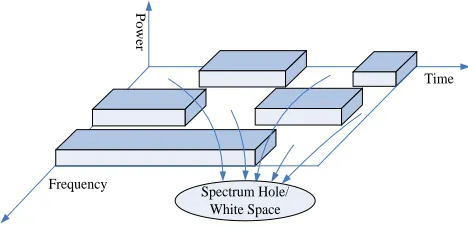
[image:1.612.326.560.244.364.2]The Federal Communications Commission(FCC) report says that almost 80% of allotted spectrum are idle at most of the time so current frequency assignment policy cannot meet the real time requirement so they recommend to change/redesign the fixed frequency assignment policy and suggest the opportunistic access of licensed spectrum by SUs conditioned that there is no any interference on the PUs or user who pay charges for communication[1]. Cognitive radio is intelligence device which is capable to Sense the spectrum and avoid the interference on the licensed users, It is capable of identifying the presence or absence of the primary user (PU) signal.
Fig. 1 Utilization of Spectrum Holes
The PU signal is always suffered by deep fading because of propagation loss and secondary-user (SU) interference.
Spectrum sensing is a difficult task because of shadowing, fading, and time-varying nature of wireless channels [2]. Due to the severe multipath fading, a cognitive radio may fail to detect the presence of the licences user (PU) and then will access the licensed channel and cause interference to the PU. In order to cope with this problem in cognitive radio networks, multiple cognitive users can cooperatively work for spectrum sensing. It has been shown in [3], [4] that cooperative spectrum sensing can improve the probability of detection and probability of false alarm parameter of spectrum sensing performance.
The paper is organized as follows. We present the spectrum sensing in Section II. In Section III, we proposed the system model related to cooperative spectrum sensing and optimization problem, Section IV are for the PSO based weighting method for a improvement of detection performance. Simulation results in section V are given to compare our proposed technique with conventional scheme for improvement of detection performance.
II. SPECTRUM SENSING
A Spectrum sensing is a key element in cognitive radio networks as it should be firstly performed before allowing CR users to access a vacant licensed channel.
P
o
w
e
r
Frequency
Time
International Journal of Emerging Technology and Advanced Engineering
Website: www.ijetae.com (ISSN 2250-2459, ISO 9001:2008 Certified Journal, Volume 7, Issue 2, February 2017)
114
The goal of the spectrum sensing is to decide between the two hypotheses, no signal transmitted, and signal transmitted. In this regard, there are two probabilities that are most commonly associated with spectrum sensing: probability of false alarm Pf which is the probability that apresence of a signal is detected even if it does not exist and probability of detection Pd which is the probability for a
correctly detected signal.
( ) { ( ) ( ) ( ) (1)
Where ( )the signal is received by secondary user and ( ) is primary user‘s transmitted signal, ( ) is the additive white Gaussian noise (AWGN) and ( ) is the amplitude gain of the channel. We also denote by γ the signal-to-noise ratio (SNR).
In AWGN channel environment the average probability of false alarm, the average probability of detection, and the average probability of missed detection are given, respectively, by [5]
* | + ( ) (2)
* | + ( ⁄ )
( ) (3)
(4)
Where, is the energy detection threshold, is the instantaneous signal to noise ratio (SNR) of CR, is the time-bandwidth product of the energy detector, ( ) is the gamma function, ( ) is the incomplete gamma and ( ) is generalised Marcum Q-function defined as follow
( ) ∫
( ) (5)
The average probability of detection may be derived by averaging the conditional in the AWGN case over the SNR fading distribution by following
∫ ( ) ( ) (6)
When the composite received signal consists of a large number of plane waves, for some types of scattering environments, the received signal has a Rayleigh distribution [5]. Under Rayleigh fading, γ would have an exponential distribution given by
( ) ̅ . ̅/ (7)
In this case, closed-form formula for probability of detection may be obtained (after some manipulation) by substituting ( ) in the above equation by
∑ ( )
( ̅ ̅ )
( ( ) ∑
. ̅ ( ̅/
) (8)
One of the main challenging issues of spectrum sensing is the hidden terminal problem for the case when the cognitive radio is shadowed or in deep fade. To mitigate this issue, multiple cognitive radios can be cooperative work for spectrum sensing so cooperative spectrum sensing can greatly improve the probability of detection in fading channels. In cooperative spectrum sensing common receiver calculates false alarm probability and detection probability with the help of average probability of each CR. The false alarm probability is given by [5]
∑ ( ) ( ) * +
(9)
Also, Detection probability is given by;
∑ ( ) ( ) * +
(10)
In hard combing based fusion scheme, each cognitive user decides on the presence or absence of the primary user and sends a one bit decision to the data fusion center. The main benefit of this method is that it needs limited bandwidth [6]. When binary decisions are reported to the common node, three rules of decision can be used, the ―AND‖, ―OR‖, and ―MAJORITY‖. While in soft combing based fusion scheme, CR users forward the entire sensing result to the fusion centre without performing any local decision and the decision is made by combining these results at the fusion centre by using appropriate combining rules such as EGC, MRC etc., Soft combination provides better performance than hard combination, but it requires a larger bandwidth for the control channel for reporting [7]. It also generates more overhead than the hard combination scheme [6]
International Journal of Emerging Technology and Advanced Engineering
Website: www.ijetae.com (ISSN 2250-2459, ISO 9001:2008 Certified Journal, Volume 7, Issue 2, February 2017)
[image:3.612.50.301.162.626.2]115
III. PROPOSED SYSTEM MODELFig. 2 Proposed System Model
The system model for the proposed softened hard (quantize) cooperative spectrum sensing method is depicted in Figure 2. Each cooperating secondary user senses the spectrum locally and sends its ‗quantized‘ local measurement as (index of the quantization level) to the fusion center at the cognitive base station.
The fusion center makes a global decision according to and weight of corresponding energy level quantization level.
[image:3.612.328.562.335.534.2]In Soft combination based data fusion scheme, detection performance is obtained by allocating different weights to different CR users according to their SNR. In the conventional one-bit hard combination based data fusion scheme, there is only one threshold dividing the whole range of the observed energy into two regions. As a result, all of the CR users above this threshold are allocated the same weight regardless of the possible significant differences in their observed energies. softened two-bit hard combination based data fusion scheme achieve the better detection performance and less complexity with two-bit overhead by dividing the whole range of the observed energy into four regions, and allocate a different weights to this region
Fig. 3 Principle of two-bit hard combination scheme Figure 3 show the principle of the softened two-bit hard combination (Quantized) based data fusion scheme. In conventional one-bit scheme with only one threshold, Here we have a three thresholds in the two-bit scheme, λ1, λ1 and λ3, divide the whole range of the observed energy into 4 regions. Each cooperating secondary user senses the spectrum and sends its two bit information “quantized data ‖ to indicate which region its observed energy falls in to the fusion centre at the cognitive base station. The fusion centre makes a global decision according to its 2-bit value measurement
𝐻
𝐻
𝑥
(𝑘)
CR-1
∑ |𝑥 (𝑘)|
𝑀
𝑘
4 – Level Quantizer
( )
CR-1
( )
CR-1
∑ |𝑥𝑛(𝑘)|
𝑀
𝑘
∑ |𝑥 (𝑘)|
𝑀
𝑘
4 – Level Quantizer
4 – Level Quantizer
Sensing Channel
∑
Reporting Channel
𝐿
𝐿
𝐿
𝑛Global
Decision
(H0/H1)
FC
PU
Energy(Y)
Region 4 W4Region 3 W
3
Region 2 W
2
Region 1 W
1
λ
3λ
2International Journal of Emerging Technology and Advanced Engineering
Website: www.ijetae.com (ISSN 2250-2459, ISO 9001:2008 Certified Journal, Volume 7, Issue 2, February 2017)
116
The probability of having observation in respective region under hypothesis and and AWGN channel are following{
( ) ( )
( ) ( )
(11)
In the proposed method, the global decision depends on the threshold values and the weight vector. Here the weights are assigned to the energy level not the reporting nodes. For this 2-bit softened hard combination based data fusion scheme, fusion center receives the quantized measurements and counts the number of users in each quantization level. The decision function is evaluated with the help of the weights and the number of users in the each energy level which is given by following.
( )⃗⃗⃗⃗⃗ { ⃗⃗ ⃗⃗⃗
(12) Here the weighted summation is given by
∑ (13)
Where = Number of observed energies falling in region i.
Then is compare with the threshold, If ≥ , primary signal is declared present; Otherwise, it is declared absent
In softened hard combination based data fusion strategy the probabilities of cooperative detection under a Rayleigh channel are derived using [8] which is given by following.
∑ ∑ ( | ) (14) ( ⃗⃗ ) (15)
The most suitable optimality criterion for the decision is Neyman-Pearson optimality that maximizes the probability of detection. Proposed softened hard combination data fusion scheme the global decision logic need to optimize the weight vector ( ⃗⃗ ) so our optimization problem are following
Optimization Problem:
⃗⃗
IV. PSOBASED SOLUTION
Particle swarm optimization is a population based and stochastic optimization approach designed primarily to mimic the social behavior of school of fish or flock of birds [9] [10] [11]. This social has been used in solving more complex optimization problems in the particle are grouped into swarm and each particle is a potential solution to the optimization problems. Each particle moves toward the best optimal solution in the neighborhood depending on the past experience and neighbors as well. The performance of each particle is determined by the fitness function. The key success to use of PSO in many optimization problems is due to the fact that it is very simple, high search capability[12][13]
PSO is primarily governed by two fundamental equations representing the velocity and position of the particle at any particular time. After each iteration, the particle position and velocity is updated until the termination condition has been reached. The termination condition can be based on the number of iteration and achievable output required. Once the required number if iterations or predetermined outputs have been achieved, the searching process is terminated automatically. For a particle with n dimension can be represented by vector ( ) The position of the particle at time t can be mathematically expressed as ( ) which the corresponding velocity of the particle is represented as ( ) In general, the velocity and position of the particle at t +1 can be mathematically represented using following equation.
( ) ( ) ( ( ) ( ))
( ( ) ( ) (16) ( ) ( ) ( ) (17)
International Journal of Emerging Technology and Advanced Engineering
Website: www.ijetae.com (ISSN 2250-2459, ISO 9001:2008 Certified Journal, Volume 7, Issue 2, February 2017)
117
Algorithm 1: Weight Optimization Algorithm using PSO
For do Repeat
For do
If ( ) ( )then
( ) ( ) End
End
( ) For do
Update velocity ( ) ( )
( ), ( ) (
( ), ( ) ( )-
Update position
( ) ( ) ( )
End
Until end
Each particle is attracted to the position of the particle that encountered the best result globally;
¸and affected by its own best experience in exploring the field, ¸The attraction is made by a certain velocity
( ) which is determined according to the quality of the particle‘s current result and the best particle in the swarm. The PSO algorithm is used to estimate the weight¸ as shown in algorithm 1
V. SIMULATION RESULT
A simulation has been done to assess the performance of proposed PSO algorithms based softened hard decision fusion based cooperative spectrum sensing. We plot below the receiver operating characteristic (ROC), comparing it to the conventional soft decision fusion technique i.e. EGC and convention hard design fusion technique i.e. AND, OR, MAJORITY rules etc. We have considered time-bandwidth product , the channel is Rayleigh, the number of received signal samples , SNR =5dB, TW=5, N=10. In PSO, we have used the number of particles and . The other parameters are: inertia weight and
[image:5.612.333.566.130.325.2]acceleration constants . We have assumed perfect reporting channels and there is no false reporting node
Fig. 4. ROC curve of different decision logic
[image:5.612.335.555.424.592.2]The optimal weights obtained PSO algorithms are used to plot the receiver operating characteristics (ROC) curve shown in figure 4 which illustrates the probability of detection of PSO-based scheme, as well as all other conventional methods for different given probabilities of false alarm. It is observable that the performance of PSO based method is almost close to EGC.
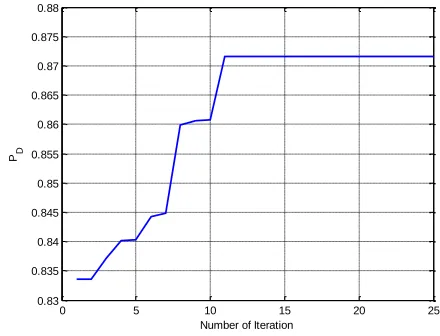
Fig. 5. Performance of PSO-based method
The convergence of PSO based softened hard decision fusion scheme for a given is shown in figure 5. It can be seen that the proposed PSO based solution converges after around 15 iterations, which is so fast that it can ensure the computation complexity of the proposed method that meets real time requirements of cooperative spectrum sensing in cognitive radio.
0 0.1 0.2 0.3 0.4 0.5 0.6 0.7 0.8 0.9 1
0 0.1 0.2 0.3 0.4 0.5 0.6 0.7 0.8 0.9 1
PF
P D
NoCoop Or Logic Majority Logic AND Optimized 2-bit EGC
0 5 10 15 20 25
0.83 0.835 0.84 0.845 0.85 0.855 0.86 0.865 0.87 0.875 0.88
Number of Iteration
International Journal of Emerging Technology and Advanced Engineering
Website: www.ijetae.com (ISSN 2250-2459, ISO 9001:2008 Certified Journal, Volume 7, Issue 2, February 2017)
118
AcknowledgementThe author wish to thank their guide, parents and god for supporting and motivating for this work because without their blessing this was not possible.
REFERENCES
[1] S.Haykin, ―Cognitive radio: Brain-empowered wireless communications,‖ IEEE J. Sel. Areas Commun., vol. 23, no. 2, pp. 201–220, Feb. 2005
[2] J. Ma, G. D. Zhao, and L. Ye, ―Soft combination and detection for cooperative spectrum sensing in cognitive radio networks,‖ IEEE Transactions on Wireless Communications, vol. 7, no. 11, pp. 4502- 4507, 2008.
[3] D. C. Oh, H. C. Lee, and Y. H. Lee, ―Linear hard decision combing for cooperative spectrum sensing in cognitive radio systems,‖ IEEE 72nd Vehicular Technology Conference, Ottawa, Canada, pp. 1-5, Sep. 2010
[4] M. Mustonen, M. Matinmikko, and A. Mammela, ―Cooperative spectrum sensing using quantized soft decision combining,‖ in
CognitiveRadio Oriented Wireless Networks and Communications, 2009. CROWNCOM’ 09. 4th International Conference on. IEEE, 2009, pp. 1–5.
[5] Wei Zhang, Member, IEEE, Ranjan K. Mallik, Senior Member, IEEE, and Khaled Ben Letaief, Fellow, IEEE ―Optimization of Cooperative Spectrum Sensing with Energy Detection in Cognitive Radio Networks‖, IEEE transactions on wireless communications, vol. 8, no. 12, December 2009.
[6] J. Ma and Y. Li, ―Soft combination and detection for cooperative spectrum sensing in cognitive radio networks,‖ in Proc. IEEE Global Telecomm. Conf., 2007, pp. 3139–3143
[7] Zhi Quan, Shuguang Cui, H. Vincent Poor, and Ali H. Sayed, ―Collaborative wideband sensing for cognitive radios,‖ IEEE Signal Processing Magazine, Vol. 25, No. 6, pp. 63–70, 2008.
[8] Jun Ma, Guodong Zhao, and Ye (Geoffrey) Li, " Soft Combination and Detection for Cooperative Spectrum Sensing in Cognitive Radio Networks" IEEE Transactions on Wireless Communications, vol. 7, no. 11, Nov. 2008.
[9] J. Kennedy, and R. C. Eberhart, ―Particle swarm optimization‖, Proc. IEEE International Conference on Neural Networks, Australia, 1995. [10] J. Kennedy and R. C. Eberhart, Swarm Intelligence, Morgan
Kauffman Publishers, California, 2001.
[11] M. Løvberg and T. Krink. ―Extending Particle Swarm Optimisers with Self-Organized Criticality‖. In Proceedings of the IEEE Congress on Evolutionary Computation, 2002
[12] C. Mendis, S. M. Guru, S. Halgamuge, and S. Fernando, "Optimized Sink node Path using Particle Swarm Optimization", 20th International Conference on Advanced Information Networking and Applications, IEEE computer society, 2006