International Journal of Emerging Technology and Advanced Engineering
Website: www.ijetae.com (ISSN 2250-2459,ISO 9001:2008 Certified Journal, Volume 4, Issue 6, June 2014)
638
Acoustic Noise Classification and Characterization Using
Statistical Properties
Prabhavathi C.N.
1, Dr. K. M. Ravikumar
21
Research Scholar, Jain University, Bangalore, India
2Second Special Officer/P.G. Co- Ordinator, VTU Regional Office, Mysore, India
Abstract- Acoustical noises or background noises degrade
the quality and intelligibility of the speech signal. The background noises are random in nature and it is important to classify such noises. Hence background noises are characterised based on statistical properties like mean, variance ,co-variance etc. The autocorrelation function which is a time invariant function is used for classifying such noises. The SNR for various noises is estimated .
Keywords— Background noise, statistical properties,
autocorrelation, SNR.
I. INTRODUCTION
The background noises like moving vehicle noise, babble noise, construction site noise, street noise, aircraft noise, fan noise etc [1] will degrade the quality and
intelligibility of the speech signal during the
communication from one end to other end. Hence the clean speech signal will be degraded and becomes a noisy speech signal. Due to these noisy signals the performance of the speech processing systems like speech recognition system, speaker recognition and identification system, speech coding system, hearing aid system [2] will degrade. Therefore it is of prime importance to eliminate or reduce the effect of noisy signals and improve the quality and intelligibility of noisy speech signal.
In order to reduce the effect of noise or to eliminate the noise in noisy speech signal it is required to characterise and classify various background noisy signals. Since the noisy signals are random in nature it is required to classify and characterise them using statistical parameters like autocorrelation ,mean, variance, co-variance etc.
Representation of random signal can be done in i) Time domain ii) Frequency domain iii) time frequency domain. In time domain the random signal is analysed with various parameters like mean, standard deviation, variance, root mean square value. In frequency domain the power spectral density (psd) function is determined. In time frequency domain the spectrogram is analysed.
In this paper, noise classification is done using autocorrelation function. The noisy signal is said to be stationary if the autocorrelation function is time invariant, otherwise the noisy signal is said to be non stationary signal. Along with this the other statistical parameters are determined. The characterization of noise signal is done by determining the mean, variance and SNR
The paper is organised as follows: Section II describes the related work, Section III describes the various statistical properties in time domain .Section IV describes the method used to determine the SNR. Section V describes the implementation steps. Section VI and VII describes results and conclusion respectively.
II. RELATED WORK
Sunitha [1] proposes a technique of noise
characterization and classification by estimating the noise level in the non-speech regions of the noisy speech. SNR estimation for wide range of SNR including low SNR is also considered for noisy speech signal. Khaled El-Maleh et.al [2] proposes a technique for noise classification using frame-by-frame basis. Burak Uzkent et. Al. proposes a pitch range (PR) based feature set to classify non speech environmental sounds, gunshots , glass breaking, scream , dog barking etc .Ling MA, Ben Milner and Dan Smith[4] proposes a HMM based technique for acoustic environment classifier. Paul Gaunard et. al. [5] proposes a technique for environmental noise recognition using HMM. The noise like car, truck, moped, air craft, train are considered for noise recognition.
International Journal of Emerging Technology and Advanced Engineering
Website: www.ijetae.com (ISSN 2250-2459,ISO 9001:2008 Certified Journal, Volume 4, Issue 6, June 2014)
639 Most of the parameter values estimated can be used to subtract / to cancel noise from the noisy speech which helps to enhance the degraded speech signal.
Also the effect of noise on various age group is considered for understanding purpose.
III. TIME DOMAIN APPROACH FOR NOISE CLASSIFICATION
The statistical characteristics of two random signals {xk
(t)} and {yk (t)} are as follows [8]:
Mean Value ( Expectation):
Variance:
Co-Variance:
Correlation:
The auto correlation of {xk (t)} and {yk (t)} is given by,
Similarly the cross correlation of {xk (t)} and {yk (t)} is given as ,
The random signal is said to be stationary if the autocorrelation is satisfied as follows:
The above property is nothing but a time invariant property.
IV. PROPOSED METHOD FOR NOISE CHARACTERIZATION
It is important to estimate the noise level in the noisy speech signal in terms of signal to noise ratio(SNR). This helps in the characterization of noise. The following equation is used to determine the SNR
The SNR is also calculated by making use the variance as follows
Where noisy speech signal and is
variance of noise signal [1].
V. IMPLEMENTATION STEPS
Noise database containing different background noises like white noise, traffic noise, canteen noise, mall noise and construction site noise are recorded using a microphone and an iphone for a duration of 60s.
International Journal of Emerging Technology and Advanced Engineering
Website: www.ijetae.com (ISSN 2250-2459,ISO 9001:2008 Certified Journal, Volume 4, Issue 6, June 2014)
640 The recording is done in a closed acoustic room for various age groups . The age groups are considered to be age less than12 yrs, age between 12-19, 20-29, 30-40, and above 40. Each age group includes a male and a female. The SNR is calculated using ―Eq. 14‖ and tabulated for various age groups across the various noises.
VI. RESULTS AND DISCUSSION
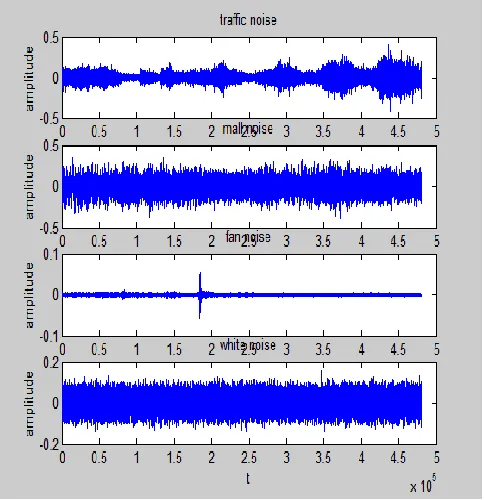
The plots of traffic noise, mall noise, fan noise and white noise is as shown in ―Fig 1‖.
[image:3.612.336.554.127.482.2]From ―Fig. 1‖ it is observed that white noise comes under stationary random signal as it is time invariant and the traffic noise, fan noise and mall noise also comes under stationary type of random signal. Whereas the gun shot noise , construction site noise, military noise can be put under the non stationary type of random signal. Since such signals has impulsive type of response Figure 2,3,4 and 5 shows the time plot for various age groups for the sentence ‗ A king ruled the state in the early days‘ . The upper plot in each graph is of female and lower plot is of male.
Fig 1: Plot of various noises
[image:3.612.49.291.376.626.2]Fig 2: Time domain plot for age <12yrs
Fig 3: Time domain plot for age between 15yrs and 21 yrs
[image:3.612.340.545.502.662.2]International Journal of Emerging Technology and Advanced Engineering
Website: www.ijetae.com (ISSN 2250-2459,ISO 9001:2008 Certified Journal, Volume 4, Issue 6, June 2014)
[image:4.612.62.275.129.315.2]641
Fig 5: Time domain plot for age 50yrs and 55 yrs
[image:4.612.324.565.197.575.2] [image:4.612.60.277.383.677.2]The tabulation of statistical parameters like mean, variance and standard deviation are tabulated as shown in ―Table I‖ for various noise signals.
Table I.
Statistical Values Of Mean, Co-Variance And Standard Deviation
Noise Mean Co-variance Standard deviation White noise -1.6801e-004
0.0012 0.0344
Traffic noise
-1.0997e-004
0.0021 0.0461
Mall noise 1.1993e-004
0.0070 0.0835
Fan noise -2.6451e-005
2.3921e-006
0.0015
Table II.
Energy And Power Of Noises
Traffic noise
Mall noise
Fan noise White noise
Energy 0.8912 2.4956 4.5358e-004
0.4863
power 0.7942 6.2281 2.0573e-007
0.2364
Table II tabulates the energy and power of the noisy signals. The following Tables III and IV gives the various SNR values for different age group.
Table III .
For Male, SNR For Various Noises
Sl No. SNR in db (traffic)
Snr(mall) Snr(fan) Snr(white)
<12 yrs
-114 -100.1 -48 -124.3
12-19 yrs
-100.1 -112.3 -35 -90.1
20-29 yrs
-97.1 -106.3 -31.5 -92.1
30-50 yrs
-109.1 -116.2 -62.2 -103.9
>50 yrs
-120 -129.3 -54 -115.1
Table IV.
For Female, SNR Of Various Noises
Sl No. SNR in db (traffic)
Snr(mall) Snr(fan) Snr(white)
<12 yrs -100 -15 -52 -80.4
12-19 yrs -81.1 -15 -76 -90.03
20-29 yrs -97.1 -31.5 -92.1 -106.3
30-50 yrs -96.5 -31.3 -103.7 -101.4
>50 yrs -98 -32.1 -92.7 -106.9
The observation from the above tables is as follows: The SNR‘s are very low which implies the quality and intelligibility of the speech signal is totally lost. Hence an improvement of the SNR has to be done by suppressing the noise.
International Journal of Emerging Technology and Advanced Engineering
Website: www.ijetae.com (ISSN 2250-2459,ISO 9001:2008 Certified Journal, Volume 4, Issue 6, June 2014)
642
VII. SUMMARY AND CONCLUSIONS
For Various noises the statistical properties were found out and tabulated. From the property of autocorrelation function, the noise signal was classified as stationary signal and non- stationary noise signal. SNR for various noises across various age groups were found out and tabulated. It has been concluded that since the snr values are very low, it is of primary importance to reduce the noise and to improve the performance of the system. Hence a robust algorithm has to be implemented to improve the snr for speaker independent and noise independent.
REFERENCES
[1] Sunita Maithani and Richa Tyagi 2008 Noise characterization and
Classification for Background Estimation, IEEE – Int. Conf. on signal processing, Communication and Networking.
[2] Khaled El- Maleh,Aro Samouelian and Peter Kabal 1999 Frame
Level Noise Classification In Mobile Envirnoments‖ Proc. IEEE Conf. Acoustics, speech, Signal Proc.
[3] Burak Uzkent , Buket D. Barkana and Hakan Cevikalp, 2012 Speech
Environmental Sound classification Using SVMS with a New set of Features , International Journal of Innovative computing, Information and Control.
[4] Ling MA , Been Milner and Dan smith 2006 Acoustic Envirnoment
classification ACM transactions on speech and Language Processing
[5] Paul Gaunard, Corine Ginette Mubikangley , Christophe Couvreur
and Vincent Fontaine Automatic Classification of Envirnomental Noise Events by Hidden Markov Models.
[6] Mark Marzinzik and Briger Kollmeier 2002 Speech Pause
Detection for Noise Spectrum Estimation by Tracking Power envelope Dynamics. IEEE Transactions on Speech and Audio Processing.
[7] Beritelli F 2006 A Speech Recognition System Based on Dynamic
Characterization of Background Noise .
[8] Scott Miller and Donald Childers 2012 Probability And Random