Ι η
ï
Mm ί
m
ti
Reactor Theory and Analysis
This document was prepared tinder the sponsorship of the Commission of the European Communities.
Neither the Commission of the European Communities, its contractors nor any person acting on their behalf :
Make any warranty or representation, express or implied, with respect to the accuracy, completeness, or usefulness of the information contained in this document, or that t h e use of any information, apparatus, method, or process disclosed in this document may not infringe privately owned rights; or
Assume any liability with respect to the use of, or for damages resulting from the use of any information, apparatus, method or process disclosed in this document.
a t the price of F F 17.50 F B 175
a t the pnce ot r r 1/.3U r o i/i>.— L/ivl 14.— u t . Χ ί ο υ r i . i^.on
When ordering, please quote the EUR number and the title, which are indicated on the cover of each report.
Mm
•1™
'IM
i» «ii! »SI
Joint Nuclear Research Center - Ispra Establishment (Ilaly) Reactor Physics Department - Reactor Theory and Analysis Luxembourg, April 1969 - 128 Pages - FB 175
The code P1NOCCFIIO, described in this report, solves the eigen value problem for the infinite lattice and evaluates the variation of reactivity as a function or time for a unit cell.
The integral transport equation is solved in a multigroup structure using the first collision probability formalism. Both single rods and
cluster-EUR 4231 e
PINOCCHIO - A COMPUTER PROGRAM FOR CELL REACTIVITY CALCULATIONS by L. AMYOT, G. CASINI. R. CUN1BERT1 and C. DAOLIO
European Atomic Energy Community - EURATOM Joint Nuclear Research Center - Ispra Establishment (Italy) Reactor Physics Department - Reactor Theory and Analysis Luxembourg, April 1969 - 128 Pages - FB 175
The code PINOCCHIO, described in this report, solves the eigen value problem for the infinite lattice and evaluates the variation of reactivity as a function of time for a unit cell.
cluster-type fuel elements are treated. The machine-time on the IBM-360 is typi cally of the order of 1-3 minutes per time-step.
EUROPEAN ATOMIC ENERGY COMMUNITY - EURATOM
PINOCCHIO
A COMPUTER PROGRAM FOR CELL REACTIVITY CALCULATIONS
by
L AMYOT, G. CASINI, R. CUNIBERTI and C. DAOLIO
1 9 6 9
ORGEL Program
Joint Nuclear Research Center Ispra Establishment - Italy
as a function of time for a unit cell.
The integral transport equation is solved in a multigroup structure using the first collision probability formalism. Both single rods and cluster-type fuel elements are treated. The machine-time on the IBM-360 is typi
cally of the order of 1-3 minutes per time-step.
In the paper, the various hypotheses underlying the model and the main features of the computer program are explained. The results of
the comparisons with experiments will be given in a forthcoming publication.
KEYWORDS
PROGRAMMING TRANSPORT THEORY P-CODES INTEGRAL EQUATIONS EIGENVALUES FUEL RODS
P a r t I - THEORY pag,
Introduction 1 1 . Eigenvalue problem 4
1 .1 The fast effect 6 1.2 Epithermal events 9 1.3 Thermal multiplication factor 15
1.4 Neutron leakage 20 2. The reactivity-time problem 21
Aácnowledgments 22 References 23
Part II - CODE DESCRIPTION
1. Generalities 25 2. Code language 28 3. Overlay organisation 35
4. Plow-Diagram 36 5. Execution time 41 6. Input data specification 42
Introduction (*)
The specific requirements of a reactor project will usually be met by the development of correlation techniques or phenome-nological descriptions which may be relied upon to provide an adequate representation of lattice cell physics in a narrow range of composition and geometry. Examples of such methods are
the codes CAROLINEv 'and PLUTHARCOv 'written at Ispra in the
framework of the ORGEL project. Of course, care must be exer-cised when the design studies stray away from the conditions to which these simple recipes are better suited; in the ana-lysis of differential effects due, for instance, to burnup or temperature, a frequent practice is to resort to methods based on more detailed physical models. Historically, this was the main incentive for the development of the code PINOC-CHIO.
A further stimulus to provide comprehensive schemes of lattice cell calculations is found in the desire to improve the precision and reliability of the theoretical predictions by searching for patterns in the discrepancies between
com-putations and measurements. The possibility of investigating many types of reactors e.g. graphite, light water and heavy water -is then highly desirable since it will provide a broad range of neutron spectra and isotopie compositions, stressing al-ternately various phases of the neutron cycle. Although prac-tical .necessities have kept this second point in the' back-ground, an effort has been made in the writing of PINOCCHIO to maintain as much generality as was compatible with more pressing requirements. The logical evolution of a code such as PINOCCHIO should produce a relatively inexpensive and
ver-satile computing tool requiring as input only the raw
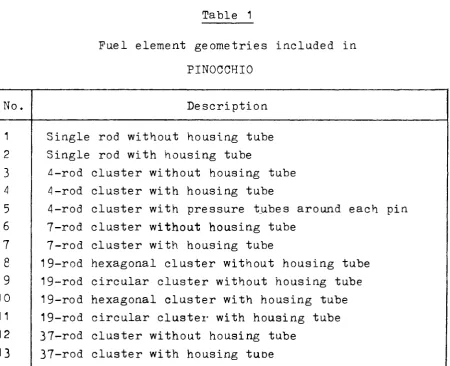
representation of the neutron cycle, the code has since under-gone several transformations embodying various improvements in the physical model, adding generality to the types of systems which may be treated and increasing the potentialities, e.g. through the adjunction of a burnup subroutine. In its present state, PINOCCHIO will solve the eigenvalue problem and perform a complete reactivity-time calculations for an infinite lattice fueled with single rods or cluster type elements. The method is based throughout on the use of first collision probabilities in a multigroup energy structure. The geometries specifically pro-vided for in the current version and the energy group structure are described respectively in Table 1 and 2.
Table 1
Fuel element geometries included in
PINOCCHIO
No.
1 2 3 4 5 6 7 8 9 10 11 12 13
Description
Single Single ¿-rod 4-rod 4-rod 7-rod 7-rod 19-rod 19-rod 19-rod 19-rod 37-rod 37-rod
; rod without housing tube : rod with housing tube
cluster without housing tube cluster with housing tube
cluster with pressure tubes around each cluster without housing tube
cluster with housing tube
hexagonal cluster without housing tube circular cluster without housing tube hexagonal cluster with housing tube circular cluster with housing tube cluster without housing tube
cluster with housing tuoe
(l)Spatial calculations
(2) Thermal spectrum calculations
Group No.
1 2 3 4 5 6 7 8 9 10 11 12 13 14 15
Group No.
1 2 3 4 5 6 7 8 9 10
Energy interval, eV
1 .49 x 107 1.35 x 10⁶
1 .35 χ 106 1.11 χ 105
1.11 χ 105 3.18 x 10Δ
3.18 x 10⁴ 961
961 130 130 47.8 ¿7.8 29.0 29.0 10.7 10.7 2.38
2.38 0 Energy interval
eV
2.200 1.500 1.500 1.300 1.300 1.200 1.200 1.150 1.150 1.110 1.110 1.090 1.090 1.070 1.070 1.050 1.050 1.025 1.025 1.000 1.000 0.970 0.970 0.910 0.910 0.700 0.700 0.500 0.500 0.414
Group No.
16 17 18 19 20 21 22 23 24 25 26 27 28 29 30
Energy interval eV
0.414 0.350 Ο.35Ο 0.310 O.3IO 0.270 0.270 0.220 0.220 0.160 0.160 0.100 0.100 0.085 0.085 0.060 0.060 0.040 0.040 O.O3O O.O3O 0.025 0.025 O.OI5 0.015 0.010 0.010 O¿005 0.005 -Ό.ο
and the GATHER-IIV library for the thermal range. However,
the 2200 m/s constants for U-233, U-235, Pu-239 and Pu-24 1
(S)
are extracted from the 1965 study of Westcott.et al. . To construct the PINOCCHIO library in the group structure de-scribed in Table 2, energy condensation was effected with
(4)
the help of GGC-II for an ideal homogeneous system consti-tuted of heavy water and natural uranium.
The code was first written in PORTRAN-II for the TBM-7090 but has recently been translated for use on the IBM 360. A
typical eigenvalue problem requires of the order of 1-2 m. The main features of the physical model are given in the following paragraphs.A brief description of the code completes the report. Comparisons with experiments will be given in a forthcoming publication.
1 . Eigenvalue Problem
Two sets of criticality equations are used in PINOCCHI"! according to whether the fast fission events are considered as forming an integral part of the average neutron lifecycle
or a side process. The first viewpoint is the more frequently adopted in reactor calculations.The second representation of-fers the advantage of being easily reducible to the classical four-factor formula (at least, in the absence of epithermal fissions).While the convenience of the latter picture is taken advantage of in the actual establisment of the neutron balance, it was thought advisable to formulate the output of PINOCCHIO in the more familiar frame of the former outlook.
buck-where
Σ*·*ϊ->·
Β
*Ψ* co
*»*
3D *
c^^ ^<m
ím.4*)
^ Ä M . »
C is the number of neutrons appearing in group n at each collision in group m; % is the cellaveraged collision cross section in group n ; Z _n ^s ^n e cellaveraged removal
cross section in group η ; D is the cellaveraged diffusion coefficient in group n.
When all reaction rates are referred to one neutron leav ing (or produced in) the system, the value of keff is given by
Since k-eff is normally close to unity, the second term on the right hand side will usually be small and, in PINOCCHIO, only the first definition of k-eff is retained.
The expressions for the infinite multiplication factor
cor-responding to both points of view are derived by : + ting the
buckling equal to zero in equations (2) and (3), am; their re-lationship is described by introducing the same modification in equation (4). It will immediately appear that, in this case the choice of the definition is not trivial and significantly diffe-rent values will be obtained according to the preferred represen-tation of the neutron cycle. Both results are printed in the out-put of PINOCCHIO.
1 ·1 Tiie_f;ast_ef; feet
with-In thermal assemblies with low fuel enrichments, the predo minant event at high energy is U-238 fission but of comparable importance for the definition of the fast range is the fact that the virgin neutron spectrum resulting from all fissions vanishes into insignificance outside a not very wide band of energy where it produces strongly localized sources. Thus, at lower energies, even complex-shaped fuel elements may reason ably be represented in a simpler geometry of concentric cylin drical annuii but, in the vicinity of the Mev-range, the rod geometry must often be more closely approximated especially with gas-cooled elements.
In PINOCCHIO, the lower threshold of the fast region is chosen as 0.1 Mev . More than 98.4$ of the fission spectrum is above this point. Furthermore, inelastic scattering and resonance capture in uranium-238 both become negligible in the vicinity of that energy which thus appears as a fairly natural limit.
The neutron balance equation in the high energy region may be written for each of the ρ fast groups as
' · i m i \i I ° « '
where the transfer coefficient g. is given by
and the source density <1. by
The indices i,j refer to regions; the indices m,η to energy groups. The entire energy range from zero to infinity is sup posed to be divided into ρ fast groups, <\ epithermal and r thermal groups. The equation for the sources Q . expresses the conditions of normalization for the fluxes in every group and region, as stated above.
A preliminary study (8) has shown that, even with an hy-drogeneous coolant, the energy distribution of neutrons lying above the fission threshold of U-238 was, in the channel, very
nearly that of the U-235 fission spectrum. While this was not true for subthreshold neutrons, the effect of variations in the lower energy spectrum on the value of the fast multiplication factor was found to be small, the order of magnitude being roughly the same as the error introduced by the uncertainty in the capture cross sections of U-238. In the light of these results, the use of a two-group structure in the calculation of the fast effect seems to be justified.
Due to the marked heterogeneity of the fast, source dis tribution, it was thought advisable to provide a rather detail ed representation of the cluster geometry for the evaluation of the spatial behaviour. At the same time,in view of the
long mean free path of fast neutrons in all materials, various approximate techniques may be used to determine the collision
(9)
mate-rials lying between given source and target pins are homoge nized, before proceeding to the calculation of the pintopin collision probabilities for fast neutrons.
The fast neutron multiplication factor is defined as t'">e number of neutrons slowing down past the lower limit (0.1 i"ev) of the high energy region per neutron produced in thermal and epithermal fission. Thus, in the case of D fast groups
^1 \>*"l+f
Mvn «lib*» ν L
Backscattering from the moderator and celltocell interaction are implicity taken into account.
1 . 2 Ep_ithermal_event s 1.2.1 Flux calculation
The intermediate energy range extends, in PINOCCHIO, from 0.1 Mev down to 2.38 eV. Formally, the neutron balance equations are quite similar to the relations pertaining to the high energy regions. However, the transfer coefficients g. „^„ no longer
° °i , m* n °
include (n, 2 n) nor virgin fission neutron contributions, and the source densities are now given by
1 Á , « L· \ Αι** ì y «*»·Μ· TÅ./·* \
The probability ρ that a neutron will escape absorption while slowing down through the intermediate energy region is simply expressed as
t 1
l
\î.,^V-^'*^.-ViJ
The denominator is seen to be exactly equal to t as defined above. The numerator, completely analogous in form, represents
the total number of neutrons slowing down into the thermal range An epithermal multiplication factor may also be defined as
1
1
ΗνίΛ. φ.
s/Λ
In the present version of PINOCCHIO, the intermediate range is divided into seven groups. The lattice cell is represented as a network of concentric circular annuii and the calculation
of the collision probabilities follows the method of Bonalumi' ' The neutrons are assumed to be reflected isotropically at the
cell boundary. The source distribution is evaluated by perfor ming a flux calculation in the same geometry also for the two
fast groups, normalizing for cluster problems the value of £ to the result obtained in the" more exact geometry, as descri bed in section 1.1.
1.2.2 Input data for flux calculations
been carried out for a typical heavy water core. This influ ence being found to be negligible, a single set of nuclear data (except for resonance cross sections) has been supplied for all materials in the form of a library.
A preliminary analysis has shown that seven energy groups in the range between 0.1 Mev and 2.3 eV are enough to reproduce the correct absorption in U-238. Since absorp tion in other materials is thought to be of secondary impor tance with the low enrichments for which the code is intended, no provision has been made in the present version to refine the energy structure.
The resonance integrals were first calculated for the different groups by Nordheim's method, using the ZUT and TUZ
(12)
programmes . However, to avoid the necessity of including in PINOCCHIO the ZUT and TUZ programmes which require a rela tively .large amount of machine-time (5-10 minutes) an anlysis was carried out in the hope of correlating the Nordheim re
sults with simplified formulae. In the Nordheim approach to resonance integral calculation, there are two parameters which enter as input datato characterize the fuel element geometry: the fuel radius and the Dancoff coefficient. The possibility of collecting them into a single variable, the effective sur face, was investigated.
A best _fit of the uranium-238 resonance integral in the
form A + Bu was performed for five values of ranging from 0.2 (Ο.τ) to Ο.Θ. Every point was calculated with ZUT and
Group
4 5 6 7 9 9
T o t a l
M e t a l
A
1 .7474 0 . 4 7 8 3 0 . 2 6 7 8 0 . 0 7 7 8 - . 0 2 0 8 - . 1 4 6 9
2 . 8 1 5 6
Β
1 .1519 3 . 0 6 4 0 2 . 5 6 6 0 3 . 6 6 5 1 4 . 5 9 0 1 1 0 . 1 6 0 5
2 5 . 1 9 7 6
S t a n d a r d e r r o r
0 . 0 0 7 6 8 0 . 0 1 9 4 7 0 . 0 0 6 7 5 0 . 0 0 9 4 0 0 . 0 0 7 04 0 . 0 2 1 6 8
0 . 0 2 9 5 7
Oxide
A
1.7446 υ . 8 4 5 4 0 . 5 9 0 5 0 . 4 3 1 5 0 . 3 6 5 5 0 . 2 9 2 3
4 . 6 8 1 9
Β
1 . 2 3 2 7 2 . 8 7 1 7 2 . 3 6 3 8 3 . 4 9 2 0 4 . 5 0 2 0 1 0 . 5 4 8 4
2 5 . 0 1 0 6
S t a n d a r d e r r o r
0 . 0 0 7 4 0 0 . 0 2 6 8 9 0 . 0 1 8 4 6 0 . 0 0 4 7 7 0 . 0 1 5 4 9 0 . 0 2 0 5 7
0 . 0 7 7 9 4
C a r b i d e
A
1 .6685 0 . 7 3 4 2 0 . 5 0 0 7 0 . 3 4 2 4 0 . 2 7 4 1 0 . 2 2 1 2
4 . 1 5 3 1
Β
1.2742 2 . 8 5 6 3 2 . 3 5 0 1 3 . 4 4 1 1 4 . 3 8 7 1 1 0 . 1 2 7 8
2 4 . 4 3 6 7
S t a n d a r d e r r o r
0 . 0 0 7 3 7 0.02526 0 . 0 1 5 1 8 0 . 0 0 3 4 0 0 . 0 1 3 3 8 0 . 0 2 0 5 8
0 . 0 6 8 0 3
coefficient. Three sets of calculations were run för 0=0.0, 0.4 and 0.6 respectively. The best fitted values of A and Β for the different energy groups, together with the standard deviations are given in Table 3 for the metal, carbide and oxide at 20°C.
As can be seen, the accuracy of the predictions appears quite satisfactory. The quoted values of A and B, have been incorporated in PINOCCHIO, thus replacing the complete ZUT and TUZ calculations. The correlation has now been extended to the range of fuel temperature from 20°C to 1600°C.
For the highest epithermal group (between 32 KeV and 0.1 MeV)a mean U238 absorption cross section of 0.34b was adopted. This value was obtained by averaging the U235 "».p as given in BNL235 on typical heavy water lattice spectra calculated by the Monte Carlo techniques.
Exactly the same procedure was used to determine the e pi thermal constants of Th232. In the case of uranium235, a slightly more complicated correlation was developed for both the fission and absorption resonance integrals:
The variable à1 which plays a part similar to that of the
effective surface in the case of the fertile isotopes is given by:
*Λ\*1*
^u
(5)
»
t
where tf . is the potential scattering cross section per
P »1 tL o
uranium atom for the i isotope in the fuel lump: Λί is tne
Mf being the fuel molecular weight and E the enrichment. Equ.
(5) is thus a form of equivalence theorem.
The resonance integral constants aQ, a. , a^ were derived,
here again, by fitting the results of ZUT and TUZ over a range of Dancoff coefficients and rod radii. Two sets resulted, one for low enrichments (0-8$), the second one for high enrich-ments (8-100$).
For the time being, correlated values of U-235 resonance constants have been introduced only in the lower three epither-mal groups. Although the standard deviations are larger than for the fertile isotopes, the results are judged to be good enough to justify an extension of the technique to higher energy groups and other fissile nuclides.
The resonance cross sections in a given group are simply defined as equal to the resonance integrals in the group divided by the lethargy width of the group . A much more re-fined method of calculation also based on the solution of the Boltzmann equation by the collision probability technique but with a very large number of group is presently being written to provide a tneoretical check on the PINOCCHIO model for
(23)
resonance absorption. This code, called PETARDv , does not
use the concept of resonance integrals and Dancoff factor: the basic cross sections are used throughout and the channel geometry is very closely represented.
1.2.3 Dancoff factor calculation
As an adjunct to PINOCCHIO, a code to evaluate the Dancoff factor in clusters and lattices has been established. The fol-lowing assumptions are adopted in the calculation:
re-actor where the organic coolant acts as a secondary moderator inside the fuel clusters. However, the assumption isstill valid if the source density ia approximately constant through-out the cluster and not too different from the source density in tne primary moderator.
b) The fuel is black to neutrons of the energy considered. This approximation becomes progressively poorer at higher energies.
c) A single collision with a moderator atom removes tne neu-tron from the energy region considered. This will be true when the resonances are narrow enough or the moderating nuclide sufficiently light.
The calculation proceeds as follow:
- first, partial Dancoff coefficients C. ., i.e. the reduction in flux at the surface of pins i due to the presence of pins j, are evaluated by following the method pioneered by Carlvik
(15)
and Pershagenv ;
- then, the total Dancoff factor for the fuel cluster (or lattice) is obtained by summing the C- . over all pins i and j. The calculation takes into account in a rigorous way the geometry of the cluster (or lattice) and of the cladding sheath.
1 .3 Thermal_multip_lication_factor 1.3.1 Spectrum calculations
('13)
through a 30 group THERMOS calculation . A previous study has shown that the variation of the neutron spectrum across a unit cell is sufficiently well approximated by taking five annular regions: three in the fuel, one in the moderator, one
in an intermediate region. The main advantage of this proce dure is that it is fast enough to allow repeated spectrum eva luations for increasing burn-up values and, for this reason, it is well suited for reactivity-time calculations
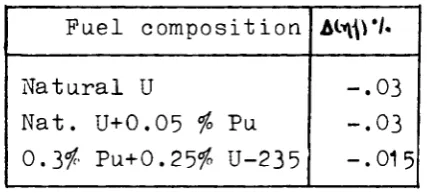
[image:24.595.234.448.422.519.2]Table 4 gives the percentage variations ofιΛ for a five-ring subdivision of a typical ORGEL-lattice cell (ECO fuel ele ment) with reference to a 20-region THERMOS calculation.
Table 4
Comparison between 5-region and 20-region THERMOS evaluationsof ECO fuel element
Fuel composition
Natural U
Nat. U+0.05 $ Pu 0.3$ Pu+0.25$ U-235
Μ*φ·/.
-.03 -.03 -.015
(17)
of an analysis carried out at Ispra v . In this study * a large
number of Pu-240 resonance integrals for heterogeneous systems have been calculated both by the use of standard codes (ZUT and ARES-Il), where such effects as spatial flux non-unifor-mity in fuel and moderator, energy depression in the moder-ator and thermal motion of moderating nuclei are not taken in-to account, and more sophisticated methods (THERMOS and WDSN), where no approximation of this nature is introduced.As an il-lustration, the results obtained with the different calcula-tion methods for a heavy water system are plotted in fig. 1 as a function of the fuel mean chord length. It can be seen that, in order to ensure that the error on the Pu-240 reso-nance integral never exceeds a few percent, it is necessary to include this calculation directly in the thermal part. The energy group-structure has been chosen in such a way as to provide a sufficient number of groups inside this 1-eV resonance,
Energy exchange between the fine thermal groups in heavy water, light water and graphite is accounted for through the Nelkin-Honeck, the Nelkin and the Parks kernels respectively.
(18)
A kernel developed at Ispra describes the interactions with the hydrogen atoms bound in the organic molecule. Col-lisions with other moderating nuclides are treated through the use of the free gas kernel.
1.3.2 Spatial flux distribution
In the cases of heavy water or graphite·moderated systems, col lision probabilities are used in the fuel channel and a layer of moderator (about one mean free path in thickness) immediately adjacent to the fuel element while the behaviour of the flux
in the rest of the moderator is treated with diffusion theory. Total reaction cross sections are used wherever the collision probability technique is applied and transport cross sections elsewhere. The cpllision probabilities 'are obtained with the
Bonalumi-Jonsson approximate method of calculation . a) When diffusion theory is used in the moderator, the neu
tron current entering the fuel element is assumed to be isotro-pically distributed. The flux normalization at the fuel-modera tor interface is effected by defining the extrapolation length in the fuel channel according to the well known method of
Kushneriuk and McKay . The neutron balance equations then read, for any region inside the channel, as
where P. is the probability of escape from the channel for neutron born in'ring i; Ρ . the probability that a neutron
01,
presenting itself at the fuel-moderator interface with an isotropic angular distribution will make its first collision in region i ; Po is given by
N being t'^e total number of annuii in the system .Index M refers to the moderator. The sources are obtained directly from the epithermal calculation.
b) When collision probabilities are used also in t'^e modera-tor, the neutron balance equations assume a form completely analogous to the relationship used in the epithermal range,i.e. they constitute a particular case of the following formulation, valid for r thermal groups
where ^
* rt»»l ' · I *
cross-sections. It has been shown that further iterations will not yield significantly different results.
Once the average fluxes in the moderator and the channel annuii are known, it is a simple matter to evaluate the ther mal multiplication factor through the standard relationship
1
2ΐ*Μ*ι\>„1
1.4 Neutron_Leakage
Originally developed in the framework of the heavy water reactor programme, the code PINOCCHIO, in its present state, incorporates a calculation scheme for the treatment of neu tron leakage which is well adapted to this type of lattices but is hampered by certain limitations in more general cases. The main features of the method are:
1) detailed treatment oí cell heterogeneity, the clusters being represented as networks of concentric annuii;
2) use of transport-corrected cross sections to account for scattering anisotropy;
3) neglect of diffusion asymmetry;
4) group diffusion theory used in all cases. Thus in every
group, the cell-homogenized absorption cross-section is incremented 2
by a term D B where the cell-averaged diffusion coefficient in group n is given by Benoist's formula
»V,V\ iti»
The sums extend over every medium in the lattice except the moderator, referred to by the index M . The symbol ψ^ denotes
the cell-averaged flux, the 'λ'* the transport mean free paths obtained directly from the GAM and GATHER homogeneous problems. The buckling is assumed to remain constant as a function of energy.
2. The Reactivity-Time Problem
Provision has been made in PINOCCHIO to perform a complete reactivity-time calculation for a given unit cell under the assumption that the power per unit length of channel does not vary. This, at least in principle, is no limitation since the history of any fuel element can always be represented by a series of PINOCCHIO calculations at different power levels.
At the present stage, the eigenvalue problem is solved anew and completely at each time step although in later ver sions it will be possible to keep the fast and epithermal parameters constant in successive time steps.
In the description of the isotopie evolution, the sim-(21 )
plified chain structure proposed by England v
this representation is still unnecessarily complex.
Accord-ingly an alternate picture consisting of 18 fission products in 6 linear chains, plus 2 pseudo-nuclides, is also included in the code: it has been verified that this structure is suffi-ciently detailed for the total poison to be reproduced within
( 22 )
5$ at the maximum irradiation considered . In both descrip-tions of fission product poisoning, direct contribudescrip-tions due to Xe-135 and SM-149 have been excluded.
The code does take into account the fact that the isoto-pie evolution is not the same in each pin ring of a fuel cluster due to the non-uniformity of the spatial flux distri-bution.
Acknowledgments
References
1. CASINI G, et al., "CAROLINE-1 : A calculation method for non-irradiated organic liquid heavy water lattices",
EUR-134.e (1962).
2. DE HAAN W. et al., "PLUTHARCO, A plutonium, uranium,
tho-rium assembly reactivity code", EUR-3141.e (1966). 3. AMYOT L. et al., "A new lattice calculation method for
ORGEL type reactors", ANS Transaction, Vol. 8 no. 2, p. 511 (1965).
4. JOANOU G.D., DUDEK J.S., "GAM-II» A B, code for the cal-culation of fast-neutron spectra and associated multi-group constants", GA-4265 (1962).
5. JOANOU G.D., et al., "GATHER-II, and IBM-7090 FORTRAN pro-gram for the computation of thermal neutron spectra and associated multigroup cross sections", GA-4132 (1963). 6. WESTCOTT C.H. et al., "A survey of values of the 2200 m/s
constants for four fissile nuclides", Atomic Energy Revew, Vol. 3, No. 2 (1965).
7. VIEWEG M.A. et al., "GGC-II program for using GAM-II and GATHER-II spectrum codes in preparing multigroup cross-section input", GA-4436 (1963).
8. AMYOT L., "Fast neutron spectrum in ORGEL-type reactors" IAEA Panel Heavy Water Lattices, Vienna (1963).
9. AMYOT L., "The fast neutron multiplication factor", EUR-1618.e (1964).
10. BONALUMI R., "Neutron first collision probabilities in reactor physics", Energia Nucleare 8, 326 (1961).
11 DE HAAN W., "Calculation of the absorption resonance inte-grals of U235 by a fitting procedure", to be published. 12. NORDHEIM L.W., KUNCIR G., "A program of research and
13. LEVINE M.M. "Resonance integral calculations for U-238 lat tices" Nuclear Science and Engineering _1_6, 271-279 (1963). 14. DE HAAN W., to be published.
15. CARLVIK I, PERSHAGEN B., "The Dancoff correction in various geometries" AE-16 (1959).
16. HONECK M.C., "A thermalisation transport theory code for thermal lattice calculations", BNL-5826 (1962).
17. BEONIO-BROCCHIERI F., DIANA E., "Studies on Pu-240 resonance absorption in heterogeneous systems", EUR-3151.e (1966). 18. ARDENTE V., "Remarks on the slow neutron scattering by or
ganic molecules", J. de Physique, 25, 6^ (1964)·;
19. JONSSON Α., "A one-group collision probability routine for annular systems", AEEW-R-253 (1963).
20. KUSHNERIUK S.A., McKay C , "Neutron density in an infinite non-capturing medium surrounding.a large cylindrical body which scatters and captures neutrons", AECL-137 (1954). 21. ENGLAND J.R., "Time-dependent fission product thermal and
resonance absorption cross sections", WAPD-IM-333 (1962). 22. BEONIO BROCCHIERI F., "Calcolo dell'evoluzione dei mate
riali fertili e fissili e dei prodotti di fissione in si stemi irraggiati", to be published.
Part II
CODE DESCRIPTION
1. Generalities
1.1 Materials
The composition of the materials which constitutes the cell is expressed in the PINOCCHIO input in terms of atomic densities. (nuclei/barn.cm). A maximum of ten compositions can be considered which correspond to the following ten regions of the cell:
1) Fuel 1 2) Fuel 2 3) Fuel 3 4) Canning 5) Coolant 6) Filler
7) Pressure tube 8) Insulating layer 9) Calandria tube 10) Moderator
The geometries specifically provided for in the current version are described in Table 1 and illustrated in Figs. 2-5. The three fuel compositions correspond to different fuel regions in the cluster depending on the geometry configuration:
single rod : the rod is divided in 3 fuel rings of equal thickness fuel 1 = central ring, fuel 2 = intermediate ring, fuel 3 = outer ring
4 rod cluster : only one fuel region is considered (fuel 2 and fuel 3 absent);
7 rod cluster : fuel 1 = central pin, fuel 2 = 1st fuel pin ring, fuel 3 = absent;
19 rod cluster : fuel 1 = central pin, fuel 2 = 1st fuel pin ring, fuel 3 = 2nd fuel pin ring;
1.2 Isotopes_and Library
A list of isotopes that are included in the present version of the code library is given in Table 5. Each isotope is identi-fied by two identification numbers (ex. 14002 40). The five numbers which compose the first identification number are chosen in the following way:
1st number (= 0 or blank) = microscopic thermal cross-sections do not depend on temperature (non-moderator isotopes), (= 1 · ) = the isotopes is present in the
li-brary at several temperatures (moderator);
2nd number (= 0 or 1 or 2etc.identifies the model used in the scattering kernel at thermal energies;
3rd to 5th number = identify the isotope.
The second identification number is equal to the isotope tem-perature in (°C). This second identification is not given in in-put for each isotope, but it is assigned to each material, as it is clear that all isotopes which belong to the same material
are at the same temperature. According to thisfthe choice of
the temperature must be made by paying attention that the tem-perature value will be used as the second identification num-ber of the moderator isotopes (i.e. of isotopes with a first
identification number with 1 as first number) and the pair of identifications must be as listed in Table 5.
When more than one fuel region is considered the temperature used for Doppler broadening calculation of resonance integrals is the FUEL 1 temperature and not the average value for the fuel. Apart from the composition of each material, a list of the identification number of resonance isotopes present in the fuel must be given by the user. For these isotopes microscopic
The diagnostic"Program ERROR Stop 101" printed in output means that the list of isotopes identifications given in
in-put is incorrect.
The PINOCCHIO library is divided into 5 sections: 1) Thermal cross sections
2) Fast and epithermal cross sections 3) Resonance integral coefficients
4) Fissile isotopes and fission products for burn-up calcula-tions
5) Chain composition for burn-up calculations
The total number of isotopes considered must be <£50; in the evaluation of the total number of isotopes, both the first and second identification numbers have to be considered, that is to say for example that (12001 27) and (12001 70) will be considered by the code as two isotopes.
1.3 Few-grou£_£arameters
Few—group macroscopic cross sections for use in diffusion calculation and heterogeneous parameters for use in the SOS code are calculated by PINOCCHIO. The parameters are averaged values for channel (fuel element and tubes) moderator and cell, Broad group limits for few-group parameters calculations must be given in the input, but each broad group must always inclu-des an integral number of PINOCCHIO groups. The 1st and 2nd PINOCCHIO fine groups must always belong to the same broad group. The last broad group must be the thermal group of PI-NOCCHIO (group 10).
2. Code Language
Table 5
Isotopes in PINOCCHIO library
Thermal ELEM. H D cross sections 1st IDENT. 10001 10001 10001 10001 10001 10001 10001 12001 14001 12001 12001 12001 12001 13001 13001 13001 13001 13001 13001 13001 13001 13001 10002 10002 10002 10002 10002 10002 10002 10002 12002 12002 12002 12002 12002 12002 12002 2nd IDENT. 27 40 50 60 70 .80 90 27 27 70 150 250 350 27 100 150 200 250 300 350 400 450 27 50 90 100 150 200 250 300 27 40 f: 50 60 70 80 90 MODEL FREI·; π II II II II II H in H O transp. H in H O transp. GAS II II II M II II without correct. with correct. H in H^O M II II ARDENTE II II II II M II II II FREE II II II II II II II NELKIN : rom GAKER II II II II II
M a
Thermal cross sections
ELEM. D
1 s t IDENT
14002 14002 14002 14002 14002 14002 14002 10012 10012 10012 10012 10012 10012 10012 10012 10012 10012 10012 10012 10012 10012 10012 10012 10012 10012 10012 10012 10012 10012 10012 10012 15012 10016 10016 10016 10016 10016 10016 10016 10016 10016 10016 10016 2nd IDENT. 27 40 50 60 70 80 90 27 100 150 177 200 250 300 350 400 450 620 627 700 720 800 820 900 927 1000 1100 1200 1300 1400 1500 27 27 40 50 60 70 80 90 150 177 250 350 MODEL NELKIN MODEL
(from GAKER 30 groups)
Thermal cross sections
ELEM. 0
Fe Al Zr Th232 U235 U236 U238 Pu239 Pu240 Pu240
Pu241
Xe Bo Mg Cr Mn Ni Cu Nb Cd Sn Pb Sm U233 Pa233 Np239
1st IDENT. 10016 10016 10016 10016 10016 10016 10016 10016 10016 10016 26 27 40 232 235 236 238 239 240 10240 10240 10240 10240 241 135 10 24 52 55 58 63
93 112 119 207 149 133
533 539
2nd IDENT.
627 700 800 900 1000 1100 1200 1300 1400 1500 27 27 27 27 27 27 27 27 27 177 327 627 927 27 27 27 27 27 27 27 27 27 27 27 27 27 27 27 27
MODEL FREE GAS
Dopp. Broa
Fast and epithermal cross sections ELEM. H D Bo C 0 Mg Fe Al Zr Cr Mn Ni Cu Nb Cd Sn Xe Sm Pb Th U233 U235 U236 U238 Pu239 Pu24 0 Pu24 ι Pa233 Np239
ve sonane e
1st IDENT. 1 2 10 12 16 24 26 27 40 52 55 58 63 93 112 119 135 149 207 232 233 235 236 238 239 240 241 533 539 integral coeff 2nd IDENT. 27 27 27 27 27 27 27 27 27 27 27 27 27 27 27 27 27 27 27 27 27 27 27 27 27 27 27 27 27 icients h °35 238 232 235 238 27 27 27
Fissile isotopes and fission products for BURN-UP
Fissile isototpes and fission products for BURN-UP
ELEM.
Ru103 Rh 103 Pd104 Nd148 Pd106 Eu155 Pd107 Pd108 Ag109 Te131m
1131 Xe131 1133 Xe133 Xe134 Mo99 Cs133 Cs134 Ce143 Pr143 Nd143 xPF(5) Eu157 Gd157 xPF(6) xPF(7) Chain comp
1st IDENT
103 403 104 648 106 155 107 108 109 131 331 431 133 333 134 299 633 334 143 343 443 306 157 357 307 308
osition from
2nd IDENT.
48 49 50 51 52 53 54 55 56 57 58 59 60 61 62 63 64 65 66 67 68 69 70 71 72 73
chain 1 to chain 25
3. Overlay organisation
CONTROL SECTION 1
O v e r l a y A
MAIN PROGRAM BUNK CØMMØN LIBRARY SUB.
C0NT.SECT.2 S u b r . THERMO
" CALDA
" DATA
XPREP STOP
" GEOM
ITER
" RELAX
( 85.792 bytes)
CONT. SECT.3
Subr. STM
( 114.66a bytes)
I
CONT. SECT. 4
Subr. RECA RECAB SIAC
CONT.SECT.11
Subr.BURNUP
" OMOGEN
CONT.SECT. 5
( 1 3 2 . J i a b y t e s )
, , ( 2 8 . 8 2 4 b y t e s )
O v e r l a y Β Κ 8 7 . 9 Ή b y t e s )
1
Subr. APP " PTJ " SIMQ "funct .PTC Subr. CAPPA
ÌONT.
S u b r .
II II II
F u n c t
SECT.10
ADRA CONS ABN APE .PIN
Overlav C
CONT.SECT.6
Subr. DISFA
" THEM1
" EFFE
TEMA 2
( 1 2 6 . 3 2 4 b y t e s )
If 1 0 7 . 6 3 0 b y t e s ) ( 1 3 3 . 6 6 6 b y t e s )
CONT.SECT.7
S u b r , ASHORE SHOCK UV CORD SIMM SPOST VET U1V1 PS OS ζ PETARD GABY THEM2 EFFEΤ2
(153.854 b y t e s )
CONT.
S u b r .
II II II II
F u n c t
11 II
S u b r .
It II II II II II
SECT.8
RABBIT WRITE PFF V0L2 VOLPI .TETA3 TETA1 TETA 2 GAUSS 1 GA US S 2 PRGP COMM ANAL EPSOA ADONE
:0NT.SECT.9
Subr.NEUTRA
" HETER
" HESSEN
QREIG
" ORT
" BWRITE
( H 9 . 3 7 2 b y t e s )
(
TIME=C|
IE
READWRITE
INPUT UATA
Ï)
COMPUTE
GEOMETR.DATA FOR THERMAL FLOT S PECT
/ ΡΈΡΓΝΈ V
\CONSTANTS χ
= 1
I
WRITE
THERMAL LIBRARY ON UNIT 10
= 2
1
READ \ 7 READ
THERMÃTTTlBRARtf THERMXTTTJIBRAI
FROM UNIT 9 A FROM UNIT 10
I
COMPUTE
KACROSC.CHOSS SECI ( 5 R E G . , 3 0 G R . )
I
COMPUTE AND WRITE
THERMAL FLUX SPECT,
ï
COMPUTE
MICROSCOPIC CROSS SECT.FOR SPATIAL
CALCULATION
« 2
Z1 = 1
Z2=1 COMPUTE
GEOMETR.DATA,MACR CROSS SECT.FOR DISADVANTAGE FACTOR CALCUL.
I
COMPUTE
DISADVANTAGE FACT FOR CANNING β 00 TA NE PR.TUBE,INS.LAYER
( Z 1 , Z 2 , Z 3 , Z 4 )
Subr. THERMO.CALDA
Subr. THERMO
Subr. DATA
Subr. XPREP, STOP
Subr. XPREP, GEOM.
S u b r . ITER, RELAX
S u b r . STM
Subr. DISFA, RECA
Subr. RECAB
Subr. THEM1, EFFE
Subr. APP, PIJ, SIWQ
Funct. BIO, BKO, BT1_
©
COMPUTEGE OMET. DATA, MACROSC. CROSS SECT.FOR THERMAL
SPATIAL CALCULATIONS
S u b r . TEMA2, SIAC
READ
¡\A.ST AND EPITHER. LIBRARY FROM UNIT
I
FAST ANTFRPITHER. LIBRAY FROM UNIT
10
S u b r . ADRA
W R I T E \ FAST AND EPITHERMAL )
LIBR. ON UNIT 10 J
— ^ ^
-I
COMPUTEGEOMETRICAL DATA, MACRO SCOPIC CROSS SECTIONS
FOR £ CALC.
S u b r . ADRA, CONS
" ABN, SIAC
η
.1READ
RESON. INTEGRAL COEFF.FROM U . 9
I
READ RESON. INTEGRAL
COEFF.FROM U . 1 0 .
S u b r . APE
WRITE
RESONANCE INTEGRAL COEFF. ON U. 10
E
COMPUTEGEOM. DATA, MACROSC. CROSS SECTION FOR
p, H,p CALCULTAIONS
«2
DANCOFF COEFF. FROM INPUT DATA
Subr. APE, RECA, RECAB
" PIN, SIAC
COMPUTE
GEOM. DATA, MACROSC,
CROSS SECT. FOR
D A N C O F F . C O E F F . C A L C U L
©
Θ
COMPUTE
ROD COORDINATES, MATRIX GROUP SYMM.
I
COMPUTE DANCOFF. COEFF.(HETER. MODEL) (PARALLEL RODS)
COMPUTE
RESONANCE INTEG. P, *lep,DIFF.COEFF., THERMAL SOURCES
I
COMPUTETHERMAL SPATIAL CALC ( f, 7> , L? e t c . )
I
WRITE \ RESULTS OF THERMAL SPATIAL )
CA LC .,DANC OFF C OEFF .,RESONAN./
-ESCAPE PROB., etc. J
I
COMPUTE AND WRITE FAST MULTIPL.FACTOR FAST FISSION RATIO
I
WRITECRITICALITY(SUMMARY OF RESULTS )
I
COMPUTE AND WRITE NEUTRON BALANCE
I
' COMPUTE AND WRITE" ,FEW-GROUP PARAMETERS
t ~
COMPUTE AND WRITE OVER-ALL NEUTRON
BALANCE
S u b r . CORD, SIMM S u b r . SPOST, VET
S u b r . SHOCK, UV, U1V1 S u b r . PSOSΖ
F u n e t .BIC
S u b r . PETARD, APP, P I J II
Funet
Subr. II
Funet
SIMO, GABY
.BIO, BI1, BKO, BK1
THEM2, APP, PIJ SIMO, EFFEΤ2
.ΒΙΟ, B U , BKO, BK1
S u b r . WRITE, CAPPA
S u b r . RABBIT,PFF,PIJ,GAUSS 1
" GAUSS2tV0L2,TFTA1,TETA2
" TETA3,VOLPI,PRGP,COMM " APP, ANAL,EPSOA F u n c t . B I C , B I O , B I 1 , B K O , B K 1
S u b r . ADONE
S u b r . NEUTRA, CAPPA
S u b r . NEUTRA, CAPPA
* 4
COMPUTE AND WRITE THREE-GROUP PARAMETERS
FOR HETER.PARAM.CALCUL.
S u b r . HETER, BWRITE
COMPUTE AND WRITE
NCAS = 2
Θ
^wm/íim
Ξ Q.
LHJEP_x
IMè
TIMET
= TIMEP READ
INPUT DATA CARD
J
S u b r . BURNUP
TOTAL ABSORPTION IN THE CELL
TOTAL FISSION IN THE CELL
ATOMIC DENSITIES FOR THE NEXT
TIME-STEP (ATOM PER CM χ * 3 ) /
FISSION PRODUCT MACR. ABSORPTION / CROSS SECTIONS
Λ
Subr. BURNUP, OMOGEN(
READ
INPUT DATA CARD
D
Main PINO
5. Execution Time
The execution time of a typical cell calculation varies from 1 minute in the case of single rods (geometry N° 1 : Table 1) to 3 minutes for geometry N° 13. This time is reduced by 10-20$ in the case in which the same calculation is repeated for different pitches. In fact in this case the library tape must be read com-pletely only once to locate the isotopes of interest.
For burn-up problems, the machine-time is somewhat reduced
since the data must only be read for the first time-step. Thus,
C a r d 1
Symbol
P r o b l e m I d e n t i f i c a t i o n and d e s c r i p t i o n
TITLE
Word Column F o r m a t
C a r d 2
Symbol
1 12
12
G e o m e t r y i n d e x
( s e e T a b l e 1)
NcG
2 4 11
=1 s q u a r e l a t t i c e =2 t r i a n
g u l a r l a t t i c e
NTft
3
56 12
Number of i s o t o p e s p r e s e n t i n t h e c e l l
X
NE
4 8 11
Number of broad groups f o r few group p a r a m e t e r s c a l
c u l a t i o n
( * 9 )
X *
NGRU
5
1 0 11
=1 S i m p l i f i e d bum up c a l e . =2 D e t a i l e d b u r n u p
c a l e . ( s e e burnup^
XXX
NBU
6
1112
12
Number of t i m e s t e p s f o r com p l e t e c e l l c a l e , and f o r t h e g i v e n PU
( s e e c a r d 8 word 4)
( ^ 9 9 )
NSTËP
χ The i s o t o p e pre s e n t a t s e v e r a l t e m p e r a t u r e s must be c o n s i d e r e d onlj
o n c e . See " i s o t o pes and l i b r a r y , , xx NGRU=4 i f h e
Card 2 (continued) Symbol time-steps for thermal calculation only (spec-tral and spatial) (always e-qual to 1)
N1 time-steps for ther-mal calcu-lation only (spatial) (always e-qual to 1)
N2
time-steps densities for deple- are read tion chainii (see osrc calculation 9-10)
(* 99) s 1 A t o m i c
densities are cal-culated (not ye1 possible
N3 NCC
is not conside-red in burn-up calcul. =1 Chain 1
is consi-dered NUCAT(1) column 25 for the chains from 2 to 25
NUCÀT(2-2$}
Word
Já.
37
"56"
38
39
"5T
40 SÖ-41 TTColumn
55
58Format 11 11 11 11 11
Card 2 (continued SymBol =0 General
descri-ption
(input
data) will not be'prin-ted out =1 will beprinted
MW(1)
=0 Thermal parame-ters (TÏÏÊ¥MOS, =0 Ephiter-mal· pa-rameters=0 F a s t pa·· =0 C r i t i c a
-THEMIS r e s u l t s w i l l no be prin ted
= 1 w i l l be p r i n t e d
w i n —
(PETARD. SHOCK ref suits) will not be prin-ted =1 will be
printed
— N W T T )
rameters (RABBIT" results) will noi be prin-ted
= 1 will be printed NW(4)
,ίϋζ.
(summary of re sults) will not be printed Ί will be printed NW(5) =0 Neutron balance will no'; be prin ted= 1 will be printed
Card 2 (continued)
Symbol
group parame ters (cell
a-veraged) will not be prin ted =1 will be
printed
NW(7)
group parame ters
(modera tor ave raged) will not be prin ted =1 will be
printed NW(8)
group parame ters (fuel-av e
raged) will not be prin
ted =1 will be
printed
NW(9)
neutron balance will not
printed =1 will be printed
NW(10)
group parame-ters for he
teroge neous par. will not be prin
ted =1 will be
printed NW(11)
group hetero geneous parame ters will not be printed =1 will be
printed
NW(12)
Word Column F orma. Τ
Card 2 (continued)
Symbol
48
67
11
=0 Burn-up (cross
sections ror tie time-stei will not be prin ted
=1 will be printed
X NW(13)
49
68
11
=0 Atomic densities ror tne next time-steps will not be prin ted =1 will be
printed
NW(14)
χ N(13)=0 t h e b u r n - u p w i l l
Card 3
Symbol
B r o a d - g r o u p l i m i t
=9 i f NGRU=2 = 2 i f
NGRU>2
NDG(1)
B r o a d - g r o u p l i m i t = 10 i f
NGRU=2 = 9 i f
NGRU=3
NDG(2)
B r o a d - g r o u p l i m i t
NDG(3)
e t c .
untilNDG(NGRu;
Word Column F o r m a t
Card 4
Symbol
1 1-5
15
T e m p . ( ° C ) f o r f u e l 1 m a t e r i a l
IEM(1)
2 6 - 1 0
15
T e m p . ( ° C ) f o r f u e l 2
IEM(2)
3
11-15 15
Temp.(°C) f o r F u e l 3
IEM(3)
4 1 6 - 2 0
15
Temp.(°C) c a n n i n g
IEM(4)
5 2 1 - 2 5
15
T e m p . ( ° C ) c o o l a n t
IE1VK.5;
6
2 6 - 3 0
15
T e m p . ( ° C ) f i l l e r
Card 4
Symbol
Temp.(°C) Pressure
tube
IEM(7)
Temp.(°C) Insulating
layer
IEM(8)
Temp.(°C) calandria
tube
IEM(9)
Temp.(°C) Moderator
IEM(10) Word
Column Format
Card 5
Symbol
1 35 Π 1st reso nance iso tope
Identifi cation num ber
iSRISd)
2 810
13 2nd reso nance iso tope
Identifi cation num ber
ISRIS(2)
1 1315
13 3rd reso nance iso tope
Identifi cation num ber
ISRIS(3)
4 1820
13 4th reso nance iso tope
Identifi cation num ber
ISRIS(4)
■5 2325
13 5th reso nance iso tope
Identifi kation num
ber
ISRIS(5)
Card 6
Symbol
fuel pins (cm)
RF
radius of canning
(cm)
RC
of rod cen ter circle
rad ius(cm)
0 if N C G = V
R1 Ρ
coeff.for NCG=1 .2
(JDHU
Word Column Format
Card 7
Symbol
1 18
E8.4
Internal radius of pressure tube (cm)
RTI
2
1017 E8.4
External radius of pressure tube (cm)
HTE
3
1926 E8.4
Internal radius of calandria tube (cm)
RCI
Δ
2835 EB.4
External radius of calandria tube (cm)
ROE
5
3744 EB.4
Volume fil ler exter nal to the rubberpband
(cm )
PILI
6
■ 4653 KB.*
Volume fil ler inter nal to the rubberpba nc
(cm )
FIL2
This card is to be supplied only
C a r d 7 ( c o n t i n u e d !
Svmbol
Volume f i l l e r i n t h e c e n t e r of t h e « r o d (cm ) . O n l y f o r t h e 4 r o d c l u s t e r
F I L 3
Word
Ρηλ ιιτηη
F o r m a t
C a r d 8
Symbol
1 18 E 8 . 4
F u e l d e n
s i t y ,
( g r / c n r )
RHO
2 1 0 1 7
E 8 . 4
E x p e r i m e n t a l b u c k l i n g u s e d i n t h e Kef f c a l c u r
l a t i o n ( l e a k a g e
t e r m s )
B2EX
1 1 9 2 6
E 8 . 4
C o n v e r g e n ce c r i t e r i o n , i f 0
s t a n d a r d o p t i o n
' E P S = 1 . 1 0 ~ i s u s e d
κ
EPS
4
2 8 3 5 E 8 . 4
F i s s i o n r a t e i n t h e c e l l
XX
PÜ
5 3 7 4 4 E S . 4^
T i m e s t e p l e n g t h f o r e v e r y NSTEî
( s e e c a r d 2 word 6 )
CE LT A Τ
6 4 6 5 3 EB.4
C o n v e r s i o n f a c t o r f o r t h e d e c a d e c o n s t a n t s i n s e c .
ALFA
χ Neutron density convergence crite rion in THERMOS flux calculation
Card 8 (continued)
Symbol
end of burnup calcula tion
TIMET
wich the PU value will be changed
TIMEP Word
Column Format
Card 9
Symbol
1 15 15
First iden tification number of the isoto pe I
(see "Iso topes and Library")
ISTBA(I)
2 1017 E8.4 Density (nuclei/ barn cm) of the iso tope I in the mat. fuel 1
EN(I,1)
3
1926 E8.4
Density is» tope I in the mat.
■fuel 2
EN (1,2)
4 2835 E8.4 Density isotope I in fuel 3
EN(I,3)
5 3744 E8.4 Density iso topes I in canning
EN(I,4)
6 4653 E8.4 Density isotope I in coolant
EN(I.5)
Card 9 and card 10 need to be re peated NE times
Card 9 (continued)
Symbol
Density isotopes I in filler
ENÍI.6)
Word
'"VI UHM
Format
Card 10
Symbol
1 18
E8.4
Density isotopes I in ins. layer
ΕΜ(Ι,δ)
Density isotopes I in pressu re tube
EN(I.7)
2
1017 E8.4
Density iso topes I in calandria tube
EN(T,9J
3
1926 E8.4
Density isotopes I in modera
tor
Card 11
Symbol
t i m e s t e p s f o r t h e new v a l u e of PU
( $ 9 9 )
NSTEP
( s e e c a r d 2word 7)
N1
( s e e c a r d 2 word 8 )
N2
t i m e s t e p s f o r d e p l e t i o n c h a i n s c a l c u l a t i o r
( * 9 9 )
Nl
r a t e i n t h e c e l l
FU
l e n g t h f o r e v e r y NSTEl
( s e e word
D
DELTAT
(see card 8 word 78) and must be repeated until TIMEP = TIMET
W^rd
f!n 1 umn
F o r m a t
C a r d 11 ( c o n t i n u e d '
Symbol
7
? f l _ 7 R
E 8 . 4
Time from z e r o t o t h e moment a t w i c h
t h e PU v a l u e w i l l be c h a n g e d
Card 12
Symbol
New value of the pitci (cm) for a calculation of the cell given
X
Ρ
Experimental ; buckling
for the new pitch
B2EX
be a new repe ing
χ Ρ
pr
complete problem, at input
2 3 4 5 6 7 8 9 10 11 12 13 14 15 16 17 18 19 20 21 22 23 24 25 1 4 1 1 1 1 1 I 7 2 0 ' ■ 0 2 S 2 2 2 5 3 0 0 2 2 0 0 Ρ 1 2 3 6 5 5 0 1 3 3 1 2 0 Κ 1 2 7 5 0 0 4 1 2 5 8 6 7 2 A 7 0 0 0 β ♦ ♦ ♦ 6 4
2 :
0 0 1 / 2 4
! 7
) 8
1 4 3 3 2 3 6
Ι Ι
2 6 3 7 3 2 3 2 0 β 1 7 5 7 6 2 3 2 2 5 0 0 2 9 β 9 Β 1 9 7 0 0 0 0 1 7 3 υ ♦ ♦ -R 1 0 0 4 2 4 ; 2 2
Ν
-4 1 2 2 5 1 3 2 3 3 6 υ 0 7 Ρ 0 9 0 7 2 3 2 3 6 5 5 9 6 2 3 2 2 S 0 0 3 2 9 8 0 3 Ι 2 0 0 2 0 1 7 7 4 Ν 7 ♦ ♦ -G 0 0 4 2 4 2 2 2 L 1 Ε 1 2 5 2 R 7 3 2 0 5 0 D 0 0 0 0 Ρ 2 + + I 7 1 0
τ C 5
Η
1 1
2 2 1 1 7 7 5 1 2 1 7 6 1 -8 1 2 2 4 1 7 9 1 3 4 2
1 1
8 6 7 1 2 6 3 6 7 1 4 2 6 0 4 -2 2 3 1 1
1 1 1 1
1
1 1 1 1 1
6
1 1 1
0 2
1 9
1
3 - 2
2 3 4 5 6 7 8 9 1 9 1 9 1 9 1 9 1 9 1 9 1 1 1 2 -0 0 0 0 0 0 0 2 -β G Τ R G G Β C -Τ β Ρ R Ε Ι Ε Ε 2 β C Β Ι Ρ
τ .
3 4 5 6 7 β 9 10 11 12 13 14 15 16 17 18 19 20 21 22 23 24 1 2 1 1 1 1 -. 2 0 2 1 1 2 7 0 0 2 2 2 2 0 0 0 3 2 7 4 3 3 3 4 2 0 1 0 1 5 7 6 2 5 8 9 0 7 1 6 2 2 8 2 1 ♦ ♦ ♦ 2 0 0 1 8 3 8
1 2 0 3 4 1 1 2 7 0 0 0 9 2 0 4 3 0 0 5 2 0 0 3 5 0 0 0 8 9 0 5 4 0 0 0 0 8 0 1 3 -♦ ♦ ♦ + -1 1 1 0 0 0 4 3 2 2 3 0 2 0 3 4 1 1 0 0 6 7 0 0 0 2 0 4 3 0 0 3 6 0 0 0 0 3 5 0 0 3 6 0 0 9 0 5 4 0 0 1 2 0 0 8 0 1 3 -0 0 0 + * + -1 1 -■f
I
0 0 0 4 3 2 2 1 1 6 1 2 4 3 4 1 1 9 5 1 7 0 0 6 2 0 4 3 0 0 0 8 0 0 3 5 0 0 0 4 9 0 5 4 0 0 0 9 8 ♦ 1 3 -0 ♦ ♦ 1 -1 1 + 0 0 3 4 3 2 2 6 0 3 0 0 0 6 0 0 0 0 0 2 0 0 0 * ♦ -0 6 1 1 0 0 0 6 3 0 7 3 0 0 5 0 0 0 _J ♦ -0 1 19 0 0 0 0 ♦ 6 3
0 . . 0 6 0 0 V 0 2 0 0
♦ 6
1 5 6 7 8 9
-1 0
9
1 0
9
I 0
9 0 9 0 9 I O 9 1 1 0 9 0 1 1 1 2 R G G B C -I E E υ 0 C S 9 e R Ν e PU
E Ν
* * * * * *
L.
OF ORGEL
AMYOT - G. CASINI - R. CUNIBERTI C. DAOLIO - A. KIND
DECEMBER 1967
* * * * * * *******************************************
ISPRA 6/2/68 UC/7/23.5 ÛIPHYL/D20 99.73 NELKIN MODEL EXPO ECO ZED-2 Ρ
1) GENERAL DESCRIPTION
GEOMETRY
NUMBER OF FUEL RODS = 7 TYPE OF LATTICE = SQUARE GEOMETRICAL CONFIGURATION NUMBER = 7 NUMBER OF ISOTOPS = 7
RADIUS FUEL ROD = 1.259999 RADIUS CANNING = 1.375000 DISTANCE BETWEEN RUDS = 2.950000 PITCH = 23.500000 RADIUS INT. OF PRESS. TUBF = 4.549999 RADIUS EXT. OF PRESS. TUBE = 4.750000 RADIUS INT. OF CAL. TUBE = 5.049999 RADIUS EXT. OF CAL. TUBE = 5.200000
TOTAL VOLUME OF THE FILLER = 0.0 FILLER VOLUME INT. RUBBER BAND = 0.0 FILLER VOLUME IN THE CENTRAL REG.= 0.0
12001 10012 235 238 10016 27 12002 PART.V. TOT.V. 0.0 3.2620E- 2.3291E- 3.2387E-0.0 0.0 0.0 4.9876E 4.9876E -02 -04 -02 00 00 0.0 3.2620E- 2.3291E- 3.2387E-0.0 0.0 0.0 4.9876E 2.9925E -02 -0* -02 00 01 0.0 0.0 0.0 0.0 0.0 0.0 0.0 0.0 0.0 0.0 0.0 0.0 0.0 0.0 5.2727E-0.0 9.5199E-6.6639E -02 -01 00 3.8616E-02 4.6340E-02 0.0 0.0 2.7624E-03 0.0 0.0 2.3462E 01 2.3462E 01 0.0 0.0 0.0 0.0 0.0 0.0 0.0 0.0 0.0 0.0 0.0 0.0 0.0 0.0 6.0293E-0.0 5.8434E 5.8434E -02 00 00 0.0 0.0 0.0 0.0 0.0 0.0 0.0 9.2363E 9.2363E 00 00
0.0 0.0 0.0 0.0 0.0 6.0293E-0.0 4.8302E 4.8302E -02 00 00 1.7932E-04 0.0 0.0 0.0 3.3207E-02 0.0 6.6234E-02 4.6730E 02 4.6730E 02