Munich Personal RePEc Archive
Economic growth and its impact on
environment: A panel data analysis
Asici, Ahmet Atıl
Istanbul Technical University - Faculty of Management
April 2011
Online at
https://mpra.ub.uni-muenchen.de/30238/
Economic Growth and its Impact on Environment: A Panel Data
Analysis
Ahmet Atıl Aşıcı
1 [email protected] Istanbul Technical UniversityApril 2011
Abstract
This paper aims to explore the relationship between the economic growth and the pressure on
nature from the environmental sustainability perspective. We measure pressure on nature as the sum of energy, mineral, net forest depletions and carbon dioxide damage, all measured in US dollars. The data is taken from the Adjusted Net Savings data of World Bank. Our panel consists of 213 countries and spans the period between 1970 and 2008. To investigate the causal effect of economic growth on nature we employ two strategies; effects and fixed-effects instrumental-variables (IV) regressions. Cross-country analysis reveals that there is a positive relationship between income and pressure on nature. However, the relationship is not linear across countries; the effect is much stronger in middle-income countries than in low and high-income countries. Our results are robust to the inclusion of various covariates and moreover they do not support the Environmental Kuznets Curve hypothesis which foresees a reduction in environmental degradation once a certain level of development is reached.
Keywords: Adjusted Net Saving, Genuine Saving, Sustainability, Panel data
JEL Classification: Q01, Q32, Q56
1
Corresponding author. Istanbul Technical University, İşletme Fakültesi 34367 Maçka İstanbul Turkey. Tel:
I. Introduction
Human activities are altering the global environment on an unprecedented level. The concentration of green house and ozone depleting gases in the atmosphere, the accelerated extinction of species, the breakdown of biogeochemical cycles, deforestation, and natural resource depletion are undeniably related to the human activity. In the literature, the question of how economic activity affects environment has been tackled from different angles with different methodologies and datasets. Yet, the conclusions are diverse, perhaps unsurprisingly simply due to the lack of consensus among scholars on how to measure the impact on nature and which dimensions to include. Measuring the impact on a complex system like nature is not easy, however. Problems related to measurement and aggregation consequently, lead some scholars to concentrate on one or few dimensions; i.e. economic growth and pollution, or deforestation. As a result, different approaches employing different datasets have come up with completely different conclusions. On one side, scholars assure that once certain level of development (or income p.c.) is reached, the negative effect of economic activity on nature is reversed. On the other extreme, others warn that the human demand has already led to an environmental degradation that surpasses the Earth’s ecological capacity to regenerate.
Although there exist no measure to fully describe the interaction between economic growth and environmental degradation, there have been several attempts to construct composite
measures to deal with the aggregation problem; among them the “ecological footprint index” and the natural disinvestment components of Adjusted Net Savings (ANS) data of the World Bank are worth to mention.
industries to relocate themselves in low and middle-income countries as can be clearly seen from the foreign direct investment (FDI) flows.3 This brings the environmental sustainability issue on the forefront. It is interesting to ask how environmentally sustainable the income generation process is. Or put differently, what is the extent of environmental degradation caused by income growth within the individual country? Putting the question like this forces us to concentrate on the origin of production and extraction, rather than the origin of consumption. From the environmental sustainability point of view, one has to measure environmental degradation that occurs where production and extraction takes place. It is clear that environmental quality indicators like air quality does not fit for such a question for it would not be able to capture the impact of affluence (as proxied by income or consumption per capita) over nature especially in small high-income countries where imported goods constitutes a fairly big share in the consumption basket of individuals. Moreover, pollution is one of the many dimensions of the impact of economic growth over the environment. For a thorough analysis one has to include as many dimensions as possible. In this vein we will construct a composite pressure on nature measure based on the natural disinvestment components of ANS data of the World Bank. Natural disinvestment consists of carbon dioxide damage, energy, mineral and net forest depletions, all measured in current US dollars.
Note that it is broader than any environmental quality indicator and most importantly it aims to measure environmental degradation in the country of production rather than consumption.
Our panel consists of 213 low, middle and high-income countries and covers the period between 1970 and 2008.
The paper is organized as follows. The coming part is devoted to the review of relevant literature. In Section 3 we describe the data. Section 4 presents our methodology and econometric model. In Section 5 we will present the results. The results of a battery of robustness checks are presented in Section 6. And finally Section 7 concludes.
2. Literature Review
The question of how human activity interacts with environment can be traced back to the
times of Malthus. In his famous 1798 book, titled as, “An Essay on the Principle of Population” Malthus proved that the growth of population will eventually reach the limit of resource base in the absence of technological progress. As many argue, technological progress
3
helps to escape from Malthusian trap by offsetting the geometrically increasing pressure from population. However, there is another channel which, given the state of technology and population, negatively contributes to environment; economic growth and resulting prosperity. In early 1970s, a debate between Commoner, Ehrlich and Holdren (1971) gave rise to the development of a formula, called as IPAT (Commoner et al. 1971), which summarizes the impact of human activity on the environment. This formula states that total impact (I) on environment is a function of population (P), affluence (A) and technology (T). Population growth negatively contributes to environment through increased land and resource uses, and pollution. Affluence measured by income or consumption per capita is another factor degrading environment. The last item in the IPAT equation is the technology, and it represents how resource intensive the production of affluence, that is, how much environmental impact is involved in creating, transporting and disposing of the goods and services used. Improvements in the technology which increases the efficiency could reduce resource intensiveness, thereby reducing the technology multiplier in the equation. IPAT formulation later gave rise to similar formulations called as ImPACT, STIRPAT (York et al. 2003).
Another strand in the literature consider environmental degradation by focusing on particular environmental indicators such as carbon dioxide, sulfur dioxide emissions (Boulatoff and Jenkins 2010; Grossman and Krueger 1991; Roberts and Grimes 1997); urban air quality
polluting technologies available. Or, rising middle class as a result of economic development is likely to demand policy reforms to ensure a healthy living environment once basic economic needs have been met (Barrett and Graddy 2000). The EKC hypothesis suggests that the negative scale effect tend to prevail in the initial stages of economic growth, but after a threshold level of development it should be outweighed by the positive structural and technological effects. But as Özler and Obach (2009) argues, this explanation raises doubts about the generalizability of the EKC hypothesis since decreasing environmental degradation in rich countries could well be achieved by increasing degradation in poorer countries. Moreover, recent stocktaking on the EKC front points out the inadequacy of the statistical methodology employed in EKC studies (see Harbaugh, Levinson, and Wilson 2002; Stern
2004). And that lack of inclusion of all pollutants in many of the models sheds doubts on the robustness of the findings (Aufhammer, Bento and Lowe 2009). As opposed to the predictions
of the EKC hypothesis Stern (2004) concludes that most indicators of environmental degradation are monotonically rising in income but the income elasticity is less than unity. The abovementioned weaknesses in the EKC literature have led researchers to turn to composite measures of ecological sustainability like “ecological footprint”. 4 The ecological footprint index measures the extent of Earth’s ecological capacity in meeting human demand (Wackernagel et al. 1999). It is constructed on the basis of several factors, such as; land consumed for the built environment, land used to produce forest products, land needed to
absorb carbon dioxide, and resources used for agriculture and fishing, which are used to generate a number representing the number of productive land hectares required in order to maintain given consumption levels with the given state of the technology. As opposed to other indicator, ecological footprint is an end-user and consumption based index. It accounts for resource use regardless of the point of extraction or manufacture, and therefore it is more suitable for a global analysis of income and environmental degradation relationship (Özler and Obach, 2009, p. 86). However, it has also some shortcomings as it does not consider all environmental impacts like hazardous waste.
Originally, ANS can be seen as a response to criticisms raised against the conventional measures of well-being like GDP per capita. Neo-classical economic growth theory links economic growth to the accumulation of physical capital. But, the conventional saving rate which solely depends on accumulation of the physical capital lacks many dimensions on which the well-being of people is assumed to rest, i.e. natural resources, human capital and
4
environmental quality. Rising GDP per capita may not necessarily reflect in an equal increase in the well-being of people. Hence, the World Bank in the late 1990s published a more comprehensive measure of net national saving, called as the ANS, by including human capital accumulation to and deducting natural resource depletion and environmental damage from the conventional saving rate. In the literature there are studies showing the superiority of ANS over the conventional savings rate in better reflecting the well-being of people. For example, Ferreira et al. (2008) investigates whether current per capita adjusted net savings is correlated with future changes in per capita consumption and finds a positive correlation between the two for developing countries; in other words, increased net savings is associated with greater future consumption, and hence an improvement in welfare. Also, Gnegne (2009) tests whether ANS explains changes in welfare which is defined by Infant Mortality Rate and Human Development Index. He concluded that there is a positive and significant relationship between ANS and welfare.
ANS is the fruit of the notion called as “weak-sustainability”(Gowdy and O’Hara 1997) and it is based on the idea of substitutability of different factors forming the fundamental basis of human existence (Gnegne, 2009, p.1129). As a notion it is controversial however, because of the issue of irreversibility and imperfect substitution among physical, human and natural
capital (Bridger and Luloff, 1999; Ekins et al., 2003). Keeping this latter point in mind, we choose to concentrate on the environmental sustainability of the income generation process.
Hence, in this study we will employ the natural disinvestment components of the ANS which are energy and mineral extractions, net forest depletions and carbon dioxide damage, all measured in current US dollars. This gives us the opportunity to construct a composite variable called as per capita pressure on nature, in constant 2005 US $, which is defined as; Pressure on Nature p.c. = Carbon Dioxide Damage p.c. + Mineral Depletion p.c. + Energy
Depletion p.c. + Net Forest Depletion p.c.
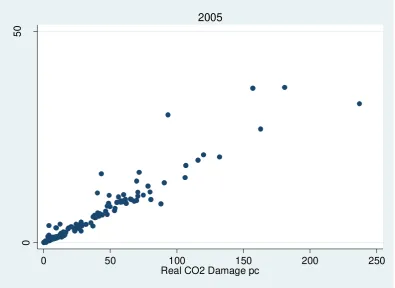
Figure 1. CO2 damage p.c. in constant dollar vs. Metric tons of CO2 emissions p.c. in 2005
Yet, natural disinvestment components of ANS have some shortcomings as well. For example, energy depletion consists of the depletion of oil, coal and natural gas only. Mineral depletion considers only the depletion of bauxite, copper, iron, lead, nickel, phosphate, tin, zinc, gold and silver. Other resources, which forms the biophysical environment (i.e. water quantity and quality, air quality, sediments and soil nutrients, wildlife, habitat and vegetation, biota, species at risk, acoustics environment, etc.) are not included because they are more difficult to evaluate (Gnegne, 2009, p.1129). Again, pollution considers only carbon dioxide damage and neglects other pollutants.5
3. Data and Descriptive Statistics
With a panel of 213 low, middle and high-income countries, between 1970 and 2008, we employ a panel regression analysis to investigate the relationship between per capita income and pressure on nature. Unless otherwise indicated, all variables are extracted from WDI-Online database of the World Bank. See Table A1 in the appendix for a detailed explanation and sources of all variables.
5
For a critical evaluation of ANS on the issue of sustainability see Pillarisetti (2005).
0
50
0 50 100 150 200 250
The table below shows that the pressure on nature takes different forms depending on income levels. Comparatively, net deforestation and mineral depletion in low-income countries, energy depletion and CO2 damage in middle-income countries, and finally energy depletion in high-income countries constitute the major sources of pressure on nature.
Table 1. Natural Disinvestment components of ANS (% of GNI)
Observation Mean Standard Deviation Min. Max. CO2 Damage
High Income 1513 0.37 0.40 0 4.4
Middle Income 2962 0.7 0.8 -0.3 7.7
Low Income 1765 0.56 0.9 0 9.7
Net Deforestation
High Income 1179 0.01 0.07 0 1.1
Middle Income 2569 0.2 0.95 0 19.4
Low Income 1766 1.34 2.3 0 20.1
Mineral Depletion
High Income 1474 0.13 1.1 0 32.5
Middle Income 2962 0.57 1.88 0 34.3
Low Income 1765 0.79 2.5 0 27.6
Energy Depletion
High Income 1513 3.8 10.3 0 98.2
Middle Income 2962 4.8 12 0 150.7
Low Income 1765 2.7 9.3 0 113.9
Notes: See footnote 7 for the determination of income groups.
Figure 2. Pressure on Nature and Income: 1970-2008 (Country Averages)
Notes: See Appendix Table A1 for data definitions. Values are averaged by country in 1970 -2008 period when both income and pressure on nature data exist together. The line represents Lowess function estimated with a bandwidth of 0.8.
However, cross-country relationship does not necessarily prove causation due to the potential endogeneity and omitted variable biases. In order to investigate the causal effect of economic growth on nature we employ two strategies. The first strategy is to control for country-specific factor affecting both economic growth and pressure on nature by including country-fixed effects. Consider for example Turkey and Finland. Finland is richer and exerts less pressure on her nature, so a simple cross-country comparison would suggest that higher per capita income causes less pressure on nature. The idea of fixed effects is to move beyond this
comparison and explore the “within country variation”. In other words, it asks whether
Turkey is more likely to exert less pressure on nature as it becomes richer. Our first results suggest that, it is actually not the case.
0
5
10
4 6 8 10 12
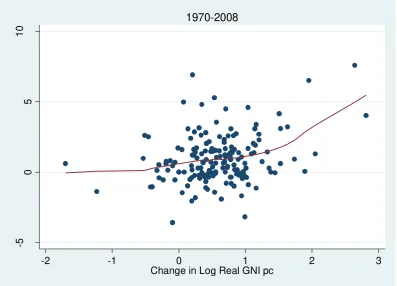
Figure 3. Change in Pressure on Nature and Income: 1970-2008
Notes: See Appendix Table A1 for data definitions. Changes are total difference between the latest and the earliest years at which both income and pressure on nature data exist together in 1970 -2008 period. The line represents Lowess function estimated with a bandwidth of 0.8.
As Figure 3 shows, even after eliminating the time-invariant country-fixed effects, the positive relation between income and pressure on nature remains. More growth leads to more pressure on nature.
While the fixed effect estimation is able to remove the time-invariant characteristics of countries, it does not necessarily heal the simultaneity bias; that is, there may be some other factor affecting both economic growth and pressure on nature. To deal with this bias, our second strategy is to use fixed-effects IV regressions to estimate the effect of income on pressure on nature.
Table 2. Descriptive Statistics
Mean
All countries
High Income Countries
Middle Income Countries
Low Income Countries
Variable
Panel A
-5
0
5
10
-2 -1 0 1 2 3
[image:11.595.70.507.632.765.2]Log real GNI p.c. (t-1) 7.81 10.2 7.9 5.94
1.6 0.43 0.72 0.53
Observations 931 209 443 279
Countries 163 42 98 64
Panel B
Rule of Law (t) -0.08 1.32 -0.22 -0.86
0.98 0.56 0.64 0.51
Observations 464 100 228 136
Countries 162 42 93 57
Panel C
Log Openness (t) 4.3 4.4 4.4 4
0.55 0.6 0.5 0.53
Log Population density (t) 3.87 4.3 3.8 3.9
1.5 1.8 1.4 1.32
Democracy (t) 0.55 0.58 0.6 0.45
0.29 0.15 0.3 0.3
Observations 894 197 431 266
Countries 161 42 95 44
Panel D
Education (t) 6.8 9.8 6.9 3.9
3.2 2.1 2.3 2.3
Enrollment rate (t) 62.3 85.7 63.9 28.5
27.7 12.3 21 20.7
Observations 570 149 247 174
Countries 118 30 62 43
Memorandum Item
Real GNI p.c. growth (median) 1.9 1.9 2.1 1.6
Countries 173 42 88 43
Notes: Standard deviations are reported in italic below mean values. Panel A refers to the sample in Table 3, column 3 and in Table 5, columns 1-3; Panel B refers to the sample in Table 6, column 4; and Panel C and D refer to the sample in Table 6, columns 1-3 and 5-6. The number of observations refers to the total number of observations in the unbalanced panel. The number of countries refers to the number of countries for which we use observations. For detailed definition and sources, see Appendix Table A1.
4. Methodology
4.1 Panel Data Econometric Model
Consider the following simple econometric model, which will be the basis of our analysis:
where nit is the log real per capita pressure on nature of country i in period t. The main variable of interest is git-1, the lagged value of log real income per capita. The parameter α therefore captures the causal effect of income on pressure on nature. Vector xit-1 contains all other potential covariates. In addition, the δi’s denote a full set of country dummies and the
μt’s denote a full set of time dummies that captures common shocks to pressure on nature levels of all countries; uitis an error term, capturing all other omitted factors, with E( uit ) = 0 for all i and t.
We construct five-year and annual panels: for the five-year panels, we take the observation every fifth year. We prefer using levels rather than averages, since averaging introduces additional serial correlation which complicates inference and estimation.
For comparison purposes we start by estimating (1) in a pooled OLS model with time and country dummies. However, the estimates of the pooled OLS model are biased and inconsistent when the δi’s are correlated with xit-1. Let, xjit-1 denote the jth component of the vector xit-1and let Cov denote the population covariances. Then, if Cov (xjit-1 , δi+ uit) ≠ 0for some j, the OLS estimator will be inconsistent. In contrast, even when this covariance is nonzero, the fixed effect estimator will be consistent if Cov (xit-1, uit) =0 for all j.
Yet, the fixed effect estimator fails to measure the casual effect of income on pressure on
nature simply because of the possibility that Cov (git-1, uit) ≠ 0 because of the reverse effect of pressure on nature on income, or because both changes in income and changes in pressure on
nature are caused by a third, time-varying factor. To account for this problem, we implement a fixed-effect instrumental variable (IV) strategy.
Stern, 2003, p. 327). Note that, the regression analysis employ five-year panel, hence for each cross-sectional unit (country) we have at most 8 observations in the 1970-2008 period. The short time dimension allows us to continue with the fixed-effects model without bothering about the stationarity of variables.
4.2.1 Fixed Effects Estimation Results
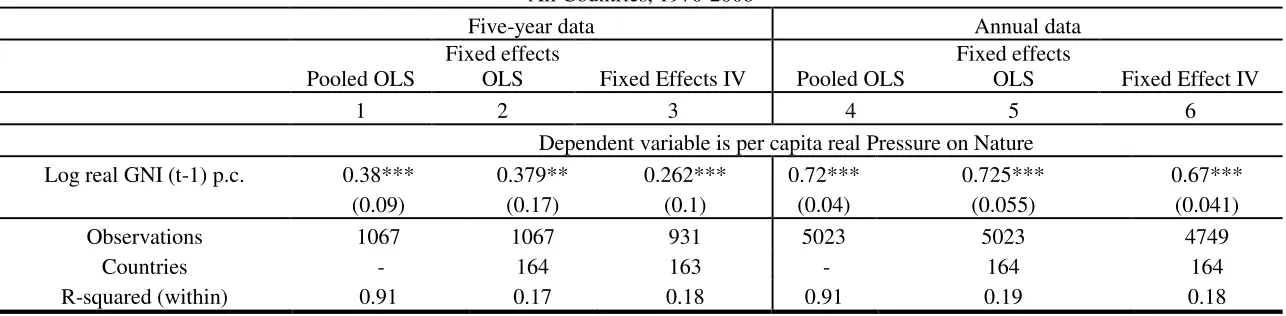
Table 3 presents the fixed effects estimation results.6 In columns 1-3 we use the five-year sample, whereas in columns 4-6 we use annual observations for comparison purposes. Log per capita real income is highly significant in all regressions and indicates the positive relationship between the income and pressure on nature, however, the effects are much stronger in the annual sample then in the five-year sample, suggesting a lower impact on the longer run.
Starting from the five-year sample, the coefficient 0.38 (standard error = 0.09) in column 1 of Table 3 implies that 10% increase in GNI per capita is associated with a 3.8% increase in the per capita pressure on nature. Yet, the pooled OLS estimates are biased. After eliminating time-invariant country effects, in column 2 we see that the relationship between income and pressure on nature remains significant and positive; and 10% increase in income leads to a 3.8% increase in pressure on nature.
In columns 4-6 we do the same exercise with annual data. The relationship between income and pressure on nature remains highly significant and positive, and the effect is almost
doubled (from 0.379 in column 2 to 0.725 in column 5).
In columns 3 and 6, we instrument for GNI per capita using a double lag to account for the bias possibly introduced by the existence of third factor affecting both income and pressure on nature. As compared to fixed-effect estimates, fixed-effect IV estimates are smaller but have the same sign, and that 10% increase in GNI p.c. increases the pressure on nature by 2.6% in the five-year sample and 6.2% in the annual sample.
6
Table 3. Fixed Effects Results
Notes: Pooled cross-sectional OLS regression with time dummies in columns 1 and 4, with robust standard errors are in parenthesis. Fixed effects OLS regressions in columns 2 and 5, with time dummies and robust standard errors clustered by country in parenthesis. Columns 3 and 6 employ the fixed-effect IV method; we instrument for GNI per capita using a double lag. Unbalanced panel, 1970-2008, with data at five-year intervals, where the start date of the panel refers to the dependent variable (i.e. t= 1975, so t-1 = 1970) in columns 1-3. Columns 4-6 use annual data, where, as before, the start date of the panel refers to the dependent variable (i.e., t=1971, so t-1 = 1970). * p<0.10; ** p<0.05; *** p<0.001. Time dummies and constants are not reported. For detailed data definitions and sources, see Appendix Table A.1.
All Countries, 1970-2008
Five-year data Annual data
Pooled OLS
Fixed effects
OLS Fixed Effects IV Pooled OLS
Fixed effects
OLS Fixed Effect IV
1 2 3 4 5 6
Dependent variable is per capita real Pressure on Nature
Log real GNI (t-1) p.c. 0.38*** 0.379** 0.262*** 0.72*** 0.725*** 0.67***
(0.09) (0.17) (0.1) (0.04) (0.055) (0.041)
Observations 1067 1067 931 5023 5023 4749
Countries - 164 163 - 164 164
All the regressions in Table 3 are estimated with time dummies. Although not presented here, time-effects are found to be increasing over time, especially during the last decade. Overall, the regression results suggest that there is a significant positive relationship between per capita income and pressure on nature. As countries grow richer so do their pressure on nature, and it is increasing over time.
5. Robustness Checks
In this part we present a battery of robustness checks to validate our results from baseline model. Firstly, we run the fixed-effects IV model with the balanced panel and secondly run the same model for different income categories (low, middle and high income) separately. Lastly, we investigate the influence of various sets of covariates on the relationship between income and pressure on nature.
5.1Robustness Check: Balanced Panel
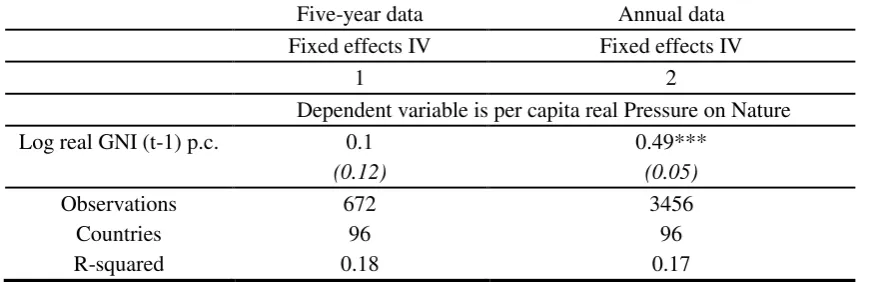
[image:16.595.68.514.465.606.2]It is useful to check whether entry and exit of some countries from the base sample in Table 3 might be affecting the results. Therefore, in this section we run the baseline regression in columns 3 and 6 of Table 3 with a balanced panel for the same period, 1970-2008.
Table 4. Robustness Check: Balanced Panel (1970-2008)
Five-year data Annual data
Fixed effects IV Fixed effects IV
1 2
Dependent variable is per capita real Pressure on Nature
Log real GNI (t-1) p.c. 0.1 0.49***
(0.12) (0.05)
Observations 672 3456
Countries 96 96
R-squared 0.18 0.17
Notes: The values in parenthesis are the standard errors. * p<0.10; ** p<0.05; *** p<0.001. Time dummies and constants are not reported.
5.2Robustness Check: Income Groups7
[image:17.595.74.548.227.396.2]Being a rich or a poor country matters when one considers environmental quality as EKC studies show. It would be interesting to test this hypothesis with a different dataset by analyzing whether interaction between income and pressure on nature varies across different income groups or not.
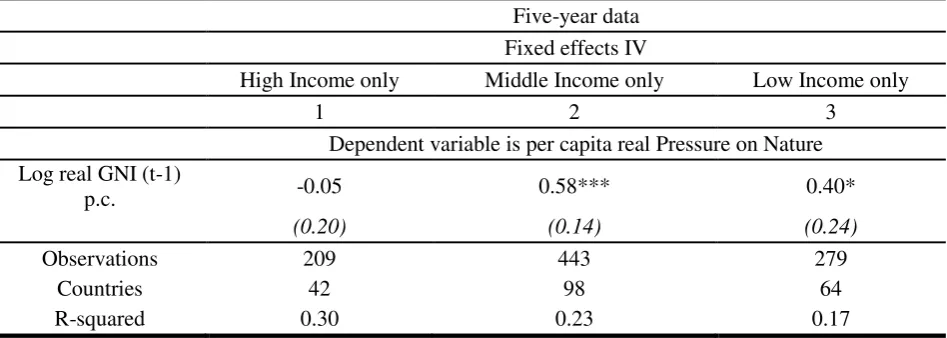
Table 5. Robustness Check: Income Groups
Five-year data Fixed effects IV
High Income only Middle Income only Low Income only
1 2 3
Dependent variable is per capita real Pressure on Nature Log real GNI (t-1)
p.c. -0.05 0.58*** 0.40*
(0.20) (0.14) (0.24)
Observations 209 443 279
Countries 42 98 64
R-squared 0.30 0.23 0.17
Notes: The values in parenthesis are the standard errors. * p<0.10; ** p<0.05; *** p<0.001. Time dummies and constants are not reported.
Table 5 presents the results of the estimation of baseline model in column 3 in Table 3 for different income groups. Remember that we found in our baseline regression that %10 increase in GNI p.c. increases the pressure on nature by 2.6% (coefficient 0.262 in column 3 of Table 3). Compared with the coefficient estimates in the table above, we see that this effect is much larger in middle-income group countries (6%); and slightly larger in low-income group countries (4%). Yet, the coefficient estimate for high income countries becomes insignificant and negative.
Our findings do not support the EKC hypothesis which asserts that environmental degradation first worsens, then slows down and finally decreases after reaching a certain level of income per capita. As opposed to the hypothesized slowed-down environmental degradation we found that the impact of economic growth on nature is highest in middle-income countries. The coefficient estimate for high-income countries is negative, however it is very small and insignificant. Although income p.c. increases 1.9% on average throughout the sample period,
it seems to be far below the rate necessary to carry countries beyond the so-called threshold after which the pressure on nature is expected to decrease.
5.3Robustness Check: Structural and Institutional Factors
In this section, we investigate the influences of some structural and institutional covariates on the relationship between income and pressure on nature.
The question of how population growth interacts with environment goes back to Malthus. According to him, as population grows so does the pressure on environment (agricultural land more specifically), which decreases the quality of land. In today’s world, one can replace agricultural land with nonrenewable resources, and measure environmental quality by the stock of forests or by the absence of air and water pollution. It can be argued that major cause of air, water and solid-waste pollution can be attributable to the population growth for its increased pressure on the assimilative capacity of the environment (Cropper and Griffiths, 1994, p. 250). Hence, we expect a positive relationship between population and pressure on nature.
When it comes to the interaction between the openness to trade and pressure on nature, there are two competing hypothesis in the relevant literature: race-to-the-bottom and
gains-from-trade effects. The first hypothesis indicates the tendency of some countries lowering environmental standards in an attempt to attract multinational corporations. The counter-argument, namely, gains from trade hypothesis, claims that trade allows countries to reach
more (and better) of what they want, which includes environmental goods as well as market-measured output. In the literature, the positive effect of openness on environmental quality is thought to be realized through the international ratcheting up of environmental standards, technological and managerial innovation brought by international trade (Frankel and Rose, 2005).
regulatory framework. The lack of clearly defined property rights and lax (or non-existent) environmental standards can be thought to lie behind the unsustainable management of natural resources in low-income countries. And for Deacon (1994) it arises from two sources: government instability or inability to enforce ownership and an absence of government accountability. However one should also take into account the fact that the existence of rules and regulations does not necessarily guarantee their enforceability. Hence it then becomes
straightforward to hypothesize that, pressure on nature decreases as countries’ ability to
enforce rule of law improves.
[image:19.595.71.540.375.712.2]Another important factor is the average level of education in the society. In the literature, education is considered to have positive effects on environmental quality. Societies with longer average years of schooling are more likely to demand a cleaner environment. (Alam, 2010; Torras and Boyce 1998). Therefore, we expect a negative relationship between the indicators measuring education level and pressure on nature.
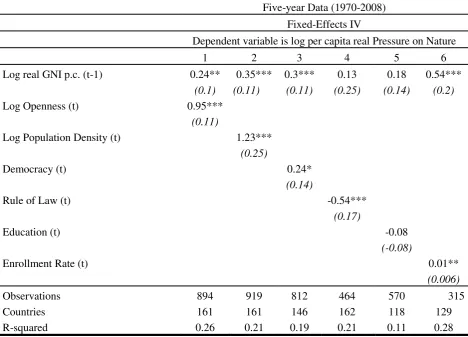
Table 6. Robustness Check: Structural and Institutional Factors
Five-year Data (1970-2008)
Fixed-Effects IV
Dependent variable is log per capita real Pressure on Nature
1 2 3 4 5 6
Log real GNI p.c. (t-1) 0.24** 0.35*** 0.3*** 0.13 0.18 0.54***
(0.1) (0.11) (0.11) (0.25) (0.14) (0.2)
Log Openness (t) 0.95***
(0.11)
Log Population Density (t) 1.23***
(0.25)
Democracy (t) 0.24*
(0.14)
Rule of Law (t) -0.54***
(0.17)
Education (t) -0.08
(-0.08)
Enrollment Rate (t) 0.01**
(0.006)
Observations 894 919 812 464 570 315
Countries 161 161 146 162 118 129
R-squared 0.26 0.21 0.19 0.21 0.11 0.28
Table 6 presents the fixed-effects IV model results. The results are fairly supportive of the race-to-the-bottom hypothesis which asserts that countries tend to lower down their environmental standards in order to attract more FDI inflows. Integration to the global system through trade, hence, comes at the expense of more pressure on environment. We found that %10 increase in openness ratio increases the per capita pressure on nature by 9.5%.
Population exerts a significant pressure on nature, and as expected, our regression results in column 2 confirm that an increase in population density by %10 increases the pressure on nature by 12.3%.
Contrary to our expectations, we found a positive and significant relationship between the democracy indicator and pressure on nature, and it is possibly due to the countries included in the regression.8 The regression results support our hypothesis that the governance structure is positively related with environmental quality. More specifically, we found that a unit increase in the rule of law indicator decreases the per capita pressure on nature by 0.5%.
Coming to the education, as number of years of education increases, the pressure on nature decreases as expected, however the relationship is not statistically significant. The other variable measuring the level of education, namely the secondary school enrollment rate, is found to be significant but with an unexpectedly positive sign, possibly due to the very
limited availability of data especially for low and middle-income countries.
Overall, we see that even after controlling for various structural and institutional indicators,
the positive relationship between income and pressure on nature continues to hold.
6 Conclusions
Our results suggest that there is a positive relationship between income per capita and per capita pressure on nature. The effect is much stronger in middle-income countries than in low and high-income countries. Per capita pressure on nature is increasing as countries jump from low-income to middle-income group. In the high-income group, the effect is negative but not statistically significant. After controlling for various covariates, institutional and structural, the effect still continues to hold. Our conclusions are fairly robust to the inclusion of these covariates, and to the inclusion and exclusion of countries from the sample.
8
The regression results shed doubts on the environmental sustainability of growth process especially in middle and low-income countries. Our findings indicate that these countries manage to succeed higher growth rates at the expense of increasing environmental degradation. The increasing pace of globalization and the resulting international division of labor are continuing to transform domestic economies along the export-led growth path. And foreign direct investment (FDI) inflows play a major role in this process. But it is fair to ask how these inflows effect the environment in recipient countries? Although we did not interest in the role played by FDI inflows in this paper, our results supports the race-to-the-bottom view, which describes the tendency of countries lowering their environmental standards to be able to attract more FDI inflows in order to sustain the growth process. Integration to world markets as measured by openness results in higher incomes but increasing affluence comes at the expense of more pressure on nature.
The institutional quality, notably the extent of enforceability of rule of law, which is highly correlated with income p.c., also matters. And we found a significant negative relationship between the degree of enforceability of rule of law and pressure on nature.
Hence, our results suggest that the predictions of the EKC hypothesis are far from reflecting the reality given the positive and significant relationship between income and pressure on nature especially in middle-income countries. Neither demand for cleaner environment and
resulting regulations nor advances in cleaner technologies seems to lower or even level off the negative impacts of human activity on nature, supporting the conclusions of similar studies employing broad measures like ecological footprint index. Hence, rather than waiting for market forces to react, technology or institutional structure to develop, more radical steps should be taken to lessen the negative impacts of affluence on the nature. Given the transboundary nature of environmental problems, these steps have to be taken in both individual country and multilateral levels, like obliging FDI inflows to follow environment-friendly code of conduct, among others.
Acknowledgements: I would like to thank Assistant Professor Mehtap Hisarcıklılar for her
References
Alam, Shaista 2010. “Globalization, Poverty and Environmental Degradation:
Sustainable Development in Pakistan”, Journal of Sustainable Development, 3:3, p. 103-114. Aufhammer, M., A. M. Bento, S. E. Lowe, 2009. “Measuring the effects of the Clean Air Act Amendments on ambient PM10 concentrations: The critical importance of a spatially
disaggregated analysis”, Journal of Environmental Economics and Management, 58:1, 15-26. Barrett, Scott, and Kathryn Graddy, 2000. “Freedom, Growth and the Environment”, Environment and Development Economics, 5:4, 433-456.
Boulatoff, C. and Michael Jenkins, 2010. “Long-term nexus between openness,
income and environmental quality”, International Advances in Economic Research, 16:4, 410-18.
Bridger, J. C. and A. E., Luloff, 1999 “Toward an interactional approach to sustainable community development”, Journal of Rural Studies, 15:4, 377–387.
Carson, Richard T., 2010, “The Environmental Kuznets Curve: Seeking Empirical
Regularity and Theoretical Structure” Review of Environmental Economics and Policy, 4:1, 3–23
Chinn, Menzie D. and Hiro Ito 2008. “A New Measure of Financial Openness”, Journal of Comparative Policy Analysis, 10:3, 309 – 322
Cole, M.A., A.J. Rayner and J.M. Bates, 1997. “The environmental Kuznets curve: an
empirical analysis”, Environment and Development Economics, 2, 401-416.
Commoner, B., Corr, M., Stamler, P.J., 1971. “The causes of pollution”, Environment, 13:3, p. 2-19.
Cropper, Maureen and Charles Griffiths, 1994. “The Interaction of Population Growth
and Environmental Quality” The American Economic Review, 84:2, 250-254.
Deacon, Robert T., 1994. “Deforestation and rule of law in a cross-section of
countries”, Land Economics, 70:4, 414-30.
Ehrhardt-Martinez, Karen, Edward M. Crenshaw, and J. Craig Jenkins, 2002.
“Deforestation and the Environmental Kuznets Curve: A Cross-National Investigation of
Intervening Mechanisms”, Social Science Quarterly, 83:1, 226–243.
Ekins, P., S. Simon, L. Deutsch, C. Folke and R. de Groot, 2003. “A framework for
the practical application of the concepts of critical natural capital and strong sustainability”,
Ecological Economics, 44:2–3, 165–185.
Esty, Daniel C., and Michael E. Porter. 2005. “National Environmental Performance:
An Empirical Analysis of Policy Results and Determinants”, Environmental and Development Economics 10:4, 391–434.
Ferreira, Susana, Kirk Hamilton, and Jeffrey R. Vincent, 2008. “Comprehensive Wealth and Future Consumption: Accounting for Population Growth”, The World Bank Economic Review, 22: 2, 233–248
Frankel, Jeffrey A. and Andrew K. Rose, 2005. “Is Trade Good or Bad for the Environment? Sorting Out the Causality”, The Review of Economics and Statistics, 87:1,85-91.
Gnegne, Yacouba, 2009. “Adjusted net saving and welfare change”, Ecological Economics, 68:4,1127-1139
Gowdy, John and Sabine O'Hara 1997. “Weak sustainability and viable technologies”, Ecological Economics, 22:3, 239-247,
Granger, C.W.J. and P. Newbold, 1974. “Spurious regressions in econometrics”, Journal of Econometrics, 2, 111–120.
Grossman, Gene M. and Alan B. Krueger, 1991. “Environmental Impacts of a North
American Free Trade Agreement”, NBER Working Paper Series, No: 3914.
Grossman, Gene M. and Alan B. Krueger, 1995. “Economic Growth and the
Environment”, The Quarterly Journal of Economics, 110:2, 353–377.
Harbaugh W. T., Levinson A., Wilson D. M. 2002. “Reexamining the empirical
evidence for an environmental Kuznets curve”, Review of Economics and Statistics, 84, 541-51.
Hardin, Garrett 1968.“The Tragedy of the Commons”, Science, 162, 1243-1248. Im, Kyung So, M. Hashem Pesaran, and Yongcheol Shin, 2003. “Testing for unit roots in heterogeneous panels”, Journal of Econometrics, 115:1, 53-74.
Jordan, Ben R., 2010, “The Environmental Kuznets Curve: Preliminary Meta-Analysis of Published Studies, 1995-2010”, Workshop on Original Policy Research Working Paper
Özler, Ş. İlgü, Brian K. Obach, 2009. “Capitalism, state economic policy and
ecological footprint”, Global Environmental Politics, 9:1, 79-108.
Parris, Thomas M., and Robert W. Kates, 2003. “Characterizing and Measuring Sustainable Development”, Annual Review of Environment and Resources, 28, 559–586.
Pedroni, Peter, 2004. “Panel Cointegration: Asymptotic And Finite Sample Properties Of Pooled Time Series Tests With An Application To The PPP Hypothesis," Econometric
Theory, 20(03), 597-625.
Perman, R and D.I. Stern 2003. “Evidence from panel unit root and cointegration tests
that the Environmental Kuznets Curve does not exist”, The Australian Journal of Agricultural and Resource Economics, 47:3, pp. 325–347.
Pillarisetti, J. Ram, 2005, “The World Bank’s genuine savings measure and sustainability”, Ecological Economics, 55, 599-609.
Roberts, J. Timmons, and Peter E. Grimes, 1997. “Carbon Intensity and Economic Development 1962–91: A Brief Exploration of the Environmental Kuznets Curve”, World Development 25:2, 191–198.
Torras, M. and J. K. Boyce, 1998. “Income, inequality, and pollution: A reassessment
of the environmental Kuznets curve”, Ecological Economics, 25, 147-160
Quah, D., 1994. “Exploiting cross-section variation for unit root inference in dynamic
data”, Economic Letters, 18, 381–386.
Stern, David I., 2004. “The Rise and Fall of the Environmental Kuznets Curve”, World Development, 32:8, 1419–1439
Stern, David I., 2009. “Between estimates of the environmental Kuznets curve," Environmental Economics Research Hub Research Reports No: 0934, Environmental Economics Research Hub, Crawford School, Australian National University.
Wackernagel, Mathis, L. Onisto, P. Bello, A. C. Linares, I.S.L. Falfan, J. M. Garcia, A. I. S. Guerrero, and M. G. S. Guerrero, 1999. “National Natural Capital Accounting with
the Ecological Footprint Concept”, Ecological Economics 29:3, 375–390.
York, R., E. A. Rosa and Thomas Dietz, 2003. “STIRPAT, IPAT and ImPACT:
Appendix
Table A1. Data and Sources
Variable Description Source
Net forest depletion
Net forest depletion is calculated as the product of unit resource rents and the
excess of round wood harvest over natural growth. WDI online database. NY.ADJ.DFOR.CD
Mineral Depletion
Mineral depletion is equal to the product of unit resource rents and the physical quantities of minerals extracted. It refers to bauxite, copper, iron, lead, nickel,
phosphate, tin, zinc, gold, and silver. WDI online database. NY.ADJ.DMIN.CD
Energy depletion
Energy depletion is equal to the product of unit resource rents and the physical
quantities of energy extracted. It covers crude oil, natural gas, and coal. WDI online database. NY.ADJ.DNGY.CD
Carbon dioxide damage
Carbon dioxide damage is estimated to be $20 per ton of carbon (the unit
damage in 1995 U.S. dollars) times the number of tons of carbon emitted. WDI online database. NY.ADJ.DCO2.CD
Real Pressure on Nature
The natural disinvestment per capita consists of energy, mineral, net forest depletions and carbon dioxide damage divided by population, all measured in
2005 constant US dollars.
Author’s calculation.
NY.ADJ.DNGY.CD+NY.ADJ.DMIN.GN.ZS+NY.ADJ.DFOR.CD+N Y.ADJ.DPEM.CD
Real GNI Gross National Income, Atlas method (constant 2005 US$) WDI online database. NY.GNP.PCAP.CD
Population
density Total population divided by land area (km2). WDI online database. SP.POP.TOTL / AG.LND.TOTL.K2
Education Average total years of schooling in the population age 25 and over. WDI online database. MYS.MEA.YSCH.25UP.MF
Enrollment rate Secondary school enrollment rate, total. WDI online database. SE.SEC.NENR
Openness Merchandise trade (% of GDP) WDI online databank. TG.VAL.TOTL.GD.ZS
Rule of Law
Rule of law captures perceptions of the extent to which agents have confidence in and abide by the rules of society, and in particular the quality of contract enforcement, property rights, the police, and the courts, as well as the likelihood
of crime and violence. Ranging from around -2.5 to 2.5. Worldwide Governance Indicators. Available at http://www.govindicators.org
Capital Account Openness
The degree of the capital account openness. Ranges from 2.5 (highly open) to
-.83 (least open). Chinn-Ito Dataset 2008, available at http://web.pdx.edu/~ito/Chinn-Ito_website.htm
Democracy Combined Polity score. Original range -10 - 10, normalized 0 - 1.