http://www.scirp.org/journal/am ISSN Online: 2152-7393
ISSN Print: 2152-7385
A Perturbative-Based Generalized Series
Expansion in Terms of Non-Orthogonal
Component Functions
Robert B. Szlavik1, Dana Paquin2, Galen E. Turner III3
1Department of Biomedical Engineering, California Polytechnic State University, San Luis Obispo, USA 2Department of Mathematics, California Polytechnic State University, San Luis Obispo, USA
3Department of Mathematics and Statistics, Louisiana Tech University, Ruston, USA
Abstract
In this paper we present a generalized perturbative approximate series expan-sion in terms of non-orthogonal component functions. The expanexpan-sion is based on a perturbative formulation where, in the non-orthogonal case, the contribution of a given component function, at each point, in the time do-main or frequency in the Fourier dodo-main, is assumed to be perturbed by con-tributions from the other component functions in the set. In the case of or-thogonal basis functions, the formulation reduces to the non-perturbative case approximate series expansion. Application of the series expansion is demon-strated in the context of two non-orthogonal component function sets. The technique is applied to a series of non-orthogonalized Bessel functions of the first kind that are used to construct a compound function for which the coef-ficients are determined utilizing the proposed approach. In a second applica-tion, the technique is applied to an example associated with the inverse prob-lem in electrophysiology and is demonstrated through decomposition of a compound evoked potential from a peripheral nerve trunk in terms of con-tributing evoked potentials from individual nerve fibers of varying diameter. An additional application of the perturbative approximation is illustrated in the context of a trigonometric Fourier series representation of a continuous time signal where the technique is used to compute an approximation of the Fourier series coefficients. From these examples, it will be demonstrated that in the case of non-orthogonal component functions, the technique performs significantly better than the generalized Fourier series which can yield non-sensical results.
Keywords
Non-Orthogonal Functions, Series Expansion, Approximate Series Expansion, Perturbative-Based Approximate Expansion, Numerical Approximations
How to cite this paper: Szlavik, R.B., Pa-quin, D. and Turner III, G.E. (2017) A Perturbative-Based Generalized Series Ex-pansion in Terms of Non-Orthogonal Com- ponent Functions. Applied Mathematics, 8, 106-116.
http://dx.doi.org/10.4236/am.2017.81009
Received: October 26, 2016 Accepted: January 22, 2017 Published: January 25, 2017
Copyright © 2017 by authors and Scientific Research Publishing Inc. This work is licensed under the Creative Commons Attribution International License (CC BY 4.0).
http://creativecommons.org/licenses/by/4.0/
1. Introduction
We propose the following novel approximate generalized series expansion for a function ψ
( )
t in terms of a finite number of component functions{
( )
}
1
m
n t n
λ =
where the component functions do not necessarily satisfy the orthogonality condition or form a basis for the function space:
( )
( )
( )
1 . m n n nt t t
ψ ψ β λ
=
∼ =
∑
(1)Let ψ
( )
t :[ ]
a b, → be a square-integrable function and let( )
f ψ( )
tΨ = (2)
be the Fourier transform of ψ
( )
t .In the expansion proposed in Equation (1), the component functions λn
( )
tmay be orthogonal or non-orthogonal. In the event that there is an infinite number of component functions that are orthogonal, satisfying the condition that any λa
( )
t and λb( )
t , on the interval τ1≤ ≤t τ2 are such that( ) ( )
2 1
d 0
a t b t t τ
τ λ λ =
∫
, the expansion is exactly yielding an equality in the expre-ssion shown in Equation (1). For a finite set of non-orthogonal component functions, the expansion is approximate.
The coefficients βn may be determined using a perturbative approach where
it is assumed that, at any given value of t, the contribution of each component
function λn
( )
t to the function ψ( )
t is perturbed by contributions from theother component functions in the set. From the perspective of the Fourier domain, it may be said that each frequency component of Ψ
( )
f consists ofcontributions from the corresponding frequency component of each component function Λn
( )
f where( )
( )
n f λn t
Λ = (3)
is the Fourier transform of the th
n component function λn
( )
t .The above description associated with a perturbed contribution of each of the component functions Λn
( )
f to the corresponding frequency components of( )
fΨ can be written mathematically as shown in Equation (4). The
coefficients i j, are the variables associated with the relative magnitude of the
perturbative contribution of the other component functions to the frequency component of the component function Λn
( )
f .( )
( )
( )
( )
( )
( )
( )
( )
( )
( )
1 2,1 1 ,1 1
1,2 2 2 ,2 2
1, 2,
m
m
m m m m m
f f f
f f f
f
f f f
Λ Λ Λ
+ + +
Λ Λ Λ
+ +
Ψ = + + + +
+ + +
Λ Λ Λ
(4)
( )
( )
( )
( )
2,1 ,1 1,2 ,2 1 2 1, 2, 1 1 1 1 1 1 m m m m mf f f f
Ψ = Λ Λ Λ
(5)
Evaluating Equation (4) or Equation (5) at a specific frequency fk for
1
k= l and re-arranging so as to isolate the terms with the variables i j, on
the right hand side yields Equation (6).
( )
( )
,( )
1 1 1
m m
m
k i k i j j k
i j i
i j
f f f
= = =
≠
Ψ − Λ
∑
=∑∑
Λ (6)The system of equations described by Equation (6) is such that 2
l>m −m
which constitutes an over-determined linear system. The value of l is the
chosen number of frequency points at which (6) is evaluated. It is then possible to solve the linear equations, in the least squares sense, for the complex values of the variables i j, .
Using the decomposition in Equation (4), we define the following super- position of each component function Λn,n=1m to be BnΛn:
( )
( )
( )
( )
( )
( )
1, 1,
1, , .
n n n n n n n
n n n n m n n
B f f f
f f f
−
+
Λ = Λ + + Λ
+ Λ + Λ + + Λ
(7)
The complex estimator Bn, 1, 2,∀ =n ,m is defined as:
1, 1, 1 1, , .
n n n n n n m n
B = + + − + ++ + + (8)
Since Bn is complex, its magnitude Bn will yield the multiplicative
coefficient βn by which each component function must be scaled as per
Equation (1)
,
n Bn B Bn n
β = = ∗ (9)
where Bn ∗
is the complex conjugate of Bn.
2. Examples
2.1. Example 1. Bessel Functions
In this first example, we utilize the proposed series expansion to estimate the coefficients associated with the sum of non-orthogonal Bessel functions Jn
( )
tof the first kind, where n is a positive integer, as described in Equation (10)
[1]:
( )
( )
(
)
2 01
. ! ! 2
z z n
n z
t J t
z z n
+ ∞ = − = +
∑
(10)A compound function was generated through the superposition of a series of Bessel functions of the first kind with a set of coefficients as per Equation (11):
( )
( )
( )
( )
( )
( )
( )
( )
( )
6 7 8 15
16 17 18 19
15 6 2 4
4 7 12 9 .
t J t J t J t J t
J t J t J t J t
ψ = + + +
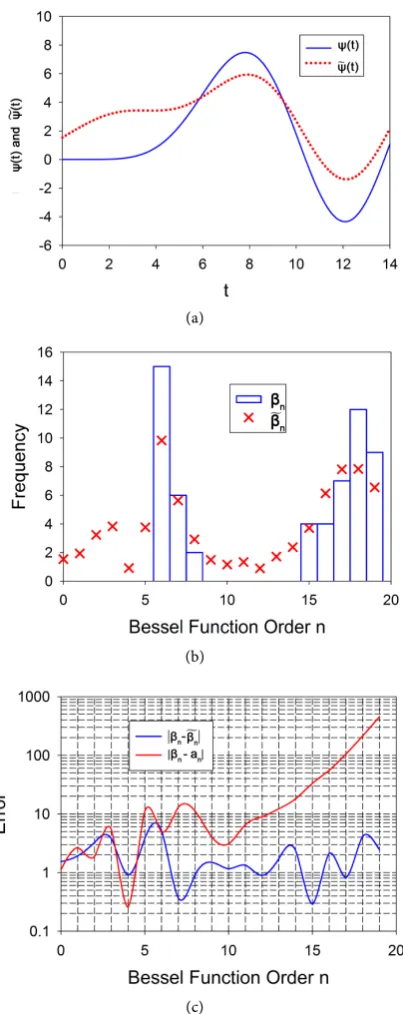
Figure 1 illustrates the results of the proposed series expansion for determin- ing the coefficients of a series of superposed non-orthogonal Bessel functions. A comparison is shown in a) of the template compound function ψ
( )
t with theestimated compound function ψ
( )
t generated using the estimated coefficientsn
β . The graph in b) is a comparison of the actual distribution coefficient values
n
β , shown in the histogram, with the estimated distribution coefficient values
n
β . A graph of the error magnitude is given in c) between the actual distribution
coefficients and the estimated coefficient values βn−βn as well as the error magnitude between the actual distribution coefficients and the generalized Fourier series coefficients β −n an . The generalized Fourier series coefficients
n
a are found from Equation (12)
( )
2 0( ) ( )
1
d
f
n n
n
a t t t
t
τ ψ
= Λ
Λ
∫
(12)where
( )
2( ) ( )
0 d
f
n t n t n t t
τ
Λ =
∫
Λ Λ [2].2.2. Example 2. The Inverse Problem in Electrophysiology
The inverse problem in electrophysiology involves utilization of recorded biopotentials to determine the characteristics of the biological signal generator that gives rise to the recorded biopotential signals. A specific situation, in the context of the inverse problem, arises when it is necessary to determine the conduction velocity or size distribution of a population of peripheral nerve fibers from a recorded compound evoked potential. The compound evoked potential, to a first approximation, may be viewed as the superposition of the single fiber evoked potentials associated with the individual nerve fibers in the nerve trunk that have been electrically activated. Information related to the size distribution, which is linearly related to the conduction velocity distribution of nerve fibers in the evoked population, is of clinical use because different disease processes selectively impact different segments of the nerve population having different diameter or size [3] [4].
When the separation of nerve fiber sizes is relatively large, the resultant single fiber evoked potentials are orthogonal to each other and a generalized Fourier series may be used to estimate the size distribution. In the event that the fiber size classes are such that there is significant temporal overlap between their associated single fiber evoked potentials, the generalized Fourier series can yield nonsensical results. In such cases, the perturbative decomposition outlined in this paper may be used to obtain an estimate of the coefficients associated with the series expansion shown in Equation (1) as first demonstrated by Szlavik [5].
(
)
(
)
{
2 2 2 2 2 2}
,
exp exp 1 exp
y vy t y r
λ δ
α α
⋅ −
= Φ −Γ ϒ − −Γ Ξ + − −Γ Θ (13)
where
2
4π
y e y
D
a σ
(a)
(b)
[image:5.595.275.477.68.576.2](c)
Figure 1. Graphs illustrating the results of the proposed series expansion for determining the coefficients of a series of superposed non-orthogonal Bessel functions. A comparison is shown in (a) of the template compound function ψ
( )
t with the estimated compoundfunction ψ
( )
t generated using the estimated coefficients βn. The graph in (b) is acomparison of the actual distribution coefficient values βn, shown in the histogram,
with the estimated distribution coefficient values βn. A graph of the error magnitude is
given in (c) between the actual distribution coefficients and the estimated coefficient values β βn− n as well as the error magnitude between the actual distribution coeffi-
cients and the generalized Fourier series coefficients βn−an . The generalized Fourier
4 y D
Γ = (15)
(
)
y y y
y
v t s
a
δ
⋅ − +
ϒ = (16)
(
)
y y y
y
v t s
a
δ
⋅ − −
Ξ = (17)
(
)
y y y
y
v t u
a
δ
⋅ − −
Θ = (18)
To illustrate the applicability of the perturbative expansion to the case where the single fiber evoked potentials are non-orthogonal, we generated a population of one hundred nerve fibers, using the distribution shown in Equation (19), with
diameters ranging from 16 μm to 20 μm using a technique outlined by
[image:6.595.340.540.75.215.2]Szlavik et al. [6]. The population was generated with the parameters shown in
Table 1 which were established from an empirical study [7].
( )
4(
)
22 1 exp 2 2π y h h d y
h h h
d
p d σ µ
γ γ = − = −
∑
(19)Each fiber y in the population of z fibers was then sorted into one of the fiber size classes n, for n=130, having a separation in diameter of 0.2 μm
where the single fiber evoked potentials, shown in Equations (13) through (18), associated with the th
n size classes are not orthogonal and are generated using the
function proposed by Fleisher et al. in Equation (6) of their paper [8]. All parameters in Equations (13) through (18) are as described in Fleisher and were assigned values
2 y y
a =d , sy= ⋅1 ay , r =1 mm , vy = ⋅c dy , α =0.998 , σ =e 1.0 S m ,
Table 1. Parameter values used in the fiber diameter distribution shown in Equation (19).
[image:6.595.210.539.500.736.2](
) (
)
y y y y
D = a +s r+s , uy=sy
(
1+α) (
1−α)
, δ =y x vy where dy is thefiber diameter and x is the propagation distance. The function has been
normalized to the current through the second pole such that λ =y g I where 1 A
I = .
An activation function ξ
( )
dy was used to determine what stimulus current amplitude was sufficient to excite each fiber with diamater dy as per Equation(20) where ζ =10 mA and η=3.5 10 m× 5 −1.
( )
dy exp dyξ =ζ −η (20)
The time domain representation of the compound evoked potential ψ
( )
tmay be written as a summation over z fibers in the population, as per
Equation (21), where the contribution of a given single fiber evoked potential of a given class n y
( )
associated with the thy fiber is only added in when the
stimulus current amplitude Ω is greater than the activation current for the given fiber diameter as quantified in Equation (20) [9].
( )
( )
( ) ( )(
( ))
1
,
z
y n y n y n y
y
t u d v t r
ψ ξ λ δ
=
=
∑
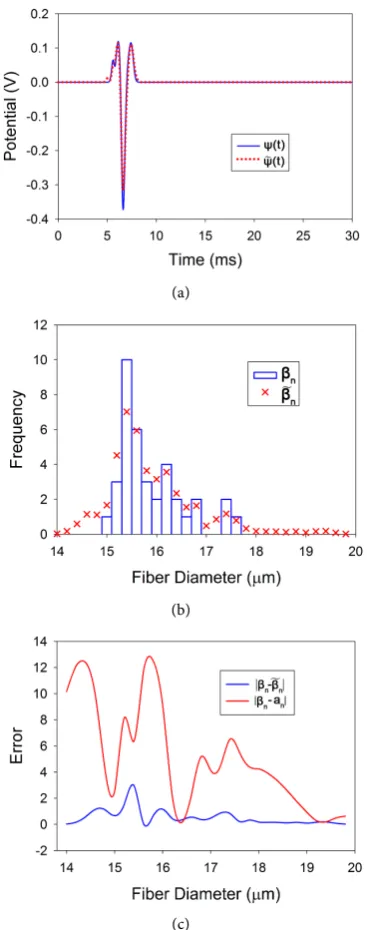
Ω − ⋅ − (21)Figure 2 illustrates the results of the proposed series expansion for estimating the diameter distribution of the nerve fibers contributing to the compound evoked potential for the population generated as described earlier. A comparison is shown in a) of the template compound evoked potential ψ
( )
t with theestimated compound evoked potential ψ
( )
t generated using the estimatedcoefficients βn. The graph in b) is a comparison of the actual fiber diameter
distribution coefficient values βn, shown in the histogram, with the estimated
fiber diameter distribution coefficient values βn. A graph of the error magni-
tude is given in c) between the actual distribution coefficients and the estimated coefficient values βn−βn as well as the error magnitude between the actual distribution coefficients and the generalized Fourier series coefficients β −n an
where the coefficients an are found using Equation (12).
2.3. Example 3. Continous Time Signals
In the theory of continuous time signals, a periodic square waveform with a periodicity of T , a fundamental frequency of fo =1T or ω =o 2πfo in
radians per second may be represented using a trigonometric Fourier series expansion as per (22) [10]:
( )
(
)
(
)
1
cos sin .
o n o n o
n
x t a α nωt β nω t
∞
=
= +
∑
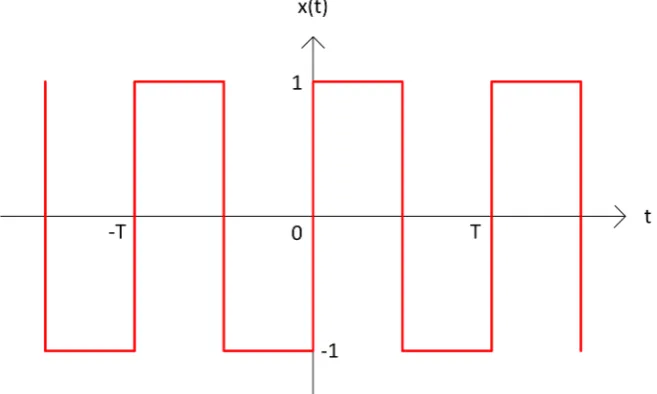
+ (22)For a square waveform of the type shown in Figure 3, the average value of the waveform is zero yielding a coefficient a0=0. The waveform may be appro-
ximated as a superposition of an infinite series of sinusoidal waveforms and thus the coefficients of the cosine term in the series expansion of (22) are α =n 0.
Evaluation of the Fourier coefficients for the sinuosidal term in (22) yields
( )
4 π
n n
(a)
(b)
[image:8.595.282.466.68.534.2](c)
Figure 2. Graphs illustrating the results of the proposed series expansion for determining the diameter distribution of the nerve fibers contributing to a compound evoked potential. A comparison is shown in (a) of the template compound evoked potential ψ
( )
t withthe estimated compound evoked potential ψ
( )
t from the estimated coefficients βn.The graph in (b) is a comparison of the actual fiber diameter distribution coefficient values βn with the estimated fiber diameter distribution coefficient values βn. A graph
of the error is given in (c) between the actual distribution coefficients and the estimated coefficient values β βn−n as well as the error magnitude between the actual distribu-
tion coefficients and the generalized Fourier series coefficients βn−an where the
coefficients an are found using Equation (12). The parameters for the neural simulation
were α=0.998, σe=1 S m,
5 1
5 10 s
c= × − , where m=30 is the number of diameter classes, Ω =50 μA is the stimulus current amplitude, x=0.05 m is the propagation
distance and 3
1.74 10
Figure 3. Square wave with fifty percent duty cycle and zero volt DC offset.
An approximation to (22) may be obtained if we limit the number of terms in the series expansion to a finite value as in (23):
( )
( )
(
)
1
sin .
m
n o
n
x t x t β nω t
=
∼ =
∑
(23)If we apply the perturbative approach, the sinusoidal functions in (23) may be considered to form the component functions λn
( )
t . The coefficient estimatesn
β may be determined using the technique proposed herein.
Figure 4 illustrates application of the perturbative approach to a square waveform of the type shown in Figure 3 for an approximate series consisting of
20
m= terms and a fundamental frequency fo =1 10π
( )
. A comparison isshown in a) of the template square waveform estimate ψ
( )
t with the approxi-mated waveform ψ
( )
t from the estimated Fourier coefficients βn. The graphin b) is a comparison of the actual Fourier series coefficient values βn with the
estimated coefficient values βn. A graph of the error is given in c) between the
Fourier series coefficients and the estimated coefficient values βn−βn . The perturbative expansion provides a robust estimate of the Fourier series coeffi- cients. The accuracy of the estimated coefficients is not unexpected since the component functions are orthogonal.
3. Conclusions
(a)
(b)
(c)
Figure 4. Graphs illustrating the results of the proposed perturbative expansion for determining estimates of the Fourier series coefficients. A comparison is shown in (a) of the template square waveform estimate ψ
( )
t with the approximated waveform ψ( )
tfrom the estimated Fourier coefficients βn. The graph in (b) is a comparison of the
actual Fourier series coefficient values βn with the estimated coefficient values βn. A
graph of the error is given in (c) between the Fourier series coefficients and the estimated coefficient values β βn−n . The parameters for the approximated square waveform were
20
[image:10.595.266.489.68.604.2]ted to the inverse problem in electrophysiology presented in Szlavik [5], the accuracy of the estimated series coefficients degrades as the degree of temporal overlap, or non-orthogonality, of the component functions increases.
The technique would appear to have broad applicability in electrophysiology and the neurosciences particularly with respect to determination of the charac- teristics of signal generators as related to the inverse problem. Currently investi- gation of the decomposition of postsynaptic potentials into the contributions of constituent receptor-ligand complexes is being undertaken. The technique is general in the sense that it may be applied in situations where a compound function is known to consist of the superposition of orthogonal or non-ortho- gonal component functions which are also known.
References
[1] Lomen, D. and Mark, J. (1988) Differential Equations. Prentice-Hall, Englewood Cliffs.
[2] Kreyszig, E. (1988) Advanced Engineering Mathematics, Vol. 6. John Wiley & Sons, New York.
[3] Harati, Y. (1987) Diabetic Peripheral Neuropathies. Annals of Internal Medicine, 107, 546-559.https://doi.org/10.7326/0003-4819-107-4-546
[4] Dorfman, L., Cummins, K., Reaven, G., Ceranski, J., Greenfield, M. and Doberne, L. (1983) Studies of Diabetic Polyneuropathy Using Conduction-Velocity Distribution (dcv) Analysis. Neurology, 33, 773-779.https://doi.org/10.1212/WNL.33.6.773
[5] Szlavik, R. (2016) A Perturbation Based Decomposition of Compound Evoked Po-tentials for Characterization of Nerve Fiber Size Distributions. IEEE Transactions on Neural Systems and Rehabilitation Engineering, 24, 212-216.
https://doi.org/10.1109/TNSRE.2015.2476917
[6] Szlavik, R. and de Bruin, H. (1997) Simulating the Distribution of Axon Size in Nerves. CMBES/SCGB, 168-169.
[7] Boyd, I.A. and Davey, M.R. (1968) Composition of Peripheral Nerves. E. & S. Li-vingstone, Edinburgh.
[8] Fleisher, S., Studer, M. and Moschytz, G. (1984) Mathematical-Model of the Sin-gle-Fiber Action-Potential. Medical & Biological Engineering & Computing, 22, 433-439.https://doi.org/10.1007/BF02447703
[9] Szlavik, R. (2008) A Novel Method for Characterization of Peripheral Nerve Fiber Size Distributions by Group Delay. IEEE Transactions on Biomedical Engineering, 55, 2836-2840.https://doi.org/10.1109/TBME.2008.921149
Submit or recommend next manuscript to SCIRP and we will provide best service for you:
Accepting pre-submission inquiries through Email, Facebook, LinkedIn, Twitter, etc. A wide selection of journals (inclusive of 9 subjects, more than 200 journals)
Providing 24-hour high-quality service User-friendly online submission system Fair and swift peer-review system
Efficient typesetting and proofreading procedure
Display of the result of downloads and visits, as well as the number of cited articles Maximum dissemination of your research work
Submit your manuscript at: http://papersubmission.scirp.org/
![Table 1 which were established from an empirical study [7].](https://thumb-us.123doks.com/thumbv2/123dok_us/7784780.723060/6.595.210.539.500.736/table-established-empirical-study.webp)