Electronic Throttle Control System: Modeling,
Identification and Model-Based Control Designs
Robert N. K. Loh1, Witt Thanom1,2, Jan S. Pyko1,2, Anson Lee1,2
1Center for Robotics and Advanced Automation, Department of Electrical and Computer Engineering,
Oakland University, Rochester, USA
2Electrical & Electronic Systems Engineering, Chrysler Group LLC, Auburn Hills, USA
Email: [email protected], [email protected]
Received May 19,2013; revised June 19, 2013; accepted June 26, 2013
Copyright © 2013 Robert N. K. Loh et al. This is an open access article distributed under the Creative Commons Attribution License, which permits unrestricted use, distribution, and reproduction in any medium, provided the original work is properly cited.
ABSTRACT
Electronic throttle control (ETC) system has worked its way to become a standard subsystem in most of the current automobiles as it has contributed much to the improvement of fuel economy, emissions, drivability and safety. Precision control of the subsystem, which consists of a dc motor driving a throttle plate, a pre-loaded return spring and a set of gear train to regulate airflow into the engine, seems rather straightforward and yet complex. The difficulties lie in the unknown system parameters, hard nonlinearity of the pre-loaded spring that pulls the throttle plate to its default position, and friction, among others. In this paper, we extend our previous results obtained for the modeling, unknown system parameters identification and control of a commercially available Bosch’s DV-E5 ETC system. Details of modeling and parameters identification based on laboratory experiments, data analysis, and knowledge of the system are provided. The parameters identification results were verified and validated by a real-time PID control implemented with an xPC Target. A nonlinear control design was then proposed utilizing the input-output feedback linearization approach and technique. In view of a recent massive auto recalls due to the controversial uncontrollable engine accelerations, the re-sults of this paper may inspire further research interest on the drive-by-wire technology.
Keywords: ETC System; System Identification; Nonlinear Control; Input-Output Feedback Linearization; xPC
Target-Based Control System
1. Introduction
In the automotive industry, one of the fruitful technolo-gies that have emerged from the increasing regulations in terms of fuel economy, emission control, drivability and safety is the drive-by-wire technology that creates the electronic throttle control (ETC) system [1,2]. The sys-tem comprises of a throttle plate equipped with a pre- loaded spring and is driven by an electronic-controlled dc motor to regulate airflow in the intake manifold. In mod-ern vehicles, the engine control unit computes and maps the throttle plate’s angle to many entries such as accel-erator pedal position, engine speed, cruise control com-mand, and so forth in order to achieve optimal air-fuel mixtures in the combustion chambers, thereby maximiz-ing fuel economy and minimizmaximiz-ing emissions. The ETC system, which responses to the prescribed reference from the engine control unit must operate with fast transient responses and precise control to regulate the throttle plate’s angular position [3,4].
posed in [9]. Reference [10] proposed a discrete-time piecewise affine model of the ETC system, and applied the clustering-based procedure to identify the parameters. Yet another approach based on nonlinear optimization and genetic algorithms were applied to estimate the un- known ETC system parameters in [11].
Much research has been conducted in the area of con- trol strategies as well. Controller realizations based on proportional-integral-derivative (PID) algorithm supple- mented with friction feedback/feed-forward can be found in [8,12,13]. In addition, a comparative study of the per- formance and advantages among the three controllers: a PID, Linear Quadratic Regulator (LQR), and LQR-plus- Integral controllers was addressed in [13]. A linear- quadratic-Gaussian (LQG) based control was proposed in [14]. Researches that utilized the sliding mode control (SMC) technique applied to an ETC system can be found in [11,15,16], and neural networks-based SMC in [17]. In [18] the development of an adaptive control scheme that guarantees speed tracking was presented. In the system integration level, the authors of [19] considered the con- trol strategy for a vehicle with ETC and automatic trans- mission. They applied dynamic programming technique to optimize the transmission gear shift and throttle open- ing to maximize fuel economy and power demand from the driver’s accelerator pedal position. In [20], the au- thors proposed a throttle-control algorithm that compen- sates two sources of delays, in the throttle response and in the manifold filling, in order to improve the engine response.
This paper enhances our previous research results in [5]. We provide in details the procedure of laboratory experiments for identifying each unknown system pa- rameter. Data and analytical computations are also pro- vided. A nonlinear control strategy based on the input- output feedback linearization approach is then investi- gated. The paper is organized as follows. Section 2 de- scribes the physical components and mathematical mod- eling of the ETC system. Section 3 elaborates in details the identification method of each system parameter. Step-by-step tests, experiments and detailed data analysis are provided to arrive at the set of system parameters. The parameters obtained were verified and validated in Section 4. The proposed design of a model-based non- linear controller for the ETC system is illustrated in Sec- tion 5, followed by the simulation results in Section 6. Finally, Section 7 contains the conclusion.
2. ETC System Modeling
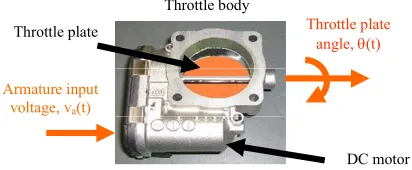
A pictorial view of a Bosch DV-E5 ETC system [21], particularly the throttle module, used in many vehicle models is shown in Figure 1. The module consists of:
a throttle plate driven by an armature-controlled dc motor with two redundant angular position sensors;
Throttle body
DC motor
Armature input voltage, va(t)
Throttle plate Throttle plate
[image:2.595.321.527.90.175.2]angle, (t)
Figure 1. Pictorial view of the Bosch ETC system.
throttle plate angle limiters acting as a mechanical stop at 90 when the throttle plate is in the fully open
position, and approximately 7.5 in the fully closed
position [12]. This small partial opening of the throt-tle plate provides enough air flow to allow the engine to run at its idle speed, allowing a driver to crawl a vehicle, sometimes referred to as limp home, to a safe
place in the absence of throttle control full power;
two sets of reduction gear trains with a total gear ratio of N = 20.68 obtained by physically counting the
numbers of the gear teeth;
a return spring Ks which ensures a safe return of the
throttle plate to its closed position when no driving torque is generated by the dc motor.
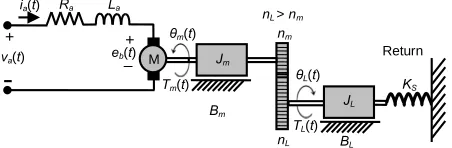
A schematic representation of the ETC system of Fig-ure1 is displayed in Figure2.
The mathematical model for the ETC system can be treated as a single-shaft mechanical system by transfer-ring all the model parameters to the throttle plate shaft (load) through the gear ratio. The parameters and nota-tions used in deriving the mathematical model of this particular ETC system are listed below:
a
R L
: Resistance of the armature circuit,
a: Inductance of the armature circuit, b
K : Back electromotive force (emf) coefficient
re-ferred to the motor side,
b
K : Back emf coefficient referred to the load side, m
K : Motor torque constant referred to the motor side, m
K : Motor torque constant referred to the load side, m
J : Motor moment of inertia, L
J : Throttle plate moment of inertia, eq
J : Equivalent moment of inertial referred to the load
side,
m
B : Motor viscous damping coefficient, L
B : Throttle plate viscous damping coefficient, eq: Equivalent viscous damping coefficient referred
to the load side,
B
s
K : Return spring stiffness, PL
T
T : Spring pre-loaded torque,
f : Frictional torque generated by the movement of
the throttle plate,
N: Gear ratio
NnL nm m L0
,
b
e t : Voltage produced by emf,
tBm nm θm(t)
nL va(t)
KS M Jm
+
nL> nm
Return eb(_ + t)
JL La
ia(t) Ra
BL θL(t) Tm(t)
[image:3.595.62.288.90.164.2]TL(t)
Figure 2. Schematic of the ETC system.
L t
tm : Angular velocity of the throttle plate,
tm : Angular position of the motor,
T t
: Angular velocity of the motor,
L : Load torque transmitted through the reduction
gear trains,
av t
i t
: Armature voltage,
a
With reference to Figure2, the armature circuit of the
ETC system is described by : Armature current.
d d
a
a a a b m
i t
L R i t K t v
t a t . (1)
Substituting N m L and KbK Nb into (1)
yields
d d
a
a a a b L
i t
L R i t K t v
t a t . (2)
The torque balance equation is given by
L
m m m m m a
T t
J t B t K i t
N
. (3)
The ETC system load torque in (3) is governed
by L
T t
sgn
L L L L L
s L PL f
T t J t B t
K t T T
L
(4)
where sgn
L is the signum function defined by
1 if 0,
sgn 0 if 0,
1 if 0.
L
L
L
L (5)
Combining (3) and (4) with N m L yields
sgn ,
eq L eq L s L
PL f L m a
J t B t K t T T K i t
(6)
where
2
eq m L
J N J J , Beq
N B2 mBL
, and mm
3. System Identification
System parameter identification is, in general, one of the most critical and difficult tasks in system modeling, analysis and synthesis. The following approaches are commonly used: 1) application of mathematical system parameters identification algorithms and techniques [22, 23]; 2) estimation based on laboratory experiments; and 3) a combination of 1) and 2). In this section, we present a series of laboratory experiments to identify the pa-rameters of the Bosch ETC system model described in Section 2. The approach is practical and proved to be effective for the ETC system investigated. The details of each experiment are described as follows.
3.1. Stalled Motor Resistance Test
In this experiment, the throttle plate was held fixed at its closed position. A slowly varying dc voltage was applied to the motor terminals which, in turn, caused the motor current to increase slowly. The data of the voltage and current were captured. Since the throttle plate was locked, that is, L
t 0, and with the fact that the armaturecurrent changed very slowly, dia dt0, thus (2) is
re-duced to a simple Ohm’s law
a a a
R i t v t
. (7)The plot of the armature voltage and armature
current a
v t
ai t in (7) is shown in Figure3. The inverse
of the slope of the approximated line yields the armature resistance which reads Ra1.15 .
3.2. Stalled Motor Inductance Test
The throttle plate was still held fixed at the closed posi-tion. A step voltage a was applied to the stalled motor
terminals. As a result, the back emf voltage
V
be t was
zero because there was no angular velocity. Therefore, the armature circuit in (1) or (2) can be expressed as
d d
a
a t a
i t
L R i t
t Va, (8)
where t was the total armature circuit resistance
con-sisting of the resistances of the armature circuit, current sensor and all the wiring in the measurement set up. The solution of the first-order differential Equation (8) with a step voltage and the initial condition
R
a
V ia
0 0 isgiven by
a
1 e t at
V i t
R
, (9)
K NK . Equations (2) and (6), therefore, represent
the ETC mathematical model referred to the load side. The immediate task now is to identify all the unknown parameters and constants: L Ra, a, Jeq,Beq, K Kb, m, Ks,
,
PL
T and Tf , which are needed to facilitate the designs
of the model-based ETC feedback control systems in Sections 5 and 6.
where L Ra t is the electrical time-constant of the
dc motor. Figure 4 shows the oscilloscope-captured
0 0.5 1 1.5 2 2.5 3 3.5 4 0
0.5 1 1.5 2 2.5 3 3.5
Voltage (V)
C
u
rre
n
t (A
)
[image:4.595.60.285.87.266.2]Measured Approximated
Figure 3. Stalled motor voltage versus current.
-0.001 0 0.001 0.002 0.003 0.004 0.005 -0.2
0 0.2 0.4 0.6 0.8 1 1.2 1.4 1.6 1.8
Time (s)
V
o
lt
age (
V
) &
C
ur
rent
(
A
)
Voltage
Current
100%
[image:4.595.311.530.337.504.2]63%
Figure 4. Stalled motor inductance test.
read from Figure 4 when the current reached
approxi-mately 63% of its steady-state value was 1 ms; this yields
t
. Therefore, the motor inductance was obtained as
1.5 mH
a t
L R .
3.3. Back Electromotive Force Test
In this test, the throttle plate was manually placed at the fully open position and released. The return spring Ks
caused rapid return of the throttle plate to its closed posi-tion. The rapid closing of the throttle plate, in turn, me-chanically drove the dc motor through the reduction gears. As a result, the back emf voltage described
by b
e t
b t Kb L
e t , (10)
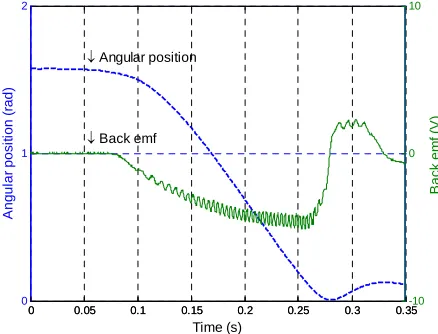
was induced at the motor terminals. Figure5 shows the
back emf voltage and the throttle plate position captured by the oscilloscope during such self-closing of the throt-tle plate.
Using the angular position data from Figure 5, the
throttle plate velocity was calculated by
d
L t L t
dt. The resulting angular velocity was
plotted together with the angular position and back emf as shown in Figure6.
The back emf signal was filtered (not shown). Using (10), the back emf constant referred to the load side Kb
= 0.4 V·s/rad was computed at time t = 0.2 s where the
plate angular velocity was the most steady. Since we used the SI unit, it follows that the motor torque constant referred to the load side was KmKb0.4 N m A
[24].
The back emf constant of the dc motor Kb can be
obtained from KbKb N0.0193 V s rad , where N =
20.68 is the gear ratio. It is important to mention that a different experiment, called a sensorless velocity
meas-urement method, in which the dc motor was detached from the ETC module was performed in Section 3.5.1, and yielded a value Kb0.0185 V s rad , which agreed
with the value obtained above. The sensorless measure-
0 0.05 0.1 0.15 0.2 0.25 0.3 0.35
0 1 2
Time (s)
A
ng
ul
ar
pos
it
io
n
(r
a
d)
Back emf
Angular position
0 0.05 0.1 0.15 0.2 0.25 0.3 0.35-10
0 10
B
a
c
k
e
mf (
V
)
Figure 5. Plot of back emf versus angular position.
0 0.05 0.1 0.15 0.2 0.25 0.3 0.35
-12 -10 -8 -6 -4 -2 0 2 4 6
Time (s)
A
ngul
ar
pos
it
ion
(r
ad
),
v
el
oc
it
y
(
ra
d/
s
),
em
f (
V
)
Back emf
Angular position
Angular velocity
ment method is a more reliable method, because, among other things, the fact that the plate angular velocity was judged to be the “most steady” at in Figure 6
was somewhat arbitrary. The new method will be devel-oped in Section 3.5.1.
0.2 s
t
3.4. Static Loads Test
The purpose of static loads test was to identify the fric-tion torque Tf, the spring pre-loaded torque PL
pro-duced by the return spring, and the return spring constant
T
s
K . When the throttle plate was moving very slowly,
that is, , the torque balance equation is given by, from (6)
t
0L L t
sgn
L s L PL f L m a
T t K t T T K i t . (11)
In order to measure the parameters in (11), the dc mo-tor was energized by a slowly increasing armature cur-rent. This caused a slow rotation of the throttle plate. The armature current and throttle plate angular position were captured by the oscilloscope as shown in Figure7.
It can clearly be seen from Figure7 that a larger
cur-rent was needed (approximately 1.7 A) to move the throttle plate towards opening than towards closing (ap-proximately 0.6 A). This was because the torque devel-oped by the motor had to overcome the torques produced by the return spring, KsL
t , PL, and the frictiontorque,
T
f
T . Using the armature current data together
with the motor constant m 0.4 obtained from the previous experiment in (11), the load torque equation becomes
K
L s L PL f
T t K t T T , (12)
where during the plate opening, and during the plate closing.
sgn L 1
L 1sgn
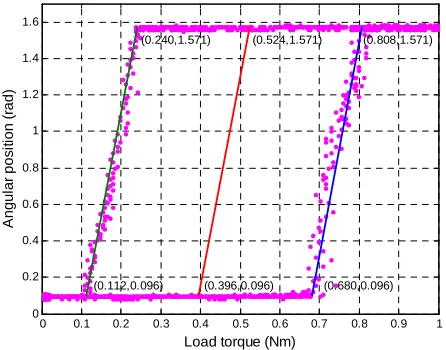
Equation (12) can be visualized by the plot of the load torque against the angular position shown in Figure 8.
Three approximatestraight lines have been inserted. The
0 2 4 6 8 10 12 14 16
0 1 2 3
Time (s)
Cu
rr
e
n
t (
A
)
Current
Angle
0 2 4 6 8 10 12 14 160
0.5 1 1.5 2
A
n
gu
la
r po
si
ti
on
(
rad
)
1.7 A
0.6 A
0 0.1 0.2 0.3 0.4 0.5 0.6 0.7 0.8 0.9 1 0
0.2 0.4 0.6 0.8 1 1.2 1.4 1.6
Load torque (Nm)
A
ngul
ar
pos
it
ion (
rad)
[image:5.595.313.536.85.260.2](0.112,0.096) (0.396,0.096) (0.680,0.096) (0.240,1.571) (0.524,1.571) (0.808,1.571)
Figure 8. Throttle plate position versus load torque.
iddle straight line representing the spring load torque, m
s L PL
K t T , lies exactly in the middle between the
es. The right straight line represents the torque during the movement towards opening which is the spring load torque plus friction torque,
other two lin
s L PL f
K t T T . The left straight line re
plate closing which is the spring load torque minus friction torque,
presents the torque during the
s L PL f
K t T T .
The following parameters can be read directly from
Fi
ng pre-loaded torque is the minimum torque
gure8:
The spri
value on the middle line which reads
0.396 N m PL
T ;
The inverse of the slope of the middle line yields the spring constant,
0.524 0.396
1.571 0.096
0.087 N m rad;
s L
K T
Finally, the friction torque is easily obtained as: 0.680 0.396 0.284 N m
f
T (during the
move-0.524 0.240 0.284 N
T
ment towards opening), or m
f
ment towards closing).
(during the
move-3.5. Viscous Frictional Coefficient Test
of the The equivalent viscous frictional coefficient Beq
ETC unit referred to the load side is given by
2
eq m L
B N B B (see (6)), where N = 20.68 is the gear
ratio. Since BL
fication
comes mostly from the lubricated and sealed throttle shaft joint, it is small and negligible, therefore 2
eq m
B N B . Thus we only have to deal with
the identi Bm. Note that the throttle plate
movement is limited t 90, but the viscous frictional
coefficient is associated h the angular velocity and thus requires the dc motor to run freely. The need to run the motor freely can be accomplished by removing the dc motor from the ETC unit. Consider the torque balance
of o
wit
3.5.1. Sensorless Velocity Measurement Method
equation of the detached dc motor
The optical sensor was disconnected and the motor was mechanically driven by another dc motor with an arbi-trary velocity , the resulting induced back emf voltage
be t shown in Figure10(a) was recorded.
m m m m fm m
J t B t T T t , (13)
where Tfm
y
represents static frictional torque of the mo-tor. At an constant speed, m
t 0, therefore thefric-tional torque caused by visc cient Bm is given
by
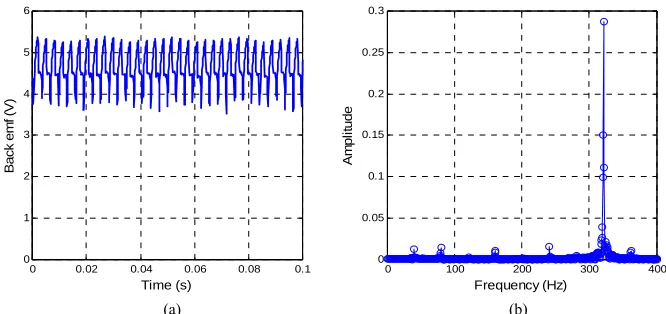
ous coeffi Two data processing runs were performed on the re-corded emf data. The first was filtered to get an average value (see Table 1); the second was Fast Fourier
transformed (FFT) using MATLAB to obtain the associ-ated frequency f (see Table 1). The FFT result is
dis-played in Figure10(b). Since there were 8 ripples per
revolution on the signals, the back emf constant can be calculated from
ˆb
e
m m m
T t B t Tfm. (14)
It is seen from (14) that if the instantaneous values of
t and m
t can be captured, the viscous coeffi-mB an ic frictional torque
m
T
cient d stat Tfm can be
de-termin Since it
ed.
was desired to obtain the velocity measure-m
ripples per re
ˆ
4ˆ2 8
b b
e K
f f
b
e
. (15) ent but the detached dc motor was not equipped with
any velocity sensor, a 16 pulse-per-revolution optical sensor was attached to the motor shaft, and the detached dc motor was energized to run smoothly. The optical sensor signal, motor voltage and current were recorded by the oscilloscope as shown in Figure9.
Here, observe that the motor produced 8
The procedures above were repeated with different ar-bitrary constant velocities and the corresponding and
b
ˆb
e K were calculated. Figure 11 shows the result of the
FFT, and the calculated data of each test is shown in
Ta-ble 1.
volution on the voltage and current waveforms caused by the non-uniformity of the magnetic field in the dc motor. This information is useful and can be used to cal-culate the motor angular velocity from a frequency measurement method proposed below, rather than using the optical sensor method conducted above. This is be-cause the dc motor was small and attaching the optical sensor to the motor shaft was not practically convenient to perform the measurements. The proposed frequency measurement approach may be called a sensorless
veloc-ity measurement method and is detailed below.
The overall average Kb calculated from Table 1 was
0.0185 V·s/rad which is very close to the result of Kb =
0.0193 V·s/rad obtained in Section 3.3 when the dc mo-tor was not removed from the ETC unit. The method of sensorless velocity measurement developed here was judged to be more reliable than the method of Section 3.3, and can be applied to the next parameters identification described in the sequel.
3.5.2. Identification of Viscous Friction Coefficient
A series of step input voltages: 2, 4, 6, 8, 10 and 12 V,
0.1 0.11 0.12 0.13 0.14 0.15 0.16 0.17 0.18 -2
0 2 4 6
O
p
ti
ca
l se
n
so
r
0.1 0.11 0.12 0.13 0.14 0.15 0.16 0.17 0.18 2.95
2.955 2.96 2.965
V
o
lt
age
(
V
)
0.1 0.11 0.12 0.13 0.14 0.15 0.16 0.17 0.18 0.3
0.4 0.5 0.6 0.7
Time (s)
C
u
rre
n
t (A
)
16 pulses/revolution of optical sensor
[image:6.595.146.451.483.714.2]8 pulses/revolution of motor current ripple
0 0.02 0.04 0.06 0.08 0.1 0
1 2 3 4 5 6
Time (s)
B
a
c
k
e
m
f (V
)
0 100 200 300 400
0 0.05 0.1 0.15 0.2 0.25 0.3
Frequency (Hz)
A
m
p
lit
u
d
e
[image:7.595.131.464.84.241.2](a) (b)
Figure 10. (a) Back emf voltage, and (b) its associated frequency.
0 100 200 300 400 500 0
0.05 0.1 0.15 0.2 0.25
Frequency (Hz) Test #1
0 100 200 300 400 500 0
0.05 0.1 0.15 0.2 0.25
Frequency (Hz) Test #2
0 100 200 300 400 500 0
0.1 0.2 0.3 0.4 0.5 0.6
Frequency (Hz) Test #3
0 100 200 300 400 500 0
0.1 0.2 0.3 0.4 0.5 0.6
[image:7.595.61.285.270.470.2]Frequency (Hz) Test #4
Figure 11. Fast Fourier transform of different motor veloc
Table 1. Result of sensorless verification test.
Test # Frequency f
i-ties.
Average back emf
ˆb
e (V) (Hz)
ˆ 4
b b
K e f
(V·s/rad)
1 0.8753 61.0426 0.01827
2 1.9009 129.41 0.018703
3 3.7113 255.77 0.018475
4 4.6501 321.69 0.018405
Average 2.7844 91.97821 0.0185
ere applied to the armature circuit of the detached dc w
motor. The voltages and currents were recorded. Figure 12 illustrates the oscilloscope-captured waveforms of the
voltage and the current with the 2 V step input voltage. The responses of the other input voltages were similar but different in amplitudes and therefore were not shown here. For each of the step input voltages, the steady-state
0 0.5 1 1.5
-2 0 2 4
Time (s)
A
rm
a
tur
e
v
ol
tag
)
e (
V
1.5
0 0.5 1 1.5
-0.5 0 0.5 1
Time (s)
A
rma
tu
re
c
u
rr
e
n
t (A
[image:7.595.313.534.274.445.2])
Figure 12. Armature voltage and current responses.
port ere
rocessed by FFT to obtain their associated frequencies f ions of the current data between 0.3 to 0.9 s w p
and the angular velocities were calculated by
2 8
m f
. The same portion of the current data, after averaging, were also used to calculate
m K im a
the motor torque from T , where KmKb0.0185.
Ta-ble 2 reports all data obtained from the experiments and
calculations ab
[image:7.595.57.286.526.641.2]The angular velocity and the motor torque data from
Table 2 were plott
ove.
ed and the MATLAB polyfit com-mand was used to perform the best fit of the data. The result is shown in Figure13 which is also
mathemati-cally represented by (14).
At m0, the approximate static frictional torque of
the dc motor read from Figure13 was Tfm6.9 10 3
5
2.05 10
Nm. T pe of the fitted line was the approximate viscous coefficient of the dc motor: Bm
he slo
Nm-s/rad. The viscous friction torque generated by the throttle shaft was small and therefore ig -tioned earlier in this section. The total viscous friction coefficient referred to the load side was therefore
Table 2. Result of viscous friction coefficient test.
Step input Angular ltage Frequency velocity FFT vo
f
(V) (Hz) m (rad/s)
Average Mo measured
to torque cu
r
rrent ia (A)
m
T
(N·m)
2 95.2 74.80 0.405 0.0075
4 211.2 165.90 0.576
6 334.6 262.76 0.688 0.0127
8 457.9 359.61 0.813 0.0150
10 580.0 455.51 0.903 0.0167
12 704.5 553.33 0.934 0.0172
0.0106
0 0.02 0.04 0.06 0.08 0.1 0.12 0.14 0.16 0.18 0.2 -6
-4 -2 0
em
f (
V
)
0 0.02 0.04 0.06 0.08 0.1 0.12 0.14 0.16 0.18 0.2 -10
-5 0
V
e
lo
c
ity (
ra
d
/s
)
0 0.02 0.04 0.06 0.08 0.1 0.12 0.14 0.16 0.18 0.2 -100
0 100
A
cce
le
ra
ti
o
n
(
ra
d
/s
2)
0 0.02 0.04 0.06 0.08 0.1 0.12 0.14 0.16 0.18 0.2 -0.4
-0.2 0
To
rq
u
e
(
N
m)
[image:8.595.311.535.320.487.2]Time (s)
Figure 13. Plot of torques versus angular velocities based on data from Table 2.
2 20.682 2.05 105
0.0088 N m s rad.
eq m
B N B
3.6. Moment of Inertia Test
back into the ETC unit ally released from the
The back emf data
In this test, the dc motor was put and the throttle plate was manu
fully open position similar to the test in Section 3.3. Since the armature current was zero, the torque balance equation can be described by
tot eq L eq L s L PL f
T t J t B t K t T T .(16)
be t
during t vel
and the angular po were captured he rapid self closing o throttle plate. The angular
sition f the
L t
tion
ocity and angular accelera-were calculated from L
t e tb
Kb , and( ) d d
L t L t
, respectively. The total torque Ttot
tcan be calculated from the right h igure
e measured and calculated values function of time.
and side of (16)
14 shows thes as a
. F
Finally, the moment of inertia can be calculated from (16), JeqTtot
t L
t . The calculated averagemo-m
2
ent of inertia at the time interval of 0.04 to 0.08 s was
eq
J 2.1 10 kg m 3 . T
identified all the unkn
is to use the mathe-6) to verify the pa-his value was the total moment of inertia of the whole ETC unit. At this point, we have own ETC system parameters and constants. The results are summarized in Table 3.
4. Parameters Verification
The main objective of this section matical model described by (2) and (
rameters identified in Table 3. Two methods were
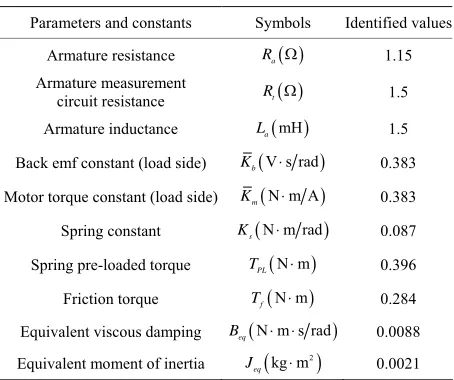
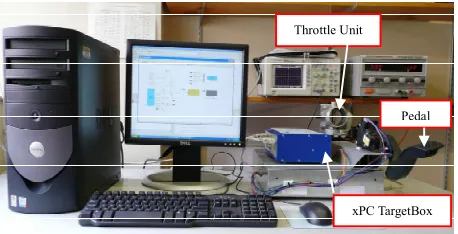
em-ployed: SIMULINK simulation, and actual real-time control implementation of the ETC system using an xPC TargetBox. The xPC TargetBox is a real-time rapid pro-totyping device, which is widely used in both industries
0 100 200 300 400 500 600
0.005 0.01 0.015 0.02
Angular velocity (rad/s)
T
o
rque (
N
m
)
Measured Approximated
fm
T
Figure 14. Filtered back emf, velocity, acceleration and tor- que versus time.
[image:8.595.310.537.543.733.2]P lues
Table 3. Results of ETC parameter identification.
arameters and constants Symbols Identified va
Armature resistance Ra 1.15
Armature measurement
circuit resistance Rt 1.5
Armature inductance LamH 1.5 Back emf constant (load side) KbV s rad 0. M
383
otor torque constant (load side) KmN m A 0.383 Spring constant KsN m rad 0.087 Spring pr que
Equivalent viscous ping
e-loaded tor TPLN m 0.396 Friction torque TfN m 0.284
dam BeqN m s rad 0. Equivalent moment of inertia 0.0021
0088
kg m2
eq
an analysis and syn hesis, see for
[image:9.595.58.532.326.719.2]examd academia for control ple [25,26]. The SIMULINK diagr m is as t n y h
1Figure 15, while the act
a show
ental se
x
x . (19) where x t1
, x t2
represent the angular position andthe angular velocity of the throttle plate, respectively,
3x t is the armature current of the dc motor; u(t) is the
armature voltage applied to the dc motor. The function
2S x defined by
in ual control experim tup
is as shown in Figure 16. A PID controller with the gains 9
p
K , Ki6 and Kd0.1 was designed to meet
the following performance criteria: 1) step response of the throttle plate angular position with no overshoot and steady-state error, and 2) settling time ts100 ms.
Figure 17 shows the SIMULINK response of the
an-gular position L
t with a reference input r t
1rad, together with the result captured b
2 22 1
1 e x
S x
, (20)
is a smooth approximation of the signum function
2sgn x with a small positive number [30]. Figure 18 illustrates the approximated sgn
x2
given by (20)with different . It is remarked that other signum ap-proximations are also possible, for example, the sig-moid-like function S
x2 x2
x2
, where is asmall positive scalar [31]. However, the approximation function (20) will be used in this study.
y the xPC Target ope in real time. It can be seen that the SIMULINK and the real-time control results were practically identical and the performance criteria were satisfied with no over-shoot and ts100 ms. Hence the parameters obtained in
Table 3 were validated. These parameters together with
the mathematical model described by (2) and (6) can now be used for other control analysis and synthesis for this particular ETC system.
5. Design of Model-Based Nonlinear
Control Systems
sc
k lin-ear
con-Applying the input-output feedback linearization me- thodology, we obtain
2,yL hf x L hg x ux
21 1 2 2 3 3 4 2 5,
f
y L h L L h u
k x k x k x k S x k
g f
x x
In this section, we applied the input-output feedbac earization technique [27-29] to design a nonlin
troller for the ETC system. For ease of analysis and ref-erence, we define the following constants in the ETC system described by (2) and (6):
3 2
2
1 2 1 1 2 3 6 2 3 2 7 3
2
2 5 2 4 2 4 3 8
d d
f f
y L h L L h u
k k x k k k k x k k k x S x
k k k k S x k k k u t
g
x x
(21)
2 3 4
1 , , , ,
eq m f
eq eq
s B T
K K
k k k k
J J
5 6 7 8
1
, , , ,
eq eq
b a
eq a
PL
a a
J J
K R
T
k k k k
J L L L
(17)
The resulting model can be expressed in a con-trol-affine single-input single-output (SISO) nonlinear state-space form
where
1
, 1
1
i i
i L h i L h
L h L L h
f f
f g f
x x
x f x x
x x g x
are the Lie derivatives for i1,2,3, L hof
x h x ,and dS x
2 tas
2
1 1 2 2
1 2
0
x x d is given by
3 3 2
6
4
2 7
5
3 3 8
0
x k x k x
2
2 e x
2
2
2 2
d
d 1 e x
S x
x
k x k S x k u
x k x k x
x f x g x
k
, (18)
t
. (22)
Equation (21) shows that the output relative degree is
Km _bar
Kb_bar
(t) (t)
(t)
Ks*(t)+Tpl
Step input
Springs
Sign
Scope Kp
9
Ki 6
Kd 0.1
1 s 1
s 1
s 1
s
Hard Limits
Tf Beq 1/Jeq 0.4
Rt
0.4 1/La du /dt
Battery 12
Ia
[image:9.595.92.288.415.474.2]emf
[image:9.595.62.513.516.723.2]Throttle Unit
[image:10.595.59.288.85.202.2]xPC TargetBox Pedal
Figure 16. Pictorial view of computer controlled ETC sys-m with xPC Target.
te
0 0.2 0.4 0.6 0.8 1 1.2 1.4 1.6 1.8 2
-0.2 0 0.2 0.4 0.6 0.8 1 1.2
Time (s)
A
ngul
ar
p
osi
ti
on (
rad)
[image:10.595.62.286.243.424.2]Step input Simulation xPC Target
Figure 17. Comparison between real-time control and simu- lation.
-20 -15 -10 -5 0 5 10 15 20
-1 -0.5 0 0.5 1
Angualr velocity (rad/s)
M
agn
it
ude
[image:10.595.59.285.464.568.2]Signum = 0.5 = 1.0 = 3.0
Figure 18. Approximated signum function with differentδ.
three and is equal to the dimension of the system. There-fore, the ETC system in (18) and (19) is fully linearizable with the nonlinear transformation given by
. (23)
It can be shown that the Jacobian matrix associated
12
1 1 2 2 3 3 4 2 5
x x
k x k x k x k S x k
z T x
with (23) has the form
2
2
1 2 4 2 3
e 1 e
1 0
0 1
2 x
x
k k k k
0 0
T x
x , (24)
which is nonsingular for all and therefore T(x) is a global diffeomorphism f . Referring to (23), the original nonlinear system in the x-coordinates
de-scribed by (18) and (19) is transformed to a linear system in the z-coordinates as
(25)
3
x
or (18)
,
v
z B
,
yCz
where A, B and C are in controllable canonical forms, and v(t) is the transformed input defined by
z A
v y b x D x u, (26)
where b(x) is the nonlinear cancellation factor an
is a nonsingular scalar function. From (21) and (2 follows that
d D(x)
6), it
2
1 2 1 1 2 3 6 2 3 2 7 3
k k x k k k k x k k k x
k k k k S
x
(27)
5 4
2 2 4
2 2
d , d
b
S x
x k
t
3 8D x kk .
In order to achieve output tracking, we introduce the tracking error as
(28)
r
e t y t y t
where y tr
ective is to force is the reference input. The main obj
0e t such that y t
yr
t
as t. Itfol-lows that
1 ,
r r
e z
e
y y y y y
2
3
, .
r r
r z r
e y y z y y y
v
r
(29)
A suitable tracking control law for the transformed
r y
input v(t) is given by
r r
v Key K T x Y , (30)
where e
e e e
T, T x
is given in (23),
Tr yr yr yr
Y , and the constant feedback gain
1 3
R
K is determined such that is Hur- witz, that is, all eigenvalues of lie in the open left- half complex plane. Finally, the linearizing fe control law can be obtained from (26) and is given by
cl
A A BK
cl
A
edback
1
uD x b x v, (31)
whe in
re v(t) is given by (30), and b(x) and D(x) are given
yields the overall c ar ETC s in the x-coordinates
losed-loop nonline ystem
11 ,
.
D b v
y h x
x x
x
x f x g x
(32)
6. Nonlinear Control Simulation R
The performance of the controller can be adjusted by ca
que will be conducted for this part of the study. As in the PID design of Sectio
quire: 1) the step response of the throttle pl
with no overshoot an and 2)
g time S
tics can be ach
ju-gate poles at
esults
refully designing the control gain matrix K in (30). A pole placement techni
n 4, we re-ate angular
position d steady-state error,
a settlin ts100 ms. uch a response characteris-ieved by placing a pair of complex con
70 7
n j d j 1.41
with
2
1
d n
, which correspo o a damping ratio of
0.7
nd t
and natural frequency of n100 rad s; and a
dominating real pole at −35. These pole locations yield a step response similar to a step response of a first-order system. The resulting gain matrix was
350 14.9 0.18 10
3
K . The simulation results of
the angular position x t1
, the angular velocity x t2
,the armature current x t3
, and the armature voltage orcontrol input u t
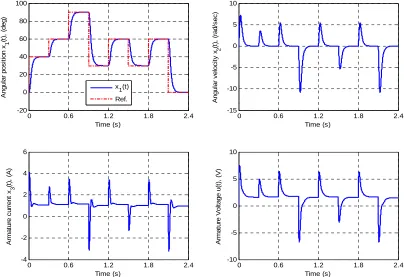
with 1 for a series of stepref-erence inputs y tr
ro, wdifferent time intervals are as sh her
seen that all responses are well within reasonable ranges, especially the unsaturated control input u(t). Figure 20
displays the simulation results for a series of step plus ramp inputs with different time intervals, y tr
ro r t1 ,where o and are constants; and Figure 21 for a
sinusoidal input
r r1
90sin 2
2.4
r
y t t .
Simulation results show that the controller yields ex-cellent tracking performance regardless of the types of reference signals. However, the ramp response in Figure 20 exhibits a small overshoot of about 2 degrees as the
ramp signal introduces one more dominant pole into the closed-loop system.
7. Conclusion
[image:11.595.95.499.440.717.2]We presented the modeling and unknown system pa-rameters identification of an industrial Bosch automotive ETC system. The identification was based on a series of laboratory experiments, measurements and data process-ing techniques. The validation of the identified parame-ters by comparing the simulation results with the real-time implementation using an xPC Target under a PID control scheme produced excellent results for this particular ETC system which demonstrated the effec-tiveness and reliability of the parameters identification techniques. We then proposed a nonlinear closed-loop control system design based on the input-output lineari-zation approach. The simulation results showed that the nonlinear controller developed was capable of accom- e is constan
Figure 19 o
r
own in
t, with . It is
0 0.6 1.2 1.8 2.4
-20 0 20 40 60 100
80
A
n
gul
a
r po
s
it
io
n x
1
(t
)
Time (s)
, (
deg)
x 1(t) Ref.
10
5
0
-5
-10
-15
0 0.6 1.2
A
ngul
ar
v
el
o
c
it
y
x2
(t
),
(ra
d
/s
e
c
)
Time (s)
1.8 2.4
6 10
0 0.6 1.2 1.8 2.4
-4 -2 0 2 4
A
rm
a
tu
Time (s)
re
c
u
rr
ent
x3
(t
),
(A
)
5
0
-5
-10
0 0.6 1.2 1.8 2.4
A
rm
at
ur
e V
ol
ta
ge u(
t)
, (
V
)
Time (s)
0 0.6 1.2 1.8 2.4 -20
0 20 40 60 80 100
A
n
gul
ar
pos
it
ion
x1
(t
),
(d
e
g
)
Time (s)
x1(t) Ref.
0 0.6 1.2 1.8 2.4
-8 -6 -4 -2 0 2 4 6
A
ngul
ar v
el
oc
it
y
x2
(t
),
(r
a
d
/s
e
c
)
Time (s)
0 0.6 1.2 1.8 2.4
-2 -1 0 1 2 3 4
A
rm
at
ure c
urrent
x3
(t
),
(A
)
Time (s)
0 0.6 1.2 1.8 2.4
-6 -4 -2 0 2 4 6 8
A
rm
a
tu
re V
ol
tage u(t
),
(
V
)
[image:12.595.116.482.84.346.2]Time (s)
Figure 20. Simulation results of step plus ramp reference input with different durations.
0 0.6 1.2 1.8 2.4
-100 -50 0 50 100
A
n
gu
la
r p
os
it
ion
x1
(t
),
(d
eg
)
Time (s)
x1(t) Ref.
3 2
0 0.6 1.2 1.8 2.4
-3 -2 -1 0 1
A
n
g
u
la
r ve
lo
ci
ty
x2
(t
),
ec
)
Time (s)
(r
ad
/s
2.5 5
0 0.6 1.2 1.8 2.4
0 0.5 1 1.5
2 4
A
rm
a
tu
re
cu
rr
e
n
t x
3
(t
),
(A
)
Time (s)
3 2 1 0 -1
0 0.6 1.2 1.8 2.4
A
rm
a
tu
re
V
o
lt
ag
e
u(
t)
, (V
)
Time (s)
Figure 21. Simulation results of sinusoidal reference input.
plishing the tracking tasks for different types of reference inputs with excel
this paper can be considered as an interesting and im-portant case study encompassing system modeling, sys-tem parameters identification, nonlinear controller de-signs, real-time control, and analytical solutions of the
closed-loop trajectories of the nonlinear ETC system. d are applica-ble to similar and/or other types of ETC systems. In view of a recent massive auto recalls due to the controversial uncontrollable engine accelerations, the results of this paper may inspire further research interest on the drive- lent performance. The results presented The techniques and methodology develope
[image:12.595.116.479.374.636.2]by-wire technology.
REFERENCES
[1] H. Streib and G. Bischof, “Electronic Throttle Control (ETC): A Cost Effective System for Improved Emissions, Fuel Economy, and Drivability,” SAE No. 960338, 1996. [2] W. Huber, B. Lieberoth-Leden, W. Maisch and A. Rep-
pich, “Electronic Throttle Control,” Automotive Engi- neering, Vol. 99, No. 6, 1991, pp. 15-18.
[3] T. Kowatari, T. Usui, and S. Tokumoto, “Optimization of an Electronic-Throttle-Control Actuator for Gasoline- Direct-Injection Engines,” SAE Paper No. 1999-01-0542, 1999.
[4] C. Rossi, A. Tilli and A. Tonielli, “Robust Control of a Throttle Body for Drive by Wire Operation of Automo- tive Engines,” IEEE Transactions on Control Systems Technology, Vol. 8, No. 6, 2000, pp. 993-1002.
doi:10.1109/87.880604
[5] R. N. K. Loh, T. Pornthanomwong, J. S. Pyko, A. Lee and M. N. Karsiti, “Modeling, Parameters Identification, and Control of an Electronic Throttle Control (ETC) Sys-tem,” Proceedings of 2007 International Conference on Intelligent and Advanced Syst
pp. 1029-1035. doi:10.1109/I
ems, Vol. 1, Malaysia, 2007, CIAS.2007.4658541 [6] C. C. de Wit, I. Kolmanovsky and J. Sun, “Adaptive
Pulse Control of Electronic Throttle,” Proceedings of American Control Conference, Virginia, 2001, pp. 2872- 2877.
[7] A. Contreras, I. Quiroz and C. C. de Wit, “Further Re-sults on Modeling and Identification of an Electronic Throttle Body,” Proceedings of 10th Mediterranean Conference on Control and Automation, Lisbon, 2002. [8] J. Deur, D. Pavkovic, N. Peric, M. Jansz and D. Hrovat,
“An Electronic Throttle Control Strategy Including Com-pensation of Friction and Limp-Home Effects,” IEEE Transactions on Industry Applications, Vol. 40, No. 3, 2004, pp. 821-833. doi:10.1109/TIA.2004.827441 [9] J. Deur, D. Pavkovic, M. Jansz and N. Peric, “Automatic
Tuning of Electronic Throttle Control Strategy,” ceedings of 11th Mediterranean Conference on Control
and Automatio 03.
ode Control of
g, “Model-Based Analysis and Tuning of
Elec-e Control fthe International Conference on
Intelligent Systems (ICIS2005), Kala Lumpur, December 2005.
[14] A. Kitahara, A. Sato, M. Hoshino, N. Kurihara and S. Shin, “LQG Based Electronic Throttle Control with a Two Degree of Freedom Structure,” Proceedings of 35th Conference on Decision and Control, Kobe, 11-13 De-cember 1995, pp. 1785- 1788.
[15] M. Horn and M. Reichhartinger, “Second-Order Sliding Mode Control of Electronic Throttle Valves,” Interna-tional Workshop Variable Structure Systems 2008, Anta-lya, 2008, pp. 280-284. doi:10.1109/VSS.2008.4570721 [16] U. Ozguner, S. Hong and Y. Pan, “Discrete-Time Sliding
Mode Control of Electronic Throttle Valve,” Proceedings of 40th IEEE Conference on Decision and Control, Or-lando, 4-7 December 2001, pp. 1819-1824.
[17] M. Baric, I. Petrovic and N. Peric, “Neural Network- Based Sliding Mode Control of Electronic Throttle,” En- gineering Applications of Artificial Intelligence, Vol. 18, 2005, pp. 951-961. doi:10.1016/j.engappai.2005.03.008 [18] Z. Xu and P. Ioannou, “Adaptive Throttle Control for
Speed Tracking,” California PATH Research Paper, UCB-ITS-PRR-94-09, April 1994.
[19] D. Kim, H. Peng, S. Bai and J. M. Maguire, “Control of Electronic Throttle and Auto- EE Transactions on Control Sys-
Pro-n (MED’03), Rhodes, 20
[10] M. Vasak, L. Mladenovic and N. Peric, “Clustering-Based Identification of a Piecewise Affine Electronic Throttle Model,” Proceedings of the 31st Annual Conference of IEEE Industrial Electronics Society, Vol. 1, Raleigh, 2005, pp. 177-182.
[11] K. Nakano, U. Sawut, K. Higuchi and Y. Okajima, “Modeling and Observer-Based Sliding-M
Electronic Throttle Systems,” ETCI Transactions on Electrical Engineering, Electronics, and Communications, Vol. 4, No. 1, 2006, pp. 22-28.
[12] C. Yan
tronic Throttle Controllers,” SAE Paper #2004-01-0524, 2004.
[13] R. N. K. Loh, S. Elashhab, M. A. Zohdy and A. Lee, “Modeling and Design of an Automotive Throttl
System,” Proceedings o
Integrated Powertrain with matic Transmission,” IE
tems Technology, Vol. 15, No. 3, 2007, pp. 474-482. doi:10.1109/TCST.2007.894641
[20] T. Aono and T. Kowatari, “Throttle-Control Algorithm for Improving Engine Response Based on Air-Intake Model and Throttle-Response Model,” IEEE Transac- tions on Industrial Electronics, Vol. 53, No. 3, 2006, pp. 915-921. doi:10.1109/TIE.2006.874263
[21] “Technical Customer Information Manual: DV-E5 Throt-tle Body for ETC Systems,” Robert Bosch GmbH, 2000. [22] L. Ljung, “SystemIdentification: Theory for the User,”
n,
ns on Prentice Hall, Upper Saddle River, 1987.
[23] T. Soderstrom and P. Stoica, “System Identification,” Prentice Hall, Upper Saddle River, 1989.
[24] B. C. Kuo, “Automatic Control Systems,” 8th Editio Prentice Hall, Upper Saddle River, 2003.
[25] P. S. Shiakolas and D. Piyabongkarn, “Development of a Real-Time Digital Control System with a Hardware- in-the-Loop Magnetic Levitation Device for Reinforce-ment of Controls Education,” IEEE Transactio Education, Vol. 46, No. 1, 2003, pp. 79-87. doi:10.1109/TE.2002.808268
[26] K. H. Low, H. Wang and M. Y. Wang, “On the Devel- opment of a Real Time Control System by Using xPC Target: Solution to Robotic System Control,” Proceed- ings of the 2005 IEEE International Conference on Automation Science and Engineering, Edmonton, 2005, pp. 345-350.
[27] A. Isidori, “Nonlinear Control Systems,” Springer-Verlag, New York, 1995. doi:10.1007/978-1-84628-615-5 [28] H. K. Khalil, “Nonlinear Systems, ” 3rd Edition, Prentice
Hall, Upper Saddle River, 2002.
Link Manipulators Using neural Networks,” Mode Control Design,” Wiley Interscience, Hoboken, 2003.
[30] H. A. Talebi, R. V. Patel and K. Khorasani, “Control of
Flexible-Lecture Notes in Control and Information Sciences,
Springer-Verlag, London, 2001. [31] C. Edwards and S. Spurgeon, “Sliding