Phenomenological and Semi-microscopic Analysis
for the Elastic Scattering of Protons from
12
C Nuclei at
Different Energies
Sh. Hamada1, N. Amangeldi2
1Faculty of Science, Tanta University, Tanta, Egypt 2Eurasia University, Astana, Kazakhstan
Email: [email protected]
Received 2013
ABSTRACT
Analysis of the elastic scattering of protons from 12C nuclei had been performed within the framework of both the
opti-cal model and single folding model at different proton energies; 17, 30.3, 40, 49.48 and 61.4 MeV. We have obtained the global potential parameters which could fairly reproduce the experimental data for p+12C elastic scattering at the
aforementioned energies. The radial and energy dependence of the real and imaginary parts of the potential were calcu-lated. Good agreement between experimental data and theoretical predictions in the whole angular range was obtained using both phenomenological approach (Optical Model), and semi-microscopic approach (Single Folding). In single folding calculations, the real part of the potential was calculated from a more fundamental basis by the folding method in which the NN interaction VNN(r), is folded into the density of the target nuclei and supplemented with a
phenomenol-ogical imaginary potential. The obtained normalization factor Nr is in the range of 0.75 - 0.9.
Keywords: Elastic Scattering; Optical Model; Nuclear Structure; Single Folding Model
1. Introduction
Elastic scattering of nucleon-nucleus data at intermediate energies is a useful tool for testing and analyzing nuclear structure models and intermediate energy reaction theo-ries [1-10]. The elastic scattering of protons from 12C was
analyzed at different energies (17, 30.3, 40, 49.48 and 61.4 MeV) from literature [11-15]. The analysis of the experimental data was performed either by using Wood-Saxons (WS) forms for both real and imaginary parts of the potential, or by obtaining the real part from the folding procedure [16,17] and using it with a WS term for the imaginary part of the potential, in addition to spin orbit potential which has been introduced due to the 0.5 spin of protons.
The folding model which is a powerful tool for the microscopic analysis of nuclear reactions has been used for years to calculate the nucleon-nucleus optical poten-tial and inelastic form factors. It can be seen from the basic folding formulas that this model generates the first-order term of the microscopic optical potential that is derived from Feshbach’s theory of nuclear reactions. The success of this approach in describing the observed nucleon-nucleus elastic scattering data for many targets suggests that the first-order term of the microscopic op-tical potential is indeed the dominant part of the nucleon
optical potential. A popular choice for the effective NN
interaction has been one of the M3Y interactions. Al-though these density independent M3Y interactions were originally developed for using in the Distorted Wave Born Approximation (DWBA) for the analysis of (p,p′) reaction, they have been used much more often in the double folding calculation of the heavy ion interaction potential at low and medium energies. The elastic scat-tering of proton nucleus has been analyzed in order to determine ground state matter densities empirically for comparison with Hartree–Fock predictions [18-20]. In single folding calculations, the real part of potential ob-tained from the folding model was supplemented by a phenomenological imaginary potential, and during the fitting process the real potential was normalized and the imaginary potential optimized. The basic inputs for a single folding calculation of the nucleon-nucleus poten-tial are the nuclear densities of the target and the effec-tive nucleon-nucleon (NN) interaction. The folding model is a very useful approach to check the target nu-clear densities [21].
2. The Nuclear Optical Model and Single
Folding Model
been carried out for a wide range of incident proton en-ergies, and a few attempts have been made to empirically determine the energy dependence of the optical model potential. In practice it is required to obtain the potential from the experimental data, and this may be done by systematically varying the parameters of the potential to optimize the overall fit to the data, using appropriate computer programs. To do the best fitting, we kept the product V0r02 constant, the same we have done for the
imaginary part. In the energy region below 61 MeV, ex-tensive proton elastic scattering data exist. These have, in general been analyzed in terms of an optical model in which the interaction is represented as the scattering of a point particle (proton) by a potential of form:
( ) ( ) ( ) ( ) ( )
op C so
U r V r V r iW r V r (1)
The Coulomb potential was assumed to be as two uni-form charge distributions with radii consistent with elec-tron scattering [22].
2 22 / 3 2 ) ( C C t p
C r R
R e Z Z r
V
forr R
C (2)2
( ) p t
C
Z Z e V r
r
for
r R
Cwith radius
1/3
( ), , ,
i i T
R r A i V W C
Real volume part has the following form:
1
0
( ) ( , , ) 1 exp V
V V
V
r r V r f r r a V
a
(3)
Imaginary volume part has the following form:
1
0
( ) ( , , ) 1 exp W ,
V w w
W
r r
W r f r r a W
a
(4)
Real spin-orbit part has the following form:
2 1/3
2 d 1
( ) d 1 exp so so so so
V r V
r
h r r r A
a (5)
The spin-orbit term Uso(r) = Vso(r) + iWso(r), it is usual
to take Wso(r) = 0, leaving the three parameters Vso,
rsoand W.The model thus involves nine parameters
al-though several analysis have been performed using more restricted sets by equating some of the geometrical pa-rameters and/or neglecting one the imaginary terms. So, the interaction potential can be rewritten as:
a 0 0 2 ( ) ( ) ( , , ) ( , , ) 2 d ( , , ) d
C V V W
so so so
U r V r V f r r a iW f r r a
V f r r a r
h r
Many such analysis of nucleon scattering have now been made and is found that the potentials are quite similar for all nuclei and vary other slowly with the inci-dent energy.
In practice it is frequently found that many sets of pa-rameters give equally good fits to the data, and the ques-tion then arises whether any one of these is more physi-cal than the others and if so which is to be preferred. These parameter ambiguities, as they are called, are of two main types, discrete and continuous. The existence of these ambiguities means that it is not possible to es-tablish the optical potential by phenomenological analy-ses alone and it is necessary to derive the potential using more microscopic method such as double folding. The real part of the optical potential for the nucleon–nucleus elastic scattering is given within the framework of single folding model, in the following form:
3
1 1 1 1
( ) ( ) ( )
SF
r NN
V R N
r V R r d r (7)where, 1( )r1 is the matter density distribution of the
target nucleus (12C),
NN is the effective NN-interaction.
In the present calculation the effective NN-interaction is taken according to [23] in the form of M3Y-interaction
V
exp( 4 ) exp( 2.5 )
( ) 7999 2134
4 2
0.005
276 1 ( )
R R V R R R E R A .5 (8)
The nuclear density distribution for 12C was calculated
using Three-parameter Fermi model (3PF), where ρ(r) was calculated from the following formula
2
0 2
( )r (1 wr ) / (1 exp((r ) / ))
c
c z (9)
with w =﹣0.149, z = 0.5224 and c = 2.355.
3. Results and Discussion
W
(6)
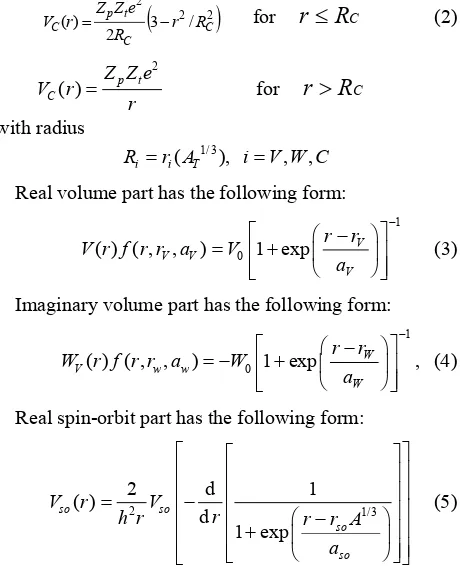
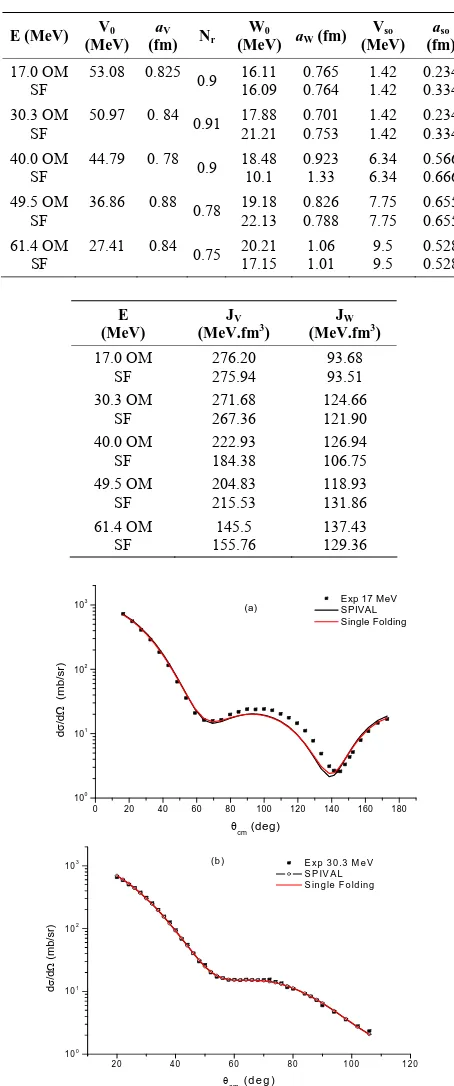
The comparison between the experimental data and the theoretical predictions within the framework of both; the optical model and single folding model at energies 17.0, 30.3, 40.0, 49.48 and 61.4 MeV is shown in Figure 1.
The optimal optical potential parameters obtained from (SPIVAL code) [24], and also those from single folding model (DFPOT code) [25] using Three parameter Fermi model for calculating 12C density distributions are shown
in Table 1. The obtained normalization factor (Nr) is in
the range 0.9 - 0.75. We investigated the energy depend-ence on the values of V0 and W0 for 12C(p,p)12C (Figures
2 and 3), which showed that, with increasing energy, the
[image:2.595.59.289.320.603.2]radii of the real and imaginary parts of the potential were fixed at rV = 1.15 fm and rW = 1.25 fm, Coulomb radius
parameter was fixed at 1.25 fm and the radius parameter rso for spin orbit potential was fixed at 1.1 fm. The radial
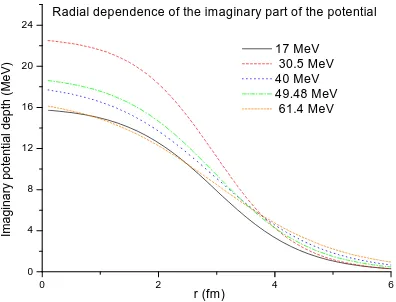
[image:3.595.313.533.85.491.2]dependences of the real and imaginary parts of the poten-tials are shown in Figures 4 and 5 respectively.
Table 1. Optimal potential parameters from SPIVAL code, and also those from single folding model.
E (MeV) V0
(MeV)
aV
(fm) Nr
W0
(MeV) aW (fm)
Vso (MeV) aso (fm) 17.0 OM SF
53.08 0.825 0.9 16.11
16.09 0.765 0.764 1.42 1.42 0.234 0.334 30.3 OM SF
50.97 0. 84 0.91 17.88
21.21 0.701 0.753 1.42 1.42 0.234 0.334 40.0 OM SF
44.79 0. 78 0.9 18.48
10.1 0.923 1.33 6.34 6.34 0.566 0.666 49.5 OM SF
36.86 0.88 0.78 19.18
22.13 0.826 0.788 7.75 7.75 0.655 0.655 61.4 OM SF
27.41 0.84 0.75 20.21
17.15 1.06 1.01 9.5 9.5 0.528 0.528 E (MeV) JV
(MeV.fm3) (MeV.fmJW 3)
17.0 OM
SF 276.20 275.94 93.68 93.51
30.3 OM SF 271.68 267.36 124.66 121.90 40.0 OM SF 222.93 184.38 126.94 106.75 49.5 OM SF 204.83 215.53 118.93 131.86 61.4 OM SF 145.5 155.76 137.43 129.36
0 20 40 60 80 100 120 140 160 180
100
101
102
103
(a) Exp 17 MeV SPIVAL
Single Folding d /d (m b /s r)
cm (deg)
2 0 4 0 6 0 8 0 1 0 0 1 2 0
1 00
1 01
1 02
1 03 (b ) E xp 3 0 .3 M e V
S P IV A L S in g le F o ld in g
d /d (mb /sr )
c m (d e g )
0 2 0 4 0 6 0 8 0 1 0 0 1 2 0 1 4 0 1 6 0 1 8 0
1 0- 1
1 00
1 01
1 02
1 03 ( c ) E x p 4 0 . 0 M e V
S P I V A L S in g le F o ld in g
d /d (mb /sr)
c m ( d e g )
0 2 0 4 0 6 0 8 0 1 0 0 1 2 0 1 4 0 1 6 0
1 0- 2
1 0- 1
1 00
1 01
1 02
1 03
( d ) E x p 4 9 . 4 8 M e V S P IV A L S in g le F o ld in g
d /d (mb /s r)
c m ( d e g )
0 2 0 4 0 6 0 8 0 1 0 0
1 0-2
1 0-1
1 00
1 01
1 02
1 03
1 2 0
(e ) E x p 6 1 .4 M e V
S P IV A L S in g le F o ld in g
d /d (m b /s r)
[image:3.595.55.282.190.733.2]c m ( d e g )
Figure 1. The comparison between the experimental data for p+12C elastic scattering and the theoretical predictions using both optical and single folding model at energies (a) 17 MeV, (b) 30.3, (c) 40 MeV, (d) 49.48 MeV and (e) 61.4 MeV.
20 30 40 50 60
20 30 40 50 60 V0 (Me V ) r e a l po te nt ia l de pt h (a)
E (MeV)
Figure 2. The relation between the real potential depth (V0)
[image:3.595.312.529.567.707.2]10 20 30 40 50 60 70 16
18 20
W
0
(M
e
V
) im
ag
ina
ry
po
te
nt
ial
de
pt
h
(b)
E (MeV)
Figure 3. The relation between the imaginary potential depth (W0) and energy (E).
0 2 4
0 10 20 30 40 50
6
Rea
l
p
otenti
al
de
pth (Me
V
)
r (fm)
[image:4.595.75.274.83.234.2]17 MeV 30.5 MeV 40 MeV 49.48 MeV 61.4 MeV Radial dependence of the real part of the potential
Figure 4. The radial dependences for the real part of the potentials.
0 2 4 6
0 4 8 12 16 20 24
r (fm)
Radial dependence of the imaginary part of the potential
17 MeV 30.5 MeV 40 MeV 49.48 MeV 61.4 MeV
Imagina
ry poten
tial dep
th
(MeV)
Figure 5. The radial dependences for the imaginary part of the potentials.
4. Summary
The analysis of the elastic scattering of protons from 12C
at energies 17, 30.3, 40, 49.48 and 61.4 Mev was per-formed within the framework of two approaches: an op-tical code SPIVAL and single folding potential using DFPOT code. Both approaches give satisfactory results.
The normalization factor Nr was calculated and found to
be in the range 0.75-0.9. A good agreement in the whole energy range was found using the two previous discussed approaches with reliable values for the real and imagi-nary volume integral JV, JW.
REFERENCES
[1] H. O. Mayer, P. Schwandt, G. L. Moake and P. P. Singh,
“Elastic Scattering of 200 Mev Polarized Protons from 12,13C and the Optical Potential,” Physical Review
C ,Vol. 23, 1981, pp. 616-622.
doi:10.1103/PhysRevC.23.616
[2] M. Jaminon, C. Mahaux and P. Rochus, “Optical-Model Potential in a Relativistic Quantum Field Model,”
Physical Review C, 1980, Vol. 22, pp. 2027-2042.
doi:10.1103/PhysRevC.22.2027
[3] C. Mahaux, Lecture Notes in Physics, Vol. 89, No. 1,1979 .
[4] F. A. Brieva and J. R. Rook, “Nucleon-Nucleus Optical : Nuclear Matter Approach,” Nuclear Physics A, Vol. 297, No. 2, 1977, pp. 299-316.
doi:10.1016/0375-9474(77)90322-0
[5] F. A. Brieva and J. R. Rook, “Nucleon-Nucleus Optical Model Potential:(Ⅱ).Finite Nuclei, ” Nuclear Physics A Vol. 291, 1977, pp. 317-341.
doi:10.1016/0375-9474(77)90323-2
[6] F. A. Brieva and J. R. Rook, “Nucleon-Nucleus Optical Model Potential:( Ⅲ ).the Spin-Orbit Component,” Nuclear Physics A, Vol. 297, No. 2, 1978, pp. 206-230.
doi:10.1016/0375-9474(78)90272-5
[7] F. A. Brieva and J. R. Rook, “Microscopic descrip-tion of nucleon-nucleus elastic scattering” Nuclear Physics A, Vol. 307, No. 3,1978, pp. 493-514.
doi:10.1016/0375-9474(78)90461-X
[8] L. Ray, G. W. Hoffmann, M. Barlett and J. McGill, “Proton Elastic Scattering from 40,42,44,48Ca at 800
Mev,”Physical Review C, Vol. 23, 1981, pp. 828-837.
doi:10.1103/PhysRevC.23.828
[9] R. D. Amado, J. A. McNeil and D. A Sparrow, “Two-Step Processes in Intermediate Energy Had-ron-Nucleus Scattering,” Physical Review C. Vol. 23, 1981, 2186-2197.doi:10.1103/PhysRevC.23.2186
[10] M. Rashan, Eur. Phys. J. A, Vol. 16, 2003, p. 371.
doi:10.1140/epja/i2001-10270-4
[11] B. Q. Chen and A. D. Mackellar, “Proton-Nucleus Scat-tering Based on the Relativistic Brueckner-Hartree-Fock Model,” Physical Review C., Vol. 52, 1995, pp. 878-889.
doi.org/10.1103/PhysRevC.52.878
[12] F. Sammarruca, E. J. Stephenson and K. Jiang, “Micro-scopic Calculations of Medium Effects for 200-MeV” Physical Review C., Vol. 60, 1999, 064610 .
doi.org/10.1103/PhysRevC.60.064610
[image:4.595.74.272.466.617.2]doi:10.1103/PhysRevC.53.3022
[14] I. E. Dayton and G. Schrank, “Elastic Scattering of 17-Mev Protons by Nuclei,” Physical Review Online Archive., Vol. 101, No. 4, 1956, pp. 1358-1367.
doi:10.1103/PhysRev.101.1358
[15] B. W. Ridley and J. F. Turner, “Optical Model Studies of Proton Scattering at 30 MeV:(Ⅰ).Different Cross Sections for Elastic Scattering of Protons at 30.3 MeV,”Nuclear Physics,Vol. 58, 1964, pp. 497-508.
doi:10.1016/0029-5582(64)90561-9
[16] L. N. Blumberg, E. E. Gross, A. van der Woude, A. Zucker and R. H. Bassel, Physical Review, Vol. 147, No. 3, pp. 812-825
[17] J. A. Fannon, E. J. Burge, D. A. Smith and N. K. Gan-guly, “Elastic and inelastic of 50 MeV Protons by 12C
and 16O,” Nuclear Physics A, Vol. 97, 1967, pp. 263-281. doi.org/10.1016/0375-9474(67)90487-3
[18] C. B. Fulmer, J. B. Ball, A. Scott and M. L. Whiten, “Elastic Scattering of 61.4-MeV Protons,” Physical Re-view Online Archive., Vol. 181. No. 1, 1969, pp. 1565- 1579.
doi:10.1103/PhysRev.181.1565
[19] M. E. Brandan and G. R. Satchler, “Folding Model Analysis Of 12,13C+12C and 16O+12C Scattering at Intermediate Energies Using A Density-Dependent In-teraction,” Nuclear Physics A, Vol. 487. No. 2, 1988, pp.477- 492.doi: 10.1016/0375-9474(88)90625-2
[20] M. El-Azab Farid and G. R. Satchler, “A Den-sity-Dependent Interaction in the Folding Model for Heavyion Potentials,” Nuclear Physics A, Vol. 438. No.
2, 1985, pp. 525-535.
doi:10.1016/0375-9474(85)90391-4
[21] L. Ray, G. W. Hoffmann and W. R. Coker, “Nonrelativ-istic and Relativ“Nonrelativ-istic Descriptions of Proton-Nucleus Scattering,” Physics Reports, Vol. 212. No. 5, 1992, pp.223- 328.doi:10.1016/0370-1573(92)90156-T
[22] L. Ray, “Neutron Isotopic Density Differences Deduced from 0.8 GeV Polarized Proton Elastic Scattering,” Physical Review C, Vol. 19, 1979, pp. 1855-1872.
doi:10.1103/PhysRevC.19.1855
[23] L. Ray, “Proton-Nucleus Total Cross Sections in the In-termediate Energy Range,” Physical Review C, Vol. 20, 1979, pp. 1857-1872. doi:10.1103/PhysRevC.20.1857
[24] L. Ray G. W. Hoffmann and R. M. Thalar, “Coulomb Interaction in Multiple Scattering Theory,” Physical Review C, Vol. 22, 1980, pp. 1454-1467.
doi:10.1103/PhysRevC.22.1454
[25] E. H. Esmail and M. A. Allam, Acta Physical Polonicab, Vol. 39, 2008, p. 159.
[26] J. E. Poling, E. Norbeck and R. R. Carlson, “Elastic Scattering of Lithium By 9Be,10B,12C,13C,16O,and 28Si
from 4 to 63 MeV,” Physical Review C, Vol. 13, 1976, pp. 648-660.
doi:10.1103/PhysRevC.13.648
[27] Z. Majka, H. J. Jils and H. Rebel, Z. Physics A., Vol. 288, 1978, p.139.
[28] Perey F. // SPIVAL an optical model code unpublished. [29] J. Cook, Computer Physics Communications, Vol. 25,