Munich Personal RePEc Archive
Financial development, bank savings
mobilization and economic performance
in Ghana: evidence from a multivariate
structural VAR
Adenutsi, Deodat E.
University of Stellenbosch
2010
Online at
https://mpra.ub.uni-muenchen.de/29571/
Financial development, bank savings mobilisation and economic performance in Ghana: Evidence from a multivariate structural VAR
Deodat E. Adenutsi
Graduate School of Business
University of Stellenbosch
P.O. Box 610, Bellville 7535
Cape Town, Republic of South Africa
Email: [email protected]
Abstract
This paper examines the implications of financial development for commercial bank savings mobilisation and economic performance in Ghana since the pursuit of financial reforms programme in September 1987. To achieve this objective a Structural Vector Autoregressive (SVAR) model on quarterly time series data spanning from 1987(3) to 2009(4) was employed. The methodological approach of the analysis hinged on the verification of the theoretical stance that financial development promotes improved financial intermediation, efficient resource mobilisation and allocation for higher economic performance. The empirical results suggest that, in Ghana, financial development has enhanced the performance of commercial banks by way of savings mobilisation but adversely impacted on long-run economic performance directly. Thus, financial development can only enhance long-run economic performance indirectly through increased savings mobilised by banks. The success of Ghana’s financial reform programme is largely contingent on the depth of the financial market, which should be considered as the starting point in the sequencing of policy implementation. It is concluded that prudent and rigorous policy measures that will further enhance financial deepening are critically required and this should be seen by policymakers in Ghana as the necessary condition for resource mobilisation and long-run economic performance.
Keywords: Financial Development, Bank Savings Mobilisation, Economic Performance, SVAR
Model
JEL Classification:C32 E13 E44 E58 G21
1.0 INTRODUCTION
The role of the financial system in economic growth has been at the centre of intense policy debate
since the beginning of financial history. Financial development should, at least in principle, imply
economy. In developing countries like those in Sub-Saharan Africa (SSA), however, financial
systems have not been well-developed to play this vital role of intermediation. In SSA, the
financial markets are often extremely fragmented with the various segments serving distinct
groups of clients with similar features and needs, without functional direct and indirect linkages
and interaction among the market segments (Nissanke and Aryeetey, 1999). As a solution to this
financial market fragmentation, McKinnon (1973) and Shaw (1973) suggest abolishing
government interference in the credit market while stabilising the price level through prudent
macroeconomic policies. This, they argue should enable the formal financial sector to expand,
leading to higher financial deepening (McKinnon, 1988).
In response to the McKinnon-Shaw hypothesis, many developing countries have since the
mid-1980s, embarked on far-reaching reforms of their financial systems via liberalization towards
market-orientation. Such development represents a policy response made up of a package of
measures designed to remove undesirable state-imposed constraints on the efficient functioning of
the financial system. These measures include the removal of interest rate ceilings, and the
loosening of deposit and credit controls. In addition some countries established and/or actively
promoted the development of their stock markets. These programmes of financial reforms and
development in developing countries have been predicted on the presumption that a market-based
financial system can most effectively mobilise savings, making them available for credit allocation
in financing businesses and investment projects.
The emergence of what has become known as new theories of endogenous economic growth has
given a new impetus to the relationship between growth and financial development as these
models postulate that savings behaviour directly influences not only equilibrium income levels but
also growth rates (Romer, 1986, 1990; Greenwood and Jovanovic, 1990; Bencivenga and Smith,
1991). On that account, the performance of financial markets are said to have a strong impact on
real economic activity. Indeed, Hermes (1994) asserts that financial liberalization theory and the
new growth theories basically assume that financial development, which is the outcome of
financial liberalization, leads to economic growth. On the other hand, Murinde and Eng (1994)
and Luintel and Khan (1999) argue that a number of endogenous growth models show a two-way
In Ghana, financial sector development and reform programmes were broadly initiated in
September 1987 with the overall objective of improving efficiency within the financial system and
broadening the scope of financial services for higher resource mobilisation, improved
intermediation, and thus ultimately promoting rapid economic growth. Since then, a number of
financial and macroeconomic policies have been implemented in order to achieve this objective.
Meanwhile, as at now, bank savings are low with limited access to credit by the private sector. It is
also evident that the financial market remains shallow in spite of the fact that competition among
banks has now become keener than during the pre-reforms era. It is, therefore, imperative to verify
the extent to which the implementation of financial reforms and development programmes has
improved savings mobilisation by commercial banks and subsequently promoted long-run
economic performance in Ghana.
The remaining part of this paper is organised as follows. In Section 2 the theoretical underpinnings
and policy practice on the role of the financial sector in resource mobilisation and advancing
higher economic performance is provided. The theoretical framework upon which the empirical
models rest constitutes section 3. In section 4 the empirical model and the methodological
approach to the analyses are presented together with issues relating to data. The empirical results
and analysis are presented in Section 5. Policy guidelines for action can be found in Section 6,
which concludes the paper.
2.0 THEORETICAL CONSIDERATIONS AND POLICY PRACTICE
2.1 The Finance-Growth Nexus in Theory
Theoretically, the relationship between finance and economic growth appears quite complex as
this relationship has the potential of passing through various transmission mechanisms. The
channel of the linkage between financial development and economic performance is the functions
that the financial sector performs. Basically, there are two fundamental considerations with regard
to the role of a financial system. First, in an unstable macroeconomic environment of high risk and
uncertainty, the onus lies on the financial system to provide the facilities for efficient risk-sharing
and diversification. In an uncertain macroeconomic environment, the critical functions of modern
financial markets go beyond the traditional mobilisation and allocation of financial resources to
include risk-sharing and allocation, which has consequently motivated the pursuit of financial
the quantum and quality of financial resources are highly essential and hence must be taken into
account in determining the efficient functioning of a contemporary financial market.
Second, there is the need to examine the role of financial markets in an asymmetrically-informed
environment characterized by moral hazards and other agency problems commonly found in
developing countries. The strategic linkage of financial institutions with imperfect information and
agency costs gives the financial system a more vital role to play in realizing the efficient allocation
of scarce financial resources in underdeveloped economies. In this regard it is imperative that a
well-performing and liquid financial system must be capable of providing the mechanism for
efficient intermediation among the various competing participants. It is in line with this premise
that economic growth theories are generally formulated to take into account the role of interest
rate in equilibrating savings and investment in an economy. From the neoclassical perspective, the
optimal growth path is equal to the real interest rate, for which reason the transmission channel
from finance to economic performance is of critical importance.
The McKinnon-Shaw financial liberalization hypothesis provides the fundamental theoretical
framework for examining the implications of financial sector reforms on an economy (Reinhart
and Tokatlidis, 2003; Agca et al., 2007). This hypothesis postulates that the pursuit of financial
repressive policies impairs economic growth through a mechanism of low savings rate. As real
interest rates are regulated at abysmally low levels, public disincentive for saving increases
vis-à-vis increasing demand for financial resources for investment purposes, which results in capital
scarcity and inefficient allocation. In effect, under financial repression, financial institutions are
impeded from achieving optimal allocation of resources to the productive sectors of the economy.
In the course of implementing interest rate liberalization policy, because the equilibrium interest
rate is determined under a more competitive condition, interest rates rise in real terms to levels that
stimulate higher savings, thereby reducing disintermediation, and enhancing quality productive
investment to promote improved economic performance. Consequently, the simplified versions of
most popularly known economic growth models seem to suggest some important linkages
between the financial system and the level of economic activity. For instance, as the financial
sector develops, the potential loss associated with resource allocation is reduced; increases in the
Yet still, as expected, there is lack of consensus on the theoretical role of financial liberalization in
inducing domestic resource mobilisation. For example, recently Kelly and Movrotas (2008)
contend that, in principle, financial development enhances the savings mobilisation process and
channels financial resources towards sustainable economic development. Nevertheless, Bayoumi
(1993), Bandierra et al. (2000) and Aghion et al.(2004) note that financial deregulation minimizes
borrowing constraints, which could trigger instability in financial systems thereby reducing the
incentives to save. Indeed, Liu and Woo (1994) postulate that a low level of financial development
could serve as an incentive to households to save more towards initiating self-finance projects. In
various empirical studies, Page (1994), Cardenas and Escobar (1998), Adenutsi (2002) and
Krieckhaus (2002) find that financial savings positively impact on economic growth, although
some endogenous theorists like Barro and Sala-i-Martin (1999) do not predict any significant
long-run impact of savings on growth. Chaturvedi et al. (2009) find that a positive bi-directional
causal relationship exists between savings rate and economic growth but inflation adversely
impacts on growth, albeit with a positive effect on saving rate.
2.2 Financial Reforms and Development, Financial Savings and Economic Performance
Keynes (1930) identifies the importance of the banking sector for improved economic
performance. In the words of Keynes (1930: 220) bank credit is the pavement along which
production travels, and the bankers, if they knew their duty, would provide the transport facilities
to just the extent that is required in order that the productive powers of the community can be
employed at their full capacity. Robinson (1952) similarly argue that financial development
follows economic growth, and articulates this causality contention by suggesting that ‘where
enterprise leads, finance follows’.
Patrick (1966) distinguishes two possible causal relationships between financial development and
economic growth. The first relationship described as ‘demand following’ views the demand for
financial services as contingent on the growth of real income and on the commercialization and
modernization of agriculture and other subsistence sectors. According to this assertion, the
creation of modern financial institutions, their financial assets and liabilities and related financial
services are a response to the demand for these services by investors and savers in the real
economy (Patrick, 1966). According to this viewpoint the more rapid the average growth of real
others) and hence financial intermediation, since under most circumstances firms will be less
capable of financing expansion from internally generated depreciation allowance and retained
profits. For this same reason, with a given aggregate growth rate, the greater the variance in the
growth rates among different sectors or industries, the greater will be the need for financial
intermediation to transfer savings to fast-growing industries from slow-growing industries and
from individuals. The financial system can thus support and sustain the leading sectors in the
process of growth. In this case an expansion of the financial system is induced as a consequence of
real economic growth.
The second causal relationship between financial development and economic growth is termed
‘supply leading’ by Patrick (1966: 75). ‘Supply leading’ has two basic functions: to transfer
resources from the traditional, low-growth sectors to the modern high-growth sectors and to
promote and stimulate an entrepreneurial response in these modern sectors (Patrick, 1966). This
implies that the creation of financial institutions and their services occurs in advance of demand
for these services. Consequently, the availability of financial services stimulates the demand for
these services by the entrepreneurs in the modern growth-inducing sectors.
It is believed that economic performance may be constrained by credit creation in underdeveloped
economies where the financial systems are less developed, whereas in a more sophisticated
financial environment, finance is viewed as endogenous responding to demand requirements.
Obviously, this line of argument suggests that the more developed a financial system, the higher
the likelihood of growth causing finance. In the view of Robinson (1952), therefore, financial
development follows growth or, perhaps, the causation may be bi-directional. However,
McKinnon (1973) and Shaw (1973), contributing to the earlier work of Schumpeter (1911),
propounded the financial liberalization doctrine, arguing that state restrictions on the banking
system restrain the quantity of investment. More recently, the endogenous growth literature has
suggested that financial intermediation, a key measure of financial development, has a positive
effect on steady-state growth and that government intervention in the financial system has a
negative effect on the equilibrium growth rate (King and Levine, 1993).
Notwithstanding the above, the empirical support for the financial reforms and development
Makonnen (1986) and Adenutsi (2002) find that improved financial development promotes
financial savings; Gupta (1984), Giovannini (1985), Stiglitz (1994), Levine and Zervos (1998),
Bandiera et al. (2000) and Reinhart and Tokatlidis (2001) conclude that generally financial
reforms and development indicators either have no significant statistical impact or a significant
negative impact on financial savings especially for developing countries. For instance, for 50
sampled countries consisting of 14 advanced and 36 developing countries, Reinhart and Tokatlidis
(2001) find that the impact of financial liberalization on savings is mixed but largely negative or
approximately zero. Similarly, Bandiera, et al. (2000) analyzing time series data from 1970 to
1994 on Chile, Ghana, Indonesia, Korea, Malaysia, Mexico, Turkey and Zimbabwe conclude that
broadly, interest rate does not significantly and positively impact on savings, but for Ghana and
Indonesia, in particular, the impact has been significantly negative. The reasons assigned to the
non-positive impact of financial development on savings are low incomes and the existence of
imperfect financial markets. There are related empirical studies such as the study by Hellmann et
al.(2000) that show that an increase in bank competition resulted in a weaker banking system.
On the impact of financial development on economic growth, Goldsmith (1969) in a study
comprising 35 countries for the period 1860-1963 and Gupta (1984) for 12 sampled Asian less
developed countries, conclude that on the whole the impact is significantly positive. In King and
Levine (1993), and Rousseau and Wachtel (1998) find that financial development leads to
economic growth. Levine et al. (2000) also find a significant impact of financial intermediation
indices on economic growth and productivity but an ambiguous impact on saving and investment.
Other empirical studies in which it is concluded that financial development is a stimulant for
higher economic growth and productivity growth, include the studies by Mooreet al. (2006), Das
and Gosh (2006), Iimi (2004), Spiegel and Yamori (2003), and Honda (2003). In contrast, with
reference to the Ghanaian economy, Adenutsi (2002) finds deleterious direct effects of financial
liberalization on economic performance, but a positive indirect effect through improved
mobilisation of savings by commercial banks. Again, in the case of the Ghanaian economy,
Adenutsi (2011) reports that financial development in itself is detrimental to economic growth
unless it succeeds in mobilising risk-free external resources such as remittances. Similarly, African
Development Bank (1994) and Seek and El-Nil (1993) find no significant impact of financial
2.3 Evidence of Financial Reforms and Development in Ghana
In September 1987, a comprehensive programme of financial reforms was introduced in Ghana.
The main goals of the programme were:
to enhance the soundness of the banking institutions by improving the regulatory
framework and strengthening banking supervision by the Central Bank;
to restructure the financially distressed banks following the formulation of specific
restructuring plans; and
to improve the mobilisation of resources and the efficiency of the allocation of credit by
the domestic banking system.
Under the financial reforms and development programme interest rates were liberalized. The aim
was to encourage competition in the domestic banking system. The move towards interest rate
development was gradual. Interest rates were partially liberalized in 1987 with the removal of
maximum lending rates and minimum time deposit rates. This was followed by the removal of
minimum savings deposit rates and sectoral credit allocation in the following year. Controls on
bank charges and fees were abolished in 1990. The bank specific credit ceilings, which had been
the main instrument of monetary control during the adjustment programme, were replaced with an
indirect method of monetary control involving the weekly auctioning of treasury bills and other
government and Bank of Ghana securities, backed up with statutory cash reserve and liquid asset
requirements.
A major step in the financial reforms programme was the enactment of an amended banking law in
1989. This new law provided a sound prudential and regulatory base for the banking system by
requiring banks to maintain a minimum capital base equivalent to 6 percent of their risk adjusted
net assets, by setting uniform accounting and auditing standards, and by introducing limits on risk
exposure to single borrowers and sectors. Further, reporting requirements were strengthened,
therefore, enabling the Bank of Ghana to improve its ability to regulate the banking systems
effectively.
A restructuring plan for the banking sector was designed and approved by the government of
nonperforming loans and other claims on both public enterprises and the private sector from the
portfolios of the banks. The Bank of Ghana issued promissory notes to temporarily replace
nonperforming loans or other government guaranteed obligations to public enterprises for example
at the end of 1988. After the validation of these non-performing assets, the promissory notes were
either replaced by Bank of Ghana bonds, or offset against debts to the Bank of Ghana and the
government. Largely as a result of the offset or replacement of non-performing assets, banks were
able to meet the new capital adequacy requirements by the end of 1990. All of the more than 1300
non-performing bank assets were passed on to a newly created and wholly government-owned
agency called the Non-Performing Assets Recovery Trust (NPART). The NPART was mandated
to try to recover as many of these assets as possible by the end of 1995.
African Development Bank (1994) in its review of financial development in Ghana including the
Financial Sector Adjustment Programme (FINSAP) reveals that although real interest rates turned
positive in 1991 and 1992, largely through a fall in the rate of inflation, there is very little evidence
that private or total savings are responsive to real interest rate changes. It was thus concluded that
in Ghana the savings rate has still not recovered to the level of the 1970s. Sowa and Acquaye
(1998) with quarterly data from 1972 to 1994, find that Ghana’s financial reforms have not
attracted banks to mobilise savings or intermediate finance in the formal financial sector because
of the wide spread between lending and deposit rates. Besides, the development of the exchange
rate and interest rates in nominal and real terms failed to have a significant impact on real imports,
exports and inflation.
During the implementation of the financial reforms programme in 1988, 1989 and between 1991
and 1994, however, real interest rate gained positive values. The real deposit rate, for instance,
turned positive in 1991 for the first time (Adenutsi, 2002). It was expected that these
improvements would directly promote the mobilisation of savings and efficient credit allocation
by commercial banks. This, however, did not happen as private savings with commercial banks
have remained abysmally low and somehow inconsistent.
As a result of the financial reforms programme, lending and discount rates have been very high
compared to very low deposit rates. According to Dordunoo (1995), whilst in 1993 lending rates
ranged between 6 percent and 12 percent on savings deposits. The high interest rate spread can be
attributed mainly to lack of keen competition among the banks and partly to the high transaction
cost of granting loans. Consequently, even though the share of banks’ credit to the private sector
increased from 13.6 percent in 1986 to 35.8 percent in 1993 private investment remained very low
during the Economic Recovery Programme (ERP). Between 1983 and 1991, private investment to
GDP ratio was 3.8 percent on the average, whilst the ratio increased slightly to 4.1 percent during
the post-ERP period of 1992-97.
3.0 THEORETICAL FRAMEWORK
In line with the Keynesian macroeconomic framework, an equilibrium national income is a
composite of household consumption expenditure (C), investment (I) representing expenditure on
capital goods by firms, government spending on social infrastructure and other welfare services
(G), and net income from the external sector, which is measured as export earnings less spending
on imports (NX). Mathematically, this can be expressed as:
Y C I G NX , which implies that Y C S T NX (1)
when I Sand T Gin equilibrium and when the government is running a balanced
budget, and where Sand Tdenote savings and tax revenue respectively. It follows that, in
an economy with net transfer incomes equal to zero at equilibrium (as expected in the
assumed ideal case), if Yd is the disposable income, then from (1):
d
Y T Y C S C I, which follows that Yd f S( )and S f Y( d) (2)
Therefore, changes in Yd should be considered as representing the general economic performance
of a country. For a more specific representation, changes in actual per capita income are a
measure of economic performance from both the theoretical and empirical viewpoints.
From (1) and (2) above, it should be clear that, more generally:
( , , )
d
Y f S G NX just as S f Y G NX( d, , )so long as S f Y
d f G NX( , )
(3)The implication is that disposable income and savings depend on each other, with government
spending and the external trade sector being potential determinants of both. However, the external
sector performance of a typical developing economy is largely influenced by government policies
the global market. Accordingly, openness to external trade which is also widely used as an index
for economic globalisation, and exchange rate can be seen as a potential factor affecting economic
performance in a typical import-dependent developing country such as Ghana. Besides, from
endogenous growth models and the total factor productivity theory of economic growth, human
capital is an essential determinant of long-run economic performance as it is critically required for
higher technological advancement and entrepreneurship through research and development.
As noted in the previous section, the motivation for the pursuit of financial reforms and
liberalization programmes in Ghana, and indeed, in any economy, is principally to enhance
resource mobilisation and efficient resource allocation to finance pro-growth and development
projects. This suggests that if the pursuit of financial liberalization programmes is truly successful,
this should be reflected in various aspects of financial sector development such as improved
financial deepening (an indication of higher public confidence in the banking system), improved
financial widening (a measure of financial efficiency in credit allocation), and an “attractive”
nominal savings rate1 (an indication of improved financial competitiveness). Thus, financial
development which embodies the improvement in quantity, quality and efficiency of financial
intermediary services is expected to enhance financial resource mobilisation and credit allocation
towards improved general economic performance with a reduced rate of inflation.
Theoretically, one important factor which adversely affect savings mobilisation by banks is higher
inflation in a low-income country where the propensities to save are already low and close to zero.
Again, as higher inflation is likely to (negatively) affect financial savings and hence private
investment negatively due to credit constraints confronting financial institutions, a typical
developing economy may (as well) suffer from lower performance as well due to low investment
incentives2and the risks associated with rising prices and higher volatility. In this regard, inflation
can be seen as a key factor that can obstruct savings mobilisation and economic growth in an
economy. Moreover, it is believed that as commercial banks succeed in mobilising more financial
resources within the domestic economy, excess liquidity will reduce, and given that government
expenditure is essentially directed at the productive sectors of the economy (which is expected to
1This also measures the degree of money illusion and money neutrality hysteresis which are expected to be minimal
under a competitive financial environment associated with reduced information asymmetry.
2For instance, effective demand for non-essential commodities and services may fall, demand for higher wages may
be the case especially under multi-party democratic governance), the rate of inflation is expected
to fall whilst prices become more stable. Consequently, whereas inflation can be seen as a
determinant of savings mobilisation and economic growth, bank savings, economic performance
and government expenditure also have the potential of affecting the rate of inflation in Ghana.
From the foregoing, bank savings mobilisation, economic performance and inflation are the
endogenous variables within the analytical framework under consideration. The matrix of the key
exogenous variables includes the financial development indicators aforementioned. The other
matrix of the remaining exogenous variables comprises exchange rate, openness to international
trade, government expenditure, and human capital development.
4.0 EMPIRICAL MODEL, METHODOLOGY AND DATA
4.1 The Empirical Model
In consistency with the theoretical framework espoused in 2.4 above, the explicit simultaneous
system of which financial savings, economic performance and inflation are endogenous variables
takes a general Structural Vector Autoregressive (SVAR) model of the form:
, , ,
t t l t l t l t
BSM f EPF INF (4)
, , ,
t t l t l t l t
EPF f BSM INF (5)
, , ,
t t l t l t l t
INF f BSM EPF (6)
where
EPFis economic performance proxied by GDP per capita in US dollars.
INFis the rate of inflation in the domestic economy computed as quarterly changes
in consumer price index.
BSM denotes bank savings mobilisation measured as the quarterly variation in the
ratio of total bank deposits as a ratio of nominal GDP.
represents the set of exogenous financial development variables notably the
average nominal savings deposit rate (NSR) paid by commercial banks on credit
balances of savings accounts of customers; financial deepening
2
(M /GDP)denoted (FND); and financial widening measured as private sector
credit as a ratio of total credit allocated by commercial banks (FNW). These
is the matrix of other exogenous variables comprising government spending
(GSP) which is a proxy for fiscal policy; HCD represents human capital
development proxied by the enrolment in second cycle institutions; EXR is the
average nominal exchange rate of the Ghanaian cedi to the US Dollar; and
economic openness (OPN) proxied by exports plus imports as a ratio of GDP.
The subscripts t and l represent a particular time period and the maximum lag
structure of the variables.
From (4-6), given the obvious element of simultaneity and hence endogeneity; and given that a
functional relationship exists among the set of dependent variables (BSM, EPF, INF) and with the
set of exogenous variables, three equations of simultaneity from (4-6) respectively are, thus,
specified as follows:
1 2 3 4 0 1
t t l t l t l t t
BSM EPF INF (7)
1 2 3 4 0 2
t t l t l t l t t
EPF BSM INF (8)
1 2 3 4 0 3
t t l t l t l t t
INF BSM EPF (9)
where 0, 0 and 0are intercepts of the three endogenous variables; 1,...,4;1,...,4and
1,..., 4
are the coefficients of the explanatory variables;1t,2t and 3tare the disturbance
terms in (7-9) respectively; and tis the time period. The a priorisigns of the estimated coefficients
are expected to be 1, 0, ,1 00, 0, 2, 0, 2, ,1 20 while 3, 4, 3, 4, 3, 4 / 0. The
specific estimated SVAR model, however, followed a systematic estimation procedure,
essentially to determine the overall (static and dynamic) long-run implications of financial
development for bank savings mobilisation and economic performance in Ghana.
4.2 The Empirical SVAR Methodological Approach and Data
4.2.1 The SVAR Methodological Framework
SVAR methodology ameliorates the analysis of various economic issues by eliminating the
problems of identification of the contemporaneous and dynamic relationships between a set of
macroeconomic variables and the appropriate policy instruments. For any system of simultaneous
equations the empirical relationships can be modelled within the SVAR framework as follows:
0Yt 1Yt1 2Yt2 ... n t nY t
such that iis an NN matrix of parameters for i0,1, 2...n, Yt is an N1vector of
endogenous variables at time t, and tis an N1multivariate white noise error process with
( )t 0
E andE( t j ) {0 when t jwhen t,,j being its fundamental properties. Within the SVAR analytical
framework, the structural innovations tare assumed to be orthogonal, such that the structural
disturbances are not serially correlated and the variance-covariance matrix
is constant anddiagonal (Bernanke, 1986; Asteriou, 2006).
Each equation in the SVAR is unique and has its own dependent variable which emerges after the
contemporaneous matrix 0(in Equation 10) has been normalized along the principal diagonal.
Similar to when estimating a system of traditional simultaneous equations, SVAR parameters are
estimated in two stages, the first being deriving the reduced-form parameters from Equation 10.
1 1 1 1
0 1 1 0 2 2 ... 0 0
t t t n t n t
Y Y Y Y (11)
1 1 2 2 ...
t t t n t n t
Y Y Y Y (12)
such that 1
0 ,
i i
i1, 2,....n, with twhich denotes 1 0t
being the reduced-form system
innovation with a normal distribution features of 2
~ (0, ).
t iid
When Equation (12), which is
essentially a VAR model with N number of system equations, is estimated by Ordinary Least
Squares (see Faust, 1998; Asteriou, 2006), and the VAR residualstare obtained, the innovations
in the structural models represented by E( t j ) {0 when t jwhen t,,jare related to the reduced-form
innovations as 1 1
0 0
( t t) ( t t)
E and 2 1 1
0 ( 0 )
.Next, the identification of the contemporaneous matrix 0and the variance-covariance matrix
which maximizes the likelihood function conditional on the parameter estimates of VAR derived from stage one (Hamilton, 1994). Therefore, following Hamilton (1994), the fullinformation maximum likelihood of a dynamic SVAR can be specified as:
1 1 1
1 1 1
10 0 0 0
2 2 2 ˆ ˆ
where
is restricted to be a diagonal matrix, and tbeing the estimated residuals from thereduced VAR; and within a typical SVAR system, 0contains N2parameters, with having only
1
2 N N( 1) discrete values. Naturally, a model identification problem arises because
1
2 N N( 1) number of restrictions must be imposed on the simultaneous system in order to
establish the exact identification conditions, for which otherwise, the system is under-identified3.
The residuals obtained from the reduced-form VAR are then transformed into a system of
structural equations by imposing restrictions based on relevant underlying theories and
conclusions drawn from empirical studies on policy reaction functions rather than in accordance
with the commonly used Choleski’s decomposition approach. According to Bernanke (1986),
Blanchard and Watson (1986), Sims (1986), and Sims and Zha (1998), this is the approach of
orthogonalising the reduced-form residuals to recover from the underlying shocks.
As three endogenous variables were identified from the theoretical framework, three normalization
restrictions were imposed such that the coefficients of BSM, EPF and INF take a value of unity in
the first, second and third vector respectively, following Persaran and Shin (2002).
4.2.2 Tests for Unit Roots and Granger-Causality / Endogeneity
To begin with the estimation, a series of unit root tests (Dickey-Fuller GLS,
Kwiatkowski-Phillips-Schmidt-Shin (KPSS) and Ng-Perron) was conducted on all the variables in order to
determine the order of integration of each variable. Conclusion on the order of integration was
based on the coincidence of any two tests in case of a conflicting result among the three alternative
tests. The results as presented in Table A1 in the Appendix show that, in general, each of the
variables is integrated of order one4. Following this, it is the first-differenced version of each
variable that was used in the empirical modelling.
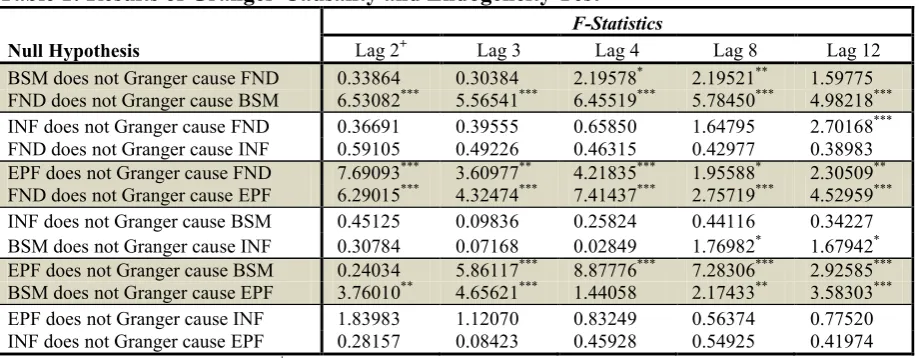
After identifying cointegrating vectors, a causality test between financial development, bank
savings mobilisation, economic performance and inflation was carried out. In essence, this was
3
However, once the system is cointegrated, endogeneity bias is no longer a serious problem in a simultaneous model as proved by Mukherjee et al. (2003). Notwithstanding this, the system is over-identified according to the order condition but the rank condition test cannot be carried out since none of the exogenous variables is excluded from an equation in the SVAR framework.
4 The most consistent results were obtained from DG-GLS and Ng-Perron suggesting that each variable is I(1)
also to verify the status endogeneity of variables as Hall and Milne (1994) demonstrate that weak
erogeneity in a cointegrated system equals long-run causality. For instance, if the null hypothesis
that Xdoes not Granger-cause Yis rejected, the Xvector is not weakly exogenous with respect to Y
[image:17.595.71.531.210.389.2]which also implies that Xdoes cause Yin the long run.
Table 1: Results of Granger-Causality and Endogeneity Test
Null Hypothesis
F-Statistics
Lag 2+ Lag 3 Lag 4 Lag 8 Lag 12 BSM does not Granger cause FND 0.33864 0.30384 2.19578* 2.19521** 1.59775 FND does not Granger cause BSM 6.53082*** 5.56541*** 6.45519*** 5.78450*** 4.98218*** INF does not Granger cause FND 0.36691 0.39555 0.65850 1.64795 2.70168*** FND does not Granger cause INF 0.59105 0.49226 0.46315 0.42977 0.38983 EPF does not Granger cause FND 7.69093*** 3.60977** 4.21835*** 1.95588* 2.30509** FND does not Granger cause EPF 6.29015*** 4.32474*** 7.41437*** 2.75719*** 4.52959*** INF does not Granger cause BSM 0.45125 0.09836 0.25824 0.44116 0.34227 BSM does not Granger cause INF 0.30784 0.07168 0.02849 1.76982* 1.67942* EPF does not Granger cause BSM 0.24034 5.86117*** 8.87776*** 7.28306*** 2.92585*** BSM does not Granger cause EPF 3.76010** 4.65621*** 1.44058 2.17433** 3.58303*** EPF does not Granger cause INF 1.83983 1.12070 0.83249 0.56374 0.77520 INF does not Granger cause EPF 0.28157 0.08423 0.45928 0.54925 0.41974 Source: Author's estimation +optimal lag selected according to SIC
*/**/***indicate 10%, 5%, 1% level of statistical significance respectively
Quarterly data ranging 1987(3)-2009(4) was used in this study. The choice of the study period was
based on the desire to investigate how financial development following the implementation of the
financial reforms programme in September 1987 has influenced bank savings mobilisation and
economic performance in Ghana. Real GDP per capita in US dollars as reported by the World
Bank in World Development Indicators (WDI) was used to measure economic performance.
Essential aspects of financial development were captured in the estimation. Thus, the indicators of
financial development included the ratio of credit to the private sector out of the total which
measures the financial widening aspect of financial development (FNW), broad money as a ratio
of nominal GDP measuring financing deepening (FND) and nominal savings deposit rate (NSR)
measuring financial competitiveness and efficiency which were obtained entirely on a quarterly
basis from the Central Bank of Ghana (BoG). The rate of inflation was computed using Consumer
Price Index (CPI) as reported by BoG on a quarterly basis. Enrolment to second-cycle schools as
obtained from WDI was used as a proxy for human capital development (HCD). Like nominal
BoG Quarterly Statistical Bulletin. The generation of quarterly data of GDP and human capital
development (HCD) followed the universally adopted repetitive procedure.
4.2.3 The Cointegration Test
To determine whether or not the system variables move towards long-run steady state, a
cointegration test was performed following Johansen and Juselius’s (1990) maximum likelihood
procedure. With this test, it was possible to identify the maximum likelihood estimators of the
unconstrained cointegrating vectors and also to determine empirically the number of cointegrating
vectors without relying upon arbitrary normalization. The results of the cointegration test reported
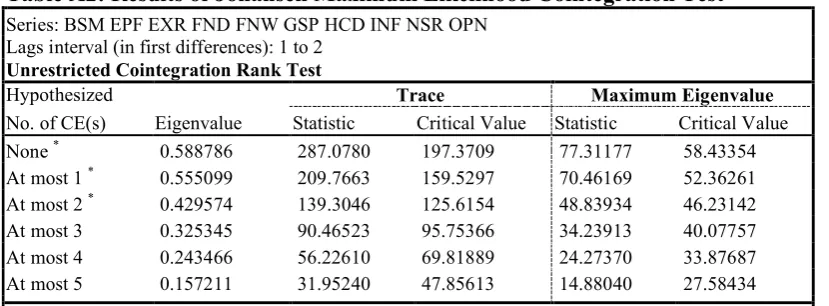
in Table A2 in the Appendix show that the series individually exhibit a random walk with strong
evidence of an equilibrium long-run relationship among the system variables having three
cointegrating equations by both the trace and the maximum eigenvalue criteria.
4.2.4 Derivation of Impulse Response Functions and Test for Variance Decompositions
An empirical SVAR model is imperative in analyzing the dynamic characteristics of the model by
deriving the impulse response functions and estimating the forecast variance decompositions. To
analyse the dynamic responses of the endogenous variables to independent one-standard deviation
shocks emanating from the variables within the empirical SVAR system, it was necessary to draw
on impulse response functions. The forecast error variance decomposition was also estimated from
the empirical SVAR system in order to explain the proportion of a shock to a specific endogenous
variable.
5.0 THE EMPIRICAL RESULTS AND ANALYSES
5.1 Results of the Estimated Static and Dynamic SVAR Models
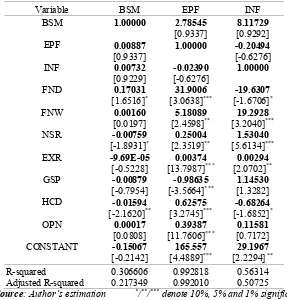
The results of the estimated static SVAR model are presented in Table 2 below. The results show
that, in the static long run, financial deepening as a component of financial development is the
only positive factor that enhances bank savings mobilisation in Ghana. Nominal savings rate and
human capital development are factors that undermine higher savings mobilisation by commercial
banks whilst factors such as economic performance, inflation, financial widening, exchange rate,
government spending and openness to international trade do not affect banks’ savings
mobilisation. This could imply that, in the long run, the key macroeconomic determinants of bank
Table 2: Results of the Estimated Static SVAR Model
Variable BSM EPF INF
BSM 1.00000 2.78545 8.11729
[0.9337] [0.9292] EPF 0.00887 1.00000 -0.20494
[0.9337] [-0.6276] INF 0.00732 -0.02390 1.00000
[0.9229] [-0.6276]
FND 0.17031 31.9006 -19.6307
[1.6516]* [3.0638]*** [-1.6706]* FNW 0.00160 5.18089 19.2928
[0.0197] [2.4598]** [3.2040]*** NSR -0.00759 0.25004 1.53040
[-1.8931]* [2.3519]** [5.6134]*** EXR -9.69E-05 0.00374 0.00294
[-0.5228] [13.7987]*** [2.0702]** GSP -0.00879 -0.98635 1.14530
[-0.7954] [-3.5664]*** [1.3282] HCD -0.01594 0.62575 -0.68264
[-2.1620]** [3.2745]*** [-1.6852]* OPN 0.00017 0.39387 0.11581
[0.0808] [11.7606]*** [0.7172] CONSTANT -0.15067 165.557 29.1967
[-0.2142] [4.4889]*** [2.2294]** R-squared 0.306606 0.992818 0.56314 Adjusted R-squared 0.217349 0.992010 0.50725
Source: Author’s estimation */**/***denote 10%, 5% and 1% significance level 90 observations included; [] = t-statistics
The static long run results again reveal that financial development is the most important propeller
of higher economic performance as financial deepening, financial widening and nominal savings
rate have individual positive effects on economic performance. Whereas increases in government
spending as well as depreciation of the local currency (the Ghanaian cedi) are detrimental to
higher economic performance, openness to external trade and human capital development
positively impact on economic performance in Ghana. The estimated result from the static
inflation model shows that, overall, improvements in financial development by way of increases in
the depth of the financial sector and improved human capital development are significant in
reducing the rate of inflation in Ghana. Furthermore, in the static long run, increases in the
nominal savings rate, financial widening and exchange rate depreciation directly contribute to
higher rates of inflation in Ghana, whilst variations in openness to international trade and
government spending have no impact on the rate of inflation in Ghana.
the financial widening component of financial development and openness to international trade
does not have any long-run dynamic effects on variations in bank savings mobilisation, economic
performance or inflation.
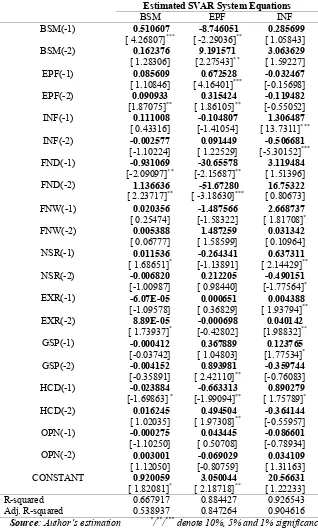
The results show that, although, the dynamic impact of financial deepening on bank savings
mobilisation vary overtime (from negative to positive over the first and second lag values), the
overall impact of financial deepening on bank savings mobilisation in Ghana is positive for the
period under investigation (Table 3). Increases in the first and second lag values of inflation, and
nominal savings rate have inconsistent impacts on the rate of inflation, moving from positive to
negative, whilst increases in the immediate initial values of government spending and human
capital development increase the rate of inflation in the long run. The overall long-run dynamic
impact of initial economic performance on current economic performance is positive just as the
second lag of government spending whereas those of banks savings mobilisation, human capital
development and financial deepening significantly inhibits economic performance.
From the combined static and dynamic results, it is apparent that, in the long run, improved
financial development by way of financial deepening, financial widening, and financial efficiency
is the foremost macroeconomic factor that positively impact on bank savings mobilisation in
Ghana. Besides financial development, only higher economic performance proxied by increased
per capita income has a positive marginal impact on bank savings mobilisation; and although the
exchange rate depreciation promotes increased savings mobilisation by banks, the estimated
coefficient is insignificant or approximately zero. Improved human capital development proxied
by secondary school enrolment is the only factor which, in the long run, impedes bank savings
mobilisation probably. A probable explanation of this result is that, given the low income level of
Ghanaians, households might dissave to pay for education especially during secondary school
admission. Another possible explanation is that the educated might be more sophisticated and
hence could diversify their saving and investment portfolios away from bank deposits. Openness
to international trade, government spending, inflation and financial widening have no long-run
Table 3: Estimated Results of Dynamic Long-Run SVAR Model
Estimated SVAR System Equations
BSM EPF INF
BSM(-1) 0.510607 -8.746051 0.285699
[ 4.26807]*** [ -2.29036]** [ 1.05843] BSM(-2) 0.162376 9.191571 3.063629
[ 1.28306] [2.27543]** [ 1.59227] EPF(-1) 0.085609 0.672528 -0.032467
[ 1.10846] [ 4.16401]*** [-0.15698] EPF(-2) 0.090933 0.315424 -0.119482
[1.87075]** [ 1.86105]** [-0.55052] INF(-1) 0.111008 -0.104807 1.306487
[ 0.43316] [-1.41054] [ 13.7311]*** INF(-2) -0.002577 0.091449 -0.506681
[-1.10224] [ 1.22529] [-5.30152]*** FND(-1) -0.931069 -30.65578 3.119484
[-2.09097]** [-2.15687]** [ 1.51396] FND(-2) 1.136636 -51.67280 16.75322
[ 2.23717]** [ -3.18630]*** [ 0.80673] FNW(-1) 0.020356 -1.487566 2.668737
[ 0.25474] [-1.58322] [ 1.81708]* FNW(-2) 0.005388 1.487259 0.031342
[ 0.06777] [ 1.58599] [ 0.10964] NSR(-1) 0.011536 -0.264341 0.637311
[ 1.68651]* [-1.13891] [ 2.14429]** NSR(-2) -0.006820 0.212205 -0.490151
[-1.00987] [ 0.98440] [-1.77564]* EXR(-1) -6.07E-05 0.000651 0.004388
[-1.09578] [ 0.36829] [ 1.93794]** EXR(-2) 8.89E-05 -0.000698 0.040142
[ 1.73937]* [-0.42802] [1.98832]** GSP(-1) -0.000412 0.367889 0.123765
[-0.03742] [ 1.04803] [1.77534]* GSP(-2) -0.004152 0.893981 -0.359744
[-0.35891] [ 2.42110]** [-0.76083] HCD(-1) -0.023884 -0.663313 0.890279
[-1.69863]* [-1.99094]** [ 1.75789]* HCD(-2) 0.016245 0.494504 -0.364144
[ 1.02035] [ 1.97308]** [-0.55957] OPN(-1) -0.000275 0.043445 -0.086601
[-1.10250] [ 0.50708] [-0.78934] OPN(-2) 0.003001 -0.069029 0.034109
[ 1.12050] [-0.80759] [ 1.31163] CONSTANT 0.920059 3.050044 20.56631
[ 1.82081]* [ 2.18718]** [ 1.22233] R-squared 0.667917 0.884427 0.926543 Adj. R-squared 0.538937 0.847264 0.904616
Source: Author’s estimation */**/***denote 10%, 5% and 1% significance level [ ] = t-statistics; n=88(included after adjustments)
5.2 Results of Variance Decomposition
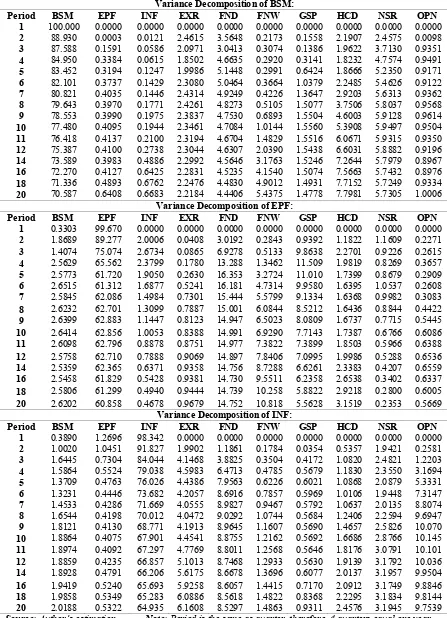
The forecast error variance decomposition mechanism was pursued to explore the interactions
Appendix reports the proportion of the variations of the three endogenous variables as explained
by each other and other system variables. The empirical results show that over the forecast
horizon, the main variations in each endogenous variable are strongly explained by its own shock
followed by minimal shocks emanating from financial development variables, with financial
deepening leading the pack. In particular, apart from being largely affected by its own shock
(averaging 70% over the initial five years), bank savings mobilisation is also influenced by
marginal shocks originating nominal savings rate, financial deepening and human capital
development throughout the forecast period in a descending order of importance respectively. The
three most important variables from which bank savings mobilisation responds to shocks within
the short term (i.e. within the 1styear) are financial deepening, nominal savings rate and exchange
rate. During the medium term (i.e. between the 2ndand 3rdyears), nominal savings rate, financial
deepening, and human capital development are the leading variables that emit shocks to bank
savings mobilisation. Human capital development, nominal savings rate, financial deepening and
financial widening are the leading variables that shock bank savings mobilisation in the long term.
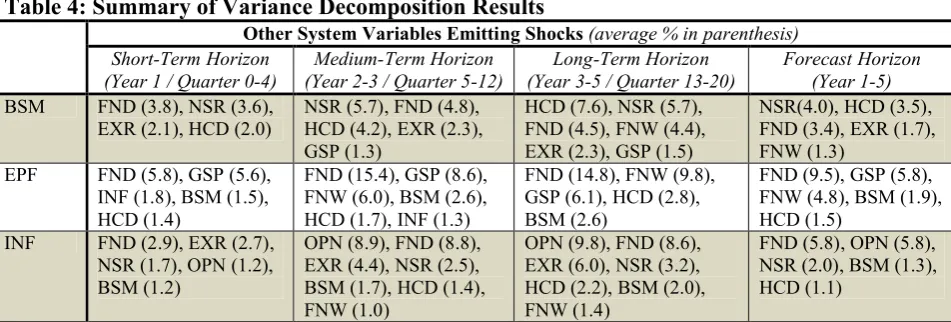
In Table 4 below, a summary of the results of the variance decomposition of the endogenous
[image:22.595.68.544.445.606.2]variables is presented.
Table 4: Summary of Variance Decomposition Results
Other System Variables Emitting Shocks (average % in parenthesis) Short-Term Horizon
(Year 1 / Quarter 0-4)
Medium-Term Horizon (Year 2-3 / Quarter 5-12)
Long-Term Horizon (Year 3-5 / Quarter 13-20)
Forecast Horizon (Year 1-5)
BSM FND (3.8), NSR (3.6), EXR (2.1), HCD (2.0)
NSR (5.7), FND (4.8), HCD (4.2), EXR (2.3), GSP (1.3)
HCD (7.6), NSR (5.7), FND (4.5), FNW (4.4), EXR (2.3), GSP (1.5)
NSR(4.0), HCD (3.5), FND (3.4), EXR (1.7), FNW (1.3)
EPF FND (5.8), GSP (5.6), INF (1.8), BSM (1.5), HCD (1.4)
FND (15.4), GSP (8.6), FNW (6.0), BSM (2.6), HCD (1.7), INF (1.3)
FND (14.8), FNW (9.8), GSP (6.1), HCD (2.8), BSM (2.6)
FND (9.5), GSP (5.8), FNW (4.8), BSM (1.9), HCD (1.5)
INF FND (2.9), EXR (2.7), NSR (1.7), OPN (1.2), BSM (1.2)
OPN (8.9), FND (8.8), EXR (4.4), NSR (2.5), BSM (1.7), HCD (1.4), FNW (1.0)
OPN (9.8), FND (8.6), EXR (6.0), NSR (3.2), HCD (2.2), BSM (2.0), FNW (1.4)
FND (5.8), OPN (5.8), NSR (2.0), BSM (1.3), HCD (1.1)
Source: Author’s compilation Note:For detailed decompositions including those less than 1% see Table A4
It is clear from Table 4 that, bank savings mobilisation, economic performance and inflation are
largely self-driven and hence not significantly driven by the other variables within the SVAR
system, since over the initial 5 years, the proportion of variation in any of these endogenous
5.3 Results of Impulse Response Functions
Impulse response functions were analysed to enable us examine the dynamic responses of the
endogenous variables to one standard deviation shocks originating from the variables within the
empirical SVAR system over the initial five years. The magnitudes of the shocks are measured by
the independent shocks of the corresponding orthogonal errors obtained from the estimated SVAR
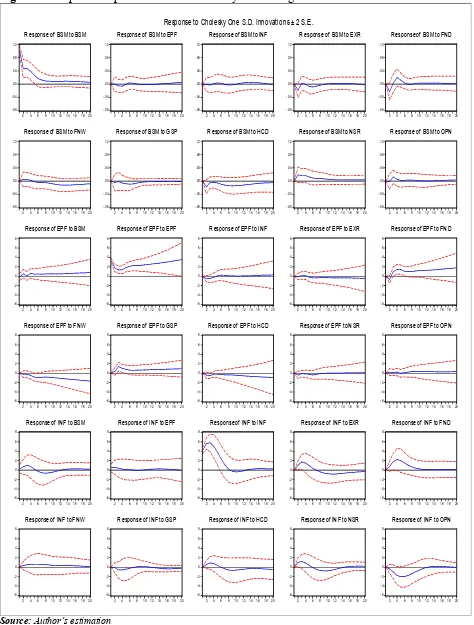
model. The derived impulse response functions reported in Figure A1 in the Appendix reaffirm the
fact that each of the endogenous variables responds mainly to its own shock rather than to shocks
stemming from the remaining system variables. For instance, a one-standard deviation positive
shock to innovation of bank savings mobilisation causes it to spring instantaneously above its
equilibrium level, followed by a sharp initial drop during the first two quarters, and a stagnation
between the 2ndand the 3rdquarters before continuing to decline gently until the 6thquarter beyond
which it dissipates. Bank savings mobilisation does not significantly respond to shocks emanating
from other variables within the system.
A positive one standard deviation shock to economic performance due to innovations of economic
performance causes economic performance to rise instantaneously on impact. This is followed by
an immediate decline over the first year (i.e. between the 1stand 4thquarters) before resurgence in
a continuous upward deviation from its equilibrium throughout the 5-year forecast period. In
response to a one-standard deviation positive shock to innovations from financial deepening,
economic performance will initially drop slightly over the first-two quarters; disappear between
the 2nd and the 4th quarters, and re-surface with a marginal rise between the 4th and the 7th
quarters, after which its significance fades away completely. A marginal latent rise between the
2nd and the 3rd quarter followed by a drop between the 3rd and the 6th quarter constitutes the
response of economic performance to an independent shock originating from fiscal policy
represented by government spending. None of the remaining variables within the SVAR system
significantly elicit a response from economic performance as a result of a one-standard deviation
shock over the 20-period forecast horizon.
Apart from reacting to its own one standard deviation shock, only innovations of exchange rate
and financial deepening appear to force a slight temporary upward response from inflation over
the initial three quarters. There were no impulse responses from inflation due to individual
From the observed impulse response functions derived over the initial 5-year horizon, the sizes of
the one standard deviation shocks from the financial development variables, fiscal policy proxied
by government spending, and indeed, the remaining explanatory variables within the SVAR
system can be described as generally marginal, temporary and insignificant. Only financial
deepening as a component of financial development has been reasonably consistent in eliciting a
temporary marginal response from the endogenous variables within the system, )
6.0 CONCLUSIONS, POLICY IMPLICATIONS AND RECOMMENDATIONS
The conclusions that can be drawn from the key findings of this paper are:
i. In the long run, improved financial deepening is the only component of financial
development that significantly promotes bank savings mobilisation in Ghana. Specifically,
an increase in deepening the Ghanaian financial sector by 100 percent will lead to at least a
21 percent increase in the amount of deposits mobilised by commercial banks as a ratio of
GDP. The overall positive impact on nominal interest paid by commercial banks on
deposits is negligible in increasing savings mobilisation in the long run. Financial
widening by way of increasing the proportion of bank credits allocated to the private sector
does not, in the long run, influence savings mobilisation of commercial banks in Ghana.
ii. Economic performance has a positive long-run impact on savings mobilisation in Ghana
although the impact is not robust as a 100 percent rise in income per capita has a mere 9
percent positive impact on bank savings mobilisation. In turn, bank savings mobilisation
impacts significantly on economic performance to the tune of 45 percent for an upward
100 percent variation in deposits as a ratio of GDP mobilised by commercial banks in
Ghana.
iii. In the long-run, improved financial widening and financial efficiency components of
financial development are more important than financial deepening as far as higher
economic performance is concerned when the impact analysis in considered directly.
iv. The total impact of improved financial development on the rate of inflation is negative but
widening and nominal interest rate paid on bank deposits from the estimated static and
dynamic models.
v. A bi-directional causality exists between financial deepening and economic performance,
while a uni-directional causal relation runs from financial deepening to bank savings
mobilisation, and also from bank savings mobilisation to economic performance.
vi. The direct overall impact of financial development on long-run economic performance is
negative; suggesting that, in Ghana, the mechanism of transforming savings mobilised into
investible funds might still be weak due to information asymmetry. It could also imply that
the vital entrepreneurial class to bear the risks of accessing capital from banks to initiate
productive ventures is absent. All the same, in view of the fact that financial development
significantly promotes higher bank savings mobilisation but impacts negatively on
economic performance directly; it can be concluded that, in Ghana, in the long run,
financial development promotes higher economic performance indirectly through increased
prior savings with commercial banks, so long as bank savings mobilisation impacts
positively on economic performance.
Based on the above findings, the following policy implications and recommendations are
advanced:
i. For commercial banks in Ghana to improve upon domestic resource mobilisation there is a
need for policy makers to boost public confidence in the banking sector. This is because
with higher public confidence in the financial system, the amount of currency circulating
outside the banking system is likely to reduce, resulting in excess liquidity. Apart from
this, improved financial efficiency resulting in the payment of more attractive returns on
bank deposits could serve as an important means by which commercial banks in Ghana can
mobilise higher domestic resources in the long run. More specifically, it is suggested that
commercial banks and indeed other formal sector deposit mobilisation institutions should
spread to the rural centres with specialized services aimed at mobilising deposits from this
large segment of the Ghanaian population who are currently either non-banked or
under-banked.
long-run economic performance arising from the dynamic effects of higher financial
deepening, there is the need for policy reorientation towards improved financial sector
development that lays emphasis on increased credit allocation to the private sector and
attracting the saving public with higher interest payable on bank deposits. With consistent
improvement in financial widening and efficiency through higher private sector credit
allocation and attractive interest rates on savings, the overall impact of financial
development on economic performance could turn positive, if the anticipated positive
impact out if the Ghanaian banking industry becomes more competitive and efficient with
diversified risks.
iii. Further development of the Ghanaian financial system, though necessary and desirable for
its positive and significant influence on bank savings mobilisation, should not be
considered as an end in itself. Efforts are also required in order to erect proper structures
like the expansion and the development of the capital market to absorb the likely increase
in demand for funds that can be invested. Together with the implementation of other
policies, this measure will help promote the efficiency of equity markets, raise corporate
savings or even encourage foreign inflows, needed as complements to financial
development in a developing country like Ghana. In this regard, all supporting or
associated reforms must help to integrate the financial markets fully as a necessary
condition to synchronize the revealed benefits of financial development in totality.
iv. Given the direction of the observed causal effects, policymakers should consider the
sequencing and focus of financial sector development towards improved savings
mobilisation and economic performance as essentially important. For instance, in order to
ensure long-run growth through domestic resource mobilisation, the financial deepening
component of financial development cannot be ignored or downplayed. In fact, as the
evidence shows, financial deepening is the only element of financial development that can
cause higher savings mobilisation by banks, which in turn positively impacts on long-run
economic performance in Ghana. Therefore, there is the need to put premium on financial
deepening to create the necessary platform for improved economic performance through
higher resource mobilisation in Ghana in the long run. It can, thus, be concluded that, in
the long run, programmes of financial reforms and development are central to higher
the necessary condition for its success.
v. It is imperative for financial institutions in Ghana to selectively allocate more credit to the
investing private sector to boost the financing pro-growth and development projects rather
than over-concentrating on employee loans and pre-financing generally non-productive
personal assets such as the purchase of private cars under bank auto-loans for customers
who are salaried workers. Without this, higher private sector credit allocation will not have
the desired impact on long-run growth, and the economy could even suffer from
overheating, culminating in higher inflation in the long-run. This appears to be the
situation for Ghana for the period studied.
REFERENCES
Adenutsi, D.E. (2002), Ghana: Financial Liberalization, Bank Savings Mobilisation and
Economic Performance, Unpublished MPhil Thesis. Cape Coast: University of Cape Coast,
Department of Economics.
Adenutsi, D.E. (2011), “Financial Development, International Migrant Remittances and Endogenous Growth in Ghana,” Studies in Economics and Finance, 28(1): 68-89.
African Development Bank (1994), “Financial Structures, Reforms and Economic Development in Africa,” inAfrican Development Report 1994,192-256. Tunis: African Development Bank.
Aghion, P., P. Bacchetta and A.V. Banerjee (2004), “Financial Development and the Instability of Open Economies,” Journal of Monetary Economics, 51(6): 1077-1106.
Agca, S., G. De Nicole and E. Detragiche (2007), “Financial Reforms, Financial Openness and Corporate Borrowing: International Evidence,” IMF Working Paper WP/07/186. Washington, D.C.: International Monetary Fund.
Asteriou, D. (2006), Applied Econometrics: A Modern Approach using Eviews and Microfit.
Bandiera, G. Caprio, P. Honohan, and Schiantarelli (2000), “Does Financial Reform Raise or Reduce Saving?” Review of Economics and Statistics, 82(2): 239-263.
Barro, R. and X. Sala-i-Martin (1999), Economic Growth. Cambridge Mass: MIT Press.
Bayoumi, T. (1993), “Financial Deregulation and Household Saving,” Economic Journal, 103(421): 1432-1443.
Bencivenga, V.R. and B.D. Smith (1991), “Financial Intermediation and Endogenous Growth”,