Munich Personal RePEc Archive
Increasing returns and stability
Kakarot-Handtke, Egmont
2 September 2011
Online at
https://mpra.ub.uni-muenchen.de/33133/
Increasing Returns and Stability
Egmont Kakarot-Handtke*
Abstract
Increasing returns are an incontrovertible fact since Adam Smith hailed them as the very originators of wealth, yet they play havoc with general equilibrium. They fit, in marked contrast, nicely into the structural axiomatic framework. This indicates that it is worthwhile to replace the behavioral axioms of stan-dard economics by objective structural axioms. These are in the present paper applied to the question of how increasing returns affect the systemic interrela-tions in the pure consumption economy. To invite a reality check the logical implications of the structural employment equation are set in relation to three well-known statistical relationships.
JELD24, E23, E24
KeywordsNew framework of concepts, Structure-centric, Axiom set, Ver-doorn’s law, Phillips curve, Okun’s law
*Affiliation: University of Stuttgart, Institute of Economics and Law, Keplerstrasse 17, D-70174
A competitive equilibrium is not possible at a point of increasing re-turns to scale because no one wants to be the firm (negative profits). A competitive equilibrium is not possible at a point of decreasing returns to scale because everyone wants to be the firm (positive profits). Gen-eral equilibrium theory for a competitive capitalist economy only works in the special case of constant returns to scale where (by assumption) no one cares who acts as the firm (zero profits). (Ellerman, 1986, p. 70)
For the relation between labor input and product output standard economics hypoth-esizes a production function with formally convenient properties. The property of diminishing returns, which is crucial with regard to the application of the marginal principle, has been made plausible by the agrarian production conditions of farmer Smith (Samuelson and Nordhaus, 1998, pp. 121-124). On the other hand it has been observed since Adam Smith that the outstanding characteristic of industrial production is increasing returns (Young, 1928, p. 528). This poses a serious problem for the application of ‘naïve price theory’ in capital intensive industries (Perelman, 1996, pp. 31-39). Hahn has made perfectly clear what ismethodologicallyat stake:
The whole [invisible hand] theory is at risk if there are increasing returns which are ‘large relative to the size of the economy’. . . . It arises from the fact that, even if firms continued to act as price takers, there may exist no equilibrium prices. (Hahn, 1984, p. 116)
Confronted with the stark choice between industrial reality, as basically correctly described by Adam Smith (Negishi, 1985, pp. 11-22), and agricultural reality, as experienced by farmer Smith, standard economics opted for the wrong Smith and the preservation of the marginalistic equilibrium apparatus (McCombie and Roberts, 2009, p. 13).
Each theory starts from a small set of foundational ‘hypotheses or axioms or postulates or assumptions or even principles’ (Schumpeter, 1994, p. 15). General equilibrium theory rests on a set ofbehavioralaxioms (Arrow and Hahn, 1991, p. v). The standard set of behavioral axioms is in the present paper at first replaced by structural axioms. These are subsequently applied to the question of how increasing returns affect the systemic interrelations in the pure consumption economy.
By choosing objective structural relationships as axioms behavioral hypotheses are not ruled out. On the contrary, the structural axiom set is open toanybehavioral assumption and not restricted to the standard optimization calculus.
profit distribution, varying wage rate–price configurations, and productivity changes are put together in an employment expansion scenario in section 5. It turns out that it is objectively impossible for the representative firm to realize the marginalistic equilibrium condition. This, though, has no significant effect on the structural stability of a system with productivity increases positively dependent on employ-ment increases. In section 6 the logical implications of the structural employemploy-ment equation are set in relation to stylized facts. Verdoorn’s law, the Phillips curve, and Okun’s law are shown to be compatible with the structural axiom set. Section 7 concludes.
1 Axioms and definitions
The first three structural axioms relate to income, production, and expenditures in a period of arbitrary length. For the remainder of this inquiry the period length is conveniently assumed to be the calendar year. Simplicity demands that we have at first one world economy, one firm, and one product.
Total income of the household sectorY is the sum of wage income, i.e. the product of wage rateWand working hoursL, and distributed profit, i.e. the product of dividendDand the number of sharesN.
Y=W L+DN |t (1) Output of the business sectorOis the product of productivityRand working hours.
O=RL |t (2)
Consumption expendituresCof the household sector is the product of priceP
and quantity boughtX.
C=PX |t (3)
The axioms represent the pure consumption economy, that is, no investment expenditures, no foreign trade, and no taxes or any other government activity.
The sales ratio is added for formal convenience as:
ρX ≡ X
O |t (4)
The expenditure ratio is defined as:
ρE ≡ C
Y |t (5)
0 500.000 1.000.000 1.500.000 2.000.000
0 50 100 150 200
t
Employment
constant productivity increasing and decreasing productivity wage increase 1
wage increase 2
price increase
distributed profit increase
[image:5.595.118.479.126.359.2]beginning of reversals
Figure 1:Alternative paths of employment depending on constant or increasing–decreasing
produc-tivity
it is essential to consider the configurations in more detail that have a counterpart in the world we happen to live in, that isrX6=1andrE6=1.
2 Employment
The centerpiece of the analysis is the employment equation which follows straight from the axioms and definitions:
L= YD
PRρX
ρE
−W
|t (6)
The axioms are supplemented by theadditionalassumption that employment as dependent variable is determined by the rest of the system. This is an assumption about the direction of dependency in a system with complex and mutual interrela-tions and thisadd-onassumption is no constituent of the axiom set which is clearly open to various dependency interpretations. Dependency is conceptually different from causality.
The employment equation states − with the other variables unaltered in each case:
(ii) A price increase is conductive toloweremployment.
(iii) Provided that wage rate, price and distributed profit all change with the same rate there is no effect on employment.
(iv) If the configuration of price and wage rate changes is such that the denominator remains unchanged then employment stays where it is, no matter how large wage rate and price changes are. In this case perfect wage–price flexibility has no impact on employment.
(v) An increase of the expenditure ratiorE leads to higher employment.
An expenditure ratiorE>1presupposes the existence of at least one bank.
(vi) A productivity increase leads to lower employment.
(vii) As the difference in the denominator approaches zero employment goes (formally) off to infinity. This singularity is an implicit prop-erty of the economy as given by the structural axiom set. When this point of discontinuity is approached the system’s behavior changes in unpredictable ways.
(viii) Distributed profits exert a positive influence on employment.
Statements (i) to (viii) follow without regress to any behavioral assumptions from the axiom set and the ‘laws of algebra’ (Shaik, 1980, p. 83). If the axioms capture reality the logical implications should be observable (see section 6). The structural employment effects of wage rate and price changes are clearly at variance with what is to be expected if one accepts the indefensible behavioral assumptions of standard economics (for details see 2011h).
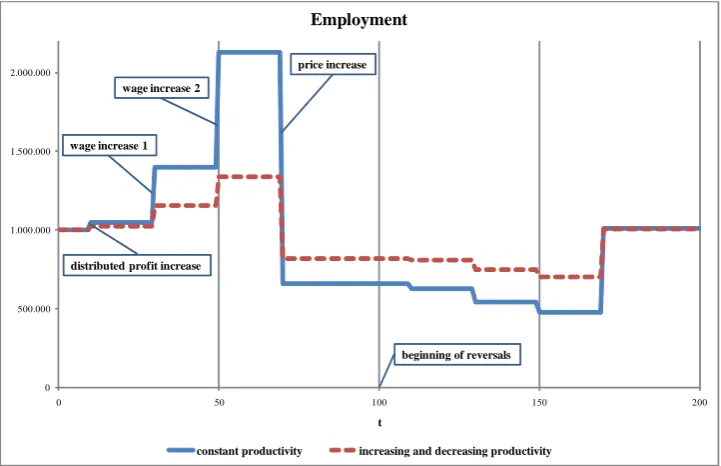
Figure 1 shows two wage rate increases of the same magnitude (= 2.5 percent). It is noteworthy that the second increase produces a larger employment effect than the first. This is because the effect depends also on thedifferencein the denominator of (6). After the first increase the denominator is smaller and this gives more impact to the subsequent wage rate hike.
3 Increasing or decreasing productivity
In the structural axiomatic context no “law” of production exists. Diminishing or increasing productivities are at first logical alternatives.1 Since both cases occur in the real world, a general theory has to embrace both. For the pure consumption econ-omy we consider, as examples, two formal realizations of increasing productivities in section 6.1.
In Figure 1 the employment effects of variations of distributed profitYD, the
wage rateW and the pricePare visualized. The productivityRis given with the 2nd axiom (2) and therefore independent of employment. It would, of course, be possible at any time to admit the widely used Cobb-Douglas production function to the structural axiomatic formalism by determining the productivity as follows:
R=γLα−1Kβ (7) This yields a falling productivity for increasing employment and a fixed real capital stockK. The crucial point is that, in contrast to standard economics, the structural axiomatic approach is not for good or for evil wedded to decreasing productivities. Hence all kinds of production functions that may be convenient for the application of the profit maximization hypothesis (but for nothing else, see Lavoie, 1992, pp. 27-36; Shaik, 1980; Robinson, 1953) are shelved for the time being.
When increasing and decreasing productivities relative to the initially given employment according to Figure 4a areaddedto the axiom set employment takes a different path as depicted in Figure 1. The symmetric productivity effect attenuates the employment effect. Whether this systemic property is welcome depends on the situation. When the economy is initially at full employment the productivity effect operates as stabilizer. When unemployment prevails initially it becomes harder to get out of it. The actual problem, therefore, is not a lack of wage–price flexibility. For the same degree of flexibility greater changes of wage rate (+) or price (-) are needed to attain the same positive employment effect.
It is, of course, possible that the productivity effect is so strong as to override the expansionary effect of the remaining independent variables. Taken in isolation
1 “Increasing returns derived from the process of accumulation and technological change, associated
a productivity increase is, according to (6), conductive to a fall of employment. Hence two factors are of importance: a) that the productivity effect is tightly coupled to employment as exemplified by the alternatives in Figure 4, and b) that the decelerating productivity effect is less than the combined accelerating effects of the remaining independent variables. If the productivity effect is coupled to the growth of the capital stock or to autonomous technical progress it has, in the present context, to be taken as a random variable.
For the economy as a whole increasing productivity accounts under this con-ditions for overall stability. It has been maintained that the fact that the market economy neither ‘explodes to infinity nor contracts to zero’ indicates that there must be a tendency toward equilibrium (Weintraub, 1991, p. 140, quotation Negeshi). Seen from the structural axiomatic viewpoint neither the notion of a behavioral equilibrium nor this kind of rhetorical proof makes much sense. A measured pro-ductivity effect in direct dependency of employment changes is sufficient to explain a certain inertness of the economic system. This inertness may occur at any level of employment. Hence neither the conception of a gravitation toward full employment equilibrium nor of a persistent Keynesian disequilibrium, that both depend on arbi-trary behavioral assumptions, is in dire need. Thestructureis self-stabilizing at the given level.
It is an analytical advantage of the 2nd axiom (2) that it decouples employment and productivity without preventing their eventual coupling. The corresponding disadvantage of the well-behaved production function is that employment and productivity are hardwired by an arbitrary assumption. There is no justification for this reality distorting approach other than that it enables the application of the optimization hypothesis.
From the employment equation (6) one can conclude that a rising productivity has a retarding effect on employment expansion. The direct comparison in Figure 1 shows for the same scenario that the dampening effect may be considerable. Hence increasing returns do not destabilize the pure consumption economy seen as a whole. This does not preclude phenomena like multiple outcomes, cumulative causality or lock-in at the market level (Arthur, 1994, p. 28).
Figure 1 shows the positive effect of profit distribution on employment. For completion the origination of profit has now to be formally added.
4 Profit and distributed profit
The business sector’s financial profit ❉Qfi in periodt is defined with (8) as the difference between the sales revenues – for the economy as a whole identical with consumption expendituresC– and costs – here identical with wage incomeYW:
∆Qf i≡C−YW ≡PX−W L ⇐ YW ≡W L |t (8)
For the business sector as a whole to make a profit consumption expendituresC
into existence in thepure consumption economythehouseholdsector must run a deficit at least in one period.2 This in turn makes the inclusion of the financial sector mandatory (for details see 2011e, 2011f).
From (8) and (1) follows for the relation of financial profit and distributed profit:
∆Qf i≡C−Y+YD ⇐ YD≡DN |t (9)
When consumption expenditures are greater than total income and stay there for some periods a positive feedback loop emerges as a systemic property. It works as follows: profit up, distributed profits up, consumption out of distributed profits up, profits up and so on. This chain is weakened when, for example, profits are not fully distributed. The loop, though, is not a fixed deterministic mechanism. It can be stronger in one period and weaker in another.
5 An employment expansion scenario with increasing productivity
The constituent employment effects of (6) can now be integrated into a more detailed sequence.
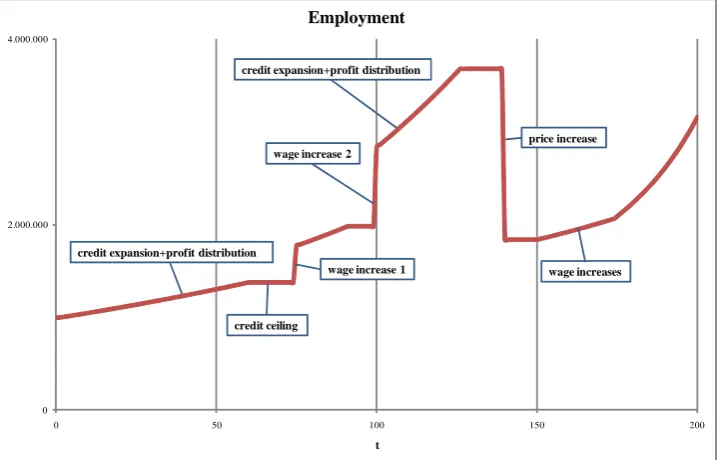
To begin with it is assumed that the household sector has a free credit limit of x percent of total incomeYat its disposal. The expansion process starts in Figure 2a with a step-up of the expenditure ratiorEfrom initially 1.0 to 1,001. According to
(9) profit comes for the first time into being because distributed profit is initially zero. It is assumed that profits are fully distributed in the next period. Thus, with an expenditure ratiorE>1,the process of profit origination and distribution is self-reinforcing. After some time the credit ceiling is reached. The expenditure ratio returns to unity and the expansion stops. According to (9) profit is now in each period equal to distributed profit.
A wage increase then reanimates the expansion process. Because of rising incomes the credit ceiling moves upwards and thereby makes room for further expansion. The wage increase is repeated in period100 with even more effect.
A price increase then turns the tide and employment shrinks. In the rightmost section of Figure 2a the wage rate escalates faster than productivity. Under the condition of market clearing and budget balancing this propels employment higher. When the wage increase accelerates the employment expansion accelerates. The formal properties of (6) ensure that employment goes off to infinity as the wage rate rises further. Somewhere in between full employment is reached. This structural effect of the wage rate increases on employment is, as the case may be, decelerated by an increasing productivity or accelerated by a decreasing productivity. Here it is assumed that productivity increases with employment as shown in Figure 4b.
On the firm’s level the process is mirrored as shown in Figure 2b. From (1) and (2) follows the development of total costTCin dependence of period output:
2 It needs hardly emphasis that in the investment economy the process of profit generation appears
0 2.000.000 4.000.000
0 50 100 150 200
t
Employment
credit expansion+profit distribution
credit expansion+profit distribution
wage increase 2
price increase
wage increases wage increase 1
credit ceiling
(a)Employment expansion due to variations of the independent variables in combination with profit distribution
0,00 0,50 1,00 1,50 2,00 2,50 3,00
0 50 100 150 200
t
Price and Cost per Unit
price average cost marginal cost profit/unit
[image:10.595.122.483.155.385.2](b)Impact of the variations of Figure 2a on marginal cost, average cost, and profit/unit
TC≡W
RO+Wf ixLf ix (10)
Marginal costMCare independent of the employment level. Average costAC
become virtually equal to marginal cost as output increases:
MC=W
R AC= W
R +
Wf ixLf ix O | {z }
→0
(11)
The standard equilibrium condition ofP=MC=AC(Samuelson and Nordhaus, 1998, p. 468) is not realized once over the whole process. The pricePis throughout above marginal costMCand average costAC;profit per unit, which is given by the difference between price and average cost, is positive throughout. The deeper reason is that overall profit is positive according to (9) and that, by consequence, there is a wedge between the market clearing price and unit wage cost. The price, here taken forexpositorypurposes as dependent variable, follows from the axioms and definitions as:
P=ρE
ρX
(1+ρD) W
R ⇐ ρD≡ YD YW
(12)
Under the condition of market clearing, i.e.rX=1,the price is determined by the expenditure ratiorE, the distributed profit ratiorD, and unit wage costW/R. As long
asrE>1orrD>0the market clearing price is above unit wage cost and therefore the standard equilibrium condition for a single firm is not realizable. Profit maximizing behavior cannot alter this structural fact. Zero profit equilibrium models therefore are formal artifacts with zero explanatory value.
Beginning with period150 the wage rate increases faster than productivity.
Marginal and average cost go up, profit per unit is squeezed. Total profits, though, remain unchanged if the expenditure ratio is unity and profits are fully distributed. At the capacity limit, where the employment expansion must ultimately come to a halt, the price is still above average and marginal cost. The firm covers the fixed costs and realizes a positive profit per unit of output. There is no problem of repro-ducing this configuration over an indefinite time span. And there is scant reason to suspect that anybody is particularly disturbed by the fact that price is not equal to marginal cost. To the contrary, if the firm actually behaves according to the profit maximizing principle this configuration induces apermanentemployment expan-sion. Figure 3 summarizes the close dependency of the productivity development on the employment expansion.
The central question of the structural axiomatic approach is (not about the existence and stability of a general behavioral equilibrium but) about the structural and behavioral preconditions that create a favorable environment for long term economic growth. The key points are:
8,8 9,0 9,2 9,4 9,6 9,8
0 50 100 150 200
t
[image:12.595.115.479.126.360.2]Productivity
Figure 3:Productivity moves in tandem with employment
This can be realized through the purchase of durable consumer goods, e.g. cars, houses on credit (for details see 2011b, pp. 8-12).
• The positive effect of an expenditure ratio greater than unity on employment must not be neutralized by full price flexibility.
• The expansionary bias lasts as long as the (net) growth of credit continues. The financial sector is crucial because it softens the budget constraint.
• Increasing returns for the business sector as a whole do not destabilize the pure consumption economy. It is possible – in principle – to stabilize the economy in the vicinity of full employment.
6 Implications
The employment equation (6) is composed of measurable variables. Therefore, its implications are observable. Because of the simplicity of the pure consumption economy on the one hand and the highly differentiated micro-structure of the real economy on the other a direct confrontation of theory and facts would be premature. Hence at the present stage we have to be content with some stylized facts.
6.1 Verdoorn’s law
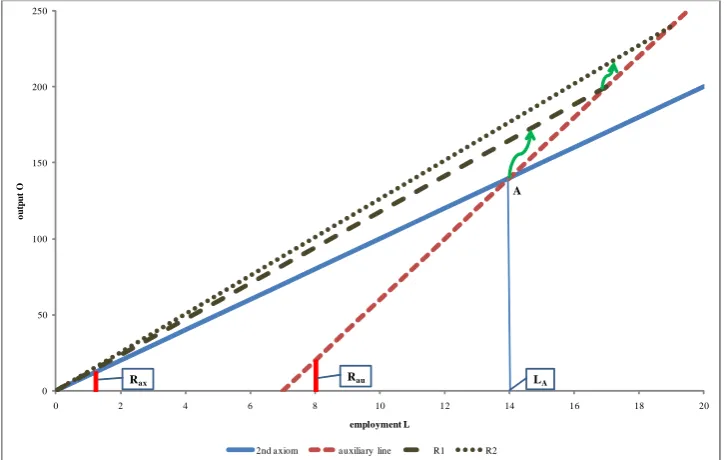
Wickens, 1982, p. 21). To connect this proposition to the structural axioms it is formalized in two different ways. The symmetric case is given by (13) and depicted in Figure 4a.
Oax=RaxL |t Oau≡RauL−a
(13)
The reference line is given by the 2nd axiom (2) which is supplemented by a steeper auxiliary line. Both lines cross atA. From this follows for the productivity
Rthat enters into (6):
R≡Rax LA
L +Rau
1−LA
L
|t (14)
Accordingly, the productivity in Figure 1 increases if employment is higher than in the initial period (at full employment respectively unemployment) and vice versa. This reference point is indicated byA. The symmetric case is plausible for short-run fluctuations around a normal capacity.
The asymmetric case is depicted in Figure 4b. The reference line is given by the 2nd axiom (2) that has been shifted to the right to account for a fixed labor input that is not directly involved in production. The productivity is then dependent on the relation of the variable and fixed part of total employment:
R≡ O
Lf ix+Lax
⇐ L≡Lf ix+Lax |t (15)
From this follows for the productivityRthat enters into (6):
R≡ Rax
1+ 1
L Lf ix
−1
|t (16)
If the productivity is constant with reference to the increasingvariablelabor input then productivity with reference tototallabor input increases with overall employ-ment. In this caseRaxacts as the upper limit. The asymmetric case is plausible for the long-term relation between growing employment and rising productivity. Whatever the ultimate causes and properties of Verdoorn’s law may be, the effects have to be an integral part of a general theory:
0 50 100 150 200 250
0 2 4 6 8 10 12 14 16 18 20
o
u
tp
u
t
O
employment L
2nd axiom auxiliary line R1 R2
Rax
A
LA
Rau
(a)Symmetrically increasing and decreasing productivity with reference to the initial employment atA
0 20 40 60 80 100 120 140 160 180 200
0 2 4 6 8 10 12 14 16 18 20 22 24
o
u
tp
u
t
O
employment L
2nd axiom R1 R2 R3
Rax
R
[image:14.595.120.484.160.390.2](b)Increasing overall productivity due to a fixed labor input that is unrelated to production
6.2 Phillips curve
Equation (6) is the structural axiomatic version of the Phillips curve and contains the original as special case. The formal connection to the unemployment rate is at first established by:
U+L=L∗ ⇒ Urate≡1− L
L∗ (17)
The relation of the statements in section 2, which explicate (6), and the Phillips curve is as follows:
(i) . . . is in accordance with the correlation of Phillips’ original study (Phillips, 1958) of more than a century’s worth of data on unemploy-ment and wage rates in the UK.
(ii) . . . is indiscordance with the Samuelson-Solow-Fisher version of the Phillips curve, that is, the trade-off between unemployment and inflation (Samuelson and Nordhaus, 1998, pp. 590-595). The stagfla-tion of the 1970s is generally seen as an empirical refutastagfla-tion of the neoclassical synthesis version of the Phillips curve (Davidson, 2009, pp. 175-179), (Forder, 2010, p. 330). This refutation of ‘perverted’ Keyne-sian economics (Davidson, 2009, pp. 18-20) indirectlycorroborates
the employment equation (6).
(iii/iv) . . . are in accordance with the NAIRU and rational expectations inter-pretation of the Phillips curve (Blanchard and Katz, 1997), i.e. in this cases the Phillips curve is a vertical.
The Phillips curve has been described as ‘a piece of statistics in search of a the-ory’ (Kaldor, 1985, p. 38). The employment equation (6) provides a theoretical foundation given that the structural axiom set captures reality.
6.3 Okun’s law
Okun’s law (Samuelson and Nordhaus, 1998, pp. 565-566) can be directly derived from (6). The combination with (2) gives:
L= YD
ρX
ρE PO
L −W
(18)
From this follows for the relation between output and employment:
L=ρX
ρE P WO−
YD
W (19)
Urate=
−0.5 z }| {
1−ρX ρE
P W
1
L∗
| {z }
1.5
O+ YD
L∗W (20)
For Okun’s law a slope of approximately -1/2 has been determined as a ‘rule of thumb’ (Samuelson and Nordhaus, 1998, p. 566), (Knotek, 2007, p. 74). This implicates according to (20) that the relation between wage rate and price is on the averageP≈1.5Wif markets are cleared and the budget is balanced. A connection between Okun’s law and Verdoorn’s law has been established by Chatterji and Wickens (1982, p. 27) .
Okun’s law has been characterized as ‘a statistical relationship rather than a structural feature of the economy’ (Knotek, 2007, p. 73). The employment equation (6) provides a theoretical foundation given that the structural axiom set captures reality.
7 Conclusions
Behavioral assumptions, rational or otherwise, are not solid enough to be eligible as first principles of theoretical economics. Hence all endeavors to lay the formal foundation on a new site and at a deeper level actually need no further vindication. The present paper suggests three non-behavioral axioms as groundwork and applies them to the analysis of the structural effects of increasing returns in the pure consumption economy. From this two main results emerge:
• To attain growth in the vicinity of full employment the positive feed-back loop between employment and productivity has to be supported in the pure consumption economy by an expenditure ratio greater than unity and a rising wage rate. Profit distribution, too, supports the virtuous expansion process.
• Verdoorn’s law, the Phillips curve, and Okun’s law are statistical relationships that are not only compatible with the set of structural axioms but can be related to it as the common theoretical core.
References
Arrow, K. J., and Hahn, F. H. (1991). General Competive Analysis. Amsterdam, New York, NY, etc.: North-Holland.
Blanchard, O., and Katz, L. F. (1997). What We Know and Do Not Know About the Natural Rate of Unemployment. Journal of Economic Perspectives, 11(1): 51–72.
Chatterji, M., and Wickens, M. (1982). Productivity, Factor Transfers and Economic Growth. Economica, 49(193): 21–38. URLhttp://www.jstor.org/stable/2553521.
Davidson, P. (2009). The Keynes Solution. The Path to Global Economic Prosperity.
New York, NY: Palgrave Macmillan.
Eatwell, J. (2008). Returns to Scale. In S. N. Durlauf, and L. E. Blume (Eds.),The New Palgrave Dictionary of Economics Online. Palgrave Macmillan, 2nd edition. URLhttp://www.dictionaryofeconomics.com/article?id=pde2008_R000134.
Ellerman, D. P. (1986). Property Appropriation and Economic Theory. In P. Mirowski (Ed.),The Reconstruction of Economic Theory, pages 41–92. Boston, MA, Dordrecht, Lancaster: Kluwer-Nijhoff.
Forder, J. (2010). Friedman’s Nobel Lecture and the Phillips Curve Myth.Journal of the History of Economic Thought, 32(3): 329–348.
Hahn, F. (1984). Equilibrium and Macroeconomics. Cambridge, MA: MIT Press.
Kakarot-Handtke, E. (2011a). Keynes’s Missing Axioms. SSRN Working Paper Series, pages 1–29. URLhttp://ssrn.com/abstract=1841408.
Kakarot-Handtke, E. (2011b). Primary and Secondary Markets. SSRN Working Paper Series, pages 1–26. URLhttp://ssrn.com/abstract=1917012.
Kakarot-Handtke, E. (2011c). Properties of an Economy Without Human Beings.
SSRN Working Paper Series, pages 1–23. URLhttp://ssrn.com/abstract=1863788.
Kakarot-Handtke, E. (2011d). The Pure Logic of Value, Profit, Interest. SSRN Working Paper Series, pages 1–21. URLhttp://ssrn.com/abstract=1838203.
Kakarot-Handtke, E. (2011e). Reconstructing the Quantity Theory (I). SSRN Working Paper Series, pages 1–22. URLhttp://ssrn.com/abstract=1895268.
Kakarot-Handtke, E. (2011f). Reconstructing the Quantity Theory (II). SSRN Working Paper Series, pages 1–18. URLhttp://ssrn.com/abstract=1903663.
Kakarot-Handtke, E. (2011g). Squaring the Investment Cycle.SSRN Working Paper Series, pages 1–23. URLhttp://ssrn.com/abstract=1911796.
Kakarot-Handtke, E. (2011h). Unemployment Out of Nowhere. SSRN Working Paper Series, pages 1–21. URLhttp://ssrn.com/abstract=1885544.
Knotek, E. S. (2007). How Useful is Okun’s Law? Economic Review, Federal Reserve Bank of Kansas City, (4th quarter): 73–103.
Lavoie, M. (1992).Foundations of Post-Keynesian Economics. Cheltenham: Edward Elgar.
McCombie, J., and Roberts, M. (2009). On Competing Views of the Importance of Increasing Returns, Cumulative Causation and Path Dependence. In S. Berger (Ed.),The Foundation of Non-Equilibrium Economics. The Principle of Circular and Cumulative Causation., pages 12–42. London, New York, NY: Routledge.
Negishi, T. (1985).Economic Theories in a Non-Walrasian Tradition. Cambridge, New York, NY, etc.: Cambridge University Press.
Perelman, M. (1996). The End of Economics. London, New York, NY: Routledge.
Phillips, A. W. (1958). The Relation Between Unemployment and the Rate of Change of Money Wage Rates in the United Kingdom, 1861-1957. Economica, 25: 283–299. URLhttp://www.jstor.org/stable/2550759.
Robinson, J. (1953). The Production Function and the Theory of Capital.Review of Economic Studies, 21(2): pp. 81–106. ISSN00028282. URLhttp://www.jstor.org/ stable/2296002.
Samuelson, P. A., and Nordhaus, W. D. (1998). Economics. Boston, MA, Burr Ridge, IL, Dubuque, IA, etc.: Irwin, McGraw-Hill, 16th edition.
Schumpeter, J. A. (1994). History of Economic Analysis. New York, NY: Oxford University Press.
Shaik, A. (1980). Laws of Production and Laws of Algebra: Humbug II. In E. J. Nell (Ed.),Growth, Profits, and Property, pages 80–95. Cambridge, New York, NY, Melbourne: Cambridge University Press.
Verdoorn, P. J. (1980). Verdoorn’s Law in Retrospect: A Comment. Economic Journal, 90(358): 382–385. URLhttp://www.jstor.org/stable/2231798.
Weintraub, E. R. (1991). Stabilizing Dynamics. Cambridge: Cambridge University Press.
Young, A. A. (1928). Increasing Returns and Economic Progress. Economic Journal, 38: 527–542.