ISSN Online: 2328-4935 ISSN Print: 2328-4927
Delay of Game: A Content Analysis of Coverage of
Black Male Athletes by Magazines
and News Websites 2002-2012
Cynthia M. Frisby
Strategic Communication, Missouri School of Journalism, Columbia, Missouri, USA
Abstract
According to research on sports media, reporters have both gender and racial biases. Women are marginalized in the media (Billings, Halone, & Denham, 2002), and ath-letes are stereotyped based on race (Banet-Weiser, 1999). These depictions affect the public’s image of athletics and particular athletes. The purpose of this analysis is to determine if White male athletes are offered both more media attention and more sa-lient coverage than Black male athletes (Billings, Halone, & Denham, 2002). Data obtained in the analysis show that, currently, coverage of athletes is not equal quan-titatively or qualitatively. Disproportionate coverage involving black male athletes was found in news stories that involved instances of crime, domestic/sexual violence, moral failure, and/or the athlete’s “natural” skills and abilities.
Keywords
Male Athletes, Framing of Sports, Framing Athletes, News Coverage of Crime, Domestic Violence, Race/Ethnicity
1. Introduction
The role that the media play in shaping individual attitudes and beliefs about male ath-letes as well as society has been of great importance to many scholars (Whisenant & Pedersen, 2004). In fact, Whisenant & Pedersen (2004) believe that the media’s “words and images have a major impact on societal processes and institutions… the influence of the media is projected not only by what is being said, but also what is not being re-ported through the absence of coverage” (Whisenant & Pedersen, 2004: p. 55). Accord-ing to media scholar Fujioka (2005), “negative minority images have been prevalent in the mainstream media” (p. 451). As a result, the negative portrayals of African Ameri-How to cite this paper: Frisby, C. M.
(2016). Delay of Game: A Content Analysis of Coverage of Black Male Athletes by Magazines and News Websites 2002-2012. Advances in Journalism and Communica-tion, 4, 89-102.
http://dx.doi.org/10.4236/ajc.2016.44009
Received: October 17, 2016 Accepted: December 2, 2016 Published: December 5, 2016
Copyright © 2016 by author and Scientific Research Publishing Inc. This work is licensed under the Creative Commons Attribution International License (CC BY 4.0).
http://creativecommons.org/licenses/by/4.0/
cans have led many white viewers of sports to perceive African Americans in a more negative context (Fujioka, 2005; Rada, 1996). News media, research suggests, tend to cover stories that perpetuate stereotypes of the black male (Fujioka, 2005; Rada, 1996).
According to Fujioka (2005), news media do not generally publish stories about an African American male athlete who known as a positive role model, or one who also gives back to his community, or better yet, has never been to jail. With this in mind, the present study, a framing study employing the use of a content analysis, focuses on me-dia coverage of athletes, giving particular attention to type of story and the race of the athlete. Media coverage was evaluated to determine whether or not journalists covering stories about male athletes focus on immediate events or specific incidents, or, if the news stories focus on the bigger picture and give the reader a fuller understanding of the story by providing statistics, expert analysis or other information to help the public view the athlete and the event in a broader context. In other words, the present study seeks to assess the way news media frame and cover issues involving male athletes, spe-cifically black athletes. For purposes of this study, news media are defined and meant to focus on stories and presentation of information found in TV, radio, stories, magazines, web pages and blogs. Thus, an example of news media is any outlet where a reporter’s story could be printed or spoken.
What types of frames will be found in online news stories written about male ath-letes, and, will disparities in the types of frames/themes found based on the race of the athlete? Recent research focused on broadcast news coverage shows that frequent ste-reotypes used to describe white and black athletes are mostly the same—that is, white athletes are more dedicated and skilled mentally, while black athletes tend to be gifted more in terms of athletic abilities (Bruce, 2004; Denham, Billings, & Halone, 2002; Ra-da, 1996; Rainville & McCormick, 2007). Thus, the present research study seeks to ob-tain data which will explore the common stereotypes or frames used in online news media when describing white and black male athletes.
According to framing research, three dominant media images can be found of black males: criminals, athletes, and entertainers (Entman, 2006; Entman & Rojecki, 2000). Entman & Ross’s (2008) research found that black male athletes and black entertainers often receive more publicity for allegedly committing a crime, than they do for their positive contributions. Very little research exists on the various ways athletes, namely black athletes are portrayed in online/print news media—this study aims to fill that gap.
Using framing theory, the study will accomplish the following: 1) outline the types of stories found in U.S. magazines and online sites and will delineate the types of episodes or events surrounding male athletes that are addressed in the news stories; 2) examine the types of episodic or thematic frames found in stories about male athletes and their potential impact on perceptions and stereotypes of the issue. The results of this study can be used to equip media and journalism professionals, particularly those in sports journalism with information on how certain frames are being used to characterize male athletes.
2002 through 2012, specifically examining how black and white athletes are framed in news media such as online websites and magazines. It is possible that sport can influ-ence the way cultures are framed and portrayed on a global level, therefore the overall purpose guiding the present study is to assess the coverage that the media provide for athletes based on race to determine if stereotypes that exist for black athletes are found not just in societal, cultural thought, but in sports journalism. Research suggests that journalists make stereotypical, biased comments focusing on race or gender on a regu-lar basis (Oliver, 1994; Stone, Perry, & Darley, 1997; Rada, 1996). Halone & Billings (2010), for instance, found that sportscasters often frame and characterize blacks and white differently, and that racial discrimination still exists and is perpetuated by news media coverage. Thus, the data obtained in the present study will either confirm or disconfirm this hypothesis by analyzing stories of individual athletes and quantifying the number of stories published as well as the type of story by the athlete’s race/race.
Delimitations
1) This study examined written and electronic media only, televised coverage was not included.
2) Media vehicles chosen and stories selected for this study will be gathered by two coders for a ten-year total time frame.
2. Literature Review
Published research on sports media indicates that the coverage on athletic performance about white and black athletes is implicated through the language of racial stereotypes about the athlete’s success in terms of commitment, work ethic and mental ability as opposed to natural athlete ability and the respective sport (Billings & Eastman, 2003; Denham, Billings, & Halone, 2002; Peffley, Shields, & Williams, 1996; Rada, 1996; Rainville & McCormick, 1977). Billings & Eastman (2003), for example, found that sports reporters covering the Olympic Games ascribed the process of white athletes to their commitment and drive in their respective sports as opposed to the fact that most of the success of black athletes was attributed to their inherent skill and athletic ability in sports.
Data obtained in the Billings & Eastman (2003) study further show that more than two-thirds of the athletes mentioned in broadcast coverage of sports were white and their mentions in fact outnumber black athletes. And, when Black athletes are men-tioned, these researchers found that their mentions tend to focus on what is considered to be their natural athletic abilities (i.e., moves that are quick and powerful) without much mention to their passion, commitment, and drive for their sport.
2.1. Sports Journalism
ability as opposed to innate athlete ability and the respective sport (Billing, Halone, & Denham, 2002; Billings & Halone, 2002; Mercurio & Filak, 2010). Billings & Eastman (2003), for example, found that sports reporters covering the Olympic Games ascribed the success of White athletes to their commitment and drive in their respective sports while most of the success of Black athletes was attributed to their inherent skill and athletic ability in sports.
Eagleman (2011) analyzed articles on athletes in major league baseball in Sports Illu-strated from 2000-2007 and found that more than 80% of the time, White athletes were framed as hard workers, driven by dedication to succeed, whereas hard work and the passion to succeed were not as prominent in articles about African American baseball players. Few if any stories on White players were found to contain similar themes. In fact, if White players faced similar obstacles, the stories were not published in the sev-en-year time period of the Eagleman study.
The literature on representation of race in sports leads to findings that Black athletes tend to be characterized by their athletic abilities, while White athletes were characte-rized more for their intelligence and hard work (Billings & Angelini, 2007; Billings & Eastman, 2001; Denham, Billings, & Halone, 2002; Gray, 1995).
2.2. Media Coverage of the Male Athlete
The Televised Sports Manhood Formula (Messner, Dunbar, & Hunt, 2000) revealed that televised sports and accompanying advertisements present a narrow scope of what is masculine and identifies ten distinct themes: White males are the voices of authority, sports is a man’s world, men are foregrounded in commercials, women are sexy props or prizes for men’s successful sport performances or consumption choices, Whites are foregrounded in commercials, aggressive players get the prize; nice guys finish last, boys will be (violent) boys, give up your body for the team, sports is war, and show some guts!
2.3. Theoretical Framework: Framing Theory
This study is based on the framing theory of mass communication. Scheufele & Tewksbury (2007) explained that media framing is based on the notion that how an issue is cha-racterized in news reports can have an impact on how the audience interprets the story. Framing research has become quite popular in the field of media coverage and sports journalism and promotions. While there are many definitions of framing, one approach is to conceive of framing as a sociological process of news production, focusing on the interpretative and rhetorical processes of news media discourse (Gamson & Modigliani, 1989; Gitlin, 1980).
balanced and “objective” assessment of the story, individual, and situation.
According to Scheufele (1999), “media and individual frames have to be considered when reading a news story” (p. 106). Media frames are defined as a main organizing objective or story line that delivers meaning to events that are unfolding (Scheufele, 1999; Scheufele & Tewksbury, 2000). Scheufele (1999) further explains that “viewing media or news frames as necessary to turn meaningless and nonrecognizable happen-ings into discernible event” is what actually leads a story toward “being framed” (p. 106). A framing effect, therefore, occurs when a phrase, image or statement suggests a particular meaning or interpretation of an issue. Frames link issues to particular beliefs that carry with them concepts for interpreting implications of the issue. The theory of framing is useful and relevant to the present study because the postulates associated with the theory can be used to address and describe types of news stories written about male athletes.
Framing theory suggests that through the use of images, words, and by presenting a general context around the information presented, journalists and the stories they write can influence how people think about that information (Gamson, 1989). The context in which information is delivered shapes assumptions and perceptions about that infor-mation, and when the information is taken out of context the message can be perceived as meaningless (de Vreese, 2005; Gamson, 1989). Information within a context, namely within a frame, is affected by context and the associated frame (de Vreese, 2005; Gam-son, 1989; Scheufele, 1999; Scheufele & Tewskbury, 2000). People often reach conclu-sions based on the framework within which a news story, message, idea, and/or situa-tion is presented.
When people are exposed to multiple and conflicting frames, research shows that this can cause cognitive dissonance and any effect of framing will be reduced and neutra-lized leaving audiences to rely more on their own internal frames (heuristics) that have been created over their lifetime, especially since frames are reference points by which all future decisions and judgments are made. Research shows that stress and the pressure of time can amplify both (Banks, Salovey, Greener, Rothman, Moyer, Beauvals, & Epel, 1995; Salovey & Wegener, 2003; Salovey & Williams-Piehota, 2004; Scheufele, 1999). Data obtained in this study will provide quantitative results on the types of frames used to cover male athletes, allowing researchers to use data to further explore the effects of exposure to specific frames identified in the study.
Frames set expectations. A large part of framing is setting expectations by placing information inside a certain context (Dorman et al., 2005; Entman, 1993; Ko & Kim, 2010; Willams-Piehota, Schnieder, Pizarro, Mowad, & Salovey, 2003). Frames that are vague and lack context leads people to interpret things based on their internal expecta-tions. Dorfman, Wallack, & Woodruff (2005) describe two types of frames, conceptual and news frames, and argue that these two frames help provide a framework on how to create and produce messages that determine what needs to be changed and how to create the change through the power of language.
and emphasize and which to leave out or de-emphasize. Frames are usually implicit ra-ther than explicit. News frames are effective because they operate inside a consumer’s head to help us interpret and organize cues found in the world. News frames, conse-quentially, work with cues found in the world—cues that come from people, situations that we do not personally experience, from the media, from the news, from entertain-ment media, from family, our group association and memberships and other associa-tions. News frames help journalists provide meaning in stories, telling readers what is and what is not important (Entman, 1993).
2.4. Episodic and Thematic News Frames
News frames refer to the structure of a story and are used by the news media to organ-ize and present information so that it frames the event, the person, the conflict, and the facts. News frames are episodic and when people watch news stories with content and meaning, they are likely to gain insights and perhaps work to solve their own problems or accept consequences of their behavior. According to Dorfman et al. (2005), reporters must do a better job to describe the events surrounding individuals so that the context of the issue becomes understandable and visible to the audience. This, according to Dorfman et al. (2005) is also known as a thematic story, and, according to the literature, thematic news stories engage viewers with information other than personal stories. Thematic stories give readers background, consequences and other cues that provide context. Iyengar (1991) found that viewers who are exposed to thematic stories under-stand and relate to the concept and are more likely to show effects from exposure to the frame.
On the other hand, episodic framing, according to Iyengar (1991), depicts concrete events that illustrate issues, while thematic framing presents collective or general evi-dence. Iyengar (1991) found that subjects shown episodic reports were less likely to consider society responsible for the event. In one study discussed in the Iyengar’s (1991) book, subjects who viewed stories about poverty that featured a concrete event/ issue like the homeless or unemployed people (episodic framing) were much more likely to blame poverty on individual failings, such as laziness or low education, than were those who instead watched stories about high national rates of unemployment or poverty (thematic framing). Viewers of the thematic frames are more likely to attribute the causes of homeless and unemployment to governmental policies and other factors beyond the victim’s control (Iyengar, 1991).
RQ1: What are the narrative techniques journalists use to frame the news about male athletes?
H1: Compared to white male athletes, stories focused on black male athletes will be more negative in nature, focusing on themes related to crime, violence, and other anti- social behaviors.
The present study analyzes a wide range of news stories that influence the way jour-nalist’s frame news about male athletes. The study will identify frames that occur commonly in U.S. news coverage about athletes. The frames that the study will examine are: crime, domestic/sexual violence, training/work ethic/dedication to sport; moral success; violations of league rules; personal and/or professional successes accomplish-ments; lifestyle; and athletic prowess and skills). Based on these frames, the present study analyzed online magazines and news stories for a ten-year period and identified news frames in order of predominance.
3. Method
A content analysis was designed and conducted for this study to determine the repre-sentation and overall role of black athletes in online news magazines and websites. Content analysis is a quantitative research method that involves exploring the images and representation of subordinate groups in a representative sampling of television (Berger, 1991; Holsti, 1969). Krippendorff (2004), defines content analysis in relation to this study as: “… the analysis of the manifest and latent content of a body of communi-cated material (as a book or film) through classification, tabulation, and evaluation of its keys symbols and themes in orders to ascertain its meaning and probable effect.” Similarly, Mittell (2004) defines content analysis as the setting of specific boundaries to measure within a selected group of programs and count the appearance of characters that fit into the identified categories. Mittell also suggests that content analysis is “best for answering questions where the coding groups are clear-cut and objective such as with appearance and visibility of certain identity characters.”
We relied on a content analysis so that we could readily answer questions that ad-dress how journalists cover stories about white and black male athletes. Specifically, we were interested in the following: 1) Topic: What story topics are published on landing pages on magazine and news websites? 2) What triggered the journalist to cover the story? In other words, what made the event or issue news in the first place? and 3) What narrative device or framing approach was used by journalists in composing and framing the story?. For example, was the story built around a specific episode or event? Or, was the story built around a theme or issue? The analysis of media coverage of male athletes includes several elements that need to be examined from previous literature. The factors to be addressed include theoretical effects relating to media framing.
“marijuana”, “narcotics”, “Professional Sports Teams”, “Professional Athletes”, “NFL”, “NHL”, “NBA”, “NASCAR”, “MLB”, “PGA”, “NLL”, “UFC”, “MOTOGP”, “Men’s Pro-fessional Tennis Tour”, “Track and Field”, “Volleyball”, and the “WWE”. We restricted results to the English language and sought online news stories that were within the 10-year time-span. We analyzed all stories appearing on the landing page of the website and coded any story that discussed an individual athlete.
Operationalization and Coding of the News Frame Variable: Type of Media Cover-age
Ethnic group categories were defined as: 1) White = Anglo/European, fair-skinned.
2) African American = distinguished by dark skin color.
3) Hispanic = distinguished by medium/olive skin tone, audible accent or Hispanic surname.
4) Other visible minority = (Asian, Native American, etc.) distinguished by accent, dress, skin color, facial features
Type of Frame was coded by story type: (i.e. 1 = crime, 2 = domestic/sexual violence, 3 = training and/or work ethic, 4 = moral failure, 5 = violating the rules of heleague, 6 = accomplishment/moral success, 7 = personal life/lifestyle, 8 = other) for males and fe-males and race of the athlete (operationalizations of these categories follow in the en-suing section). Then percentages were calculated, determining if male athletes received more coverage and commentary than female athletes. Percentages were also calculated to see if Caucasian athletes received more coverage than black athletes, and also to de-termine the tone and type of coverage. Since coders were instructed to identify the one main theme found in the story, if a male athlete was arrested and charged with domes-tic violence, it was given the label or code, “2” and not a “1” for crime. The researcher felt that this would provide more specificity behind the type of frame (i.e., event) used in the story.
• Crime: a harmful act not only to some individual, but also to the community or the state—an illegal, unlawful act. Examples: theft, kidnapping, drug use, assault, mur-der.
• Domestic/sexual violence: a harmful act to a family member, significant other, or son/daughter. Examples: violence, rape, emotion/verbal abuse.
• Training/work ethic: acquiring skills during practice to implement during games or performances. Examples: attending training camp, extra practices, trying their best. • Morally successful or failure: doing the right or wrong thing for society/community.
Examples: philanthropy, lying, using slurs or bad talking a teammate, volunteering, etc.
• Violating the rules/laws of the league: promoting or participating in activities that are against the formal rules of their sport’s association. Examples: using performance- enhancing drugs, cheating during a game, un-sportsman-like conduct.
• Personal/Lifestyle: of having nothing to do with an athletes’ sports career, legal mat-ters, or morality—primarily dealing with family matters. Examples: marriage, child-ren, sexuality, hobbies, purchases.
Other variables for this study included tone of the story and mention of the athlete (negative, neutral, positive), story placement of the article (headline, lead, paired with graphic, body), page prominence (landing page, scroll down, click a link), type of story (i.e. frame), and the overall episode or circumstance by which the mention was made. Coders were trained to look for stories that were published on the home and/or landing pages of each magazine and news websites.
Using a content analysis on the preceding categories, it was determined that results will determine the specific stories that prevail in feature stories and online sites. Thus, if the thematic frames and negative stories are observed for Black male athletes more than the good behaviors of Black male athletes, it can be speculated that news stories display and focus on negative behaviors of the black male athlete, while definitely not enforcing the idea that these individuals are human beings who can be proactive and engage in positive, pro-social behaviors.
Inter-Coder Reliability Analysis
Coding instruments used included the LexisNexis database and a coding sheet. The co-debook was tested for inter-coder reliability after it was drafted. Two undergraduate research assistants helped to analyze behavior in the shows using the codebook and the principal investigator established that there had to be at least an 80% agreement evident in the coding schema and operationalization of the variables for the coding to be valid and reliable.
A pilot study drawn from 23 articles was conducted to determine the effectiveness of the coding process and to check coding form categories and definitions. Having tested the coding procedure and form, the actual study did commence with two coders. The researcher attempted to ensure reliability and validity of the categories by carefully and clearly defining category boundaries and instructing the coders accordingly. The trial sample of articles came from a search of news stories found online outside the random sample of magazines and websites generated for this project. Through three training sessions of the analysis, the Cronbach’s reliability coefficient met the minimum crite-rion of .85 for all variables.
4. Results
Headings and headlines were also tallied for all sources. Articles were also printed from all websites that were found on the main homepage under top stories or headlines. Re-sults from each individual source are included.
RQ1: What are the narrative techniques journalists use to frame the news about male athletes?
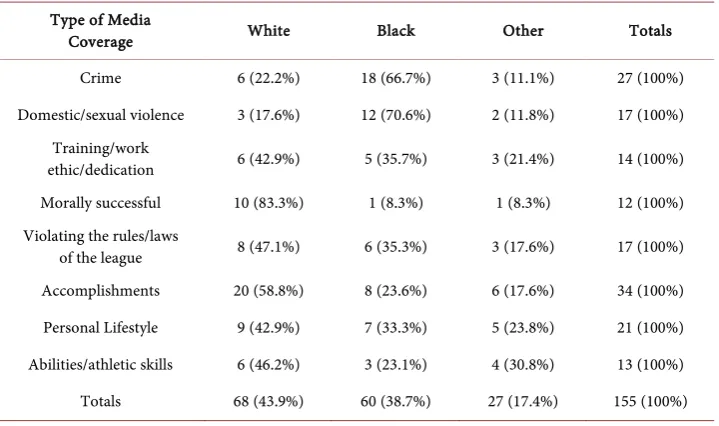
Data indicated that of the 155 media stories coded, more news stories were written about white male athletes (43.9%) than Black athletes (38.7%). A review of the data and number of stories analyzed presented in Table 1 show that of all the types of news sto-ries published, there were more positive stosto-ries involving moral successes, accomplish-ments, and training were written about white male athletes than black athletes, and the difference in this type of coverage by race was significant (p < .0001).
Analysis in Table 1 show that in terms of news stories on domestic and sexual vi-olence stories, data revealed that coverage of this topic centered more on black male athletes 70.6% than White athletes 17.6%, p < .0001. While overall, data revealed that White male athletes receive more media coverage, in terms of specific types of stories. Data also show that Black male athletes tend to be the focus of news stories about crime and domestic and sexual violence (p < .0001).
[image:10.595.195.555.484.697.2]Data also show that black male athletes receive significantly more negative media coverage than white male athletes, p < .0001. As Table 1 shows, White male athletes receive more media coverage, in terms of specific types of stories, data show that Black male athletes tend to be the focus of news stories about crime and domestic and sexual violence (p < .0001). This research shows that media tend to write more news stories about African American athletes who behave badly as opposed to writing stories that focus on how African American celebrities and African American athletes give back to society and do positive things for humankind (p < .0001).
Table 1. Thematic frames and type of story by race of athlete.
Type of Media
Coverage White Black Other Totals
Crime 6 (22.2%) 18 (66.7%) 3 (11.1%) 27 (100%) Domestic/sexual violence 3 (17.6%) 12 (70.6%) 2 (11.8%) 17 (100%)
Training/work
ethic/dedication 6 (42.9%) 5 (35.7%) 3 (21.4%) 14 (100%) Morally successful 10 (83.3%) 1 (8.3%) 1 (8.3%) 12 (100%) Violating the rules/laws
of the league 8 (47.1%) 6 (35.3%) 3 (17.6%) 17 (100%) Accomplishments 20 (58.8%) 8 (23.6%) 6 (17.6%) 34 (100%) Personal Lifestyle 9 (42.9%) 7 (33.3%) 5 (23.8%) 21 (100%) Abilities/athletic skills 6 (46.2%) 3 (23.1%) 4 (30.8%) 13 (100%) Totals 68 (43.9%) 60 (38.7%) 27 (17.4%) 155 (100%)
5. Discussion and Conclusion
As discussed in the literature review, media framing is the process by which an issue is portrayed in the news media. Prior research suggests that media frames provide boun-daries around a news story and determine what is and is not newsworthy or notable. Journalists rely on media frames to decide what to include in a story and what to leave out, a process that may be conscious, instinctive or culture-bound.
This study found support for the idea that news stories about black male athletes rely on episodic frames, or stories that are more likely to blame the black male athlete for his individual failings, such as being criminal or violent. Thus, data obtained show that journalists use news frames that may prevent most audience members from making a balanced and “objective” assessment of the situation and the black male athlete (Iyen-gar, 1991).
The present study analyzed a wide range of news stories that influence the way sports journalists frame news about male athletes. The study identified eight news frames that occur commonly in U.S. news coverage about athletes: crime, domestic/sexual violence, training/work ethic/dedication to sport; moral success; violations of league rules; per-sonal and/or professional successes accomplishments; lifestyle; and athletic prowess and skills).
This is an important study in that it sets the framework for future, more extensive investigations into the way media portray and cover male athletes, as well as athletes from different ethnic backgrounds. Data obtained in this study provides quantitative evidence of disparities found in media coverage of athletes and should serve as a begin-ning look into disparities on how news media frame black male athletes. Future re-search in this area might also be conducted to examine differences between syndicated national media versus local media to determine if differences exist in media coverage published by media sources with smaller, less diverse staff and few resources.
There has been an increasing acceptance and appreciation of the skill of athletes, but yet research suggests that there is still much to be done (Billings, 2008). One would not know of the positive contributions of black professional athletes made by reading on-line magazine and new sources, watching networks, listening to the radio or reading the sports pages. The amount and type of coverage provided to male athletes continue to yield stereotypic profiles of black athletes. It is clear that more research into this area is warranted.
6. Limitations
1) The times of sporting events, special coverage of the Olympics, playoffs, under-dogs, and other special broadcasts and sporting news may affect number or stories and type of coverage.
2) Unattainable archives and websites may prevent access to every feature story/news article written about individual male athletes.
3) Multiple events may be held at the same time, which might affect publication and ultimately the type of media coverage.
4) Televised events may affect what written and electronic media is exposed to, in-fluencing the stories for certain events.
5) U.S. media coverage will tend to focus on U.S. athletes, thus showing cultural ste-reotypes and norms.
Young black men’s aspirations to play professional sports are shaped largely, though not entirely, by television and other forms of media. Thus, it is extremely important for sports reporters and journalists to highlight other aspects of Black male athletes beyond their criminal activity and/or athletic prowess. More reporting must be done on young adolescent black boys and men, those who simultaneously perform well in classrooms and on the field or court. For example, media content could focus on positive stories that involve former Black male student-athletes who attended college, achieved aca-demic and athletic success, were engaged campus leaders within and beyond athletics, graduated in 4 - 6 years, and took divergent post-college pathways (meaning, some enrolled in graduate school, some began full-time jobs in their fields of study, and oth-ers embarked on professional sports careoth-ers). Positive stories such as this would not only advance a more complete understanding and realistic depiction of this population, but might possibly preclude the perpetuation of negative stereotypes of Black male ath-letes.
Media content and stories could also highlight personal stories of success and strate-gies that the athletes use in order to balance academics with success in athletics. Pro-ducers might also create media content that focuses on black men’s post college aspira-tions and goals and show that they aspire for careers outside of professional basketball and/or football. Media content might then be consumed by vulnerable and impres-sionable youth through stories articles and sports magazine features. Media must stop the irresponsible, biased, stereotypic journalistic practices that continually yield one- sided media coverage, news stories, and portrayals of Black male athletes.
future research in this area of sports journalism can help determine how our growing knowledge of genetics, race, and human differences may contribute to racial disparities and discrimination. In addition, we can learn how research in this area might best be presented to the public to deepen the appreciation of cultural and ethnic differences in a way that does not undermine any group of people, no matter how the group is de-fined by biological, cultural, or social status constructs.
References
Berger, A. (1991). Media Research Techniques. Newbury Park, CA: Sage.
Billings, A. C., & Eastman, S. T. (2003). Framing Identities: Gender Ethnic, and National Parity in Network Announcing of the 2002 Winter Olympics. Journal of Communication, 53, 369- 386. https:/doi.org/10.1111/j.1460-2466.2003.tb02911.x
Billings, A. C., Halone, K. K., & Denham, B. E. (2002). “Man, That Was a Pretty Shot”: An Anal-ysis of Gendered Broadcast Commentary Surrounding the 2000 Men’s and Women’s NCAA Final Four Basketball Championships. Mass Communication & Society, 5, 295-315.
https:/doi.org/10.1207/S15327825MCS0503_4
Bruce, T. (2004). Making the Boundaries of the “Normal” in Televised Sports: The Play-by-Play of Race. Media Culture & Society, 26, 861-879. https:/doi.org/10.1177/0163443704047030
de Vreese, C. H. (2005). News Framing: Theory and Typology. Information Design Journal + Document Design, 13, 48-59.
Denham, B. E., Billings, A. C., & Halone, K. K. (2002). Differential Accounts of Race in Broadcast Commentary of the 2000 NCAA Men’s and Women’s Final Four Basketball Tournaments.
Sociology of Sport Journal, 19, 315-332. https:/doi.org/10.1123/ssj.19.3.315
Entman, R. M. (1993). Framing: Toward Clarification of a Fractured Paradigm. Journal of Com- munication, 43, 51-58. https:/doi.org/10.1111/j.1460-2466.1993.tb01304.x
Entman, R. M. (2006). Young Men of Color in the Media: Images and Impacts. Washington DC: Joint Center for Political and Economic Studies.
Entman, R. M., & Gross, K. A. (2008). Race to Judgement: Stereotyping Media and Criminal De-fendants. Law and Contemporary Problems, 71, 94-133.
Entman, R. M., & Rojecki, A. (2000). The Black Image in the White Mind: Media and Race in America. Chicago, IL: University of Chicago Press.
Fujioka, Y. (2005). Black Media Images as a Perceived Threat to African American Ethnicidenti-ty: Coping Responses, Perceived Public Perception, and Attitudes towards Affirmative Action.
Journal of Broadcasting and Electronic Media, 49, 450-467.
https:/doi.org/10.1207/s15506878jobem4904_6
Gamson, W. A. (1989). News as Framing. American Behavioral Scientist, 33, 157-161.
https:/doi.org/10.1177/0002764289033002006
Gamson, W. A., & Modigliani, A. (1989). Media Discourse and Public Opinion on Nuclear Pow-er: A Constructionist Approach. American Journal of Sociology, 95, 1-37.
https:/doi.org/10.1086/229213
Gitlin, T. (1980). The Whole World Is Watching: Mass Media in the Making and Unmaking of the New Left. Berkeley, CA: University of California Press.
Halone, K. K., & Billings, A. C. (2010). The Temporal Nature of Racialized Sport Consumption.
American Behavioral Scientist, 53, 1645-1668. https:/doi.org/10.1177/0002764210368090
Krippendorff, K. (2004). Reliability in Content Analysis: Some Common Misconceptions and Recommendations. Human Communication Research, 30, 411-433.
https:/doi.org/10.1111/j.1468-2958.2004.tb00738.x
Mittell, J. (2004). Genre and Television: From Cop Shows to Cartoons in American Culture. New York: Routledge.
Oliver, M. B. (1994). Portrayals of Crime, Race, and Aggression in “Reality-Based” Police Shows: A Content Analysis. Journal of Broadcasting & Electronic Media, 38, 179-192.
https:/doi.org/10.1080/08838159409364255
Peffley, M., Shields, T., & Williams, B. (1996). The Intersection of Race and Crime in Television News Stories: An Experimental Study. Political Communication, 13, 309-327.
https:/doi.org/10.1080/10584609.1996.9963120
Rada, J. (1996). Color Blind-Sided: Racial Bias in Network Television’s Coverage of Professional Football Games. The Howard Journal of Communications, 7, 231-240.
https:/doi.org/10.1080/10646179609361727
Rainville, R., & McCormick, E. (1977). Extent of Covert Racial Prejudice in Pro Football An-nouncers’ Speech. Journalism Quarterly, 54, 20-26.
https:/doi.org/10.1177/107769907705400104
Scheufele, D. A. (2000). Agenda-Setting, Priming, and Framing Revisited: Another Look at Cog-nitive Effects of Political Communication. Mass Communication & Society, 3, 297-316.
https:/doi.org/10.1207/S15327825MCS0323_07
Scheufele, D. A. (1999). Framing as a Theory of Media Effects. Journal of Communication, 49,
103-122. https:/doi.org/10.1111/j.1460-2466.1999.tb02784.x
Scheufele, D. A., & Tewksbury, D. (2007). Framing, Agenda Setting, and Priming: The Evolution of Three Media Effects Models. Journal of Communication, 57, 9-20.
https:/doi.org/10.1111/j.1460-2466.2006.00326.x
Stone, J., Perry, Z. W., & Darley, J. M. (1997). White Men Can’t Jump: Evidence for the Percep-tual Confirmation of Racial Stereotypes Following a Basketball Game. Basic and Applied Social Psychology, 79, 291-306.
Tuchman, G. (1978). Making News: A Study in the Construction of Reality. New York: Free Press.
Submit or recommend next manuscript to SCIRP and we will provide best service for you:
Accepting pre-submission inquiries through Email, Facebook, LinkedIn, Twitter, etc. A wide selection of journals (inclusive of 9 subjects, more than 200 journals)
Providing 24-hour high-quality service User-friendly online submission system Fair and swift peer-review system
Efficient typesetting and proofreading procedure
Display of the result of downloads and visits, as well as the number of cited articles Maximum dissemination of your research work