Sociology Dissertations Department of Sociology
Summer 8-18-2010
Scrapworthy Lives: A Cognitive Sociological
Analysis of a Modern Narrative Form
Stephanie R. Medley-Rath
Georgia State University
Follow this and additional works at:https://scholarworks.gsu.edu/sociology_diss
Part of theSociology Commons
This Dissertation is brought to you for free and open access by the Department of Sociology at ScholarWorks @ Georgia State University. It has been accepted for inclusion in Sociology Dissertations by an authorized administrator of ScholarWorks @ Georgia State University. For more information, please [email protected].
Recommended Citation
Medley-Rath, Stephanie R., "Scrapworthy Lives: A Cognitive Sociological Analysis of a Modern Narrative Form." Dissertation, Georgia State University, 2010.
by
STEPHANIE R. MEDLEY-RATH
Under the Direction of Ralph LaRossa
ABSTRACT
Over the past 20 years, scrapbooking has become immensely popular in America. This
dissertation is the study of scrapworthy lives, that is, how lives become structured by
scrapbooking and how people show others that their own life and the lives of their loves ones are
value—or scrapworthy. I conducted in-depth interviews with 38 scrapbookers, 11 scrapbook
industry workers, and 10 family and friends of scrapbookers. I also used photo-elicitation
interviewing techniques with both the scrapbookers and the family members and friends of 10
scrapbookers to examine a selection of scrapbook pages the respondents had completed. I used
grounded theory methods to analyze my data, providing a more thorough understanding of
the larger society can be seen within the scrapbooking thought community. Moreover, through
scrapbooking, people can demonstrate their membership in other thought communities (e.g.,
motherhood). Though scrapbookers are able to demonstrate their gender, family status, race,
ethnicity, and religion through scrapbooking, the hobby is done primarily for the scrapbookers
and not for others. Scrapbooking is a leisure activity, though some may consider it as a form of
work.
Scrapbookers are a thought community in their own right and an excellent site to explore
Zerubavel‟s (1997) six cognitive acts (i.e., perceiving, classifying, reckoning time, attending,
assigning meaning, and remembering). In particular, scrapbookers come to classify nearly
everything (including people, things, time, and space) in the world around them as either
scrapworthy or not.
Scrapbooks are a modern narrative form, though versions of scrapbooks have been
around for centuries. Scrapbooks are memorials about everyday life. The content of scrapbooks
is what is left out of the typical history book but is considered just as memorable by
scrapbookers. Scrapbookers are storytellers. These stories could just as easily be passed down
orally or recorded on blogs and some scrapbooks combine elements of oral histories and blogs.
Ultimately, scrapbooks are memorials about the scrapbooker.
INDEX WORDS: Scrapbook, Cognitive sociology, Doing gender, Doing family, Narrative,
by
STEPHANIE R. MEDLEY-RATH
A Dissertation Submitted in Partial Fulfillment of the Requirements for the Degree of
Doctor of Philosophy
in the College of Arts and Sciences
Georgia State University
Copyright by
Stephanie R. Medley-Rath
by
STEPHANIE R. MEDLEY-RATH
Committee Chair: Ralph LaRossa
Committee: Wendy Simonds
Adia Harvey Wingfield
Electronic Version Approved:
Office of Graduate Studies
College of Arts and Sciences
Georgia State University
DEDICATION
ACKNOWLEDGMENTS
I have had a lot of support throughout the dissertation process. I thank my mom and dad,
Kay and Mike Medley, for always supporting me throughout my academic training.
I thank my mom and husband, Rob for providing childcare and entertainment to my
daughter, Rachel so I could conduct, transcribe, and analyze interviews and also so I could write
my dissertation. I thank my dad for providing childcare so that I could actually defend my
dissertation. I also thank my husband for his support throughout my schooling. He has been a
part of my life since before I chose sociology as a major and even moved across the country with
me when I decided to attend graduate school. He now knows more about sociology and
scrapbooking than he ever thought he would.
I am thankful for the owner of a local scrapbook store for hiring me in 2003 despite my
little experience as a scrapbooker. My life has been forever changed. I scrapbook everything and
have completed a doctorate about scrapbooking. I had no idea either of these things would ever
be true about me.
I thank every single person who volunteered for this study and shared their scrapbooks
with me. Each of you provided valuable information and also inspired me to scrapbook in new
ways. I am forever changed by each of you. Keep on scrapbooking.
I thank my dissertation chair, Ralph LaRossa, for putting up with my procrastination,
supporting this project, but most of all for giving me the idea that my work in a scrapbook store
could turn into something as big as a dissertation. I still remember the day I told him I worked in
a scrapbook store and the light bulb appeared above his head back in 2003 before I had
I also thank my dissertation committee members, Wendy Simonds and Adia Harvey
Wingfield. I thank Wendy for challenging me to write a more convincing dissertation and
correcting my many typographical errors. I thank Adia for joining my committee even though we
did not know each other outside of this project. She challenged me to think about my topic in
new and interesting ways.
I want to thank my classmates and professors through my graduate school years who
have read very early incarnations of this project and provided feedback and support. I am
grateful for Saori Yasumoto who made sure everyone that needed a copy of my dissertation
received a copy before my defense. I also must thank my proofreaders: Kay Medley, Lindsey
TABLE OF CONTENTS
ACKNOWLEDGMENTS v
LIST OF TABLES
LIST OF FIGURES
x
xi
CHAPTER 1: INTRODUCTION 1
1.1 THE GROWTH OF SCRAPBOOKING
1.2 PREVIOUS RESEARCH ON SCRAPBOOKING
1.3 SCRAPWORTHY LIVES
1.4 A NOTE ON TERMS
6
9
12
15
CHAPTER 2: THEORETICAL FRAMEWORK
2.1 COGNITIVE SOCIOLOGY
2.2 SYMBOLIC INTERACTIONISM
2.3 ETHNOMETHODOLOGY
17
17
29
32
CHAPTER 3: METHODS
3.1 SAMPLE
3.3 INTERVIEWS
3.4 GROUNDED THEORY METHODS
CHAPTER 4: THE SCRAPBOOKING THOUGHT COMMUNITY
4.1 SOURCES OF SCRAPBOOKING NORMS
4.2 SCRAPBOOKING NORMS
4.4 SCRAPBOOKING IS DEVIANT
4.5 SCRAPBOOKERS VIEW THE WORLD DIFFERENTLY
4.6 BECOMING A SCRAPBOOKER 100
CHAPTER 5: DOING GENDER, FAMILY, RACE, ETHNICITY, AND
RELIGION
5.1 DOING GENDER
5.2 DOING FAMILY
5.3 DOING RACE AND ETHNICITY
5.4 DOING RELIGION
CHAPTER 6: SCRAPBOOKING AS A CLASSIFICATION SYSTEM
6.1 WHAT IS A SCRAPBOOK?
6.2 WHO ARE SCRAPBOOKERS?
6.3 WHERE DO YOU SCRAPBOOK?
6.4 HOW DO YOU SCRAPBOOK?
6.5 IS IT SCRAPWORTHY?
6.6 BOUNDARIES BETWEEN HOBBY, HOME, AND WORK
112 112 120 140 143 146 147 154 158 175 202 217
CHAPTER 7: TIME
7.1 SPENDING TIME
7.2 THE SPEED OF TIME
221
222
237
CHAPTER 8: SOCIAL MEMORIES
8.1 CULTURAL CHANGES
8.2 COLLECTIVE FAMILY MEMORY
8.3 IMITATION AND REPLICATION
8.4 PERFECT MEMORIES
241
242
248
250
CHAPTER 9: CONCLUSIONS
9.1 IMPLICATIONS
9.2 LIMITATIONS AND FUTURE RESEARCH
9.3 FINAL THOUGHT
257
257
262
265
REFERENCES 267
APPENDICES
APPENDIX A. RECRUITMENT FLYERS
APPENDIX B. INFORMED CONSENT
APPENDIX C. PARENTAL PERMISSION
APPENDIX D. DEMOGRAPHIC SHEET
APPENDIX E. INTERVIEW GUIDES
APPENDIX F. DEMOGRAPHICS OF YOUR SCRAPBOOKS SURVEY
APPENDIX G. DEMOGRAPHICS OF YOUR SCRAPBOOKS RESULTS
291
291
296
299
302
304
308
LIST OF TABLES
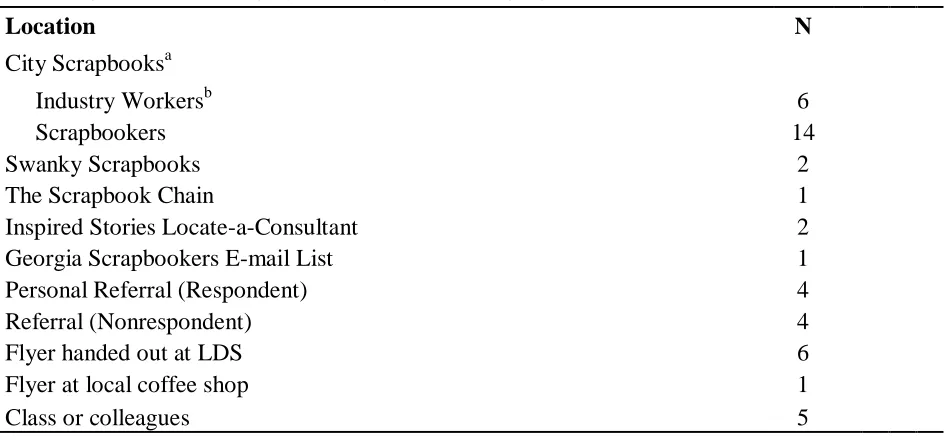
TABLE 3.1. WHERE RESPONDENTS WERE RECRUITED 41
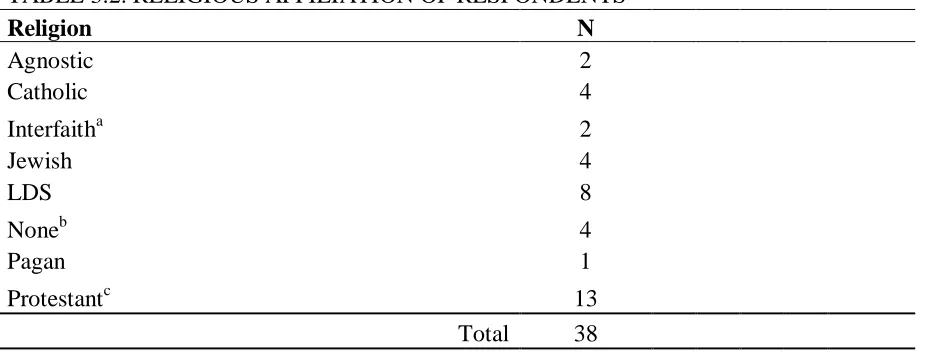
TABLE 3.2. RELIGIOUS AFFILIATION OF RESPONDENTS
TABLE A.1. NUMBER OF RESPONDENTS REPORTING SCRAPBOOKING THE
FOLLOWING THEMES
46
LIST OF FIGURES
CHAPTER 1: INTRODUCTION
Over the past 20 years scrapbooking has grown from an obscure, kitschy craft
stereotypically practiced by grandmothers and Mormons, to an economic powerhouse practiced
by men and women of all walks of life. Though economically scrapbooking has leveled off, it is
still an incredibly popular hobby. Scrapbooking involves arranging photographs, journaling1 a
story, and placing embellishments2 (e.g., stickers), memorabilia3 (e.g., a ticket stub), or both on
archival4 paper and then placing the page in a scrapbook album5 (i.e., an album specially
designed to hold scrapbook pages6) telling a story about a life or a subject in a way a
conventional photo album does not.
In this dissertation I present the results of 59 interviews with scrapbookers, family and
friends of scrapbookers, and industry workers to elucidate how scrapbooking is currently
practiced and understood. My research draws on cognitive sociology, symbolic interactionism,
1
Journaling refers to the words on the scrapbook page that tell the story of the photographs.
2
An embellishment is a decoration such as a sticker, chipboard, or ribbon; they are items
included in the scrapbook that are not the paper background, photographs, or journaling.
3
Memorabilia includes items collected from everyday life serving as souvenirs, such as ticket
stubs or wedding invitations.
4
Paper designed for use in scrapbooks is acid-free and lignin-free and plastic page protectors
that hold the scrapbook pages are PVC-free. Acid, lignin, and PVC can all damage and degrade
photographs over time. Lignin naturally occurs in wood and causes paper to degrade.
5
A scrapbook album is the book form that contains scrapbook pages.
6
and ethnomethodology for a theoretical framework. Overall, I argue that the lives of
scrapbookers come to be structured in terms of scrapworthiness—everything comes to be
scrapworthy or not, including, but not limited to people, everyday items, and time. Like other
leisure activities, scrapbooking “shape[s] the meanings people give to their lives” just like
“work, family, and religion” (Gillespie, Leffler, and Lerner 2002:285). Before discussing my
results in detail, I now provide a literature review about scrapbooking and photographs.
LITERATURE REVIEW
Scrapbooks have existed for centuries. Mark Twain actually sold a patented scrapbook in
1873, Giorgio Vasari recommended storing art in albums similar to scrapbooks in 1551, and
memory keeping in general has been practiced since at least the early Greeks7 (Ott, Tucker, and
Buckler 2006). Despite this long history, only recently has the hobby of scrapbooking gained
currency as an actual hobby.
Many scrapbooks preserve a family‟s history (Donofrio 2005; Gagnon 2004; Maguire
2005; Mire 2004; Schoen 2004) and are meant to be passed down to future generations within
the family (Broili 2005). As this research shows, however, how the popular press characterizes
scrapbooking is not necessarily how scrapbookers see it.
The center of most scrapbooks is photographs, but the scrapbook provides more detail
than a photograph alone; therefore, it is appropriate to consider the literature on photography
when discussing scrapbooking. Scrapbooks are like photographs in that they visually preserve
memories (Walker and Moulton 1989), tell us something about ourselves (Caufield 1996;
7
See Tucker, Ott, and Buckler (2006) for a more thorough description regarding the history of
Prosser 1998), and are a significant part of social rituals (Blyton 1987; Goffman [1976] 1979;
Reiakvam 1993). According to Orvell (2003), “we can hardly conceive of an event „happening‟
unless it has been photographically recorded” (p. 161) (see also Holland 1991). The photograph,
as Orvell (2003) sees it, provides proof (see also Beloff 1985; Cronin 1998; Ferrarotti 1993;
Reiakvam 1993). Photographs, however, only provide proof of what was physically in the view
of the camera‟s lens, can contain a lot of information, and “are a minute time sample—a
hundredth-of-a-second slice of reality” (Collier Jr. and Collier 1986:13). Though photographs
serve as evidence and memory prompts, they are just a sample of what really happened.
Photographs do tell a story, but that story can be easily manipulated (Blyton 1987;
Dowdall and Golden 1989; Harper 1998). Scrapbooks tend to tell more of a story than a
photograph alone and can also be edited, but are still an important source of information about
how people live. Moreover, what really happened might not even matter. What might be more
important is what image and what story the photographer or scrapbooker chooses to share.
Photographs (and scrapbooks) are deeply important to people and are mentioned as things
that people would save if their house were on fire (Noble 2004; Smith 1999). People have a deep
relationship with photographs, finding them difficult to throw away. Cutting or tearing a
photograph is considered as an act of violence (Mavor 1997) and beginning scrapbookers often
have great difficulty cutting their photographs as scrapbookers commonly do for their albums.
People have such difficulty throwing away photographs that they will sell photographs of
unknown people in a rummage sale and restaurateurs will hang up these photos of unknown
people on the walls of popular chain restaurants.8
8
In particular, photographs preserve the memory of close relatives (Csikszentmihalyi and
Rochberg-Halton 1981). To throw photographs of people away would be like throwing away
someone‟s child or father. The importance of photographs can be further seen by what is stored
with photographs: marriage certificates, love letters, and other important family documents
(Seabrook 1991).
Photographs of family members are for many people, especially women, their favorite
possession (Wallendorf and Arnould 1988). Photographs can stand-in for the people in the
photograph (Musello 1979), especially if “they are far away, or grown up, or dead” (Beloff
1985:9). Moreover, scrapbooks are becoming an important addition to funerals because of their
ability to keep a person‟s memory alive.
Important possessions are an extension of a person‟s self and allow a person to know
one‟s past and the past of her or his family (Belk 1988). Handcrafted possessions, such as
scrapbooks, are especially important. In contrast to mass-produced possessions, handcrafted
possessions take longer to create and therefore more of a person‟s self is part of the finished
product (Belk 1988). In this way, scrapbooks are so much bigger than the photographs they
contain.
In a scrapbook, individuals can create proof of their existence, memorializing their life
and the lives of their loved ones. Studying scrapbooking allows the researcher to explore what
people remember and choose to memorialize for future remembering. Moreover, scrapbooking is
therapeutic (Cass 2004; Chadwick 2004; Donofrio 2005; Geering 2004; Meeks 2005; Murray
2005; Nolan 2004; O'Malley 2004; Sheridan 2005), a stress reliever (Dempsey 2004; Nies 2004),
a form of relaxation (Eaton 2004; Levy 2003; Pederson 2003), a form of escape (Adkins 2005;
time scrapbooking is described as an addiction (Broili 2005; Burt 2005; Francis 2004; Gagnon
2004; Kelley 2005; Levy 2003; Nies 2004; Tayler 2004), an obsession (Brokaw 2004;
Hennebury 2006; Sauer 2004), and a passion (Hennebury 2006; Johnson 2004). Scrapbooks and
scrapbooking, then, do much more than provide a narrative of a person‟s life.
As a narrative, scrapbooks are autobiographical occasions, which Vinitzky-Seroussi
(2000:57), following Zussman (1996), defines as “an opportunity to constitute an identity, to lay
claim to one‟s own life, to the right to tell one‟s own story.” Scrapbooks can be autobiographical
because they often memorialize the scrapbooker‟s life and what is important to her or him (see
Stewart 1993). Scrapbooks, like autobiographies, are a great source to better understand
Goffman‟s (1959) concept of “self” because in an autobiography, authors are free to present their
“selves” in a favorable light (Bjorklund 1998). Scrapbooks, however, are also distinct from
autobiographies and memoirs because the latter are completed further away from the time of the
event and tend to include more reflection (Buckler 2006). Overall, scrapbooking is an occasion
for impression management and therefore an important source to explore how people do this
(Demos 2006).
Though scrapbooks are autobiographies, scrapbookers are storytellers; and as storytellers
they are constructing the reality of their lives via scrapbooking. Scrapbookers, however, do not
create scrapbooks in isolation—scrapbooks and scrapbookers are also products of our society.
The scrapbook industry, in particular, influences scrapbookers—in sometimes unobvious ways.
For example, people may not think about scrapbooking the photographs he or she took when
remodeling her or his home until seeing stickers made for scrapbooks about home remodeling.
Ultimately, a scrapbook is a medium in which people can tell their stories. Alternatively,
process of scrapbooking should be explored instead of relying only on analysis of the end
product. In this dissertation, this process will be illuminated, but first I discuss a brief history of
the growth of scrapbooking, previous sociological research on scrapbooking, and scrapbooking
terms.
THE GROWTH OF SCRAPBOOKING
The first scrapbooking store opened in Spanish Fork, UT in 1981 (Davis 1997; Helfand
2008) and later became the first online scrapbook store in 1996 (Helfand 2008; Scrapbook
Classroom 2008). Scrapbooking grew from a nearly non-existent industry in 1995 (Davis 1997)
to a $2.5 billion industry in 2003 (Castleman 2003). The Hobby Industry Association went from
having zero booths devoted to scrapbooking product at their annual trade show in 1996 to 100
booths in 1997 (Davis 1997). Though the scrapbooking industry experienced a sharp increase in
its early days, sales have declined since about 2004 (Crow 2007). At its peak, scrapbooking was
said to be more popular than golf. The pervasiveness of scrapbooking, however, is open to
debate due to flawed industry sponsored marketing research.
According to one allegedly nationally representative study, nearly 30 percent of U.S.
households have at least one member who scrapbooks (CK Media 2007). Another study from
Scrapbooking.com found “that only 1.7 percent of the American population, or 4.5 percent of
women between the ages of 16 and 64” scrapbook (Conforto 2007:7). Finally, a third study by
the Craft & Hobby Association suggests that 12 percent of households contain a scrapbooker
(Anonymous 2007). I believe the truth lies somewhere in between. Part of the difficulty in
assessing how many households or how many people scrapbook has to do with what counts as a
scrapbook and the fact that many people may scrapbook but do not identify as scrapbookers. Part
these studies, as the data are sold for marketing purposes rather than shared for free with
anyone.9
9
I contacted the authors of two of the studies (the CK Media and Scrapbooking.com study). I
could not get anywhere with CK Media. The company was sold in 2009 and I could find no
information beyond a press release from 2005 regarding their 2004 survey. In December 2003,
“[t]hree scrapbooking-related questions were distributed to 40,000 households as part of a large
general study; 65 percent of households responded. Phase II of the survey, conducted by Rose
Market Research, targeted 2,500 households that were identified as scrapbooking households in
order to create a consumer profile by querying them on their spending habits, supplies and
resources used, time spent on the hobby, etc. Thirty-five percent of households responded”
(Anonymous 2004:n.p.). The author of the Scrapbooking.com study did follow-up with me.
Conforto (2009), the author of the study, described how their study was superior to the CK
Media (2007) study but he still did not use random sampling or get any sort of nationally
representative sample. Scrapbooking.com has surveys on their website every week that visitors
of the website can choose to complete. The first problem is that the only people who might
complete their survey are people visiting Scrapbooking.com—people who are likely to be
scrapbookers. Their sample may be large and may provide a better picture regarding the number
of scrapbookers in America, but they still are not very accurate in terms of being representative.
Conforto (2009) was critical of the CK Media (2007) survey in that he argued the company
over-inflated their numbers to make the industry appear much larger than it actually was so that they
could sell their company. I do not doubt this at all. CK Media sold their results to scrapbook
Even less is known about how large the scrapbook industry is outside the U.S., but it is an
international industry. For example, Creative Memories® has consultants in eight countries10 and
its word stickers are available in English, French, and Spanish. Scrapbooking is how many
middle class citizens of the world are passing down their family histories and stories.
Scrapbooking is classed because it is not free, like oral histories. For example, American
scrapbookers spend approximately $90 a year on scrapbooking supplies (CK Media 2007).
Scrapbooking may exist in many Western Nations, but it is by far most common in the United
States. This is not because people in other societies do not want to scrapbook, but it is due to the
nature of the industry. Most of the manufacturers of scrapbook supplies are based in the United
States so once shipping costs are factored into the cost of supplies the hobby becomes
cost-prohibitive for many outside the United States.
Scrapbooking is different from traditional forms of storytelling such as oral histories, in
that there is an entire industry devoted to this form of narrative. The scrapbooking industry is an
example of an industry “devoted to telling people how to do biography” (LaRossa and Sinha
2006:434). Scrapbook manufactures choose what they will produce and in this way shape the
wonder that many scrapbook stores have had to close because they were and still are being sold
bad market research data.
10
These countries are: Australia, Austria, Canada, Germany, Japan, New Zealand, United
Kingdom, and the United States (Creative Memories® 2010). Creative Memories® expanded to
South Africa in 2004 and left in 2008. Creative Memories® products are still sold in South
Africa through a distributor called Forever Memories (whose owner was a South African
stories that people consider for their scrapbooks. Scrapbooking to preserve family stories has
become normalized to the point that one wonders how non-scrapbookers preserve their family
stories. Moreover, scrapbooks provide evidence that something “really” happened in a society
requiring evidence for nearly everything. For instance, one respondent shared a scrapbook page
about her grandchild sitting up as a newborn and talked about how no one would have believed
her without the photograph.
The number of scrapbookers may be open to debate, but what is not open to debate is that
scrapbooking is incredibly important to many of the people who do it. Furthermore, what
scrapbookers do is important work because they memorialize the things that often get left out of
the history books. In this way, they provide rich detail about how people lived—even if it is a
biased account (like any other historical account). Scrapbooking, also, has largely been
overlooked by scholars as a serious source of inquiry, which I now be discuss.
PREVIOUS RESEARCH ON SCRAPBOOKING
Previous scholars provided valuable sociological information about scrapbooking as I
discuss throughout this dissertation. This dissertation builds on the work started by Demos
(2006), Downs (2006), Goodsell and Seiter (2010), Kelly and Brown (2005), and Stalp and
Winge (2008) who all examine how scrapbookers socially construct gender and family through
scrapbooking. This research, however, differs in significant ways.
Both Demos (2006) and Downs (2006) observed in-store crops11and interviewed 30 and
42 scrapbookers respectively. Downs (2006) interviewed 24 additional women scrapbook
11
An in-store crop refers to people scrapbooking together in a store. The act of scrapbooking is
industry workers and completed a discourse analysis of a selection of layouts12—one or more
scrapbook pages that tell a story—from approximately two scrapbooks self-selected from each of
her respondents. Kelley and Brown (2005) interviewed 11 women scrapbookers who were part
of a scrapbooking club. Demos (2006), Downs (2006), and Kelley and Brown (2005) miss a
large segment of scrapbookers, by focusing on scrapbookers who attend crops and belong to
scrapbooking clubs. Not all scrapbookers could be thought of as scrapbookers who attend crops,
as my research clearly indicates. Only a few of my respondents ever crop with other people and
even fewer crop at stores. Moreover, cropping at stores is becoming less common because there
are fewer scrapbook stores that remain open, compared to when these researchers collected their
data.
Demos‟ (2006) sample ranged in age from 20-70. Most of her respondents had children
(80 percent), worked at least part-time (60 percent), were married (84 percent), and were white
(80 percent). Downs‟ (2006) sample overwhelmingly included married, white women. Neither
researcher interviewed men. Kelley and Brown‟s (2005) sample ranged in age from 33-58, most
had children, and all were white women. My sample fits this model yet differs in important ways
in terms of gender, race, marital status, parental status, sexual identity, and religion, as will be
discussed in greater detail in Chapter 3.
Goodsell and Seiter‟s (2010) research is different in that their focus of analysis was 998
scrapbook pages (11 volumes) that all belong to one woman scrapbooker (who was white,
middle-class, married, and a mother). Though their sample is derived from one person, it is an
12
important study in that they focused on how the life history of a family changes over time and
how the scrapbooker‟s scrapbooking style changes over time.
Finally, Stalp and Winge (2008) did not focus exclusively on scrapbookers but instead
interviewed 44 handcrafters, which included scrapbookers. This study is important because the
authors focus on how handcrafters collect and hoard raw materials to create their crafts and how
they negotiate their crafts with others, especially those sharing the same living space. Their
research shows that scrapbookers are a segment of a larger group of people sharing common
discourse and challenges as handcrafters.
This research builds on the work of previous scholars, yet also explores many areas that
they overlooked. For example, my sample includes men and child-free women, both of whom
are generally thought not to scrapbook at all. I interviewed 59 scrapbookers, industry workers,
and family and friends of scrapbookers and used grounded theory methods to provide a more
thorough understanding of scrapbooking and how people come to have scrapworthy lives.
In addition to differences in my sample compared to other scholars, my theoretical
framework also differs. Other scholars have used symbolic interactionism (Kelly and Brown
2005), cultural capital (Goodsell and Seiter 2010), and family discourse theory (Downs 2006;
Goodsell and Seiter 2010) to frame their research. Demos (2006) employed Goffman‟s
presentation of self, a feminist perspective (i.e., second shift, feeding the family), and collective
memory as her theoretical framework. This research too, relies on symbolic interactionism as
part of the theoretical framework. My research differs in that it relies on cognitive sociology to
frame the project. In particular, my research illustrates how thinking is socially constructed; that
SCRAPWORTHY LIVES
The story that this dissertation tells is about how scrapbooking is a way to both view the
world and communicate that one‟s life has value. Most scrapbookers come to view the world
through the eyes of a member of the scrapbooking subculture or thought community.
Scrapbooking becomes a structure through which they live their lives. Moreover, by
scrapbooking their lives and the lives of their loved ones, scrapbookers are communicating that
their life and the lives of scrapbooked others have value because they are worth remembering.
Scrapbooks are memorials.
My theoretical framework draws on cognitive sociology, symbolic interactionism, and
ethnomethodology. Examples of how the six cognitive acts (i.e., perceiving, classifying,
reckoning time, attending, assigning meaning, and remembering) are shaped by scrapbooking are
the basis of several chapters of this dissertation. Symbolic interactionist theory provides the basis
for exploring how people give meaning to their lives through scrapbooking. In Chapter 2, I detail
how cognitive sociology, symbolic interaction, and ethnomethodology are relevant to this study.
I explain my methodology in Chapter 3. I discuss my sample, data collection methods,
and methods of analysis. I interviewed 59 scrapbook industry workers, scrapbookers, and family
or friends of a scrapbooker. My interviews were structured with an interview guide but follow-up
questions were asked where appropriate. In my interviews with scrapbookers and a family or
friend of a scrapbooker, I used photo-elicitation interview techniques to learn more about the
actual scrapbooks that are being made. Finally, I used grounded theory methods to analyze my
data.
The discussion of my results begins in Chapter 4 where I explain how the scrapbooking
what the norms of scrapbooking include, and how scrapbooking comes to shape one‟s
perspective. I focus on how the language of deviance is used by scrapbookers to describe their
hobby despite the fact scrapbookers themselves do not explicitly consider themselves to be
deviant. Lastly, I explore the process of becoming a scrapbooker.
In Chapter 5, I address how gender, family, race, ethnicity, and religion both shape and
are shaped by scrapbooking. To talk about scrapbooking is to talk about gender because most
scrapbookers are women. This research provides further evidence of how people “do gender”
(i.e., the social construction of gender) through scrapbooking. In other words, scrapbookers
demonstrate their gender through scrapbooking. Moreover, family is socially constructed through
scrapbooking (both by the actual scrapbooker and their family), by scrapbookers with and
without children. Scrapbooking is also a site where race, ethnicity, and religion are socially
constructed. In sum, scrapbooking allows people to demonstrate both achieved and ascribed
statuses.
In Chapter 6, I explain how scrapbooking is a classification system. Here, I talk about
how scrapbooks are distinct from other forms of personal recordkeeping (e.g., diaries or photo
albums), who scrapbookers are (e.g., artists, historians, or crafters), where scrapbooking takes
place, how people scrapbook, and what the rules of scrapbooking are. In this chapter, I introduce
the core variable, scrapworthiness, which is what guides the other topics in this chapter and the
rest of the dissertation. Finally, I close this chapter with a discussion about how scrapbooking
reinforces and blurs the boundaries between home and work.
Scrapbooking is a site to explore the social construction of time, which I address in
Chapter 7. Choosing to scrapbook means choosing to spend time scrapbooking (i.e., in leisure)
they choose to spend some of their (free) time scrapbooking, not because they have the (free)
time to scrapbook and others do not. Lack of time is a standard accepted explanation as to why
someone does not do something, yet this explanation is rarely challenged in any way. Time is
also given as a reason as to why scrapbooking has increased in popularity. In particular, my
respondents talk about how life is more fast-paced than it was in the past, which draws people to
scrapbooking.
In Chapter 8, the discussion turns to how memory is shaped by society. Scrapbookers
exemplify the value society places on both photographs and memories and how the two are
connected. Here, my respondents draw on similar explanations as to why scrapbooking increased
in popularity in the early 2000s. Because scrapbooks often chronicle family life, they are a
source of collective family memory. Moreover, I assess the validity of the criticism scrapbookers
receive for over-emphasizing the positive and neglecting the negative altogether in their
scrapbooks—focusing on perfect memories. These memories—especially positive memories—
tend to be shaped by the calendar. Scrapbooks are calendar-like and in fact, are often organized
chronologically. The calendar-like aspect of scrapbooking allows the researcher to explore what
dates people are likely to scrapbook. Finally, I explore how scrapbookers use imitation and
replication in their scrapbooks as this process often attempts to recreate past time periods within
specific scrapbook types.
I conclude this dissertation in Chapter 9. Here, I discuss the limitations of this study and
questions and concerns future research should address. I conclude with a discussion of this
dissertation‟s contribution to sociology. Before proceeding to my discussion of my theoretical
framework, it is important to provide a note on the terms I use in this dissertation because there
A NOTE ON TERMS
I have chosen to use the words artists, crafters, hobbyists, and handcrafters
interchangeably when referring to scrapbookers. As I discuss in Chapter 6, scrapbookers
consider their work to be both an art and a craft, which is consistent with previous research (see
Kelley and Brown 2005). Craft refers to “consumption activity in which the „product‟ concerned
is essentially both „made and designed by the same person‟ and to which the consumer typically
brings skill, knowledge, judgment and passion while being motivated by a desire for
self-expression” (Campbell 2005:23). In Western Society, art is typically thought of as that which is
exhibited and sold (Nelson, LaBat, and Williams 2005) and being housed in an art museum
confirms its status as art (Peterson 2003). For the most part, scrapbooks are not exhibited or sold
but that does not mean they are not a form of art. One industry leader, Creative Memories®,
prefers the term album-making instead of scrapbooking because “scrapbooking is viewed as a
hobby or a craft, while making keepsake albums is about building connections enriching our
lives, and leaving a lasting family legacy” (Lightle and Anderson 2002:4). My research finds that
most people who are making scrapbooks are also “building connections, enriching our lives, and
leaving a lasting family legacy” as Lightle and Anderson (2002:4) suggest. The point is, that the
terms are used inconsistently and different thought communities want to prevent these terms
from being diluted by others. Nelson et al. (2005) argue that leisure activities done
predominantly by women, such as textile art (e.g., quilting, knitting, crocheting), are typically
not elevated from crafts to art by outsiders. Outsiders (and even insiders) may reflect this line of
thinking with regards to scrapbooking. Others suggest that scrapbooking of the past may have
been a craft, but today it is “a sophisticated art form” (Fantin 2010:n.p.). At the very least
and may be considered as either casual leisure13 (Stebbins 1982; 1997; 2001) or serious leisure14
(Stebbins 1982; 1992; 2001).
13
Stebbins (2001:58) defines casual leisure “as immediately, intrinsically rewarding, relatively
short-lived pleasurable activity requiring little or no special training to enjoy it.”
14
The six qualities of serious leisure are “the occasional need to persevere,” making it a career,
effort (acquired knowledge, training, or skill), durable benefits or outcomes, an identity found
CHAPTER 2: THEORETICAL FRAMEWORK
I use cognitive sociology, symbolic interactionism, and ethnomethodology for my
theoretical framework because these theoretical perspectives allow the researcher to further
understand how thought processes are socially patterned and how people assign meaning in their
lives. Most scrapbooks are assembled individually, yet are socially patterned. Moreover, what is
considered scrapworthy is typically taken for granted. These theoretical perspectives allow me to
challenge the taken-for-granted world of scrapbooking. The world of scrapbooking is also an
important site for exploring gender, race, and class in society as scrapbooking is gendered, raced,
and classed.
COGNITIVE SOCIOLOGY
Which stories are included in a scrapbook and how these stories are told within the
scrapbook is determined by the individual scrapbooker in interaction with her or his society. For
example, a scrapbooker might include the wedding program, engagement announcement, and
photographs of the wedding party, guests, cake, and so on in a scrapbook about a wedding. The
bride creating this scrapbook of her wedding would probably include photographs from the
honeymoon. She might even include photographs of the inside of the hotel room. It is highly
unlikely, however, that she would include any photographs or journaling detailing any sexual
intimacy beyond photographs of her and the groom kissing at the wedding ceremony in her
scrapbook that holds the story of her wedding. In this research, for example, only one
scrapbooker out of 38 showed me any scrapbook pages that included adult nudity. Clearly, some
subjects are scrapworthy and some are not. Berger and Luckmann‟s (1966) social construction of
reality perspective helps illuminate the process scrapbookers use to determine scrapworthiness.
perspective that is grounded within the society in which he or she resides. Using a social
construction of reality perspective allows me to understand the commonsense knowledge and
taken for granted world of scrapbookers and learning what is and is not scrapworthy.
A cognitive sociological focus is on intersubjectivity—in contrast to subjectivity and
objectivity. Zerubavel (1997) explains that intersubjectivity means that our experiences are based
not on personal experience alone (i.e., subjectivity) or are logically inevitable (i.e., objectivity)
but instead bridge these two thought processes in socially patterned ways. A memory may seem
subjective but through being corroborated by another person is shown to actually be
intersubjective. For example, one respondent says that she and her mom share photographs.
During our interview with her and her mother, this respondent said “this was one example of
how if we both have taken pictures at the same time that we share them so that we can each take
whatever is useful for what it is that we want to remember.” In this way, pages are made about
memories they intended to remember and pages are made of memories they had not considered
prior to seeing the photographs taken by the other person. Scrapbooking is an excellent place to
learn more about intersubjectivity because scrapbooks make memories concrete. Others can view
the scrapbook and assess the memory for accuracy.
Drawing on Berger and Luckmann‟s (1966) social construction of reality perspective and
Mannheim‟s (1936 [1929]) sociology of knowledge, Zerubavel (1997:5) outlines a theory of
cognitive sociology to help “explain why our thinking is similar to as well as different from the
way other people think.” In other words, a person‟s thought patterns are influenced by one‟s
socialization or thought community, which is like a subculture. Each person belongs to multiple
thought communities, leading to multiple perspectives of the world. One scrapbooker included
nudity were scrapbook layouts chronicling Pagan rituals. This respondent belongs to the thought
communities of scrapbookers and Pagans, among others. For her, adult nudity in the scrapbook
was perfectly normal, whereas most other respondents felt nudity was something that was
definitely not scrapworthy.
In addition to providing theoretical insights for understanding how thinking is socially
patterned yet also individually determined, Zerubavel (1997) identifies six cognitive acts to
illustrate this process. The six cognitive acts are: perceiving, classifying, attending, assigning
meaning, remembering, and reckoning time.
Perceiving is influenced by a person‟s previous experiences and by others‟ perceptions.
Becoming a scrapbooker actually changes how a person interacts with and perceives the world.
The scrapbooker now views the world through the lens of a scrapbooker. For example, going on
vacation is no longer just a chance to explore a new place or relax but it is now a chance to
collect items for the scrapbook. The menu at the restaurant is no longer just a menu to choose
food from but is now an item to include in the scrapbook so that the person remembers every
detail about the food he or she ate while on vacation. What other vacationers might view as trash,
the scrapbooker views as memorabilia. Memorabilia is anything that the scrapbooker infuses
with meaning that can stand in for something on the scrapbook page; in other words, symbols.
The scrapbooker does not just include anything and everything, but is selective—classifying
some items as scrapworthy and other items as not scrapworthy. Memorabilia can be considered
as souvenirs which symbolize a physical memory (Stewart 1993). Zerubavel (1997) would
consider memorabilia to be social souvenirs—physical items serving as memory prompts.
Scrapbookers rely on multiple mental lenses (or “optical” pluralism) (Zerubavel 1997) to
different individuals have different and shared perspectives, but also, individuals have different
perspectives within themselves. If we examine the example of the scrapworthiness of a restaurant
menu, we can understand how different scrapbookers may perceive that menu. Some would
perceive it as trash, just like a nonscrapbooker. Of those who perceive the menu as scrapworthy,
however, how to scrapbook the item differs. Some scrapbookers would not keep the menu in its
original form because it is typically not of archival quality. They may photograph or photocopy
the menu and include the archival quality copy in their scrapbook. Others would include the
original menu and risk it deteriorating and contaminating other items in their scrapbook. Among
both of the groups who view the item as scrapworthy, they also might scrapbook it differently in
terms of whether the whole menu or only pieces of the menu are scrapworthy. Does the
scrapbooker want to remember the food (then copy the part of the menu that lists the food)?
Does the scrapbooker want to remember the cost of the food (then emphasize the price of the
food)? Does the scrapbooker just want to remember the actual restaurant (then focus on the front
of the menu with the name and logo of the restaurant)? The point is, even among those who
deem an item as scrapworthy, how the item is scrapworthy varies.
Zerubavel (1997:32) points out that there also exist “„optical‟ deviants who dare to defy
or ignore the „optical‟ norms of their social environment that by maintaining a „view‟ of the
world that is at odds with the one commonly shared by others around them.” Even among
scrapbookers, where there supposedly are no rules, a couple of respondents reported feeling
marginalized by other scrapbookers due to the subject matter of their scrapbooks, their
scrapbooking style, or both. Despite scrapbooking bringing together people who otherwise have
nothing in common, it is still possible for deviants to be excluded for violating the norms of
Scrapbooking actual food, for instance, would be deviant. Not one of my respondents
scrapbooked actual food, because food would rot and deteriorate making it not scrapworthy in its
current form even though the food may be memorable. The restaurant menu in the eyes of the
scrapbooker, then, is “lumped” into the scrapworthy pile, while the actual food is “split” off into
the not scrapworthy pile. The menu symbolizes the food and is classified as scrapworthy. The
culture of scrapbooking is a very good place to understand Zerubavel‟s (1991) concepts of
lumping and splitting—classification in action. The menu is not the only way that the food could
be memorialized in the scrapbook. The scrapbooker might take a photograph of the food before it
is eaten and include the photograph in the scrapbook. Or the scrapbooker might write or journal
about the food he or she ate: what food was eaten, how the food tasted, or why was this food
chosen over other food items. The actual food is not scrapworthy in its present form because it
would deteriorate, in direct contradiction of one of the purposes of a scrapbook, which is
preservation. The line between trashworthy and scrapworthy is a very fine line as a few
respondents referred to their scrapbooking supplies as others sometimes do: “crapbooking”
supplies. By dropping a single letter, nonscrapbookers are emphasizing the trashworthiness of
items scrapbookers consider to be scrapworthy. Not only does this classification pattern vary
depending on whether a person is a scrapbooker or not, but it also varies depending on the
person‟s overall mindset.
Zerubavel (1997) suggests that there are three types of minds when it comes to
classifying: rigid, flexible, and fuzzy. Rigid-mindedness is inflexible and characterized by an
either/or mindset. Fuzzy-mindedness is characterized by lack of boundaries.
Flexible-mindedness is fluid and described as a both/and mindset. The mindset of a scrapbooker varies
fuzzy-mindedness over other types of mindsets. Those who consider scrapbooking as very purposeful
outside of the realm of art (e.g., I must scrapbook my child‟s first year because I am the child‟s
mother and this is what mother‟s do) may have a more rigid-mind. The scrapbooking thought
community is somewhere in between having flexible-mindedness rather than rigid- or
fuzzy-mindedness. In some cases, they are very rigid (e.g., “It must be archival to be included in the
scrapbook”), while in other cases they are very fuzzy (e.g., “It‟s not archival, but I still think it
belongs in the scrapbook, so I‟ll include it anyway”). Scrapbookers overall are flexible-minded
but the other thought communities the person belongs to could cause the individual scrapbooker
to be more rigid- or fuzzy-minded than flexible-minded.
Scrapbookers attend to the world differently than non-scrapbookers. Attending refers to
how people come to mentally focus on what it is to which one directs her or his focus. People,
places, and things are photographed, photographs are printed, and photographs are ultimately
chosen for inclusion in the scrapbook with care in an effort to tell or direct focus on a particular
story. Scrapbookers perceive some of their surroundings as scrapworthy while the rest of their
surroundings are perceived as not (or imperception) scrapworthy. Even the photographs the
scrapbooker takes are different than they were before he or she became a scrapbooker. The
scrapbooker often takes more photographs than he or she did as a non-scrapbooker and he or she
now takes photographs differently to create the perfect shot for the scrapbook. He or she might
take hundreds of photos but chooses only a third of the photos to be printed and then includes
only half of the printed photos in the finished scrapbook.
Studying what people attend to as important and what people disregard as irrelevant leads
the researcher to a broader understanding of mental horizons. Zerubavel (1997) proposes that
what is perceived and what is ignored. As scrapbookers become more experienced scrapbookers,
they begin to take photographs differently. Whereas before, they may have taken photographs
just to get a shot, now they take photographs to get the shot. Respondents mention taking more
photographs than before, but also they are more likely to focus their photographic lenses on the
story they want to tell in their scrapbooks. If the people are what are important, then the
photograph may contain very little outside of the people (i.e., white space or background).
The scrapbooker assigns meaning to particular items and uses items that have already
been assigned meaning (e.g., symbols) in order to tell their story. For example, a respondent
shared with me her scrapbook of her trip to Washington, DC during the National Cherry
Blossom Festival. Her entire scrapbook was about this trip. Most of the pages and the album
cover were the same light pink color as the cherry blossoms. The color was chosen to emphasize
how pink the city is when the cherry trees are in bloom. The color was the “signifier,” which
stood in for the actual cherry blossoms, or the “signified” (Zerubavel 1997).
Symbols are typically symbolic in relation to what they do not symbolize. Zerubavel
(1997) introduces the “semiotic square” to illustrate how symbols are related to one another and
become distinct by being contrasted with other symbols. In scrapbooking this can clearly be seen
in baby books. Scrapbooks about baby girls regularly include pink while scrapbooks about baby
boys regularly include blue. Pink symbolizes femaleness, while blue symbolizes maleness. Pink
and female are semantically associated with one another just as blue and male are semantically
associated with one another. At the same time, pink and blue are syntactically contrasted with
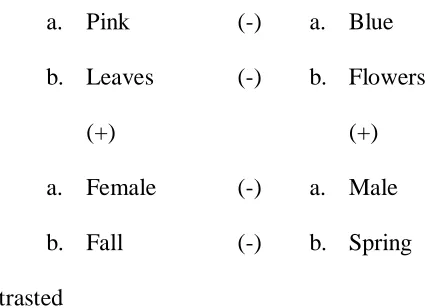
(1997:74) lays out the semiotic square as such:
a. Pink (-) a. Blue
b. Leaves (-) b. Flowers
(+) (+)
a. Female (-) a. Male
b. Fall (-) b. Spring
(-) Syntactically Contrasted
[image:38.612.173.386.115.269.2](+) Semantically Associated
FIGURE 2.1. SEMIOTIC SQUARE
In the second example, leaves and flowers can be syntactically contrasted (-) as plant matter as
can fall and spring as seasons. Leaves are semantically associated (+) with fall and flowers
semantically associated with spring. Scrapbook pages about fall are much more likely to include
stickers or papers of leaves (in fall colors of brown, red, orange, and purple) and pages about
spring are more likely to include stickers and papers of flowers. In this way, a page about fall or
spring does not have to state that it is about fall or spring as long as accepted symbols are used to
signify the season. Studying how scrapbookers use symbols, allows the researcher to not only
understand how a signifier stands in for the signified, but also how symbols are semantically
associated and syntactically contrasted with one another forming a semiotic square.
Symbols are used to help a person remember. Moreover, choosing to scrapbook
something, says to the world that this is something worth remembering. Remembering is done
both individually and collectively. People are socialized as to what is important to remember and
what is important to forget (Zerubavel 1997; 2003), which is how some things become
their life is scrapworthy—that it is worth remembering. Furthermore, scrapbooks serve to
corroborate our memories when we view the scrapbook with others.
Scrapbooks are narratives about the past. In essence, scrapbooks are historical stories of
the scrapbooker‟s life (or the person the scrapbook is about). A scrapbook may be the only
narrative that exists of the person‟s history (see Milgram 1976). These narratives, though highly
personal, are constructed in socially patterned ways. Memory may be private (Milgram 1976),
but it is also socially constructed (Zerubavel 1997); memory, then is intersubjective.
What is considered scrapworthy is generally, that which is also considered to be
memorable. In this way, scrapbooking serves as a useful site to study the “social rules of
remembrance that tell us quite specifically what we should remember and what we must forget”
(Zerubavel 1997:84). Though scrapbookers insist that the reason most of the memories
scrapbooked are happy memories due to social conventions regarding photography and a belief
that they will remember the unhappy memories just fine without them being scrapbooked, it does
not change the fact that scrapbooks contain mostly happy memories. Happy memories are both
more easily forgotten and are more scrapworthy than unhappy memories according to
respondents. The narrative in scrapbooks then, is overwhelmingly happy.
Rules of remembrance include beginnings and endings. At what point does a scrapbook
begin or end? Does an album about a marriage begin with the wedding ceremony, the proposal,
or the first date? Does the same album end with the opening of wedding gifts, writing thank you
cards, the end of the honeymoon, the first anniversary, or even the end of the marriage through
divorce or death? Wedding albums often begin with the preparation for the actual ceremony (that
day or day before during a rehearsal dinner) and end with the end of the reception. It is as if
as something that is memorable (though the case could be made that the pre-wedding should be
more memorable than the actual wedding as the wedding is just the culmination of the
relationship up to that point). Everything after the wedding is perceived as just as forgettable if
not considered scrapworthy.
Rules of social remembrance are taught to us through mnemonic socialization (Zerubavel
1997). In the above example, weddings are scrapbooked and remembered in socially patterned
ways because of the mnemonic tradition involving weddings. The actual wedding ceremony is
typically held up as more important than the relationship before and after the ceremony in
scrapbooks because the ceremony is thought to actually transform the couple in some profound
way. A man becomes a husband and a woman becomes a wife through marriage. Different
mnemonic communities (or thought communities) may see things differently. If a person does
not see marriage as transformative beyond a change in legal status of the relationship, then they
might be more likely to chronicle the relationship prior to and after the wedding in the scrapbook
because it is considered all equally important and therefore memorable. A scrapbook
emphasizing the wedding over the relationship prior to the wedding serves to mnemonically
decapitate (Zerubavel 1997; 2003) all that happened prior to the wedding. The story of the
couple, then, begins with the wedding.
As previously mentioned, scrapbooks can serve as a source for the corroboration of
memories. Many scrapbooks serve as social souvenirs of abstract memories for not only
individuals but also groups, in particular, families. According to Zerubavel (1997), social
souvenirs are physical items that serve as memory prompts. Scrapbooks contain the collective
memory of groups even if only compiled by one person because the books typically are made to
memory. The scrapbook eventually comes to represent the family‟s collective memory in that
everything not included in the scrapbook is forgotten. Of course, if family members disagree
with how the scrapbooker portrays various memories or chooses to include or exclude certain
memories, a mnemonic battle may ensue (Zerubavel 1997). In a family with a scrapbooker, there
is typically only one scrapbooker who is making a scrapbook that contains the family‟s collective
memory; therefore, it is likely that their memory prevails in the scrapbook, though the oral story
that goes along with the scrapbook may point out mnemonic battles with other family members.
Finally, the sixth cognitive act, reckoningtime, can be explored through scrapbooks.
Zerubavel (1981; 1997; 2003) proposes that different thought communities keep time in different
ways. Reckoning time is illustrated in many different ways by scrapbookers. Scrapbookers
commonly scrapbook in two main ways: thematically and chronologically. A chronological
scrapbooker typically creates a scrapbook chronicling a chunk of time in her or his life or their
family‟s life, using a standard time-reckoning framework. The year may spread across multiple
scrapbook albums but very rarely would a scrapbooker assign a smaller chunk of time (e.g., a
month, week, or day) than a year in one album with any regularity. Standard time-reckoning
frameworks would include measuring time by year, month, day, hour, minute, and so forth
(Zerubavel 1981; 1997). Even thematic scrapbookers often rely on chronology to determine how
to organize the pages in their album. For example, a scrapbook may be about a vacation.
Everything in the album is about the vacation. The album is then organized by day with the
album beginning with the arrival at the destination and album ending with the arrival home.
As previously discussed, choices about when a scrapbook begins or ends are shaped by
social dating frameworks. A social dating framework means that individuals and groups, such as
family may consider moving into a new house as a significant moment in time in that any one
family member can say, „remember, it was when we moved into this house,‟ rather than, „it was
in September of 1996.‟ Everyone in the family knows it was September 1996, but the time
measurement becomes a personal reference, moving into a new house. Moving into a new house,
serves as a sociotemporal landmark (Zerubavel 1997). Levine (1997) distinguishes types of time
as well. He would consider „moving into the house‟ as event time and „September 1996‟ as
calendar time.
Moving into a new house could serve as watershed moment, delineating one period of
time from another (or periodization) (Zerubavel 2003). Many scrapbooks contain very little
outside of watershed moments for the family or individual, jumping from Easter, to a high school
graduation, to a summer wedding, then to Christmas, for instance. Scrapbooks, then, serve as a
place to understand what events or moments scrapbookers consider scrapworthy and in extension
are a way to understand how a scrapbooker periodizes their and their family‟s lives. Scrapbooks
are often structured using a combination of event time and clock time. Clock time may jump
from event time to event time. For example, an album may hold stories of things that happened
in 2008 (clock time). Inside the album, pages may jump from event to event. Instead of being
organized by day, week, or month, it is organized by event. There may not be any events that
occurred during January, but something scrapworthy happened in February and that gets
memorialized. Moreover, the scrapbook then begins with the first event, which occurred in
February, rather than in January when according to clock time, a new year begins.
As I have shown, studying scrapbooking and drawing on cognitive sociology, allows the
researcher to further understand how thinking is socially patterned. Cognitive sociology draws
meanings come from our interactions with others (Blumer 1969). Furthermore, symbols only
have meaning because individuals agree on the meaning (Rothman [1981] 1991). According to
Mead ([1967] 2005), it is the response to the symbol that gives the symbol meaning.
SYMBOLIC INTERACTIONISM
A researcher using a symbolic interactionist perspective is paying attention to how
“people act towards things on the basis of the meaning that these things have for them, not on the
basis of the meaning that these things have for the outside scholar” (Blumer 1969:51). In other
words, what things mean to an individual influences how he or she will act towards the thing.
For example, to most, children‟s artwork is not artistic and worth displaying or even saving. To
the parents of the child whose artwork it is, however, the artwork is art and should be saved or
even displayed. Parents proudly display their children‟s artwork on refrigerator doors or even in
frames on a wall in the home. The artwork holds meaning to the individuals because of their
connection to the person who created the art. Most people without a connection to the child artist
would simply view the art as trash and not art at all. In terms of scrapbooking, then, what is
deemed scrapworthy is in the eye of the scrapbooker. While others may view an item as
trashworthy, scrapbookers may consider it scrapworthy and include it in their scrapbook.
Symbolic interactionism has three premises first articulated by Herbert Blumer (1969).
The first premise is that “human beings act toward things on the basis of the meanings the things
have for them” (Blumer 1969:2). Scrapbooks contain physical items such as photographs and
abstract items such as memories and are often one of a person‟s most prized possessions. Many
scrapbookers (and the scrapbook industry supports this practice) take steps to make sure their
scrapbooks will not deteriorate. With the goal of preservation in mind, scrapbookers are careful
with others. In sum, scrapbookers will act toward items on the basis of something that is to be
remembered or not.
This leads to Blumer‟s (1969:2) second proposition: “the meaning of such things is
derived from, or arises out of, the social interaction that one has with one‟s fellows.” Building on
the previous example, scrapbooks are created to preserve more specifically a person‟s or a
family‟s stories for future generations. The scrapbook derives its meaning not only from the
scrapbooker but also from any person the scrapbook is shared with or is about. Many people
continue scrapbooking because they have received a positive reaction to their work through
other‟s willingness to look at their books or others soliciting their assistance to create a book of
their own. Scrapbooking, then, becomes meaningful in its own right through the positive social
interactions that result from it.
The way a scrapbooker interprets another‟s reaction to their hobby influences their
participation in the hobby, pointing to Blumer‟s (1969:2) third axiom that “these meanings are
handled in, and modified through an interpretive process used by the person dealing with the
things he [sic] encounters.” Scrapbooking is a site to explore meaning-making and how this
process of meaning-making supports a person‟s continued involvement in scrapbooking.
Meaning emerges through scrapbookers interacting with each other and through their
interactions with nonscrapbookers. For instance, some respondents report that their husbands
would roll their eyes at their hobby, yet they did not interpret this eye rolling as a serious threat
or mockery of their scrapbooking. Instead, they interpreted this eye rolling as fun (i.e., kidding
around without negative intent). Husbands may find scrapbooking to be a bit silly, but would
never prevent their wives from actually scrapbooking. Scrapbookers who interpret the eye rolling
Overall, scrapbookers continue to scrapbook and people begin scrapbooking because they
find value in it. Scrapbookers find this value through their interactions with others regarding
their hobby. Moreover, scrapbooking is used by scrapbookers to shape others‟ interpretations of
themselves, or as Goffman (1959) would consider it, scrapbooking is a way for people to
practice impression management.
Goffman‟s (1959) contribution to this dissertation is his proposition that social interaction
should be viewed as a performance. Three concepts are important to understanding his argument
as I apply it to scrapbooking: front stage, back stage, and impression management. The front
stage is our performance for others or what we allow others to see of us (Goffman 1959). The
back stage is everything we hide from the view of others. Successfully managing our front stage
and back stage is referred to as impression management. Scrapbooks are used in a couple of
different ways as part of impression management. For example, mothers might scrapbook their
children‟s lives in an effort to demonstrate to themselves, their children, and others that they are
good mothers (Demos 2006).
The process of scrapbooking delineates the front stage and back stage. The back stage
might include all the photographs that were taken but did not make it onto the scrapbook page
and the front stage is the final scrapbook. The story included in the scrapbook is the story a
person is comfortable sharing with others partially in an attempt to manage the impression others
have of the person. No matter what happens in a person‟s life, he or she can present that life as a
good life in a scrapbook regardless of whether that portrayal is accurate. Lyman and Scott (1970)
argue that what counts is whether a life can be portrayed positively when it matters. In other
words, if a person can present a positive front stage in a scrapbook, it is unimportant to observers
ETHNOMETHODOLOGY
Garfinkel (1967) coined the term ethnomethodology and proposed that sociologists study
the taken for granted everyday life of society. This approach allows for an understanding of how
people actively create their social reality instead of understanding social reality as something
existing outside of her or his self. Garfinkel (1967:11) “use[s] the term „ethnomethodology‟ to
refer to the investigation of the rational properties of indexical expressions and other practical
actions as contingent ongoing accomplishments of organized artful practices of everyday life.”
An ethnomethodological approach allows the researcher to question the taken for granted
world under study. In this case, it allows me to investigate the world of scrapbooking as an
outsider to the hobby instead of investigating it as someone who is a member of the
scrapbooking thought community. One way I did this was through a breaching experiment. A
breaching experiment attempts to challenge accepted social norms (Garkinkel 1967) and in this
case I attempted to challenge the accepted social norms regarding scrapbooking. As I later
discuss in Chapter 6, I showed my respondents three items: a conventional scrapbook, a bulletin
board, and a conventional photograph album. I asked respondents which item or items could be
considered a scrapbook. All agreed the conventional scrapbook was in fact a scrapbook. Most
seemed surprised at the thought of considering the other two items as a scrapbook. Some agreed
the other two items could be considered scrapbooks either as is or they could be considered
varieties of scrapbooks. Moreover, during the course of the interviews when I examined my
respondents‟ scrapbooks with my respondents, I would ask them why they chose to include a
particular item or take a photograph of a particular subject. I did the best I could to get my
respondents to explain their taken for granted behaviors surrounding scrapbooking in order to