Georgia State University Georgia State University
ScholarWorks @ Georgia State University
ScholarWorks @ Georgia State University
Art and Design Theses Ernest G. Welch School of Art and Design
Spring 5-10-2013
You Define Me.
You Define Me.
Nicole A. Klein
Follow this and additional works at: https://scholarworks.gsu.edu/art_design_theses
Recommended Citation Recommended Citation
Klein, Nicole A., "You Define Me.." Thesis, Georgia State University, 2013. https://scholarworks.gsu.edu/art_design_theses/136
This Thesis is brought to you for free and open access by the Ernest G. Welch School of Art and Design at ScholarWorks @ Georgia State University. It has been accepted for inclusion in Art and Design Theses by an authorized administrator of ScholarWorks @ Georgia State University. For more information, please contact
YOU DEFINE ME
by
NICOLE ANN KLEIN
Under the Direction of Nancy Floyd
ABSTRACT
The work I created in conjunction with this paper is a representation of myself and my family, both individually and as a unit. The work was spawned by a search for my identity at my current age of 25. The outcome is an installation of photographs that focus on my heritage and
family work ethic and a series of altar-like tables highlighting the personalities of my grand-mother, grandfather, grand-mother, father, and sister when they were experiencing life at my stage. I
believe that this work culminates in defining me. Every element, every individual, reflects a part of myself in the people I love. The following paper explores the elements that come into play in the creation of this work.
YOU DEFINE ME
by
NICOLE ANN KLEIN
A Thesis Submitted in Partial Fulfillment of the Requirements for the Degree of Master of Fine Arts
in the College of Arts and Sciences
Copyright by Nicole Ann Klein
YOU DEFINE ME
by
NICOLE ANN KLEIN
Committee Chair: Nancy Floyd
Committee: Constance Thalken
Joseph Peragine
Electronic Version Approved:
Office of Graduate Studies College of Arts and Sciences
vi
TABLE OF CONTENTS
LIST OF FIGURES ... vii
1 INTRODUCTION ... 1
2 REPRESENTING A FAMILY ... Error! Bookmark not defined.
2.1 INFLUENCES ...
3 ON MOURNING, MEMORY, AND PERCEPTION Error! Bookmark not defined.
4 CONCLUSIONS ... 15
REFERENCES ... 16
vi
LIST OF FIGURES
Figure 1 Leon Klein 1952 ... 3
Figure 2 Female Tables ... 4
Figure 3 Male Tables ... 4
Figure 4 Mercy Klein 1986 detail………...6
Figure 5 Nathan Klein 1983………7
Figure 6 Eileen Romano 2011 detail………...8
Figure 7 Lucas Samaras, Box #124, 1988, mixed media……….9
Figure 8 Mercy Klein, The Family, Nicole Klein ………..10
Figure 9 Leon Klein and Eileen Klein ………...11
Figure 10 Installation Views………11
vi
1 INTRODUCTION
Upon entering the graduate program, it became clear how little I understood about my-self, both personally and artistically. In reflecting upon my character, I think back to my
child-hood, where it occurs to me (as I am sure it has occurred to many other Americans) that the per-sonal history of my individual family members was a mystery. My inability to define myself was a direct result of my failure to understand my family. A project began to take root. I began
to collect research in an attempt to find a common thread among my family and myself; to deep-en my overall understanding of my heritage, and to solidify my own self-iddeep-entity.
Twenty- five seems to have been an integral time for me and acts as a point of departure when examining the lives of my immediate family and remaining grandparents. Since entering graduate school I have been on a quest to define myself andto form myself as an individual and
an artist. The integration of family into this definition has led me to the conclusion that much of what defined my family members at the age of 25 and continues to define them today deals with
vi
2 REPRESENTING A FAMILY
“My dearest Harriet, don’t worry about me, I’m safe. My time spent in Seoul has been quite nice so far, and my skills as a draftsman have significantly grown. The people here are competent, every need is met, with the exception of you. My only hope is that when I return I will be able to meet your every passion. Until then, my dashing good looks should hold you over. Enclosed is a photograph to ensure you that my appearance has not faded. One of the men I am stationed with is quite the artist. He took a photograph of you and rendered the most beautiful drawing; on the cool and quiet evenings it takes me back to you. I miss you, deeply. Leon.”
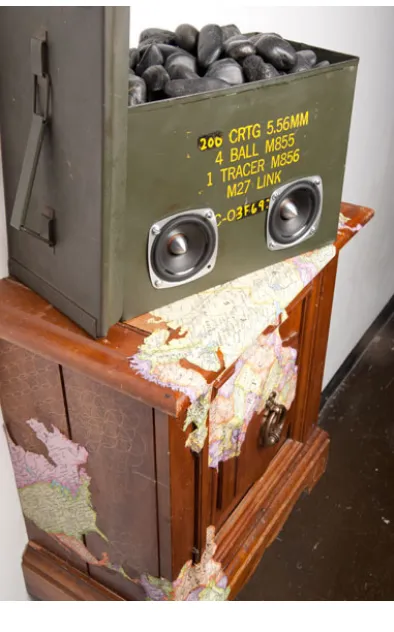
The above paragraph is the audio from one of the altar-like table tops constructed to
rep-resent my grandfather, Leon Klein. The monologue streams from a dark green ammunition box filled with shiny, omnipresent, black rocks. The box sits upon a portion of an elevated end table,
covered in a world map dating back to the Soviet Era and is etched with compass marks that transform into sacred geometry patterns.
Each of these elements, including the audio track, is derived from interviews I conducted
with my grandfather. At the age of 25, he was involved in the Korean War and was parted from my grandmother, Harriet, with whom he was already madly in love. The ammunition box and
compass marks denote his role as a draftsman in the war, whereas the world map alludes to both his military exposure and subsequent world travel with my grandmother. Black rocks fill the ammunition box to signify my grandfather’s total love for her, and his proper Jewish mourning
vi
Figure 1 Leon Klein 1952
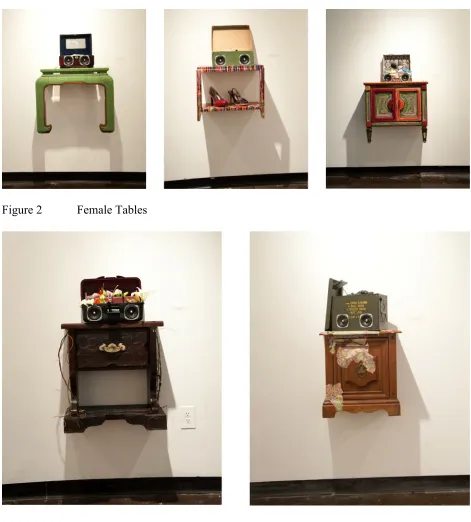
You Define Me includes five tabletop pieces, one for my paternal grandfather, maternal
grandmother, father, mother, and sister. Each tabletop consists of a box with an audio track, that is created independently, based upon the individual it represented. However, the results are
any-thing but incongruous. While a strong visual thread ties the tabletops together, a slight division is revealed when examining the females’ installations in relation to the males. The tables of the males are treated more sparingly, relying on muted colors and circular motifs whereas the female
[image:13.612.72.269.69.385.2]vi
Figure 2 Female Tables
Figure 3 Male Tables
Although the tables were initially constructed to provide insight into each individual of my family unit, what ultimately is conveyed is the love that drove their lives. My grandmother, Alicia, showed great love for her children. Her table surface is treated with yarn and is topped
vi
raised her children, Alicia made many of their clothes. Although she had already made a life for
herself in Cuba, Alicia left her husband to shepherd her children to the United States, where they would be granted greater opportunity. The audio track that accompanies her box is the only one
I did not write. Whereas all the other tracks are scripted in English and are 45 seconds to one minute in length, my grandmother’s piece is a reading of a famous work by treasured Cuban
po-et, Jose Marti, entitled Los Zapaticos de Rosa. The poem tells a story of a wealthy little girl who
gives up her new and most treasured shoes to an ill girl who is much less fortunate, despite the repercussion of returning home without them. This type of giving is the embodiment of my
grandmother.
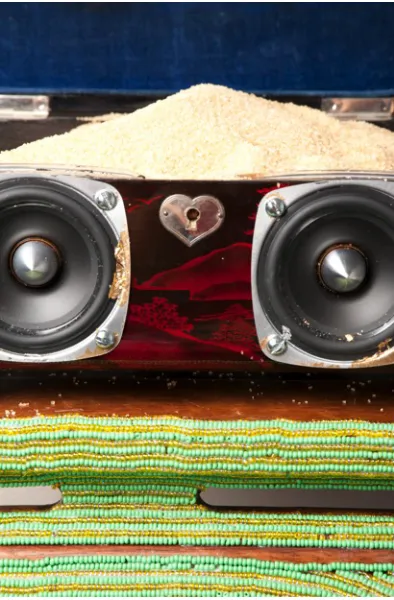
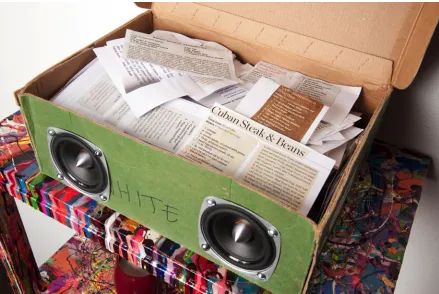
Alicia’s daughter, Mercy, is my mother. Her table is treated with alternating yellow and green beads and topped with an antique Japanese music box filled with turbinado sugar. Despite
having relocated to the United States, my mother ferociously holds onto her Cuban heritage and continues to practice the popular Cuban religion of Santeria. The green and yellow beads on her
table represent this practice in the form of the patron saint, Obatala. In Christianity, Obatala is generally equivocated with either Saint Lazarus or Our Lady of Mercy (my mother’s American name). My mother’s time working in the sugar cane fields of Cuba were replaced with a sweeter
vi
Figure 4 Mercy Klein 1986,detail
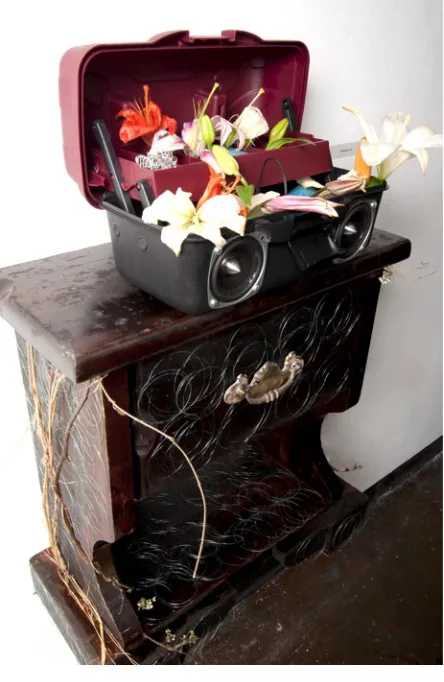
Upon coming to the states my mother married my father, Nathan Klein. He was a
rough-around-the-edges guy who loved fishing and the outdoors. His table reflects these interests with the fishing line and braided branches that coat the surface. His box is a tackle box filled with
live, fragrant, lilies that represent the lilies he gave to Mercy every week in order to demonstrate his love for her. My father was a hot-headed, brash, party animal in his twenties, but he was a business man as well. These elements of his personality are portrayed in the audio component of
his installation.
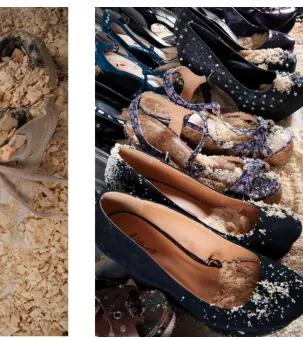
My older sister, Eileen came to fall in love and marry in her early twenties as well. She
vi
her piece speaks of her frustration with her failing marriage. Eileen embodies the same
[image:17.612.72.294.155.496.2]work-hard, play-hard mentality of my father; high heels and a timberland box occupy her table as a result.
vi
Figure 6 Eileen Romano 2011,detail
Boxes serve as a containment device because it is my belief that everyone has a box in
which they store small treasures (and perhaps secrets?). An end table supports the presentation of the box, further reinforcing character roles and alluding to domesticity. I define these
individ-uals largely on how their domestic lives define them. The audio track, which is a reenactment or simulation of the individual, is the only thing that gives them public voice. In other words, I give them public voice based upon my perception of them.
2.1 INFLUENCES
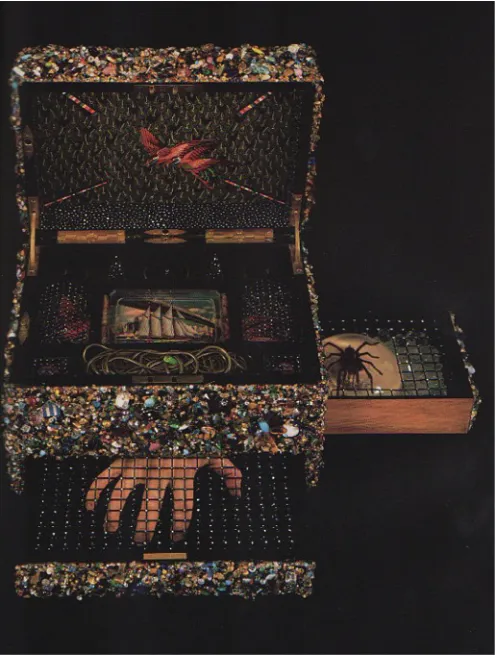
Another artist who works with boxes is the well-known mixed-media artist Lucas
Sama-ras. His 1988 Boxes and Mirrored Cell exhibition at the Pace Gallery included box work
cos-vi
mic chasm, they are often self-referential. This notion is reinforced by the implementation of
biological diagrams and religious figures. The elements Samaras combines interest me. His use of everyday items, combination of lens based media, and prominent placing of scientific and
[image:19.612.72.321.237.567.2]re-ligious figures are elements that I examined in the construction of my boxes. Yet, the interweav-ing of these elements takes on a different role in my pieces, aiminterweav-ing to reconcile the past and pre-sent, myself with my family, and my family with their heritage.
Figure 7 Lucas Samaras, Box #124, 1988, mixed media
I choose to use lens-based media in my installations, displaying photographs along side
the tables. The photographs consist of three elements: shoes, sugar, and matzo. After examining my family members individually and defining them primarily through their love, I created
vi
the photographs represent the work-hard mentality of certain family members, whereas high
heels represent both the product of their toils and the play-hard mindset. We are defined by our labors. My mother signifies her success through the purchase of shoes: she has amassed a
hun-dred pairs she still deems fashionable. My father’s shoes chosen for a purpose: a pair to work, a pair to fish, to keep warm in the cold weather, to protect his feet while swimming.
Sugar and Matzo in the photographs allude to Cuban and Jewish heritage respectively,
and to the idea of labor. Sugar is one of Cuba’s primary exports, and many citizens produce cane. The cane is frequently partially processed into turbinado sugar, a sugar that lies
some-where between white and brown. It is mixed, much like my background. The Cuban people of-ten depend on this crop to repay the country’s foreign debts and have toiled in the past to try and make it so. The fable of the Jewish people’s plight from the wrath of the Egyptian pharaoh
speaks of unleavened bread’s role in keeping them fed while wandering in the desert. While the photographs I created are of individuals’ shoes, they are masked with either matzo or
[image:20.612.71.373.460.557.2]compli-mented with sugar.
vi
[image:21.612.85.393.66.405.2]Figure 9 Leon Klein and Eileen Klein
vi
3 ON MOURNING, MEMORY, AND PERCEPTION
Geoffrey Batchen’s book, Forget Me Not, deals with the immortalization of images and
their arrangement with other items. In his writing, he speaks of timelines intersecting in the con-struction of lockets and other such mementos. There is the time that the photographs were taken,
the time of each objects manufacture, the time in which these objects were combined, and the
time that it is being viewed. You Define Me adopts this complex weaving of time and raises
ques-tions about the subject’s past in relation to my present.
In commenting on photographic lockets, Batchen states, “… a photograph by itself was not enough to alleviate the fear of mortality to which the object is surely dedicated” (p. 61). In a
sense, You Define Me stands as a shrine that express both my fear of mortality, while granting
my family member’s everlasting life. As the void in my family history fills, I feel myself creat-ing these works in a state of pre-mourncreat-ing. Annette Kuhn suggests that the act of takcreat-ing a
pho-tograph implies the death of that moment and, arguably the death of that moment’s memory. It is my impression that false memories can be created in this fashion as well. Through the use of
story and image, the memories of my subjects become open to my interpretation. Kuhn ob-serves, “the memories promised by the family photography industry are characterized by pleas-ure and held-off clospleas-ure – happy beginnings, happy middles, and no endings to all the family
sto-ries” (p. 477). My work is forced to function in a similar fashion. I represent my family some-where in the middle of their lives, keeping my impressions of their characters in perpetual limbo.
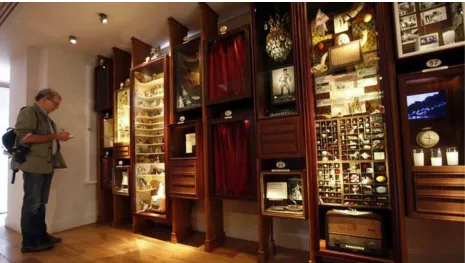
Orhan Pamuk is a Nobel Prize award winning writer who put items that related to his 2008 novel, “Museum of Innocence” on permanent display in Istanbul. The Museum seeks to provide visual support to his story. It is highly nostalgic and houses a plethora of items,
vi
narrative and to strengthen the viewer’s perception of the individual as well as to invoke
nostal-gia.
Pamuk’s Museum not only creates a story for his lover Fusin, but also speaks of the
his-torical state of Turkey. He weaves elements of the era into his displays, from tricycles to images of scandalous women in the newspaper. The struggle Turkey experiences with regards to the push toward and pull against westernization is prevalent. Similarly, Cuba has struggled with the
embrace of “western” culture. Its geographic presence implies that it should mimic the United States in some way, yet it does the opposite. History takes precedence over capitalism. Country
resides over all.
Lastly, Pamuk incorporates sounds into his museum. Vanessa Larson of the Washington Post notes that, “soft music, the whir of a machine, running water or the twittering of birds — are
occasionally used to help set the scene”. Like Pamuk, I use sound as a primary element in my boxes, to tell you the stories and of my family. Individual voices speak about their experiences
as youths. Failed marriages, mental ailments, drug use, and child bearing all come into play as visual cues imply the complexity of these situations. Pamuk states that “this is a museum about daily life” (Larson, 2). Yet, it is about the daily life of Pamuk as well. The book and museum
are both drawn from experiences with people he loved, in a place he was familiar. He gathered the supplies he needed to represent his loved ones individually, as well as in the context of a
vi
Figure 11 Image from inside Orhan Pamuk's Museum, Istabul, Photo Credit: Reuters
vi
4 CONCLUSIONS
Gustavo Perez Firmat, author of Life on the Hyphen, calls individuals who immigrated to
this country as adolescents the 1½ generation. This generation consists of individuals having
migrated from Cuba after having been raised there. He cites the likes of Desi Arnaz and Gloria
Estefan in this group and goes on to quote Rubert Rumbaut:
“These refugee youth must cope with two crisis-producing and identity-defining transi-tions: (1) adolescence and the task of managing the transition from childhood to adulthood, and
(2) acculturation and the task of managing the transition from one sociocultural environment to
another.”
Although I am not personally part of the 1½ generation, I believe that I am currently
un-dergoing some of these transitions in that I am transitioning into adulthood after having been transplanted from the Northeastern United States to Atlanta, GA. Although these locations are in
the same country, the difference is staggering. I experience limbo between the 2nd generation
that I am and the 1½ generation that I want to represent.
You Define Me was created to explore and configure myself in the context of my family.
The resulting installation provides insight into the transitions required of 1½ within the
frame-work of my family unit. Each individual had undergone transitions from adolescence to
vi
REFERENCES
Allende, Isabel. The House of the Spirits. New York: A.A.Knopf, 1985. Print.
Costentino, Donald J. Vodou Things: The art of Pierrot Barra and Marie Cassaise. Oxford:
University Press of Mississippi, 1998. Print.
Diaz, Junot. Drown. New York: Riverhead Books, 1996. Print.
Gomez-Pena, Guillermo, perf. Guillermo Gomez-Pena. Annenberg/CPB Collection, 1997. Film.
Hammonds, David, and Maria Magdelena Campos-Pons. Diaspora memory place: David
Hammons, Maria Magdalena Campos-Pons, Pamela Z. New York: PrinceClaus Fund Library, 2008. Print.
Hatoum, Mona. Mona Hatoum: Interior Landscape. Milano: Charta, 2009. Print.
Hirsch, Marianne, ed. The Familial Gaze. Hanover: University Press of New England, 1999.
Print.
Kennedy, J. Michael. "Turkish Writer Opens Museum Based on Novel." New York Times
[New York] 29 04 2012, n. pag. Print.
Kienholz, Edward. Kienholz : die Zeichen der Zeit. Koln: Walther Konig, 2011. Print.
Kuhn, Annette. “Remembrance.” Family Snaps: The Meanings of Domestic Photography pp. 17
25. Rpt. in Illuminations: Women Writing on Photography from the 1850s to the Present.
Ed. Liz Heron and Val Williams. Durham, NC: Duke University Press, 1996. 471-478 Larson, Vanessa H. "Orhan Pamuk’s Museum of Innocence builds on best-selling book."
Washington Post. (2012): n. page. Web. 16 Apr. 2013.
<http://articles.washingtonpost.com/2012-05-01/lifestyle/35454881_1_real-life-museum-admission-first-museum>.
Lindsay, Arturo, ed. Santeria Aesthetics in Contemporary Latin American Art. Washington:
Smithsonian Institution Press, 1996. Print.
Liss, Andrea. Feminist Art and the Maternal. Minneapolis: University of Minnesota Press, 2009.
Print.
Perez Firmat, Gustavo. Life on the Hyphen: The Cuban-American Way. Revised. Austin:
vi
Prosser, Jay. Light in the Darkroom: Photography and Loss. Minneapolis: University of
Minnesota Press, 2005. Print.
Saar, Betye. Betye Saar: Extending the Frozen Moment. Ann Arbor: University of Michigan
Museum of Art, 2005. Print.
Salcedo, Doris. Doris Salcedo. London: Phaidon, 2000. Print.
Salcedo, Doris. The image and the witness : trauma, memory and visual culture. New York:
Wallflower Press, 2007. Print.
Samaras, Lucas. Samaras. New York: Pace Gallery, 1988. Print.
Stewart, Susan. The Open Studio: Essays on Art and Aesthetics. Chicago: The University of
Chicago Press, 2005. Print.
Weitz, Chris, dir. A Better Life. Perf. Bichir Demian. 2011. Film. 7 Oct 2012.
Wiggins, Collin. The Hoerengracht : Kienholz at the National Gallery London. New Haven:
Yale University Press, 2009. Print.
Wood, Michael. Gabriel García Márquez : One hundred years of solitude. New York: