Art and Design Theses Ernest G. Welch School of Art and Design
Fall 11-15-2012
A Roadmap to Promoting and Marketing Artwork from a Veteran
A Roadmap to Promoting and Marketing Artwork from a Veteran
Visual Art Teacher's Perspective
Visual Art Teacher's Perspective
Ann P. Dodys Ann P. Dodys
Follow this and additional works at: https://scholarworks.gsu.edu/art_design_theses
Recommended Citation Recommended Citation
Dodys, Ann P., "A Roadmap to Promoting and Marketing Artwork from a Veteran Visual Art Teacher's Perspective." Thesis, Georgia State University, 2012.
https://scholarworks.gsu.edu/art_design_theses/122
This Thesis is brought to you for free and open access by the Ernest G. Welch School of Art and Design at ScholarWorks @ Georgia State University. It has been accepted for inclusion in Art and Design Theses by an authorized administrator of ScholarWorks @ Georgia State University. For more information, please contact
FROM A VETERAN VISUAL ART TEACHER’S PERSPECTIVE
by
ANN PEASE DODYS
Under the direction of Kevin Hsieh
ABSTRACT
The advancement in technology in the twenty first century has introduced new and
exciting ways for artists to self-promote their artwork while traditional methods remain
viable. To be competitive in the art market an artist must understand and implement a
variety of marketing strategies. Effective marketing is particularly critical for an art
teacher who is also a practicing artist in order to sell their artwork. Through a
comparative analysis of readily available marketing tools for artwork, I explore in this
study a variety of ways that an artist can establish a successful career in art through the
use of technology, and create a roadmap that can be used to shorten their route.
INDEX WORDS: Art marketing strategies, Virtual gallery, Internet marketing of Art, Art websites
FROM A VETERAN VISUAL ART TEACHER’S PERSPECTIVE
by
ANN PEASE DODYS
A Thesis Submitted in Partial Fulfillment of the Requirements for the Degree of
Master of Art Education
in the College of Arts and Sciences
Georgia State University
!
!
!
!
!
!
!
!
!
!
!
!
!
!
!
!
!
!
!
!
!
!
Copyright by Ann Pease Dodys
FROM A VETERAN VISUAL ART TEACHER’S PERSPECTIVE
by
ANN PEASE DODYS
Committee Chair: Dr. Kevin Hsieh
Committee: Dr. Melanie Davenport
Dr. Melody Milbrandt
Electronic Version Approved:
Office of Graduate Studies
College of Arts and Sciences
Georgia State University
DEDICATION
I dedicate this thesis to my supportive family and friends who have been by my side
over the last two years. To my husband, Dimitri, my rock, the one who kept me going,
you may never know how much your support has meant to me. To my parents for
instilling in me a strong work ethic. To my children; Sarah, Micah, Drue, Angelo and
Ana, who are always in my thoughts, I hope to be an inspiration to you all. To my editor,
Suzanne Sammons, you made this all possible by being able to read between the lines.
To Lindsey Nelson, always encouraging but ready for this “damn” paper to end. It takes
ACKNOWLEDEGEMENTS
Thank you to all my Georgia State professors who have been with me on this
journey. The past two years have not been easy ones but without your support and
guidance I may have given up on my dream of graduating with a Masters in Art
Education. A special thank you goes to my committee members, Dr. Melanie
Davenport, Dr. Melody Milbrandt and to my chair Dr. Kevin Hsieh. Thank you Kevin for
your unending patience with my thesis writing, I know at times it was extremely difficult
on you but you always made me believe that I could get through this process and be a
TABLE OF CONTENTS
!
DEDICATION ... iv!
ACKNOWLEDEGEMENTS ... v!
LIST OF TABLES ... viii!
CHAPTER 1: INTRODUCTION ... 1!
Purpose of the Study ... 3!
Need for the Study ... 4!
Research Questions ... 5!
Methodology ... 6!
Limitations ... 7!
CHAPTER 2: REVIEW OF LITERATURE ON SALES TECHNIQUES ... 9!
Art Buyers ... 11!
Good Work Habits ... 12!
Mission Statement ... 13!
Artist Statement/ Artist Biography ... 13!
Creating a Brand ... 15!
Sharing Your Craft ... 17!
Creating a Blog ... 18!
Social Networking ... 20!
Marketing through the Internet ... 21!
CHAPTER 3: COMMERCIAL ARTISTS WEBSITES ... 23!
Etsy ... 24!
Artquest ... 25!
Artcrawl... 26!
Ebay ... 27!
ArtsyHome ... 27!
Artbreak ... 28!
RedBubble ... 29!
Galleries ... 30!
CHAPTER 4: ANALYSIS AND RESULTS ... 34!
Establishing Work Habits ... 34!
Marketing Tools ... 35!
Websites ... 37!
Fee Structure ... 40!
Website Marketing Tools ... 41!
Customer Service ... 43!
Customer Reviews ... 44!
Personal Websites ... 47!
CHAPTER 5: CONCLUSION ... 50!
Limitations ... 55!
Summary... 55!
LIST OF TABLES
Table 3.1 Websites that Market Artwork ... "#!
Table 4.1 Artist Roadmap………..47
CHAPTER 1: INTRODUCTION
!
As an adolescent, art was my passion. After spending so much of my spare time
in my teen age years making pottery, art became my calling. I decided to pursue a
career in visual arts. I graduated from college in 1974 with a Bachelor of Fine Arts
degree and later received my teaching certification through Georgia State University in
Atlanta.
My ambition was to channel my art-making into a career and not merely an
avocation. College professors and administrators offered very little direction or insight
on the process of establishing a career in the field of art when I was in school in the
1970’s. It has been my experience that self-promoting and marketing one’s art has not
been part of the art curricula in the colleges I have attended. I had no idea how to use
the knowledge attained and skills developed over the four years spent studying the
creation of art as an employment vehicle. The entrepreneurial aspect of being an artist
was given little emphasis. The challenge I faced was to tailor a career in art that would
provide a livelihood. Developing artistic skill into a career is a challenging task.
According to Grant (2010), few art schools and almost no university art departments do
much to prepare their students for a career in art after college. Grant’s research was
based on information collected over the previous two years, 2008 and 2009. Colleges
and universities are doing more today to address these issues.
For several years after college, my activity in art consisted of freelance work
painting murals, furniture and decorative painting for home and office. At this point, I
decided to return to school and earn a teaching certificate in art. Grant’s (2010) report
there were 7,460 Bachelor of Fine Arts degrees issued and 1,173 Masters of Fine Arts
degrees awarded. Many of these graduates sought teaching positions: in some cases
there were between 150-200 applications per job opening for an experienced art
teacher (Grant, 2010). Having secured employment as an art teacher, I have been a
supervising teacher for art students working through their student teaching experience,
and I have seen first-hand how few students find an art position when they complete
their college degree. Teachers seeking certification in art education need to realize that
there are more art teachers available than there are art positions (Grant, 2010).
Thus, it is necessary for many art majors to think of a second source of income
as a means of supporting themselves. Beginning artists may not make enough money
to support themselves or their families by creating and selling art alone. For more than
10 years I worked in a picture frame shop framing the artwork of others. This was my
second source of income and gave me the means to financially support myself and my
family. After receiving my teaching certificate, I was one of the lucky few to find a
teaching position in Atlanta, even though I had been told by my professors that I would
probably have to move to another state in order to teach art because of the lack of art
positions available in the metro Atlanta area. Entering the teaching field was a decision
that I have never regretted because teaching art has given me more pleasure and joy
than I could have possibly imagined. I have now been in the classroom for more than
twenty years and every day of work I look forward to a new classroom adventure. But I
remain a working artist with a keen desire to sell my work profitably as well. In this
thesis I will explore effective strategies through the use of technology for promoting and
Purpose of the Study
It is my belief that many art educators who are practicing artists need an outlet to
display and sell their artwork. Art production is a driving force for many artists. For this
thesis I chose the subject of marketing one’s own art and how to go about doing so in
the twenty-first century because colleges and universities may not do enough to prepare
their art students for promoting their artwork once they graduate. I believe that effective
strategies do exist, and further analysis of these will benefit both newly minted Fine Arts
graduates and veterans of the art education field as well. There are many means to
market artwork. Traditional means include placing work in art fairs, galleries and with art
representatives. Now, especially through the use of technology, artists can potentially
be marketed to an exponentially greater potential pool of clients. Twenty years ago the
internet was not commonly used. “The Internet has opened up a whole new world for
craftspeople and artists alike” (Lewis, 2010, p. 20). With the easy and quick access of
the Internet, Americans are increasingly using the internet as a popular method to
locate the information they need and the products they wish to buy (Estabrook, 2007).
Previously, most art sales were handled through galleries where the gallery
owners choose the artists and artwork that they wished to represent (Abbott, 2005).
That is not the case today with the advent of wide-spread internet access in the late 20th
century. There are now a number of sites devoted exclusively to buying and selling
artwork, many for high end work by prominent artists and many for aspiring artists trying
to make their mark. The way in which we acquire and experience art is now constantly
able to turn on their plasma screen televisions and bring museums, galleries, and
artists’ studios into their living room” (Abbott, 2005, p.XII).
The idea of self-promoting one’s art can be overwhelming and paralyzing at the
same time. For instance, as artists we often keep our work close to our chest for fear of
rejection. Our work becomes extremely personal which can be a hindrance when you
start a career in art where self-promotion is critical. As a personal example I am in the
process of trying to develop a line of home accessories that cater to a beach community
clientele. A boutique in Jacksonville, Florida has accepted some of my work already.
The prospect of exhibiting and selling my art was an exciting one. The excitement was
short lived, however, once I thought about where I was to go from here and, more
importantly, how I was going to get there. This study will document some marketing
techniques that are already effective for artists and attempt to suggest ways in which an
art educator who is a practicing artist can maximize sales of their skills and talent
through the use of modern technology.
Need for the Study
Artists/art educators need information about marketing strategies and the
resources that are available to help them be knowledgeable and competitive in their
field if they are to be able to sell their work. There are a few books written about
marketing strategies for artists. These include I’d Rather be in the Studio, Allison
Stanfield;Starving to Successful/ The Fine Artist’s Guide to Getting Into Galleries and
Selling More Art,by J. Jason Horejs; and How to Survive and Prosper as an Artist:
at such a rapid pace, however, some books may be outdated by the time they go to
print. But there are still art marketing strategies that remain timeless. Artists and art
educators also tend to be solitary individuals. They need the support from other artists if
they are to prosper in such a competitive field. The internet offers a number of ways for
the individual artist to connect with other artists as well as establish a clientele who may
be interested in their artwork.
Due to the increased use of technology in today’s society there is a need to
research and discover how individual artists/art educators can use technology to
promote and market their artwork. As an art educator I am personally interested in
finding the most efficient means to drive sales due to time constraints from having a full
time teaching position. To teach, create art, and promote one’s artwork is a challenging
task even with the proper resources to help one do so effectively. This study will attempt
to shine light on techniques that have proven to yield results.
Research Questions
In this paper I will attempt to answer several questions regarding ways in which
an artist/art educator can get their artwork available to many potential buyers. I will
address traditional galleries and explore the use of newly available technologies. Based
on perceived artist needs including the need to produce artwork; the necessity of
discovering an outlet to sell or exhibit artwork; and the need to determine the most
efficient way to market artwork, the following questions will guide my work:
1. How do art educators who are practicing artists utilize marketing strategies to
a. What are the current technologies used by art educators who are practicing
artists to promote their artwork?
b. Where do artists/art educators go to sell their artwork and what 21st century
marketing strategies are being used?
2. What are the implications of technology for art educators who are practicing
artists to promote their work through professional networking?
The answers to these questions will give me guidance in my personal pursuit to
find a means for selling my artwork and through this research, I also hope to benefit
other artists/art educators as well. All too often art teachers are creating artwork on their
own, away from their classroom. This is an inherent need artists have to keep creating,
but raises the problem of disseminating the work produced. This research is intended to
give art teachers the tools that they need to sell their work so that others can enjoy the
creativity that artists feel the need to share. It is my belief that communication through
visual art is a vital part of our society and must not stay housed in a studio for only the
artist to experience.
Methodology
In this study I investigated options for marketing and selling artwork available to
artists through online sources and traditional galleries to determine which avenues
would be best suited for an art educator who is also a practicing artist. Most of my
research will concentrate on a variety of internet websites and traditional and online
1. I have reviewed books and articles about web-based and traditional marketing
strategies used to sell artwork and decided which strategies would be beneficial
for art teachers who may wish to have a second, parallel career creating and
selling their artwork. I have chosen eight internet sites to research that offer a
variety of resources’ for artists to market their artwork: Etsy.com, Artcrawl.com,
ArtQuest.com, Ebay.com, Artsyhome.com, Artbreak.com, RedBubble.com and
Zatista.com. These websites have been chosen based on article reviews as sites
that reach the largest number of potential clients (Lewis, 2010b)..
2. I have analyzed and compared the eight websites to see which one or
combination of sites will offer the largest potential customer base, what
strategies each site uses to sell artwork, and which sites are most easy to
navigate using basic computer skills.
3. After reviewing the literature and the comparative analysis, I have created a
roadmap of strategies for artists to best navigate through internet art sites, give
guidelines for web page content, and examine the criteria needed to place
artwork in traditional and virtual galleries.
Limitations
Due to rapidly changing technology, new methods for displaying and selling
artwork through online sources are constantly evolving. Thus, an artist now needs to
keep up with current trends in technology to stay on top of the art market. I have limited
the technology associated with the World Wide Web to Web 2.0 for this study. Web 3.0
for selling artwork were reviewed in depth. There are many more websites available for
those who wish to search further. These websites were chosen based on published
articles about art marketing through the internet, as reaching the largest targeted
audience of art buyers. This research is designed to address the needs of an art
educator who is also a practicing artist. It is not intended to be used by full-time artists
whose sole career is making art. Full-time artists will need to seek additional venues,
both technological and traditional, in order to generate sufficient sales to support
themselves and their families. Some marketing strategies discussed in this study may
be used for both professional artists as well as art educators. This study was, however
CHAPTER 2: REVIEW OF LITERATURE ON SALES TECHNIQUES
For this thesis, I have read a number of books and articles on how an artist can learn
to market their artwork successfully using a variety of marketing strategies and through
the use of new technologies. Fine Art Publicity by Susan Abbot helps guide the artist
and gallery owner through various steps to create a strong marketing plan and ways to
implement this plan. The Business of Being an Artist by Daniel Grant also offers
marketing strategies for the entrepreneurial aspect of promoting one’s artwork.
Allyson Stanfield created the website, Artbiz.com, which is devoted solely to the
needs of a self-promoting artist. On this website she addresses marketing strategies,
the use of the internet to promote one’s artwork, technology needs for an artist, and a
number of proven ways to help an artist implement a successful marketing plan. One
component of the site, Artbizblog.com, is to help artists learn about self-promoting or
marketing their work that includes everything from tips on writing a mission statement to
setting up a webpage. Stanfield also founded ArtBizCoach.com in 2002 to help artists
promote themselves and build their businesses through online courses, newsletters,
and podcasts (Stanfield, 2012). There are podcasts available on this website that
introduce a wide range of subject matter relating to the business of promoting one’s
artwork. There is also a blog where viewers can discuss hot topics. An artist can sign up
for the art marketing online newsletter through the website as well. These newsletters
come out about once a week. Stanfield’s new book I’d Rather be in the Studio is also
Stanfield (2007) recognized a need among struggling artists and became interested
in helping them market themselves after she left her museum curator position. She used
the skills that she had acquired at the museum to set up the Artbiz website. She
explains:
I began consulting with artists informally 18 years ago as part of my position as a
museum curator. When I left museums, my old artist friends continued coming to
me for help and advice. Everyone wanted an agent! A little research into that field
led me to conclude that I wouldn’t be doing artists any favors by doing all of the
work for them. Instead, I decided to teach them how. You know the Chinese
proverb: Give a man a fish and you feed him for a day. Teach a man to fish and
you feed him for a lifetime”. (p. 50)
Emptyeasel.com is an online magazine that offers advice, tips, and tutorials for selling
art.The website is more like a blog where artists can discuss a variety of topics. Each
week new articles are posted. Artists’ works are featured but who gets chosen is at the
discretion of the magazine staff. Artists are encouraged to submit articles, sign up for a
free artist’s newsletter, and link their artist website to that of Emptyeasel offering artists
greater exposure.
I have also accessed a number of articles from trade magazines: Craft
Technology, The Craft Report, Art Business News, American Craft, and Art in America,
all written about art marketing strategies. The information in this chapter is compiled
from a review of successful art marketing strategies, including the use of Web 2.0,
promoting ones artwork. I will begin by reviewing the targeted audience, patrons of the
21st century who purchase art.
Art Buyers
Art buyers now are less knowledgeable than the art patrons of the fifties and
sixties who collected art primarily for its own sake (Abbott, 2005). Today’s buyers are
interested in establishing a lifestyle through the décor they choose for their homes with
trendy pieces that can also be investment pieces. Art buyers may take different
approaches to their acquisition. There are art buyers whose decisions are arrived by
careful research. Perhaps these buyers may be more concerned with the investment
potential of art. By contrast, another buyer may be influenced simply by the personal
appeal of the aesthetic qualities of the art. His or her most relevant concern would be
simply whether or not the piece was attractive or pleasing. Confidence is the key factor
in a person’s art buying decisions which is more important than quality, price, or
convenience (Abbott, 2005). Customers like to know who has created the artwork
before they buy it. This engenders a personal connection. “They don’t really care if they
buy it (artwork) on a website, at a craft fair or in a store. It’s the relationship they have
with the maker that makes that purchase special” (Knight, 2011, p.46). Making a
personal connection with your buyer may help with future sales because art is personal
and developing a relationship between buyer and artist gives more meaning to the
artwork. Several strategies/ideas that I discovered from the books, websites and trade
magazine articles will be discussed in this chapter. These strategies consist of the
following: establishing good work habits; writing a good mission statement, artist
others; blogging; social networking; and internet marketing (Abbott, 2005; Grant,2010;
Lewis, 2010; Stanfield, 2007).
Good Work Habits
As with any business undertaking, establishing good work habits to become
successful at creating and marketing artwork is essential. Stanfield (2007) explains that:
If your business is going to become what you envision it to be, you have to work
hard while practicing greater self-discipline. People who succeed do not succeed
simply because they are the best at what they do. The reasons are far more
complicated than that. People achieve their goals because they have a combination
of passion, commitment, focus, self-confidence and fortitude (p. 1).
We all have routines that we feel work for us in our daily lives that may be different from
those of others. Stanfield (2007) articulates routines that she believes will help an artist
to become better at the business of marketing their art. These are not strategies but
work habits, which are:
x When writing or returning emails always begin with Dear or the person’s name,
and when ending make sure to sign your full name.
x Read books on business and art monthly. The more you know the easier it will be
for the artist.
x Stay in touch with your client-base through hand written notes; try to write five
notes weekly. Include your logo or image of your art to help establish your brand.
x Network with other artists, business people, or collectors weekly.
x Review your goals weekly or by the month and decide where you stand and what
needs to be completed.
x Plan the day before and write down three to five things you want to accomplish
the following day.
x Keep up with your finances weekly.
x Blog weekly and comment on the blogs of other artist to help build your artist
community.
x Stay organized by clearing out and filing emails daily.
x Each week try to invite one new person to see your studio or see a new work of
art in an attempt to build new relationships (Stanfield, 2007).
Mission Statement
Before an artist begins marketing artwork, a mission statement needs to be
created about what the artist has to offer and who they think will be interested in their
work. When creating a mission statement, the artist needs to think about where they
wish to take their art business and decide who their target audience will be. Concentrate
marketing efforts on the audiences or establishments that will be interested in the artists
work (Abbott, 2005). It is important to know the intended client and to match an art style
to a compatible client base.
Artist Statement/ Artist Biography
A well written artist’s statement and an artist’s biography are necessities to help
about the artist, their artistic accomplishments, and process for creating art. It should be
written in the third person. An artist should think about their biography as a resume in
paragraph form. It is written in reverse chronological order putting their most recent
accomplishments first (Stanfield, 2007). This is about the artist, so add personal
information to a biography that the artist wants potential clients to remember that will
help clients make that personal connection.
The artist statement, on the other hand, is about the artwork being created,
techniques used, and the artists’ intended meaning behind the artwork. An artist wants
to define their body of work before the viewer defines it for them. The artist statement is
written in first person. Artwork is ever evolving so the artist statement should be as well.
According to Stanfield (2012) from her Art Biz Blog, there are five things to watch out for
when writing and editing an artist statement:
1. Do not use the word “unique” when describing your art but instead find
qualities of your artwork that you can write about so that those reading your artist
statement will see that your work is unique.
2. Do not use the following phrases; I am excited by, I’ve always been an artist, I
have to make art, my work is about the human condition, or any statement about “I
love”.
3. Stay clear of repetition. Do not repeat yourself by saying the same thing in a
different way. Be clear and concise with your wording.
4. Do not overuse adjectives when describing your work.
Stanfield (2010) offers an e-book called The Relatively Pain-Free Artist Statement for
those who need help drafting their statement. Creating an artist biography and artist
statements are two specific ways to help a consumer connect with the artist.
Creating a Brand
The key to success with any online site is marketing, according to Jim Griffith, the
author of The Official eBay Bible and lead instructor for eBay’s tutorial program, the
eBay University (Bannon, 2007). This is why building a brand is so important. Your
brand is a way to distinguish yourself and your work. Your buyer needs to know who
you are so it’s important to include an artist biography and establish a website where an
interested client can learn more about you and your process for creating art. Knight
(2011) quoted the CEO of Artful Home, Lisa Bayne, “The key to successful selling of
craft and art online is trust: trust on the part of the artist and trust on the part of the
consumer. And just as in any relationship, trust is something you build over time”
(Knight, 2011, p. 47).
Building brand recognition takes a consistent approach. The first step is creating a
useful website. “Personal websites have become an indispensable tool for artists; in
fact, it’s now almost impossible to build a reputation and a career without one” (Parks,
2012, p. 65). To help artists create a personal website, Clint Watson created a system
known as Fine Art Studio Online (FASO), where an artist can simply plug in their
information into a template which includes a blog, email newsletter, and a domain name
(Parks, 2012). A monthly fee is charged once you sign up. Part time artists might use
needed to have a professional web designer plan a site. That may be a future goal once
they get more active in their art marketing plans.
If an artist would rather pay a professional designer to set up a website, expert web
designer Clint Watson offers some suggestions on how to approach this task:
Find out what other websites the designer has created and if they are specific to the
needs of artists. Ask what technologies will be used to build the site as well as to
achieve the maximum color and image quality. The images need to have a back-up
storage plan, and there needs to be a provision in place to prevent the website from
crashing. The website needs to be hosted on the artist’s own domain and should have
the ability to be easily updated and changed as needed. The website should allow
clients to join the artist’s email newsletter list and to receive spam-free communication
from the artist. The website should include a separate mobile-friendly design for people
to access with their Smartphones. The URLs and navigation need to be structured so
that the site has good search engine optimization (Parks, 2012).
For a consumer to remember products or artwork the artist must develop a brand
that will distinguish their work from the artwork of others (Abbott, 2005, Knight, 2011).
The term brand is used in art marketing to define an artist’s particular style or theme. My
brand, for instance would be my nautical images. According to Knight, the best way to
stand out is to have an artist push their brand more than their product so people who
really admire your brand will stay with you (Knight, 2011). Krystina Morrison of Ava
Landen: Modern Quilting & Crafts (as cited in Lewis, 2011c) suggests that you pick one
name and stick with it since your customers will be scattered across multiple sites.
recognition. Artists should create a logo to help identify their work and use this symbol
on their website, business cards, and publications and on distributed materials (Knight,
2011). Whether artists send traditional newsletters or e-newsletters, the advertising or
logo should look like the artist’s store, be it a traditional retail shop or online store, so
that the customer will associate the text with the product to help establish the artist’s
brand for artist or gallery owner (Raphel, 2003).
Sharing Your Craft
An artist needs to decide who they are and what they do best professionally in
order to publicize and market themselves properly. This includes selecting which body
of work to market and what goals they set for themselves (Abbott, 2005). Sharing your
craft builds recognition and raises your visibility as a practicing artist. “Artists who teach
or like to write have been very successful at building their brand with collectors,
museum professionals and art critics by writing opinion essays, features, or educational
articles” (Abbott, 2005, p.20). This is a great way to get free publicity because it puts the
artist’s name out to the people they want to reach. Artists can demonstrate an
interesting process they may use in creating their art on a YouTube video which can
become an advertising link when sending emails or other promotional materials to the
media, as well as being posted on your blog (Lewis, 2011). Lewis (2010b) quoted
Coleman, an expert in origami:
The most important component to Internet selling is engaging the prospective
customer by sharing your craft. I cannot stress this enough. Most artists and
secret. I have found that through sharing my techniques, by writing books and
creating Internet content, my reputation precedes me. People are more willing to
buy my books and more willing to invest in my sculptures because they have
tried my work, seen my videos, read my magazine and want me to be successful
because they want to be successful doing the same thing. (p.18)
As a practicing artist and art teacher, it is particularly important to get your name out to
the public, and sharing your craft processes is a great way for this to become possible.
Artists can create their own podcasts creating art or having a dialogue about their
creative process. The term podcast comes from combining the words, “iPod” and
“broadcast” which creates a form of audio broadcasting (Buffington, 2010). I have
podcasts and videos in my collection at school, created by art teachers, which I show to
my students each year. An art teacher can create short videos on successful lesson
plans and post them on YouTube for free. Now with the use of web 2.0, individual artists
can share their techniques with other artists and the public through videos, blogs,
podcasts, and personal websites. All are ways to share your craft easily and effectively.
Creating a Blog
Creating a blog is another way to promote an artist’s work at low cost or for free.
A blog is a website that is updated frequently and usually includes some degree of
interactivity that allows readers to post comments (Buffington, 2008, p.38). Through a
blog an artist can explain why they create artwork and the effects their work has on their
life. A blog will have automatic formatting, time and entry dates, the ability to archive old
The artist can also show work in progress, but the important thing is to personalize the
blog with the artists’ own experience (Lewis, 2010c). Artists need to explain in detail
what and why they are creating their artwork, what motivates them, and where their
journey of creating artwork has taken them. To make that personal connection, so vital
to generating sales and recognition, potential clients need to feel as if they know the
artist. Ceramic artist Sue Pariseau, (as cited in LaFever, 2010) uses her blog to
communicate with her customers about the stoneware that she makes:
Blogging allows you to share photos, explanations of work, your processes, and
little bits of your life to make your work more personal. Additionally, I think
participating in other blogs by guest authoring or commenting on posts helps
drive traffic to mine. I always use a form on my blog to allow people to sign up for
my mailing list, which helps grow my non-Internet business as well. (p. 22)
Violette Clark of Violette’s Creative Juice (as cited in Lewis, 2010b) (www.violette.ca or
www.freakflag.ca) says “I’ve been blogging for five and a half years. If I never blogged, I
would never have been found by editors and customers. The Internet has opened up a
whole new world for craftspeople and artists alike” (Lewis, 2010b, p. 20). This artist also
has learned to shoot and create videos in an attempt to help people to get to know her.
Her videos demonstrate her quirky personality and help to establish her brand (Lewis,
2010b).
Thus blogging is another useful internet-based strategy that artists need to use
when marketing their artwork to make personal connections with other artists and
interested potential clients. What an artist writes about opens the eyes of others to their
Social Networking
Social networking refers to an online community of people with a common
interest who use a web site or other technologies to communicate with each other and
share information and resources. The web is an excellent way for an artist, gallery
owner or museum to engage and expand their audience. Having a page on Facebook
can connect you to other artists and potential buyers. This is a marketing tool that can
reach people all over the world. Most galleries use Facebook to let their “friends” know
what is happening in the gallery at the moment and to share future events, showcase
artists at work, and stay connected with their customer base in a way which can be
more efficient than mass mailings (Russeth, 2010). Twitter is another way to post things
immediately for those who wish to follow a particular artist or gallery. “Tweets” or short
messages can be sent out to a client base to help the artist create an overall identity
that will be helpful in attracting business (Russeth, 2010). Twitter can be useful for the
art community for creative advice, business strategies, to inspire other artists, and see
what’s new in the arts world (Pahle, 2012).
If an artist’s business is on more than five social networking sites they will need
a tool to help them manage the content. HootSuite (www.hootsuit.com) is a tool that will
allow artists to manage all of their social media on one dashboard. Once an account is
established the artist can add all the social media sites that they use to advertise and
will be able to monitor mentions about their business, create schedules, send twitter
updates, and move content to multiple sites, rather than cutting and pasting to each site
Marketing through the Internet
The internet has become a powerful force in the marketing and sales of so many
different products. Online sales also tend to attract a younger group of individuals that
are more familiar with the use of technology. Art sites and art blogs have popped up
everywhere. Many museum curators are by-passing the galleries to hunt for the next
up- and-coming artist on their own so as to maximize the limited budget available to
them through the use of the internet (Grant, 2007). “There’s a strong group of young
collectors coming into the market right now, and it’s without question one of the most
educated and passionate I have ever seen”, says Marc Glimcher of the New York’s
Pace Wildenstein gallery, (Falkenstein, 2004, p. 108). The internet also helps gallery
owners to inform their client base about new products and product availability
worldwide, providing a larger targeted market. “As consumers become more
comfortable with online marketing, so do artists, vendors, and galleries. And they must,
if they want to weather a stormy economy and a changing virtual landscape” (Knight,
2011, p.44).
There are a number of mall sites on the internet where artists can display and
sell their work like Etsy.com, Ebay.com, ArtCrawl.com, Artquest.com, Absoluteart.com,
Artfromthesourse.com, and Portrait.com. Different sites offer a number of options for the
seller so it’s important to research which ones will best suit what artists are trying to sell.
Some sites charge an annual or monthly fee, while others charge by the image posted,
or a sliding commission scale. The websites mentioned allow all art to be shown except
search engines allowing customers to select areas of interest, color, subject matter,
style, medium, size, and price range (Grant, 2010). Some sites report sales but many
just tell you how many “hits” there are to the site. A hit means how many people have
looked at the web site. Before an artist begins the process of putting their artwork on a
particular site they will need to research how each site conducts sales, what type of
artwork the site caters to, how the artwork is marketed, and what potential fees will be
CHAPTER 3: COMMERCIAL ARTISTS WEBSITES
Online marketing tools are more powerful than they were five years ago and an
artist does not have to be proficient in computer skills to use them. A couple of hours of
training for most sites and the artists are ready to sell (Lewis, 2010c). Web 2.0 has
added a new dimension to online marketing strategies for the artist to utilize. Marketing
tools include: sharing a craft, name recognition or brand, using social media for
nonprofits, sharing helpful tips, introducing the artist on social media sites and
managing the sites they are on (Lewis, 2010b). Professional grade archival digital
images are the key to success with marketing artwork online, especially for the visual
artist (Apter, 2008). Many of the online marketing tools are free. Through the internet
the target audience can be global rather than limited to a local audience. Learning about
art websites is critical for a part time artist who hopes to build sales of their artwork.
There are many sites available on the web where artists can go to list and sell
their artwork. I have chosen eight of these websites to research, based on literature
review as well as having user friendliness, ease of navigation, and the ease of financial
transactions for buyer and seller. These websites are Etsy.com, Ebay.com,
Artquest.com, Artcrawl.com, Artsyhome.com, Artbreak.com, RedBubble.com, and
Etsy
Etsy is a website that sells handmade and vintage items. Etsy.com helps
craftspeople establish themselves in the cut-throat business world by providing
information on grants, classes, and small business advocates who are working to
expand the craft market (blog.etsy.com). It is a rapidly growing business that forecast
$400 million in sales for 2011 (Knight, 2011). The items for sale are broken down into
categories from art to woodworking with everything in between. To be able to sell art or
crafts on Etsy, an artist must first register. Once registration is complete, the artist can
set up their shop and add items to it. To help the consumer know about the artist, a
public profile can be posted which will have a photo as well as an artist biography. Etsy
is also working to make products listed on Etsy also appear under Google’s Product
Search under “shopping” on the Google home page (Jones, 2010). As stated
previously, people who purchase art want to have a personal connection with the artist,
so the more an artist writes about her/himself and the process of creating art the better
for future sales. Shop Sections are a way to organize items so it will be easier for
customers to locate artwork and see the variety of art offered. One marketing strategy
on Etsy is to analyze what the buyer is reviewing and make suggestions for similar
items (Jones, 2010). Featured items can be displayed at the top of the page and can
be easily updated when an item sells, or when an artist wants to promote a new item.
There is a new drop-down menu on the search bar to help navigate your way through
the website (Jones, 2010). Once the artist has set up their shop they will need to decide
on how they want to be paid when items are purchased. There are many options, such
choose one form of payment or all of them; it’s up to the individual shop. It’s not
mandatory but strongly recommended by Etsy that sellers display their policy for
payment, shipping, and returns to avoid disputes in the future. For every item listed the
seller is charged twenty cents. The listing will last four months and if the item does not
sell, the seller must re-list it and pay the twenty cent fee per item again. When an item
sells there is also a transaction fee of 3.5%. The seller is billed monthly for all expenses.
Advertising fees are separate and are billed monthly as well. All sales use the US dollar
as currency and Etsy will make the currency conversion when necessary.
Artquest
Artquest.com is a website that has been in the business of directly connecting art
buyers and sellers with each other since 1991. In 1993, Michael Fitzpatrick of Reuters
Wire Service, wrote, “Artquest lets dealers find, buy and sell artwork in a computerized
system worthy of Wall Street” (Artquest.com). Artquest has members from every state
as well as from 94 countries. Confidentiality is important and the Artquest list of artists
and dealers is never shared.
ArtQuest is not a broker of art, or a physical gallery. We simply provide a listing
service for locating art in a virtual gallery where interested parties can reach you
directly by email. This method reduces fees and commissions and you are
directly emailing the member listing the art unless the member has chosen to list
art by Private Placement. The responsibilities of appraisals, certificates, sales,
authenticity, etc., are all up to the buyer and seller to transmit and secure from
and comments are always welcome and help us provide a better service.
(Samuels, 2011, “Administrative Notes,” para 2)
Because Artquest is primarily a listing service, sales transactions are not often known. A
few testimonials from buyers/sellers can be found on the website. There is a ten dollar
charge to list each work of art and the listing will last for six months. If a buyer is
interested in a piece of artwork they simply click on the image and the artists email
appears so the buyer can contact them directly. Artquest has 5000-7000 viewers a day.
Artcrawl
Artcrawl.com is an artist-friendly site where the artist has control over their
webpage twenty-four hours per day, seven days per week. To increase exposure,
artwork will be placed on DoubletakeGallery.com. There is a $250.00 annual fee to be a
member of Artcrawl but there is no further commission charged upon sale of an item.
Collectors deal directly with the artist. Artcrawl will set up an initial studio page with five
images and the artist then has access to change his or her images or information at any
time. For the $250.00 annual fee, the artist will receive an artist’s administrative page
where they can tell potential clients about themselves and their artwork, post an artist
statement and biography, and display digital images of artwork. Artists can display a
maximum of twenty images, but may pay extra for more. A built-in search engine is
provided that will search by type, style, medium, or subject matter. A calendar of events
Ebay
Ebay.com is a more generic online auction site that sells just about everything.
There are two Ebay categories entitled “Art from Dealers and Resellers” and “Direct
from the Artist” where artists can list their artwork. Sellers can list fifty items a month for
free and pay only when an item sells. When an item sells the seller pays 9%
commission with a maximum fee of one hundred dollars per item. To get started an
artist needs to open up a Seller Account along with a Paypal account. Artists need to
make sure to list artwork in the appropriate category with good photographs of the work
along with a product description. Ebay provides tutorials to help get started. Shipping
information and shipping fees should be included in the Sellers’ Account. By going
through the Post Office, sellers can get free United States Postal Service Priority Mail
flat rate shipping boxes with set shipping fees. By going to My Ebay, shipping labels can
be printed from a home computer.
ArtsyHome
! The!ArtsyHome.com website is a division of Distinctive Living Magazine, which
helps consumers find products for the home. ArtsyHome.com is interested in artists who
produce pottery, ceramics, sculpture, paintings, wood carvings, furniture, textiles, art
glass, leather goods, jewelry, weavings, and mosaics. The site promotes artists to
upscale home owners, interior designers, and trade professionals. According to their
website, ArtsyHome has a team of professionals that use the latest tools to help make
the artist searchable on all search engines by using keywords, social media, email
types of “studios” that an artist can choose to exhibit in, Commission Free Studios and
Commission Studios. In the Commission Free Studio, there are no listing fees or
commissions taken once an item sells, but there is a monthly fee of $14.95. If an artist
chooses the Commission Studio, a 25% fee on the retail price will be charged per item
upon sale. Both studios include unlimited product and image uploads and all the latest
marketing tools listed above. If an artist has lower priced artwork or a limited number of
items to sell, the Commission Studio may be the best place to show their artwork on this
website. Shipping prices are determined by the artist and are included in the artworks
description. The website is easy to update, artwork in a “studio” can be added or
changed simply by clicking the edit button. Videos can be easily added once they are
hosted on a video hosting site such as Youtube. Sellers are paid through Paypal and
any credit card transaction fees are charged to the seller.
Artbreak
Artbreak.com is an artist website whose purpose is to give independent artists a
global audience and a chance to sell their artwork commission-free directly to a buyer,
without a gallery or an art representative. Some artists choose to only show their
artwork here, but if an artist wishes to sell their work there is a “For Sale” option in the
tool bar. Artbreak is a listing service similar to Artquest.com. If a buyer is interested in
an artists’ work, Artbreak.com will email the artist and supply them with the buyers’
information. The artist assumes all shipping responsibilities. There are a number of
ways to interact with artists on Artbreak by using buttons designed to give the artist
feedback. The “I Like It” button can be used on individual works of art and the more
add items to their “favorites” list which in turn can be added to the lists of other artists.
For a monthly fee of $5.00 an artist can sign up for Artbreak Plus, where the artist’s
profile page will be ad-free to others, receive priority website support, and the artist will
be the first to learn about new and experimental website features.
RedBubble
! RedBubble.com is a website based in Australia that creates art prints, art cards,
and t-shirts from artwork uploaded from its members. The website went global in July of
2007 so artists from all over the world can now participate on the site. RedBubble is a
community oriented artist site that offers its members a blog, artist page, and a way to
create prints and t-shirts from their artwork that artists can use for marketing. Many of
RedBubble’s artists participate in blogging here, which has been an effective marketing
tool to drive others to this site.
Zatista
Zatista.com is another new website for selling art that was launched in April
2012. The site was founded by Pete Borowsky, formerly of Ebay, who was looking for
an easy-to-navigate website where he could find and purchase original contemporary
artwork. The site is mainly for art that can be hung on a wall such as drawings and
paintings but the site does offer photography, digital works and lithographs. These
items, however, must have an edition of fewer than 100. The website is clean and
uncluttered and easy to navigate through. Sellers are not allowed to change the layout
of their storefronts so the website has a unified feel. Art Explorer is a tool on the
15 images will appear under Art Explorer and the buyer can choose the style that
appeals to them and place it in their “items I like” pane. Based on this information, 15
more similar images will appear. More similar items are shown with each click. This
system attempts to learn the buyers’ aesthetic preference and match their preference
with artwork. The section “Art 101” offers a number of articles written about buying and
selling artwork as well as a glossary of terms covering everything from art styles to a
variety of art mediums. Zatista does not, to date, provide a forum where artists and
buyers can interact.
Membership is free on Zatista and artists pay a flat fee of 18% when an item
sells. There is no “pay for placement” on this site. After signing up, each artist is given a
“store”, which is the artists’ homepage where the artist will add their biography, upload
images, and give descriptions. There are four steps for the seller to follow to list their
artwork. In the first step, the seller will provide a detailed description of the work and
state whether or not the artwork is framed. Step two involves uploading the main image
and four additional images. The seller also selects two main colors that are used to help
buyers find the art by color. Step three is listing the sale price, shipping price and
shipping address. The last step allows the seller to review their listing and make any
changes.
Galleries
Traditional, brick and mortar galleries offer a number of ways for artists to display
and promote their artwork including online or virtual gallery space. Some galleries offer
established artists. In today’s economy galleries have to be more resourceful with their
marketing strategies to get their customers into their shop. Many contemporary art
galleries have had to close their doors. Traditional galleries with low fixed costs and
those representing emerging artists seem to be doing better in today’s economy
(Douglas, 2009).
A relationship needs to be cultivated between the artist, gallery owner, and
potential customers. Many traditional galleries have opening receptions when a new
show is installed as a strategy to help promote sales. In Atlanta, the Trinity Gallery has
stepped away from the typical wine and cheese opening and has created a party
atmosphere where each opening is a one-of-a-kind event. The events have become so
popular the gallery has had to limit those invited. Leibrock (2001) quoted Trinity Gallery
owner Alan Avery: “We try to cultivate new and young clients because we realize that
most of the older clients might have all the artwork they need, you’ve got to cultivate the
next generation” (p.33). The event theme needs to compliment the art style represented
in the show. “For many, out-of-the box events have proven to be invaluable tools for
increasing traffic, attracting clients, and networking during tough times” (Mullen, 2009,
p.24).
Newsletters are a way for galleries to keep in touch with customers. New
products can be offered and new artists introduced. Some galleries are moving to
e-newsletters to save on the cost of paper and postage but in order to do this they must
have a client’s email address, which can be time-consuming to locate.
Galleries can also offer more than original fine arts such as paintings and
many galleries are adding other items to sell such as crafts and jewelry, not usually
found in fine arts galleries. Fine craft art, a fourteen billion dollar a year industry, is
growing at a fast pace. The craft industry includes two dimensional art, collage and
mixed media works, prints, ceramics, woodwork, handmade and hand painted furniture,
fiber art, glass sculpture and home accessories (Mullen, 2009). These items can be
added as a compliment to a gallery’s inventory to bring in a more diverse group of
buyers.
Galleries often look for corporate and interior design clients to get their artists
work to the public. Gallery owners can have openings that are only for this select group
of clients. Corporate clients may want an original for a large space and prints for lesser
areas so it’s important to have a wide selection at various price points (Mullen, 2009).
Interior designers usually already have a client that they are working with when they go
looking for art, which guarantees a sale (Mullen, 2009)
There are those who wonder if online shops will take the place of “brick and
mortar” galleries. India Hart Wood, owner and principal researcher at Hart Business
Research, which produced The CODA Review 2011: Craft Artists, Income, and the U.S.
Economy, sees online sites more as a cooperative competition, not a replacement for
galleries (Knight, 2011). For a beginning artist, online sales would be the least
expensive way to begin marketing and selling your work. Knight (2011) quoted
Christofferson, “It’s easier to set up an online shop and see what’s working and what’s
not working and then jump into a brick-and-mortar from there” (p. 46). With gallery
space there is a great deal of much overhead with rent and utilities that it is hard to
Gallery in New York, as saying that he sees the Internet as a supplement to his gallery-
and a “game-changer” but not a replacement (p.46). Online art sites and galleries will
most likely be interconnected in the future, both offering a variety of marketing options
for artists to utilize.
CHAPTER 4: ANALYSIS AND RESULTS
In the previous chapter I explored ways for an artist/art educator to use a number
of marketing tools and resources that exist to promote artwork. In order to establish a
successful marketing strategy, each artist must develop a strategy unique to his or her
particular situation. The artist’s plan must fit in with other obligations. For an art
educator, a delicate balance exists between maintaining current routine and creating
precise marketing strategies. In this chapter, a roadmap will be established to help
guide art educators who are practicing artists through the steps needed to utilize proven
art marketing strategies to optimize sales and exposure through the use of the internet.
Teaching full-time, creating artwork, and self-promoting one’s work can be an
overwhelming and monumental task. This chapter will clarify current marketing
strategies and demonstrate how to use available resources in the most efficient manner
to help guide art educators to become successful selling artists while maintaining a
teaching career.
Establishing Work Habits
As with any new business adventure, good work habits are essential. You can
have all the marketing tools at your disposal but if you don’t establish a good working
routine your efforts may be in vain. Stanfield (2007) suggests that you use proper letter
writing skills when emailing, read business books and magazines monthly, write at least
weekly, update and build a mailing list, review goals weekly, plan each day a day
ahead, make a list of things to accomplish, check finances weekly, blog at least three
times a week, write on other artist’s blogs, and invite someone new to the studio or to
see a new piece of artwork each week. A full time art teacher may experience difficulties
establishing these working routines due to time constraints, so each art educator will
need to analyze this list and decide what will work best for them. I am a list-maker so
that is a practice I have been doing for years to keep my priorities in order. My list helps
me plan my day and what doesn’t get taken care of one day moves to the next’s day’s
list. Reading business and art books and magazines more often would be my second
priority to help me stay current on marketing trends and be more involved in the arts
community.
Marketing Tools
Before an artist/art educator begins to market their artwork to the public they
must establish a specific marketing plan. There are many steps to creating a successful
marketing plan and the plan will vary depending on the artist. In Chapter Two I
discussed a number of marketing tools that the experts believe should be used by all
artists wishing to sell or exhibit their work whether on the internet or through traditional
galleries.
Creating a mission statement and writing an artist statement and biography are
important first steps in telling others who the artist is and what they do. These three
documents will be included in almost everything an artist does to market their work.
statement and artist bibliography. Artbiz.com and Emptyeasel.com are great resources
that help artists with marketing strategies and have in-depth instructions on what needs
to be included when writing the artist statement and artist biography. Artists can sign up
to be added to their mailing list and receive emails with a variety of ideas for the self
promoting artist. Each week Artbiz sends out tip and strategies as well as words of
encouragement to keep an artist motivated.
Creating a brand is a way to distinguish an artists’ work from that of others. If the
subject matter varies, an artist needs to decide on one type of image to represent them
and their artwork that can be used for advertising. An artist needs to keep the same
name to establish continuity and brand recognition when selling through a variety of
online and traditional venues. The advertising that is chosen should include some form
of the artist’s brand so that the potential client will recognize their work immediately. I
am in the process of creating linoleum block prints that have a beach theme. I would
use one of these designs as my brand image. This image will appear on my website,
business cards, shipping labels, receipts, and all future advertising.
The term Web 2.0 reflects how content on the World Wide Web is created and
used through social interaction. Users now have the ability to create and distribute
information to others free of charge, and access to evaluate this information (Buffington,
2008). As an art educator I have access to digital equipment to create videos and a Mac
computer to edit the videos that I create. My expertise is limited but I have taken a few
classes and am becoming more comfortable with the process. I have created videos for
art techniques that we use on specific art projects that I show to my students. I have not
my own videos, maintain a blog, and participate in social media forums furthering my
exposure.
Creating a blog is a tool that can be used to help establish that personal
connection between artist and buyer. A blog is a written form of communication between
artist, potential clients and other artists that should be included on an artist’s website. I
am not ready to create and maintain my artist website at this time, but I have visited the
sites of other artists, read their blogs, and posted comments. By keeping up with a blog,
these artists create an interactive dialog with those who are interested in their artwork
and who want to hear about new ideas for future work. Through using a blog an artist
can encourage potential clients to sign up for their mailing list to expand their business.
Social networking like Facebook has become a popular tool for disseminating all
types of information. I have several artist “friends” who actively use Facebook to show
images of new pieces they are working on, and advertise coming events such as art
shows or artist workshops. One artist I know travels back and forth to France and uses
Facebook to give her global audience the information they need to sign up for her
workshops in both countries. Social networking is a quick and easy method to get
information to a large group of people and is not confined to just a select few as in a
mass emailing.
Websites
The eight websites that I researched in depth were Artbreak.com, Artcrawl.com,
Each website offers a number of similar options for an artist to use but some seem more
applicable for attracting a better client base.
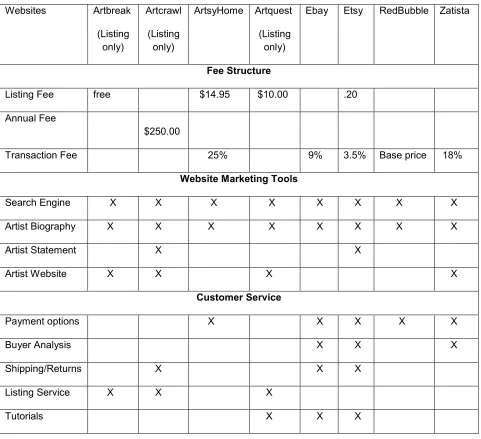
In order to facilitate the analysis of these websites I have created a table which
directly compares the most useful features of each website. Table 3.1 shows that there
Table 3.1 Websites that Market Artwork
Websites Artbreak
(Listing only)
Artcrawl
(Listing only)
ArtsyHome Artquest
(Listing only)
Ebay Etsy RedBubble Zatista
Fee Structure
Listing Fee free $14.95 $10.00 .20
Annual Fee
$250.00
Transaction Fee 25% 9% 3.5% Base price 18%
Website Marketing Tools
Search Engine X X X X X X X X
Artist Biography X X X X X X X X
Artist Statement X X
Artist Website X X X X
Customer Service
Payment options X X X X X
Buyer Analysis X X X
Shipping/Returns X X X
Listing Service X X X
Tutorials X X X
Based on my research questions I will discuss the content and structure of these eight
websites. The content and structure include the website fee structure, marketing tools, and
Fee Structure
Seven out of the eight websites studied charge some form of fee payment. The fee
structures vary considerably. Artbreak.com, Artquest.com, and Artcrawl.com are websites that
are primarily listing services where the website connects artist with buyer. Each of these
websites charges a fee except for Artbreak.com. Artbreak offers their services for free unless
artists sign up for Artbreak Plus which charges a $5.00 monthly fee. By paying the additional fee
of $5.00, the artist receives special services that include an artist’s profile page, priority website
support, and the artist will be the first to learn about new and experimental website features.
Artquest.com charges a listing fee per item of $10.00. There are no additional charges once an
item sells. Artcrawl.com charges an annual fee of $250.00.
The non-listing websites are ArtsyHome.com, Ebay.com, Etsy.com, RedBubble.com,
and Zatista.com. ArtsyHome charges $14.95 a month but the artist has the option of choosing a
commission-based form of payment. If an artist has a limited number of items and lower priced
work, it would be to their advantage to go with the Commission Studio on ArtsyHome. Each of
these five websites is commission based with each site having a different commission scale.
The commission on ArtsyHome.com is 25% per item sold. Zatista.com charges 18% per item
sold, Ebay charges 9%, and Etsy.com is the lowest at 3.5%. Etsy does charge a per-item listing
fee of .20 cents. RedBubble.com is the only website that has the artist establish a base unit
price per item and the company adds their mark-up on each item listed. The base price is the
amount the artist wants to receive for their artwork. This price is their wholesale price.
RedBubble will make a profit by raising the artists’ wholesale price and establishing a retail