2017 2nd International Conference on Computer, Network Security and Communication Engineering (CNSCE 2017) ISBN: 978-1-60595-439-4
An ABE-based Data Distribution Model for Usage Control in OSNs
Jian WANG
1,*, Kuo-yuan QIAO
2and Fei XIANG
21
Zhengzhou University, School of Information Engineering, Zhengzhou, China
2
Henan University of Science and Technology, School of Information Engineering, Luoyang, China
*Corresponding author
Keywords: Attribute-based encryption, Access control, Usage control, Online social networks.
Abstract. Attribute-based encryption (ABE) based access control and usage control methods have been proposed to control private data access and propagation. However, ABE-based access control will be invalid when the data goes out of the owner’s control domain. Usage control can’t reach the requirement of application in OSNs (Online Social Networks) for its inflexible policy definition neither. In this paper, we present an ABE-based data distribution model for usage control, combining ABE-based access control theory with usage control method, to protect user privacy in data dissemination. The scheme supports user data encrypted storage in OSN server, fine-grained access control based on user attributes, and persistent control even if it goes out of the user control domain without complicated key management. Extensive analysis shows that our scheme is efficient for secure data access and sharing in OSNs.
Introduction
OSNs have become more and more popular and important in daily life for that it provides a primary way for interacting and sharing information. The explosive growth of sensitive and private user data has raised an urgent expectation for an effective method to protect users’ data away from unauthorized accessing in OSNs. A general method to protect private data from unauthorized access is access control [1,2] which is good to realize the fine-grained access, but the users’ data is stored in plaintext on the web servers. Once the server is attacked, the confidentiality of the user data will be threatened [3], and this method can’t protect private data from revealed by the privileged insiders.
Recent years, the attribute-based encryption (ABE) scheme [4] provides a new way for privacy protection in distributed resource sharing in OSNs. ABE scheme takes attributes as the public key and associates the ciphertext and user’s secret key with attributes, so that it can support not only encrypted storage but also expressive access control policies. Zheng et al. [5] utilized two dimensions of trust levels to control pervasive data access in a heterogeneous manner on the basis of ABE. Huang et al. [6] proposed a secure data sharing scheme based on attribute-based proxy re-encryption. Guo et al. Shuai et al. [7] proposed a novel access control mechanism called Masque employing ABE, as a hierarchical solution for interactive sharing of encrypted data in OSNs. However, access control schemes can only protect data from unauthorized access at the time of initial release, and they will lose effect when the data has already been got by the authorized users.
such policies are not suitable for social networks environment for the famous “privacy paradox” [13], that is, people in OSNs expect both show themselves and protect privacy from unauthorized access. Therefore, considering the merits and the shortcoming of both ABE-based access control models and usage control models, we propose an ABE-based data distribution model for usage control in OSNs, which combines the characteristics of them both, to support encrypted storage and flexible persistent controls.
Preliminary
Attribute-based Encryption (ABE)
Attribute-based encryption is a generalization of identity-based cryptosystems, which incorporates attributes as inputs to its cryptographic primitives. The basic ABE only supports threshold based access control. To express more flexible access control policy, the later researchers provided key-policy ABE (KP-ABE) and ciphertext-policy ABE (CP-ABE). CP-ABE describes access policy with tree construction, supporting message sender to decide the access control policy, which fits the application of access control in social networks [N4]. The ABE scheme used in our model is the one that Ostrovsky [14] presented, where private keys can represent any access formula over attributes, including non-monotone ones.
Definition 1 Access Structure (AS):
Let P={P1,P2,…,Pn} be a set of parties. A collection AS⊆2P is monotone if ∀B, C: if B∈A and B⊆C
then C∈A. An access structure is a collection AS of non-empty subsets of P. The sets in AS are called the authorized sets, and the sets not in AS are called the unauthorized sets.
Definition 2 Non-monotone Access Structure (NM(AS)):
Let {P1,P2,…,Pn ,P’1,P’2,…,P’n} be a set of parties Pi(i=1,2,…,n) and the negation of them each P’i(i=1,2,…,n), denoted by P. Let S⊂{P1,P2,…,Pn}, then N(S) is a collection that includes all the elements
in S and the corresponding negation for all the elements not in S but in{P1,P2,…,Pn}. We define a
non-monotone access structure for AS, denoted as NM(AS), by specifying that S is authorized in
NM(AS) if N(S) is authorized in AS. Then, for each access set S in NM(AS), there will be a set in AS
that has the elements in S plus the negation for each party not in S.
An Attribute-based encryption scheme consists of four algorithms:
Setup. This is a randomized algorithm that takes no input other than the implicit security parameter. It outputs the public parameters PK and a master key MK.
Encryption. This is a randomized algorithm that takes as input a message M, a set of attributes (that is, AS), and the public parameters PK. It outputs the ciphertext E.
Key Generation. This is a randomized algorithm that takes as input an attributes set S and the master key MK. It outputs a decryption key SK.
Decryption. This algorithm takes as input the ciphertext E and the decryption key SK for the attributes set S. It outputs the message M if S∈AS.
Usage Control (UCON) Model
In UCON [15], security policy statements and access decisions are determined by three factors: authorizations, obligations and conditions. Which are briefly described in the part below.
Subjects. A resource requester (or subject) holds rights on the target object (resource). Subject’s attributes, ATT(S), are properties or capabilities of the subject that can be used for the usage decision. In our discussion, anyone wants to access others’ data is a “subject” in the usage control model.
Attributes. Attribute is used to describe a subject’s property or ability, and used in the decision process in the UCON. In our scheme, we mainly consider the subject’s attributes and divide them into two kinds as subjective attributes and objective attributes. The former is the attributes about the social relationships which are defined by this subject’s direct contacts from themselves’ perspective. The latter is the attributes about the subject’s personal information which are objective facts.
Rights. UCON rights denote usage permissions which can be exploited by subjects on objects. The existence of a particular right is not predefined, but it is determined when the access is attempted by the subject, and depends on subject, object, and environmental attributes, authorizations, obligations and conditions. In our scheme, “Rights” means some operations over an object (e.g. read only, read & write, save, sharing n times or unlimited, etc.), when the subject has some certain attributes.
Authorizations. Authorizations are functional predicates over attributes that have to be satisfied to grant a certain right to a digital object.
Obligations. Obligations examine the accomplishment of mandatory tasks that are relevant to the usage process. For example, in our scheme, all the subjects have the obligation that they should be registered users in the OSN website.
Conditions. Conditions are environmental constrains that are taken into account in the usage decision process, based on environmental attributes. For example, in our scheme, the requester is required to have downloaded and installed the Reference Monitor (RM) [16] to ensure the usage policy can be performed honestly on his terminal, through which, he use the OSNs services.
Proposed Scheme
System Model
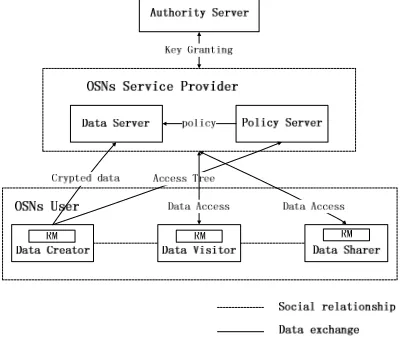
[image:3.612.205.405.411.583.2]We consider the data sharing scenario in OSNs as shown in Figure 1. The system model of the proposed scheme consists of the following three parties:
Figure 1. System model of the proposed scheme.
1. OSNs service provider. The OSNs server provider is a semi-trusted server, which manages the registered users and stores their encrypted data and policies defined themselves.
2. Authority server. The authority server is a trusted third party, which in charge of granting different access rights to the users by issuing attribute secret keys based on their attributes.
has no relationship with the creator. All the OSNs users in our discussion have downloaded and installed the Reference Monitor from the OSNs service provider when they register.
Scheme Definition
In this section, we introduce the notation of our scheme as the followings:
A. A is the collection of subjects’ attributions, including the subjective attributes SA and the objective attributes OA. That is, A=SA∪OA.
C. C is a tuple (id, AS) to represent the data creator in the above model, where id is the unique
identity for C in the OSN and AS is the non-monotone access structure built according to the security access policy defined by C himself.
V. Vis a tuple (id, atts, atto) to represent the data visitor in the above model, where id is the unique identity for V in the OSN, and atts⊆SA, atto ⊆OA.
S. Sis a tuple (id, atts, atto) to represent the data sharer in the above model, where id is the unique identity for S in the OSN, and atts⊆SA , atto ⊆OA.
O. O is a tuple (id, ucp) to represent the object to be shared through the OSNs, which is created by
C and O.id equals C.id. And the ucp represents the usage control policy file defined by C which is described in XACML [17]. The encrypted O is represented by EOO.id.
Scheme Describe
In this section, we will describe our distribution scheme in two scenarios, respectively. The one is direct distribution, and the other is re-distribution. All the message transmission mentioned in the scheme is through a secret tunnel.
Preparation Phase:
The entities of the system have completed these following works before the data distribution: When a Data Creator registers with the OSNs Service Provider, the Authority Server outputs the system public key PKi and a master secret key MKi for the C, where i=C.id.
When the Data Creator C creates a new object O, C takes as input PKi, C.AS (the access control
policy for O) and O, outputs the encrypted object EOO.id. Then, C stores EOO.id to the Data Server and C.AS to the Policy Server, respectively.
When a OSNs user becomes a direct contact of C, that is, he becomes a potential Data Visitor V to C, the OSNs Service Provider sends <V.atts∪V.atto> to the Authority Server, and the latter computes
a secret key SK for V with V.atts∪V.atto and MK, which is returned to V by the OSNs Service Provide.
Direct Distribution:
The visitor V sends the message (O.id) to the OSNs Service Provider to request the object O. The OSNs Service Provider returns EOO.id to V.
The decryption algorithm mentioned in the above section 2.1 is performed in the Reference Monitor of V, then V will get O if (V.atts∪V.atto)∈C.AS, and have to honestly perform O.UCP after
he gets O. Otherwise, the access of V will be refused.
Re-distribution:
When a Sharer S requests the object O from V, S sends a message <O.id, S.att> to V. The Reference Monitor in V will check whether the “Rights” defined in O.UCP is “sharing” (the number of sharing times isn’t exhausted or sharing times is unlimited). If yes, V sends a message <O.id, S.atts, S.attO> to the OSNs Service Provider. Otherwise, the request will be denied.
The OSNs Service Provider checks whether the distance between C an S is 1 (that is, S is a direct contact of C) in the topology graph of the OSNs users. If yes, the OSNs Service Provider will go on with step (3). Otherwise, go on with step (4).
Checks whether (S.atts∪S.atto) ∈C.AS. If yes, return “yes” message to V; else, return “No” to it.
Supposing all the conditions about the subjective attributes expressed in C.AS are satisfied, checks whether S.attO satisfies C.AS, either. Such hypothesis is because the sharer doesn’t have subjective attributes about C when he is not a direct contact of C. That is, the conditions about subjective attributes defined in C.AS become invalid when the object goes out of the control domain of C. If yes, return “yes” message to V; else, return “No” to it. Then, go to step (5).
If V gets “yes” from the OSNs Service Provider, it returns SK of himself and EOO.id to S. otherwise, refuse S. When a sharer “S” gets the object and requested by others, he will become the “V”, and the others become the “S”. It’s a recursive procedure.
Security and Performance Analysis
Our scheme combines the ABE-based access control method and the usage control theory, so it has the security properties of the both two:
(1) Data confidentiality. All users’ data is encrypted based on CP-ABE before uploaded to the OSNs service provider. The direct accessor and other sharers can get the data if and only if they have a matching set of attributes. Besides, the OSN service provider has no way to get user data, which avoids the possible privacy violation from untrusted third party.
(2) Fine-grained access control. The ABE-based encryption adopted in our scheme supports non-monotonic access structure, which can be used to realize any access formula represented by AND, OR, NOT and threshold operations.
(3) Persistent control. The scheme uses the usage control theory into the data distribution in OSNs. Each object to be shared has an attached part “usage control policy”, which describes the requirement to the future sharers of the object creator. This usage control policy will go with the object wherever it reached, and be honestly performed by the node which has got it in the OSNs through the Reference Monitor.
(4) Supporting privacy paradox. Considering such a scenario, a user shared a photo, but the photo is got by a friend which is not authorized after retweeting. In our scheme, users can disseminate their private data without worrying about that it falls into the hands of anyone in their blacklist.
Obviously, the computational performance of direct distribution in our scheme equals ABE-based access control schemes. In re-distribution, there is only encrypted communication cost and no computational cost caused by attributes based encryption for the disseminator. So, to be compared with ABE-based access control, our scheme realizes the consistent control with same computational cost. And to be compared with present usage control, our scheme uses the attributes based asymmetric-encrypted which not only realizes encrypted store but also decreases the cost of key storage and management because of nodes generation is replaced by a key for each user to be shared.
Conclusion
In this paper, we first analyze the existing problems of ABE-based access control and UCON as the two main ways to provide privacy protection in OSNs environment. Further, based on them two, we introduced a secure data sharing scheme for users of an OSN supporting their data to be encrypted stored in OSN server and still controlled out of the domain of themselves. The scheme has not more computational cost than ABE-access control while realizes consistent control as UCON without key management trouble. As future work, we will consider how to use trusted computing technology and hardware to ensure the consistent control to take effect.
Acknowledgement
References
[1] Yuan Cheng, Jaehong Park, Ravi Sandhu, An Access Control Model for Online Social Networks Using User-to-User Relationships, IEEE Transactions on Dependable and Secure Computing. 99(2) (2015) 1-15.
[2] Feng Weining, Zhang Zhiyong, Wang Jian, Han Linqian, A Novel Authorization Delegation for Multimedia Social Networks by using Proxy Re-encryption, Multimedia Tools and Applications (Springer). 75(21) (2015) 1-20.
[3] Franchi E, Poggi A, Tomaiuolo M., Information and Password Attacks on Social Networks: An Argument for Cryptography, Journal of Information Technology Research. 8(1) (2017) 25-42.
[4] Su Jinshu, Cao Dan, Wang Xianfeng, Sun Yipin, Hu Qiaolin, Attribute-based Encryption Schemes, Journal of Software. 22(6) (2011) 1299-1315.
[5] Zheng Yan, Mingjun Wang, Niemi and V. Kantola, R. Secure pervasive social networking based on multi-dimensional trust levels, in Proceedings of IEEE Conference on Communications and Network Security. (2013) 100-108.
[6] Huang Qinlong, Ma Zhaofeng, Yang Yixian, Niu Xinxin, Fu Jingyi, Improving security and efficiency for encrypted data sharing in online social networks, China Communications. 11(3) (2014) 104-117.
[7] Shuai Huimin, Zhu Wentao, Liu Xin, Publishing and Sharing Encrypted Data with Potential Friends in Online Social Networks, Security and Communication Networks. 7(2) (2014) 409-421.
[8] Black S R, Schmiege S, Bull S, Actual versus perceived peer sexual risk behavior in online youth social networks, Translational Behavioral Medicine. 3(3) (2013) 312-319.
[9] Debmalya Biswas, Nikolai Nefedov and Valtteri Niemi, Distributed Usage Control, in Proc. of the 8th International Conference on Mobile Web Information Systems. (2011) 562-569.
[10] Anastasi G.F., Carlini E., Coppola M., Dazzi P. et al., Usage Control in Cloud Federations, in Proceedings of IEEE International Conference on Cloud Engineering. (2014) 141-146.
[11] Huang Qinlong, Ma Zhaofeng, Yang Yixian, Niu Xinxin, Fu Jingyi, Attribute based DRM scheme with dynamic usage control in cloud computing, China Communications. 11(4) 2014 50-63.
[12] Ibrahim M, Ibrahim H, Abdullah A, et al., A High Oerformance Ucon and Semantic-based Authorization Framework for Grid Computing, Journal of Cleaner Production. 15(1) (2016) 183-202.
[13] Acquisti A and Grossklags J., Privacy and Rationality in Individual Decision Making, Security & Privacy. 3(1) (2005) 26-33.
[14] Rafail Ostrovsky, Amit Sahai and Brent Waters, Attribute-Based Encryption with Non-Monotonic Access Structures, in Proceedings of the ACM Conference on Computer and Communications Security (2007) 195-203.
[15] Aliaksandr Lazouski, Fabio Martinelli, Paolo Mori, Usage control in computer security: A survey, Computer Science Review. 4(6) (2010) 81-99.
[16] P. Samarati, S.D.C. di Vimercati, Access control: Policies, models, and mechanisms, in Proceedings of International School on Foundations of Security Analysis and Design. (2001) 137-196.