University of Huddersfield Repository
Fabricatore, Carlo and López, Ximena
Using Gameplay Patterns to Gamify Learning Experiences
Original Citation
Fabricatore, Carlo and López, Ximena (2014) Using Gameplay Patterns to Gamify Learning
Experiences. In: Proceedings of the 8th European Conference on Game Based Learning. Academic
Conferences and Publishing International Limited, Reading, UK, pp. 110117. ISBN 9781910309
551
This version is available at http://eprints.hud.ac.uk/id/eprint/22100/
The University Repository is a digital collection of the research output of the
University, available on Open Access. Copyright and Moral Rights for the items
on this site are retained by the individual author and/or other copyright owners.
Users may access full items free of charge; copies of full text items generally
can be reproduced, displayed or performed and given to third parties in any
format or medium for personal research or study, educational or notforprofit
purposes without prior permission or charge, provided:
•
The authors, title and full bibliographic details is credited in any copy;
•
A hyperlink and/or URL is included for the original metadata page; and
•
The content is not changed in any way.
For more information, including our policy and submission procedure, please
contact the Repository Team at: [email protected].
1
[Final draft post-refereeing]
Carlo Fabricatore1, Ximena López2
1University of Huddersfield, Huddersfield, UK
2Pontifical Catholic University of Chile, Santiago, Chile
[email protected], [email protected]
Corresponding author postal address: Carlo Fabricatore
University of Huddersfield
School of Computing and Engineering Queensgate,
Huddersfield, HD1 3HD
Please cite as:
Fabricatore, C., & López, X. (2014). Using Gameplay Patterns to Gamify Learning Experiences. In C. Busch (Ed.), Proceedings of the 8th European Conference on Game Based Learning (pp. 110–117). Reading, UK: Academic Conferences and Publishing International Limited.
Abstract: Gamification refers to the use of gaming elements to enhance user experience and engagement in non-gaming systems. In this paper we report the design and implementation of two higher education courses in which ludic elements were used to enhance the quality of the learning experience. A game can be regarded as a system of organised gameplay activities, and a course can be regarded as a system of organised learning activities. Leveraging this analogy, analysing games can provide valuable insights to organise learning activities within a learning experience. We examined a sample of successful commercial games to identify patterns of organisation of gameplay activities that could be applied to a course design. Five patterns were identified: quest structure, strategic open-endedness, non-linear progression, orientation, and challenge-based reward. These patterns were then used to define the instructional design of the courses. As a result, courses were organised as systems of quests that could be tackled through different strategies and in a non-linear way. Students received frequent feedback and were rewarded according to the challenges chosen, based on mechanics common in quest-based games. The courses involved two lecturers and 70 students. Learning journals were used throughout the term to collect data regarding student perceptions on the clarity and usefulness of the gamified approach, level of motivation and engagement in the courses, and relevance of the activities proposed. Results show that students felt challenged by the activities proposed and motivated to complete them, despite considering most activities as difficult. Students adopted different cognitive and behavioural strategies to cope with the courses’ demands. They had to define their own team project, defining the objectives, managing their times and coordinating task completion. The regular and frequent provision of feedback was highly appreciated. A sense of mastery was promoted and final achievement was positively impacted by the gamified strategy.
Keywords: gamification, gameplay patterns, higher education, instructional design
1. Introduction
of game elements that can inform in a deeper way the instructional design of educational experiences (Jensen 2012; Nicholson 2012).
This study proposes an approach for the deep gamification of instructional design. Our research aimed at: identifying gameplay mechanics patterns present in successful gaming products that deeply define players’ experiences; applying them to the instructional design of educational courses; and exploring the impacts of gamification on student perception and academic achievement.
2. From game design to instructional design
A starting point to deeply gamify educational courses is to consider both games and courses as systems of problem-solving activities. Problem-solving is a process of activities aimed at transitioning from an initial state to a desired goal state, overcoming obstacles, and often developing knowledge (Ward 2011). Educational courses can be conceived as organised systems of activities driven by problems set in contexts meaningful to learners, and whose solution fulfils desirable learning goals (Jonassen 1999; Jonassen & Rohrer-Murphy 1999).
As to games, they all require players to engage in organised activities aimed at pursuing game goals, acting in accordance with game rules to overcome challenges and generate desirable changes within the gaming environment (Fabricatore & López 2011; Schell 2008). In this process, players must learn about relevant elements of the game like goals, entities and mechanics (Fabricatore 2007), and develop knowledge and skills required to succeed, which makes of meaningful learning an essential source of challenge and fun in games (Fabricatore 2007; Fabricatore & López 2011; López 2010). Gaming can be consequently considered a proper problem-solving activity (Schell 2008).
Some types of games more than others explicitly leverage the problem-solving nature of gaming in order to articulate the player experience. This is the case of quest-based games, in which quest systems are used as a mechanics to organise gameplay activities and contextualise them in a coherent narrative frame, defining narrative and activity progression within the game (Howard 2008; Smith et al. 2011). Quest-based games have a primary aim that players must fulfil through achieving concrete objectives associated to quests. This requires players to generate desirable changes in the gaming world through engaging in possibly interrelated quest activities (Howard 2008). Thus, quest-based games are deliberately designed as systems of problem-solving activities aimed at achieving objectives that need to be successfully addressed in order to progress and eventually win.
Analogising games and courses as problem-solving activity systems allows using game analysis to identify elements key to define the player experience and applicable for the design of educational courses. The Activity Theory provides a useful theoretical framework to organise game analysis, adopting gameplay activities as units of analysis, and focussing on the elements that define them (Kuutti 1995; Barr, Noble & Biddle 2007). Within our study such focus was specifically set on core gameplay mechanics patterns.
Gameplay mechanics define the interrelationship and interoperability of the game system elements, the provision of contextual information to the player, and the dependencies between gameplay activities (Salen & Zimmerman 2003; Fabricatore 2007; Adams & Dormans 2012). Hence, they determine possible dynamics within and across gameplay activities. Mechanics are not unique to each game, and recurring mechanics can be identified across games and described through game mechanics patterns (Björk & Holopainen 2006).
Core mechanics have a paramount influence on the player experience, as they are mechanics that players have to deal with throughout most of the gameplay activities, and whose mastery is essential to achieve most of the game objectives (Fabricatore 2007). Core mechanics are therefore key to make gameplay activities engaging and intrinsically motivating (Polaine 2005).
After their identification, gameplay mechanics patterns can be applied to design specific aspects of a course. For this, courses should be designed following a problem-based approach (Savery & Duffy 1995), identifying key problems meaningful to learners and mapped to desirable learning outcomes, and gameplay mechanics patterns should be implemented to define possible problem-solving dynamics within and across learning activities.
3. Identifying Gameplay Patterns
3.1. Materials
F2 is a fantasy action role-playing game requiring the player to join forces with three heroes to defeat an evil lord seeking to rebuild a magical artefact to control the world. LAN is an action-adventure game in which player acts to solve a range of police cases set in 1947 Los Angeles. Three criteria were followed to choose these games:
i. Gameplay articulation: player activities articulated as problem-solving quests. We focussed our analysis on quest-based games because these are explicitly designed as systems of problem-solving activities (Howard 2008).
ii. Market impact: be in the top-50 worldwide sales rankings, according to the website VGChartz
http://www.VGChartz.com.
iii. Critics’ appreciation: be in the top-quartile game press critics’ appreciation, based on the website Metacritic (http://www.metacritic.com)
3.2. Procedure
We analysed games looking for patterns of core game mechanics, this is, for patterns related to the definition and organisation of quests, and to the facilitation of player progression and engagement in quests. Each game was played by one of the researchers until achievement of 70% game progress minimum (gauged based on game feedback and on-line reviews and tutorials).
The quests to be analysed were identified as activities explicitly defined as such (e.g. through the game interface in F2), or as processes leading to measurable progress in the game (e.g. missions in AC2 and police cases in LAN).
Patterns were identified through examining mechanics underpinning quests in the selected games. Mechanics recurring in more than 75% of the quests in at least one of the games examined were generalised into patterns.
The game patterns identified were then used to design and administer two courses in game software engineering, delivered over one semester to computing students at the University of Worcester (UK). The courses aimed at studying key topics and challenges of software engineering in the domain of game development, exploring related theories, approaches and techniques.
3.3. Results
Table 1: Game play patterns and their application to educational course Gameplay
Pattern
Description Implementation
Quest structure
Quests are defined by:
An objective requiring the accomplishment of victory conditions through tasks to be completed within each quest. Core victory conditions are sometime accompanied by optional conditions, usually entailing additional challenges engendering additional positive outcomes (e.g. enhanced tools to engage in further quests).
Means required or beneficial for the fulfilment of the objective
A motivation, explaining the importance of the quest to progress in the game.
Quests are usually structured as a sequence of briefing, action and debriefing activities. Briefing and debriefing activities provide information necessary to engage in a quest and understand the outcomes of a quest, respectively. Action stages allow players to act to fulfil a quest goal. At least one briefing activity precedes player action, and one debriefing activity follows the completion of all the quest action stages. Briefing and debriefing information is usually expressed through concrete and contextualised game elements (e.g. storyline, game entities) rather than through abstract concepts (e.g. progress percentages).
The course was designed to revolve around a capstone game development team project, requiring students to address five core problems related to game software engineering through engaging in five related collaborative quests. Core and supplementary winning conditions were defined as requirements mapping to essential and complementary challenges, respectively. ‘Sailing’ metaphors was used to communicate the level of difficulty (mastery level) of each challenge, ranging from “Shipmate” (basic level) to “Wave Master” (very advanced). Teams were analogised to crews, and challenges were means to allow crews to self-organise their activities.
Briefing activities: Early core lectures and project workshops. Lectures were used to present information for each core problem, and the core and supplementary requirements. This allowed students to engage in each problem as soon as possible. Project workshops allowed crews to engage in their project activities and interact with tutors acting as mentors throughout the semester.
Action: Crews could engage in their quests through self-organised work during the project workshops and out-of-class time.
Debriefing: Two project milestones were defined to review each project and provide feedback regarding the achievements of each student. The appraisal comprised a ‘sailing status’ employing six metaphors to describe students’ progression in their journey, ranging from “Get on Board” (indicating insufficient engagement) to “Full Sail” (excellent progression).
Strategic open-endedness
Quest goals can be achieved through alternative strategies, allowing players to “do more” or “differently”. This allows players to embrace alternative play approaches, and motivates them to explore increasingly challenging approaches as their confidence increases.
Requirements of learning activities were designed to be fulfilled through different strategies. Requirements provided sufficient organisation to orient students while allowing varied and flexible responses. Supplementary requirements were designed to be more challenging than core ones, demanding more advanced learning.
Non-linear
progression The organisation of quests generally allows
them to decide when to engage in specific quests. When this is not allowed, it is usually related to quest narrative articulation or functional dependencies. Briefing and debriefing feedback provide the information regarding quest engagement and functional dependencies.
Gameplay Pattern
Description Implementation
Orientation The game delivers briefing information that is available to the player at any time through orientation artefacts (e.g. maps), to support decisions in relation to when, how and in what to engage.
Students received handouts which served as an incrementally unfolding “progression map”, flagging the emergence of new problems and succinctly describing their goals, relevance, difficulty and possible interrelations.
Students received just-in-time summative and formative feedback related to the intrinsic nature of the problem-solving activities they engaged in. To foster intrinsic motivation, the feedback used the above-mentioned progression and mastery metaphors, and was entirely disconnected from the formal literal grading system.
Challenge-based reward
Rewards are normally granted based on a “the more you achieve, the more you receive” rationale. The fulfilment of core victory conditions earns a baseline reward. Success achieved through more challenging strategies earns additional rewards (e.g. additional resources), and a recognition of increased mastery (e.g. enhancement of the formal role of the player). Rewards in collaborative quests depend on the contribution of each participant.
Learning activities were designed so that engagement in higher challenges, adoption of advanced strategies and operational leadership roles were recognised at each milestone using the above-mentioned mastery metaphors, and possibly through extra marks at the end of the semester. For collaborative quests, rewards to individual contributions were given based on information reported by each crew member in a learning journal, and signed off by the whole crew.
4. Impact on Student Engagement and Achievement
4.1. Participants
Participants were 70 computing students, 50 2nd-year and 20 3rd-year students, 73% male and 27% female. Age was not recorded. Each student had to complete three learning journals throughout the semester. However, students did not complete all learning journals, hence a total of 163 journals were available for the analysis. Two tutors delivered the courses, working closely so the courses would be as similar as possible.
4.2. Data collection and analysis
We used the information provided by students in the learning journals they had to complete as part of the courses requirements. These journals collected information regarding: students’ feelings, cognitive involvement, and learning strategies and behaviours used to complete the milestone and perform in the course so far; the perception of relevance and difficulty of activities; and the perceptions of progress and expertise. Learning journals had 28 closed-ended items, being check-all-that-apply and 5-point Likert scale items. In the final learning journal, 12 additional items were included to evaluate the students’ perceptions at the end of the semester. Learning journals were not marked, and were used by tutors to provide general formative feedback to the whole class and specific feedback to teams and individuals. Check-all-that-apply items were transformed to dummy variables. Descriptive statistics were calculated for each item to gain insight of the student experience in the courses. Spearman correlations and point-biserial correlations were run to identify the relationship between students’ perceptions and their academic achievement.
4.3. Results
There were no significant differences between the courses as to the answers provided by students, hence results are presented aggregated. Throughout the semester, students judged 74% of the milestones activities as interesting or very interesting, although (or because) half of them were considered difficult or very difficult. 74% of activities were considered helpful to understand the course topics, and a third of them required a significant amount of time or effort to carry them out.
do further study. 60% of the activities made students feel enjoyment, while boredom or indifference was mentioned by students in less than 5% of activities. As to cognitive efforts, the courses’ activities required students to use higher order skills, evaluating the results of their own work, testing things and analysing elements to understand a whole. Using lower order cognitive skills such as memory was mentioned in less than 10% of activities. Activities were performed using different behavioural strategies. Studying lecture notes, looking for further information in websites, tutorials and academic writings, and working with a classmate or team were the most frequently mentioned ones.
Throughout the semester, students perceived that they were progressively mastering the skills and knowledge needed to complete the courses. They perceived they were understanding more and that their competence was increasingly improving. Students also perceived their performance in the activities was good or excellent. Teamwork made students feel more at ease as in most cases their level of confidence was higher than working autonomously. Further results are presented in Table 2.
Table 2: Students’ opinions throughout the semester
% of activities
Perception of activities
Interesting or very interesting 74.2
Difficult or very difficult 49.7
Helpful to understand better the topics of this module 74.2
Requiring a lot of time 33.1
Requiring a lot of effort 23.3
Cognitive efforts required by the activity
Test different things (strategies, resources, etc.) 55.8 Skills to evaluate or judge the results of your actions 44.8 Decompose, decode or deconstruct to understand a whole 42.9
Ability to apply a procedure 35.0
Skills to create and produce new things 34.4
Ability to foresee effects of your actions 30.1
Memory 9.8
Emotions raised by the activities
Challenged 89.0
Motivated to complete it 70.6
Motivated to do further study 66.3
Enjoyment 60.7
Indifferent 4.9
Bored 3.7
Behavioural Strategies
Study lecture notes 84.7
Look for further information (websites, tutorials, etc.) 83.4
Work with classmate/friend/group/team 76.1
Ask advice to/interact with lecturers/experts 44.8
Complete further learning activities 42.3
Perception of Mastery
High level of confidence, working in a team 63.2 I am increasingly improving the abilities required 61.3 I am gaining more confidence with the module topics 59.5 My individual performance is good or excellent 58.3 High level of understanding of the course topics studied so
far 57.7
High level of confidence, working autonomously 47.2
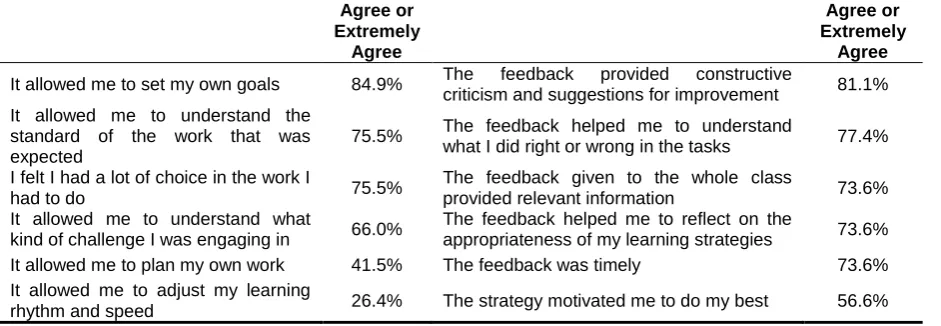
Table 3: Students’ opinions at the end of the semester Agree or
Extremely Agree
Agree or Extremely
Agree
It allowed me to set my own goals 84.9% The feedback provided constructive
criticism and suggestions for improvement 81.1% It allowed me to understand the
standard of the work that was expected
75.5% The feedback helped me to understand
what I did right or wrong in the tasks 77.4%
I felt I had a lot of choice in the work I
had to do 75.5%
The feedback given to the whole class
provided relevant information 73.6% It allowed me to understand what
kind of challenge I was engaging in 66.0%
The feedback helped me to reflect on the
appropriateness of my learning strategies 73.6% It allowed me to plan my own work 41.5% The feedback was timely 73.6% It allowed me to adjust my learning
rhythm and speed 26.4% The strategy motivated me to do my best 56.6%
Regarding student final achievement, it was expressed in categories defined by the progression metaphors (see Table 1). These were subsequently transformed to the conventional marking system. 17.1% of students achieved the highest rank (“Full sail”, grade A), 11.4% “Favourable winds” (grade B), 28.6% “Misty waters” (grade C) and 14.3% “Rough waters” (grade D). 2.9% of students did not achieve the minimum necessary to pass the courses, falling in the category “Eye of the storm”. Single-item correlations were done to determine the relationship between the students’ opinions and their final achievement. Results suggest that students who thought the activities were interesting, helpful, enjoyed working on them and felt motivated to do their best had better final academic results. In addition, students who perceived their competence was improving (and their confidence in dealing with the courses topics was increasing, also had better academic results. Correlations are presented in Table 4.
Table 4: Correlation with Academic Achievement
Spearman r
The activity was interesting 0.50
It motivated to do my best 0.44
Helpful to understand better the topics of this module 0.50
Enjoyment 0.51
I am increasingly improving the abilities required 0.54
I am gaining more confidence with the module topics 0.46
The feedback helped me to understand what I did right or wrong in the tasks 0.45
The feedback helped me to reflect on the appropriateness of my learning strategies 0.55
5. Discussion
The present study aimed at identifying core gameplay mechanics patterns influencing player engagement, applying them in the design of two educational courses, and evaluating the impacts of such gamified educational strategy on students’ perceptions and achievement. The study focussed on core gameplay mechanics because they define nature and relations of gameplay activities (Fabricatore 2007), and are consequently key to deeply engage players in intrinsically motivating mechanics (Polaine 2005). We identified five patterns by analysing three successful commercial games through direct play, and expected that they could be successfully employed to inform instructional design, based on analogising games and educational courses as systems of problem-solving activities (Jonassen 1999; Schell 2008).
Structuring educational courses using the identified game patterns is an approach coherent with constructivist perspectives on learning, which conceive courses as systems of activities based on problems situated in meaningful contexts, and whose solution requires the active participation of the learner (Jonassen 1999). By gamifying the courses using the game patterns, students were prompted to define the type of project to work on, choose the type of challenges in which to engage, organise their individual and team work, and define (to a degree) the strategies to be used. In addition, as it happens in most games, students received constant feedback to help them redefine their strategies and actions.
Our results suggest that the gamified courses had a positive impact on students. Most activities defined and organised through the strategy were considered interesting and useful to understand the course topics, despite being mainly judged as difficult. Students appreciated the feedback provided, in particular its timeliness and relevance. Moreover, a large number of them indicated feeling challenged and motivated by the activities, and were encouraged to engage in additional learning activities, such as working with classmates and looking for further information. The strategy provided students with sufficient autonomy to define their own goals and strategies, while also giving them a frame of reference helpful to understand the type of work to be done and the expected outcomes. All this is an interesting result, as it suggests that the educational strategy was successful in presenting students with activities that were attractive, meaningful, and valuable from an academic perspective. Furthermore, the gamified courses apparently provided to students a balance of independence and support appropriate to promote their motivation and engagement. This suggests that appropriately selected gameplay mechanics patterns can generate in an educational context effects similar to what they are meant to trigger in gaming contexts. However, the perceived low freedom to plan own work and adjust learning rhythms suggests that further research is needed to understand the potentially problematic consequences of our gamified approach.
Academic achievement was favoured by the gamified strategy. Although a high number of activities were judged difficult, and students constantly mentioned feeling challenged by them, more than half of the students finally attained high levels of achievement (grades A or B). Students perceived that activities effectively focussed them on solving problems and not just memorising information, which suggests that the gamified strategy also benefitted the quality of learning. Moreover, the correlational analyses show that academic achievement was associated with high levels of motivation and an increased perception of mastery. Games engage players through challenging tasks and promoting the players’ sense of mastery (Fabricatore 2007), which creates conditions favourable to foster player achievement. Our results suggest that the use of gameplay mechanics patterns to design learning activities generate similar effects in learning environments, enhancing students’ affective engagement in learning activities with further positive impacts on their academic achievement.
It is worth emphasising that in this study we described the characteristics of each gameplay mechanics pattern, and the approach for the identification and implementation of relevant patterns. Studies in gamification tend to focus on results omitting details on the rationale for the selection and application of game elements (e.g. Hamari, Koivisto & Sarsa 2014). This makes it difficult to understand the results obtained and/or to replicate experiences. By describing how we identified and applied game patterns, we sought to provide actionable information to guide the use of game analysis to inform instructional design and gamify educational courses.
The patterns identified in this study are not the only ones that can be derived from games. Games come in different shapes and sizes, and can be analysed focussing on different aspects. Therefore, embracing alternative analytical perspectives and analysing games of other types may lead to identifying further game patterns, useful to inform other types and aspects of learning experiences. We believe the results obtained in this study are encouraging to continue exploring the impacts game elements can have when applied to educational contexts. In particular, we think it is worth to further study game mechanics patterns defining deep engagement, and their application to inform a gamified instructional design.
6. References
Adams, E., and Dormans, J. (2012) Game Mechanics: Advanced Game Design, New Riders, Berkeley, CA.
Barr, P., Noble, J., and Biddle, R. (2007) “Video game values: Human–computer interaction and games”, Interacting with Computers, Vol 19, No.2, pp 180–195.
Deterding, S., Dixon, D., Khaled, R., and Nacke, L. (2011) “From game design elements to gamefulness: defining gamification”, in Proceedings of the 15th International Academic MindTrek Conference: Envisioning Future Media Environments (MindTrek ’11).
Deterding, S. (2012) “Gamification: Designing for Motivation”, Interactions, Vol 19, No.4, pp 14–17. Fabricatore, C. (2007) “Gameplay and game mechanics design: a key to quality in video games”, in
Proceedings of the OECD-CERI Expert Meeting on Videogames and Education (Vol 14), OECD, July, Santiago, Chile.
Fabricatore, C., and López, X. (2012) “Sustainability Learning through Gaming: An Exploratory Study”, Electronic Journal of e-Learning (EJEL), Vol 10, No.2, pp 209–222.
Howard, J. (2008) Quests: Design, Theory, and History in Games and Narratives. A.K. Peters, Wellesley, MA.
Hamari, J., Koivisto, J., and Sarsa, H. (2014) “Does Gamification Work? A Literature Review of Empirical Studies on Gamification”, in Proceedings of the Forty-Seventh Annual Hawaii International Conference on System Sciences (CD-ROM) (p. 10), Computer Society Press, Hawaii.
Jensen, M. (2012) “Engaging the Learner: Gamification Strives to Keep the User’s Interests”, T+D Training+Development, Vol 66, No.1, pp 40–44.
Jonassen, D.H. (1999) “Designing constructivist learning environments”, in C.M. Reigeluth (Ed.) Instructional-design theories and models (2nd ed., pp 215–240), Lawrence Erlbaum Associates, Mahwah, NJ.
Jonassen, D.H., and Rohrer-Murphy, L. (1999) “Activity theory as a framework for designing constructivist learning environments”, Educational Technology Research and Development, Vol 47, No.1, pp 61–79.
Kapp, K. M. (2012) The Gamification of Learning and Instruction: Game-based Methods and Strategies for Training and Education, Wiley, San Francisco, CA.
Kuutti, K. (1995) “Activity Theory as a potential framework for human-computer interaction research”, in B.A. Nardi (Ed.), Context and consciousness: activity theory and human-computer interaction (pp 17–44), MIT Press, Cambridge, MA.
López, X. (2010) Videogiochiamo dunque impariamo? Un modello per l’analisi educativa dei videogiochi, Rome, Nuova Cultura.
Lyonhead Studios (2008) Fable II [Computer Game], Microsoft Game Studios, Redmond, WA.
Nicholson, S. (2012) “A User-Centered Theoretical Framework for Meaningful Gamification”, in C. Martin, A. Ochsner, and K. Squire (Eds.), Proceedings of the GLS 8.0 Games+Learning+Society Conference (pp 223–230).
Polaine, A. (2005) “The flow principle in interactivity”, in Y. Pisan (Ed.), Proceedings of the Second Australasian Conference on Interactive Entertainment (IE2005) (pp 151–158) , Creativity and Cognition Studios Press, Sidney, Australia.
Salen, K., and Zimmerman, E. (2003) Rules of Play: Game Design Fundamentals, MIT Press, Cambridge, MA.
Savery, J.R., and Duffy, T.M. (1995) “Problem based learning: An instructional model and its constructivist framework”, Educational Technology, Vol 35, pp 31–38.
Schell, J. (2008) The Art of Game Design: a Book of Lenses, Morgan Kaufmann, Burlington, MA. Smith, G., Anderson, R., Kopleck, B., Lindblad, Z., Scott, L., Wardell, A., Whitehead, J. and Mateas,
M. (2011) “Situating Quests: Design Patterns for Quest and Level Design in Role-Playing Games”, in M. Si, D. Thue, E. André, J.C. Lester, J. Tanenbaum, and V. Zammitto (Eds.), Interactive Storytelling - Proceedings of the 4th International Conference on Interactive Digital Storytelling, ICIDS 2011 (pp 326–329), Springer, Vancouver, Canada.
Team Bondi (2011) L.A.Noire [Computer Game], Rockstar Games, New York.
Ubisoft Montreal (2009) Assassin’s Creed 2 [Computer Game], Ubisoft, Montreal, Canada.