Thesis by
Gwendolyn B. Johnson
In Partial Fulfillment of the Requirements
for the Degree of
Doctor of Philosophy
California Institute of Technology
Pasadena, California
2013
© 2013 Gwendolyn B. Johnson
Acknowledgements
I would like to begin by thanking the members of my thesis committee–Drs. Michael Ortiz, Sigrid
Leyendecker, Sergio Pellegrino, and Ravi Ravichandran–for their guidance, feedback, and advice
during my time at Caltech. To begin, I am indebted my advisor Dr. Michael Ortiz for his enthusiasm
and encouragement to pursue topics that I found truly interesting and exciting, and for providing
the opportunity to teach and travel as part of my time at Caltech. Michael, you’ve always received
A+ ratings on Caltech’s annual (confidential until this point) mental health surveys. In addition
to being a close collaborator and outstanding proofreader, Dr. Sigrid Leyendecker and her research
group have been gracious hosts for two summers in Kaiserslautern and Erlangen. The main direct
application of my work thus far is related to the AAReST mission, a project funded by the Keck
Institute for Space Studies jointly with Caltech and JPL and supervised by Dr. Sergio Pellegrino,
who has provided valuable feedback on the more practical aspects of my work. Finally, my thanks to
Dr. Ravi Ravichandran for allowing me to take up as much of his time as needed for both technical
and professional advice.
The support staff for my committee members, Lydia Suarez, Marta Kahl, Cheryl Gause, and Beate
Hegen should also be acknowledged for the skill it takes to keep people, machines, and plans running
smoothly.
In addition, the members of the KISS (or AAReST...or whatever the new acronym becomes) group
John Baker, Dr. James Breckinridge, Dr. Chiara Daraio, Terry Gdoutos, Dr. Marin Kobilarov,
Dr. Namiko Yamamoto, Keith Patterson, and John Steeves have provided useful insights and keeping
up on their work has been the ‘spice’ in my academic life at Caltech. In particular, I would like
to thank Marin for his outstanding work on building the experimental testbed for the AAReST
satellites and his collaboration on the feedback controller design for the system–and his tolerance of
my soldering technique. Dr. Tim Sullivan, has also provided useful feedback and instruction on the
analysis contained in this work, and has a gift for getting others excited about mathematics.
without family and friends. To my parents, who inspired and encouraged my interest in engineering
and hopefully didn’t regret it after they paid for my undergraduate education at M.I.T., thank you.
I’ll get to work on your massive retirement fund ASAP if you’ll still let me do laundry at your house.
To my big brother Evan and my friends from Phoenix–some of which I’ve known for the better part
of 20 years–and my friends from M.I.T., thank you for accepting my quirks and only judging me
mildly for being a nerd. Last, to my Caltech friends and in particular Sebastian and my roommates
of more than three years–two legged and four–this has been a lot more fun than I ever thought it
could be. May be we’re not working hard enough.
Finally, this work would not have been possible without generous support from the Keck Institute
Abstract
Motivated by issues inherent in modeling and designing self-assembling systems (e.g. multiple
colli-sions, collisions between non-smooth bodies, clumping and jamming behaviors, etc.), the goal of this
thesis is to develop robust numerical tools that enable efficient and accurate direct simulation of self
assembling systems and the application of optimal control methods to this type of system. The
sys-tems will be alternately modeled using linear finite elements, rigid bodies, or chains of rigid bodies.
To this end, this work begins with development of a linear programming based collision detection
algorithm for general convex polyhedral bodies. The resulting linear program has several features
which render it extremely useful in determining the force system at the time of contact in numerical
collision integrators. With robust collision detection in hand, three related numerical integration
methods for dynamics with collisions are treated; a direct potential-based approach, and exact
col-lision integrator in a discrete variational setting, and a decomposition-based algorithm, again in the
discrete variational setting. Finally, several control problems are treated in the Discrete Mechanics
and Optimal Control–Constrained (DMOCC) framework in which collisions between non-smooth
bodies either need to be avoided or explicitly included in the optimal control problem. A globally
stable feedback controller and a family of trajectories for spacecraft docking are also developed and
Contents
Acknowledgements iii
Abstract v
1 Introduction 5
1.1 Background . . . 5
1.2 Motivation . . . 6
1.3 Overview . . . 7
2 Non-Smooth Collision Detection 9 2.1 Introduction . . . 9
2.2 Background and Related Work . . . 9
2.2.1 Previous Work . . . 9
2.2.2 A Motivating Example . . . 10
2.2.3 Organization . . . 15
2.3 Hyperplanes and Affine Geometry . . . 16
2.3.1 Affine Sets . . . 16
2.3.2 Convex Sets . . . 16
2.3.3 Hyperplanes . . . 16
2.3.4 Construction of Convex Sets . . . 17
2.3.4.1 Intersection of Half-Spaces . . . 17
2.3.4.2 Convex Hull of Extreme Points . . . 18
2.3.5 Supporting Hyperplanes . . . 18
2.3.6 Normal Cone to a Convex Set . . . 18
2.3.7 Separation of Convex Sets . . . 19
2.4 Supporting Separating Hyperplane Algorithm . . . 20
2.4.1 Formulation as a Quadratically Constrained Linear Program . . . 23
2.5.3 Solutions to the Primal Simplex Algorithm . . . 33
2.6 Nonsmooth Analysis . . . 35
2.6.1 Generalized Differential . . . 36
2.6.2 Generalized Directional Derivative ofF(A) . . . 36
2.6.3 F◦(A;Λ) for Unrestricted Variables . . . 39
2.7 Implementation . . . 41
2.7.1 Algorithm Overview . . . 41
2.7.2 Computational Complexity . . . 42
2.7.3 Linear Programming Solver . . . 42
2.7.4 Choice ofβ . . . 43
2.7.5 Subgradient Direction . . . 44
2.8 Examples . . . 46
2.8.1 Collision Type and Closest Features . . . 46
2.8.2 Exact Intersection Point . . . 47
2.9 Conclusion . . . 47
3 Dynamics with Non-Smooth Collisions 48 3.1 Introduction and Organization . . . 48
3.2 Time Integration Overview . . . 49
3.2.1 Newmark-β . . . 50
3.2.2 Discrete Variational Integrators . . . 50
3.2.3 Constrained Discrete Variational Integrators . . . 51
3.2.4 Constrained Rigid Multi-Body Kinematics . . . 56
3.3 Potential-Based Contact Dynamics . . . 63
3.3.1 Non-Smooth Equations of Motion . . . 63
3.3.2 Contact Potential . . . 64
3.3.3 Invariance of the Contact Potential. . . 68
3.3.4 Examples: Explicit Dynamics with Newmark-β . . . 72
3.3.5 Examples: Constrained Mechanical Systems . . . 80
3.3.6 Discussion . . . 89
3.4.1 Continuous Constrained Equations of Motion . . . 91
3.4.2 Discrete Constrained Equations of Motion . . . 95
3.4.3 Examples . . . 103
3.4.4 Discussion . . . 115
3.5 Decomposition-Based Contact Dynamics . . . 116
3.5.1 Algorithm Overview. . . 117
3.5.2 Discrete Constrained Equations of Motion Revisited . . . 119
3.5.3 Projection Operations for Constrained Rigid Bodies . . . 122
3.5.4 Momentum Decompositions for Constrained Rigid Bodies . . . 124
3.5.4.1 Frictionless Contact. . . 129
3.5.4.2 Frictional Contact. . . 131
3.5.5 DCR-DMC Algorithm Summary . . . 134
3.5.6 Examples . . . 137
3.5.7 Discussion . . . 150
3.6 Discussion . . . 152
3.7 Applications: Robust Docking System Design . . . 155
3.7.1 Experimental Apparatus . . . 155
3.7.2 Kinematic Docking Port Design . . . 157
3.8 Conclusion . . . 161
4 Control Problems 162 4.1 Introduction and Organization . . . 162
4.2 Constrained Discrete Mechanics and Optimal Control (DMOCC) . . . 163
4.2.1 Continuous Optimization Problem . . . 163
4.2.2 Discrete Optimization Problem . . . 165
4.3 Optimal Control with Collision Avoidance . . . 171
4.3.1 Examples . . . 173
4.4 Optimal Control with Planned Contacts . . . 187
4.4.1 Penalty-Based Formulation . . . 187
4.4.2 Example: Penalty-Based Formulation . . . 188
4.4.3 Momentum Reflection Formulation . . . 191
4.4.3.1 Examples: Momentum Reflection Formulation . . . 194
4.5 Feedback Stabilized Trajectory Tracking . . . 202
4.5.1 Spacecraft Dynamics . . . 202
4.5.2 Trajectory Tracking . . . 203
5 Conclusion and Future Directions 216
A Articulated Manipulator 219
A.0.1 Redundant Forces . . . 219
A.0.2 Null Space Matrix . . . 220
A.0.3 Local Reparametrization and Explicit Update. . . 223
B AAReST Experimental Apparatus 225
B.0.4 Overview . . . 225
B.0.5 Airtable . . . 225
1
Introduction
1.1
Background
A self-assembling system is a system in which a collection of bodies (e.g., particles, robots) arrange
themselves into a larger coherent structure which is typically endowed with different or augmented
functionality. The ideas behind and motivation to build many self-assembling systems come from
the widespread existence and apparent efficiency of self-assembling systems found in nature like virus
capsids, membranes, and crystal growth (c. f. Hormoz and Brenner [35], Klavins [42], Whitesides
and Gryzbowski [84]), and man made systems of this type are an active area of research from the
nano to macro scales.
On the nano- and micro-scales, there is active research in optimizing the assembly of devices with
applications in bioengineering, medicine, solar cells, and microdevices (c. f. Pankavich et al. [69],
Peet et al. [71], Solomon et al. [79]). On larger scales, autonomous modular robotic systems and
autonomously reconfigurable structures have also been an alluring topic for several years. Many
authors have made progress in grammars for robotic communication (see Murata et al. [62, 63], Napp
and Klavins [64]) which make use of graph grammars∗ so that a pre-programmed final structure can be built from what are typically identical modules. Probabilistic control laws for stochastic
self-assembling systems, e. g. for large swarms of miniature robots, have also been investigated by
Correll and Martinoli [18] and Tolley and Lipson [82]. What the works cited here as background
have in common is the development of control laws, communication systems, and the investigation
of the kinetics and kinematics of self-assembling systems in simulation. Many authors build small
experiments to test their analysis but thedynamicsof the proposed assembly process go unmodelled in computational investigations, which limits the scale on which these systems can be tested and
characterized prior to implementation.
The use of self-assembling systems for space applications follows naturally from challenges inherent in
control for small satellites. Woellert et al. [88] provides a useful review of the popular CubeSat
platform and Kenyon et al. [40] describes one of the most advanced low-cost small satellite missions
to date using this platform. Several other groups have focused on developing specialized systems like
the FIMER robots of Everist et al. [23] and the flux-pinned magnet-superconductor pair of Shoer
and Peck [78] to facilitate the assembly of large space structures.
With self-assembling space systems well on their way to becoming a reality, the need for robust
simulations of the dynamics of the assembly process to both design and test that process is apparent,
and motivates the work contained in this thesis.
1.2
Motivation
The work contained in this thesis is largely motivated by the desire to understand and design systems
capable of either actively or passively building themselves from the bottom up, with a focus on the
application of such systems to space apertures. This focus, which represents a paradigm shift in the
construction of large space telescopes, stems from a collaborative technical development grant from
the Keck Institute for Space Studies (KISS) that aims to demonstrate the feasibility and practicality
of various components of a modular telescope system, which will be demonstrated on the AAReST
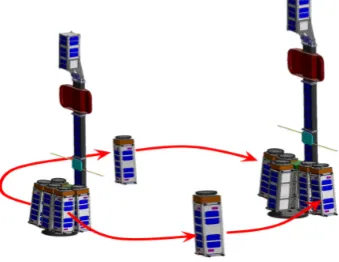
[image:11.595.236.406.522.653.2](Autonomous Assembly and Reconfiguration of a Space Telescope) mission (see Figure 1.1).
Figure 1.1: Concept for AAReST mission reconfigurable space telescope.
The problem of accurately and robustly modeling the dynamics of a self-assembling system presents
several challenges which, while also present in other types of systems, play a predominant role in the
dynamics of the systems of interest. For example, the dynamics to be modeled include collisions,
sustained contact (i.e. clumping or jamming), and complicated multiple-contact scenarios between
stiff or rigid bodies. A general model also needs to account for non-smooth non-convex bodies and
strong attractive forces at contact interfaces between bodies.
In addition to the problem of modeling the dynamics, the design and certification problems for this
type of system present novel challenges in their own right in the areas of robust and optimal control,
and model-based system design and certification. These problems take on several flavors for active
and passive systems. For passive systems, one can think of controlling the dynamics to affect a
desired final configuration via the design (geometry, inertial properties, potentials) of the modules
themselves, subject to uncertainty. For active systems, control algorithms must be formulated to
avoid contact between non-smooth bodies or to account for the fact that contact interactions will
play a role in the dynamics. For computational studies of passive systems, an accurate description
of the mechanical system including contact interactions is essential. In the case of active systems,
a method of controller design that explicitly accounts for the non-smooth nature of the system is
required.
Before moving on to a more detailed overview of how these challenges are met, it is worth
not-ing that they are not unique to self-assemblnot-ing systems. However, the extent to which they are
present motivates the need for new tools to model, design, and better understand self-assembling
systems, with the added benefit that, once developed, these tools become directly applicable to
related problems.
1.3
Overview
This thesis is organized as follows. In Chapter 2, a novel approach to robust fine-scale collision
detection for non-smooth polyhedral bodies is presented. This approach, which is called the
Sup-porting Separating Hyperplane algorithm (or simply the SSH algorithm), is based on fundamental
separation theorems for convex sets. It is shown that for polyhedral sets, the SSH algorithm may
be evaluated as a linear program (the SSH LP), and that this linear program is always feasible and
always subdifferentiable with respect to the configuration variables, which define the constraint set
of the linear program. This is true regardless of whether the program is primal degenerate, dual
degenerate, or both. The subgradient of the SSH linear program always lies in the normal cone of the
closest admissible configuration to an inadmissible contact configuration. In particular if a contact
imations. In the final category, a parameter-free explicit contact algorithm for rigid body dynamics
is developed for smooth or non-smooth geometries within the framework of a constrained variational
integrator. This algorithm extends the decomposition contact response (DCR) algorithm for finite
element dynamics of Cirak and West [15], and can be considered an explicit approximation to the
fully implicit (exact) variational approach of Fetecau et al. [25]. For non-smooth bodies, collision
detection and accurate momentum updates are enabled by the supporting separating hyperplane
SSH algorithm.
With robust collision detection and simulations methods in hand, in Chapter 4 these concepts
are combined and incorporated into optimal control problems with both collision avoidance and
planned contacts between non-smooth bodies. This chapter is divided into two main sections. In
the first, the structure preserving constrained optimal control methodology for discrete mechanical
systems (DMOCC) introduced in Leyendecker et al. [52] is extended to include collision avoidance
and planned contacts. The latter goal is accomplished without over-constraining the problem by
allowing the physical contact time(s) and configuration(s) to vary in the course of the optimization.
The final sections of both Chapters 3 and 4 summarize the application of the methods developed
therein to real-world design and control problems of the AAReST mission.
As mentioned in the motivation for this work, the problems inherent in modeling and designing
self-assembling systems are not necessarily unique to this type of system; it follows that the tools
developed in this thesis can naturally be extended to enrich other fields. To this end, future research
directions related to and inspired by the work presented in this thesis are presented in Chapter 5
2
Non-Smooth Collision Detection
2.1
Introduction
In this chapter, a contact detection algorithm for non-smooth convex bodies is developed. The
pro-posed contact detection algorithm can be concisely described as a supporting separating hyperplane
(SSH) test for interpenetration, and is based on standard separation theorems for compact convex
sets. The test is developed in detail for polyhedral bodies, where the SSH test can be effectively
reformulated as a linear programming problem–the SSH LP. It is further shown that the subgradient
of the SSH LP can be readily evaluated and–as will be discussed in detail in future chapters–that
the subgradient supplies the force system at the time of contact.
2.2
Background and Related Work
2.2.1
Previous Work
A large body of literature exists on the efficient detection of collisions, driven in large part by
advances in computational geometry, computer graphics and robotics (see Akgunduz et al. [2], Aliyu
and Al-Sultan [3], Chakraborty et al. [13], Chung and Wang [14], Cohen et al. [17], Dobkin and
Kirkpatrick [20], Ericson [22], Gilbert et al. [29], Gilbert and Hong [30], Gottschalk et al. [33], Li
et al. [54], Lin et al. [56], Tang et al. [81]). While several advances have taken place in the past several
years, the 2001 review by Jimenez et al. [36] and the 2005 book Ericson [22] effectively summarize
the essential state of the art. The development of the SSH algorithm follows the same track as much
of this literature, which develops collision detection algorithms for use with convex polyhedra and
for solid models that have been discretized by polyhedra. However, the collision detection algorithm
presented here is general enough to extend to an interpenetration test between any two smooth or
can quickly compute candidate areas for contact, and refine those areas to determine which simplices
are actually involved in a collision. However, when the objects get close enough for the bounding
volumes to suggest that contact might have taken place, a finer detection test must be used to
conclusively declare that a collision has taken place. Another option that works on the coarse and
fine levels, proposed by Chung and Wang, detects collision based on the existence (or not) of a
separating vector [14]. While the present interpenetration function is universal and robust, in that
it can be evaluated for any pair of convex bodies, and is certainly capable of serving as a coarser
scale collision detection test, one would rather suggest its use as a final test in conjunction with one
of the coarser tests referenced here.
The interpenetration function here can be seen as an alternative to the heuristic search for a
sepa-rating vector developed by Chung and Wang [14], and also as a an alternative to other linear
pro-gramming approaches such as those proposed by Akgunduz and others [2] and Aliyu and Al-Sultan
[3], to which Seidel [77] made key contributions. The advantage of the proposed linear
program-ming approach to collision detection is that it provides extremely useful additional information for
physics-based dynamics simulations and closest-point projection (CPP) operations. In the present
work, a well known path to collision detection and undertaken in the form of a search for a separating
vector. However, this search for this vector si conducted in an optimal way so that it always lies in
the normal cone of the closest admissible configuration to an inadmissible contact configuration and
respects any symmetries present in the geometry of the contact configuration. Furthermore, unlike
previously proposed methods, the present approach ensures that the subgradient of the SSH linear
program is only non-zero with respect to degrees of freedom directly involved in the collision and
also respects the geometry of the contact configuration. For example, if a contact surface exists, the
subgradient is orthogonal to the contact surface.
2.2.2
A Motivating Example
The aforementioned useful additional information is the key motivation for this work. By way of illustration, a widely accepted treatment of contact in the equations of motion may be considered:
the introduction of a contact potential into the action functional. This potential takes the form of the
indicator function,IAof a setA ⊂ Qcontaining all admissible (non-interpenetrating) configurations
varibles consist of configurations q ∈ Q and velocities ˙q ∈ TqQ (see Cirak and West [15], Clarke
[16], Fetecau et al. [25], Gonzalez et al. [32], Kane et al. [38], Leyendecker et al. [50], Pandolfi
et al. [68] and additional details in Chapter 3). For simplicity in the present example, bothQ and
TqQ will be associated with Rn. Admissible (non-contact) configurations for q occupy the subset A ⊂ Q.
In the absence of other potentials and external forces, the action functional reads
I(q) =
Z T
0 L
(q,q˙)dt, (2.1)
for the Lagrangian
L(q,q˙) = ˙qTMq˙
−IA(q), (2.2)
whereM is an appropriate mass matrix and
IA(q) =
0 ifq∈ A ∞ otherwise
. (2.3)
The equations of motion can be recovered by requiring stationarity ofI
Mq¨+∂IA(q)30. (2.4)
In (2.4), ∂IA(q) denotes the generalized differential of the indicator function (c.f. [16, 38]). It is readily shown that the generalized differential of the indicator function of a set is given by the normal
cone,NA, of the set
∂IA(x) =NA(x). (2.5)
It follows from (2.4) that the contact forcesfconare related to the normal cone by:
fcon∈ −NA(q). (2.6)
The normal cone is defined precisely in Section 2.3 of this paper. For this introductory example it
WhereL(q,q˙) is the same as the expression in (3.34). In this case, the equations of motion at the time of contact read as jump conditions on the change of momentump=Mq˙ and kinetic energy during the collision
pTM−1ptc+
tc− = 0 (2.8a)
[[p]]tc+
tc− ∈NA(q(tc)). (2.8b)
Equations (2.8a) and (2.8b) describe the conservation of energy and momentum during the collision,
respectively. In practice, the restriction that the forces from (2.6) and the change in momentum in
(2.8a) be in the normal cone of the admissible set are accomplished by constraining the configuration
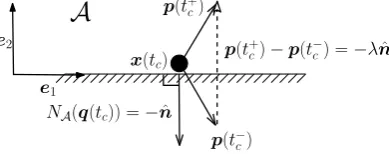
variables to be in A ⊂ Q via an interpenetration function g(q) that is negative if two bodies are not overlapping and positive if they are, that is A = {q∈ Q|g(q)≤0}. For example, consider a point mass in two dimensions (i.e., q = (q1, q2)) falling onto a flat surface coincident with the e1−axis (see Figure 2.1). In this case, the admissible set of configurations for the mass are described
by A =
q∈R2| h−nˆ,qi ≤0 with q = (q1, q2) and ˆn = (0,1)T, and the normal cone of the
admissible set has the unique values NA(q) =−nˆ if q2 = 0, NA(q) =0if q2 >0 and NA(q) =∅
otherwise.
In this case, (2.8a) can be expressed as [15]
[[p]]tc+
tc− =λ∇g, (2.9)
which for our example is equal to
[[p]]tc+
tc− =−λnˆ (2.10)
ifq2= 0. Here,λ∈Ris a scalar parameter (see [15] for details). The simplest re-expression of (2.6)
IA(q)≈VA(q) =
0 ifg(q)<0 C
2g(q)2 otherwise
, (2.11)
whereC∈Ris a constant. This leads to the formulation
fcon=−∇VA(q), (2.12)
which for the point-mass example is
fcon=
0 ifg(q)<0
−Ch−nˆ,qinˆ otherwise
. (2.13)
This simple example lends itself to a straightforward geometric interpretation of NA = ∂IA, in
that the contact forces must be normal to the contact surface (see (2.12)) and that the change of
momentum must also be normal to the surface (see (2.9)). Thus, to accurately conserve momentum
and approximate the continuous equations of motion, a constraint function g(q) should have the property that∇g(q)≈NA(q), as in the point-mass example.
x(tc)
p(t−
c)
e2
e1
A
NA(q(tc)) =−nˆ
p(t+
c)
p(t+
[image:18.595.227.422.418.495.2]c)−p(t−c) =−λnˆ
Figure 2.1: A point mass striking a flat, frictionless surface in the absence of external forces and potentials. In this example,λ= 2h−nˆ,p(t−c)i.
Some time integration schemes based on Lagrangian mechanics use a contact potential in the action
functional and require a continuous interpenetration function that is at least sub-differentiable [15,
25, 32, 41, 50]. Such a potential is easy to construct for models of geometrically simple bodies
and admissible configurations, but a good choice for this potential is much less obvious for complex
geometries.
The preferred function for use in these applications has been a test for overlapping oriented simplices
(OOS); i.e. tetrahedra in three dimensions, and triangles in two dimensions (c.f. [15, 38]). The OOS
test can accurately provide a functiong(x), which indicates whetherIA(q) is zero, but it is obvious
composed of these simplices. Thus, the OOS test is inadequate in particular for systems that do
not have the capacity to absorb these spurious forces through deformations or motions; for example,
in crowded or tightly-packed systems, stiff systems, and rigid body dynamics an accurate gradient
∇g(q)≈NA(q) is essential.
The OOS test has another key shortcoming. Before it can be evaluated, the algorithm must first
determine whether the two segments or triangles of interest are indeed overlapping. Other versions
of the test call for determining the type of contact first (face-edge, face-corner, face-face). These
different ‘switches’ that precede the actual evaluation of the OOS test are particularly cumbersome
when the time-integration algorithm is implicit or calls for optimization to resolve the contact
con-figuration as they amount to changing the potential energy function or contact constraints as the
algorithm is trying to converge.
In contrast, the supporting separating hyperplane (SSH) algorithm which is outlined in Algorithm
1 in Section 2.7 compares favorably to the OOS approach because 1) it is global in that it considers
whole bodies and it does not require any ‘switches’ or additional calculations to classify types of
contact that have taken place, and 2) it always supplies a gradient direction in the normal cone
of the contact configuration, i. e., the closest admissible configuration to the present inadmissible
configuration. Furthermore, the force system described by −∇VA(q) in a contact configuration is local to the features on each body involved in the collision. Finally, the dual solution to the SSH
linear program can be used to determine closest-feature information and to determine an excellent
approximation to the exact point of contact.
(a) OOS function gradient (b) SSH function gradient
2.2.3
Organization
The development of the SSH algorithm, including the derivation of its subderivative is illustrated in
the workflow diagram in Figure 2.3. The algorithm is based on concepts and theorems from convex
and affine geometry, and can be reduced to a quadratically constrained linear program (QCLP) for
polyhedral bodies with isolated extreme points. However, the structure of this QCLP is such that an
equivalent linear program (LP) can always be formulated. Due to the nature of linear programming,
an explicit expression of the subderivative of the SSH LP can be derived, which can then be used in
various applications.
Separation Theorems, Signed Distance Function
Convex Geometry, Affine Geometry, Hyperplanes General SSH Test (any convex bodies)
SSH QCLP for Polyhedral Bodies SSH LP for Polyhedral Bodies
Affine Geometry, Finite Extreme Points QCLP Properties Explicit Formula for SSH LP Subderivative
Solution Structure of Linear Programs Applications Using SSH LP+Subderivative
Figure 2.3: Work flow pyramid for the development of the SSH algorithm and the explicit derivation of its subderivative. Items in between levels are features of the lower level which allow progression from the lower level to the upper level.
The organization of this chapter is as follows. In Section 2.3, the basics of hyperplanes and affine
geometry are reviewed, including key separation theorems for convex sets, which are used in Section
2.4 to develop the SSH test for interpenetration and prove that the algorithm always accurately
indicates whether or not two convex sets are separable. In Section 2.4, it is shown that for polyhedral
sets, the algorithm can always be formulated and solved as a feasible linear program. Section 2.5
reviews the solution to a linear program based on the primal simplex method that is used in Section
2.6, where nonsmooth analysis is used to expand on the results of Freund [27] and Freund [26]
and derive an explicit analytical expression for the subderivative of a linear program in extended
standard form. The implementation of our method is discussed in Section 2.7. Finally in Section
2.8, the effectiveness of our function in determining the e features involved in a collision and an
we refer the reader to these resources for precise definitions of bounded, closed, and compact sets,
and the convex hull of a set. For this and the following sections, unless otherwise stated, we denote
the inner product between two vectors inRn as h·,·i, the Euclidean norm of a vector inRn as k·k,
and the cardinality of a set as| · |.
2.3.1
Affine Sets
A subsetM ⊂Rn is called an affine set if for everyx∈ M, y ∈M, andλ∈R, (1−λ)x+λy∈
M.
2.3.2
Convex Sets
A subsetC⊂Rnisconvexif for all distinct pointsx∈C,y∈C, and all 0≤λ≤1, (1−λ)x+λy∈C.
Clearly, all affine sets are also convex sets.
2.3.3
Hyperplanes
Following [34], we use the notationHα,a for the hyperplane inRn, with α∈Rn and a∈R, as the
set of points such that
Hα,a:={x∈Rn| hα,xi −a= 0}, (2.14)
which is an affine (and convex) set. It is recognized that αis the normal vector to the plane, and that Hα,a has two distinct sides. An equivalent (point-normal) representation, withα ∈ Rn and
a∈Rn, is
Hα,a:={x∈Rn| hα,x−ai= 0}, (2.15)
where we can identify a=hα,ai. For any choice of α and a, the hyperplane associated with µα
restrictα∈Sn−1. Thus, for the signed distance between a pointy
∈Rn and a hyperplane, we use
the notation
Hα,a(y) :=hα,yi −a. (2.16)
The definition of parallel hyperplanes can be further restricted to denote two hyperplanesHα,aand
Hµα,b for which µ = 1. Thus, the signed distance from Hα,a ≡ Hα,a to Hα,b ≡ Hα,b is given
by
d(Hα,a, Hα,b) =d(Hα,a, Hα,b) =b−a, (2.17)
where the equivlance of the hyperplanes is due toa=hα,aiandb=hα,bi, respectively.
2.3.4
Construction of Convex Sets
2.3.4.1 Intersection of Half-Spaces
Let the(closed) half-spaces associacted with a hyperplaneHα,a be defined as
Hα+,a:={x∈Rn|Hα,a(x)≥0} (2.18a)
Hα−,a:={x∈Rn|Hα,a(x)≤0}. (2.18b)
It may readily be shown that the intersection of convex sets is also convex (c.f. Theorem 2.1 in [75]).
Thus, the following setK is convex (and closed)
K=∩ {x∈Rn|Hαi,ai(x)≤0, i= 1. . . j}. (2.19)
If K 6= ∅ and j → ∞, then some portion of the boundary of K (bdK) is said to be smooth.
Furthermore, K is a compact set if it is bounded. For finite j, K as defined above is non-smooth
and is called a polyhedral set. In the case that a polyhedral set is bounded (and therefore compact),
it may alternately be called a polytope inRn or simply a polyhedral body (also inRn), in reference
For a compact set, extK 6=∅, and all extreme points of K are on bdK. Thus, a set K, which is
convex and compact in Rn, can alternately be described as the convex hull of its extreme points,
K= co(extK). By this construction, for a finite number of extreme points,K is a polytope. This
allows the description of all points inKas a convex combination of its extreme points. That is, for
allx∈K,y∈extK, andλi>0,
x=
|extK|
X
i
λiyi, where:
|extK|
X
i
λi= 1.
(2.20)
For a polyhedral set, the set of vertices is equal to the set of extreme points.
2.3.5
Supporting Hyperplanes
A hyperplaneHα,ais said to support the setKwhenKis entirely contained in eitherHα+,aorHα−,a, and bdK∩Hα,a6=∅. It is said to supportK atx∈K when, in addition,x∈Hα,a.
2.3.6
Normal Cone to a Convex Set
For the following analysis, it suffices to present a normal cone definition that is strictly relevant to
convex sets. However, it is important to note that the idea can be extended to non-convex sets and
is important in non-smooth analysis (see Clarke [16] for additional information). The normal cone
NK(x) to a convex set K at the point x∈K may be defined as the set of directions ν ∈Rn for
whichKis in the negative halfspace ofHν,x, i.e.
NK(x) ={ν∈Rn|Hν,x(x∗)≤0 ∀x∗∈K}
NK(x) =
ν∈Rn|K⊂Hν−,x .
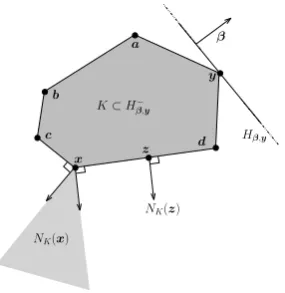
Thus, it is obvious that NK(x) will contain more than one directionν when Kis a polyhedral set of dimension nin Rn ifxis in a feature of K of dimension less thann−1. Figure 2.4 shows two
examples of normal cones.
K⊂H− β,y
NK(x) x
Hβ,y β
y
NK(z) z a
b
[image:24.595.255.398.131.278.2]c d
Figure 2.4: Schematic of concepts for hyperplanes and convex sets for a compact polyhedral set, K. Pointsa,b,c,x,d,y form the set of extreme points of K, and z is not an extreme point. The hyperplaneHβ,y supports the setK at ysuch that K⊂Hβ−,y. The normal cone of K is shown at
two points: x∈extK whereNK(x) is not unique, andz∈/extK whereNK(x) is unique.
As it will be useful later, it is noted here that for convex sets there is a one-to-one correspondence
between finding a hyperplane supporting a set at a given point, and finding a direction in the normal
cone at the point.
2.3.7
Separation of Convex Sets
Thestrictseparation of sets is defined as follows: for two non-empty closed convex sets,K1andK2
for whichK1∩K2=∅andK2 is bounded, there existsαsuch that:
sup
y∈K2
hα,yi< min
x∈K1h
α,xi. (2.22)
Furthermore, ifK1 is also bounded, then there existsαsuch that
max
y∈K2h
α,yi< min
x∈K1h
α,xi. (2.23)
In other words, a vectorαis a separating vector if it can be associated with a hyperplaneHα,a that properly classifies all of the pointsK1and K2 such thatK1⊂Hα+,aand K2⊂Hα−,a. The converse is also true. For two compact convex sets, if α cannot be found such that maxy∈K2hα,xi ≤ minx∈K1hα,yi, thenK1∩K26=∅. Figure 2.5 illustrates the definition of proper (α) and strict (β) separating vectors, along with examples of hyperplanes associated with these vectors.
K1
K2
Hα,a
Hβ,b
α β
Figure 2.5: An example of strictly separable sets. The vector β and associated hyperplane Hβ,b strictly separateK1andK2, whereas the vectorαand associated hyperplaneHα,aproperly separate K1andK2. Note that the hyperplane drawn labeledHβ,bis not a unique choice for the vectorβ.
2.4
Supporting Separating Hyperplane Algorithm
In this section, the Supporting Separating Hyperplane (SSH) algorithm as a test for interpenetration
is developed. To begin, the algorithm is developed for general compact convex sets as a constrained
optimization problem with a linear objective function. It is then shown that, for compact polyhedral
sets, the algorithm can always be reformulated so that all constraints are linear, i.e., as a linear
programming problem.
To begin, let {Hα,a}+K1 be defined as the set of supporting hyperplanes of K1 at x∈ bdK1 such
that K1⊂Hα+,a and{Hβ,b}−K2 be defined as the set of supporting hyperplanes ofK2 aty∈bdK2
such that K2 ⊂Hβ−,b. Again, all normal vectors of {Hα,a}+K1 and {Hβ,b}
−
K2 are unit vectors (i.e.,
α,β ∈ Sn−1). Define the function ˜h(K
1, K2) as follows, where the function d(Hα,a, Hα,b) was
˜
h(K1, K2) = max
Hγ,a¯∈{Hα,a}+K1 Hγ,¯b∈{Hβ,b}−K2
d(Hγ,¯a, Hγ,¯b) (2.25)
The solution to (2.25) is the maximum signed distance between parallel supporting hyperplanes of
each set, with the restriction that each hyperplane properly classify its associated set.
Remark 2.1. From the point-normal description of a hyperplane, for two non-empty compact
con-vex sets, ˜h(K1, K2) = ˜h(extK1,extK2). Since d(Hα,a2, Hα,a1) = d(Hα,a2, Hα,b1) ∀b1 −a1 ∈ Hα,a1, i.e., b1−a1 ∈Hα,a1 ⇒Hα,a1∩Hα,b1=Hα,a1 =Hα,b1. Therefore, if Hα,a1 supportsK1
ata1∈/extK1, there is an equivalent hyperplane that supportsK1 atb1∈extK1, and
˜
h(extK1,extK2) = ˜h(K1, K2). (2.26)
Remark 2.2. The problem (2.25) is always feasible. For two compact, convex sets, one can always
find two parallel supporting hyperplanes such thatHα,a1 ∈ {Hα,a} +
K1 andHα,a2 ∈ {Hβ,b}
−
K2. This
remark is obvious ifK1∩K2=∅, and at least one hyperplane exists that strictly separatesK1 and K2. To show that this is true if K1∩K26=∅, consider a plane Hβ,b that properly separates two sets
for which maxy∈K2hβ,yi= minx∈K1hβ,xi, and K1 and K2 uniquely properly separable. Because
the sets are compact and convex, such a plane can always be found. Further, define two equivalent planes for whichHβ,b2(y∗) = 0for somey∗∈bdK2andHβ,b1(x∗) = 0for somex∗∈bdK1. If one
now setsb2=hβ,y∗iandb1=hβ,x∗iand undertakes a translation ofK2 and, by extension,Hβ,b2
by β so that b2 =hβ,y∗+βi, K1 and K2 no longer are separable, but two parallel hyperplanes
that are in the domain of (2.25) are retained. The cases discussed in this remark are illustrated in Figure 2.6.
K1 K2
α Hα,a1
Hα,a2
(a) Strictly separable sets
β Hβ,b
y∗
x∗
(b) Properly separa-ble sets
β Hβ,b1
y∗+ǫβ
x∗
Hβ,b2
(c) Non-separable
sets
Figure 2.6: Figures 2.6a through 2.6c illustrate the cases discussed in Remark 2.2. One of the many possible sets of supporting hyperplanes in the domain of (2.25) is shown for strictly separable sets in Figure 2.6a. In Figures 2.6b and 2.6c, the circular set remainsK1, and the triangular set remains K2, but they are not explicitly labeled to simplify the drawing. Figure 2.6b shows a hyperplane
(Hβ,b) which is clearly in the domain of (2.25), and two arbitraily chosen points,x∗ ∈bdK1 and
y∗∈bdK
2, at whichHβ,bsupports each set, as described in Remark 2.2. Finally, Figure 2.6c shows the translation ofK2 byβ, and the corresponding hyperplanes in the domain of (2.25).
Before proceeding, a constrained optimization problem overα∈Sn−1, anda
extK1⊂Hα+,a1
extK2⊂Hα−,a2.
(2.27)
Theorem 2.1. Two compact convex sets K1 andK2 are strictly (properly) separable if and only if h >(≥)0.
Proof. It is first shown that h > 0 ⇒ K1∩K2 = ∅, and by extension that h = 0 implies that K1 andK2 are properly separable. From the definition of a supporting hyperplane, a1≤ hα,xifor
x∈extK1and likewisea2≥ hα,yifory∈extK2. It follows from the constraints in equation (2.27)
that maxa1 = minx∈extK1hα,xi and that mina2 = maxy∈extK2hα,yi at the solution. Therefore,
we can do a portion of the optimization explicitly and see that
h(K1, K2) = max
α∈Sn−1
x∈extK1
y∈extK2
a1(α,x)−a2(α,y)
= min
α∈Sn−1
x∈extK1
hα,xi − max
α∈Sn−1
y∈extK2
hα,yi,
subject to the same constraints as (2.27). From the definition of strict (proper) separation of sets, if α can be found such thath(K1, K2)>(≥)0, thenK1 andK2 are strictly (properly) separable, thus h >0⇒K1∩K2=∅, and that h= 0⇒K1∩K2⊂Hα,a1≡Hα,a2.
To show thath >0⇐K1∩K2=∅, note that the domain has been restricted such thatHα,a1 properly
classifies K1 ⊂Hα+,a1, and Hα,a2 properly classifies K2 ⊂Hα−,a1. In this domain, the maximum
distance a1−a2 is positive (non-negative) only if, in addition, K2 ⊂ Hα−,a1, and K1 ⊂H +
α,a2, in
which case, by the definition of strict (proper) separation of sets, α is a separating vector and both hyperplanes are separating hyperplanes. Therefore h >0⇐K1∩K2=∅, andh= 0⇐K1∩K2⊂
Hα,a1 ≡Hα,a2.
Corallary 2.2. Corallary to Theorem 2.1 Two compact convex sets K1 andK2 are not separable if
and only ifh <0.
Proof. Follows directly from Theorem 2.1.
K1
K2
d <0
α
Hα,a1 Hα,a2
(a)
K1
K2
d >0
α Hα,a1
Hα,a2
(b)
K1
K2
maxd >0
α∗ Hα∗,a∗
2 Hα∗,a∗
1
(c)
K1 K2
d <0
α
Hα,a1 Hα,a2
(d)
K1 K2
d <0
α
Hα,a1 Hα,a2
(e)
K1
K2
maxd <0
α∗ Hα∗,a∗
1 Hα∗,a∗
2
[image:28.595.211.425.58.400.2](f)
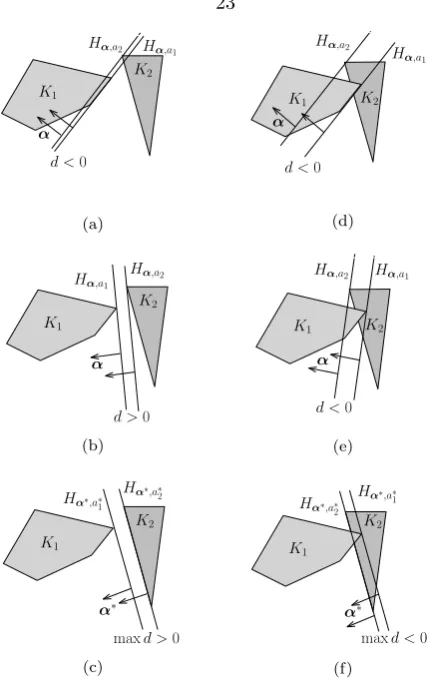
Figure 2.7: Figures 2.7a through 2.7c show the domain ofpotentially separatingsupporting hyper-planes for two separable polyhedral sets. The sign ofddenotes whetherHα,a1is in front of (positive) or behind (negative)Hα,a2 according to the direction ofα. Figures 2.7d through 2.7f show the same domain for sets that are not separable.
2.4.1
Formulation as a Quadratically Constrained Linear Program
Equation 2.27 can further be refined by transforming the restriction on the domain to constraints
on the solution vector according to the definition of a supporting hyperplane as follows:
h(K1, K2) = max
α∈Rn
a1,a2∈R
a1−a2, Subject to:
hα,xi −a1≥0, x∈extK1 hα,yi −a2≤0, y∈extK2 hα,αi= 1.
(2.28)
2.4.2
Interpenetration Detection as a Linearly Constrained Linear
Pro-gram
The goal of this section is to formulate a linear program (LP) which, like (2.28) indicates whether
or not two sets are intersecting when the sets K1 and K2 are both compact polyhedral sets. To
begin, we note that the structure of (2.28) is linear in the objective function, and in all of the
constraints with the exception of the final constraint, that hα,αi = 1. For the purposes of this analysis, consideration will be restricter to sets for which dim(K1) = dim(K2) =n, i.e. sets of the
same dimension of the space in which they are embedded, however the results may be extended to
some cases in which dim(K1) < n and/or dim(K2)< n. The following remarks will be useful in
showing that the solution to a linear program of the form
g(K1, K2) = max
α∈Rn
a1,a2∈R
a1−a2, Subject to:
hα,xi −a1≥0, x∈extK1 hα,yi −a2≤0, y∈extK2 hβ,αi= 1,
(2.29)
for certain choices of β is equivalent to (2.28), in that a solution vector, a = (αa1 a2) to the
quadratically constrained program (the QCLP, or simply QP) is equal to a solution to the linearly
constrained program (the LP) normalized bykαk.
Remark 2.3. For two compact convex sets,K1 andK2, if K1∩K2 =6 ∅, then d(Hα,a1, Hα,a2)≤ 0∀Hα,a1 ∈ {Hα,a}
+
K1, Hα,a2 ∈ {Hα,a}
−
K2. This follows from Theorem 2.1 due to0≥maxd(Hα,a2, Hα,a2)≥ d(Hα,a2, Hα,a2).
Remark 2.4. If two compact, convex sets are separable withdim(K1) = dim(K2) =n, then there
is a compact set of directions α ∈ Sn−1 which render the QP (2.28) non-negative. This follows from the observation that there is a compact set of points inbdK1 andbdK2at which a separating
hyperplane can support each set. Furthermore, with the restriction that dim(K1) = dim(K2) =n,
this set will be contained in less than a hemisphere ofSn−1. This set of separating directions will be
K1⊂Hα+,x, K2⊂Hα−,y, x∈bdK1, y∈bdK2}⊂Sn−1. An example of S(K1, K2)for two sets in
R2 is shown in Figure 2.8.
K1
K2
Sn−1
α1 α2
S(K1, K2)
Figure 2.8: The left schematic highlights the set of points in bdK1 and bdK2 at which each set can
be supported, along with several pairs of supporting hyperplanes satisfying the constraints of (2.28). In the right schematic, the setS(K1, K2) of separating directions for the two bodies sketched in the
left schematic is shown.
Remark 2.5. The QP (2.28) always has a finite solution so long as allxi, andyi are finite. This
follows from 1)the observation that the objective function only has a non-zero gradient in thea1−a2
subspace, and 2)the structure of the first two sets of contraints establishes an upper bound for a1,
and a lower bound fora2 for anyα. Thus, the objective function is always bounded in its increasing
direction for anyα∈Sn−1, as can be seen in Figure 2.9.
a
1a
2Increasinga1−a2
a1−a2= 0
K1
K2
K1
K2
α α
Figure 2.9: The level sets of the objective function, a1−a2, are shown. Schematics of the upper
bound for a1 and the lower bound for a2 are shown for selected directions α which are feasible
solutions to (2.28), sketched in the correponding diagrams superimposed on the plot.
hα,yi −a2≤0, y∈extK2 hα,βi −1 = 0.
The inner optimization problem then amounts to an optimization over (a1, a2) for a fixed vector
α = ¯β, which is always a bounded, feasible problem according to the preceeding remark. Thus, removing the constraint thatα∈Sn−1 will result in a problem with at least one feasible solution for
any β.¯
With these preliminaries established, call a1−a2 = γ a feasible solution to the QP (2.28), and
a∗
1−a∗2 = γ∗ an optimal solution to the QP. The corresponding equivalent solutions to the LP
(2.29) will have the valuesγkαLPkandγ∗kα∗LPk, respectively, withαLP satisfyingHβ,1(αLP) = 0. Futhermore, we will use the notationa= (a1, a2) to denote the solution to the QP (2.28) is thea1−a2
subspace, and aLP the corresponding solution to the LP (2.29), with the relationship a= kαaLPLPk. Before proceeding with the key theorem of this section, recall the definition of the set of separating
vectors for the sets given in Remark 2.4 asS(K1, K2) =α∈Sn−1|K1⊂Hα+,x, K2⊂Hα−,y,
x∈bdK1, y∈bdK2} ⊂Sn−1, which will be equal to the empty set ifK1 andK2are not
separa-ble.
Theorem 2.3. An optimal solution, a∗LP, to (2.29) is equivalent to an optimal solution, a∗QP, to
(2.28) for a given choice of β∈Sn−1 if the following statements hold.
i The open hemisphere of Sn−1 centered onβ contains of S(K1, K2)andα∗QP.
ii For all other feasible solutions to the linear program,aiLP,sign(γi)6= sign(γ∗),
αiLP
<
γ∗kα∗LPk
γi −1
+ 1 forγ
∗ >0, or αiLP
>
γ∗kα∗LPk
γi −1
+ 1 forγ
∗ <0.
Proof. Proof of Theorem 2.3
By statement (i), the solution direction α∗
QP has an equivalent solution direction αLP ∈ Hβ,1.
Also by statement (i), as kαk → ∞, γ becomes negative for directions α ∈ Hβ,1, so all feasible
solutions to the LP are bounded from above. It is still possible for another feasible solution direction, α0
LP ∈ Hβ,1, of the linear program to satisfy γ0 α0LP
> γ∗kα∗LPk, with γ0 < γ∗. Trivially, if
sign(γ0)
6
= sign(γ∗), then α∗
can calculate the point, acrit, at which the ray a2 = a 0 2 a0
1a1
(with a0 = (a0
1, a02)as components of the
corresponding feasible solution to (2.28)) intersects the level seta1−a2=γ∗kα∗LPkas
acrit= γ
∗kα∗
LPk γ0 a
0
It then follows fromα0LP =k
a0LP−a
0
k
ka0k + 1 that
α0LP
<kαcritk ⇒γ0
α0LP
< γ∗kα∗LPk forγ∗>0,
and
α0LP
>kαcritk ⇒γ0
α0LP
< γ∗kα∗LPk forγ∗<0,
withkαcritk=
γ∗kα∗LPk
γ0 −1
+1, which is the final condition in statement (ii).
In practice, choosing a vectorβa priori to meet the first requirement of Theorem 2.3 is not hard to do, in particular as the optimal QP solution decreases to zero or becomes negative and S(K1, K2)
shrinks to the empty set, which renders (i) less and less restrictive. We will not present a concise
result on this topic, although we note that S(K1, K2) could be explicitly calculated and a central
direction in this set chosen if needed to ensure that (i) is met so that the optimal LP solution is
bounded. Furthermore, if an unbounded LP is encountered–which in itself implies that the sets are
separable–β can simply be reset based on the unbounded direction, and the new problem solved to determine a separating direction.
Perhaps more importantly, choosingβ to meet the second requirement of the theorem is actually not essential to determine whether or not two sets are separable, or even to resolve a separating
direction if they are. By Remark 2.3, if K1 and K2 are not separable, then any choice ofβ will
indicate this fact, by rendering the objective function of the LP (2.29) negative. However, it is
possible to selectβ which gives a ‘false positive’, for which the solution to the LP is negative, but the solution to the QP is positive, implying that condition (i) in Theorem 2.3 has not been met. To
avoid this,βshould be initially selected so thatβ and some subset ¯S ⊂ S(K1, K2) are in the same
open hemisphere.
In other words, one does not need to find an equivalent LP solution to the QP (2.28) in order to obtain an accurate result for the SSH test using a linear program. Rather, one simply needs to solve
2.5
Linear Programming
For completeness, this section provides a brief review of the well-studied topic of optimality
con-ditions and solution strategies for linear programs (Dantzig and Thapa [19] provides a thorough
primary reference). While this will likely be a review for many readers, the formulation of the
problem is essential to the evaluation of its SSH linear program’s subderivative.
To simplify notation in this section, the number of inequality constraints in a linear program whill
be denoted asm1, the number of equality constraints asm2, and the number of primal variables is
n. All vectors are to be understood as column vectors and are denoted by bold lowercase letters, for
examplea∈Rn. The combination of two vectorsa1 ∈Rn1 anda2 ∈Rn2 into an extended vector
a ∈Rn1+n2 is denoted, with a slight abuse of notation, asa =
a1 a2
. Subscript notation such
as ai denotes theithcomponent ofa. Matrices such asA∈Rm×n are denoted by bold uppercase
letters, and the combination of matrices of compatible dimensions into entries in block matrices is
denoted by means of square brackets, e.g. hA1 A2 i
. Subscript notation such asAij denotes thejth
component of theith row ofA.
2.5.1
Conditions for Optimality
Linear programs of the following form will be considered
F(A,b,c) = max
x∈Xc
Tx
with:X ={x∈Rn|A1x≤b1,A2x=b2,x≥0},
(2.30)
for which X is a set of feasible solutions to the (primal) problem (2.30). Later, X∗ ⊂ X will
be defined as the set of optimal primal solutions to (2.30). In this problem, the total number of
constraints is m =m1+m2, and A1 ∈Rm1×n, A
2 ∈ Rm2×n, with b
1 and b2 also of compatible
dimensions. Alternately, the notation thatAT =h
AT1AT2 i
, andb=b1b2
will be adopted.
From the primal problem (2.30), the Lagrangian function can be written as
LP(x,λ,µ) =cTx−λT1(A1x−b1)
−λT2(A2x−b2) +µTx,
(2.31)
where λ =λ1 λ2
and µare lagrange multipliers. The Karush-Kuhn-Tucker (KKT) conditions that are necessary for optimal primal (x∗) and dual (λ∗) variables are
x∗∈X
λ∗T
1 (A1x∗−b1) = 0,
x∗T c−ATλ∗
= 0,and
ATλ∗≥c, λ∗1≥0,
where the ith constraint is said to be active if λ
i 6= 0. This corresponds an inequality being an
equality at the solution.
To state the dual program to (2.30), we first set y = y1 y2
. The dual program is then given
by
G(A,b,c) = min
y∈Yy
Tb
with:Y =
y1∈Rm1,y2∈Rm2|ATy≥c, y1≥0 ,
(2.33)
with its own Lagrangian function
LD(y,π,η) =yTb−πT ATy−c
−ηTy, (2.34)
A1π∗≤b1, A2π∗=b2, π∗≥0.
From the KKT conditions for the primal and dual problem, we see that if a solution exists to
(2.30), then a solution also exists to (2.33), and that at the solution, y∗ = λ∗, x∗ = π∗, and F(A,b,c) =G(A,b,c) (i.e.,cTx∗=y∗Tb). Furthermore, equality constraints in the primal problem lead to unrestricted variables in the dual problem, and inequality constraints in the primal problem
lead to restrictions on the sign of the dual variables associated with those constraints. This is
important, because the SSH LP is not in standard form as all primal variables are unrestricted in
sign. The primal problem of the SSH LP is of the form
F(A,b,c) = max
x∈Xc
Tx
with:X ={x∈Rn|A1x≤b1,A2x=b2},
(2.36)
and therefore the dual problem has the form
G(A,b,c) = min
y∈Yy
Tb
with:Y =
y1∈Rm1,y2∈Rm2|ATy=c, y1≥0 .
(2.37)
In many applications either the primal solution vector, the dual solution vector, or both, are not
unique. Primal degeneracy (multiple dual solutions) is quite common in applications where the
number of constraints is larger than the number of variables. In particular, for problems with
weakly redundant constraints active at the primal optimum, x∗, there are multiple dual solutions
because there is not a unique set of constraints that could be active at the solution (c.f. Akgul
[1], Dantzig and Thapa [19], Eishelt and Sandblom [21], Gal [28]). Dual degeneracy (multiple primal
solutions) occurs when the dual problem has weakly redundant constraints and in particular when
X∗=
x∈X|cTx=F(A,b,c) =G(A,b,c) (2.38a)
Y∗=
y∈Y|yTb=G(A,b,c) =F(A,b,c) . (2.38b)
Again, due to the nature of the constraints, we know that the primal and dual optimal solution sets
are polyhedral in nature. Thus, if all vertices of these polyhedral sets are known, we may express
any optimal solution vector as the convex combination of these vertices, according to equation
(2.20).
These ideas have been explored in great detail, primarily in the areas of economics and operations
research, where the primal and dual solutions have useful interpretations, c.f. Aucamp and Steinberg
[5], Lin [55], as wella as[1, 19, 21, 28]. For instance, in resource allocation when there is a unique
primal solution that is degenerate, the minimum and maximum values of yi ∈ Y∗ represent the highest buying price and lowest selling price of a given resource. In a convex analysis sense, it was
shown by [1] that if we allow F to be a function ofb, keeping Aand cfixed, then F(b) is a non-decreasing piecewise linear concave function and the set of subgradients∂F(b) ofF atbis given by ∂F(b) =Y∗.
2.5.2
Linear Program Solution Strategies
In this section, the solution to the SSH linear program based on the primal simplex algorithm
(c.f. [19]) will be developed. The structure of this solution is particularly useful in evaluating the
subgradient of the SSH program in cases that have not been treated in the literature. However,
in order to exploit this algorithm, problems must be represented in extended standard form, and
problems like the SSH LP that are in non-standard form (2.36) must first undergo a change of
variables to be represented in standard form.
2.5.2.1 Extended Standard Form
The extended standard form of the primal program (2.30) is given by
Fext(A,b,c) = max
(x,xa,xs)∈X
c csca
T
x xs xa
with:X ={x∈Rn,xs∈Rm1,xa∈Rm2|
[A I]x xs xa
=b,x xs
≥0,xa=0
o
,
M ∈R0 and1being a vector inRn with ones in all entries) or by a two phase method in which
the first phase attempts to eliminate the equality constraints from the system.
2.5.2.2 Variables Unrestricted in Sign
In our problem of interest, (2.29), all primal variables are unrestricted in sign. This differs from
the standard form of a linear program (2.30). In order to convert our problem with all variablesx
unrestricted in sign to this form, we make the change of variables
x= ¯x−1v. (2.40)
Note that v = max{0,−x}, although this last relationship need not be explicitly enforced [76]. The ¯(·) values are called the positive part of their respective variable. A related problem for ˜x=
¯
xv≥0∈ Rn+1 may then be solved, and the solution tox reconstructed from (2.40). Details
can be found in [76], however we note here that this change of variables corresponds to embedding
the original constraint polyhedron in Rn into Rn+1, and the extreme points of the problem inRn
are the endpoints of semi-infinite rays inRn+1.
To execute this change of variables, an additional column is added to A and row to c. Let us denote the augmented constraint matrix ˜A= [A −A1]∈Rm×n+1, and the augmented objective
coefficients ˜c=c −cT1∈
Rn+1. The new primal problem reads
F( ˜A,b,c˜) = max
˜
x∈X˜
˜
cTx˜
with: ˜X =nx˜ ∈Rn+1|A˜1x˜ ≤b1,A˜2x˜=b2,x˜≥0 o
,
(2.41)
where the feasible region of the primal problem that has undergone this change of variables as called ˜
X. Through simple algebraic manipulation of the KKT conditions, it can readily be shown that the
dual problem associated to (2.41) is not affected by the change of primal variables, and has the form
2.5.3
Solutions to the Primal Simplex Algorithm
Now, attention is given to solving problems of the form (2.39) by means of the primal simplex
algorithm. The primal simplex algorithm works by exploring the extreme points of the constraint
set in an organized way until a maximum is found. Each of these points is known as a basic feasible
solution to the system of linear equations [A I]x xsxa
= b, (where I denotes the identity matrix), i.e., a feasible vertex in X. At each iteration, a neighboring vertex is visited so that the
value of the objective is increased, and so on until the maximum is found [19, 21]. This corresponds
to subdividing the primal variables x xsxa
into basic and non-basic variables, and exchanging
one basic for one non-basic variable at each step in the primal simplex algorithm.
Let the columns of [A I] and the rows of x xsxa
and c csca
be indexed by the index set
J ={1, . . . , n+ 1, n+ 2, . . . , n+m+ 1}. Further, partitionJ into the index setsB andV, with
|B|=m,|V|=nandV =J\B. LetBbe the submatrix of [A I] with columns inB, andV be the analogous submatrix with columns inV. Likewise, partition the rows ofx xsxa
and c csca
accordingly intoxB andxV, andcB andcV.
Further, introduce the index setsR={1, . . . , n} andS={n+ 1, . . . , n+m} whereR corresponds
to the indices (columns of [Av I], rows of
x xsxa
andc cs ca
) of the original variables, andS
to the slack and artificial variables. The index setScan be partitioned intoS1andS2, corresponding
to the slack and artificial variables, respectively.
IfF(A,b,c) has a finite maximum, the following inequality holds at the maximum
(cT
BB−1V −cVT)V∩S1 ≥0, (2.42)
where the rows corresponding theS2 are either trivially0 if the big-M method has been used, or
not considered if a two-phase method has been used. For a primal solution vectorx∗ =x
B xV
,
xB has the form
xB =B−1(b−V xV)≥0. (2.43)
If all entries in (2.42) are strictly greater than zero, then the primal solution vector is unique, and
To find the dual solution, the row vectorc∈Rn+mis used following
c=0B (cTBB−1V −cTV)V
, (2.45)
where 0B is the m×1 zero vector indexed by B, and all previously introduced index sets, as appropriate, are embedded in c. The values in c are commonly referred to as the ‘reduced cost coefficients’. From this a solution to the dual problem can be found as
y∗=cS. (2.46)
If the big-M method is used, then at the solution any remaining factors ofM are subtracted off of
cto find the dual solution of the original problem. IfxB >0for all components, then the optimal dual vector y∗ given in (2.46) is unique, i.e., the primal solution is non-degenerate. However, if
any component of xB is zero, then it is possible to alter the index set B, and thus alter the dual solution vector, without changing the primal solution vector or the optimal value ofF(A,b,c). Let us denote the index set T ⊂B as the rows for which xB = 0. We subsequently use the notation
{B}to denote the set of unique index sets that may represent the solution to (2.39). Y∗ is of the
form [1, 8]
Y∗=
y|yT =cTS+tT(B−1[B V])T,S,
cT R∪S1+t
T(B−1[B V])T,R
∪S1 ≥0, t∈R
|T|o, (2.47)
where the notation (·)I,J refers to the submatrix with rows in the index setI and columns in the
index setJ, and t∈R|T|is a vector of parameters. Obviously, if T =∅, thenY∗={y∗}.
F(A,b,c) =cTBxB+cTVxV
=cTBB−1b−(cBTB−1V −cTV)xV.
(2.48)
2.6
Nonsmooth Analysis
Various authors, primarily in the fields of economics and operations research, have explored what
is known in the literature as the ‘sensitivity’ of a linear program to its data (A,b,c) beginning in the 1950’s with the Dantzig’s inception of the topic. That is, if F is a smooth function of A, b, and c, the values of interest in sensitivity analysis are ∂F
∂b,
∂F ∂c, and
∂F
∂A. The former two are well
understood, in particular for a program in standard form. However, the vast majority of economic
analyses take the entries in Ato be fixed. Those analyses of the sensitivity of a linear program to the coefficients in the contraint matrix that do exist make use of several regularity conditions (e.g.
the problems treated are in standard form, with no linearly dependent columns or rows) that in
general are not present for the SSH LP [26, 27, 59].
For the SSH linear program, we are interested in howF( ˜A;b,c˜) changes with respect to the entries in the original matrixA. An example of this dependence for an SSH linear program (2.29) that has been put into extended form and undergone the change of variables in Section 2.5.2.2 is shown in
Figure 2.10. In this example, thez−coordinate of one tetrahedron is varied and the vector ˆβis held constant.
z
x
y -1
0.5 2
2 -1 0.5 2
-1
(a)
1
0
0 2
vertex z-position
0
(b)
Figure 2.10: The dependence of the maximum function F( ˜A;b,c˜) on the data in the constraint matrix. One entry in the constraint matrixA is varied by increasing thez−coordinate of a vertex of the tetrahedron on the left.
In general, the maximum function is neither a smooth nor a convex function of entries inA. However, we have shown that the SSH linear program is always bounded and feasible for an appropriate choice
2.6.1
Generalized Differential
To begin, we introduce the generalized directional derivative from Clarke [16]. First, we let f be
a Lipschitz mapping from f : X →R, whereX has an associated dual space, Y. We also define
the duality pairingh·,·i, betweenX andY. Clarke’s generalized directional derivative is then given
by
f◦(x;λ) = lim sup t→0+,x0→x
f(x0+tλ)−f(x0)
t , (2.49)
where x0,λ ∈ X and t is a positive scalar. Clarke’s generalized subdifferential (or generalized
gradient, which for simplicity we alternately refer to as the subgradient) of a Lipschitz function f
atxis the subset
∂f={y∈Y|f◦(x;λ)≥ hy,λi, ∀λ∈X}, (2.50)
for y ∈ Y. The generalized directional derivative can be recovered from the generalized gradient as
f◦(x;λ) = max{hy,λi |y∈∂f}. (2.51)
In the following sections, we develop an expression for the generalized directional derivative and use
this result to recover an expression for the generalized gradient.
2.6.2
Generalized Directional Derivative of
F
(
A
)
We first develop an expression forF◦(A;Λ,b,c), which we shorten toF◦(A;Λ), in the case where
both (2.30) and (2.33) may be degenerate. Following Freund [26, 27], Williams [87] and Mills [59],
we adopt a perturbation matrixΛ∈Rm×(n+m), with a one in the entry of interest, and zeros in all
Λ=
0n 0m ..
. ...
0n 0m ej 0m
0n 0m ..
. ...
0n 0m
∈Rm×(n+m). (2.52)
In (2.52),0k∈
Rk (k=norm) is a row vector with zeros in all entries, andej ∈Rnis a row vector
with a one in the entry of interest, and zeros in all other entries. Let us call A =A+tΛ. The solution toF(A+tΛ) =F(A) is given by
F(A) =cTBB
−1
b−(cTBB
−1
V −cTV)xV. (2.53)
We assume that the perturbat
![Figure 3.1: Rigid body coordinate system with redundant configuration variables (from Betsch andLeyendecker [10]).](https://thumb-us.123doks.com/thumbv2/123dok_us/306955.1031980/63.595.228.449.261.540/figure-rigid-coordinate-redundant-conguration-variables-betsch-andleyendecker.webp)