S T U D Y P R O T O C O L
Open Access
The CAP study, evaluation of integrated universal
and selective prevention strategies for youth
alcohol misuse: study protocol of a cluster
randomized controlled trial
Nicola C Newton
1*, Maree Teesson
1, Emma L Barrett
1, Tim Slade
1and Patricia J Conrod
2Abstract
Background:Alcohol misuse amongst young people is a serious concern. The need for effective prevention is clear, yet there appear to be few evidenced-based programs that prevent alcohol misuse and none that target both high and low-risk youth. The CAP study addresses this gap by evaluating the efficacy of an integrated approach to alcohol misuse prevention, which combines the effective universal internet-basedClimate Schools program with the effective selective personality-targetedPreventureprogram. This article describes the
development and protocol of the CAP study which aims to prevent alcohol misuse and related harms in Australian adolescents.
Methods/Design:A cluster randomized controlled trial (RCT) is being conducted with Year 8 students aged 13 to 14-years-old from 27 secondary schools in New South Wales and Victoria, Australia. Blocked randomisation was used to assign schools to one of four groups;Climate Schoolsonly,Preventureonly, CAP (Climate Schools and Preventure), or Control (alcohol, drug and health education as usual). The primary outcomes of the trial will be the uptake and harmful use of alcohol and alcohol related harms. Secondary outcomes will include alcohol and cannabis related knowledge, cannabis related harms, intentions to use, and mental health symptomatology. All participants will complete assessments on five occasions; baseline; immediately post intervention, and at 12, 24 and 36 months post baseline.
Discussion:This study protocol presents the design and current implementation of a cluster RCT to evaluate the efficacy of the CAP study; an integrated universal and selective approach to prevent alcohol use and related harms among adolescents. Compared to students who receive the stand-alone universalClimate Schoolsprogram or alcohol and drug education as usual (Controls), we expect the students who receive the CAP intervention to have significantly less uptake of alcohol use, a reduction in average alcohol consumption, a reduction in frequency of binge drinking, and a reduction in alcohol related harms.
Trial registration:This trial is registered with the Australian and New Zealand Clinical Trials registry, ACTRN12612000026820.
Keywords:Prevention, School, Internet, Personality, Selective, Universal, Randomized controlled trial
* Correspondence:[email protected] 1
National Drug and Alcohol Research Centre, University of New South Wales, 22-32 King Street, Randwick, NSW 2052, Australia
Full list of author information is available at the end of the article
Background
Alcohol misuse amongst young people is common and the burden of disease, social costs, and disability associated with this use is considerable [1-4]. The peak of this disabil-ity occurs in those aged 15–24 years and corresponds with the typical age of initiation to alcohol and other drug use [5]. The high prevalence of use amongst adolescents is of particular concern given that early initiation to substance use is a risk factor for the development of substance use disorders, co-morbid mental health problems, juvenile offending, impaired educational performance and early school drop-out, all of which negatively impact on both current functioning and future life options [6-8].
To reduce the occurrence and cost of such problems, prevention is essential and needs to be initiated early be-fore harmful patterns of alcohol and other drug use are established and begin to cause disability [9,10]. Although an array of school-based prevention programs exist [11-16], the majority show minimal effects in reducing alco-hol use and related harms [17-20], and some have even reported iatrogenic effects [21,22]. The most common factor which impedes on effectiveness is implementation failure [23-25]. Given that school-based prevention is the primary means by which alcohol and other drug education is delivered, it is essential to focus on increas-ing program efficacy.
There are two common approaches to school-based drug education; ‘universal’ and ‘selective’ [26]. The se-lective approach involves delivering programs which tar-get specific populations, such as individuals at greatest risk for developing substance use problems. On the other hand, the universal approach aims to deliver inter-ventions to all students regardless of their level of risk for drug use, and focus largely on teaching normative edu-cation and drug resistance skills [27]. Ideally, preventive interventions should aim to delay onset in both adoles-cents with low-risk profiles who may be influenced to take up alcohol and other drugs due to peer influence and so-cial conformity, and adolescents with high-risk profiles whose underlying vulnerability to psychopathology can lead to substance misuse. Yet, there appear to be no models of well implemented programs that do this. The current cluster randomised controlled trial (RCT) addresses this gap by developing and evaluating an integrated ap-proach to preventing alcohol misuse and related harms in adolescents by combining the efficacious‘universal’Climate Schoolsand‘selective’Preventureprograms.
The universal‘Climate Schools’program
The universal Climate Schools program aims to reduce the use of the most commonly used licit and illicit drugs in most developed countries: alcohol and cannabis [2,4]. The Climate Schools program is based on the effective harm-minimisation approach to prevention [28-32] and
uses cartoon storylines to engage and maintain student interest and involvement over time. The program is facilitated by the internet which guarantees complete and consistent delivery whilst ensuring high implemen-tation fidelity. The program is designed to fit within the school health curriculum and be implemented to students 13–14 years old before significant exposure to alcohol and other drug use occurs. TheClimate Schoolsprogram con-sists of twelve 40-minute lessons; the first six lessons focus specifically on alcohol and are delivered approximately six month prior to the remaining six lessons which focus on both alcohol and cannabis.
The first part of each lesson is completed individually over the internet where students navigate through cartoon storylines which impart information about the short- and long-term effects of alcohol and cannabis, normative alco-hol and cannabis use, drug refusal and harm-minimisation skills, and tips on staying safe and first aid. Students are provided with confidential login details to access the
Climate Schoolswebsite. The second part of each lesson is a group or class activity delivered by the teacher which reinforces the information in the cartoons and allows interactive communication between students. Teachers are provided with a manual containing the activities, im-plementation guidelines, links to the education syllabus and teacher and student summaries for each lesson.
The efficacy of the Climate Schoolsprogram has been established using a cluster RCT in 10 schools in Sydney, Australia (n = 764) [31-33]. Results of the trial demon-strated that compared to the control group, students in the intervention group showed significant improvements in alcohol and cannabis knowledge at the end of the course and at six and twelve months following the inter-vention. In terms of behaviour change, the intervention group showed a reduction in frequency of cannabis use at the six-month follow-up, a reduction in average weekly al-cohol consumption at the six and twelve month follow-ups, and a reduction in frequency of drinking to excess twelve months following the intervention. In addition, program evaluation showed that students and teachers rated the program as an acceptable and enjoyable means of delivering drug education in schools. Specifically, 100% of teachers who implemented this program in their class-room rated it as superior to other drug prevention pro-grams, and over 90% of students reported information delivered in this format was easy to learn and would like more school subjects to be taught through this method.
Despite these positive results, the effectiveness of the
rather than universal prevention programs [34]. Sec-ondly, although theClimate Schoolsprogram had signifi-cant effects on reducing alcohol and cannabis use, the effect sizes were modest (<0.38) [35], as is expected with universal programs [12,16]. In addition, analyses of the efficacy of Climate Schools in high-risk students only (i.e., youth already using substances or youth with sub-stance using peers), found the effects to be smaller than those high-risk students experience as a result of partici-pating in ‘selective’ interventions [36,37]. This could be attributed to the fact that most universal preventive interventions address substance use through a social in-fluence perspective and do not take into account the many other risk factors involved in developing substance use disorders such as underlying vulnerabilities due to individual and genetic factors [38]. This suggests that high-risk students may benefit from additional‘selective’ prevention which is specifically tailored to their needs and risk factors. Selective programs offer the benefit of being able to focus on the role of other risk factors for substance use such as psychopathology and personality. Such programs have often been overlooked due to their practical limitations as not only is it difficult to ini-tially identify those individuals at greatest risk, but finding suitable, cost-effective ways to screen and deliver interventions can also be challenging [26]. The selective personality-targetedPreventureprogram overcomes these obstacles.
The selective‘Preventure’program
The school-based Preventureprogram is a brief manua-lised personality-targeted substance use preventive inter-vention for high-risk adolescents aged 13–15 years.
Preventure is the first and only selective school-based program that has been shown to curb excessive alcohol and illicit drug use in Canada and the United Kingdom (UK) [37,39-41]. Unlike universal programs delivered to a whole population, this selective personality-targeted approach addresses four personality risk-factors for early-onset substance misuse and other risky behaviours: Sensation Seeking, Impulsivity, Anxiety Sensitivity and Negative Thinking [42]. The Preventure program is also consistent with new models which conceptualise sub-stance use as being driven by personality traits such as impulsivity and disinhibition [43].
ThePreventureprogram involves two 90-minute group sessions, specific to the four personality types, which are carried out by a trained facilitator and co-facilitator. The interventions are conducted using manuals which incorp-orate psycho-educational and cognitive behavioural com-ponents, and include real life scenarios shared by high-risk youth in specifically-organised focus groups. In the first session, participants are guided in a goal setting exer-cise, designed to enhance motivation to change behaviour.
Psycho-educational strategies are used to teach partici-pants about their target personality trait and associated problematic coping behaviours like avoidance, interper-sonal dependence, aggression, risky behaviours and sub-stance misuse. They are then introduced to the cognitive behavioural model and guided in breaking down personal experience according to the physical, cognitive and behav-ioural components of an emotional response. A novel component to this intervention approach is the fact that all exercises discuss thoughts, emotions and behaviours in a personality-specific way, e.g. identifying situational trig-gers and cognitive distortions related to Sensation Seeking specifically. In the second session, participants are encour-aged to identify and challenge personality-specific cogni-tive distortions that lead to problematic behaviours.
The efficacy of the Preventure program has been demonstrated in a number of RCTs in Canada and the UK [36,37,40,41,44]. Results from these trials revealed that
Preventure successfully stemmed the growth in drinking and binge drinking in high-risk youth at six- and twelve-months following the intervention [37], and more recent analysis has revealed the onset and escalation of drug misuse was prevented over a two-year period [41]. In addition,Preventurehas been shown to reduce emotional and behavioural problems specific to each of the personal-ity profiles [45]. This is of particular importance given that comorbidity between substance use disorders and ill men-tal health is substantial and leads to worse outcomes [8]. Finally, a recent effectiveness cluster RCT showed that a standardised training model which trained teachers to deliver the program in schools resulted in treatment effects that are comparable to those reported for the previous trial involving more controlled treatment de-livery conditions [36].
Objectives of the CAP study
The primary objective of the current study is to integrate the effective universal Climate Schools and selective
Preventure programs into a comprehensive model to pre-vent alcohol misuse and related harms in adolescents. This model will be known as the ‘CAP (Climate and Preventure) intervention’ and will result in a sequential approach to drug prevention which overcomes traditional implementation obstacles to school-based prevention. Delivering prevention using the proposed comprehensive approach offers a way of preventing substance misuse at a whole population level and has the potential to maximize outcomes for both high- and low-risk youth. To our knowledge, in Australia there is currently no evidence of effective selective prevention and internationally there is no evidence of an integrated universal and selective ap-proach to substance use prevention.
to stand-alone ‘universal’ prevention and treatment as usual (TAU), in reducing the uptake and harmful use of alcohol, and reducing alcohol related harms. In addition, for high-risk students only, we aim to evaluate the efficacy of the selective personality-targetedPreventure
program in comparison to stand-alone‘universal’ preven-tion and TAU, in reducing the uptake and harmful use of alcohol, and reducing alcohol related harms.
Secondary outcomes of the study will be examined and will include effects of the programs on increasing al-cohol and cannabis related knowledge, reducing canna-bis related harms, reducing intentions to use, and reducing mental health symptomatology.
Methods/Design
In 2010, we were awarded a five year National Health and Medical Research Council of Australia (NHMRC) project grant to conduct the CAP study. Ethics approval was obtained by the University of New South Wales Human Ethics committee (HREC 11274), the Sydney Catholic Education Office (Ref: 772) and the NSW Department of Education and Training (SERAP 2011201).
Modification of Preventure
In 2011 the Preventure interventions and student man-uals which were originally developed for Canada and the UK were modified for use in Australia using feedback obtained from focus groups with young Australians. Eight focus groups were conducted in three Sydney high schools covering the four personality groups; Sensation Seeking, Impulsivity, Anxiety Sensitivity and Negative Thinking. In the focus groups, students were first asked to share their own experiences regarding alcohol and drugs and what would lead them to use alcohol and other drugs in the future. They were also asked to pro-vide scenarios where teenagers are likely to drink alcohol and asked if their personality type was linked to reasons people drink alcohol. Following this, the student man-uals were focus tested. The student manman-uals consist of text, exercises, and real-life experiences and scenarios that were originally generated by organized focus groups of high-risk personality adolescents. Students were asked to provide feedback on the content, the illustrations, and the scenarios in the manuals specific to their personality group. Using this feedback and scenarios provided the content and illustrations in the student manuals were modified for the cultural and school context of Australia.
Study design
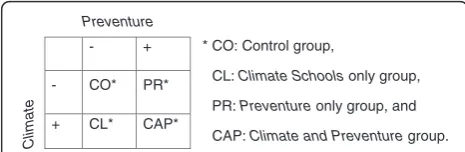
Following the modification ofPreventure,we seek to es-tablish the efficacy of the integrated CAP intervention. To do this we are currently conducting a cluster RCT in Australian schools. Cluster randomisation was employed
to avoid contamination of the control group with the intervention group through student communication. Par-ticipating schools have been randomly allocated to one of four groups; (1) the ‘Control’ condition (CO), (2) the ‘Climate Schoolsonly’condition (CL), (3) the ‘Preventure
only’condition (PR), or (4) the ‘Climate and Preventure’
condition (CAP). See Figure 1 for a graphical display of the experimental design.
Sample size calculations
To account for cluster randomisation, sample size calcula-tions were based on recent methods developed by Heo & Leon [46] to detect intervention by time interactions in longitudinal cluster RCTs. This trial is powered to detect differences between groups in the overall sample as well as in the high-risk students only. To allow for comparisons between the high-risk students and the overall sample, 600 high risk students from 20 schools were required (i.e. 30 high-risk students per school and 5 schools per interven-tion group). This achieves 80% power to detect a standar-dized between-group mean difference of 0.3 (p = 0.05) in outcomes at the end of the trial with 5 measurement occa-sions. An effect size of 0.3 is comparable to previous trials of drug prevention programs [12,16], and is the expected difference between the CAP and CL groups based on ana-lyses of our previous research.
To account for dropouts during the trial which we ex-pect to be approximately 10% [31,41], our initial aim was to recruit 80 students per school, 40% (n = 32) of whom were expected to be high-risk based on previous research by Dr. Conrod [37,39], and 6 schools per group giving us a total of 1920 students from 24 schools at baseline to test the effect of the intervention in the overall group.
Recruitment of schools and randomisation
The recruitment, inclusion, and randomization of the par-ticipants (schools and students) commenced in September 2011. A total of 190 schools were selected randomly from a list of all public and private secondary schools in New South Wales and Victoria. A letter outlining the aims of the research trial was sent to school principals. This letter provided information on what was required of their school if they agreed to participate, including time frames and in-formation on the randomisation procedure. A total of 27
* CO: Control group,
CL: Climate Schools only group,
PR: Preventure only group, and
CAP: Climate and Preventure group. Preventure
- +
Climate
- CO* PR*
[image:4.595.304.537.640.716.2]+ CL* CAP*
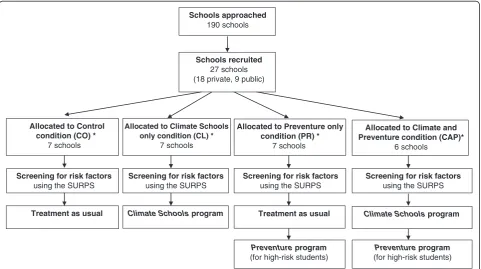
schools agreed to participate in the research. The main reasons for schools not participating were lack of time and no interest in participating in research in general. Follow-ing school consent, blocked randomisation occurred usFollow-ing the online program www.randomization.com, and schools were allocated to one of the four intervention groups shown in Figure 2. Information and consent forms were sent home to parents/guardians of all Year 8 students (ages 13–14 years) at participating schools, and only students who received parental consent (passive for private schools and active for public schools) and gave active consent themselves were eligible to be involved in the study.
Interventions
Following the baseline assessment and the SURPS screen-ing, students in the intervention groups are currently re-ceiving; TAU, theClimate Schoolsprogram, thePreventure
program, or the CAP intervention during Year 8.
The Climate Schools program consists of twelve 40-minute lessons aimed at reducing the use of alcohol and cannabis and related harms. The first six lessons focus specifically on alcohol and are delivered approximately six month prior to the remaining six lessons which focus on alcohol and cannabis. Students create unique confi-dential login details to access the CAP study website (www.capstudy.org.au) where they complete the first part of each lesson in the form of a cartoon storyline which
imparts information on alcohol and cannabis. The second part of each lesson is a group or class activity delivered by the teacher which reinforces the information in the car-toons and allows interactive communication between stu-dents. Teachers are provided with access to an online or hard copy of the teacher’s manual which contains activ-ities, implementation guidelines, links to the syllabus and summaries for each lesson.
The Preventure intervention involves two 90 minute group sessions, carried out at the participant’s schools and delivered one week apart. The interventions are spe-cific to each of the four personality profiles (SS, NT, AS and IMP) and only students who score‘high-risk’on any one of the four personality subscales on the SURPS are invited to receive the Preventure interventions. The interventions are provided by a qualified facilitator and a co-facilitator who were trained according to the training protocol described in O’Leary Barrett et al. [36]. The facilitators (registered clinical psychologists) and co-facilitators (minimum training, Bachelor of Psych-ology Honours degree) received three days training from Dr Conrod, who developed the original interventions. In addition, the facilitators were supervised by Dr Conrod in the delivery of the full intervention at two pilot schools with students in each personality high-risk group.
In the firstPreventuregroup session, psycho-educational strategies are used to educate students about the target personality variable (NT, AS, IMP, or SS) and the associated
Schools approached
190 schools
Schools recruited
27 schools (18 private, 9 public)
Allocated to Control condition (CO) *
7 schools
Allocated to Climate and Preventure condition (CAP)*
6 schools
Treatment as usual
Preventure program
(for high-risk students)
Allocated to Climate Schools only condition (CL) *
7 schools
Climate Schools program Climate Schools program
Screening for risk factors
using the SURPS
Screening for risk factors
using the SURPS
Screening for risk factors
using the SURPS
Allocated to Preventure only condition (PR) *
7 schools
Screening for risk factors
using the SURPS
Treatment as usual
Preventure program
[image:5.595.58.540.446.715.2](for high-risk students)
problematic coping behaviours, such as interpersonal de-pendence, aggression, risky behaviours, and substance misuse. Students were motivated to explore their person-ality and ways of coping with their personperson-ality through a goal-setting exercise. Thereafter, they were introduced to the cognitive behavioural model by analysing a personal experience according to the physical, cognitive, and behav-ioural responses. In the second session, participants are encouraged to identify and challenge personality-specific cognitive thoughts that lead to problematic behaviours. For example, the impulsivity intervention focused on not thinking things through and aggressive thinking, and the sensation-seeking intervention focused on challenging cognitive thoughts associated with reward seeking and boredom susceptibility.
Students randomised to the Control group receive their usual health education classes (including lessons on drugs and alcohol) over the year. Control schools have been asked to record what drug education, if any, they deliver during the year including how many lessons and the format of the lessons. Control schools will be offered the use of the CAP intervention following com-pletion of the study. See Figure 2 for intervention break-down by group.
Assessment occasions
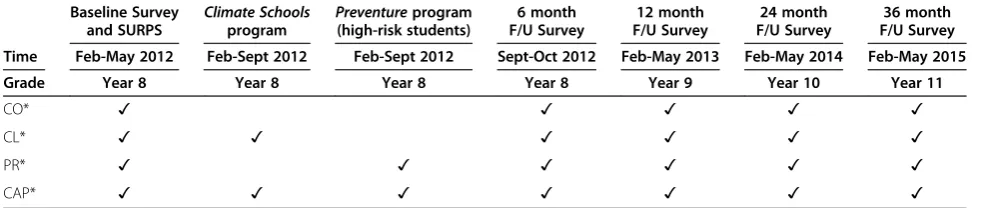
Regardless of the condition to which schools were assigned, all students are assessed via a self-report questionnaire at baseline, immediately-post intervention (6 month follow up), and 12, 24 and 36 months after baseline. Students from 26 of the 27 schools have opted to complete assessments online via the CAP study website www.capstudy.org.au. Each student has a unique user-name and password to login to the website and all survey data obtained is strictly confidential. The remaining school opted to complete pen and paper surveys due to limited availability of computer resources. Table 1 displays the anticipated CAP study assessment times.
Measures
Demographic data including gender, age, academic per-formance, and truancy rates are obtained to determine baseline equivalence of the groups.
Screening for high-risk students
During the baseline assessment, all students are screened for levels of personality risk to substance use using the Substance Use Risk Profile Scale (SURPS) [42]. The SURPS is a 23-item questionnaire assessing variation in personality risk for substance abuse/dependence along 4 dimensions: Sensation Seeking, Impulsivity, Anxiety Sensitivity and Negative Thinking. Students who score more than one SD above the school mean on any of the four personality risk subscales are categorized into
these sub-groups. If a student scores a high score on more than one subscale, they are assigned to the group in which they show the most statistical deviance according to z-scores. Approximately 40% of students fall into one of these four sub groups. The SURPS has good concur-rent, predictive and incremental validity with regards to differentiating individuals prone to reinforcement-specific patterns of substance use [37,39].
Alcohol and other drug use
Alcohol use is assessed using a questionnaire adapted from the SHAHRP‘Patterns of Alcohol’index [47]. This measures frequency and quantity of consumption in standard drinks, and frequency of drinking to excess defined as having more than four standard drinks on a single occasion. Other drug use is measured based on the questions from the NDSHS 2010 [48]. This allows for comparison between use in the current sample and a large scale representative group of Australians.
Alcohol and cannabis related harms
Alcohol related harms (in the past 6 months) are assessed using an abbreviated version of the Rutgers Alcohol Problem Index (RAPI) [49], based on the most frequently endorsed problems by adolescents age 14–16 years from Preventure surveys [44]. Cannabis related harms are assessed using a set of questions adapted from the Adolescent Cannabis Problems Ques-tionnaire [50].
Alcohol and cannabis knowledge
Alcohol related knowledge is assessed using a question-naire adapted from the School Health and Alcohol Harm Reduction Project (SHAHRP)16 item Knowledge of Alcohol’ index [47]. The Cannabis knowledge question-naire was adapted from the Cannabis Quiz and included 16 items [51].
Intention to use alcohol and other drugs in the future
Five questions are used to assess student’s intention to use alcohol and other drugs in the ‘future’. Each ques-tion will require students to rate their intenques-tion on a five point likert scale labelled‘very likely’,‘likely’,‘unsure’,‘ un-likely’and‘very unlikely’[34].
Mental health symptoms
Program evaluation
Upon completion of the Climate Schools program, stu-dents and teachers are asked to evaluate the program. Students are asked to indicate how acceptable, appropri-ate and enjoyable they found the program and to indi-cate how likely it is they will use the information taught in their own lives. Teachers are asked to give an overall rating of the program, rate it in comparison to other drug education programs, rate the educational quality of the program and to indicate how easy it was to imple-ment, how well it held students attention, and how likely it was that they would use the program in the future.
For Preventure, students are asked to give an overall rating of the programs, and to indicate how much they liked the stories, how relevant they found the scenarios and how helpful they found the program, if they would recommend the program to others and to write down one thing they liked and didn’t like about the program.
Implementation and treatment fidelity
All teachers delivering the Climate Schools program are asked to complete a logbook indicating which lessons and activities they completed with their class and to write down any adaption they made to the program. To ensure completion of the online part of the program, students are required to view the lessons in full and in order.
To measure treatment fidelity of the Preventure pro-gram, facilitators are evaluated by an Independent rater on 20% of sessions. The Facilitation Criteria Scale devel-oped by Dr Conrod is used to assess treatment fidelity and has been employed in previous trials of Preventure [36]. Facilitators are evaluated on their adherence to the 14 core components of the Preventure Program (e.g., introduction to the program, goal setting, and decision-balancing exer-cise) on a 7-point Likert Scale ranging from“Poor”to“ Ex-cellent”. Facilitators are also evaluated on five core counselling skills deemed essential for the successful deliv-ery of the interventions (listening, enabling, involving the entire group, being inquisitive and empathic). The co-facilitator is required to complete notes for each session to indicate how well the therapist adhered to the core com-ponents of the program, and to rate the overall
engagement and concentration of the students. The facili-tator is also required to complete a short therapist evalu-ation for each session.
Statistical analysis
Baseline equivalence and attrition between groups will be examined using single-level analyses; one-way analyses of variance to examine normally distributed data, Chi-square to examine binominal data, and Mann–Whitney U-test to examine non-normally distributed data. To examine inter-vention by time interaction effects, mixed effects regres-sion will be used due to the multi-level and hierarchical nature of the data. To account for intracluster correlations between schools, intervention effects will primarily be examined using hierarchical linear modelling (HLM) for normally distributed data and hierarchical generalized lin-ear modelling using Poisson sampling for count data. Out-come variables will be centred at post-test to allow for comparisons between groups immediately after the inter-vention and growth terms will be analysed to determine the magnitude of the follow-up effects. Analyses will be conducted using the program HLM 6 [53]. If uncondi-tional models reveal that less than 10% of systematic vari-ance exists at the between-school level for any outcome variable, HLM will be abandoned and single-level analyses will be used [54]. For these variables, ANCOVAs utilising the SPSS GLM procedure will be conducted to account for any baseline differences that might exist between groups. Bonferroni adjustments will be made for multiple comparisons. Odds ratios, effect sizes and 95% confidence intervals will also be calculated.
Discussion
[image:7.595.55.547.101.205.2]The present study protocol presents the design of a rando-mized controlled trial evaluating the effectiveness of the CAP study; an integrated universal and selective approach to prevent alcohol misuse and related harms among ado-lescents. The primary aims of the study are to evaluate the efficacy of the CAP intervention in comparison to stand-alone‘universal’prevention and treatment as usual (TAU), in reducing the uptake and harmful use of alcohol, and re-ducing alcohol related harms. In addition, for high-risk Table 1 Anticipated CAP study assessment times
Baseline Survey
and SURPS Climate Schoolsprogram Preventure program (high-risk students)
6 month F/U Survey
12 month F/U Survey
24 month F/U Survey
36 month F/U Survey
Time Feb-May 2012 Feb-Sept 2012 Feb-Sept 2012 Sept-Oct 2012 Feb-May 2013 Feb-May 2014 Feb-May 2015
Grade Year 8 Year 8 Year 8 Year 8 Year 9 Year 10 Year 11
CO* ✓ ✓ ✓ ✓ ✓
CL* ✓ ✓ ✓ ✓ ✓ ✓
PR* ✓ ✓ ✓ ✓ ✓ ✓
CAP* ✓ ✓ ✓ ✓ ✓ ✓ ✓
students only, we aim to evaluate the efficacy of the select-ive personality-targeted Preventure program in compari-son to stand-alone ‘universal’ prevention and TAU, in reducing the uptake and harmful use of alcohol, and redu-cing alcohol related harms.
Strengths and limitations
The greatest strength of the CAP study is that it is the first study to evaluate the combined effect of two programs which have already proven their efficacy in preventing and reducing alcohol and other drug use. Secondly, the CAP intervention has the potential to maximize outcomes for both high- and low-risk youth and offers a way of prevent-ing substance use at a whole population level. Finally, it overcomes traditional implementation obstacles to school-based prevention by being in part facilitated by the internet and in part manualised thereby minimising potential adaptation and enhancing implementation fidel-ity. In Australia there is currently no evidence of effective selective prevention and internationally there is no evi-dence of a combined universal and selective approach to substance use prevention.
One limitation of the study is that the information obtained from students including information on their risky behaviour is done so using self-reports. While this method might lead to measurements errors, self-report is the most favoured method of assessment for young people and has been found to have excellent discrimin-ant [55] and predictive [56] validity with regards to substance-related symptoms [37,41]. There are currently no viable alternatives for data collection on alcohol use in an adolescent sample, as biological measures would not be appropriate in a sample at the early stages of alcohol use initiation [57]. Recommended methods to maximize the accuracy of participants self-reports are followed, e.g., visual prompts to assess quantity of al-cohol consumption, and research staff independent of the schools carrying out paper and pencil assessments. In addition, participant anonymity and confidentiality is guaranteed, and it is emphasised that schools and parents would not have access to individual student data.
A second limitation regards the power of the trial. While this study is not powered to detect ES differences of below 0.3 between the integrated CAP intervention and the individualClimate Schoolsand Preventure pro-grams, it maybe that only moderate effect sizes would justify the added burden of implementing both pro-grams in schools. As an initial investigation, will seek to establish a moderate level of incremental validity of the integrated program over and above the signifi-cant effects of the two individual evidence-based pro-grams. Future research may wish to recruit greater number of schools to detect smaller differences between the groups.
A final issue regards the selection of participants and stigmatization involved with screening participants to the selectivePreventureintervention. To avoid stigmatization, neither the parents, teachers nor students at the interven-tion schools are explicitly informed about the selecinterven-tion process of determining which students are high-risk. This is an ethical issue which should also be taken into account if the program is implemented at other schools in the Australia in the future.
Conclusion
Alcohol misuse by young people is a serious concern, yet few prevention strategies exist which are effective in decreasing alcohol use and related harms, and there are no programs which integrate universal and selective approaches to maximize the prevention outcomes at the population level. This article has described the study protocol, design and current implementation of a cluster randomized controlled trial to evaluate the effectiveness of the CAP study, a comprehensive and integrated uni-versal and selective approach to prevent alcohol use and related harms among adolescents. The CAP intervention represents a utility that is practical, acceptable, fits within the school health curriculum, and is scalable to meet the needs of all schools in Australia.
Evaluation of the program will provide insight into the efficacy of the CAP intervention in Australian adoles-cents when compared to a stand-alone universal pro-gram and drug education as usual. If the propro-gram can reduce the target risk factors by levels equal or greater than that of the stand-alone Climate Schools program, then it will be a most significant contribution to promot-ing and maintainpromot-ing the good health of the community in Australia and reducing the burden of disease, social costs, and disability associated with alcohol misuse and related harms.
Competing interests
PC is one of the developers of thePreventureprogram. MT and NN are two of the developers on theClimate Schoolsprogram in Australia. Both programs are distributed not for profit. The other authors declare that they have no competing interests.
Authors’contributions
MT, PC, NN and TS are the Chief Investigators on the CAP study NHMRC grant in Australia. EB, NN and MT are responsible for ethics and clinical trial submission, recruitment of schools, and data collection. All authors will be involved in data analysis and reporting of the study results. All authors read and approved the final manuscript.
Acknowledgements
This study is funded by the National Health and Medical Research Council (APP1004744). We would like to acknowledge Associate Investigators on the grant as well as the schools, teachers and students who have agreed to participate in this research.
Author details
Received: 5 June 2012 Accepted: 17 August 2012 Published: 20 August 2012
References
1. Collins DJ, Lapsley HM:The costs of tobacco, alcohol and illicit drug abuse to Australian society in 2004/05. Canberra: Commonwealth of Australia 2008; 2008.
2. Australian Institute of Health and Welfare:National Drug Strategy Household Survey: First results, in Drug Statistics Series No. 202008. Canberra: AIHW; 2007. 3. Begg S,et al:The burden of disease and injury in Australia. Canberra: AIHW;
2003. PHE 822007.
4. Hibell B,et al:The 2007 ESPAD Report: Substance Use Among Students in 35 European Countries. Stockholm, Sweden: The European School Survey Project on Alcohol and Other Drugs; 2007.
5. Andrews G, Henderson S, Hall W:Prevalence, comorbidity, disability and service utilisation: Overview of the Australian National Mental Health Survey.Br J Psychiatry2001,178:145–153.
6. Copeland J, Swift W:Cannabis use disorder: epidemiology and management.International Review of Psychiatry2009,21:96–103. 7. Loxley W,et al:The prevention of substance use, risk and harm in Australia: A
review of the evidence, in Monograph. Canberra: Ministerial Council on Drug Strategy; 2004.
8. Teesson M,et al:Substance use and mental health in longitudinal perspective. InPreventing harmful substance use: The evidence base for policy and practice. Edited by Stockwall T. Chichester: John Wiley and Sons; 2005:43–51.
9. Spooner C, Hall W:Public policy and the prevention of substance-use disorders.Current Opinion in Psychiatry2002,15(3):235–239.
10. Botvin GJ:Preventing drug abuse in schools: Social and competence enhancement approaches targeting individual-level etiologic factors. Addict Behav2000,25(6):887–897.
11. Lloyd C,et al:The effectiveness of primary school drug education.Drugs: Education, Prevention & Policy2000,7(2):109–126.
12. Cuijpers P:Effective ingredients of school-based drug prevention programs: A systematic review.Addict Behav2002,27(6):1009–1023. 13. Faggiano F,et al:School-based prevention for illicit drugs' use.Cochrane
Database of Systematic Reviews2005,2(1):79.
14. Hansen WB:School-based substance abuse prevention: A review of the state of the art in curriculum, 1980–1990.Heal Educ Res1992,7(3): 403–430.
15. Tobler NS, Stratton HH:Effectiveness of school-based drug prevention programs: A meta-analysis of the research.J Prim Prev1997,18(1):71–128. 16. Tobler NS,et al:School-based adolescent drug prevention programs:
1998 meta-analysis.J Prim Prev2000,20(4):275–336.
17. Gorman DM:Do school-based social skills training programs prevent alcohol use among young people?Addict Res1996,4(2):191–210. 18. White D, Pitts M:Review: Educating young people about drugs: A
systematic review.Addiction1998,93(10):1475–1487.
19. Babor T,et al:Alcohol: No ordinary commodity. Research and public policy. New York: Oxford Medical Publications; 2003.
20. Ennett ST,et al:Long-term evaluation of Drug Abuse Resistance Education.Addict Behav1994,19(2):113–125.
21. Sloboda Z,et al:The Adolescent Substance Abuse Prevention Study: A randomized field trial of a universal substance abuse prevention program.Drug and Alcohol Dependence2009,102(1–3):1–10.
22. Werch CE, Owen DM:Iatrogenic Effects of Alcohol and Drug prevention Programs.Journal of Studies on Alcohol2002,63(5):581–590.
23. Botvin GJ:Advancing prevention science and practice: Challenges, critical issues, and furture directions.Prev Sci2004,5(1):69–72.
24. Ennett ST,et al:A comparison of current practice in school-based substance use prevention programs with meta-analysis findings.Prev Sci 2003,4(1 Mar):1–14.
25. Bosworth K:Application of computer technology to drug abuse prevention.InHandbook of Drug Abuse Prevention: Theory, Science and Practice. Edited by Sloboda Z, Bukoski WJ. New York: Kluwer Academic/ Plenum Publishers; 2003:629–648.
26. Offord DR:Selection of levels of prevention.Addictive Behaviours2000,25 (6):833–842.
27. Mrazek PJ, Haggerty RJ:Reducing risks for mental disorders: Frontiers for prevention intervention research. Washington DC: National Academy Press; 1994.
28. McBride N,et al:School Health and Alcohol Harm Reduction Project: Details of intervention development and research procedures. Perth, W.A: National Drug Research Institute, Curtin University of Technology; 2006.
29. Vogl L,et al:A computerised harm minimisation prevention program for alcohol misuse and related harms: Randomised controlled trial.Addiction 2009,104:564–575.
30. Newton NC,et al:CLIMATE Schools Alcohol Module: Cross-validation of a school-based prevention programme for alcohol misuse.Australian and New Zealand Journal of Psychiatry2009,43:201–207.
31. Newton NC,et al:Delivering prevention for alcohol and cannabis using the internet: A cluster randomised controlled trial.Preventive Medicine 2009,48:579–584.
32. Newton N,et al:Internet-based prevention for alcohol and cannabis use: final results of the Climate Schools course.Addiction2010, 105:749–759.
33. Newton NC,et al:Developing the Climate Schools: Alcohol and Cannabis Module: A harm-minimisation, universal drug prevention program delivered over the internet.Substance Use and Misuse2011,46(13): 1654–1663.
34. Vogl L,et al:Climate Schools: Drug prevention programs. National Drug and Alcohol Research Centre, UNSW: Sydney; 2009.
35. Teesson M, Newton NC, Barrett E:Australian school-based prevention programs for alcohol and other drugs: A systematic review.Drug and Alcohol Review2011, in press.
36. O'Leary-Barrett M,et al:Personality-targeted interventions delay uptake of drinking and decrease risk of alcohol-related problems when delivered by teachers.Journal of the American Academy of Child and Adolescent Psychiatry2010,49(9):954–963.
37. Conrod P, Castellanos N, Mackie C:Personality-targeted intervention delay the growth of adolescent drinking and binge drinking.J Child Psychol Psychiatry2008,49(2):181–190.
38. Newton NC, Conrod P, Teesson M, Faggiano F:School-based alcohol and drug prevention.InDrug Abuse and Addiction in Mental Illness: Causes, Consequences and Treatment. Edited by Verster JC, Conrod P, Brady K, Galanter M. Totowa, NJ: Humana Press; 2012.
39. Castellanos N, Conrod P,et al:Personality and substance misuse: Evidence for a four factor model of vulnerability.InDrug Abuse and Addiction in Medical Illness. Edited by Verster J.: Humana/Spring Press; in press. 40. Conrod P,et al:Preventative efficacy of cognitive behavioural strategies
matched to the motivational bases of alcohol misuse in at-risk youth. Journal of Clinical Child Adolescent Psychology2006,35:55–563.
41. Conrod PJ, Castellanos N, Strang J:Brief, personality-targeted coping skills interventions prolong survival as a non-drug user over a two-year period during adolescence.Arch Gen Psychiatry2010,67(1):85–93.
42. Woicik PB,et al:The Substance Use Risk Profile Scale: A scale measuring traits linked to reinforcement-specific substance use profiles.Addictive Behaviours2009,32:1042–1055.
43. Dick DM,et al:Using dimensional models of externalizing
psychopathology to aid in gene identification.Arch Gen Psychiatry2008, 65:310–318.
44. Conrod PJ, Castellanos-Ryan N, Mackie C:Long-term effects of a personality-targeted intervention to reduce alcohol use in adolescents. Journal of Consulting and Clinical Psychology2011,79:296–306.
45. Castellanos N, Conrod P:Brief interventions targeting personality risk factors for adolescent substance misuse reduce depression, panic and risk taking behaviours.J Ment Heal2006,15:645–658.
46. Heo M, Leon AC:Sample size requirements to detect an intervention by time interaction in longitudinal cluster randomized clinical trials.Statistics in Medicine2009,28:1017–1027.
47. McBride N,et al:Harm minimisation in school drug education: Final results of the School Health and Alcohol Harm Reducation Project (SHAHRP).Addiction2004,99:278–291.
48. Australian Institute of Health and Welfare:National Drug Strategy Household Survey report, in Drug statistics series no. 25. Cat. no. PHE 145. 2011. Canberra: AIHW; 2010.
49. White HR, Labouvie EW:Towards the assessment of adolescent problem drinking.Journal of Studies on Alcohol1989,50:30–37.
50. Martin G,et al:The adolescent cannabis problems questionnaire (CPQ-A): Psychometric properties.Addictive behaviours2006,31(12):2238–2248. 51. Bleeker A, Malcolm A:The cannabis quiz. Sydney: Manly Drug Education and
52. Derogatis LR, BSI:Administration, scoring and procedures manual for the brief symptom inventory (4th ed.). Minneapolis, MN: National Computer Systems; 1993.
53. Raudenbush SW, Bryk AS, Congdon RT:HLM 6: Hierarchical Linear Modelling and Non Linear Modelling. Lincolnwood, IL: Scientific Softwarre International, Inc; 2004.
54. Lee VE:Using hierarchical linear modelling to study social contexts: The case of school effects.Educ Psychol2000,35(2):125–141.
55. Clark DB, Winters KM:Measuring risks and outcomes in substance use disorders prevention research.J Consult Clin Psychol2002,70:1207–1223. 56. Crowley TJ,et al:Validity of structured clinical evaluations in adolescents
with conduct and substance problems.Journal of American Acadamy for Child and Adolescent Psychiatry2001,40:256–273.
57. Carrol KM:Methodological issues and problems in the assessment of substance use.Psychol Assess1995,7(3):349–358.
doi:10.1186/1471-244X-12-118
Cite this article as:Newtonet al.:The CAP study, evaluation of integrated universal and selective prevention strategies for youth alcohol misuse: study protocol of a cluster randomized controlled trial.
BMC Psychiatry201212:118.
Submit your next manuscript to BioMed Central and take full advantage of:
• Convenient online submission
• Thorough peer review
• No space constraints or color figure charges
• Immediate publication on acceptance
• Inclusion in PubMed, CAS, Scopus and Google Scholar
• Research which is freely available for redistribution