2016 International Conference on Computer, Mechatronics and Electronic Engineering (CMEE 2016) ISBN: 978-1-60595-406-6
Research on Rate Maximization Algorithm Based
on Sub-bands for Power Line Carrier
Ke ZHOU
1,2*, Qiu-yan ZHANG
3and Wei LIU
21Guizhou power grid company post-doctoral research station, Guiyang Guizhou 55001, China
2Guizhou University, Guiyang Guizhou 550025, China
3Guizhou Electric Power Research Institute, Guiyang Guizhou 55001, China
Keywords: Power consumption, Power metering, Sub-bands, Adaptive modulation, SNR threshold, Home plug AV.
Abstract. In order to effectively improve the collection rate of electric energy information in the low-voltage electricity collecting area under the requirement of Q / GDW 1379.4-2013 communication unit testing technical specification, a high-speed real-time and bidirectional intelligence electricity consumption information collecting system with an algorithm based on molecular band for power line carrier rate maximization is proposed. The algorithm combines the adaptive subcarrier modulation scheme of the Homeplug AV protocol, in which 2 ~ 30MHz is the carrier frequency, then the carriers are divided into some logical subgroups which contain some adjacent subcarriers. In the subcarrier allocation process, the median SNR algorithm, which is injected into the greedy distribution mechanism, is used. In this way, the subcarriers are allocated reasonably and the carrier rate is maximized. The simulation results show that the proposed algorithm has higher carrier rate than the traditional SNR threshold algorithm and Homeplug AV adaptive bit allocation algorithm. Compared with the traditional greedy algorithm, the carrier rate achieved is slightly lower which reduces computational complexity and hardware overhead.
Introduction
In recent years, the “intelligent power utilization”[1], which emphasizes the power users' participation in demand-side response, has become a research hotspot in China's smart grid [2]. Intelligent metering and collection system, as the “intelligent power utilization” important component of the public perception of the power grid is the key to intelligent services. Since 2009, the intelligent metering and collection system has been built and covered in large scale in the domestic power supply and distribution area. The power data acquisition, storage and transmission have been realized by the power line carrier (PLC) communication technology. However, it is difficult to meet the demands of real-time analysis[3-4] because the narrow-band power line carrier communication scheme used in china only brings the information transmission rate of 150 ~ 2400bps. Therefore, the development of high-speed, bi-directional, accurate and stable PLC communication technology is the key to the real-time interactive between power users and power grid.
the communication unit based on Home plug AV scheme cannot meet the requirements of "Q / GDW 1379.4-2013 communication unit test technical specifications". The reason is due to the communication unit modem chip bits, power allocation algorithm is poor.
The water injection algorithm and its improved algorithms [5-11] are widely used in power-line carrier communication bit and power allocation. These allocation algorithms make the subcarrier rate as arbitrary real number and the total input power and the subcarrier power margin are greedily used, so the system throughput is relatively high. Simultaneously, these algorithms will adaptively encode and modulate work state of each subcarrier according to the gain situation of the current subchannel, which will transmit a large amount of signaling and channel feedback information, which will increase the power consumption.
In order to solve the problem of high power consumption of the communication unit, a new power line carrier rate maximization algorithm based on molecular band is proposed in this paper. The algorithm divides the adjacent subcarriers into subbands, each subband encodes and modulates adaptively as a minimum unit. The subband bit loading algorithm based on the median SNR threshold algorithm, the greedy distribution of each subband power margin is accomplished by controlling the granularity of subband bit loading.
Carrier signal power optimization criteria
The signal power of a Homeplug AV communication unit is tested according to the test specification
[12]
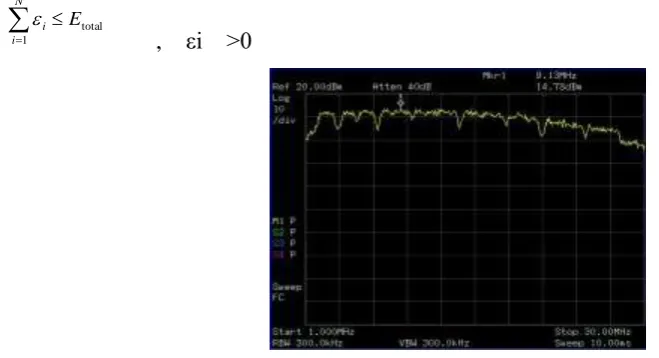
Q / GDW 1379.4-2013. The graph obtained on the spectrum analyzer is shown in Fig. 1.
In Figure 1, the Homeplug AV communication unit work band at 1.8MHz~28MHz, At the frequency of 9.13MHz, the carrier signal power reaches the maximum, which is 14.78dBm. Considering the test instrument error, communication hardware circuit board unit of capacitance and inductance of the carrier signal absorption, the initial rough estimate of carrier signal power is 20dBm, which is the total input power.
It is assumed that the channel estimation of the OFDM system is accurate, the feedback error and the signaling delay are negligible. The bit error rate BER (i) on each subcarrier is related to its assigned power εi , bit number bi and SNR gi. Assuming that the total input power of the channel is
Etotal = 20dBm, the power of each subcarrier needs to be satisfied equation 1:
N
i
i E
1
total
[image:2.595.68.398.497.676.2], εi >0 (1)
Figure 1. The power of Homeplug AV communication unit.
Power Line Carrier Molecular Band Division Algorithm
the relationship between the bit rate bi and the signal-to-noise ratio gi transmitted on the i-th
subcarrier can be expressed by equation 2:
) 1 ( log 2 1
2
i i
i
g
b
(2) where Γ is the SNR margin..
The carrier rate is maximized, that is, the transmission rate of the entire channel is maximized by appropriately allocating the number of bits and the transmission power between the subchannels under the condition that the total transmission power Etotalis constant. The maximizing rate as the following expression:
N i N i i i i g b b 1 12(1 ) log
2
1
(3) Assuming the number of OFDM subcarriers is N and the number of bands is S, SNR(s) is the
average of the SNR for all subcarriers in the subband. The signal to noise ratio of each subcarrier is
g(i)=|h(i)|2/δ2, where h(i) is the transfer function of i-th subcarrier, and δ2
is the power noise power. According to the test data provided in reference [8], the transfer function of the low-voltage power line channel is:
k
k j f
K
k
f
k e e
g f
H 2
1
) ( 0 1
) (
(4) Let H’(i) be the frequency response estimate of the i-th subcarrier and g' (i) be its SNR estimate. Then, the channel estimation error of the subcarrier i can be expressed as
N i i g i g N 1 2 ) ( ) ( 1 E (5) Let g''(x) be the SNR estimate of the i-th subcarrier within the partitioned molecular bands,that is) ( )
(i SNR s
g .
The SNR error introduced by the subband is
N i i g i g N 1 2 ) ( ) ( 1 E (6) The actual signal-to-noise ratio error σ of the sub-carrier i after dividing into the molecular band s is equation 7. 2 2 2 ) ( ) ( 1 E ) ( ) ( 1 E ) ( ) ( 1 E i g i g N i g i g N i g i g N (7) To minimize the loss of system spectral efficiency brought by subcarrier packets, the following equation should be satisfied [13].
dB 15 ) lg(
20 (8)
Rate Maximization Algorithm
Assuming that the initial carrier power of each carrier signal is the same as εA = Etotal/S, the adaptive modulation scheme based on the Homeplug AV specification is adopted, including BPSK, QPSK,
modulation scheme is [θ0,θ1,θ2,θ3,θ4,θ5]. In general, θ0<θ1<θ2<θ3<θ4<θ5. When the adaptive bit and power allocation algorithm based on the SNR threshold is used at the receiver, if jSNR(s)j1,
j∈[0,5], the molecular band s corresponds to the modulation method of θj .The rate maximization
algorithm are as follows:
1. The system initialization, the total number of sub-carriers is N, the number of bands is S, the average number of bits per subcarrier to be transmitted is m, and the signal-to-noise ratio of the
subcarriers in the subband is SNR(s).
2. According to the molecular band division method, so as to get the value of the number of S. 3. The bit error rate (BER) of the OFDM system based on the Homeplug AV specification is simulated and the SNR threshold θj of each modulation scheme is determined according to the
target BER.
4. We obtain the molecular band SNR(s) by channel estimation, and choose the appropriate
modulation scheme according to θj for each molecular band. The method is as follows: taking the median value of adjacent signal-to-noise threshold (θj+θj+1)/2 as the center, if it satisfies the
formula jSNR(s)(jj1)/2, then the sub-carrier of molecular subband adopts the modulation
method corresponding to θj; if it satisfies the formula (jj1)/2SNR(s)j1, the subcarrier of the
molecular band s adopts the modulation method corresponding to θj+1. Calculate the signal-to-noise
ratio of subcarriers in the in-band.
A
s SNR s
d ( )
(9)
θA is the signal-to-noise threshold corresponding to the modulation scheme adopted by molecular
band S in the end.
5. Calculate the power margin of each carrier band
) ) ( 1
(
s R SN
A A
s
(10) and total power margin
1
1
S
s A
s S
(11) If Ψ>0, there is a power margin, and find the band with the largest difference of the signal-to-noise ratio ds in the subband group with ηs>0, so that the modulation mode of the in-band carrier signal goes up one level (QPSK → 16QAM), return to step 5 to Ψ≤0; if Ψ= 0, it means no power margin, no adjustment of power and bit allocation; if Ψ<0, it means that the current power band is ahead, The molecular band with the largest difference in signal-to-noise ratio ds in the band
of ηs<0 is found, and the modulation scheme is lowered to one level (for example, 1024QAM →
256QAM). Then, go back to steps 5 to Ψ≥0.
6. To adjust the power of the carrier molecular band. By equation (1), it can be known that the power required to transmit b bits at a molecular band is εs(b)=(22b-1)/gs×Γ. Define the minimum information increment interval (granularity) for the transmission of β for low voltage power line channels.
b b
b b b b
s s
s s s
) 0 ( ) (
) ( ) ( ) (
(12)
And Δεs(b)=ηs。
) ( min ) (
} ..., 3 , 2 , 1
{
S s s
s b
b
(13) φ∈[1,2,3,...,S]。
8. If total
1
) ( )
(b b E
S
s s
s
, then bφ=bφ+β, return to step 7 to continue the implementation of the
order until Etotal is assigned to complete. At this point, the final power of the molecular band for the
formula.
) ( s s A
s b
(14)
9.Put the formula (14) into the formula (3), get the maximum carrier rate
S
s
S
s
s s s A s
g b b
b
1 1
2 )
)) ( (
1 ( log 2
1
(15)
Experimental Simulation Analysis
Bit Error Rate Analysis
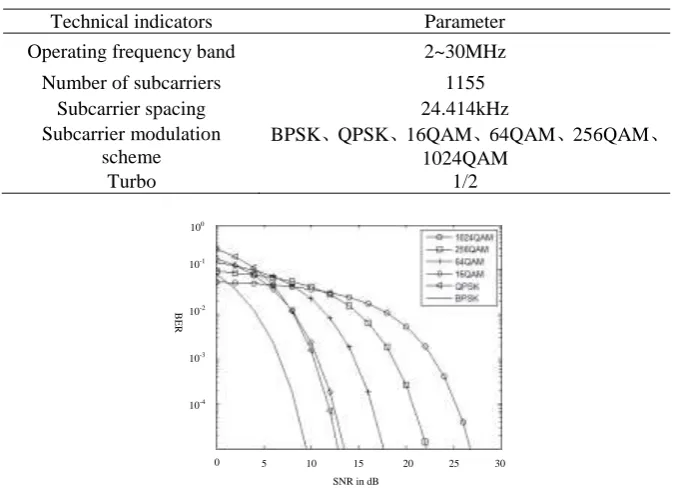
To verify the performance of the proposed algorithm, select the Homeplug AV protocol on the low-voltage broadband power line carrier technology parameters, as shown in Table 1.
Let the bit error rate threshold [8] is BERΣ=10-4, the bit error rate performance curve of BPSK,
QPSK and M-QAM as shown in Figure 2.
According to the BER curve given in Fig. 3, we can get the signal-to-noise ratio threshold corresponding to each modulation mode when the bit error rate is 10-4, namely θ0=8.5dB,
[image:5.595.129.466.413.658.2]θ1=12.3dB,θ2=12.8dB,θ3=16.5dB,θ4=20.6dB,θ5=25.6dB.
Table 1. Technical parameters of AV Homeplug protocol.
Technical indicators Parameter
Operating frequency band 2~30MHz
Number of subcarriers 1155
Subcarrier spacing 24.414kHz
Subcarrier modulation scheme
BPSK、QPSK、16QAM、64QAM、256QAM、 1024QAM
Turbo 1/2
0 5 10 15 20 25 30 100
10-1
10-2
10-3
10-4
SNR in dB
B
E
[image:5.595.129.464.417.662.2]R
Figure 2. BER performance analysis of AV Homeplug modulation mode.
Carrier Rate Analysis
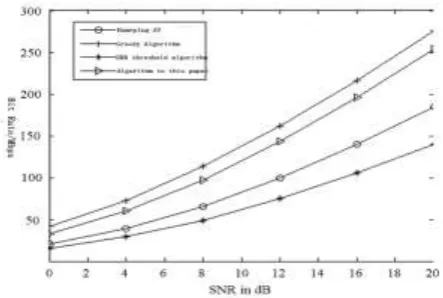
Figure 3. Simulation and comparison of carrier rate.
In Fig. 3, the proposed algorithm divides and classifies the OFDM subcarriers reasonably, avoids the overhead of signaling and power wasting, and improves the spectral efficiency. As a result of the median SNR threshold method and the power band allocation in the band with the greedy allocation mechanism, when the SNR is 20dB, the carrier rate achieved to 250Mbps. The rate is 1.3 times faster than the Homeplug AV protocol and 1.7 times the original SNR threshold. In this algorithm, the granularity of the minimum information increment of the original greedy algorithm is an integer. In each bit allocation process, the information of the particle band with the smallest power increment is assigned to 2 granularities. This allocation will result in a certain performance loss, so the proposed algorithm is lower than the original carrier rate greedy algorithm. However, in the power margin allocation, the algorithm will do Etotal iteration, each iterative process should do S × 2 power comparison, so the algorithm complexity O (Etotal × 2S). Since the original greedy algorithm does not define the granularity β as an integer, in order to do Etotal iteration, N × N power comparisons need to be done. The algorithm complexity is O (Etotal × N2). Usually, the value of the molecular band S << N, we can see that the complexity of the proposed algorithm is far less than the original greedy algorithm.
Conclusions
In this paper, based on the smart metering and collecting system in the environment of "intelligent power utilization" [14], the paper proposes a new algorithm based on molecular band, which is satisfied the requirement of the national communication unit test specification. The experimental results show that the proposed algorithm can effectively improve the subcarrier transmission rate and reduce the hardware overhead in the low-voltage power line channel where the line attenuation, noise interference and input impedance are time-varying.In the signal to noise ratio of 20dB, the carrier rate can reach 250Mbps, it is 2000 times the demand for smart grid applications[15]. In the signal to noise ratio of 20dB, the carrier rate can reach 250Mbps, is 2000 times the demand for smart grid applications.Based on the transmission rate, the acquisition time can be reduced to the second level, which will which will be two-way interactive business development laid the theoretical basis.
Acknowledgement
This research was financially supported by the Guizhou province natural science foundation (2014)7614 and Guizhou Power Grid Corporation of Science and Technology Project2014-2-0050.
References
[2] Liu Wen, Yang Hui-xia, Zhu Bin. Review of research on smart grid technical standard system[J]. Power System Protection and Control, 2012, 40(10): 120-126.
[3] Zhou Shangli, et al. The Development and Application of Electric Energy Metering, Management System[J]. Electrical Measurement & Instrumentation, 2009, 46(1): 26-29.
[4]Zhang Youbing, Cao Yijia. Distribution Line Carrier Communication in Networked Power Quality Monitoring System[J]. Transactions of China Electro Technical Society, 2010, 25(6): 116-122.
[5] Li Jiao-Jun, Zeng Xiao-Ping. An adaptive bit loading and power allocation algorithm in ofdm system for powerline communication [J]. Information and electronic engineering, 2007, 1(5): 15-20.
[6] Wang Ye-Sheng, Ji Wei, Hou Xiao-yun. An improved algorithm based on water filling power allocation in Cognitive OFDM System[J]. Computer technology and development, 2013, 23(1): 79-86.
[7] Luo Wenliang, Ke Xizheng, Ma Ming. Study of channel capacity for low voltage power-line based on monte carlo simulation[J]. Chinese journal of radio science, 2009, 24(4): 691-696. [8] He Wei, and so on. Study of channel capacity for low power-line based on QoS
strategy[J]. ,Power System Protection and Control 2014, 42(13): 106-111.
[9] Wu Shao-qin. Research on Channel Capacity under Received-power Constraint Condition[J]. Telecommunication Engineering , 2012, 1(52): 86-89.
[10]Wang Hang. A Novel dynamic resource allocation algorithm for CR-OFDM system[J].Journal of Nanjing University of Posts and Telecommunications (Natural Science), 2012, 32(4): 23-27. [11]Hu Jianwu, Zhang Qi, et al.Design and Research of Low Voltage Power Line Carrier Point to
Point Communication Performance Test System [J]. Application of Electronic Technique, 2008, (7): 91-93.
[12] Deng Guiping, Wei Shengqing, Guo Yue. The Design and Realization of Point to Point communication performance testing system for Low Voltage Power Line Carrier[J]. Instrumentation Technology, 2013, (1): 1-4.
[13]Cai Liping, Liu Ying, Xue Xianjun. An adaptive algorithm with throughput maximisation based on ofdm sub-bands division for power line[J]. Computer Applications and Software, 2012, 29(6): 260-263.
[14]Liu Zhen Yin. To build global energy internet to promote the green development of clean energy[J]. Qinghai Science and Technology, 2016(01): 38-41.