2017 2nd International Conference on Manufacturing Science and Information Engineering (ICMSIE 2017) ISBN: 978-1-60595-516-2
Research on 3D Technology in Design Method
of the Dental Orthodontic Brackets
Kai Lu, Qingqing Shang, Xitong Sun and Tongming Yin
ABSTRACT
Through 3Dtechnology, exploring a design and manufacture method of the orthodontic brackets with the characteristics of individuation, highly compact degree and high production rate. Methods: By the technology of 3D scanner and Reverse engineering, a new design and manufacturing technology of individual bracket was presented. Firstly, got the 3D scanning data of teeth and then transformed it into the dental CAD models by reverse technology. Secondly, designed customized bracket based on the CAD model. Finally, used 3D printing equipment of selective laser melting to manufacture brackets. Results: 3Dtechnology can be used to design and produce personalized orthodontic brackets effectively. Conclusion: In the design and production of orthodontic brackets,3D technology has more advantages than traditional design and production methods.1
KEYWORDS
3D printing; Reverse Engineering; Orthodontic Brackets; Computer-Aided Design
INTRODUCTION
The wide application of 3D technology has promoted the rapid development of modern manufacturing industry, and got increasing attention from medical domain in recent years. By dint of Computer aided design and manufacturing technology, in
1Kai Lu, Qingqing Shang, Xitong Sun, Tongming Yin, NanJing Forestry University, Nanjing,
the designing period, it’s an effective method for 3D modeling using various modeling software platform. With the help of the 3D scanning technology obtaining the digital model directly is another efficient way. 3D printing technology is an emerging mode of manufacturing in the production phase besides of the traditional methods of production. Considering of the complex structure that traditional processing technology can’t meet the processing needs, 3D printing technology has great advantages.
Dental braces are devices used in orthodontics that align and straighten teeth and help position them with regard to a person's bite, while also aiming to improve dental health. Most orthodontic patients are children or adolescents, however, in recent years, more and more adults have also begun to seek orthodontic treatment. Currently the most widely used dental braces structures is a common metal bracket.
The traditional method of production can only produce a fixed type of dental braces. There are many drawbacks when selecting the type of dental braces. This article will be put forward a new type of dental brackets design and production methods based on 3D technology.
BASIC STRUCTURE OF DENTAL BRACES AND
OPERATIONALPRINCIPLE WITH PROBLEMS IN PROCESSING
The Basic Structure of Dental Braces
Dental braces are tools used to correct the position of the teeth. The main clinical manifestations of dental malformations are abnormalities in the position and posture of the teeth and the consequent dislocation of the occlusion relationship and the imbalance of the facial features. Orthodontic traction is a key factor in tooth movement during orthodontics, which devices for dental appliances. In order to adjust the teeth to the proper position, it’s important to understand the structure and working principle of the dental braces before analyzing the way the dental braces to correct teeth.
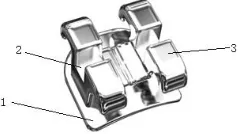
The basic structure of metal dental braces is divided into brackets and arch wire. The material of arch wire is nitinol, we can choose different sizes according to the different needs of patients. The arch wire is embedded in the groove of the bracket and fixed by a steel wire sleeved on the bracket wing. The soleplate of the bracket is stuck on the tooth, the orthodontic traction force transmitted from the arch wire, so that the tooth is displaced and steered to correct position completely.
Operational Principle of Dental Braces
regains normal three-dimensional posture to reach normal standards while improving face shape. The adjustment phase requires a large clearance between the bracket and the arch wire, as well as a small friction. Calm stage bracket and arch wire clearance between the small and large friction. This requires dental braces to achieve different needs in different orthodontic phases.
[image:3.612.243.362.192.259.2]1. Bracket bottom plate 2. Groove 3. Bracket wings Figure 1. Metal bracket.
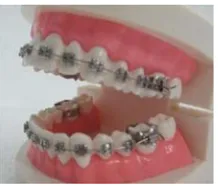
First of all, during the tooth positioning phase, the point contact of the arch wire and the groove of the bracket slot is used to correct the dislocation of the orthodontic and complete the tooth flattening quickly. In the phase of posture, The orthodontic wires were inserted into the groove of the brackets and were in contact with the brackets and grooves. At the same time, the dental braces use the elastic force of the self-locking lid on the arch wire into the bracket groove. The friction of arch wire and bracket groove is large, which can accurately control the three-dimensional teeth posture. The doctor can control the orthodontic process by changing the traction applied to the brackets by selecting different diameters of wire. Only fully fit the brackets on the tooth surface, the traction is suitable, so as to achieve the best therapeutic effect, see in fig 2. Brackets on both sides of the tooth are responsible for securing both ends of the arch wire and exerting traction on the arch wire.
Problems During The Dental Braces Design
In order to meet the needs of different patients, each patient needs a different treatment of the dental tray bracket tailored to personalize. In traditional orthodontic clinical work, it uses gypsum model records the actual shape of the patient's teeth, and the doctor choose the right dental braces through the plaster model. In the production, the traditional brackets CNC machine tool cutting the overall production. Firstly, the stainless steel block is cut by wire cutting tool, and the bracket wing and groove are generated. Then, the CNC machine is used to process the bottom plate by point by point milling, and the individual bracket is formed.
model, the gypsum needs to be put in the mouth of the patient, which may cause discomfort to the patient.
Second, The traditional method of bracket processing is batch production. Faced with different patients and different stages of tooth adjustment, mass production of dental braces is difficult to fully meet the needs of patients to modify or replace and use unsuitable brackets, it is uneasy to teeth Corrected to the ideal location, thus affecting the treatment effect.
[image:4.612.244.353.286.379.2]Third, the bracket floor needs to completely fit the tooth surface, while the tooth surface is a complex 3D surface that increases the machining difficulty. In the meantime, after the traditional processing method is used to finish the processing of the bottom plate of the bracket, in order to facilitate the bonding of the bracket and the tooth surface, the surface of the bottom plate needs to be sandblasted and micro-etched so as to increase the manufacturing process and increase the cost.
Figure 2. Use metal braces to correct the teeth.
As a result, there is a need to find a new way of production that is able to adapt to different patient needs while meeting the machining accuracy requirements with the lowest possible cost.
DENTAL BRACES DESIGNS BASED ON 3D TECHNOLOGY
3D Scan The Outer Surface of The Tooth
In addition to meeting the needs of different patients, dental braces made with 3D scanning can also be used for phased treatment. In different stages of treatment, besides of the location of the patient's teeth, the dental posture is not the same. After obtaining the three-dimensional digital model of the tooth, the dental model can be divided and the correction path can be planned to simulate the entire tooth correction process. In different stages of orthodontics, 3D models can be used to obtain dental models quickly enough to produce dental braces for different courses in time, which avoids the cumbersomeness of traditional modeling methods. Throughout the treatment process, patients simply follow the doctor's instructions, wear different dental braces in different courses, to maintain the effect of arch wire force.
The Formation of 3D Tooth Model
After the 3D point cloud data of the outer surface of the tooth is obtained by the 3D scanner, which needs to be further processed. The basic process includes removing noise, filling cavities, cross-section splicing and so on. Then it obtains three-dimensional continuous and complete data. The three-dimensional model data is stored in WRP format, which has the advantages of small file size and high precision, and facilitates post-production.
Figure3. 3D model of metal bracket.
3D Printing --- Production of Dental Braces
Although the traditional processing technology can’t meet the processing needs of complex structures gradually, the use of 3D printing technology greatly improves the ability to produce complex structures.
The 3D printing braces are used by the laser sintering technology based on titani um alloy powder. Laser sintering method is a way using laser beams, through the layered scanning, selective sintering alloy powder, sintered through the layers to form a solid, after simple processing so that production can be used.
Using laser sintering Direct manufacturing technology to produce brackets, of which floor surface is accuracy, meeting the individual needs of patients. In order to facilitate the fitness of bracket floor and tooth surface, the traditional processing methods also need sandblasting and micro-etching the bottom surface of the plate, thus increasing the cost. By using of 3D printing technology, it can print out the required bracket directly on the bottom surface, achieving the same result with sandblasting or micro-etching, thereby enhancing the adhesion. This reduces a production process directly, speed up the production and reduce costs.
CONCLUTIONS
This paper introduces a dental braces design and production method based on 3D technology, compares the new braided design and production method with the traditional methods, and draws the following advantages:
(1) Personalization and high degree of confidentiality: By scanning the patient's teeth with 3D scanning technology, the patient's dental model can be conveniently and quickly drawn on the computer to match with the high density of the dental tray which meets the requirements of the patient’s personalized needs and makes them feel comfortable.
(2) Easy to replace and modify: the traditional processing methods can only be in accordance with different models of mass production, the use of further selection, the choice is limited. 3D printing technology can be customized directly to produce a personalized floor according to bracket bottom plate model generated by the tooth model, matching with teeth of different patients accurately.
(3) Fast production, high precision: After the scanning of the teeth, only with the brackets that fit the teeth of the patient can be put into production immediately, and the 3D printing technology has higher speed and accuracy in the processing of the bracket bottom plate.
ACKNOWLEDGEMENTS
The work has been funded by the Special Fund for Forest Scientific Research in the Public Welfare by the state forestry administration (201304102) and 2015 Jiangsu higher education educational reform research subject(2015JSJG520)
REFERENCES
1. Shufan Wang, Yongqiang Yang. 2013. "Three-dimension digitized printing technology of lingual orthodontic brackets," Journal of Dental Prevention and Treatment, 21(8): 408-411
2. Xueying Wang. 2012. "Analysis of 3D printing technology and industry development," China High Technology Enterprises, (26): 3-5
3. Qingqing Shang, Tongming Yin, Mingxingt Liu. 2017. " Study on structure and effect of trunk injection needle," C e Ca. (42): 92-96
4. Ran Fan, YeXing Niu, Xiaogang Jin, Shuhua Gu, Jiedu Shi, HuiMing Wang. 2013. "Computer Aided Invisible Orthodontic Treatment System", Journal of Computer-Aided Design & Computer Graphics, (1): 81-92
5. Wenjian Zhang. 2007. "Computer aided design and manufacture of individual straight wire bracket and new positioning tray ," Nanjing Medical University
6. Qingqing Shang, Tongming Yin, Hongwei Li, Huanping Zhang, Zhiwu Sun. 2016. "Countermeasures for Treatment of Support out of Model in 3D Printing", Iberian Journal on Information Systems & Technologies, (13): 273-279
7. Stava O., Vanek J., Benes B., et al, Stress relief. 2012. "improving structural strength of 3D printable object," ACM Transactions on Graphics, 31(4): 48
8. Umetani N., Schmidt R. 2013. Cross-sectional structural analysis for 3D printing optimization," Proceedings of SIGGRAPH Asia 2013 Technical Briefs. New York: ACM Press, 2013: 5 9. Guth J.-F., Keul C., Stimmelmayr M., et al. 2013. "Accuracy of digital models obtained by direct
and indirect data capturing," Clin Oral Investig, 17(4): 1201-1208
10. Christiansen A.N., Schmidt R., Bxrentzen J.A. 2015. "Automatic balancing of 3D models," Computer-Aided Design, (58): 236-241
11. Qingqing Shang, Tiantian Jiang, Tongming Yin. 2015. "Study on resistance and structure optimization of tree trunk injector's needle," INMATEH - Agricultural Engineering, 47(3): 164-171.
12. Changchun Zhou, Kefeng Tu, Zhanwen Xiao, Xingdong Zhang. 2014. "Research and application of 3D printing technology in Biomedical Engineering ," Technology Innovation and Application, (21): 41-42.