University of Huddersfield Repository
Refai, Deema and Thompson, John L.
The Significance of ProblemBased Learning in the Development of Enterprise Skills for Pharmacy
Students in UK HEI
Original Citation
Refai, Deema and Thompson, John L. (2011) The Significance of ProblemBased Learning in the
Development of Enterprise Skills for Pharmacy Students in UK HEI. In: ISBE Conference 2011
Sustainable Futures: Enterprising Landscapes and Communities, 910 November 2011, Sheffield,
UK. (Unpublished)
This version is available at http://eprints.hud.ac.uk/id/eprint/17230/
The University Repository is a digital collection of the research output of the
University, available on Open Access. Copyright and Moral Rights for the items
on this site are retained by the individual author and/or other copyright owners.
Users may access full items free of charge; copies of full text items generally
can be reproduced, displayed or performed and given to third parties in any
format or medium for personal research or study, educational or notforprofit
purposes without prior permission or charge, provided:
•
The authors, title and full bibliographic details is credited in any copy;
•
A hyperlink and/or URL is included for the original metadata page; and
•
The content is not changed in any way.
For more information, including our policy and submission procedure, please
contact the Repository Team at: [email protected].
1
The Significance of Problem-Based Learning in the Development of Enterprise Skills for PharmacyStudents in UK HEI
By: Deema Refai: Researcher/ University of Huddersfield
(BS2/39 Business School/ University of Huddersfield/ Queensgate HD1 3DH/ Mbl: 07849089386/ email: [email protected])
John Thompson: Professor of Entrepreneurship/ University of Huddersfield
Date: Sep. 19th, 2011
Key words: Enterprise education, enterprise skills, innovative learning approaches, problem-based learning, employability, pharmacy education.
(i) Abstract:
This research focuses on studying enterprise skills in terms of generic transferable employability skills that are valuable for everyone in all contexts. The research is conducted in the pharmacy education context where opinions of pharmacy academics are primarily considered, along with the opinions of pharmacy employers and students. Pharmacy education has undergone a lot of changes during the last two decades that incorporated application of Problem-based Learning (PBL) in the curricula. These changes aimed at enhancing a range of pharmacists’ knowledge and skills in order to improve the profession and meet up with the challenges of the continuous advancements in the complexity and diversity drug therapy. At the same time, there is a wide call nowadays to promote the development of graduates’ enterprise skills during Higher Education (HE); a significant number of employers are calling for the inclusion of more specialized courses in HE that aim at developing students' communication, negotiation, critical thinking, problem solving... etc.
Nevertheless, many may argue that the development of such skills is not the responsibility of HE, or that the curricula in HE are already packed with knowledge making it quite difficult to introduce such extra courses. In this research the development of enterprise skills during HE will be considered through PBL which is seen as a means for embedding enterprise into curricula. PBL is increasingly being applied in HE, and it has been established in literature that such learning could lead to the development of a range of skills in students. But questions remain: are pharmacy schools utilizing PBL for the development of students' enterprise skills? And if so, do the skills developed satisfy the expectations of employers in the marketplace? And what are the barriers facing pharmacy schools in this regard? Through this exploration, the research will evaluate the extent to which developing these skills is a valuable inclusion in an undergraduate pharmacy degree and/or the responsibility of employers in the marketplace.
The research used a qualitative approach where interviews were conducted initially with pharmacy employers in the marketplace followed by interviews with pharmacy academics at pharmacy schools in a number of HEI. Following that, several reflective interviews were conducted again with a number of pharmacy employers and academics to discuss and confirm some findings of the research. The research showed that pharmacy graduates lack some of the essential enterprise skills. Pharmacy academics agree that HE has a great responsibility toward developing student’s enterprise skills. At the same time, significant changes are being introduced into pharmacy education where a lot of efforts are made for the development of students’ enterprise skills. Nevertheless, there is still a lack of understanding of the concept of enterprise education among academics, and despite that pharmacy schools are aiming at developing students’ enterprise skills through PBL and other innovative learning approaches, there are still some weaknesses and gaps in the application of these learning approaches that are likely to limit their benefits in terms of developing students’ enterprise skills. Initial conclusions of this research point out a number of barriers for the development of students’ enterprise skills during HEI. Some of these barriers are internal and can be overcome by HEI; where improvement of the application of PBL can play a major role in this aspect. On the other hand, the research points out some external barriers to the development students’ enterprise skills which cannot be overcome without joint efforts between HEI and the real-world organizations.
This research focuses on enterprise education – ‘the processes or series of activities that aim to enable an individual to assimilate and develop the knowledge, skills, and values required to become enterprising’ (Broad, 2007, p.5) – and its role in developing enterprise skills through PBL. For pharmacists to become effective managers and leaders in industry, hospitals or retail sectors they need to be equipped with a set of generic transferable enterprise skills by which they can demonstrate an enterprising behaviour alongside their professional knowledge and expertise. This is not the same as 'entrepreneurship', although some will become self-employed retail pharmacists. This issue has brought several implications upon the pharmacy education process in terms of when and how the learning approaches should be developed to satisfy the growing need for enterprising pharmacists.
The last decade has witnessed a notable growth in enterprise education (Davies, 2002), which has been accompanied by suggested guidelines and frameworks to support the learning and assessment processes. Several methods of and objectives for enterprise education have been identified in research, but yet many aspects of this education and its role in developing the necessary enterprise skills require further investigation, especially when it comes to examining the specific discipline-based approaches (Broad, 2007, p.5). This study aims to investigate the value of the contribution that PBL can make to developing enterprise skills in undergraduate pharmacy education in UK HEI, and accordingly come up with a better understanding of what PBL is, which is a matter that is still lacking in research according to Savin-Baden (2007). The research will link together opinions of pharmacy employers from the retail, industry and hospital sectors who might believe it is their role to develop these skills, with the opinions of academics who might agree or disagree with employers as to when, where and how these skills should be developed. Through this investigation, the extent of the need for enterprise education for pharmacy undergraduate students will be explored, alongside the extent to which pharmacy schools embrace and understand the concept of enterprise education in terms of what efforts are being introduced to develop enterprise skills, how they are being developed and whether they are developed as part of undergraduate education or workplace environment. Finally, views of pharmacy students will be considered to evaluate their perceptions as to the value and benefits of enterprise education.
(iii) The rationale behind choosing undergraduate pharmacy education as a context for this study?
Considering the lack of research concerning the development of enterprise skills in specific discipline-based contexts, the pharmacy education context provides a very good opportunity for this research, and conclusions derived from the study of this context could potentially be of value in other contexts as well. Pharmacy education has witnessed a shift in the focus of education over the last 20 years from the traditional supply of medication to focusing on the provision of primary patient-care services (Reid and Posey, 2006). This has brought about an increased emphasis on equipping pharmacists with a range of skills, which has lead to more focus on application of student-centered and interactive learning approaches in pharmacy education, such as PBL (Marriott, 2008 and Beck, 2002). Anderson, et al. (2011) also expressed a view that innovative learning approaches to learning need to be to be more considered in pharmacy curricula in such a way that leads to more efficient teamwork among health professionals across disciplines.In this regard, PBL is regarded as one of the best approaches for developing pharmacists’ skills as indicated by Jungnickel (2009). However, research indicates that the development of skills in pharmacy education contexts so far is largely limited to developing student’s patient-care and clinical skills without having a more general focus on a wider range of enterprise skills, which is the focus of this research.
3
The following section discusses the theoretical framework of this research alongside a brief review of the relevant literature and existing gaps that this research addresses.(iv) Theoretical Framework of the research based on existing knowledge
A greater emphasis is placed nowadays on the need for HE graduates who could compete at an international level, and demonstrate a level of thinking and behaviour that allows for developing various business ideas and achieving effective enterprising environments and organizational growth. Draycott and Rae (2011) argue that enterprise should be built-in as a fundamental part of the 'survival skills' that are essential for young people to start their lives and build their portfolios by having the necessary flexibility, continuous learning skills and diversity. Such skills are essential not only for graduates planning to become independent entrepreneurs and start their own business, but also for those who simply want to successfully compete in the employment market.
Nabi and Bagley (1999) argued that it is becoming increasingly difficult to secure a life-long job especially with the degree of organizational ‘downsizing’. This issue is becoming more difficult in light of the current economic environment where there is an increasing number of graduates competing for a limited number of job openings in the marketplace (e.g. Singh, 2008). Accordingly, many graduates nowadays are shifting away from the traditional life-long jobs toward building up the skills and traits that add up to their reputation as indispensible organization resources (Hytti and O’Gorman, 2004; Galloway et al., 2005). Additionally, employers are increasingly focusing on and valuing the skills demonstrated by graduates. Hiring today is no longer an issue of filling vacancies but more about investing in individuals who are capable of demonstrating the skills necessary to fulfil organizational tasks effectively (Mallon, 1998; Templer and Cawsey, 1999; Sullivan, 1999). Such issues have added to the significance of delivering enterprise education over the past years, and a growing trend toward applying such education is noted in HEI. In his paper, Rae (2009), argues that enterprise education might be facing its greatest challenges nowadays to produce secondary and higher education graduates who are ready for employment in light of the post-recession economic situation and the high unemployment rates among young people.
In general, application of enterprise education at HEI can fall under one or more of the categories listed under the three-category framework suggested to identify the objectives of enterprise education. Here a distinction is made between education ‘about’, ‘for’ and ‘into’ enterprise. The first type ‘about’ basically deals with creating awareness about enterprise and entrepreneurship. Education ‘for’ enterprise has the specific objective of preparing entrepreneurs and encouraging participants to start up their own business. Whereas education ‘into’ enterprise, which is the interest of this research, deals with providing the skills necessary for carrying out various organizational tasks effectively. More specifically, teaching ‘into’ enterprise deals with preparing people and helping them adopt an enterprising approach in different areas of life. Therefore, enterprise education is not related only to business disciplines, but to all disciplines that aim to develop enterprising people who can create and add value to their careers and organizations (Jack and Anderson, 1999; Gibb, 1999; London and Smither, 1999, Henry, Hill & Leitch, 2005a).
PBL is a well-known learning approach that is based on reflective learning methods (Droege, 2003; Wee, 2004). PBL was first applied as a pedagogical approach at the medical school of McMaster University in 1969 Savin-Baden and Howell Major, 2004), and is defined as ‘learning that is centered around a problem, a query or a puzzle that the learner wishes to solve’ Boud (1985) p.5). Today, PBL is widely applied in medical education and there is quite a lot of literature investigating its methods and approaches in the medical education context. PBL has also been successfully applied to develop students’ intellectual skills in several other disciplines as pharmacy, nursing and others (Cisneros et al., 2002). Haworth et al. (1998) argued that PBL can be applied for the development of such skills as knowledge retention, problem solving, critical thinking and self-directed learning (Lubawy and Brandt, 1998). There are several arguments in academic literature about the extent to which right and left brain techniques should be involved in educational approaches; applying PBL shifts the learning process more toward involving right brain activities through experience and experiential learning (Thompson, 2010), which adds to the value of this learning in developing a range of skills. In this sense, PBL is regarded in this research as a means for delivering education into enterprise, whereby a range of enterprise skills are developed. PBL
literature that investigates PBL and a growing amount of literature that discusses enterprise education and enterprise skills, there is hardly any literature that links these two areas together nor any literature that explores whether enterprise skills are developed formally as an outcome of learning through PBL or informally in an unstructured manner where students develop them by the way as part of the learning experience.
PBL is a very flexible innovative learning approach that has changed widely in the last decade giving rise to a lot of varieties and models that share certain views and philosophies (Savin-Baden, 2007). This research however does not investigate PBL as a learning pedagogy, but investigates its application for the development of enterprise skills in the pharmacy education context. Through this investigation, the research will hopefully come out with a better understanding of what PBL is and shed light on possible gaps in its application while providing suggestions for overcoming them.
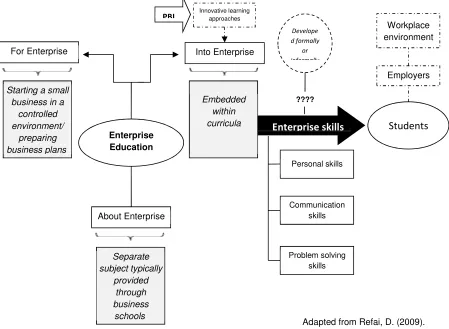
Figure (1) represents the conceptual framework of this research. Among the three types of enterprise education, the figure represents education ‘into’ enterprise as part of enterprise education, where embedding enterprise into curricula results in the development of a range of generic transferable enterprise skills for students. PBL is presented in the figure as an innovative learning approach that can be utilized to embed enterprise into curricula. The enterprise skills developed vary between a number of personal skills, communication skills and problem-solving skills which are all among the essential employability skills that are highly valued by employers in the workplace environment.
Figure (1): Developing enterprise skills by embedding enterprise education ‘into’ disciplines
(v) Methodology
Developing enterprise skills can raise debates as to how these skills are developed, which of these skills are important and why, and who is responsible for developing them and at which stage(s). Accordingly, a qualitative research methodology has been adopted to gain an in-depth understanding of all these issues from all parties who could influence the development of pharmacy students’ enterprise skills; and those include pharmacy employers who have experience with pharmacy graduates in the marketplace, pharmacy
Into Enterprise
About Enterprise For Enterprise
Enterprise Education
Embedded within
curricula
Enterprise skills
Starting a smallbusiness in a controlled environment/
preparing business plans
Separate subject typically
provided through business
schools
Personal skills
Communication skills
Problem solving skills
Students
Employers Workplace environmentAdapted from Refai, D. (2009).
Develope d formally
or informally
????
[image:5.595.71.520.331.660.2]5
academics who are involved in undergraduate pharmacy education, and pharmacy students who have experienced PBL.In accordance with this research paradigm, the data collection methods employed involved in-depth interviews as well as reflective interviews with pharmacy employers to evaluate their opinions regarding the need for enterprise skills and whose responsibility it is to develop them. In-depth and reflective interviews were also conducted with pharmacy academics to evaluate their opinions regarding the current practices in enterprise education, the skills focused on in the pharmacy educational process, and how PBL is utilized as vehicles to develop enterprise skills. The next stage of data collection will involve focus groups with pharmacy students to assess their perceptions as to the value and need for enterprise skills and the impact of innovative learning approaches on developing them.
(vi) Results:
Significance and responsibility of developing enterprise skills:
Early results of this research show that enterprise skills are highly valued in pharmacy workplace environments whether in retail, hospitals or industry sectors, and are almost always considered in employment processes. All personal, communication and problem-solving skills were highly valued by employers who emphasized that pharmacists are exposed to critical real life situations from the moment they start their careers, and therefore should be equipped with a good level of skills that enables them to face the challenges of the real world. Employers stressed the importance of enterprise skills in workplace environments and mentioned that HE could contribute to developing more knowledgeable pharmacists but that doesn’t necessarily mean they would be good pharmacists.
Employers pointed out that HEI could and probably should contribute to developing graduates' enterprise skills, but also agreed that the development of these skills could not be completely achieved through HE since engagement in real life careers is essential for improving those skills and sharpening them. Employers were supportive of the notion that HEI should contribute to developing a range of enterprise skills up to a certain level that would enable students to take a step toward real life careers once they graduate. However, the level of skills demonstrated by recent graduates so far has not met that level yet. There was a general dissatisfaction among employers about the level of skills demonstrated by recent pharmacy graduates especially when it came to communication skills and the ability to demonstrate confidence which seemed to be lacking according to the opinion of employers.
In terms of pharmacy undergraduate education, it was clear from interviews with academics that pharmacy schools in general dedicate a lot of effort to embed various innovative learning approaches in pharmacy curricula. Academics pointed out that the development of skills is considered in the pharmacy educational process, but neither the concept of enterprise education nor enterprise skills were familiar. Most academics generally related the latter concepts to entrepreneurship education or more specifically to concepts of management and starting and running of new businesses and consequently the development of entrepreneurial skills.
Academics agreed with employers that HE could and should contribute to the development of students' enterprise skills, and also agreed that the level of skills demonstrated by recent pharmacy graduates is not up to the level required by employers. Nevertheless, academics agreed that pharmacy schools are placing a lot of effort to develop their students' skills. Academics also believed that despite not presenting with the level of skills required by employers, pharmacy graduates in general should be able to take the step into the real world and cope with its challenges. In this regard, academics discussed some reasons and justifications for the low level of enterprise skills demonstrated by recent graduates alongside some suggestions for improving the development of enterprise skills during undergraduate HE, which will be discussed later in this paper.
Academics emphasized that the responsibility of developing enterprise skills is a joint one between HEI and the real world, and therefore HEI cannot be expected to completely satisfy the employment sector’s expectations on their own in this regard. People develop enterprise skills continuously as they mature and engage in more situations that lead to sharpening of these skills and developing them at a higher level, which makes engagement in real life essential for the development of enterprise skills up to the level needed in real life contexts. As mentioned by one of the academics 'maturity comes with dealing with these skills in the real life situations which are different from here'.
It was clear that pharmacy schools place a lot of efforts in applying PBL and other innovative learning approaches as case-based learning (CBL) and enquiry-based learning (EBL) which have some pedagogical differences from PBL. Despite that there is still a notable amount of traditional lecturing in pharmacy, there is yet growing awareness by pharmacy schools and academics about the value of PBL for developing students’ skills and knowledge. Application of either traditional or problem-based learning varies according to differences in personality of academics, number of students, and the modules themselves in terms of their level, nature of subject and knowledge compactness. In terms of the personality of tutors, academics explained that some prefer to teach in a traditional way giving students a lot of theory and facts, and others are more flexible and open to changes and interaction with students and believe that innovative teaching including PBL is an excellent way of learning and motivating students. The number of students obviously plays a role here as well since it is quite difficult to apply PBL in classrooms with large numbers. Regarding modules, it was noted that PBL and other forms of innovative learning are generally more applied in senior years in the higher level modules than in early years. It was also mentioned that some subjects lend themselves more easily to PBL and other forms of innovative learning than others, and these in general are the subjects that have more application in the real world like pharmacy practice for example as opposed to the more rigid science-based modules like pharmacology. Furthermore academics mentioned that sometimes modules are compacted with knowledge making it quite difficult to embed PBL or other modes of innovative learning which generally require more time to introduce.
During interviews, academics were asked to describe their application of PBL at pharmacy schools. Here, academics expressed a view that at many times pharmacy schools do not apply PBL in its pure traditional sense which is mostly seen in medicine schools, where students are divided into small groups and allowed time to resolve various problems while being supervised by an academic supervisor; and this will be applied throughout the academic year. The reason why pharmacy academics did not relate their application of PBL to it pure traditional form is that the application of this learning does not usually take place throughout the modules or academic years, and is not applied as part of a school philosophy of pre-set schemes, even though this does take place only to some extent at a very small number of schools.
In pharmacy schools, academics mentioned that students are engaged in various types of problems/scenarios delivered through a number of ways that generally have the investigation of problems/scenarios as the centre of the learning process. These problems are mainly provided to students through case studies, experiments and prescriptions, and these generally increase in complexity as the students’ progress in order to develop their skills at higher levels. These problems/scenarios are provided to students through various learning environments that offer the opportunity for interaction and engagement among students. Such environments mainly include tutorials, laboratories, placements/real-world contexts and workshops, and were mentioned to facilitate self-learning skills, team skills, problem-solving skills and others.
In most cases when PBL or other modes of innovative learning are applied, academics mentioned that students are divided into small groups with numbers ranging between 6 students in some cases to around 12 or 15 in others. These groups are offered sufficient time to meet and resolve the problem in hand, and are provided with guidance and monitoring by an academic facilitator. It was noted that a separate academic facilitator was not always assigned to each group individually –mainly due to financial reasons– even though this does take place quite often at some schools. Nevertheless, academics’ roles in all cases generally involved them acting as facilitators rather than lecturers, where they arrange for group meetings and provide advice to students. After tackling a problem/scenario and coming up with findings, results, observations, resolutions and others, students are faced with the challenge of presenting those findings in a logical way alongside the approaches followed to reach them. Vehicles used to present findings by students varied between written format vehicles as portfolios, reports, essays or theses sometimes, or through presenting a concept or an issue in a condensed and coherent way through posters. Oral vehicles for presenting findings are also utilized like presentations, role plays and vivas.
Utilizing PBL for the development of enterprise skills at pharmacy schools:
7
To investigate the mode of applying PBL at pharmacy schools three main domains were investigated with academics. These involved the investigation of whether PBL is applied as a learning philosophy that is considered in the design of pharmacy undergraduate programmes or as a personal effort by academics who are interested in its application. The second domain is to investigate the contexts in which PBL is applied, followed by investigating whether inter-disciplinary and/or integrated learning are considered in the delivery of pharmacy programmes through PBL.In investigating the first domain, it was noted that despite the fact that PBL is applied at pharmacy schools alongside other innovative learning approaches and that there is a move away from traditional toward innovative learning, pharmacy schools do not generally apply PBL as a learning philosophy or strategy at most times. In other words, pharmacy schools in general do not set a scheme for application of PBL in a complementary way that guides the students throughout the four year educational process and let them see how this learning helps them relate and link their knowledge together. Rather, the application of PBL is mainly done as a personal effort by academics interested in applying it as indicated by one academic ‘it’s largely down to the individual members of staff and how passionate they are about using alternative learning methods’.
In terms of the knowledge/theory included in pharmacy degrees, it was noted that all pharmacy schools in UK follow the strict subject guidelines of the Royal Pharmaceutical Society of Britain (RPSB) that specify the knowledge/theory that must be included in pharmacy curricula in order for schools to become accredited. But in terms of skills, the society defines a number of skills that should be considered as an outcome of the learning process without defining the learning approaches or contexts for developing these skills even though a number of them can only be developed in clinical contexts. Accordingly, the development of enterprise skills is considered in pharmacy education but not across all modules.
In investigating the second domain regarding the contexts in which PBL is applied, it was noted that efforts to embed PBL and other modes of innovative learning in the curricula are more evident in practice-related pharmacy modules as therapeutics and pharmacy practice than the science-related ones as pharmacology and pharmaceutics for example. So despite that pharmacy schools focus on developing a range of skills through PBL and other modes of innovative learning, these approaches are mainly applied in practice-related courses, which means that students mainly get to develop these skills in clinical and practice-related contexts, as mentioned by one academic ('...I would say there is more focus on developing the skills in pharmacy practice than in science...').
The reason behind this focus as explained by academics lies in the fact that about 90% of the pharmacy graduates end up working in practice-related contexts which are basically represented in hospital and retail sectors. Furthermore, pharmacy is a profession that aims primarily to graduate health care providers who are experts in drug therapy and patient treatment. Accordingly, practice is seen as a more relevant area to a pharmacist’s careers. However, a number of pharmacy employers in the marketplace complained that this focus on practice in pharmacy education is leading to graduates who are too much clinically focused to the extent that they cannot see themselves working on jobs that are not centred around pure clinical tasks. Such jobs are mainly the basic kind of jobs that are required from any recent graduate like for example working in a dispensary, which graduates perceive as a menial job for which they are overqualified, while employers see as an essential starting point for recent graduates to start and develop themselves in the real world. Furthermore, employers in the industry sector added that the focus on practice-related courses in pharmacy education is directing the interest of pharmacy students more toward practice-related jobs because they feel more comfortable in these environments and can better envision themselves working in them rather than the more science-relevant environments as research and industry. This issue is causing some frustration among those industry employers as mentioned by one of them ‘… some pharmacists would love to work for industry but they don’t really know what industry expects from them and what they need to have to enter this sector’. Careers in research and industry no longer appeal to pharmacy graduates especially nowadays with the growing number of pharmacy students and the limited number of placements available for students in these areas.
inter-disciplinary learning in pharmacy schools, though some schools have already achieved much more in this regard than others. Here, pharmacy schools apply innovative learning approaches including PBL in practice-related modules in a way that links these modules to the science-practice-related ones through problems/scenarios that help students see the value of each one to the other, and the value of both in real life. So students will not only learn about the science and practice, but will also link between them and understand why they are learning about them.
Reasons for the low level of pharmacy graduate skills and suggestions for improvement:
Employers were generally dissatisfied by the level of graduates’ enterprise skills and added that the graduates themselves cannot really appreciate the value and the need for these skills in the real world once they graduate. Employers attributed this to the educational process which they saw as too much knowledge-focused, and added that the educational process does provide for sufficient exposure to real-life situations, leading to graduates who cannot connect different fields of knowledge together or realize the application of their knowledge in real world. To improve the contribution of HE to the development of graduates’ enterprise skills employers suggested hiring more teacher-practitioners from all sectors of pharmacy, and perhaps even non-pharmacy people like librarians who could develop students’ research skills and communication specialists who can develop their communication skills…etc. Employers also stressed the need to put students through real life situations involving different contexts and assess their ability to handle these situations during their education.
Academics agreed with employers that HE could contribute more toward the development of a better level of graduates’ enterprise skills and that more improvements could and possibly should be introduced into pharmacy curricula to achieve this. Besides working on developing students’ enterprise skills through PBL, academics added that they also discuss with students the value of enterprise skills and their impact on their professional role in the marketplace, and make it very clear for them from the beginning how the educational process will help them develop a range of those skills.
Nevertheless, academics stressed that it is necessary for the employment sector to understand that the objective of the educational process is to produce day-one pharmacists and not chief pharmacists. In other words, pharmacy schools work on developing pharmacists with the necessary knowledge and with a wide range of transferable skills that are needed in all types of careers, and that are necessary for them to take that first step in the real world where those skills are expected to become more developed and sharpened through engaging in real life experiences. Consequently, it is not until graduates get the opportunity to engage and demonstrate skills in real life that they will be able to develop those skills up to the level required there, thus making the development of enterprise skills up to the expectations of employers in the marketplace quite difficult to be achieved by HEI alone. Accordingly, academics supported employers’ suggestions to introduce improvements into pharmacy curricula that entail exposing students to more real life situations and giving them the opportunity to engage in the workplace throughout their studies in an integrated manner that should help them develop the theory and knowledge while applying it in parallel in the real world. Academics believed this should help in better sharpening of students’ enterprise skills and understanding of the application of their knowledge in real life; academics also expected this to contribute to enhancing the confidence and professionalism of graduate pharmacists.
However, to achieve such curricular improvements, academics stressed the need for more collaboration between pharmacy schools and the real world organizations, and mentioned that the employment sector should not expect HEI to enhance graduates’ enterprise skills up to their expectations without stepping forward and taking an active role that involves establishing more links with HEI and offering students more placements in their organizations during their studies. Academics were quite frustrated about not finding such support from many of the real world organizations especially with the growing demand from most of these organizations to receive financial returns for training students or offering placements for undergraduate students.
(vii) Conclusions:
In this paper, the opinions of academics and employers in pharmacy context were brought together to evaluate the extent to which pharmacy schools are contributing to the development of pharmacy graduates’ enterprise skills and the specific contribution of PBL in this regard.
9
development of enterprise skills resulted from applying all these modes of innovative learning considering that the differences between them are limited to some pedagogical differences only. It was also found that pharmacy schools do utilize such learning approaches for the development of a range of students’ skills in a formal way that considers the development of skills as part of the learning outcomes of a course. However, this development of skills is considered as a learning outcome in some but not all modules, besides not being focused on in a systematic way when setting school strategies. In other words, application of these learning approaches is commonly done as a personal effort by academics who are interested in applying them and not set as a school philosophy. This might explain why –in many cases– there are still some academics who do not have the motivation or willingness to improve their modules through applying PBL and other modes of innovative learning.Education into enterprise that leads to the development of enterprise skills can be achieved through embedding PBL and other modes of innovative learning into curricula, which is currently taking place in pharmacy undergraduate education. Nevertheless, the term ‘enterprise education’ or ‘education into enterprise’ are not commonly used at pharmacy schools nor is PBL applied as part of any of them. There is still a lack of understanding of the concept of enterprise education in the sense referred to in this research as most academics in HEI limit the concept to pure management and entrepreneurship education and the development of entrepreneurial skills.
Furthermore, there is still some lack in the understanding of PBL as an innovative learning approach that offers great flexibility in the way it is applied. Academics in HE usually refer PBL to its pure traditional form that is applied at medicine schools without realising the variety of modes and the great range of flexibility that this form of learning offers. However, the researchers’ views in this study go along with the views of Savin-Baden (2007) in that if we move away from the rigid thinking about PBL in its traditional sense, there will be room for more creative and flexible ways of delivering it; several modes were suggested in this regard but these are not the interest of this paper. So in order to apply PBL, it is not necessary to have it always implemented as a school philosophy or even to have it implemented in all modules and by all academics. Based on that, pharmacy schools in UK could and are actually are applying PBL at many instances but in other modes than those traditionally applied at medicine schools, which leaves room for introducing a lot of developments to the way in which PBL is delivered.
PBL can and actually is being used for developing student's enterprise skills in pharmacy undergraduate education, though it is not applied under the concept of enterprise education as mentioned earlier. Nevertheless, application of PBL and possibly other modes of innovative learning is not yet utilized in the best possible ways to achieve this result. In pharmacy schools, the curricula in general aim to develop students' skills besides their knowledge, but there is still a general dissatisfaction about the level of enterprise skills demonstrated by recent graduates in the marketplace. Accordingly more efforts could and possibly should be done to improve the curricula in this regard. This research has uncovered some of the problems that have to be attended to in order to encourage more effective development of enterprise skills by HEI through PBL. Some of these problems are related to weaknesses embedded in the way of delivering PBL and can be resolved by HEI alone, while others are actually related to the lack of sufficient support from the employment sector and thus cannot be overcome by HEI alone.
Before coming up with conclusions about how to utilize PBL in a better way for the development of enterprise skills, it is best to come up with a better framing of what PBL is in order to address the existing gaps in a more specific way. There is still no clear framework that defines what PBL is and how schools could utilize it as a flexible means of learning (Savin-Baden, 2007). The findings of this research have helped in setting a possible better framing of what PBL is in a simple and clear way. In this regard, PBL is seen to involve six main aspects that should be considered in its provision and development. This categorization should support the identification of areas of weakness in the learning process which should also help in utilizing PBL more effectively for the development of student’s enterprise skills in a more focused way, thus supporting the objectives of the research.
utilize it for the development of their courses. Furthermore, such adoption means that schools will seriously consider how to utilize PBL to link the components of courses together, resulting in better integration of students’ learning. This research has highlighted the value of embedding PBL through problems/scenarios that cross the spectrum of all modules involved in a programme in an integrated manner that links the different modules together, rather than having it embedded in some modules separately or by some academics and not others. Adopting PBL as part of school strategies is shown to result in better integration of learning that is seen to enhance students’ holistic understanding. This will help students understand the application of their knowledge and why they learn what they learn, and accordingly result in better sharpening of a number of their enterprise skills. Nevertheless, adopting PBL as part of a school philosophy is not an easy matter at all times. The growing number of pharmacy students and the limited funding to support such learning can act as barriers to implementation of PBL at many instances. In such cases, it might be useful for pharmacy schools to utilize the application of PBL for better development of students’ enterprise skills through addressing one or more of the first five aspects of PBL, considering that in order to apply PBL it is not essential to have it always implemented as part of a school philosophy.
In summary, development of graduate’s enterprise skills is an important matter especially in light of the growing demands and competitiveness of the real world. Graduates should be capable of making wise and rational decisions when choosing among the different career options available for them once they graduate, and go for the option that emphasizes their strength points and matches with their ambitions. This issue is receiving growing attention by HEI, but so far no systematic or organized efforts are evident. This paper should hopefully help HEI focus on some of the issues that would help in developing the curricula in ways that lead to better development of students’ enterprise skills through PBL, in addition to highlighting the important supportive and cooperative role of the employment sector toward HEI in this regard.
(viii) Research contribution and implications
This research will contribute to knowledge by adding more clarity to the enterprise education process and the significance that (Brown, 2011) PBL can add to it. Besides the significance of the educational process in developing students’ knowledge and ability to carry out tasks, the research is expected to help pharmacy academics in HEI decide more specifically on what needs to be taught to pharmacy students and how. The research will begin to fill the gap in literature by concentrating on the significance of the educational process in HEI on the development of students’ enterprise skills and the way they carry out different functions, while focusing the attention on aspects through which PBL leads to the development of these skills. Through its exploration, this research should also contribute to adding more clarity on what PBL is, and how HEI could maximize the benefits gained from it by utilizing it to support the development of students' enterprise skills.
Enterprise education is about enterprising people and not just entrepreneurs, and thus should be available on a wide variety of degrees that cross the spectrum of disciplines. Enterprise education helps students engage with the needs of the real-world economy, and is thus capable of helping pharmacists as well as graduates from other disciplines become more effective managers and leaders. This issue is receiving more attention by governments, companies and HEI. Through its focus on enterprise education, which emphasizes the importance of real-life knowledge and understanding of business and working environments, this research is also expected to contribute to practice by providing the opportunity to develop a strong and skilled workforce with the necessary level of skills needed to support the growth and success of any organization.
(ix) References
- Anderson, C.; Brock, T.; Bates, I; Rouse, KM.; Marriott, J.; Manasse, H.; Futter, B.; Bhojraj, S.; Brown, A. and Gal, D. (2011) Transforming Health Professional Education, American Journal of Pharmaceutical Education, Vol. 75 No. 2: Article 22.
- Beck, D.E. (2002) Where will we be tomorrow? We need a 2020 vision, Journal of the American Pharmacists Association, Vol. 66 No. 2: Article 208.
- Boud, D. (1985) Problem-based learning in education for the professions, Sydney: Higher Education Research and Development Society of Australia.
- Broad, J. (2007) Enterprising Skills: A Literature Review, White Rose Centre for Excellence in Teaching and Learning (CETL) Enterprise Research Report, coordinated by The University of Sheffield.
- Brown, G. (2011) Free the pharmacist! The Canadian Journal of Hospital Pharmacy, Vol. 64 No. 3 (May-June). Available online [http://journals.sfu.ca/cshp/index.php/cjhp/article/view/1018/1252]. Accessed 13/7/2011.
11
- Davies, H. (2002) A Review of Enterprise and the Economy in Education, HM Treasury, London. - Draycott, M. and Rae, D. (2011) Enterprise education in schools and the role of competencyframeworks, International Journal of Entrepreneurial behaviour and Research, Vol. 17 No. 2, pp. 127-145.
- Galloway, L., Anderson, M., Brown, W. and Wilson, L. (2005) Enterprise skills for the economy, Education + Training, Vol. 47 No. 1, pp. 7-17.
- Gibb, A. (1999) Can we build effective entrepreneurship through management development, Journal of General Management, Vol. 24 No.4, pp.1-21.
- Henry, C., Hill, F. and Leitch, C. (2005a) Entrepreneurship education and training: can entrepreneurship be taught? part I, Education + Training, Vol. 47 No. 2, pp. 98-111.
- Hytti, U. and O’Gorman, G (2004) What is ‘enterprise education’? An analysis of the objectives of methods of enterprise education programmes in four European countries, Education + Training, Vol. 46 No. 1, pp. 11-23.
- Jack, S.L. and Anderson, A.R. (1999) Entrepreneurship education within the enterprise culture. Producing reflective practitioners, International Journal of Entrepreneurship Behaviour & Research, Vol. 5 No. 3, pp. 110-25.
- Jungnickel, P.W., Kelley, K.W., Hammer, D.P., Haines, S.T. and Marlowe, K.F. (2009) AACP Curricular Change Summit Supplement – Addressing Competencies for the Future in the Professional Curriculum, American Journal of Pharmaceutical Education, Vol. 73 No.8, Article 156.
- London, M., Smither, J.W. (1999) Empowered self-development and continuous learning, Human Resource Management, Vol. 38 No.1, pp.3-15.
- Mallon, M. (1998) The portfolio career: pushed or pulled to it?, Personnel Review, Vol. 27 No.5, pp.361-77.
- Marriott, J.L.; Nation, R.L.; Roller, L.; Costelloe, M.; Galbraith, K.; Stewart, P. and Charman, W.N. (2008) Pharmacy education in the context of Australian practice, Journal of the American Pharmacists Association, Vol. 72 No. 6:Article 131.
- Nabi, G. and Bagley, D. (1999) Graduate perceptions of transferable personal skills and future career preparation in the UK, Education + Training, Vol. 41 No. 4, pp. 184-193.
- Rae, D. (2009) Entrepreneurship: too risky to let loose in a stormy climate? , International Journal of Entrepreneurship and Innovation, Vol. 10 No. 2, pp. 137-148.
- Refai, D. (2009) The significance of problem-based learning in developing enterprise skills for pharmacy students in UK HEI, Business and Organizational Survival and Sustainability – Papers from the Nothern Leadership Academy Fellows 2009 Conference, pp. 73-84.
- Reid, L.D. and Posey, L.M. (2006) The changing face of pharmacy, Journal of the American Pharmacists Association, Vol. 46 No.3, pp. 320-321.
- Savin-Baden, M. (2007) Challenging models and perspectives of problem-based learning, in Management of Change: Implementation of Problem-based and Project-based learning in Engineering. Sense publishers, Rotterdam, Taipei, pp. 2-29.
- Singh, R.P. (2008) The shortage of academically trained entrepreneurship faculty: Implications, challenges, and opportunities, Journal of Entrepreneurship Education, Vol. 11, pp. 117-131.
- Sullivan, S.E. (1999) The changing nature of careers: a review and research agenda, Journal of Management, Vol. 14 No.4, pp.457-84.
- Templer, A., Cawsey, T. (1999), Rethinking career development in an era of portfolio careers, Career Development International, Vol. 4 No.2, pp.70-76.