Formative evaluation of community strategies: Process Evaluation of Plan Rationalisation 20042007
Original Citation
Monro, Surya (2008) Formative evaluation of community strategies: Process Evaluation of Plan Rationalisation 20042007. Technical Report. Communities and Local Government Publications, Leeds.
This version is available at http://eprints.hud.ac.uk/id/eprint/7941/
The University Repository is a digital collection of the research output of the University, available on Open Access. Copyright and Moral Rights for the items on this site are retained by the individual author and/or other copyright owners. Users may access full items free of charge; copies of full text items generally can be reproduced, displayed or performed and given to third parties in any format or medium for personal research or study, educational or notforprofit purposes without prior permission or charge, provided:
• The authors, title and full bibliographic details is credited in any copy; • A hyperlink and/or URL is included for the original metadata page; and • The content is not changed in any way.
For more information, including our policy and submission procedure, please contact the Repository Team at: [email protected].
2004‑2007
www.communities.gov.uk
2004‑2007
Prepared for:
Local and Regional Governance Research Unit
Communities and Local Government
August 2008
By:
The Policy Research Institute
Policy Research Institute
Leeds Metropolitan University
Faculty of Business & Law
22 Queen Square
Leeds LS2 8AF
Telephone: 020 7944 4400
Website: www.communities.gov.uk
© Crown Copyright, 2008
Copyright in the typographical arrangement rests with the Crown. This publication, excluding logos, may be reproduced free of charge in any format or medium for research, private study or for internal circulation within an organisation. This is subject to it being reproduced accurately and not used in a misleading context. The material must be acknowledged as Crown copyright and the title of the publication specified.
Any other use of the contents of this publication would require a copyright licence. Please apply for a Click-Use Licence for core material at www.opsi. gov.uk/click-use/system/online/pLogin.asp, or by writing to the Office of Public Sector Information, Information Policy Team, Kew, Richmond, Surrey TW9 4DU
e-mail: [email protected]
If you require this publication in an alternative format please email [email protected]
Communities and Local Government Publications PO Box 236
Wetherby West Yorkshire LS23 7NB
Tel: 08701 226 236 Fax: 08701 226 237
Textphone: 08701 207 405 Email: [email protected]
Online via the Communities and Local Government website: www.communities.gov.uk
August 2008
Product Code: 08 LGSR 05379
Contents
List of Acronyms 3
Summary of key findings 4
1 Introduction 6
1.1 The process evaluation of plan rationalisation 6
1.2 Outputs and dissemination 7
1.3 The treatment of Government Department names 8
1.4 Content and structure of the report 8
2 Context 10
2.1 Introduction 10
2.2 The extent of the planning burden on local government 10 2.3 Policy drivers and development of plan rationalisation 12
2.4 Summary 16
3 Progress in central government 17
3.1 Introduction 17
3.2 Progress on plan rationalisation 17
3.3 Residual planning requirements 19
3.4 Perceptions of plan rationalisation within central government
departments 21
3.5 Drivers and barriers to plan rationalisation 22
3.6 Summary and implications 24
4 Progress in local government 27
4.1 Introduction 27
4.2 Progress on plan rationalisation 27
4.3 Relationship between plan rationalisation, community strategies
and LAAs 32
4.4 Local government perspectives 33
4.5 Drivers and barriers to plan rationalisation 37
4.6 Summary 40
5 Conclusions 45
5.1 Progress 45
5.2 Emerging issues 47
Annex 1 – Methods 49
List of Tables
Table 1: Progress on plan rationalisation since 2002, by department
Table 2: Remaining planning burden on local authorities, by department
Table 3: Plans being produced in addition to central government requirements
List of Boxes
Box 1: Central Government Primary Principles for achieving Plan Rationalisation
List of Acronyms
BVPP Best Value Performance Plans
CPA Comprehensive Performance Assessment CSP Community Safety Partnership
CYPP Children and Young People’s Plan
CLG Department for Communities and Local Government DCMS Department for Culture Media and Sport
DEFRA Department for Environment Food and Rural Affairs DfES Department for Education and Skills
DfT Department for Transport DoH Department of Health
DTLR Department of Transport, Local Government and Regions KPI Key Performance Indicator
LAA Local Area Agreement
LDF Local Development Framework LEA Local Education Authority
LGMA Local Government Modernisation Agenda LPSA Local Public Service Agreement
LPT Local Partnership Team LSC Learning and Skills Council LPSA Local Public Service Agreement LSP Local Strategic Partnership
MAA Multi-Area-Agreement
MASP Mansfield Area Strategic Partnership
NRF Neighbourhood Renewal Fund
ODPM Office of the Deputy Prime Minister PCT Primary Care Trust
PI Performance Indicator
PM Performance Management
Summary of key findings
This report addresses the nature and context of plan rationalisation, its development within both central government and local government, assesses progress to date and highlights emerging issues. Detailed
information regarding methods can be found in Annex 1. Since the research was a process evaluation, it has focused on the processes underpinning the development of plan rationalisation, including both drivers and barriers, rather than seeking to assess its overall impacts.
Progress regarding plan rationalisation has been marked at local and central levels in some places, but has generally been quite uneven. At central
government level, a number of plans have been completely removed, with a range of measures being used to do this including primary legislation, the use of guidance to encourage local authorities to merge plans, and the removal of some requirements in high performing authorities. Research with central government departments showed that there were perceptions in some departments of good progress at a national level in some policy areas. However, the evidence suggests that there was a gap between the views of certain central government respondents and the actual situation. It is important to note that there are a number of new plans that have been introduced during the life of the research. The reduction in the number of statutorily required plans has meant that central government has, arguably, fewer levers available to ensure that local authorities pursue central
government priorities. One of the consequences of the reduction in the number of plans is a corresponding reduction in the data provided by local government to central government. In some cases this is unproblematic as data was collected as evidence for the planning process. However, where data is required by central government alternative means need to be found of collecting this.
At the local level, plan rationalisation has had a positive influence in a number of ways in some localities, including reducing the burden of bureaucracy, improving the coordination of planning and improving
efficiency. Both understandings and awareness of plan rationalisation have been somewhat variable both within and between and authorities, although greater awareness of the process has developed over time. For local
authorities, plan rationalisation is more likely to mean better coordination of plans rather than their total removal. The sustainable community strategy is one vehicle through which this coordination has taken place. From a local government perspective a result of more closely aligning plans with the community strategy is the development of performance management systems that are used across a number of different plans and, in some cases agencies, which use a common set of indicators. This is clearly beneficial in terms of reducing the bureaucracy associated with performance
An important tension of relevance to plan rationalisation is the balance between central prescription – to ensure that central government priorities are addressed locally – and local flexibility - ensuring that the ways in which policies are interpreted and applied are sensitive to local needs. Plan
1 Introduction
Plan rationalisation is an ongoing process, driven by a broad range of statutory and other changes that are associated with the modernisation of local government. As part of evaluative work on the impact of local government modernisation, the ODPM (now CLG) commissioned a national process evaluation of plan rationalisation. This report presents a synopsis of the evaluation results produced by the 2004-2007 study.
This report presents, firstly, a brief review of the study aims and
methodology. It then provides an overview of key policy developments of relevance to plan rationalisation. The report then moves on to explore the development of plan rationalisation within central government, before examining plan rationalisation within local government. Lastly, we provide a summary of the findings and highlight key ongoing issues.
It is worth noting that this is a process evaluation and, as such, we have deliberately not focused on the impacts of plan rationalisation per se. The evaluation has focused very much upon the processes underpinning the development of plan rationalisation. The intention to undertake a process evaluation influenced the design of the evaluation and in particular the research tools that were used to gather evidence. It is not, therefore, a summative evaluation and comments and findings relating to impact should be treated as only tentative.
1.1 The process evaluation of plan rationalisation
This is the final report from the national process evaluation of plan
rationalisation. The evaluation has been undertaken by the Policy Research Institute at Leeds Metropolitan University and the Centre for Regional Economic and Social Research at Sheffield Hallam University.
The evaluation of plan rationalisation has focused on processes at both central and local government level. The original specification for the evaluation set out the following terms of reference for the evaluation:
1. Evaluate the processes adopted by central government departments and agencies as part of the general move towards a rationalisation of plan requirements on local government.
2. Evaluate the processes local authorities have adopted in response to rationalisation of plans they have been required to produce.
3b. Document and assess the burden of remaining plan, strategy and data requirements on local government.
4. Develop an analytical framework to enable an evaluation of the impacts of plan rationalisation in the longer term.
This evaluation has been undertaken jointly with the formative evaluation of community strategies. The rationale for this is that plan rationalisation and community strategies are in practice closely intertwined. As two of the key elements of the modernisation process within local government they have closely related aims, in particular giving local authorities new freedoms and flexibilities, recognising the role of the local authority as community leader, identifying new ways to deliver services through partnership and,
fundamentally, changing the relationship between central and local
government (for example through allowing central government to develop a more differentiated relationship with local government, based on local needs and differences and the most appropriate means to achieve central
government policy objectives). In addition, the process of plan rationalisation itself entails subsuming some plans – for example local agenda 21 strategies, local cultural strategies and local library plans – into community strategies.
This report focuses on the process evaluation of plan rationalisation. The final evaluation report for community strategies is published as a separate document. Both reports however draw out linkages between the two initiatives.
1.2 Outputs and dissemination
The emphasis of the evaluation has been on producing regular timely outputs to inform emerging policy in this area. For instance findings from the evaluations have been fed into consultation papers and government white papers, as well as forthcoming guidance. Initial findings from the evaluation have also been presented at academic and practitioner conferences.
The evaluation has produced a number of outputs at regular intervals. A full list of outputs is included at Annex 2, but key amongst these have been:
A scoping report setting out the findings from the scoping phase of the
•
research and presenting the evaluation framework in detail;
Annual Reports in 2004 and 2006 summarising key findings;
•
Reports of individual elements of the research, including a report of a
•
‘Issues papers’ drawing together findings from across the evaluation
•
concerning plan rationalisation, and summarising findings from additional shorter ‘light touch’ case studies concerning plan rationalisation in local and central government.
All published outputs from the evaluation are available on the CLG website:
http://www.communities.gov.uk/corporate/publications/all/
1.3 The treatment of Government Department names
During the course of the process of plan rationalisation and the duration of this research several government departments have changed their names and/or organisational structures, sometimes with the effect that policy areas have been split between different government departments. For instance, the initial research underpinning the move toward plan rationalisation was undertaken by the Department for Transport Local Government and the Regions (DTLR). Since then, policy responsibility for local government transferred to the new Office of the Deputy Prime Minister (ODPM) and again to its successor, the Department for Communities and Local
Government (CLG). This obviously creates some difficulties in referring to departments and presenting findings associated with them. As such, the approach taken in this report is to refer to departments using the names which were current at the time to which the findings or discussion are related. For example,where discussion refers to evidence gained from
respondents or to documents from the then ODPM, this is the nomenclature employed. Where evidence is more recent the term CLG will be used. This same convention also applies to other past government departments such as Department for Education and Skills (DfES) which has now been split into the Department for Innovation and Universities (DIUS) and the Department for Children, Schools and Families (DCSF).
1.4 Content and structure of the report
This report focuses on the process evaluation of plan rationalisation and draws together and summarises the findings from all parts of the evaluation.
It primarily summarises the outputs from three existing reports, which themselves presented findings from the range of outputs provided by the different strands of the evaluation regarding plan rationalisation1.
These reports are2:
1 The section on central government and plan rationalisation is entirely taken from Darlow, A., Jassi, S., Percy Smith, J. and Wells, P. (2006) Process Evaluation of Plan Rationalisation; Formative Evaluation of community strategies. Plan Rationalisation Issues Paper. Subsequent sections provide a reference at the end of the material from each report.
Darlow, A., Jassi, S., Percy-Smith, J. and Wells, P. (2006) Process Evaluation of Plan Rationalisation; Formative Evaluation of Community Strategies. Plan Rationalisation Issues Paper
Darlow, A., Fidler, Y., Percy-Smith, J. and Wymer, P. (2006) Process Evaluation of Plan Rationalisation; Formative Evaluation of Community Strategies. Report of the May 2006 Survey of Local Authorities on Plan Rationalisation
Monro, S. and Purcell, M. with Hawtin, M. and Stevens, A. (submitted 2007) Process Evaluation of Plan Rationalisation; Formative Evaluation of Community Strategies. Case Studies Synthesis Report (2008).
2 Context
2.1 Introduction
This section summarises and reviews the policy context for plan rationalisation. The focus here is on the key developments between 2000 and 2007 which have led to the current position in relation to plan rationalisation.
Central government has traditionally required local government to produce a range of plans relating to different service responsibilities, but especially addressing those areas where central government sought to influence local outcomes. More recently the emphasis has shifted towards an increased focus on local differentiation. As a result, concerns were raised about the extent, nature and appropriateness of planning requirements on local government.
The complex system of plans within local government has emerged
incrementally over many years. There have been a number of distinct phases of policy planning in local government. For example, the 1970s may be viewed as a ‘boom’ period for plan making within local authorities, with one study identifying over twenty policy planning systems linking central and local government3. During the 1980s and 1990s, the emergence of new planning requirements and area based initiatives led to increasing concerns around co-ordination and duplication. For example, research by Brown et al. (2000)4 on rural housing strategies found that in some authorities there were in excess of 30 policy plans relating to housing issues.
Clearly plans were developed for a wide range of purposes and have shaped the relationship between central and local government. The extent of the planning burden on local government is considered in the next section.
2.2 The extent of the planning burden on local
government
Whilst it was generally recognised that the planning burden on local authorities increased throughout the 1980s and 1990s, there had been no consistent attempt to map out the extent of planning requirements on local government.
In response to this, a DTLR (2002) study reviewed the extent of statutory and non-statutory planning requirements on local government. The aim of the research was to map existing planning requirements and also to assess the
3 Hambleton, R. (1978) Policy Planning and Local Government London: Hutchinson and Co.
scope for and implications of streamlining planning requirements. The DTLR (2002) study was taken forward in a further study for ODPM undertaken by Portico Consulting and the New Policy Institute which reported at the end of 20025. This considered the planning burden on local authorities in terms of
the 66 plans identified previously and applied central government principles for achieving plan rationalisation (set out below).
Box 1: Central Government Primary Principles for achieving Plan Rationalisation
P1. There is a presumption against the imposition of any new planning requirement from Central Government or the expansion of
requirements in respect of existing plans.
P2. All planning requirements must be kept under review and should be subject to regular evaluation against the principles set out in this document. Evaluation should include consultation with
representatives of local government.
P3. A purpose of a planning requirement must be clear and necessary for the delivery of national policy priorities in line with the agreed central/local government shared priorities.
P4. A plan must not be required where other mechanisms for achieving those purposes would be more effective, particularly mechanisms for performance assessment such as inspection and performance data or for performance improvement such as action plans. Alternatives must also be proportionate to the priority attributed to outcomes.
P5. The necessity for a planning requirement, and the degree of
prescription and detailed reporting for those that are retained should be considered in the context of authorities’ performance.
P6. The introduction and content of any new planning requirement
should be subject to:
the principles set out in this document;
–
consultation with representatives of local government;
–
an assessment of its potential impact on authorities; and
–
a specified period of operation before a formal evaluation and
–
should, wherever possible, be integrated within an existing planning requirement.
The study set out three broad options for the future:
Option 1:
• Plan requirements continue as at present, with some rationalisation based on selected removals and mergers.
Option 2:
• Radical merging of plan requirements such that a much more limited number of ‘broader’ plans are required.
Option 3:
• Over time replace all centrally mandated plan requirements by using performance assessment systems to assess the effectiveness of authorities’ planning (as opposed to plans), together with clear communication of national priorities.
Overall Option 3 was the recommended course of action from the study; all centrally mandated plans apart from Best Value Performance Plans (BVPPs) and community strategies should be replaced by performance assessment or management systems. Local authorities would still be required to plan their activities but this should serve local managerial purposes rather than being a central government requirement.
In practice, a hybrid model has been adopted by the government, with elements of all three options - a combination of plans being removed, plans being radically merged into broader plans, and (for top performing
authorities at least) the removal of the need to produce all centrally mandated plans apart from the community strategy and BVPPs.
2.3 Policy drivers and development of plan
rationalisation
Focusing on policy development over the past nine years, it is possible to identify a number of central Government policy drivers for plan
rationalisation which reflect aspects of the broader local government modernisation agenda. An over-reliance on plans runs counter to the local government modernisation agenda, which seeks to give local authorities the freedom to develop local solutions and to put in place the appropriate capacity. The 1998 White Paper Modern Local Government in Touch with the People set out the Government’s intention to define a new role for councils, involving the provision of local leadership and offering
additional freedoms for high performing authorities.
The plan rationalisation process has also been driven by the community planning process, with the community strategy providing an overarching integrative framework for existing planning processes and a focus on joining up services. In addition, the introduction of new mechanisms, for example
Local Public Service Agreements (LPSAs) and more recently the roll out of
The 2001 Local Government White Paper, Strong Local Leadership – Quality Public Services6committed the government to reduce and
rationalise planning requirements on local government by at least 5%. The White Paper indicated specific plans that were to be subsumed within the community strategy (for example Local Agenda 21 Strategies), a
commitment to significantly reduce the number of plans in specific policy areas (particularly education and health), and removal of the requirement to submit certain plans to government once they reach a required standard (for example Asset Management Plans and Capital Strategies). The 2001 White Paper also developed LPSAs giving greater freedoms for higher performing councils and incentives to support the achievement of stretching targets.
In November 2002, following the CPA results for upper tier authorities; an announcement was made by the government around the package of measures that authorities in each CPA category could expect. As part of this a commitment was made to reduce planning requirements by a further 75%, to be achieved through a mixture of administrative and statutory action7. For the top performing authorities more radical reductions were announced, and there was to be a presumption against any new planning requirements. To aid this process, the Local Government Gateway was established with a remit to examine the case for any new planning requirements, or the scope to retain, or modify, existing ones in order to streamline them and ensure they are fit for purpose.
Subsequent developments were set out in a series of communications from ODPM/CLG. Following a Parliamentary Order in April 2004, those authorities rated as ‘excellent’ under the 2002 CPA were required to produce only a streamlined BVPP and community strategy, as well as plans associated with land use development and Emergency Plans. Additionally, ‘excellent’
authorities were required to contribute to plans that are the responsibilities of partnerships rather than the authorities themselves, along with an
Accessibility Strategy produced through the Local Education Authority (LEA). For other authorities the announcement set out current requirements and central government intentions to further integrate plans. An update to Council Leaders in November 2004 set out in detail progress to date on plan rationalisation and clarified central government requirements particularly in relation to providing additional freedoms and flexibilities for the top
performing authorities8.
The Future of Local Government: Developing a 10 year vision9 (2004)
re-emphasised a more coherent and joined-up approach across central Government with a focus on a partnership arrangement between central and local government that ‘delivers results’ and instigated an overall push
6 Office of the Deputy Prime Minister (2001) Strong Local Leadership – Quality Public Services London: Office of the Deputy Prime Minister.
7 Office of the Deputy Prime Minister (2002) ‘Government Action Following the Comprehensive Performance Assessment’.
8 Office of the Deputy Prime Minister (2004) ‘Letter to all Council Leaders from Phil Hope MP: Reducing Local Authority Plan’.
9 Office of the Deputy Prime Minister (2004) The Future of Local Government: Developing a 10 year vision
within central government towards reducing bureaucracy. This policy
direction was developed initially through a range of means. LAAs were seen as a having significant implications for community strategies and in March 2005, 21 pilot LAAs were created and an announcement was made that the Government ‘would roll LAAs out across England’ over the next two years; LAAs have since been established across the country. In early 2005 there were two further developments in relation to plan rationalisation. First, the
Local Authorities Plans and Strategies (Disapplication) (England) Order 200510 was signed on the 31 January 2005. This removed the
requirement for ‘excellent’ authorities to produce seven statutory plans, including a Local Transport Plan and a Homelessness Strategy. Second, the
Children Act 2004 came into force on 31 January 2005, removing seven statutory and several non-statutory plan requirements which were replaced by the Children and Young People’s Plan (CYPP). This is not required of ‘excellent’ authorities. These developments were set out in a letter to Sir Brian Briscoe at the Local Government Association11.
A consultation paper was published by ODPM in January 2006 on the proposed changes to the delivery of local authority freedoms and flexibilities under the new CPA 2005. The Government’s proposals were to extend the freedoms given to excellent authorities to 4 and 3 star authorities, which were broadly supported by respondents to the consultation12.An
announcement in September 2006 confirmed that 4 and 3 star authorities would be exempted from the requirement to produce Homelessness Strategies, Youth Justice Plans and Home Energy Conservation Act Reports.
The introduction of flexibilities and freedoms as part of the local government modernisation process which provided the context for plan rationalisation, was considered in a report published by Communities and Local Government in 200613. It was argued that as a result of the number of plan
requirements, there were dangers of fragmentation and duplication and resulting bureaucracy and inefficiency. It was recognised by government that it needed to employ planning requirements in a more measured and
considered way. Plans have often been seen as a first resort, rather than as one of a range of policy tools and, once introduced, central government departments have on occasion been slow to remove requirements, even when they no longer serve a useful purpose.
The Local Government White Paper ‘Strong and Prosperous Communities’14(2006) set out a number of changes of significance to
community strategies. These changes may briefly be summarised as:
10 Available from: http://www.opsi.gov.uk/si/si2005/20050157.htm
11 Office of the Deputy Prime Minister (2005) Letter to Sir Brian Briscoe from Neil Kinghan: Reducing Local Authority Plan Requirements <http://www.communities.gov.uk/documents/localgovernment/doc/133577.doc> 12 Department for Communities and Local Government (2006) Consultation on proposed changes to the delivery
of local authority freedoms and flexibilities under CPA 2005: Analysis of responses London: Department for Communities and Local Government.
13 Department for Communities and Local Government (2006) Evaluation of Freedoms and Flexibilities in Local Government: Baseline Study. London: DCLG.
Giving local communities more influence, and rebalancing the relationship
•
between central and local government.
Putting greater emphasis on service user consultation and participation
•
underpinned by statute.
A new approach to strategic leadership focusing on delivery plans for the
•
sustainable community strategy being framed via Local Area Agreements (LAAs) – there will be a duty on local authorities and their partners to agree priorities for their LAA and to have regard to these on an ongoing basis.
A new assessment regime to replace the CPA with around 35 LAA
•
priorities for each locality, out of about 200 outcome-based indicators.
Other structural changes: [i] Councils will be presented with three
•
different options for leadership (a directly elected mayor, a directly elected executive of councillors, or a leader elected by fellow-councillors with a four-year mandate); [ii] Two tier areas will be able to seek Unitary status subject to meeting certain criteria, and [iii] A ‘Community Call to Action’ foregrounds the role of councillors and there is encouragement for local authorities to develop Neighbourhood Charters and to manage services at neighbourhood level.
In a further effort to reduce the burden on local authorities in 2006, the Cabinet Office and ODPM published a joint study15 to identify the consent
regimes which government departments can remove or simplify. Consent regimes are the process by which a local authority has to apply for
permission from the Secretary of State to carry out certain activities in order to perform their statutory duties. The outcome of the project is a total of 47 actions that government departments have agreed to take, including
repealing 21 consent regimes during 2006 and 2007 and reviewing a further 14 regimes with a view to simplifying or removing them.
There have been various other key policy developments affecting the context for plan rationalisation. Some of these relate specifically to sustainable community strategies; these are addressed in the Formative Evaluation of Community Strategies 2004-7, final report16. Some relate to particular areas
of policy, such as transport – an evaluation of Local Transport Plans has recently been published17. Others relate to developments in planning,
including the requirement for Local Development Frameworks (LDFs) and LAAs
15 Office of the Deputy Prime Minister and the Cabinet Office (2006) Consent Regimes – Reducing Unnecessary Bureaucracy London: Office of the Deputy Prime Minister.
16 Darlow, A., Hawtin, M., Jassi, S., Monro, S., Percy-Smith, J., and Purcell, M. (October 2007) Formative Evaluation of Community Strategies 2004-7, final report (draft). A paper prepared for: Local and Regional Government Research Unit/Communities and Local Government.
A range of other statutory developments will impact on the future
environment in which plan rationalisation takes place, including the Local Government and Public Involvement in Health Act (October 2007)18 which enacts many of the proposals in the 2006 White Paper (for example the establishment of a statutory basis for LAAs) and the ‘Empowerment Action’ Plan’ (October 2007), which addresses various means of bringing about greater devolution and empowering communities. A further
development relates to the shifting regional and sub-regional policy framework. The Treasury-sponsored Sub‑national Review of Economic Development and Regeneration19(2007) proposed a strengthened role
for regions, emphasising partnership working between local authorities, regional development agencies and regional ministers in setting the strategic policy direction at a regional level. The potential role of Multi Area
Agreements (MAAs) was addressed, as well as a strengthened regional role in relation to economic development. The Review suggests greater local authority involvement at the regional level. However, how this will work in practice remains to be seen as it implies co-ordination not only at the regional level, but within the region between the strategies produced at different geographic levels.
Policy development in this area is ongoing and includes the development of the 198 indicators which will form the basis of the new performance framework and revised guidance20 on the next phase of development of LAAs Implementation of plan rationalisation.
2.4 Summary
As part of the local government modernisation agenda there has been a drive to rationalise planning processes in local authorities. The emphasis has been to move away from mandatory planning requirements, reflecting the broader focus on outcomes and performance management rather than planning as tools for monitoring local government’s performance.
A succession of statutory and other developments has radically reduced the planning burden on local authorities especially those which are assessed as being high performing.
18 http://www.opsi.gov.uk/acts/acts2007/ukpga_20070028_en_1
3 Progress in central
government
3.1 Introduction
Plan rationalisation has been driven by a number of statutory developments across central government departments. It has involved the removal of central government planning requirements for top performing local
authorities and in some cases, local plans being merged into broader ones. This section explores the processes associated with plan rationalisation within central government. It discusses, firstly, progress with plan rationalisation within central government, before looking at residual planning requirements. It then explores the barriers to plan rationalisation existing within central government.
3.2 Progress on plan rationalisation
For central government, plan rationalisation is an important part of the overall strategy of reducing bureaucratic requirements on local authorities and offering greater freedoms and flexibilities for those local authorities that are performing well. The purpose of, approach to, and principles informing plan rationalisation were initially outlined in a report by Portico and the New Policy Institute (2002)21, within the 2001 Local Government White Paper
Implementation Group, and in subsequent guidance issued to local authority chief executives. However despite attempts – through these mechanisms – to develop a joint approach across central government, interviews
undertaken as part of the evaluation scoping work22 revealed that the
approach adopted across departments did vary. In part this reflects the different purposes that plans serve. The Portico report summarised these purposes as:
A mechanism to influence the behaviour of local authorities;
•
A mechanism for raising the profile of a subject; and
•
A vehicle for data collection.
•
A number of measures have been put in place by central government in order to achieve a reduction in the planning requirements for local government. These include:
21 Portico Consulting and New Policy Institute (2002) Plan Rationalisation Study Final Report London: Office of the Deputy Prime Minister.
The use of primary legislation to remove the requirement to produce
•
certain plans (for example the Children’s Act 2004 removed the
requirement to produce seven statutory and seven non-statutory plans);
The use of orders to remove the requirement for excellent authorities to
•
produce a number of specific plans (for example the Local Authorities Plans and Strategies (Disapplication) Order 2005 removed the requirement for excellent authorities to produce a number of plans including a Local Transport Plan and a Homelessness Strategy);
Removing the requirement to submit plans to central government once a
•
certain threshold has been met (for example, Asset Management Plans and Capital Strategies no longer have to be submitted to RGOs once they are considered to be ‘fit for purpose’);
Issuing guidance for local authorities to encourage the merger of plans or
•
specific groups of plans (for example the Drugs Action Team Strategy to be merged with the Crime and Disorder Strategy by 2004/05);
Merging or aligning plans with the community strategy (for example the
•
Local Neighbourhood Renewal Strategy, Local Agenda 21 Strategy, Biodiversity Strategy, Local Cultural Strategy); and
Maintaining plans but reducing the frequency of reporting requirements
•
(for example local Housing Strategies to be produced every 3-5 years once threshold has been reached).
Since the original audit of planning requirements was undertaken by DTLR in 2002 it is clear that considerable progress has been made within central government departments in terms of the plans that local authorities are required to produce and submit to central government, within individual central government departments.
The evaluation scoping report showed that departments where plan rationalisation had progressed furthest were those where plans were, in effect, merged rather than abolished altogether (for example the then
Department for Education and Skills (DfES), Department of Health (DoH) and the then Office of the Deputy Prime Minister (ODPM))23. For example, the
Single Education Plan included the Class Size, Education Development, School Organisation and Excellence in Cities Plans (this later became part of the CYPP). In addition, it was felt that plan rationalisation had a close ‘fit’ with the wider policy agendas of these departments and, in some cases, mechanisms had been set up to facilitate the process. For example, in DfES, plan rationalisation was taken forward by a Star Chamber that coordinated and limited the bureaucratic burden on LEAs. This was in contrast to DCMS which saw the removal of requirements to produce Local Library Plans and Local Cultural Strategies without there being any alternative requirements on local authorities.
3.3 Residual planning requirements
The evaluation of plan rationalisation updated the original audit of local government planning requirements in the light of various policy documents that emerged from ODPM and CLG in particular, and other government departments in general. The guidance from CLG stated that the objective by the end of 2005/06 in terms of separate plans which local authorities would be required to produce and submit are:
Five major service plans required from non-excellent authorities in addition
•
to the BVPP and the community strategy;
A small number of plans required for specific purposes or for specified
•
areas; and
A small number of plans which are the responsibility of a partnership of
•
which the local authority forms a part.
In addition, for the plans that remained, it was intended that local authorities would have greater flexibility in the way in which the plans were produced, regarding whether they were required to be submitted to central
government or not, and in respect of the performance management and monitoring frameworks associated with them.
Guidance was also issued giving local authorities flexibility to subsume certain plans within others. For example, Homelessness Strategies could be subsumed within Local Housing Strategies, and Rights of Way Improvement Plans were allowed to be subsumed within Local Transport Plans.
Overall a complex picture emerged of the remaining planning requirements with certain plans removed, key strategies merged or subsumed, and some performance related freedoms enabling excellent authorities to escape the obligation to produce certain plans, though this did not absolve them from the substantive process of planning, merely of the need to submit plans to central government.
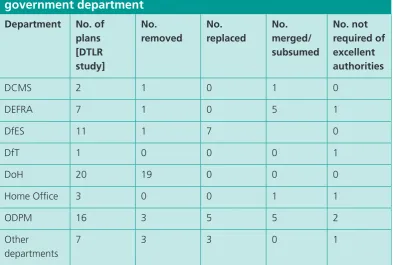
Table 1 (below) summarises the state of play in 2006 regarding the planning requirements of individual central government departments against the 66 plans identified by the DTLR (2002) study. The table sets out the number of plans that have been completely removed as a planning requirement by central government, those than have been replaced by other planning requirements, those that have merged with other plans and the number of plans that are no longer required by excellent authorities24.
Table 1: Progress on plan rationalisation since 2002, by central government department
Department No. of plans [DTLR study]
No. removed
No. replaced
No. merged/ subsumed
No. not required of excellent authorities
DCMS 2 1 0 1 0
DEFRA 7 1 0 5 1
DfES 11 1 7 0
DfT 1 0 0 0 1
DoH 20 19 0 0 0
Home Office 3 0 0 1 1
ODPM 16 3 5 5 2
Other departments
7 3 3 0 1
Table 2 (below) sets out the residual planning burden on local government for excellent and all other authorities, including the new planning
requirements that we have identified. This only includes plans where a separate plan is required. Where provisions have been made that certain plans may be subsumed, these have not been included as a separate burden. For example, Homelessness Strategies may be subsumed within Local
Housing Strategies, and Accessibility Strategies may be subsumed within any other education plan.
Table 2: Remaining planning burden on local authorities, by central government department
Department Excellent authorities All other authorities
DCMS 0 0
DEFRA 0 1
DfES 1 2
DfT 0 1
DoH 1 1
Home Office 1 2
ODPM 5 6
Cabinet Office 1 1
Since the original study, a number of new planning requirements have been introduced, either as a result of changing legislation, or to replace a series of existing plans. These include the Civil Contingencies Plan, the CYPP, and the set of three documents which form the Local Development Framework (which replaced the suite of land use planning documents including local and structure plans as well as plans for minerals and waste).
A key development has been the increasing role of Regional Government Offices within the central-local relationship. The enhanced role of the
regional tier of government takes a number of forms including an increased role in inspection, performance management and monitoring but also encouraging partnership working and providing advice and guidance in relation to a number of policy areas including, for example, Children’s Services and housing and policy areas covered by the Home Office including crime and youth justice.
3.4 Perceptions of plan rationalisation within central
government departments
as the new plan requirements had proved difficult to separate out from the implementation of other aspects of the Children Act.
It appears that at some points a gap has existed between perceptions within central government departments and actual events at a local level in certain policy areas, although some of this delay may have been due to a natural ‘policy lag’ between central government policy development and
implementation at local government level. More generally there was something of a divergence between the dominant central government view – that plan rationalisation is progressing well because of the drastic reduction in the number of plans that authorities are now required to produced and submit to central government – and what is actually
happening on the ground, namely that plans are still being produced even though they are no longer required by central government.
The impact of plan rationalisation has yet to be felt fully at the local level; authorities are not (yet) taking advantage of freedoms from plan production (see below). This is a long-term process. However, there is evidence to suggest that there has been a shift in the relationship between central and local government, although this varies by service area.
3.5 Drivers and barriers to plan rationalisation
The drivers of plan rationalisation are outlined above, in the section on context. Overall, plan rationalisation has been interpreted by central government departments as a need to liberate local government from unnecessary burdens and bureaucracy, thus freeing up resources to focus on frontline services and creating more joined-up working at the local level, and also as a need to ensure that departmental mechanisms fit in with and join up with key developments in the modernisation agenda, for example LAAs.
Levels of enthusiasm for plan rationalisation across central government have clearly been varied, and some departments suggested they had been ‘pushed into’ rationalising plans through the mechanisms put in place by CLG. This reticence is to be expected, given the implications of plan rationalisation in terms of how central government departments work, their changing relationship with local government, and associated shifts in accountability.
Perhaps the most significant barrier remains a perception within departments that the loss of a plan may result in the lowering of the status of that policy area within local government. In the past, plans have been introduced as a means of increasing the profile of a policy area in response to a policy driver or push within central government. This was viewed as a particular issue in departments where plans have been culled and not replaced by other
requirement to produce a plan can be seen as downgrading that area of policy. This is linked to the purpose that plans play locally and nationally and the need to find appropriate alternative mechanisms for prioritising policy areas and monitoring activity. The reduction in the number of statutorily required plans has meant that central government has, arguably, fewer levers available to it to ensure that local authorities pursue central
government priorities. This issue emerges particularly in policy areas that are high on the agenda of central government, but do not fit in neatly with local government service areas.
Where certain areas of policy are very high on the policy agenda, there has been a reluctance to abandon plans as means of ensuring that local
authorities are delivering. For example, this is a pertinent issue in relation to Biodiversity Action Plans, which are non-statutory plans that were introduced as a result of the National Biodiversity Action Plan. The plans have always been viewed as being marginal to local authorities, but are high up the policy agenda of DEFRA. The intention is that the plans are to be subsumed into community strategies. However, there are strong concerns that because of this, biodiversity issues will be downgraded in importance and will be one competing priority amongst many within the community strategy. It was suggested by one interviewee that DEFRA is ‘struggling to find an alternative mechanism for ensuring that local authorities buy in to the national
commitment to ensure bio-diversity’. The lack of prescription of what should be included in a community strategy was an issue of concern to some
departments.
It was also noted that although local authorities often resent attempts by central government to impose priorities, it is also the case that they sometimes lack the confidence to make full use of the freedoms and flexibilities that are offered. This reflects, perhaps, a historic mistrust of central government, a fear that if they do not do the ‘right’ thing they will be penalised.
Through our work with central government departments we have looked for evidence of a change in mindset within central government regarding the role of plans. Whilst it is clear there has been resistance within some
departments regarding the loss of plans, and that there are ongoing and real concerns about the impact of the loss of plans, in general, plan
rationalisation has been accepted as important in terms of reducing the burden on local government and encouraging new ways of working – not just between central and local government, but also between central government departments.
All departments suggested, regardless of how positively they regarded plan rationalisation, that there was a firm presumption against new planning requirements being imposed on local government and this had been taken on board when developing new policy areas, and the majority of
3.6 Summary and implications
In terms of progress within central government departments, there has been a concerted focus on reducing and consolidating the planning requirements on local government. Focusing on the 66 plans identified through the original DTLR study, it appears that planning requirements on local government have been dramatically reduced and that the government’s intention to reduce planning requirements by 75% has been realised. However, it should be noted that this does not take into account the additional returns and reporting requirements that have been imposed on local government as a response to concerns around loss of data by central government.
Responses to plan rationalisation across central government have been variable and there have been varying degrees of reticence about the loss of plans. Interviews with stakeholders identified a number of barriers within central government, and it was clear that whilst potential benefits to local authorities were apparent, there were significant concerns about the impact on plan rationalisation within central government. More positively, there were many instances where rationalisation had resulted in central
government departments working together to positive effect. It has been generally accepted that there is a presumption against the imposition of new planning requirements from the centre, and movement away from the ‘culture of planning’, which represents a major shift in mindset.
More critical, however, is the issue of the impact of plan rationalisation on central government ways of working and the relationship between central and local government. It is clear that it is still early days in terms of assessing the impact of plan rationalisation, as due to the time lag in planning cycles local authorities are only now producing plans in line with new requirements.
There is some evidence of shifts in ways of working within central
government which are consistent with the whole modernisation process. For instance, there were moves, in some policy areas at least, towards the development of shared priorities between central and local government. There is also evidence of the development of new ways of working in relation to monitoring local government activity, performance management and inspection, through for example developing new BVPIs, new inspection regimes, working through RGOs or through an emphasis on local scrutiny.
government. The evidence below appears to point to the appreciation by local authorities of some central government departments however, saw plan rationalisation as a ‘one off’ activity; the removal by the department of the requirement to produce a particular plan has meant that for them plan rationalisation has been accomplished, whether or not local authorities are still producing plans locally.
Finally, there was some evidence of a changing relationship between central and local government, although this is hard to isolate as being as a result of the reduction in planning obligations, in relation to the wider changes that are taking place as part of the modernisation process. This is characterised by a more differentiated relationship between central and local levels, with greater emphasis on partnership working, as well as an enhanced role for regional government in terms of monitoring and performance management.
A number of issues emerge from these findings in terms of policy development:
Because of a natural policy lag, and also the long-term nature of the some
•
of the planning cycles in local government, the impact of plan rationalisation is only beginning to be felt in central and local
government. This is in terms of the loss of information, loss of levers and means of performance managing by central government, and at the local government level in terms of reducing level of bureaucracy and the freedom to plan to different and perhaps more locally relevant ways. This sets the context for any longer term evaluations of plan rationalisation.
Discussions with central government stakeholders highlight the
•
importance of LAAs in changing the relationship between central and local government in some policy areas. To some degree it is felt that plan rationalisation has been ‘done’ in central government, and LAAs are very much seen as the new and emerging policy area that they need to get to grips with and which are likely to impact most on central-local relations.
There is some evidence to suggest that plan rationalisation is having a
•
limited impact within local government, with relatively few authorities taking up some of the newer powers particularly in terms of performance based flexibilities. These findings, and also evidence from elements of the evaluation with local government, points to a lack of awareness of plan rationalisation within local government. There may need to be further clarification of the varying requirements from different central
Whilst there is evidence of a change in mindset in terms of planning, and
•
a general presumption against the requirement to produce further plans, it should be ensured that this message continues to be reinforced within central government. There may be a tendency for departments to try and introduce planning requirements or other mechanisms for information gathering ‘through the back door’.
Overall, perceptions of progress with plan rationalisation at the local level have varied across central government departments reflecting, perhaps, the different purposes and priorities that central government departments attach to plan rationalisation. There has been something of a divergence between the dominant central government view - that plan rationalisation was
progressing well because of the drastic reduction in the number of plans that authorities were now required to produce and submit to central government – and what is actually happening on the ground, namely that plans are still being produced even though they are no longer required by central
4 Progress in local
government
4.1 Introduction
The initial survey and case study work carried out as part of the evaluation in 2004 suggested that progress with plan rationalisation in local authorities was patchy and limited. Whilst progress has continued to be somewhat variable, the later case study and survey work (2006) showed indications of a more corporate approach to plan rationalisation within local government. Plan rationalisation is increasingly seen within the context of wider
developments, such as the roll out of LAAs.
This section addresses progress regarding plan rationalisation in local government, followed by a discussion of the relationship between plan rationalisation, sustainable community strategies, and LAAs. We then summarise local government perspectives on plan rationalisation. Lastly, we discuss drivers and barriers to plan rationalisation at the local level.
4.2 Progress on plan rationalisation
Evidence from the first survey and the case study work (2004) indicated that while general awareness of plan rationalisation at the local level was
relatively high, understanding was at best variable across authorities and at worst quite low. While many officers clearly thought that plan rationalisation was a ‘good thing’, exactly what they understood by that phrase was highly variable. For example, few officers explicitly linked plan rationalisation to the broader local government modernisation agenda; rather the two processes were seen as running in parallel.
At the local level progress has been generally uneven, although it is important to stress that the fieldwork was undertaken at an early stage in relation to the rationalisation process. In some cases, plans were being allowed to run their course before being phased out or merged with others. Nevertheless, as was noted above, relatively few authorities had, at that time, developed a strategic approach to plan rationalisation (14% according to the survey) or accorded it much priority locally. Typically plan
plans had been linked to or combined with the community strategy. The lack of coordination is also evidenced by the fact that almost half of all
authorities were unable to respond to a question in the survey asking which service areas had made the most progress on plan rationalisation.
However, there were exceptions to this uncoordinated approach. For
example, in one authority a corporate approach was adopted which involved an audit of existing plans – both statutory and non-statutory. Taking account of central government guidance, decisions were then taken as to whether plans should be maintained, phased out or integrated with other plans. As a result of this exercise, 21 plans remained. This highlights the fact that even in authorities where there is a conscious and strategic approach to plan
rationalisation it is difficult for authorities to reduce the number of plans purely to those required by central government25.
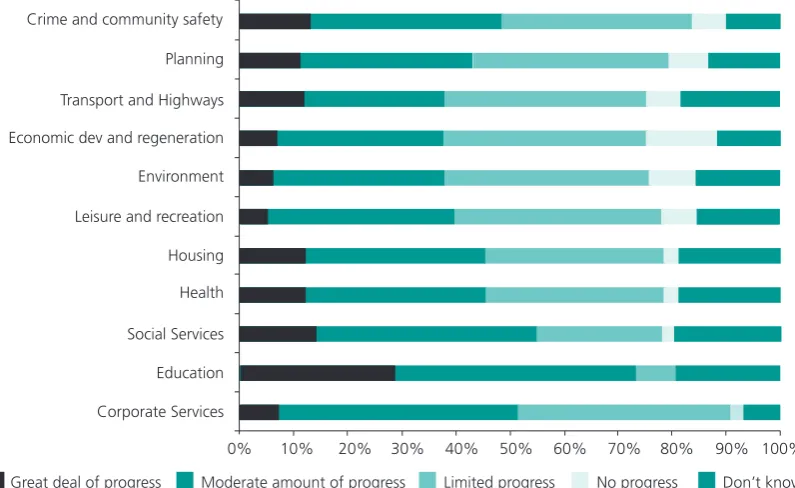
In the second of our surveys (2006), respondents were asked about the overall progress that had been made in their authority in relation to plan rationalisation. Overall 43% of respondents said that limited progress had been made on reducing the number of plans in their authority during the previous 12 months, and 42% said that a moderate amount of progress had been made. There were no significant differences between types of authority or between excellent and non-excellent authorities. The key findings from the 2006 survey include the following:
Although relatively few authorities had a coordinated approach to plan
•
rationalisation, over 50% said that their approach was being led from the corporate centre. It was also clear from statements made by respondents that plan rationalisation was beginning to be recognised as a task that needed to be undertaken. Responsibility for this task was increasingly being assigned to a lead officer.
In terms of progress on plan rationalisation, 43% of respondents said that
•
limited progress had been made on plan rationalisation over the past 12 months, while 42% said that moderate progress had been made.
Around two thirds of all respondents linked the process of reducing the
•
number of plans to the development and implementation of the community strategy – an increase from 36% in 2004.
Progress within individual service areas was explored through the survey.
•
Education was the service area in which respondents were most likely to say that ‘a great deal of progress’ had been made during the past 12 months. Excellent authorities were significantly more likely to say they had made progress in relation to education.
Although excellent authorities are exempt from the requirement to
•
produce certain plans produced by other authorities, this freedom has had relatively little impact so far with most excellent authorities continuing to produce numerous plans and stating that they were unlikely to stop producing them in the future.
Where plans continue to be produced locally despite there being no
•
central government requirement to do so, this is typically because they serve a useful purpose in terms of local planning or internal monitoring. This applies to both performance-based freedoms for excellent authorities and to plans that are no longer required of any authority.
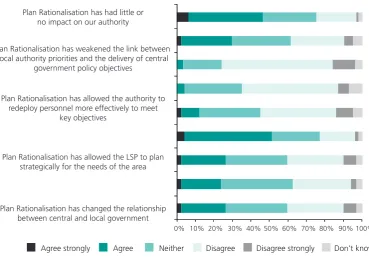
The impact of plan rationalisation is only slowly becoming apparent; just
•
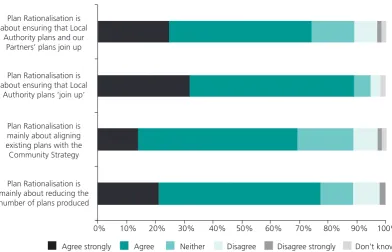
under half of all respondents said that plan rationalisation had had little or no impact on their authority. More positively, just over 51% of
respondents thought that plan rationalisation was a key component in the creation of integrated services.
There is little evidence to suggest that plan rationalisation has weakened
•
the link between local authority priorities and the delivery of central government objectives, with 71% disagreeing or disagreeing strongly with that statement. Equally, there is also little evidence to suggest that plan rationalisation has had, or is likely to have an impact on the
relationship between central and local government.26
In addition ‘moderate’ or a ‘great deal of’ progress was also evident in
•
around 50% of cases in relation to Corporate Services and Crime and Community Safety.
Government guidance on plan rationalisation states that a number of
•
plans may be integrated into the community strategy. Of these plans we found that:
70% of respondents still produce a Supporting People Strategy.
–
53% of respondents still produce a Local Cultural Strategy.
–
41% of respondents still produce a Biodiversity Action Plan.
–
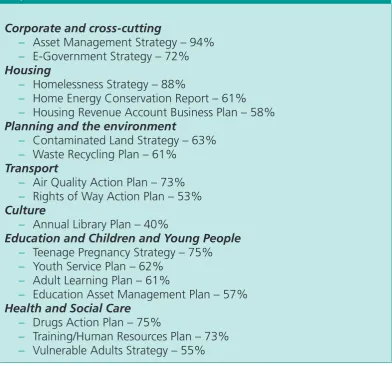
Other plans that are still being produced by more than 50% of authorities that responded to the survey (although they are no longer required by central government) are detailed in the table below:
26 Darlow, A., Fidler, Y., Percy-Smith, J. and Wymer, P. (2006) Process Evaluation of Plan Rationalisation; Formative Evaluation of Community Strategies. Report of the May 2006 Survey of Local Authorities on Plan
Table 3: Plans being produced in addition to central government requirements (2006)
Corporate and cross-cutting
Asset Management Strategy – 94%
–
E-Government Strategy – 72%
–
Housing
Homelessness Strategy – 88%
–
Home Energy Conservation Report – 61%
–
Housing Revenue Account Business Plan – 58%
–
Planning and the environment
Contaminated Land Strategy – 63%
–
Waste Recycling Plan – 61%
–
Transport
Air Quality Action Plan – 73%
–
Rights of Way Action Plan – 53%
–
Culture
Annual Library Plan – 40%
–
Education and Children and Young People
Teenage Pregnancy Strategy – 75%
–
Youth Service Plan – 62%
–
Adult Learning Plan – 61%
–
Education Asset Management Plan – 57%
–
Health and Social Care
Drugs Action Plan – 75%
–
Training/Human Resources Plan – 73%
–
Vulnerable Adults Strategy – 55%
–
In the final round of case studies carried out as part of the evaluation, it became apparent that the plan rationalisation process is an ongoing one. Local authorities are at different stages with plan rationalisation, depending largely on whether they had been granted the freedoms associated with excellent CPA status. Progress was also uneven within the case study authorities, with awareness of and engagement in plan rationalisation varying considerably. Although overall there did seem to be some reduction in plans, there was little or no impact in some service areas in some localities. It was clear from the research findings that the authorities continued to meet their statutory obligations to produce plans, and that beyond this some authorities were taking advantage of the streamlined requirements for plans within some services. The need for plans as part of strategic planning and operationalisation, which was identified in previous research in the case study localities remained a common theme.
Thus the final case studies indicated that plan rationalisation is impacting to a degree in terms of streamlining plans and services. For example, in one unitary authority, contributors discussed the way in which the development of the LAA and associated attempts to steer away from duplication was encouraging officers to focus upon planning. This was felt to be having some effect; for instance the Children’s Services Plan had been aligned with the corresponding LAA block. The value of plan rationalisation in
contributing to releasing resources to allocate to priority areas elsewhere was well recognised by most. Respondents acknowledged that there was a need to produce relevant and robust plans, while actions (such as that discussed above) to integrate and rationalise plans were seen as ‘desirable and potentially beneficial’ (local authority respondent).
In some localities authorities continued to build on the progress that had been made in previous years. For example, as reported last year in a further unitary, the Council had devolved responsibility for responding to the flexibilities offered under the plan rationalisation process to each individual service area. However, progress on plan rationalisation was in some cases due to other factors. For instance, in one authority it was felt that progress in 2005/6 on plan rationalisation had been achieved partly because policy officers had been ‘far too busy (with the LAA process) to write plans’. It is more likely, as the same respondent confirmed, that this move away from generic plan-making reflects a shift in emphasis from ‘fund-chasing’ plans (for example to secure RDA funds such as the Market and Costal Towns Initiative, Rural & Urban Renaissance Funds and so on) to ‘broad topic’ plans (such as the Local Transport, Community Safety and CYPPs). This has
resulted in a more streamlined corporate planning process, with fewer single-issue plans being required overall.
agencies and with the public) about what exactly is meant by a ‘single point of entry’.
From the findings of the final round of case studies, it appeared that plan rationalisation may have decreased in perceived importance at a local level. Local authority players were busily engaged in planning concerning the LAAs and LDFs (see below), and whilst the ‘joining up’ element of plan
rationalisation continued to be central, it was not necessarily termed ‘plan rationalisation’27.
4.3 Relationship between plan rationalisation,
community strategies and LAAs
One issue that has become increasingly pertinent concerns the coordination of LAAs, sustainable community strategies, and Local Development
Frameworks (LDFs) and other planning developments. Authorities varied concerning the cohesiveness of planning processes and the possibility to which it was possible to rationalise these. The future challenge of Multi-Area Agreements was mentioned in a minority of cases.
In the 2006 case studies, authorities showed considerable diversity around the extent to which they were coordinating LAAs, community strategies, and other plans in a way that supported plan rationalisation. Some appeared to be organised and cohesive in their approach; for instance, in one unitary authority there are clear linkages between the Council’s revised approach to planning (i.e. reflecting the plan rationalisation agenda) and the planning processes set in place by the LSP to oversee the development and
implementation of the LAA and community strategy. Further good practice was apparent in some localities. For example, in one authority work
undertaken over the past twelve months in developing an Integrated Housing Strategy was cited by several respondents as an example of good practice highlighting how the Council and its partners had worked together effectively to identify and devise plans to address joint priorities within a more streamlined planning process. This revised strategy has provided the basis of the work behind the generation of the Economic Development and Stronger Communities blocks and the Housing Key Partnership will operate as the Outcome Body charged with overseeing the housing elements that cut across these different LAA blocks.
Despite such evidence of progress regarding plan rationalisation, it was clear that all authorities were experiencing difficulties in coordinating the different plans and mechanisms, even in authorities where progress had been made and a more proactive approach was being adopted. This emerged
particularly in relation to certain policy areas.
The arrangement of (some) LAAs around four blocks raised concerns in terms of the impact on those strategies, policy areas and priorities which
were addressed within the community strategy but which did not have a clear ‘home’ within the four blocks. For instance, specific issues were raised in relation to culture and it was suggested that closer alignment with the LAA could impact adversely on that strategy: ‘if there is a greater move to only four blocks then the implication is you only need four strategies and that would be a threat to culture’ (local government officer). In addition, a lack of a focus on culture through the LAA process would mean that there would be a reduction in the need to collect data fo