THE RELATIONSHIP BETWEEN STUDENTS’ SELF
ASSESSMENT AND THEIR ACTUAL PERFORMANCE OF
ENGLISH DEPARTMENT STUDENTS
(A Thesis)
By
NERY EKA PRATIWI
MASTER IN ENGLISH LANGUAGE TEACHING STUDY PROGRAM LANGUAGE AND ARTS EDUCATION DEPARTMENT
TEACHER TRAINING AND EDUCATION FACULTY LAMPUNG UNIVERSITY
ABSTRACT
THE RELATIONSHIP BETWEEN STUDENTS’ SELF ASSESSMENT OF COMMUNICATIVE COMPETENCE AND THEIR ACTUAL PERFORMANCE OF ENGLISH DEPARTMENT STUDENTS
By
Nery Eka Pratiwi
The aims of the present research are i) to find out whether there is significant correlation between students’ self assessment of communicative competence and their actual performance, ii) to explore the influence of length of language learning toward students’ self assessment and iii) to find out whether there is significant difference across the students’ performance achievement in terms of length of language learning. To achieve the aims of the study, the research was conducted by modifying self assessment questionnaire consisting 40 items of communicative competence criteria and assessing the students’ performance by using several performance tests. The subjects of the research were 72 English Department students of Lampung University (16 freshmen, 31 sophomore, and 25 juniors). The collected data of self assessment questionnaire and performance scores were correlated by using Pearson Product Moment; then the data also have been analyzed by using one way ANOVA to cover the second and the third aims of the research.
The results reveal that there is significant correlation between students’ self assessment of communicative competence and their actual performance (p < 0.05) at significant level. Though, the size of correlations of students’ self assessment of communicative competence and their speaking performance score is still low (0.256). Concerning the second and the third aims of the research, it was found that there is significant difference between students’ length of language learning toward their self assessment and there is significant difference means of students’ performance scores among the groups of the difference years of the study.
Based on the findings, it can be concluded that there is still a gap between students’ self assessment and teacher judgement. The students are not confidence to judge theirself so they need more experience in assessing their quality especially in their speaking performance. Moreover, students need time to acquire English competences in order to make they are ready to have a good performance. Keywords: Students’ Self Assessment, Communicative Competence, Students’
THE RELATIONSHIP BETWEEN STUDENTS’ SELF
ASSESSMENT AND THEIR ACTUAL PERFORMANCE OF
ENGLISH DEPARTMENT STUDENTS
By
NERY EKA PRATIWI
A Thesis
Submitted in a partial fulfillment of The requirements for S-2 Degree
MASTER IN ENGLISH LANGUAGE TEACHING STUDY PROGRAM LANGUAGE AND ARTS EDUCATION DEPARTMENT
TEACHER TRAINING AND EDUCATION FACULTY LAMPUNG UNIVERSITY
CURRICULUM VITAE
Nery Eka Pratiwi was born in Tanjung Karang on January 27, 1988. She is the first daughter of two daughters from Mr. and Mrs. Yaya. In 2013, she got married with a great man named Ferizal Atmajaya. Now she has a two-year daughter and a future baby boy soon.
She had her first formal education in SDN 2 Tanjung Gading. She continued her study in SMPN 1 Bandarlampung then she went to SMAN 9 Bandarlampung. After she graduated from senior high school, she continued her bachelor to Indonesia University of Education (UPI) Bandung majoring English Education Department. In 2015, she took her master degree in Master Program of English Education at Lampung University and finished in 2017.
DEDICATION
Education is an admirable thing, but it is well to remember from time to time that nothing that is worth knowing can be taught
ACKNOWLEDGEMENTS
Alhamdulillahirabillalamin. Praise merely for Allah SWT, The Most
Gracious and The Most Merciful, who gives me all the best in this life. This paper is based on the research entitled: The Relationship between Students’ Self Assessment and Their Actual Performance of English Department Students. The paper was presented to fulfill one of the requirements in accomplishing the S-2 degree at the Department of Language and Arts of Teacher Training and Education Faculty, University of Lampung.
In the writing process of the study, the writer got supports, advices, and encouragement from many people. Therefore, I would like to extend my deepest gratitude to:
1. Hery Yufrizal, Ph.D., as my first advisor, for his sincere patience, assistance and valuable guidance in correcting and checking my paper until I can completely finish this paper.
2. Dr. Muhammad Sukirlan, M.A., as my second advisor, for his sincere
patience, guidance, and revision in the writing process during the completion of this paper.
3. Mahpul, Ph.D. and Prof. Dr. Cucu Sutarsyah, M.A, as the examiners for your encouragements, contributions, and suggestions for the betterment of the paper.
4. Dr. Flora, M.Pd., as the Chief of Master Program of English Education, for her encouragement, suggestion, and guidance.
5. Dr. Ari Nurweni, M.A., as the head of English Department Study Program for giving me chance to conduct and manage the time of this research.
6. All MPBI lecturers for teaching me valuable lessons and subjects.
8. My beloved Husband, Abang Ijal who always gives me the best prayer and supports when I wanted to give up. My beloved daughter, Syifa, you are my motivation and mood booster to struggle in finishing my study. Your smile and kiss means a lot dear. I love you both forever!
9. My beloved Mom and Dad, Yaya and Lin Karmina who always give the best prayer for their first daughter. Thank you for your help in any kinds of prayer, spirit, and motivation. My beloved mother-in-law, Djarniati, for your prayer and understanding. My beloved sister, Dliya and Sister in Law, Lisa and Berta, for your caring and motivating.
10. The students of S-1 English Education at Lampung University who are the subjects of the study. You all take big role, thank you.
11. All my friends in the 3rdBatch of MPBI Unila, especially all my classmates, Class-B, for your supporting and encouraging me.
Last but not least, I hope this script will give a positive contribution to education
development and be useful to the readers and for the further researchers.
Bandarlampung, July 2017
The writer,
vii
TABLE OF CONTENT
ABSTRACT ... i
STATEMENT OF AUTHORIZATION ... ii
CURRICULUM VITAE ... iii
DEDICATION ... iv
MOTTO ... v
ACKNOWLDGEMENTS ... vi
TABLE OF CONTENT ... vii
LIST OF FIGURES ... x
LIST OF TABLES AND CHARTS ... xi
LIST OF APPENDICES ... xiii
I. INTRODUCTION 1.1 Background ... 1
1.2 Research Questions ... 7
1.3 The Objectives ... 8
1.4 The Significance... 9
1.5 The Scope ... 9
1.6 Definition of the Terms ... 10
II. LITERATURE REVIEW 2.1 Definition of Communicative Competence ... 11
2.2 Types of Communicative Competence ... 13
2.2.1 Linguistic Competence... 13
2.2.2 Sociolinguistic Competence ... 14
2.2.3 Discourse Competence ... 15
2.2.4 Strategic Competence... 15
2.3 Swain and Canale’s Model... 15
2.4 Celce-Murcia’s Model ... 19
viii
2.5.1 Performance-oriented self-assessment ... 28
2.5.2 Development-oriented Self-assessment ... 29
2.5.3 Advantage of Self Assessment ... 30
2.6 Actual Performance ... 31
2.6.1 Definition of Performance... 31
2.6.2 A Theory of Linguistic Performance ... 32
2.6.3 Performance as a Reflection of Competence ... 33
2.7 Students’ Productive Skill in Communicative Competence ... 33
2.8 Theoritical Assumption ... 34
2.9 Previous Research ... 35
2.10 Hypothesis ... 37
III. RESEARCH METHODOLOGY 3.1 Research Design ... 39
3.2 Variables ... 39
3.3 Source of the Data ... 39
3.4 Data Collecting Procedures ... 40
3.5 Subjects of the Research ... 41
3.6 Instruments ... 41
3.6.1 The Self Appraisal Questionnaire of Communicative Competence ... 42
3.6.2 Students’ Actual Performance Test ... 43
3.6.2.1 Speaking test in the form of Role Play... 43
3.6.2.2 Writing Argumentative Test ... 44
3.6.2.3 Structure and Vocabulary ... 44
3.6.2.4 Pronounciation Test ... 44
3.7 Time Allocation ... 45
3.8 Validity Test ... 46
3.8.1 Validity test of Students’ self appraisal questionnaire ... 46
3.8.2 Validity Test of Performance Test ... 46
3.9 Reliability Test ... 47
3.9.1 Reliability Test of Self Appraisal Questionnaire ... 47
3.9.2 Reliability of Performance Test ... 48
3.10 Hypothesis Testing ... 48
3.11 Data Analysis ... 49
3.11.1 Data Analysis of the Correlation between the score of Questionnaire and score of performance test... 49
3.11.2 Data Analysis of the Questionnaire... 50
ix
IV FINDINGS AND DISCUSSION
4.1 The Correlations between Students’ Self Assessment of Each Sub
communicative competence and their actual performance ... 52
4.1.1 The Correlations between Students’ Self Assessments of Linguistic competence and their actual performance... 55
4.1.2. The Correlations between Students’ Self Assessment of Sociolinguistic Competence and their actual performance ... 58
4.1.3. The Correlations between Students’ Self Assessment of Discourse competence and their actual performance ... 61
4.1.4. The Correlations between Students’ Self Assessment of Strategy competence and their actual performance ... 63
4.2. The Influence of Students’ Length of Language learning toward their Self Assessement ... 66
4.3. The Result of Actual Performance Tests ... 69
4.3.1. The Result of the Students’ Performance in the form of Role Play ... 69
4.3.2. The Result of the Students’ Performance in the form of Argumentative Essay ... 70
4.3.3. The Result of the Students’ Structure and Performance ... 71
4.3.4. The Result of the Students’ Pronounciation Test ... 72
4.4 Discussion ... 75
4.4.1 The Correlation between Students’ Self Assessment of Communicative Competence and Their Performance ... 75
4.4.2 The Influence of Students’ Length of Language Learning toward Their Self Assessment ... 78
4.4.3 Students’ Actual Performance in terms of the Length of Language Learning ... 80
V. CONCLUSIONS AND SUGGESTIONS 5.1 Conclusions ... 82
5.2 Suggestions ... 85
x
LIST OF FIGURES
Figure 2.1 Communicative Competence Model by Swain and Canale ... 17
xi
LIST OF TABLES AND CHARTS
Table 2.1 The Communicative Competence Focus Area toward Language
Skill ... 18
Table 2.2 Table of Specification of Communicative Competence Elements of Cerce-Murcia’s Model ... 21
Table 3.1 Specification of the Number of Questionnaire Items Regarding To Communicative Competence Categories ... 43
Table 3.2 The Schedule of Research Time Allocation ... 45
Table 3.3 The Guideline for Describing Alpha Value ... 47
Table 3.4 The Correlation Interval Value... 50
Table 4.1 Descriptive Statistics of Students’ Self Assessment of Four Communicative Competences ... 54
Table 4.2 The Correlation between Students’ Self Assessment of Linguistic Competence and their Performance ... 55
Table 4.3 The Correlation between Students’ Self Appraisal of Sociolinguistic Competence and their Performance ... 58
Table 4.4 The Correlation between Students’ Self Assessment of Discourse Competence and their Performance ... 61
Table 4.5 The Correlation between Students’ Self Assessment of Strategic Competence and their Each Performance ... 64
Table 4.6 Descriptive Statistics of Students’ Self Assessment of Communicative Competence According to the Years of Study. ... 67
xii
Table 4.8 The Means Score of Speaking Performance Regarding to the Length of Language Learning... 70
Table 4.9 The Means Score of Writing Performance Regarding to the Length of Language Learning... 71
Table 4.10 The Means Score of Structure and Vocabulary Performance
Regarding to the Length of Language Learning ... 72
Table 4.11 The Means Score of Pronounciation Performance Regarding to the Length of Language Learning ... 73
Table 4.12 The Significant Difference among the Groups in terms of Length of Language Learning... 75
xiii
LIST OF APPENDICES
Appendix 1 Research Instrument I: Self Assessment Questionnaire of
Communicative Competence
Appendix 2 Research Instrument II: Role Play
Appendix 3 Research Instrument III: Writing Argumentative Essay Test
Appendix 4 Research Instrument IV: Vocabulary and Structure Test
Appendix 5 Research Instrument V: Pronounciation Test
Appendix 6 Scoring for Speaking and Writing Test
Appendix 7 Students’ Self Assessment Questionnaire
Appendix 8 Students’ Writing Argumentative Essay
Appendix 9 Students’ Vocabulary and Structure Test
Appendix 10 Pearson Correlation between rater I and rater II in Speaking and
Writing Performance Test
Appendix 11 Data of Reliability Test for Self Assessment Questionnaire
Appendix 12 Normal Distribution Test of All Performances Test
Appendix 13 Surat Izin Penelitian
I. INTRODUCTION
This introductory chapter of the paper presents the background of the study, research questions, scope of the study, and the aims of the study. It also covers the brief overview of the significance of the study, the definition of some special terms and an outline of organization of the paper.
1.1 Background
2
In addition, among the awareness and many skills required for competence at formal schools even in the university, communicative competence is crucial (Yufrizal, 2016; Al Alami, 2014). One needs to be able to communicate effectively and appropriately in a language other than one’s own in the given occasion. Language teaching in the ESL countries is based on an idea that the goal of language acquisition is communicative competence in which the ability to use the language correctly and appropriately to accomplish communication goals.
The desired outcome of the language learning process is the ability to communicate competently, not the ability to use the language exactly as a native speaker does. Therefore, it would be ideal if we use communicative competence (the ability to use English for oral and written communication) categories as the final objective of learning English.
The term communicative competence has been discussed in several studies (Swain and Canale, 1983; Savignon, 1992; Larsari, 2011; see Yufrizal, 2016). Other investigators use the term to represent an overall framework from which to study aspects of communicative behavior across various communicative levels. Other, like Canale and Swain (1986) identified four components of communicative competence. They are grammatical competence, sociolinguistic competence, discourse competence and strategic competence.
3
communication partners due to socially inappropriate style, and to use strategies for recognizing and managing communication breakdowns.
However, Taha & Reishaan (2008) state that the competence cannot be separated with the performance. They believe that by studying competence subject sheds the lights on the mental phenomenon called language meanwhile the performance is the reflection on the hard tasks of grammarian to provide various aspects of language in the form of the nature of the language processing. Clark and Clark (1977: 6) state that Chomsky distinguishes between linguistic competence, one’s capacity to use language, and performance to be the actual application in the form of productive skills such as speaking and writing. In the middle of the 20th century, language can best be studied according to speech and writing. These two activities represent for the actual measurable performance.
Respecting to the students’ productive skills performance (language learning) in Indonesia, actually English has become part of students’ everyday activities since English is officially taught from junior high school. Unfortunately, although many students communicate more in English, they still cannot find out how well they are able to communicate in English despite their length of studies at formal school.
4
is normally in a form of a report resulted from evaluator judgments. However, learner-center pedagogy allows students to take part in assessing their quality of performance using self assessment.
In Indonesian context, it is not familiar for students or teachers to get the use of students’ self assessment. By using self assessment, the students appraise their work individually in which it requires higher level thinking. Also, the student has opportunities for feedback and revision during the task for example by responding to discrepancies betweenstudents’judgment and teacher judgment.
Many language testers have been inspired to investigate whether students are able to make a meaningful contribution to their own evaluation (Bachman, 2000; Hamayan, 1995). The current trends in learner-centered language teaching approaches, and a growing interest in authenticity and interactiveness (Bachman & Palmer, 1996) have led to a greater interest in expanding the use of second language self-assessment. Mahmoodi & Shahrebabaki (2014) note that students self assessment can play a crucial role in helping learners become more dedicated and motivated.
5
scored significantly higher than those who did not. They discussed the use of self assessment checklist in order to make English language learners self directed.
Another notable example of the use of self assessment is the experiment which was conducted in new students in undergraduate second language programs. They were asked to rate their receptive skills in their target language using a self-assessment questionnaire prior to taking standardized proficiency tests. High correlations were obtained between the two kinds of measure after modifying the questionnaire content so it was relevant to the students’ experience (LeBlanc and Painchand, 1985 cited in Ito, Kawaguchi, and Ohta 2005). Their modifying self assessment questionnaire, then, become the sequence of experiments on validity of self assessment measure by using the self assessment questionnaire as a placement test at the University of Ottawa.
Ito, Kawaguchi, and Ohta (2005) have conducted the study on the relationship between TOEIC score and self assessment toward functional job Performance. They found that there is substantial relationship between TOEIC scores and the scores of functional job activities in the self assessment questionnaire. It was also found that there are correlations between each sub-test of the TOEIC and each part of self-ratings. Their study gave the meaningful ways for company to design a checklist that would permit the users to interpret TOEIC score.
6
design and confirmatory factor analysis, they investigated three language traits like grammar, pragmatic, and sociolinguistic competence. The result indicates that difficulty questions inquiring about subjects’ perceived difficulty are more effective than ability questions. They conclude that self-ratings can be reliable and valid measures of communicative language abilities.
Even the use of self assessment is clear enough, but still there is the problem in which there is discrepancybetween students’judgment of the levels of competence self-perceived and their performance. Students who are not self confidence to assess their level of competence or underestimate their skill sometimes they are good in their performance or vise versa.
Considering the ability to make an assessment, there are factors affecting the convergence of self assessment and task performance such as gender differences, proficiency, age, learning experience, cultural environment and other training experience. How about students in university? Particularly English department students who will be future English teachers. As pre-service teacher, they are expected to have good performance whether in language learning or in assessment part.
7
themselves. Based on the important of communicative competence, the use of self assessment and the study of students’ language performance, the current research tries to investigate students’ self assessment of communicative competence which has not been investigated before then correlate the result with the students’ actual performance. The second intention is how university students appraise themselves in terms of length of language learning. The last is to find out the level of achievement of students’ actual performance based on the length of language learning.
1.2 Research Questions
Based on the explanation about the issues of students’ self assessment of communicative competence and their performance, there are several questions which have to be answered in this research;
1. Is there any significant correlation between students’ self assessment of communicative competence and their actual performance?
a. Is there any significant correlation between students’ self assessment of linguistic competence and their actual performance?
b. Is there any significant correlation between students’ self assessment of sociolinguistic competence and their actual performance?
c. Is there any significant correlation between students’ self assessment of discourse competence and their actual performance?
8
2. Is there any significant influence of students’ length of language learning toward their self assessment of communicative competences?
3. What is the level ofstudents’ actual performance achievement in terms of the length of language learning?
1.3 The Objectives
In this research, some objectives to be obtained;
1. To find out whether there is signifcant correlation between students’ self assessment and their actual performance or not.
a. To find out whether there is any significant correlation between students’ self assessment of linguistic competence and their actual performance?
b. To find out whether there is any significant correlation between students’ self assessment of sociolinguistic competence and their actual performance?
c. To find out whether there is any significant correlation between students’ self assessment of discourse competence and their actual performance?
d. To find out whether there is any significant correlation between students’ self assessment of strategic competence and their actual performance?
9
3. To find out the level ofstudents’ actual performancein terms of the length of language learning.
1.4. The Siginificance
The results of the research are expected to give some positive impacts both to the reader and the writer about communicative competence issues that might be encountered instudents’ performance. The results are expected:
1. To give contribution and valuable information to the development of self assessment research.
2. To give valuable information to practitioner or university teachers to find out the ability of university students in assessing their ability of communicative competence in order to improve the process of EFL teaching and learning to the actual performance.
3. To provide information of the use of students’ selfassessment so the students will notice their language ability especially when they are assessed.
4. To provide information about the extent of students’ university achievement toward their the length of language learning
5. To be a reference for further research.
1.5. The Scope
10
In this research, the students’ self assessment is in the form of questionnaire including communicative competence categories while some performance tests are used to get the students’ achievement of students’ performance. The study was focused on the result of questionnaire and performances score. After all the data obtained, the research then analyzed the result and answered the research questions.
1.6. Definition of Terms
To keep away from the possibility of misunderstanding the investigated problem, the writer clarified the term used in this research:
1. “Students’ Self-Assessment” is the involvement of students in identifying standards and/or criteria to apply their work and making judgments about the extent to which they met these criteria and standards. (Boud, 1986)
2. “Communicative Competence” is the speaker’s ability to produce and understand which are appropriate to the context in which they occur, what the speaker really needs to know in order to communicate effectively in socially distinctive setting. (Taha & Raishaan, 2008)
II. LITERATURE REVIEW
This chapter consists of theoretical framework of this study. There are several theories related to three main areas in this study namely communicative competence, self aassessment, and actual performance. In communicative competence, the theories consist of definition, types, and linguists’ theory of its model. In self assessment, the theories consist of definition and kinds of self-assessment. Actual performance part discusses the definition and types of actual performance conducted by students. The last, this chapter ends with the theoretical assumption and hypothesis.
2.1 Definition of Communicative Competence
12
competence called linguistic competence. Since Chomsky’s (1965) distinction between competence and performance in terms of linguistic knowledge and Hymes’ first use of the term communicative competence, various definitions have been given.
According to Yule (1996), communicative competence can be defined in terms of three components: (1) grammatical competence, (2) sociolinguistics competence and (3) strategic competence. Yufrizal (2007) reporting the characteristics of communicative as what Savignon (1983) outlines:
1) Communicative competence is a dynamic rather than a static concept that depends on the negotiation of the meaning between two or more persons who share some knowledge of the language. In this sense, communicative competence can be said to be an interpersonal rather than an intrapersonal trait (p8)
2) Communicative competence should not be thought of as only an oral phenomenon. It applies to both written and spoken language.
3) Communicative competence is context-specific, in that communication always takes place in a particular context or situation. The communicatively competence language user will know how to make appropriate choices in register and style to fit the particular situation in communication occurs.
13
and it is only through performance that competence can be developed, maintained, and evaluated.
5) Communicative competence is relative and it depends on the cooperation of all those involved. It makes sense, then, to speak of degrees of communicative competence.
2.2. Types of Communicative Competence
Communicative competence is used to refer to the ability not only to apply the grammatical rules of a language in order to form correct utterances, but also to know when to use these utterances appropriately (Taha & Raishaan, 2008). The successful language use for communication presupposes the development of communicative competence in the users of that language and that the use of language is constrained by the socio-culture norms of the society where the language is used. Some experts define types of communicative competence as follows.
2.2.1 Linguistic Competence
14
2.2.2 Sociolinguistic Competence
One of Hymes (1972) contributions to the study of the competence is the notion of sociolinguistic appropriateness where he distinguishes between what is possible, what is feasible, what is appropriate, and what is actually done in the use of communicative competence. Swain (1984) in Taha and Raishan (2000) states that sociolinguistic competence addresses the extent to which utterances are produced and understood appropriately in different sociolinguistic contexts, depending on contextual factors such as topic, status of participants, and purposes of the interactions. Appropriateness of utterances refers to both appropriateness of meaning and appropriateness of form. This appropriateness could vary in accordance with the status of participants, objectives of the communication and norms of the communication.
2.2.3 Discourse Competence
Canale and Swain (1980) do not use the term, discourse competence, but they included the notion of cohesion and coherence in sociolinguistic competence. Yoshida (2003), discourse competence refers to mastery of the way grammatical forms and meanings are combined to develop consistent and meaningful texts, how texts are developed as a result of the combination of grammar and meaning. That is why it is sometimes called textual competence.
15
situational context. Thus, when a text is consistent internally, it is cohesive; when it is consistent with its context, it is coherent.
2.2.3 Strategic Competence
Strategic competence is verbal and non verbal communication strategies that may be called into action to compensate for breakdowns in communication due to performance variables or to insufficient competence (Canale and Swain, 1980). They later extended the definition of strategic competence as:
a. to compensate for breakdowns in communication due to insufficient competence or to performance limitations and
b. to enhance the rhetorical effect of utterances
Strategic competence includes all the individual procedures, whether conscious and unconscious or verbal and non verbal, used to solve the problems found during the translation process. The problem-solving process can be described as a series of acts or recursive, complex acts that lead from an initial state to an objective. Examples of strategies are: distinguishing between main and secondary ideas, establishing conceptual relationships, searching for information, paraphrasing, back translating, translating out loud, and establishing an order for documentation, etc.
2.3 Swain andCanale’s Model
16
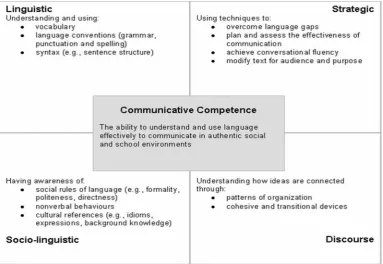
out during the teaching and learning processes. The communicative competencies consist of: a) grammatical competence, b) sociolinguistic competence, c) discourse competence, d) strategic competence.
1. The competency of grammatical competence consists of five tasks: a) spelling alphabets/letters and numbers, and pronouncing English sounds; b) understanding main words and functional words; c) understanding the rules of noun phrases & constructing and presenting description texts which describe objects by using noun phrases; d) understanding rules of word and sentence formations or structural skills: tenses, active and passive voices, direct and indirect speeches, degrees of comparison, use of wish, etc., e) constructing sentence types: simple, compound, and complex sentences; and constructing sentence forms: statement, interrogative, imperative, request, and exclamation sentences.
2. The competency of sociolinguistic competence consists of three tasks: a) understanding English language teaching for elementary schools students such as interesting strategies: singing songs, playing simple film/drama, creating interesting media, etc. based on the socio cultural context; b) being able to teach by using English as the language of bilingual instruction in the social context of the elementary school level; c) producing appropriate utterances of self introduction.
17
different genres in the form of different text types: poems, procedures, descriptions, reports, news items, narratives, recounts, spoofs, discussions, expositions, argumentative, reports, letters, announcements, etc.
4. The strategic competence consists of one task: being able to use relevant language contents such as language functions/English expressions clearly in an organized and coherent way, according to the genre and communicative situation; selecting the relevant contents and expressing them using the appropriate tones of voice, body language, and gestures.
[image:35.595.115.499.463.727.2]The above model is summarized into the following figure:
18
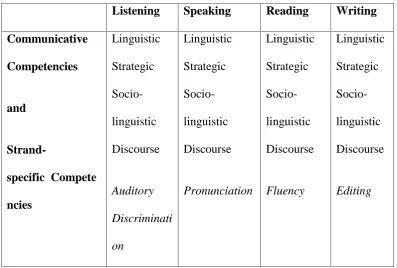
[image:36.595.112.510.248.516.2]The descriptive indicators within each strand are organized around four communicative competence areas. Each of these strands has an additional communicative focus: auditory discrimination, pronunciation, fluency and editing as shown in the table below.
Table 2.1 The Communicative Competence Focus Area toward Language Skills
Listening Speaking Reading Writing
Communicative Competencies and Strand-specific Compete ncies Linguistic Strategic Socio-linguistic Discourse Auditory Discriminati on Linguistic Strategic Socio-linguistic Discourse Pronunciation Linguistic Strategic Socio-linguistic Discourse Fluency Linguistic Strategic Socio-linguistic Discourse Editing
Listening Strand-specific Competency: Auditory Discrimination
Auditory discrimination is the ability to hear specific sounds and words, and to recognize changes in tone and other nuances of spoken English.
Speaking Strand-specific competency: Pronunciation
19
Reading Strand-specific Competency:Fluency
Fluency relates to the rate, ease and accuracy with which a student decodes and comprehends a text in English.
Writing Strand-specific Competency: Editing
Editing is the process of reviewing, revising and refining a text for the purpose of improving it based on English language conventions (spelling, punctuation and grammar), word choice, the form of the text, and its intended audience and purpose.
2.4 Celce-Murcia’s Model
[image:37.595.207.446.455.672.2]Another model of Communicative competence is provided by Celce-Murcia (2000) as presented below:
20
This model is based upon the belief in the potential of a direct, explicit approach to the teaching of communicative skills, which requires a detailed description of components of communicative competence to be used as a content base in syllabus design.
Celce Murcia (2000) listed the components of communicative competence as
follows:
1. Linguistic or grammatical competence, which consists of the basic elements of communication: sentence patterns, morphological inflictions, lexical resources and phonological or orthographic systems.
2. Socio–linguistic competence, which consists of the social and cultural
knowledge required to use the language opportunity with reference to formality, politeness and other contextually defined choices.
3. Discourse competence,which involves the selection, sequencing and arrangement of words, structures, and sentences utterances to achieve a unified spoken or written whole with reference to a particular message and context.
4. Strategic competenc,which refers to the ability to know when and how to
start the talk, how to keep a conversation going, how to terminate a conversation, breakdown as well as comprehension problems.
21
5. Actional competence: It includes knowledge of language functions.
[image:39.595.120.503.284.731.2]A complete description of communicative competence is summarized into the following table.
Table 2.2 Table of Specification of Communicative Competence Elements of Cerce-Murcia’s Model
No Terms Definition Elements Notes
1 Communicative Competence
Speakers of a language have to have more than grammatical competence in order to be able communicated effectively in a language; they also need to know how language is used by members of a speech
community to
Linguistic competence Sociolinguistic
competence
22 accomplish their purposes. 2. Linguistic competence: Phonological competence Linguistic Competence
Knowing how to use the grammar, syntax and vocabulary of language. Phonological competence is the ability to recognize and produce the distinctive meaningful sounds of a language, including:
Grammatical competence is the ability to recognize and
Phonology, grammar, semantics.
consonants
vowels
tone patterns
intonation
patterns
rhythm patterns
stress patterns
any other suprasegmental features that carry
23
Lexical Competence
produce the distinctive grammatical structures of a language and to use them effectively in communication
24
among families of words and the common collocations of words Sociolinguistic competence Sociolinguistic competence is the ability to interpret the social meaning of the choice of linguistic varieties and to use language with the appropriate social meaning for the communication situation.
What is a communicative function?
Survival functions: Meeting your most basic needs
Social functions: Interacting with other people
Functions used when socializing
25
Functions involved in arguing Functions involving avoiding trouble Self-expressive functions Functions involving expressing opinions Functions involving expressing emotions Cognitive functions Functions for managing conversations
Discourse Competence
Discourse competence is used to refer to two related, but distinct abilities. Textual
discourse competence refers to the ability to understand and
26
construct monologues or written texts of different genres. discourse competence could also refer to the ability to participate effectively in conversations
are used to make important points
distinctive or prominent.
Strategic Competence
Knowing how to recognize and repair
communication breakdown, how to work in around gaps in one’ knowledge of the language, and how to learn more about the language in the context
27
2.5 Self Assessment
One of the primary reasons for the contradictory empirical results may be explained by a lack of a consistent definition of self-assessment. The concept goes by a variety of names such as self-evaluation, self-rating, self-testing, and self-appraisal. Because self-assessment is a loosely defined term, a comparison of empirical results is problematic.
According to Fitzpark, 2006, that student self assessment is a form of authentic assessment in which each students reflects on his/her strengths and weakness in order to identify learning needs and reinforce weaknessess with the aim of improving achievement and/or performance (as cited in El-Koumy, 2010). Another definition of self assessment purposed by Boud (1986) whose stated that self assessment is the involvement of students in identifying standards and/or criteria to apply to their work and making judgments about the extent to which they met these criteria and standards.
development-28
oriented assessment. A major distinction between performance-oriented self-assessment and development-oriented self self-assessment is that the former typically samples the test takers’ performance at one particular point in time,whereas the latter assesses the participants for an extended period in order to detect changes and patterns of development over time. The following will discuss the two types of self assessment and their implementation guidelines.
2.5.1 Performance-oriented Self-assessment
Performance-oriented assessment measures the outcomes related to selection, certification, placement, achievement, diagnosis, etc. For instance, if self-assessment is used as a placement exam in a university ESL program, it will be administered to the students only once prior to program entrance. In this case, students are asked to evaluate their language ability on whatever is being assessed.
29
However, these test administrators need to be aware that self-reporting is affected by many factors including the wording of the questions, the assessed language skills, the proficiency level of the students, the cultural backgrounds of the students, and so forth. Most importantly, self-assessment is severely influenced when there is a perceived advantage to a higher rating. Many test administrators are hesitant to use it insituations where the consequences of the self-assessment seriously affectthe test takers’ presentcircumstances. Because the students’ self-ratings are greatly affected by subjective errors, the results must be interpreted with caution when used for the purpose of placement, certification, diagnosis, and admission.
2.5.2 Development-oriented Self-assessment
Development-oriented assessment measures the process of learning (usually in a classroom environment) in which self-managed activities are incorporated. It is used as an observation of “the participants for an extended period in order to detect changes and patterns of development over time” (Dornyei, 2001, p. 194). This type of assessment began to receive attention as the result of an increasing interest in the learner-centered approach.
30
Furthermore, a number of empirical studies indicate the presence of increased productivity and autonomy, higher motivation, less frustration, and higher retention rates among learners when development-oriented self-assessment is utilized. Though the findings of these studies make the implementation of self-assessment sound plausible, issues regarding the validity and reliability of the assessment need to be addressed. For example, when self-assessment is implemented in a portfolio project, the students engage in multiple assessments, a cycle of self-assessment and feedback, throughout the semester. Because the final product is influenced by feedback from a teacher, a peer, or even a parent, the completed portfolio might not be an accurate measure of the students’ language ability. In other words, if the purpose is to measure the students’ language ability, the validity of the portfolio is severely affected by a confounding variable such as feedback. Furthermore, the complexity involved in grading a portfolio exacerbates the reliability of the assessment.
31
2.5.3 The Advantages of Student Self Assessment
According to El-Koumy (2010) study, given the appropriate conditions and supports, student self assessment can have the following advantages:
(1) It enhances students awareness of their own learning and thinking process.
(2) It provides direction for future learning.
(3) It makes teachers aware of their students’ needs and provides them with an additional lens through which to view their achievement. (4) It helps learners see gaps in their own learning and infinite self-repair
to redirect their learning toward the learning goal.
(5) It stimulates learners to consider course content critically and helps them achieve a high level of academic thinking skills.
(6) It promotes learners’ knowledge of their learning goals and thus enhances their motivation and goal orientation.
(7) It increases learner self esteem and intrinsic motivation.
2.6 Actual Performance
2.6.1 Definition of Performance
32
transformational generative grammar, to refer to language seen as a set of specific utterances produced by native speakers, as encountered in a corpus.
Other definition of performance proposed by Noam Chomsky who described performance as the actual use of language in concrete situations. The performance is defined in opposition to competence. The distinction between performance and competence in the transformational generative grammar, however, has been severely criticized as being not that clear-cut and there are problems, often in deciding whether a particular speech feature, such as intonation or discourse, is a matter of competence or performance (Crystal, 1985: 59).
2.6.2 Performance as a Reflection of Competence
Because of such factors, performance does not always accurately reflect competence, competence which is the fluent native speaker’s knowledge of his language is contrasted with performance which refers to what people actually say or understand by what someone else say on a given occasion. Very often, performance is an imperfect reflection of competence, e.g. the fact that people make occasional “slips of tongue” in everyday conversation does not mean that they do not know their language or do not have fluency init. “slips of the tongue” and similar phenomena are, for Chomsky, performance errors attributable to a variety of performance factors like tiredness, boredom, drunkenness, drugs, external distraction and so forth (Radford, 1981; Gelason and Ratner, 1993).
33
the actual measurable behavior. Thus, in order to describe language and write down its rules, the best way is to analyze either or both of these activities.
2.7Students’Productive Skill in Communicative Competence
Cerce-Murcia’s model of communicative competence illustrates some components of communicative competence which can be grouped to the aspects of receptive skills and productive skills. Since Chomsky believes that competence is idealization but performance is the actual use of language, the productive skills are employed as the actual performance of communicative competence. The following chart is the chart of productive skill and receptive skills involved in the communicative competence;
2.8 Theoretical Assumption
The current research correlates the result of the students’ self assessment of communicative competence questionnaire and their performance scores. It is assumed that students self assessment have association or correlation to the students’ language performance. When students fill the questionnaire, they will have the judgment of the result of language test they might be faced. The researcher assumes that this judgment will have correlation with their actual performance as the responsibility of their self-assessment. Therefore, it is assumed that students will have congruence result with the performance tests assessed by teachers.
34
assumed that the university students’ length of language learning will influence students to evaluate themselves.
For the sake of the crucial of the level of students’ performance achievement, this current research also intends to find out the level of students’ performance achievement in comparison of difference years of study. It is assumed that there is significance difference of students’ level of performance achievementamong the university students’ length of language learning.
2.9 Previous Research
To conduct the current research, some relevant researches are reviewed in order to develop the current study. The focus of the review is on the aims, samples, procedures, and findings. The previous researches which are related to the current research are as follows;
1. Ito, Kawaguchi, and Ohta (2005). The study aims at:
- Developing a checklist of self assessment users to interpret TOEIC score in more practical ways
- Exploring the relationship between self-estimated English proficiency and TOEIC score.
35
questionnaire. It was also found that there are correlations between each sub-test of TOEIC and each part of self-ratings.
2. Mahmoud & Shahrebaki (2014). The study aims at:
- Exploring relationship between filling out formative self assessment checklists and summative final assessment.
- Exploring the influence of proficiency level of EFL students on the benefit from continuous self assessment.
- Exploring the differences between gender EFL learners on the amount of aid they get from the formative assessment.
The participants of the study are 115 Iranian EFL learners of three classes with difference semesters. The result showed that there is not significant difference between the final score among groups as a whole. The mean scores of third semester learners scored significantly higher than others. At last, the study revealed the use of checklists in order to make English language learners self directed.
3. Taha & Reishaan (2008). The study aims at finding out the relationship between competence and performance toward comprehensive TG Grammar. Since the study employed qualitative study, it involved some theories and literature related to the competence and performance to develop the findings of study. The result revealed that even the competence and performance is different in practice, they can not be separated to be conducted.
36
observe the effect on intermediate and beginner language learners. The sample of the study is 120 Iranian language learners. The results showed that self assessment significantly improved EFL learners’ receptive skills. Also, the result revealed that self assessment gives effect value on beginner groups was less in comparison with intermediate groups.
5. Cruz, Tacoronte, and Betancor (2015). The objective of the study is to evaluate the self assessment accuracy of oral communication skills of university students. The participants of the study are 92 students who assessed their classmates and themselves while performing a test consisting of an oral presentation in terms of two people. The result shows that self assessment accuracy is low. They suggest to propose the development of correction factors allowing self assessment to be used for summative purposes.
2.10 Hypothesis
Concerning to the concept of and theoretical assumption above, this study formulate the three hypotheses as follow;
First hypothesis:
Ho = there is no significant correlation between students’ self asssessment and their actual performance
37
Moreover, the second hypothesis dealt with the second research question about the influence of students’ length of language learning toward their self assessment The hypothesis is as follows:
Ho : There is no significant influence of the students’ length of language learning toward their ability of self assessment.
H1 : There is significant influence of the students’ length of language learning toward their ability of self assessment.
The last hypothesis dealt with the third research question about the level of students’ achievement in terms of length of language learning. The hypothesis is as follows:
Ho : There is no significant difference of the students’ performance in terms of length of language learning
III. RESEARCH METHODOLOGY
This chapter presents and discusses research design, variables of the research, data sources, time allocation, data collecting procedure, the instruments, the procedure of data analysis, and correlation and regression analysis.
3.1 Research Design
Since the main purpose of this research is to know whether there is significant correlation between students’ self assessment of communicative competence and their performance, the research design employed in this study is expost facto correlational research. According to Setiyadi (2006 p.144), the expost facto correlational study is used to obtain the correlation between two variables which includes some possibilities. The illustration of the research method is as follow:
T1 T2
(Setiyadi, 2006).
40
40
influences the second variables. The third possibility is that there is unidentified variable which give influence to the first variable or the second variable.
3.2 Variables
Setiyadi (2006) defines a variable as an attribute of a person or an object which varies from person to person or from object to object. In this research, there are two kinds of variables named independent variable and a dependent variable. He also states that independent variable is a variable which influences or evokes the changes in the dependent variable meanwhile the dependent variable is a variable which is influenced or resulted due to independent variable. There are independent and dependent variables were used in this study.
The independent variable is students’ self-assessment of communicative competence. The ability of students’ self assessment of their communicative competence level is assumed to have association or correlation of students’ performance assessed by teachers. Therefore, dependent variable is students’ performance test with regard to communicative competence.
3.3 Source of the Data
The data of this study will be in the form of:
1) Students’ self assessmentof communicative competence in the form of questionnaire result
2) Performance test scores
41
41
3.4 Data Collecting procedures
In conducting this study, several procedures were taken to make the research run in a well-organized way. The first was organizing the instruments. The instruments were the questionnaire of self assessment and several performance tests. After that, administering the self assessment questionnaire to the sample of the study. The result of the questionnaire would show the ability of the students when they appraise their self of the level of communicative competence they perceive.
The second is administering several performance tests. The tests are actual performance tests regarding to communicative competence. The first test was speaking test in the form of role play and writing argumentative essay. The second test was structure and vocabulary and pronunciation test. The test scores were correlated to the result of questionnaire which is intended to find out whether there was significant correlation between both of them.
The data of the self assessment of communicative competence questionnaire would be the data to cover the second research questions which is aimed to find out whether the length of language learning give impact to the ability of students to appraise their self of communicative competence level.
42
42
3.5 Subjects of the Research
This present study was conducted in undergraduate students of English major taking in Lampung University. To differentiate the length of language learning, there were three groups coming from difference years of the study. The subjects were freshmen, sophomores, and juniors. They were assumed to be classified into three levels of grades; pre-intermediate, intermediate, and advanced learners. The total of students in the first years (1st / 2nd semester) is 16 students. The total of students in the second years (3rd/ 4th semester) is 31 students. The total of students in the third years (5th/ 6thsemester) is 25 students.
3.6 Instruments
There were two main instruments used in this study. The first is a self assessment questionnaire of communicative competence and the second is actual performance measurement.
3.6.1 The Self Assessment Questionnaire of Communicative Competence
43
43
The students were given opportunity to appraise them self. The students had given time around 25 - 30 minutes to fulfill the questionnaire.
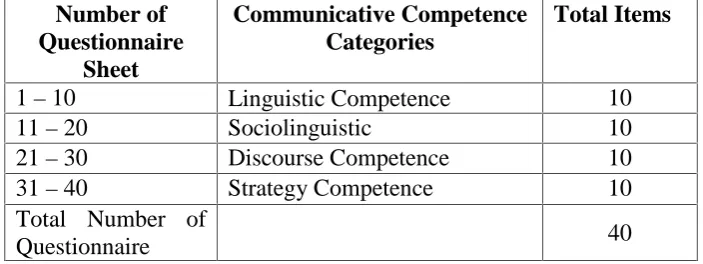
[image:60.595.136.488.285.417.2]All statements were divided into four types of communicative competence. They are linguistics, sociolinguistic, discourse, and strategy. Here is the classification of each items based on communicative competence categories;
Table 3.1 Specification of the Number of Questionnaire Items Regarding To Communicative Competence Categories
Number of Questionnaire
Sheet
Communicative Competence Categories
Total Items
1–10 Linguistic Competence 10
11–20 Sociolinguistic 10
21–30 Discourse Competence 10
31–40 Strategy Competence 10
Total Number of
Questionnaire 40
3.6.2 Students’ Actual Performance
In a line to the theory of communicative competence in chapter 2, there were several challenging actual performances employed in this study. The performances were dealt with productive skills. Since one measurement was not completed to cover students’ performance achievement, several performances tests were designed in this research. They were presented in the form of role play, writing argumentative essay, structure and vocabulary and pronunciation test. 3.6.2.1 Speaking Performance Test
44
44
play helps shy students by providing a mask (Susanti, 2007). In the current research, the role play was given to the students by pairing two students in given situation. There were two kinds of situations then the students were given a chance to create conversation related to the situations. (See appendix).
3.6.2.2 Writing Argumentative Essay
Writing Argumentative Essay was assigned in the three general topics. The argumentative essay helps students to develop critical thinking and research skills, as well as the ability to develop and logically defend a position. The students were given a chance to write their argument or idea whether agree or disagree to the topics given. (See appendix)
3.6.2.3 Structure and Vocabulary
Structure and vocabulary tests employed in this study consisted of 20 items which was adapted from many sources of TOEFL preparation book. In this research, there were no multiple choices items employed. Each items of structure and vocabulary performance was false sentences then the students had to make it correct. The objective structure and vocabulary test was used in this research (see appendix)
3.6.2.4 Pronunciation Test
45
45
parts, each part had 25 points in which when the students gave all correct pronunciation for each, and the score is 100 (see appendix).
3.7 Time Allocation
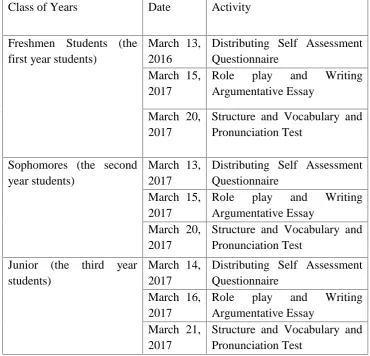
[image:62.595.126.497.354.710.2]Based on explanation of previously in the total of subjects, this research would be explained about the time for collecting data. Since there were three classes, so there are three times for researchers to distribute the questionnaire and tests. The research was conducted into three meetings for each class. Here is the schedule of time allocation.
Table 3.2 the Schedule of Research Time Allocation
Class of Years Date Activity
Freshmen Students (the first year students)
March 13, 2016
Distributing Self Assessment Questionnaire
March 15, 2017
Role play and Writing Argumentative Essay
March 20, 2017
Structure and Vocabulary and Pronunciation Test
Sophomores (the second year students)
March 13, 2017
Distributing Self Assessment Questionnaire
March 15, 2017
Role play and Writing Argumentative Essay
March 20, 2017
Structure and Vocabulary and Pronunciation Test
Junior (the third year students)
March 14, 2017
Distributing Self Assessment Questionnaire
March 16, 2017
Role play and Writing Argumentative Essay
March 21, 2017
46
46
3.8 Validity Test
3.8.1 Validity Test ofStudents’ selfAssessment Questionnaire
To get construct validity, the self assessment of communicative competence questionnaire is developed from the theory of Swain and Canale’s model of communicative competence. The questionnaire was adapted from Yufrizal (2016), some of the items was developed so the content and face validity was still required to be validated. To minimize the ambiguity of the content of the questionnaire, the face validity has been validated to Hery Yufrizal, M.A., Ph.D. and Dr. Sukirlan, M.A.
3.8.2 Validity Test of Performance Test
All of the instruments were constructed to the theory of communicative competence. The instruments were purposed to get the students’ score of their performance. The instruments are in the form of Role Play, Writing Argumentative Essay, Structure and Vocabulary, and Pronunciation Test. Content and Face Validity are also considered to be the ways of measuring this validity test.
47
47
were involved in this research. They are Hery Yufrizal, M.A, Ph.D. and Dr. Sukirlan, M.A.
3.9 Reliability Test
Reliability test was used to measure the internal consistency of the test. According to Cohen et al (2007), split half techniques and Cronbach’s Alpha were determined to get the internal consistency. A reliable test is the one that produces essentially the same results consistently on different occasions when the candidates of the test remain the same.
3.9.1 Reliability Test of Self Assessment Questionnaire
[image:64.595.195.400.517.615.2]In this study, the Cronbach’s Alpha was used to establish the most appropriate reliability. To determine the reliability of the questionnaire, Cohen et al (2007) provide the following guideline:
Table 3.3 the Guideline for Describing Alpha Value
Alpha Value Description
>0.90 Very highly reliable
0.80–0.90 Highly reliable
0.70–0.79 Reliable
0.60–0.69 Marginally/Minimally Reliable
< 0.60 Unacceptably low reliability
(Source: Cohen et al, 2007)
48
48
3.9.2 Reliability Test of Performance Test
The tests used in this study were in the form of subjective tests (writing and speaking) and objective tests (structure and vocabulary). For subjective tests, Inter-rater reliability was used to see the reliability of the raters of speaking and writing test. In order to see the coefficient of the reliability, the research employed the formula of coefficient correlation. Pearson Product Moment Correlation was applied to measure the correlation between the performance test given by rater 1 and rater 2 (see appendix).
3.10 Hypothesis Testing
There were three kinds of hypothesis proposed in this research. Those are the hypotheses to examine the correlation between students’ self assessment of communicative competence and their performance, the influence of length of language learning toward the students’ assessment, and the level of students’ achievement in terms of length of language learning. The following is the first hypothesis:
Ho : There is no significant correlation between students’ self assessment of communicative competence and their performance
H1 : There is significant correlation between students’ self assessment of communicative competence and their performance
49
49
Ho : There is no significant influence of the students’ length of language learning toward their ability of self assessment
H1 : There is significant influence of the students’ length of language learning toward their ability of self assessment.
The last hypothesis dealt with the third research question about the level of students’ achievement in terms of length of language learning. The hypothesis is as follows:
Ho : There is no significant difference of the students’ performance in terms of length of language learning
H1 : There is significant difference of the students’ performance in terms of the length of language learning.
To examine the hypothesis above, the criteria should be provided as follows:
If the value of the performance is lower than a significant level p < 0.05, so H0will be rejected.
If the value of the performance is higher than a significant level p > 0.05, so H0will be accepted.
3.11 Data Analysis
3.11.1 Data Analysis of The Correlation between The Score of Questionnaire and Score of Performance Test
50
[image:67.595.239.399.138.296.2]50
Table 3.3 The Correlation Interval Value
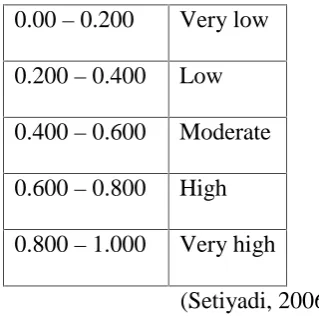
Value of Interval Correlation 0.00–0.200 Very low 0.200–0.400 Low 0.400–0.600 Moderate 0.600–0.800 High
0.800–1.000 Very high (Setiyadi, 2006) 3.11.2 Data Analysis of The Questionnaire
To cover the second research question about the possibility of length of language study which influence the students’ self-assessment of the communicative competence, the data of the questionnaire were analysed using one way ANOVA.
3.11.3 Data Analysis of Performance Test
51
51
V. CONCLUSIONS AND SUGGESTIONS
This chapter consists of two parts. The first part provides some conclusions which are taken from research findings and the second part provides some suggestions for practicioners and further study.
5.1 Conclusions
Based on the research questions, there are three conclusions which can be drawn as follows;
84
their self so they need more experience in assessing their quality especially in their speaking performance.
Having established the correlation between two measurements, this research aimed to find out the students’ self assessment ability based on the length of language learning. The current research succeeded in modifying a questionnaire of 40 items students’ self assessment according to the communicative competence. The study compares three groups of subjects when they assess their ability to the communicative competence in the form of questionnaire. It was not surprisingly when the result shows that there is significant difference among the groups toward their appraisal. The third year’s students are more confidence to give appraisal because they had a lot more experience and progress rather than when they are in lower level. The more length students study in university, the more succesful they make assessment for theirselves.