SCIENCE CLASS STUDENTS OF SMAN 9 BANDAR LAMPUNG
(A Script)
By
Savitri Fiska Tamara
ENGLISH EDUCATION STUDY PROGRAM LANGUAGE AND ART DEPARTMENT
TEACHER TRAINING AND EDUCATION FACULTY UNIVERSITY OF LAMPUNG
ABSTRACT
THE ROLE OF SELF-PERCEIVED COMMUNICATION COMPETENCE, COMMUNICATION APPREHENSION, AND MOTIVATION TOWARDS
WILLINGNESS TO COMMUNICATE OF THE SECOND YEAR SCIENCE CLASS STUDENTS OF SMAN 9
BANDAR LAMPUNG By
Savitri Fiska Tamara
The aims of this research are to find out the willingness to communicate of the students and to investigate the significant correlation between self-perceived communication competence, communication apprehension, motivation, and willingness to communicate. The research used quantitative method. The subjects were the second year science class students of SMAN 9 Bandar Lampung, and self-report questionnaires were employed to collect data addressed four different aspects of variables concerning the students’ communication and motivational orientations.
The results showed that the students have moderate willingness to communicate in English on each type of situations and receivers. The results also showed that all of the communication variables (self-perceived communication competence. communication apprehension, and willingness to communicate) are significantly correlated with each other in English communication setting, but motivation. It indicates that motivation does not influence the willingness of students to communicate in English.
SCIENCE CLASS STUDENTS OF SMAN 9 BANDAR LAMPUNG
By:
Savitri Fiska Tamara
A Script
Submitted in a Partial Fulfillment of The Requirements for S-1 Degree
In
The Language and Arts Education Department of The Faculty of Teacher and Education
FACULTY OF TEACHER TRAINING AND EDUCATION UNIVERSITY OF LAMPUNG
CURRICULUM VITAE
The writer’s name is Savitri Fiska Tamara. She was born on March 2nd
, 1995 in Bandar Lampung. She is the first kid of Wahyu Basuki and Darwati.
She graduated from Fransiskus Tanjung Karang kindergarten in 2000. She continued her study in SDN 3 Gedung Air and graduated in 2006. Graduating from the elementary school, she continued her study in SMPN 10 Bandar Lampung and graduated in 2010. In 2013, she graduted from SMAN 9 Bandar Lampung.
“Only those among His servants who possess knowledge fear Allah” (Quran 35: 28)
With love and appreciation I dedicate this research paper to:
My beloved parents (Wahyu Basuki and Darwati)
My sister and brother
(Ferrenita Septianti and Bima Azka Danuatmaja)
My best friends (Retno, Susan, Umi, Urmila)
Praise be merely for Allah SWT for the gracious mercy and tremendous blessing that enables me to accomplish this research.
This research paper, entitled “The Role of Self-Perceived Communication Competence, Communication Apprehension, and Motivation towards Willingness to Communicate of the Second year Science Class Students of SMAN 9 Bandar Lampung” is submitted to fulfill one of the requirements in accomplishing the Bachelor Degree at the Language and Art Department of Teaching Training and Education Faculty, Lampung University.
First of all, I woud like to dedicate my sincere gratitude and respect to Prof. Ag. Bambang Setiyadi, Ph.D., as my first advisor who has given his knowledge and experience, and to my second advisor, Dr. Flora Nainggolan, M.Pd., who has given her knowledge and suggestion in correcting my paper. I also would like to express deepest gratitude and respect to Drs. Ujang Suparman, M.A., Ph.D. as my examiner who has generously contributed his suggestion and critism for the improvement of this research paper.
My sincere gratitude also goes to all lecturers of English Education study program, FKIP Unila, who have given a great contribution in broadening and deepening my knowledge during my study. My deep appreciation is also addressed to The Dean of FKIP Unila, The Head of Language and Arts Department, and The Head of English Education Program.
My appreciation is also extended to Drs. Hendro Suyono, the headmaster of SMAN 9 Bandar Lampung and Dra. Hj. Sri Subekti, as the English teacher for her permission and support for me to do the research.
I woud like to acknowledge my gratitude to the people who have supported me throughout my life and especially in finishing this script. Thus, I would like to express my sincere respect and gratitude to:
1. My beloved parents, Wahyu Basuki and Darwati, for all of the greatest love, continous patience, and being the light in my life.
2. My beloved sister, Ferrenita Septianti, my beloved brother, Bima Azka Danuatmaja, and my relatives for always giving me support in accomplishing this paper.
support and pray.
5. My beloved English Departments’13 friends: Dewi, Atika, Agung, Agus, Nesia, Desta, Ade Eka, and the others that I cannot mention the names one by one, for the support, spirit, and help.
Finally, I realize that this paper still has weakness. Therefore, constructive criticism and suggestion are invited for the improvement of this paper. Hopefully, this research paper could give benefit to the readers as well as those who want to carry out further research.
Bandar Lampung, 26 May 2017 The writer
TABLE OF CONTENT Cover
Abstract ...i
Curriculum Vitae ...v
Dedication ...vi
Motto ...vii
Acknowledgments ...viii
Table of Content ...x
List of Appendices ...xii
List of Tables ...xiii
List of Figures ...xiv
CHAPTER I INTRODUCTION ... 1
1.1. Background ... 1
1.2. Research Questions ... 6
1.3. Objectives ... 7
1.4. Uses ... 7
1.4.1. Theoretically ... 7
1.4.2. Practically ... 8
1.5. Scope ... 9
1.6. Definiton of Terms ... 9
CHAPTER II LITERATURE REVIEW ... 11
2.1. Self-Perceived Communication Competence (SPCC) ... 11
2.1.1. The Concept of Self-Perceived Communication Competence (SPCC) . 11 2.1.2. The Types of Self-Perceived Communication Competence (SPCC) ... 13
2.2. Foreign Language Anxiety ... 15
2.2.1. The Concept of Communication Apprehension (CA) ... 16
2.2.2. The Types of Communication Apprehension (CA) ... 17
2.3. Motivation ... 19
2.3.1. The Concept of Motivation ... 20
2.3.2. The Roles of Motivation... 21
2.3.3. Motivation in Learning English ... 23
2.4. Willingness to Communicate ... 25
2.4.1. Willingness to Communicate in Native Language ... 25
2.4.2. Willingness to Communicate in Second and Foreign Language ... 28
2.4.3. A Conceptual Model of WTC in Second Language Communication .... 30
2.5. Willingness to Communicate with Communication Variables ... 35
2.6. Willingness to Communicate with Motivation ... 39
2.7. WTC with Communication Variables and Motivation ... 39
2.8. Theoretical Assumption ... 41
3.2.1. Population ... 46
3.2.2. Sample ... 46
3.3. Variables ... 47
3.4. Instruments ... 48
3.4.1. Measures of The Questionnaires ... 48
3.4.1.1. Self-Perceived Communication Competence (SPCC) ... 49
3.4.1.2. Communication Apprehension (CA) ... 49
3.4.1.3. Motivation ... 50
3.4.1.4. Willingness to Communicate ... 50
3.4.2. Validity of The Questionnaires ... 51
3.4.3. Reliability of The Questionnaires ... 53
3.5. Data Collecting Technique ... 54
3.6. Procedures ... 55
3.7. Data Analysis ... 57
3.8. Hypothesis Testing ... 59
CHAPTER IV RESULTS AND DISCUSSION ... 60
4.1. Results of the Research ... 60
4.1.1. Descriptive Measures and Reliability of the Questionnaires ... 60
4.1.2. First research Question ... 63
4.1.3. Second Research Question ... 65
4.1.3.1. The Correlation between Self-Perceived Communication Competence (SPCC), Communication Apprehension (CA), Motivation, and Willingness to Communicate (WTC) ... 66
4.1.3.2. The Correlation between Self-Perceived Communication Competence (SPCC), Communication Apprehension (CA), and Willingness to Communicate (WTC) ... 69
4.2. Discussion ... 78
4.2.1. The Willingness to Communicate of the Second Grade Science Class Students of SMAN 9 Bandar Lampung ... 78
4.2.2. The Correlation between Self-Perceived Communication Competence (SPCC), Communication Apprehension (CA), Motivation, and Willingness to Communicate (WTC) ... 83
4.2.3. The Correlation between Self-Perceived Communication Competence (SPCC), Communication Apprehension (CA), and Willingness to Communicate (WTC) ... 86
CHAPTER V CONCLUSIONS AND SUGGESTIONS ... 97
5.1. Conclusion... 97
5.2. Suggestions ... 98
REFERENCES ...100
1. Questionnaire of Self-Perceived Communication Competence...105
2. Questionnaire of Communication Apprehension ...107
3. Questionnaire of Motivation ...110
4. Questionnaire of Willingness to Communicate ...113
5. Reliability of SPCC Questionnaire ...115
6. Reliability of CA Questionnaire ...116
7. Reliability of Motivational Questionnaire ...117
8. Reliability of WTC Questionnaire ...118
9. Result of SPCC Questionnaire ...119
10. Result of CA Questionnaire ...121
11. Result of Motivational Questionnaire ...124
12. Result of WTC Questionnaire ...126
13. Students’ Score of Self-Perceived Communication Competence ...128
14. Students’ Score of Communication Apprehension ...131
15. Students’ Score of Motivation ...133
16. Students’ Score of Willingness to Communicate ...135
17. Distribution Frequency of the Questionnaires ...138
18. The Descriptive Statistics and Normality Test of Questionnaires ...139
19. The Correlation between SPCC, CA, Motivation, and WTC ...143
20. The Correlation between SPCC, CA, and WTC ...144
21. The Regression Analysis of SPCC, CA, and WTC ...145
22. The Regression Analysis of CA and WTC ...148
23. The Regression Analysis of SPCC and WTC ...150
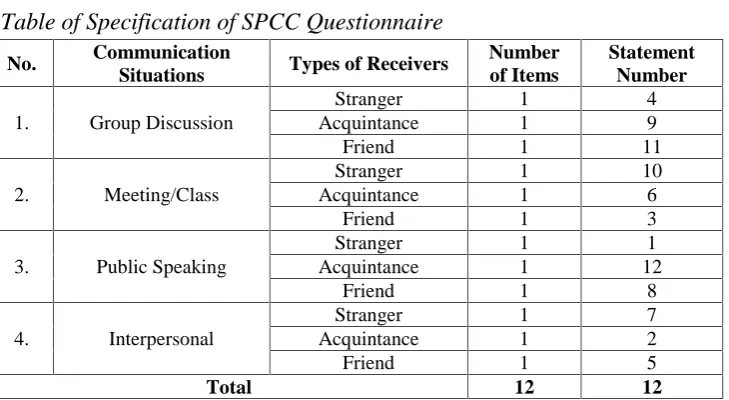
3.1. Table of Specification of SPCC Questionnaire ... 49
3.2. Table of Specification of CA Questionnaire ... 50
3.3. Table of Specification of Motivational Questionnaire ... 50
3.4. Table of Specification of WTC Questionnaire... 51
3.5. Table of Percent Agreement of the Translation of the Questionnaires ... 52
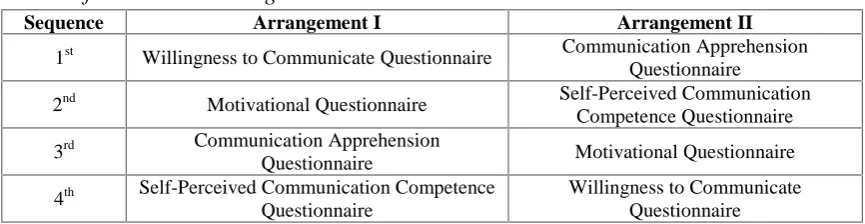
3.6. Table of Instrument Arrangement ... 55
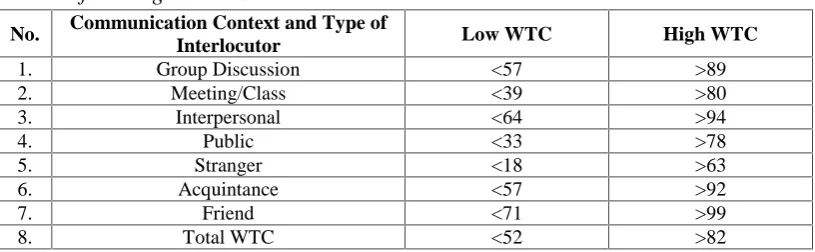
3.7. Table of Willingness to Communicate Scores ... 57
4.1. Reliability of the Questionnaires ... 61
4.2. Descriptive Statistics I... 61
4.3. Descriptive Statistics II ... 61
4.4. Descriptive Statistics III (Willingness to Communicate)... 63
4.5. Descriptive Statistics IV (Willingness to Communicate) ... 63
4.6. Correlation among CA, SPCC, Motivation, and WTC ... 69
4.7. Descriptive Statistics V (Motivational Orientation) ... 69
4.8. Descriptive Statistics of the Communication Variables... 70
4.9. Correlation Matrix for Communication Variables ... 71
4.10. F Test Results for the Multiple Regression Model ... 73
4.11. T Test Result for the Multiple Regression Model ... 73
4.12. Model Summary ... 73
4.13. Model Summary of Regression between CA and WTC ... 75
4.14. Model Summary between SPCC and WTC ... 76
4.15. Similar Studies across the Countries ... 87
This chapter presents the background, research questions, objectives, uses,
scope, and definition of terms of the research.
1.1. Background
In Indonesian context, English is learned as a foreign language and acts as
the target language. Looking at the present era, it is almost certain that
communication is the most important part in language learning and being able to
communicate in the target language is the goal of learning the target language.
According to Setiyadi (2006), communication is really important in language
learning since by communicating, the students learn how to interact with others
using the target or learned language: English. Moreover, the fundamental goal of
language learning is currently defined as “authentic communication between
persons of different languages and cultural backgrounds”(MacIntyre, et al., 2002:
556).
Theoretical researches throughout the current decade have primarily
promoted the important role of using language to communicate in second and
foreign language learning and teaching. According to Şener (2014), learners
cannot be expected to develop their oral skill required for successful
communication if there is no interaction in the classroom. The problem in
interaction and communication in the classroom due to the lack of willingness of
the students to communicate in the target language. A study conducted by Exley
(2005) showed that Indonesian students are passive, compliant and unreflective.
She also stated that Indonesian students are‘passive, shy and/or quiet’. Based on
the researcher’s experiences during her studies in senior high school and the
answers of the students who were asked by the researcher, many students were
afraid to talk in front of the class and there were less students who wanted to
communicate in English. The students might answer to a direct question, but not
many of them wanted to engage in a communication in English. Moreover, from
the interview with the English teacher in the high school, it was found that most of
the students in this high school were facing grammatical problems. Besides, many
of the students did not want to engage in the English communication unless the
teacher forced them to speak out.
Communication is important in language learning since the students do the
interactions to others in the target language by communicating (Setiyadi, 2006).
However, being able to communicate to someone in a target language is not
enough if someone does not have a willing to talk or to say something in order to
build a communication in a target language. MacIntyre, Dörnyei, Clément, &
Noels (1998: 547) argued that the ultimate goal of second and foreign language
learning should be to “engender in language students the willingness to seek out
communication opportunities and the willingness actually to communicate in
them”.
Willingness to communicate (WTC) is the idea that language learners who
language and they do communicate in that target language. McCroskey and
Richmond (1987) defines willingness to communicate as an individual’s general
personality orientation towards talking. It refers to the probability of engaging into
a communication when an individual has the freedom to choose to do so. If
someone has a willing to communicate then the person will automatically have
willingness to engage in a certain context to have a communication with the
interlocutor(s). It can be implied that if learners have willingness to communicate
in a target language, it means that they already get interested in learning a
language and will communicate in order to achieve their purpose(s). Their
willingness to communicate can affect their language learning achievement.
Therefore, MacIntyre et al. (1998) proposed that willingness to communicate
should be a proper goal for language learning.
The willingness to communicate of every single person is different
depends on the factors affecting it. According to MacIntyre, Baker, Clément, &
Donovan (2002), there are two variables most closely affect someone’s
willingness to communicate: perceived competence and communication
apprehension. Self-perceived communication competence refers to how an
individual believes his/her communication competence is, based on self awarness
rather than the actual communication competence (McCroskey & Richmond,
1987). The perceptions of people towards their competence will influence the
willingness of someone to communicate. The low perception of people of their
own competence in communication will become the primary reason why some
people are less willing to communicate (MacIntyre et al, 2002). Whereas
associated with either real or anticipated communication with others (MacIntyre et
al. 2002: 539). A research has shown that people who experience high level of
fear or anxiety about communicating tend to avoid it (MacIntyre at al, 2002: 539).
More recently, Aliakbari, Kamangar, & Khany (2016) conducted a study
investigating the correlation between willingness to communicate and
communicative competence, It found out that there was a positive correlation
between those variables. In their study, they stated that L2 perceived
communication competence is the strongest predictor of WTC. The study
conducted by Şener (2014) also showed that self-perceived communication
competence revealed a positive, significant correlation with WTC. Moreover,
Shahbaz et al. (2016) conducted a study to find out the role of communication
apprehension and self-perceived communication competence for WTC in L1 and
L2. In their study, they found that there is a positive relationship between
self-perceived communication competence (SPCC) and WTC. They also found that
strong communication apprehension (CA) can result in positive SPCC in other
language. However, there is limited study conducted to see the role of
self-perceived communication competence (SPCC) and communication apprehension
(CA) towards WTC in English as a foreign language.
Motivation, furthermore, may affect someone’s willingness to
communicate. MacIntyre et al. (2002: 541) states that motivational process have a
clear role play in L2 communication. Motivation can act as a force that is grow in
one’s self in any situation. Motivation acts as an internal attribute of the individual
In Indonesian context, Setiyadi et al. (2016) states that motivation
embodies three major elements: extrinsic motivation, intrinsic motivation, and
international orientation. It is believed that someone who experiences high
motivation will communicate better in the target language. Some researchers
(Yashima, 2002; Şener, 2014) believe that motivation as the affective factor gives
effect to the learners to communicate in a target language. Research has shown
that motivation influences the reported of L2 use but might operate somewhat
independently from the influence of L2 WTC (MacIntyre & Charos, 1996).
MacIntyre, Baker, Clément, & Donovan’s study (2002) found a
statistically significant relationship between motivation and WTC in the
participants’ L1 and L2, suggesting that people who had positive attitude and
motivation were more willing to communicate. However, the study conducted by
MacIntyre and Charos (1996) found that motivation was not significantly
correlated with the participants’ L2 WTC. The previous researches conducted to
see the relationship between motivation and WTC in English as a foreign
language are limited and the findings whether motivation affects students’ WTC
or not is still unclear.
The majority of studies done on the issue are oriented towards English as
Second Language (ESL) context leaving the gap in English as a foreign language
(EFL) context. The studies conducted to see the willingness to communicate in
foreign language are limited and have just conducted in some countries, such as
Turkey, Japan, and Iran. However, there is no research on willingness to
communicate in a foreign language in Indonesian context is carried out. Those
no research conducted to find out the willingness to communicate in senior high
school setting. Therefore, researches on willingness to communicate in foreign
language communication settings are needed to enrich the theoretical foundation
of the willingness to communicate research.
In line with the reasons stated above, the researcher focuses on the
research of the willingness to communicate of the second year science classes
students of a senior high school in Indonesian context and to find out whether
some aspects related to communication and motivation affect their willingness to
communicate. Hence, the researcher entitles her research “The Role of
Self-Perceived Communication Competence, Communication Apprehension, and
Motivation towards Willingness to Communicate of the Second Year Science
Class Students of SMAN9 Bandar Lampung”.
1.2. Research Questions
Based on the background above, the questions of the research were formulated as
follows:
1. How willing the second year science class students of SMAN 9 Bandar
Lampung to communicate?
2. How is self-perceived communication competence, communication
apprehension, motivation, and WTC of the second year science class
1.3. Objectives of The Research
Based on the problem of the research, the objectives of the research were:
1. To find out the willingness to communicate (WTC) of the second year
science class students of SMAN 9 Bandar Lampung.
2. To examine the correlation between self-perceived communication
competence, communication apprehension, motivation, and WTC of the
second year science class students of SMAN 9 Bandar Lampung.
1.4. Uses of The Research
The results of this research are expected to give benefits for the students of
SMAN 9 Bandar Lampung, English teachers, English lecturers, material
developers, the researcher herself, and other researchers.
1.4.1. Theoretically
This research is expected to be beneficial for other researchers on which
they could use the result of it as a comparative study which gives a contribution in
the researches of the willingness to communicate of senior high school students
and the relationship between students’ self-perceived communication competence,
communication apprehension, motivation, and willingness to communicate that
would affect the achievement of the students in learning English as foreign
language, and to complement the previous studies or researches in order to enrich
1.4.2. Practically
The senior high school students, English teachers, English lecturers, and
material developers could take benefit from the findings of the current research.
a) For senior high school students, the result of this research would make them
more aware of their own willingness to communicate. Moreover, they would
also know their level of motivation in learning English so that they may give
themselves intrinsic motivation to increase their ability in learning English
and in order to be able to communicate in a target language successfully.
Besides, they would also get the information about their level of their
perceived competence and communication apprehension in communication.
The information could be useful for them as a prospect to continue their study
to a higher level.
b) For English teachers, they could take benefit of this research to find out the
willingness to communicate of the students. Besides, they would get the
information about the students’ level of self-perceived comunication
competence, communication apprehension, and motivation so that they could
give some extrinsic motivations for the students and develop their teaching
techniques that would make the students communicate more in English as the
target language.
c) For English lecturers, the result of this research would give them the
information about the senior high school students’ willingness to
communicate. This information would be useful for them to apply the
appropriate teaching technique(s) for the students when they entered English
d) For material developers, knowing the result of this study which consists of
the level of willingness of communicate, self-perceived communication
competence, communication apprehension, and motivation would give them
further knowledge to develop the materials for students especially English
learning materials which made them learn motivationally and communicate
more in English.
1.5. Scope of The Research
The researcher limited this study on the object of the research of the
students’ willingness to communicate (WTC), and the correlation between the
students’ self-perceived communication competence, communication
apprehension, motivation and willingness to communicate. The subject of this
research was the second year science class students of SMAN 9 Bandar Lampung
by the year of 2016/2017. The students’ self-perceived communication
competence, communication apprehension, motivation, and willingness to
communicate were found out by questionnaires spreaded to them.
1.6. Definition of Terms
There are some terms used by the researcher. In order to make them clear,
the researcher gives the definition as follows:
1) Willingness to Communicate (WTC)
In L1 communication settings, McCroskey and Richmond (1987) defined
WTC as “an individual’s predisposition to initiate communication with
probability of engaging in communication when free to choose to do so”
(MacIntyre et al., 1998).
2) Self-Perceived Communication Competence (SPCC)
The term self-perceived communication competence refers to how an
individual believes his/her communication competence is, based on self
awarness rather than the actual communication competence (McCroskey
& Richmond, 1987).
3) Communication Apprehension (CA)
Communication apprehension is defined as an individual’s level of fear or
anxiety associated with either real or anticipated communication with
another person or persons (McCroskey, 1997: 192).
4) Motivation
Motivation acts as an internal attribute of the individual that can be
influenced by external forces (MacIntyre et al, 2002: 541). Motivation
embodies three major elements in Indonesian context: extrinsic
motivation, intrinsic motivation, and international orientation (Setiyadi, et
al., 2016).
In short, those are the background of the problem, research questions,
This chapter deals with the concepts of self-perceived communication
competence, foreign language anxiety, communication apprehension, motivation,
willingness to communicate in native language, willingness to communicate in
second and foreign language, WTC with communication variables, WTC with
motivation, WTC with communication variables and motivation, theoretical
assumption, and hypothesis of the research.
2.1. Self-Perceived Communication Competence (SPCC)
This section reviews the literature of self-perceived communication
competence. The concept and types of self-perceived communication competence
are considered in this section.
2.1.1. The Concept of Self-Perceived Communication Competence (SPCC)
The way of an individual believes in his or her competence may play a big
role in the way his or her acts the actual behaviour. The believes of the students in
their competence in communication can affect their actual competence in a target
language communication.
McCroskey and Richmond (1987) defines self-perceived communication
competence as how an individual believes his/her communication competence is,
believe that someone has on their communication competence will affect his/her
actuall skill in communicating in the target language.
Chu (2008) found that the communication skills of self-identified reticent
speakers were not different from those who claim non-reticent. Therefore, the
perception of one’s own communication skill level might weigh more
significantly than the person’s actual skill level.
McCroskey and McCroskey (1988), then, reiterated the definition of
communicative competence which had been provided in McCroskey’s previous
studies (McCroskey, 1982). They defined communicative competence as
“adequate ability to pass along or give information; the ability to make known by
talking or writing” (p. 109). McCroskey and Richmond (1990) argued that
self-perceived communication competence might be more associated with people’s
willingness to communicate since “the choice of whether to communicate is a
cognitive one, it is likely to be more influenced by one’s perceptions of
competence (of which one usually is aware) than one’s actual competence (of
which one maybe totally isunaware)” (p. 27).
The perception of individual or the perceptions of people on an individual
may affect the willingness of someone to communicate since he/she is aware to
choose whether they want to communicate or not. A person who has good
communication skill but perceives him/herself as not good in communicating in a
target language will not communicate better than a person who has moderate
communication skill but perceives him/herself as good in communicating in a
target language.McCroskey (1997) reemphasized that it was not a person’sactual
willingness to communicate; it was more likely that the individual’s
self-perceived communication competence would make the difference. Therefore,
people who consider themselves competent in communication are believed to be
more willing to initiate or participate in communication behaviors.
The willing of someone to engage in a communication can be predicted by
how he/she perceived themselves in the target language communication. Someone
who sees him/herself as not very competent in communicating in the target
language will be hesitated to engage in a communication and will not show their
best skill in the target language communication since he/she does not believe in
their communication competent. In the other hand, if someone believes that he/she
competent in communicating in the target language, he/she will not be hesitated in
showing their ability or skill and will communicate better. Thus, the people who
perceive themselves competent will be more willing to communicate than those
who believe themselves not competent in communicating in the target language.
From the opinions of the experts stated above, the researcher agrees that
self-perceived communication competence is the perception of someone’s ability
to communicate to others and to engage in particular situation(s).
2.1.2. The Types of Self-Perceived Communication Competence (SPCC)
Self-perceived communication competence is one’s preception towars
himself on his competence in communicate to others. Bandura’s (1986, 1988, as
cited in MacIntyre et al., 1997) model of self-regulation has suggested that the
perception of competence and the belief that one can control desired outcomes
Bandura has emphasized that perceptions of control (e.g. competence) determine
the amount of effort expended in pursuing a goal. If expectancies are high, then
one will expend greater effort, with greater likelihood of success. If, on the other
hand, expectancies are low, one expends less effort, with concomitantly less
success.
MacIntyre et al. (1997) argued that two biases may be operating in the L2.
The first bias, “self-enhancement,” stems from a need to increase feelings of
personal satisfaction and self-worth. Accordingly, individuals view themselves
and their behavior in a positive light; in fact they may become unrealistically
optimistic. They argued that this bias helps during the acquisition of new skills,
such as communication skill, because it provides the encouragement to confront a
challenging obstacle, in this case is communication in a target language. Someone
who sees himself in a positive way will have high perceived communication
competence so that they will communicate better because they think that they are
able to communicate in a target language.
Rather than self-enhancement, MacIntyre et al. (1997) stated that some
individuals systematically underestimate their abilities, what is called as
“self-derogation”. This, perhaps, more commonly happens to highly anxious or
depressed individuals who have little faith in their capacities and their ability. By
leading the self to see himself as having a poor skill or to see himself in a negative
way, someone will get a poor outcome, in this case is the person will not
communicate better in a target language. Self-derogation may control one’s level
negative way, he will experience anxiety when he want to do something, such as
communicating in a target language.
Self-perceived communication competence may takes a great effort to
someone in learning English and communicate to others in it. Based on the
explanation above, it can be inferred that perceived competence may affect
someone’s willingness to communicate. A study conducted by Şener (2014) and
Aliakbari et al. (2016) showed that self-perceived communication competence
revealed a positive, significant correlation with students’ willingness to
communicate. It means that when someone has a good perception of his
competence in learning a language, he has willingness to communicate in that
language and communicate better in language that he learns.
In short, the way the students see and perceive their communication
competence may affect their actual competence and their willingness to engage in
the target language communication.
2.2. Foreign Language Anxiety
Language teachers have been long aware of the discomfort and worry that
their students experience in learning English as a foreign language in class. The
feeling of discomfort and worry can be indicated as the feeling of anxiety.
Foreign language anxiety can be defined as “the feeling of tension and
apprehension specifically associated with second language contexts, including
speaking, listening, and learning” (MacIntyre & Gardner, 1994, as cited in Chu,
2008). The studies on L2 and foreign language anxiety are mainly focused on
constructs making up the construct of foreign language anxiety: communication
apprehension, text anxiety, and fear of negative evaluation.
2.2.1. The Concept of Communication Apprehension (CA)
Communication apprehension occurs when an individual engages in
interpersonal communication, may it be speaking or listening. Based on the early
work of Clevenger (1959) on stage fright and Philips (1965) on reticence,
McCroskey (1982) advanced the original conceptualization of communication
apprehension in the 1970s. He viewed communication apprehension as “abroadly
based anxiety related to oral communication”. From then on, communication
apprehension has inspired research in relevant areas focusing on different
communication notions (i.e. unwillingness to communicate, social anxiety,
audience anxiety, shyness, willingness to communicate, etc.), among which the
most principal concept is willingness to communicate.
Communication apprehension was redefined by McCroskey (1997) as “an
individual’s level of fear or anxiety associated with either real or anticipated
communication with another person or persons” (p. 192). Two main concerns
have been particularly addressed during the re-conceptualizing process of
communication apprehension; one pertains to its oral communication focus, and
the other concerns its trait orientation. He re-emphasized the concept of
communication apprehension on these two concerns:
Consequently, it should be recognized that current instruments labeled as CA
measures...are restricted to oral CA, specifically apprehension about talking
In sum, the CA construct has been broadened substantially. Although it
originally was restricted to a trait orientation, it is now viewed as
representing both trait and state approaches….It should be recognized,
however, that the most popular measures of CA are restricted to a trait
conceptualization. (p. 84).
While there is no explicit claim whether communication apprehension was
originally advanced as a trait-like or situational communication factor, it has been
dominantly treated and examined as a trait-like personality-type variable in most
of the studies conducted in the area of L1 communication.
When an individual felt anxious about something, such as the person he or
she wanted to meet or to talk to, or the situation he or she wanted to face, then he
or she might down his or her believe in their competence and it might also down
their willingness to engage in the communication. It was because the person felt
anxious about themselves whether he or she was able to communicate properly in
the target language or not.
Thus, it can be inferred that communication apprehension is the feeling of
fear or anxiety that is experienced by someone when he/she speaks to public in
certain or almost all contexts.
2.2.2. The Types of Communication Apprehension (CA)
The most recent conceptualization about the types of communication
apprehension was presented by McCroskey (1997). Four types of communication
1) Trait-like CA. It is viewed as a relatively enduring,
personality-type orientation toward a given mode of communication across a
wide variety of context.
2) Generalized-context CA. It is viewed as a relatively enduring,
personality-type orientation toward communication in a given type
of context.
3) Person-group CA. It is viewed as a relatively enduring orientation
toward communication with a given person or group of people.
4) Situational CA. It is viewed as a transitory orientation toward
communication with a given person or a group of people.
McCroskey (1997) stated that the trait-like and generalized-context CA are
viewed as trait-like communication apprehensions which are caused by heredity
and environment. While person-group and situational CA are viewed as
situational communication apprehensions which are caused by novelty, formality,
subordinate status, conspicuousness, unfamiliarity, dissimilarity, and degree of
attention from others. Therefore, he argued there was no absolute trait or state
communication apprehension, but a continuum “ranging from the extreme trait
pole to the extreme state pole, although neither the pure trait nor pure state
probably exists as a meaningful consideration”.
Foreign language learners may experience some kinds of communication
apprehension. Some learners may feel anxiety when they have to talk in front
many people or in certain situations in foreign language. Some may feel less
anxiety when they communicate to certain people but they feel more anxiety to
communication apprehension that the learners experience can make them less
willing to communicate in English and this can make them feel hard to achieve
the goal of foreign language learning.
The particular communication apprehension that takes place in foreign
language learning also comes from the personal knowledge that an individual will
most likely have difficulty understanding others and making himself or herself
understood. Possibly because of this reason, many talkative people in their native
language are quiet in the foreign language class. However, learners who are
usually self-conscious and inhibited in their first language may find
communicating in a foreign language liberating because they feel as if they take
on a different persona while speaking a foreign language and therefore are less
anxious. A research conducted by Shahbaz et al. (2016) showed that strong
communication apprehension in one language can result in positive self-perceived
communication competence in the other language and becomes a reason to
enhance willingness to communicate in that particular language. However, the
study to show that communication apprehension has a direct or indirect
relationship to someone’s willingness to communicate has not been revealed yet.
In short, communication apprehension has different types that may affect
someone’s willingness to communicate in English as a foreign language.
2.3. Motivation
This section reviews the literature of motivation. The notion, roles and
2.3.1. The Concept of Motivation
According to David McClelland (1985) in Aprilia (2011), “Motivation is
associated with a need for achievement”. According to him, there are three factors
that cause motivation: (1) command that is given to somebody, (2) task that is
given to someone and asked to do it, (3) successful or failure from doing test that
is given for him. Moreover, motivation stems from a need to avoid failure. Thus,
motivation seems as a power that activates the students’ performance to achieve
the goal and to avoid failure in order to be successful. It is stated in Oxford and
Shearin (1994:12) that “motivation is an inner power that determines successful
learning activity”.
Motivation refers to “the driving force in any situation” (Gardner,
2001:9). Motivation has three elements: 1) the motivated individual expends effort
to learn the language; 2) the motivated individual wants to achieve the goal; 3) the
motivated individual will enjoy the task of learning the language. Therefore, in the
social-educational model, “all three elements, effort, desire, and positive effect,
are seen as necessary to distinguish between individuals who are more motivated
and those who are less motivated. Each element, by itself, is seen as insufficient to
reflect motivation”.
Moreover, Yufrizal (2001) states that “motivation is very important in
language learning as in other field of human learning”. In other words, motivation
as an inner power is very important in language learning because it might take
language learning activity runs smoothly and this might affect the students’ ability
make enough effort to achieve the goal, this individual is not truly motivated in
the language learning.
He described two types of motivation: integrative and instrumental
orientation. A learner with integrative motivation has a genuine interest in the
second language community. He wants to learn their language in order to
communicate with them more satisfactorily and to gain closer contact with their
culture. For example, someone studies English because he wants to live in a place
where English is used as the first medium of communication there.
By contrast, a learner with instrumental motivation is more interested in
how the second language can be a useful instrument towards furthering other
goals, such as gaining a necessary qualification or improving employment. For
example, someone learn English because the place where he wants to apply for a
job requires someone who is quilified in English.
From the opinion of some experts about the notion of motivation, it can be
inferred that learning motivation is the energy whether internal or external in
learning process which acts as an activator that makes change of attitude.
2.3.2. The Roles of Motivation
Motivation is an essential condition of learning. According to Sardiman
(1986), there are three roles of motivation:
1. Pushing human to do something. Motivation has a role as an
activator or motor which escapes energy. In this case, motivation is
2. Determining the destination or behavior towards the goal that
would be achieved. Thus, motivation can give the destination and
the activity that has to be done based on the objectives.
3. Selecting the action, which is determining what suitable actions
that have to do to achieve the goal, by eliminating the actions
which are useless for that goal.
Soekamto in Sutarmin (2009) states that the roles of motivation are:
1. Providing optimal condition for studying
2. Activating students spirit for learning
3. Awaking the students to study
4. Binding students attention to process of learning
5. Helping the students in order to be able and want to find and
choose the way or behavior which is suitable to support the aim of
study achievement or his life purpose in a long period.
Aprilia (2011) states that there are three important roles of motivation:
1. Energizing us (i.e., turning the key and starting the motivational
engine)
2. Directing us (i.e., pointing us in a particular direction)
3. Helping us to select behavior most appropriate for achieving our
goals.
Thus, it can be inferred that motivation pushes one to do something. In
terms of willingness to communicate, the function of motivation is to push
2.3.3. Motivation in English Learning
Hammer (as cited in Marsono, 2005) mentions that the motivation itself is
some kinds of internal drive that encourages somebody to pursue an action. It
seems to be the case that we receive a goal that is sufficiently attractive, we will
be strongly motivated to do anything needed to reach the goal. Motivation is
essential in language learning. Students should be motivated in learning a
language that they should enjoy learning it from the beginning. The teacher also
need to protect them from being embarassed through their active participation in
the classroom activities.
According to Gardner and Lambert in Aprilia (2011), motivation in
learning English is devided into two parts. The first is integrative motivation that
identified with positive attitudes toward the target language group and the
potential for integrating into that group or at least an interest in meeting and
interacting with members of the target language group. The second is instrumental
motivation. This refers to more functional reasons for learning a language, for
example, to get a better job or promotion, or to pass a required examination.
Motivation in learning English is also divided into intrinsic and extrinsic
motivation. Intrinsic motivation is a motivation as incentives, which originates
within the behavior itself rather that externally as in playing musical instrument
for enjoyment. If the reasons of studying English are for his enjoyment and
knowledge himself, it is called intrinsic motivation. Extrinsic motivation stems
from positive or negative reinforcement which is external to the behavior itself
rather than inherent in it, for instance, the students learn English to get good
Recently, Setiyadi et al. (2016) stated that there are three kinds of
motivation: extrinsic motivation, intrinsic motivation, and international
orientation. They said that extrinsic motivation is equal to instrumental motivation
which is related to rewards that are external to language learning. Different from
extrinsic motivation, intrinsic motivation refers to behaviors whose rewards are
internal, e.g., the pleasure of learning English. They stated that international
orientation also has a role in someone’s motivational orientation. Orientation is
defined as a collection of reasons that reflect common or conceptually similar
goals to learn a language (Gardner, 2001). People may be interested in learning a
language for different reasons. It can be inferred that someone learn English as a
foreign language because he has reasons which are related to international
orientation (e.g. applying for a scholarship or working in a country which English
acts as the first language).
Moreover, Setiyadi et al. (2016) argued that in Indonesian context, there is
no integrative motivation as the definition of integrative motivation itself is “the
individual’s willingness and interest in having social interaction with members of
the L2 group and he wants to learn more about the language group (Gardner and
Lambert, 1959, as cited in Setiyadi et al., 2016) because English is learned as a
foreign language, not as L2. However, in their study, they found that EFL learners
had more international orientation in learning English because they may be
interested in having social interaction with people from other countries, not
From all of the statements above, the researcher agrees that motivation is a
positive impulse towards the language learning in order to reach the goal of
foreign language learning.
2.4. Willingness to Communicate
This section reviews the literature of WTC construct. In order to gain a
better understanding of WTC, WTC in L1 is first introduced, followed by the
definition of WTC in L2. The model of L2 WTC is also considered in this section.
2.4.1. Willingness to Communicate in Native Language
The construct of willingness to communicate (WTC) was originally
developed by McCroskey and Baer (1985) in relation to communication in the
first language (L1) and as an expansion of earlier work by Burgoon’s (1976) on
unwillingness to communicate, by Mostensen, Arnston, and Lustig (1977) on
predisposition toward verbal behaviour, and by McCroskey and Richmond (1982)
who took a behavioural approach toward shyness.
WTC in L1 is defined as a stable predisposition toward communication
when free to choose to do so (McCoskey & Baer, 1985). McCroskey and
Richmond (1990) treat WTC in L1 as a personality-based, trait-like predisposition
which was relatively consistent across a variety of communication contexts and
types of receivers. In other words, even though situational variables might affect
one’s willingness to communicate, individuals exhibit regular WTC tendencies
communication competence, communication apprehension and cultural diversity
as antecedents that lead to differences in WTC.
MacIntyre et al. (1994) developed a structural model to explain the
variance in WTC. He hypothesized that communication apprehension and
perceived competence would be the causes of WTC when introversion would be
related to both communication apprehension and perceived competence, and
self-esteem would be related to communication apprehension. The model suggests that
people are willing to communicate when they are not apprehensive about
communication and when they perceive themselves as capable of communicating
effectively.
Figure 2.1. MacIntyre’s (1994) causal model for predicting WTC by using personality-based
variables.
MacIntyre, Babin, and Clement (1999) conducted a study to examine the
antecedents of willingness to communicate at both trait and state levels. In order
to investigate the trait aspect of WTC like self-perceived competence,
communication apprehension, and self-esteem, the authors gave questionnaires to
college students. To explore the state aspect of willingness like anxiety, perceived communication competence, communication apprehension and cultural diversity
as antecedents that lead to differences in WTC.
MacIntyre et al. (1994) developed a structural model to explain the
variance in WTC. He hypothesized that communication apprehension and
perceived competence would be the causes of WTC when introversion would be
related to both communication apprehension and perceived competence, and
self-esteem would be related to communication apprehension. The model suggests that
people are willing to communicate when they are not apprehensive about
communication and when they perceive themselves as capable of communicating
effectively.
Figure 2.1. MacIntyre’s (1994) causal model for predicting WTC by using personality-based
variables.
MacIntyre, Babin, and Clement (1999) conducted a study to examine the
antecedents of willingness to communicate at both trait and state levels. In order
to investigate the trait aspect of WTC like self-perceived competence,
communication apprehension, and self-esteem, the authors gave questionnaires to
college students. To explore the state aspect of willingness like anxiety, perceived communication competence, communication apprehension and cultural diversity
as antecedents that lead to differences in WTC.
MacIntyre et al. (1994) developed a structural model to explain the
variance in WTC. He hypothesized that communication apprehension and
perceived competence would be the causes of WTC when introversion would be
related to both communication apprehension and perceived competence, and
self-esteem would be related to communication apprehension. The model suggests that
people are willing to communicate when they are not apprehensive about
communication and when they perceive themselves as capable of communicating
effectively.
Figure 2.1. MacIntyre’s (1994) causal model for predicting WTC by using personality-based
variables.
MacIntyre, Babin, and Clement (1999) conducted a study to examine the
antecedents of willingness to communicate at both trait and state levels. In order
to investigate the trait aspect of WTC like self-perceived competence,
communication apprehension, and self-esteem, the authors gave questionnaires to
competence, and communication tasks, the authors asked participants to complete
four specific tasks and observed them in a laboratory setting.
The trait aspect of WTC had similar results with MacIntyre’s (1994)
previous study except this time in the structural model the path from
communication apprehension to WTC was not significant. Instead the path from
perceived competence to WTC was unexpectedly strong. Furthermore,
self-perceived competence, and communicative apprehension were negatively
correlated. Personality variables seemed to be related to self-esteem, perceived
competence, and anxiety. Results indicate that extraverts are likely to feel less
anxious, more competent about their communication ability, and have higher
self-esteem.
The results of the state aspect of willingness to communicate indicated that
volunteers for the laboratory study were more willing to communicate than the
students who did not. Students who initiated the conversation in the lab were more
willing to communicate compared to the ones who did not initiate the
conversation, and while perceived competence predicted the speaking time for
easy speaking task, communication apprehension predicted the speaking time for
difficult tasks.
From the opinion of the experts and the result of previous research,
willingness to communicate in L1 is the idea that someone will be willing to
communicate and look for chances to communicate. Willingness to communicate,
2.4.2. Willingness to Communicate in Second and Foreign Language
MacIntyre and Charos (1996) applied the more comprehensive version of
MacIntyre’s (1994) model to research communication in the second language
(L2). They broadened the structural model by adding motivation, personality, and
context as predictors of not only WTC but also the frequency of communication.
They hypothesized that WTC and integrative motivation would explain the
frequency of communication in L2. Furthermore, they theorized that personality
traits would be related to both motivation and L2 WTC through attitudes,
perceived competence, and L2 anxiety. After a few modifications of the paths
among personality traits, attitude, and perceived competence, the model explained
the L2 communication frequency, even though they could not find a relation
between motivation and WTC as expected.
In 1998, MacIntyre, Clement, Dornyei, and Noels developed a
comprehensive model of willingness to communicate in L2. They defined WTC
as “the probability of engaging in communication when free to choose to do so”
(p. 546). However, MacIntyre et al. did not treat WTC in L2 as a personality trait
but as a situational variable that has both transient and enduring influences.
They use a pyramid figure to illustrate the willingness to communicate
model, which explains the probable causes of willingness to communicate in L2.
The top of the pyramid shows the moment of L2 communication, which is
followed by WTC, which predicts actual communication behavior. The state
communicative self-confidence and desire to communicate with a specific person
follow WTC as situational factors. At the bottom of the pyramid, intergroup
include motivational and affective-cognitive context, which incorporate
motivation, intergroup attitudes, communicative competence, L2 self-confidence,
and social situation. It is hypothesized that while the top layers of the pyramid
have immediate influence, the bottom layers have more remote influence on
WTC.
Although it is a fairly recently developed model, scholars have been
testing the various aspects of it since its proposal in 1998. MacIntyre, Baker,
Clement, and Donovan (2002) studied WTC, perceived competence, French
anxiety, integrativeness and motivation in terms of sex and age among 7th, 8th
and 9th grade junior high school students in a French immersion program. The
results indicate that girls are more willing to communicate than boys, students in
grade 8 and 9 are more willing than students at grade 7, and overall students WTC
is higher in English (their mother tongue) than in French. In addition, the results
showed that students at grade 8 and 9 communicate more frequently than students
in grade 7. However, students’ motivation declines from grade 7 to grade 8 and 9.
Furthermore, it is observed that WTC, language anxiety, communication
frequency, and perceived competence are correlated which suggests that students
who are motivated tend to be more willing to communicate, have higher perceived
competence, have lower French anxiety and communicate more frequently.
Hashimoto (2002) conducted a study with Japanese ESL students to
investigate the effects of WTC and motivation on actual L2 use. His structural
equation model, which was hypothesized according to the socio-educational and
WTC model indicated that motivation and WTC can predict the frequency of
shown to be strongly associated with WTC and the result indicated a relation
between motivation and WTC.
Yashima, Zenuk-Nishide, and Shimizu (2004) conducted a study with 160
Japanese adolescent learners of English to examine the relations among WTC, the
frequency of communication in English, and “international posture”. They
illustrated that learners’ international posture was directly related to learners’
willingness to communicate in English and the frequency of communication in
English. Learners’ international posture was also related to their motivation to
learn English. They found thatlearners’ L2 communication confidence isdirectly
related to their WTC in English and their motivation to learn English is indirectly
related to WTC through L2 communication confidence. During the second phase
of the study, they demonstrated that there was a significant correlation between
frequency of communication and “students’ perception of interpersonal
relationships and adjustments” (p. 140).
From the researches conducted by some experts and their opinion, it can
be concluded that willingness to communicate in L2 and in foreign language is the
idea that students have willingness to communicate and actively look for chances
to communicate on which their willingness to communicate may be affected by
not only communication factors, but also personality traits.
2.4.3. A Conceptual Model of WTC in Second Language Communication
MacIntyre, et al. (1998) proposed a heuristic model to present the
conceptualization of WTC in an L2 communication setting. Different from its
treated as a situational variable with both transient and enduring influences.
MacIntyre, et al. distinguished and defined the transient and enduring influences
as follows:
The enduring influences (e.g., intergroup relations, learner personality, etc.)
represent stable, long-term properties of the environment or person that
would apply to almost any situation. The situational influences (e.g., desire
to speak to a specific person, knowledge of the topic, etc.) are seen as more
transient and dependent on the specific context in which a person functions
at a given time (p. 546).
Figure 2.2. MacIntyre et al,’s (1998) heuristic WTC model
The heuristic model represents the range of potential influences on WTC
in a second language. The shape of pyramid stands for the proximal and distal, or
the most immediate and the broadest foundational factors which could operate
potential influences on initiating an L2 communication.
treated as a situational variable with both transient and enduring influences.
MacIntyre, et al. distinguished and defined the transient and enduring influences
as follows:
The enduring influences (e.g., intergroup relations, learner personality, etc.)
represent stable, long-term properties of the environment or person that
would apply to almost any situation. The situational influences (e.g., desire
to speak to a specific person, knowledge of the topic, etc.) are seen as more
transient and dependent on the specific context in which a person functions
at a given time (p. 546).
Figure 2.2. MacIntyre et al,’s (1998) heuristic WTC model
The heuristic model represents the range of potential influences on WTC
in a second language. The shape of pyramid stands for the proximal and distal, or
the most immediate and the broadest foundational factors which could operate
potential influences on initiating an L2 communication.
treated as a situational variable with both transient and enduring influences.
MacIntyre, et al. distinguished and defined the transient and enduring influences
as follows:
The enduring influences (e.g., intergroup relations, learner personality, etc.)
represent stable, long-term properties of the environment or person that
would apply to almost any situation. The situational influences (e.g., desire
to speak to a specific person, knowledge of the topic, etc.) are seen as more
transient and dependent on the specific context in which a person functions
at a given time (p. 546).
Figure 2.2. MacIntyre et al,’s (1998) heuristic WTC model
The heuristic model represents the range of potential influences on WTC
in a second language. The shape of pyramid stands for the proximal and distal, or
the most immediate and the broadest foundational factors which could operate
As shown in the figure, there are six categories referred to as “layers” of
the model. The first three layers (Communication Behavior, Behavioral Intention,
and Situated Antecedents) represent situational influence on WTC at a given
moment in time. The other three layers (Motivational Propensities,
Affective-Cognitive Context, and Social and Individual Context) signify enduring influences
on L2 communication process. Therefore, from the top to the bottom, the layers
represent a move from the most immediate, situation-based contexts to the more
stable, enduring influences on L2 communication situations.
The first layer is interpreted in a broad sense of L2 use. MacIntyre et al.
(1998) argued that “the ultimate goal of the learning process should be to
engender in language students the willingness to seek out communication
opportunities and the willingness actually to communicate in them” (p. 547).
Therefore, L2 use is set at the peak of the model as the primary and ultimate
purpose of the second language learning.
In the second layer, they define L2 WTC as “a readiness to enter into
discourse at a particular time with a specific person or persons, using L2”. They
claimed that WTC strongly implies a behavioral intention and the intention is the
most immediate cause of a communication behavior if a person also has actual
control over his or her actions.
The third layer consists of two boxes: desire to communicate with a
specific person and state communicative self-confidence. MacIntyre et al. (1998)
stated that the desire to interact with a specific person and state self-confidence
are considered the most immediate determinants of WTC. The desire to interact