iii
A COMPARATIVE STUDY FOURTH ORDER RUNGE KUTTA-TVD SCHEME AND FLUENT SOFTWARE CASE OF INLET FLOW PROBLEMS
MOHAMED ABDALWAHAB ALTAHER MOHAMED
A project report submitted in partial fulfilment of requirement for the award of the Degree of Master of engineering
Faculty of mechanical and manufacturing engineering University Tun Hussein Onn Malaysia
vii
ABSTRACT
Inlet as part of aircraft engine plays important role in controlling the rate of airflow entering to the engine. The shape of inlet has to be designed in such away to make the rate of airflow does not change too much with angle of attack and also not much
pressure losses at the time, the airflow entering to the compressor section. It is therefore understanding on the flow pattern inside the inlet is important. The present work
presents on the use of the Fourth Order Runge Kutta – Harten Yee TVD scheme [1, 2] for the flow analysis inside inlet. The flow is assumed as an inviscid quasi two dimensional compressible flow. As an initial stage of computer code development, here uses three generic inlet models. The first inlet model to allow the problem in hand solved as the case of inlet with expansion wave case. The second inlet model will relate to the case of expansion compression wave. The last inlet model concerns with the inlet which
viii
ABSTRAK
Masukan merupakan sebahagian kompenan pada enjin pesawat yang memainkan peranan penting dalam mengawal kadar aliran laju udara yang masuk ke dalam enjin. Rekabentuk masukan yang digunakan sebagai aliran masuk udara ke bahagian
ix
LIST OF CONTENTS
TITLE i
DECLARATION ii
DEDICATION v
ACKNOWLEDGEMENT vi
ABSTRACT vii
ABSTRAK viii
CONTENTS ix
LIST OF TABLES xiii
LIST OF FIGURES xiv
LIST OF SYMBOLS AND ABBREVITIONS xvii
x
CHAPTER1 INTRODUCTION 1
1.0 Introduction 1
1.1 Objective 4
1.2 Scope of study 4
CHAPTER2 THE GOVRNING EQUATION OF FLUID MOTION 5
2.0 The governing equation of fluid motion 5
2.1 Physical Flow Phenomena of Flow Inside Inlet Aircraft Engine.
5
2.2 Governing Equation of Fluid Motion of Two
dimensional Unsteady Inviscid Compressible Flows.
7
2.3 Overview Various Methods For Solving The Euler Equations.
9
2.4 Solution of simple inlet problem by the use of Fluent Software
13
2.4.1 Simple inlet model compression wave. 16
xi
2.4.1.2 Mesh geometry in Gambit 16
2.4.1.3 Specify Boundary Types in Gambit 17
2.4.1.4 Set Up Problem in FLUENT 18
2.4.1.5 Solve 19
2.4.1.6 The Analytic Solution of Compression and Expansion Wave
19
CHAPTER 3 TOTAL VARIATION DIMINSHING SCHEME 22
3.0 Total variation diminishing scheme 22
3.1 Basic Idea TVD – Runge-Kutta Scheme 22
3.2 Numerical Grid generation for Inlet Engine Problem 33
CHAPTER 4 COPUTER CODES
38
4.1 Computer code (EU4). 38
4.2 Computer code (TAGG) 44
CHAPTER 5 DISCUSSION AND RESULT 47
xii
5.2 A Comparison Result With Fluent Software : Case A Simple Inlet Compression Wave
50
5.3 Simple inlet model compression / expansion wave 54
5.4 Simple inlet model symmetrical shock interaction 58
5.5 Simple inlet model unsymmetrical shock interaction 61
CHAPTER 6 CONCLUSION AND FUTURE WORK 64
6.1 Conclusion 64
6.2 Future work 65
Appendixes 66
xiii
LIST OF TABLES
2.1 Coordinates of the geometry. 14
2.2 Defining the wedges as group. 17
2.3 Defining the groups to the boundaries. 18
5.1 The difference Mach number between present code and fluent software at the bottom surface.
51
5.2 The difference density between present code and fluent software at the bottom surface.
52
5.3 The difference temperature between present code and fluent software at the bottom surface.
53
5.4 The difference Mach number between present code and fluent software at the bottom surface.
55
5.5 The difference density between present code and fluent software at the bottom surface.
56
5.6 The difference temperature between present code and fluent software at the bottom surface.
xix
LIST OF APPENDIXS
A Oblique shock wave chart 68
B Isentropic flow tables for γ=1.4 69
xiv
LIST OF FIGURES
2.1 2D engine of air craft 5
2.2 Technical drawing of the inlet in two dimensional drawing 6
2.3 Geometry of simple inlet of airplane engine. 13
2.4 coordinates of the geometry 14
2.5 Link up the coordinates of the geometry 15
2.6 Creating the faces of the geometry of the geometry 15
2.7 Start to mesh the geometry in Gambit 16
2.8 Creating the mesh in Gambit 17
2.9 Simple geometry for inlet of airplane engine. 20
3.1 The physical space which must be transformed to a uniform rectangular computational space.
33
3.2 The rectangular computational domain with uniform grid spacing. 35 3.3 The physical and computational domains generated by
transformation functions (3.53) and (3.54).
37
3.4 Metric distributions for domains of figure (3.3.a, and b). 38
4.1 The flow chart of the program code (EU4). 40
4.2 Flow chart for the computer code (TAGG). 46
5.1 Simple inlet model compression wave. 49
5.2 Simple inlet model compression / expansion wave. 49
5.3 Symmetrical simple inlet model. 50
5.4 Unsymmetrical simple inlet model. 50
5.5 A comparison result of Mach distribution between the developed computer code and Fluent for a simple inlet with expansion wave.
51
5.6a The distribution of Mach number at bottom surface produced by Fluent Software.
xv
5.6b The distribution of Mach number at bottom surface produced by the Developed Computer Code.
53
5.7a The distribution of density at bottom surface produced by Fluent Software.
53
5.7b The distribution of density at bottom surface produced by developed computer code.
54
5.7a The distribution of temperature at bottom surface produced by Fluent software.
54
5.8b The distribution of temperature at bottom surface produced by developed computer code.
55
5.9 Comparison results of Mach distribution between the developed computer code and Fluent for a simple inlet with
compression/Expansion wave.
56
5.10a The distribution of Mach number at bottom surface produced by fluent software.
57
5.10b The distribution of Mach number at bottom surface produced by developed computer code.
57
5.11a The distribution of density at bottom surface produced by fluent software.
58
5.11b The distribution of density at bottom surface produced by developed computer code.
58
5.12a The distribution of temperature at bottom surface produced by fluent software.
59
5.12b The distribution of temperature at bottom surface produced by developed computer code.
59
5.13 The result of Mach Distribution of Developed Computer for a Simple Inlet model symmetrical shock interaction.
60
5.14 The distribution of Mach number at bottom surface produced by developed computer code.
61
5.15 The distribution of density at bottom surface produced by developed computer code.
xvi
5.16 The distribution of temperature at bottom surface produced by developed computer code.
62
5.17 The result of Mach distribution of developed computer for a simple inlet model unsymmetrical shock interaction.
63
5.18 The distribution of Mach number at bottom surface produced by developed computer code.
64
5.19 The distribution of density at bottom surface produced by developed computer code.
65
5.20 The distribution of temperature at bottom surface produced by developed computer code.
xvii
LIST OF SYMBOLS
∂ Differentiation ρ Static density
t Time
υ, ω, u Cartesian velocity components p Pressure
T Temperature E Flux vector
Q The conserved flow variables
x, y distance along the reference x, y-axis F, G Flux in Cartesian coordinates
e Total energy
𝝉 Non dimensional time in transformed coordinate system η, ξ Local coordinates.
J Jacobin transformation
M Mach number
v Velocity ɑ Speed of sound β oblique shock angle
γ specific heat ratio δ deflection angle
Prandtl – Meyer angle TV tot.al variation
xviii ψ Numerical viscous derivative function
ε Entropy correction parameter. R Eigen vector
CHAPTER 1
INTTRODUCTION
The intake is important part in the aircraft engine because it will give the engine a proper supersonic air flow, the air intake is that part of an aircraft structure by means of which the aircraft engine is supplied with air taken from the outside atmosphere. The air flow enters the intake and is required to reach the engine face with optimum levels of total pressure and flow uniformity. These properties are vital to the
performance and stability of engine operation. Depending on the type of installation, this stream of air may pass over the aircraft body before entering the intake properly.
During flight, there is various flight manoeuvres had to be done such as take off, landing stage or flight turning for flight change directions. Such flight
conditions had made the aircraft are operated at different angle of attack. As result, the airflow which entering to the engine may make a certain angle of attack with respect to the main engine axis system. In appropriate inlet design may bring to the situation the rate of mass flow entering to the engine is not sufficient and the engine loss the thrust. Dropping rate of mass flow may due to a strong flow separation occurred in the inlet or may due to the presence of strong shock wave (Jack D. Mattingly).
2 form in Eulers article “Principes generaux du mouvement des fluides,” published in Mémoires de l'Academie des Sciences de Berlin in 1757(Batchelor, G. K.). They were among the first partial differential equations to be written down. At the time Euler published his work, the system of equations consisted of the momentum and continuity equations, thus it was underdetermined except in the case of an
incompressible fluid. An additional equation, which was later to be called the adiabatic condition, was supplied by Pierre-Simon Laplace in 1816.
During the second half of the 19th century, it was found that the equation related to
the conservation of energy must at all times be kept, while the adiabatic condition is a
consequence of the fundamental laws in the case of smooth solutions. With the discovery of
the special theory of relativity, the concepts of energy density, momentum density, and
stress were unified into the concept of the stress-energy tensor, and energy and momentum
were likewise unified into a single concept, the energy-momentum vector.
In fluid dynamics, the Euler equations govern inviscid flow. They correspond to
the Navier–Stokes equations with zero viscosity and heat conduction terms. They are
usually written in the conservation form(Batchelor, G. K.).
𝜕𝜌
𝜕𝑡 + ∇. 𝜌u = 0 𝜕𝜌u
𝜕𝑡 + ∇. 𝑢 × 𝜌u + ∇𝑝 = 0 𝜕𝐸
𝜕𝑡 + ∇. u 𝐸 + 𝑝 = 0
to emphasize that they directly represent conservation of mass, momentum
and energy. The equations are named after Leonhard Euler. The Euler equations can be applied to compressible as well as to incompressible flow using either an
appropriate equation of state or assuming that the divergence of the flow velocity field is zero There are various numerical method had been developed for solving such kind equation such as Beam Warming Scheme, Mac Cormack Scheme, Steger Warming Scheme. The present work will use a Total Variation Diminishing - Runge Kutta scheme as suggested by Yee-Harten (C.HIRSCH).
3
Fluent software. Fluent is the CFD solver which able to solve complex flows ranging from incompressible (low subsonic) to mildly compressible (transonic) to highly compressible (supersonic and hypersonic) flows. This software also provides various options in term of type of solver [explicit/implicit temporal discretization, upwind], will in term of grid generation this software also offer the use of multi grid method to enhance the convergence level. Beside that the FLUENT software also is to deliver an optimum solution efficiency and accuracy for a wide range of speed regimes. The wealth of physical models in FLUENT allows to accurately predict laminar and turbulent flows, various modes of heat transfer, chemical reactions, multiphase flows, and other phenomena with complete mesh flexibility and solution-based mesh adaption.
1.1 Objective:
To develop a computer code for aerodynamics analysis related to shock phenomena inside of the engine inlet.
1.2Scope of Study:
(i) Developing computer code for grid generation of flow domain by using an Algebraic grid generator approach.
(ii) Develop computer code Euler solver based on Total variation Diminishing – Runge-Kutta scheme.
(iii) Generate Mesh Flow Domain for Fluent Software by using Gambit Mesh Generator Software.
CHAPTER 2
THE GOVERNING EQUATION OF FLUID MOTION
2.1 Physical Flow Phenomena of Flow Inside Inlet Aircraft Engine.
An engine's air inlet duct is generally considered as an airframe part. During flight operation, it is very important to the engine performance. Engine thrust can be high only if the inlet duct supplies the engine with the required airflow at the highest possible pressure. (Figure 2.1) Show a physical configuration of the turbojet engine of aircraft, where from the position 0 to 2 represent the inlet part of engine will be placed.
. Figure 2.1: 2D engine of air craft.
5
Figure 2.2: Technical drawing of the inlet in two dimensional drawing
As part of aircraft engine, the inlet duct has two engine functions and one aircraft function, namely:
(i) It must be able recover as much of the total pressure of the free air stream as possible and deliver this pressure to the front of the engine compressor.
(ii) The duct must deliver air to the compressor under all flight conditions with a little turbulence.
6
This is done by locating the inlet duct behind a spike or probe which creates the shock wave in front of inlet duct. This normal shock wave will produce a pressure rise and velocity decrease to subsonic speeds. At higher Mach numbers, the single very strong normal shock wave may create and causes a great reduction in the total pressure in the duct inlet can be recovered and excessive air temperature rise inside the duct can be avoided. To avoid the presence of single strong normal shock wave, the inlet may be designed to generate a series of oblique shock waves. Hence the reduction of flow speed can be carried out gradually without loss to much in the stagnation pressure drop. To keep that the flow at the moment entering to the compressor section is a subsonic, a normal shock is created just in front of the compressor.
2.2 Governing Equation of Fluid Motion of Two dimensional Unsteady Inviscid Compressible Flows.
To ovoid the excessive pressure drop, inlet duct is normally designed to have a streamline surface, as result the flow pass through inlet can be considered as inviscid flow. However considering that the most airplanes are operated at relatively high speed the compressible effect have to be taken account. The real physical flow phenomena around the inlet engine of the aircraft are actually three dimensional flow phenomena. However this flow problem can be considered as the flow problem of a simple flow over a complex geometry. To reduce the complexity of the flow problem, especially, in the stage of computer code development, the flow problem around the inlet may be considered as the case of two dimensional planar flows.
The governing equation of motion for the two-dimensional inviscid flow is:
𝜕𝑄 𝜕𝑡 +
𝜕𝐸 𝜕𝑥+
𝜕𝐹
7 Where: 𝑄 = 𝜌 𝜌𝑢 𝜌𝑣 𝜌𝑒𝑡 2.2 𝐸 = 𝜌𝑢 𝜌𝑢2 + 𝑝
𝜌𝑢𝑣 𝜌𝑒𝑡+ 𝑝 𝑢
(2.3)
𝐹 =
𝜌𝑣 𝜌𝑣𝑢 𝜌𝑣2 + 𝑝 (𝜌𝑒𝑡 + 𝑝)𝑣
2.4
The equations of motion were transformed from physical space(𝑥, 𝑦) to computational space(𝜉, 𝜂)by the following relations. With the generalized coordinate transformation:
𝜏 = 𝑡 (2.5) 𝜉 = 𝜉 𝑡, 𝑥, 𝑦 (2.6) 𝜂 = 𝜂 𝑡, 𝑥, 𝑦 2.7
The chain rule of partial differentiation provides the following expressions for the Cartesian derivative:
𝜕 𝜕𝑡=
𝜕 𝜕𝜏+ 𝜉𝑡
𝜕 𝜕𝜉+ 𝜂𝑡
𝜕
8
𝜕 𝜕𝑥= 𝜉𝑥
𝜕 𝜕𝜉+ 𝜂𝑥
𝜕
𝜕𝜂 2.9
𝜕 𝜕𝑦= 𝜉𝑦
𝜕 𝜕𝜉+ 𝜂𝑦
𝜕
𝜕𝜂 (2.10)
Where:
𝜉𝑡 =𝜕𝜉 𝜕𝑡 , 𝜂𝑡 =
𝜕𝜂 𝜕𝑡
𝜉𝑥 = 𝜕𝜉
𝜕𝑥 , 𝜂𝑥 = 𝜕𝜂 𝜕𝑥
𝜉𝑦 = 𝜕𝜉
𝜕𝑦 , 𝜂𝑦 = 𝜕𝜂 𝜕𝑦
The Euler equation in the transformed coordinate, Eq. (2.1) can be written as:
𝜕𝑄 𝜕𝜏 +
𝜕𝐸 𝜕𝜉 +
𝜕𝐹
𝜕𝜂 = 0 (2.11)
Where:
𝑄 =𝑄
𝐽 (2.12)
𝐸 =1
𝐽 𝜉𝑡𝑄 + 𝜉𝑥𝐸 + 𝜉𝑦𝐹 (2.13)
𝐹 =1
9
2.3 Overview Various Methods For Solving The Euler Equations.
The Governing equation in the form of unsteady Compressible Euler equation can be classified as a hyperbolic partial differential system equation. There are various method had been developed for solving such type equation. They are namely: Mac Cormack Scheme, Beam Warming Scheme and lax Wendroff scheme.
Mac Cormack's (K_A.Hoffmann) technique is a variant of the Lax-Wendroff approach but is much simpler in its application. Like the Lax-Wendroff method, the Mac Cormack method is also an explicit finite-difference technique which is second-order-accurate in both space and time. First introduced in 1969, it became the most popular explicit finite-difference method for solving fluid flows for the next 15 years. Today, the Mac Cormack method has been mostly supplanted by more sophisticated approaches. However, the Mac Cormack method is very "student friendly;" it is among the easiest to understand and program. Moreover, the results obtained by using
MacCormack's method are perfectly satisfactory for many fluid flow applications. It is an excellent method for introducing the fresh learner to the joys of CFD. For various study of solving Euler Equation the study will cover some of it as:
T. H. Pulliam “Solution Methods in Computational Fluid Dynamics” for Implicit
finite difference schemes for solving two dimensional and three dimensional Euler and Navier-Stokes equations. In this study they concentrated on the Beam and Warming implicit approximate factorization algorithm in generalized coordinates. And they had some examples for 2-D inviscid and viscous calculations (e.g. airfoils with a deflected spoiler, circulation control airfoils and unsteady buffeting) and also 3-D viscous flow are included. When they used the Beam and Warming implicit approximate
factorization scheme or variants of that scheme such as the diagonalization. The codes employ improvements to enhance accuracy, (grid refinement, better boundary
conditions, more versatile artificial dissipation model) and efficiency (diagonal
algorithm, implicit treatment of artificial dissipation terms, variable time steps). Results for a wide variety of cases substantiate the accuracy and efficiency claims.
10
the TVD schemes have the property of not generating spurious oscillations for one dimensional nonlinear scalar hyperbolic conservation laws and constant coefficient hyperbolic system, so the applications of these methods to one and two-dimensional fluid flows containing shocks (in Cartesian coordinates) yields highly accurate non oscillatory numerical solutions, so the goal of this study was to extend these methods to the multidimensional Euler Equations in generalized coordinate systems then they got from numerical experiments the scheme is stable in a strong nonlinear sense the
calculation with an incident shock Mach number of 10 and the report is the first attempt to apply the TVD scheme to non-Cartesian coordinates. It is preliminary in nature.
J.Shi and E.F.Toro(1993)”Fully Discrete High-Order TVD schemes for A scalar Hyperbolic Conservation Low” The investigated fully discrete high-order TVD
schemes for a scalar hyperbolic conservation law and they used flux limiters, then they fined the courant-number dependent TVD region for second and third-order scheme have been theoretically established. Flux limited have been proposed and tested via numerical experiments. For methods of m-th order accuracy (m≥4) they proposed a semi-empirical limiting procedure that appears to work well. Test on the case of m=4 give very satisfactory results.
Dongfang Liang, Roger A. Falconer and Binliang Lin “Comparison between TVD-MacCormack and ADI-type solvers of the shallow water equations” in this study they comparison between the TVD-MacCormack model and an alternating direction implicit (ADI) model for cases involving steep-fronted shallow flows. It is
demonstrated that the ADI model is unable to predict trans-critical flows correctly, and artificial viscosity has to be introduced to remove spurious oscillations. The TVD-MacCormack model reproduces all flow regimes accurately.
11
present TVD-MacCormack model for steady flows with abrupt changes. And the performance of the TVD-MacCormack model was also compared with a typical 2-D ADI model. The results showed that the 2-D ADI model did not have the
shockcapturing capability, which is particularly necessary for modeling dam-break, levee-breach and steep riverine flows. Spurious oscillations arose in the solutions near sharp variations, and the steady hydraulic jump could not be predicted using the 2-D ADI model.
These numerical difficulties could not be overcome by simply increasing the artificial viscosity. Through comparisons between different formulations of SWEs and with the ADI model, the present TVD-MacCormack model has been validated for a range of flow conditions, including 1-D and 2-D, steady and unsteady, hypothetical and realistic, sub-, super- and trans-critical flows. Besides, a further validation was
undertaken against a complicated dyke-break experiment. The predicted hydrographs compared well with the measured data. It should also be noted that the computational grids used in this paper were relatively coarse. Since the computational results were encouraging, no finer grid resolutions were considered. The simulations were all completed within 1 minute on a Pentium 4 personal computer (3.2 GHz CPU, 2G RAM) even for the dyke-break case with 315 · 81 grid cells. The high efficiency and robustness of the present model make it a powerful tool for real-time flood predictions.
2.4 Solution of simple inlet problem by the use of Fluent Software
Present work will study three cases of geometries which related to the inlet problem, they namely (1) a simple compression wave inlet model , (2) simple
12
2.4.1 Simple inlet model compression wave.
2.4.1.1 Create geometry in Gambit:
[image:26.612.78.524.213.382.2]Creating geometry for channel as shown in figure (2.3)
Figure 2.3: Geometry of simple inlet of airplane engine.
Open Gambit software first to create this simple geometry, so define the coordinates needed first from the table (2.1) as shown in figure (2.4),
Table 2.1: Coordinates of the geometry.
Label X Y Z
A 0 0 0
B 0 5 0
C 1 5 0
D 3 5 0
E 7 5 0
F 7 0.353 0
G 3 0.353 0
H 1 0 0
7Units
5Units
1Units
4Units 2Units
[image:26.612.168.494.514.708.2]13
Fig 2.4 coordinates of the geometry.
This coordinates need to be as wedge so link up those coordinates to make the edges as shown in figure (2.5)
14
Now while creating the edges, those edges need to define as faces. So define the
(ABCH) as face1, (CDGH) as face2 and (DEFG) as face3 now after created the faces as in fig (2.6) the geometry ready to mesh.
Fig 2.6: Creating the faces of the geometry of the geometry.
2.4.1.2 Mesh geometry in Gambit:
15
Fig 2.7: Start to mesh the geometry in Gambit.
16
2.4.1.3 Specify Boundary Types in GAMBIT:
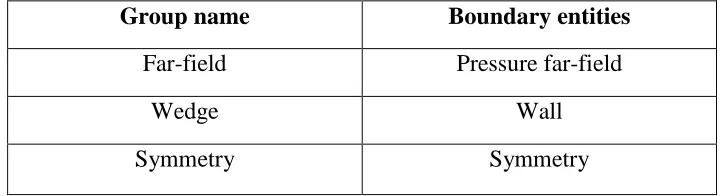
[image:30.612.164.524.329.416.2]To specify the boundary type the boundary need to label (ABCDEF) as far-field, (HG) as wedge and (FG, HA) as symmetry. Recall that these will be the names that show up under boundary zones when the mesh is read into FLUENT. At the first create groups of edges and then create boundary entities from these groups. First, so the group it will be as AB, BC, CD and DE together and define it as far afield group, and then group the other edges as shown in the table (2.2), now the defined of all wedges as groups the geometry can define the boundary type in Gambit as shown in table (2.3), then save the geometry in Gambit and save it as mesh file.
Table 2.2: Defining the wedges as group.
Group name Edges in group
Far-field AB, BC, CD, DE, EF
Wedge GF
Symmetry FG, HA
Table 2.3: Defining the groups to the boundaries.
Group name Boundary entities
Far-field Pressure far-field
Wedge Wall
[image:30.612.166.527.519.617.2]17
2.4.1.4 Set Up Problem in FLUENT:
In this case firstly open the Fluent software then read the case which have done in the previous steps then make check on this case to make sure there are no problems in the case then define the properties of the problem, for define the solver turn on a density based and an explicit because the problem expect an oblique shock then for define the viscous turn on an inviscid flow This means the solver will neglect the viscous terms in the governing equations.
In compressible flow, the energy equation is coupled to the continuity and momentum equations. So the problem need to solve the energy equation for our problem, so turn on the energy equation from defining the energy, and then make sure the material is air from defining material and we will set the density to ideal gas, CP is constant and equal to 1006.43 j/kg-k and also the Molecular Weight is constant and equal to 28.966 kg/kgmol. For selecting the ideal gas option means that FLUENT will use the ideal gas equation of state to relate density to the static pressure and
temperature. And then will go to define the boundary conditions as far afield to pressure far-field and set the (Gauge Pressure to 101325, the Mach number to 2, X-Component of Flow Direction to 1 and the temperature to 300K. We are assuming ambient
temperature.) , Set wedge to wall boundary type and symmetry to symmetry type.
2.4.1.5 Solve:
To solve the problem use a second-order discretization scheme. Then set the initial guess values for the iterative solution. Use the far-field values (M=3, p=1 atm, T=300 K) as the initial guess for the entire flow field. Then set all the equations to 1e-6 and set the iteration number to 5000 then solve the problem, after finish the iterations save the data and analysis the results which we get from the Fluent software.
18
2.4.1.6 The Analytic Solution of Compression and Expansion Wave:
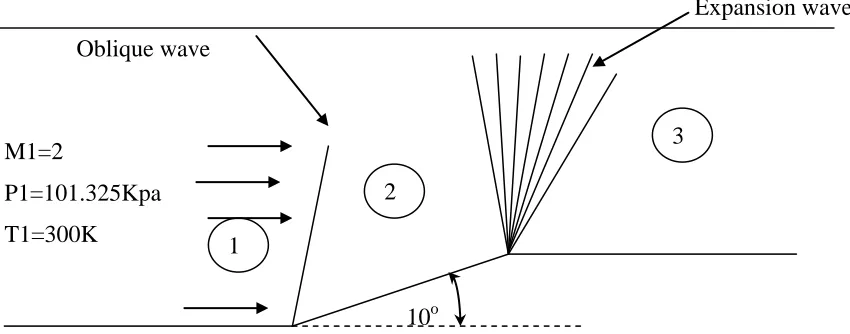
The flow problem as described in the previous sub chapter actually can be solved analytically. Refer to the Figure 2.6, For a given supersonic flow condition at entry station, let say, for example, the Mach number M, pressure P and temperature T are given as 2, 101.325Kpa, and 300Ko respectively. The bottom surface deflected at point A and B. At point A such positive deflection with respect to the flow direction create an oblique shock wave, while at the point B, the surface deflection sees with respect to the flow direction is a negative angle as result an expansion wave occurred at that point. For simplify the explanation, let the flow domain in before point A is Region (1), in between region A and B as Region (2) and after B as flow region (3). For a given flow condition in region (1), one can determine the flow condition region (2) by solving as oblique shock wave and for the flow in region (3) as expansion wave. This problem can be described schematically as shown in the Figure 2.9 bellows
Expansion wave Oblique wave
M1=2
P1=101.325Kpa T1=300K
[image:32.612.113.538.386.553.2]10o
Fig 2.9: Simple geometry for inlet of airplane engine.
Flow solution for region (2) as an oblique shock wave problem for a given Mach number M1, deflection angle δ1, and then the oblique shock angle β can be obtained through solving the M-δ-β equation defined as:
𝑀 =𝑉
𝑎 2.17
Where (V) is velocity on one − dimensional flow, and (a) is Local speed of sound 2
3
19 δ is deflection angle
Where:
𝑡𝑎𝑛𝛿 =2𝑐𝑜𝑡𝛽(𝑀1
2𝑠𝑖𝑛2𝛽 − 1)
2 + 𝑀12(𝛾 + 𝑐𝑜𝑠2𝛽) 2.18 β is oblique shock angle
Above equation is non linear algebraic equation, hence an iteration process is required. However one can use another method called as Graphical method. Equations the M-δ-β equations have already available in graphical form, so for given Mach and deflection angle δ, by use those graph which the solution for oblique shock β=39o
: Knowing this oblique shock, then other flow properties at the flow region (2) can be obtained sequentially as:
𝑀𝑁1 = 𝑀1𝑠𝑖𝑛𝛽 = 2 × 𝑠𝑖𝑛39 = 1.258
To find the properties at MN1=1.258, there is table called (Normal Shock Wave) can find those properties. So now can get:
𝑀𝑁2 = 0.808, 𝑃2
𝑃1 = 1.6793, 𝑇2
𝑇1 = 1.16433
From Eq:
𝑀2 = 𝑀𝑁2
sin 𝛽 − 𝛿 = 1.666
And from:
𝑃2 𝑃1
= 1.6793 → 𝑃2 = 170.124𝐾𝑝𝑎
𝑇2
𝑇1 = 1.16433 → 𝑇2 = 300.16433𝐾 𝑜
20
there is table called (Prandtl-Meyer Flow Table) from this table can find the 2 at M=1.666 which fined as:
2 = 16.8088°
From this value can find V3 from the Equation:
3 =2+ 𝛿 = 16.8088 + 10 = 26.8088°
Now from the same table can find M3 which equal (2.016) and to find the properties at regain 3 can find it from table called (Isentropic flow tables for γ=1.4) at M3=2.016 can find:
𝑇𝑜
𝑇 = 1.81286 → 𝑇3 = 165.5𝐾, 𝑃𝑜
CHAPTER 3
3.0 TOTAL VARIATION DIMINSHING SCHEME
3.1. Basic Idea TVD – Runge-Kutta Scheme
Numerical TVD schemes have been developed by various investigators over the last several years and more are being introduced at present(K.A.Hoffmann). The various TVD schemes can be broadly categorized and subcategorized. First, TVD schemes may be classified as first-order TVD schemes, second-order TVD schemes which are usually referred to as high resolution schemes, and predictor-corrector type TVD schemes. Furthermore, in each category, the formulation may be explicit or implicit. In terms of finite difference approximation, the resulting formulation may be classified as symmetric or upwind. Furthermore, for each formulation, different functions may be available for flux limiters. Thus, within each category, numerous formulations can be written. To familiarize with the TVD scheme, it can be done by a prototype of Euler Equation in the form of scalar hyperbolic partial differential equation which can be written as:
𝜕𝑢 𝜕𝑡 +
𝜕𝐸
𝜕𝑥 = 0 (3.1)
22
equation. The approximate solution u will not increase as the computational time in progress if fulfill the condition:
𝑇𝑉 𝑢𝑛+1 ≤ 𝑇𝑉 𝑢𝑛 3.2
Where:
𝑇𝑉 𝑢𝑛 ≡ 𝑢𝑖+1𝑛 − 𝑢𝑖𝑛 +∞
−∞
(3.3)
In implementing the Runge-Kutta fourth order time integration scheme combined with the spatial discretization which satisfies the TVD condition (Eq. 3.2) can be done through the normal use of Runge-Kutta scheme and then apply TVD
formulation the last step. For a given a scalar partial differential Eq (3-1) the Fourth Order Runge-Kutta scheme can be implemented in the form:
𝑢𝑖 1 = 𝑢𝑖𝑛 3.4
𝑢𝑖 2 = 𝑢𝑖𝑛 −∆𝑡 4
𝜕𝐸 𝜕𝑥 𝑖
1
3.5
𝑢𝑖 3 = 𝑢𝑖𝑛 −∆𝑡 3
𝜕𝐸 𝜕𝑥 𝑖
2
3.6
𝑢𝑖 4 = 𝑢𝑖𝑛− ∆𝑡 2 𝜕𝐸 𝜕𝑥 𝑖 3 3.7
(𝑢𝑖𝑛+1)𝑅𝐾 = 𝑢𝑖𝑛−∆𝑡 𝜕𝐸 𝜕𝑥 𝑖
4
23
Where:
𝜕𝐸 𝜕𝑥 𝑖
𝑚
= 𝐸𝑖+1 (𝑚 )
− 𝐸𝑖−1(𝑚 )
2∆𝑥 , 𝑤ℎ𝑒𝑟𝑒 𝑚 = 1,2,3,4 3.9
In combining with the TVD scheme, so the method called as the Fourth Order Runge-Kutta – TVD scheme, the dependent variable which at the last stage time integration completed by (Eq.3.8),is added with one additional stage for calculating u at the time level t=t n+1 as:
𝑢𝑖𝑛+1 = (𝑛𝑖𝑛+1)𝑅𝐾− 𝛥𝑡
2𝛥𝑥 ɸ𝑖+12
𝑛 − ɸ
𝑖−12
𝑛 (3.10)
Where:
ɸ 𝑖+12
𝑛 = 𝜎 𝛼
𝑖+12 𝐺𝑖+1+ 𝐺𝑖 − 𝜓 𝛼𝑖+12+ 𝛽𝑖+12 ∆𝑢𝑖+12
𝑛 3.11
ɸ 𝑖−12
𝑛 = 𝜎 𝛼
𝑖−12 𝐺𝑖+ 𝐺𝑖−1 − 𝜓 𝛼𝑖−12+ 𝛽𝑖−12 ∆𝑢𝑖−12
𝑛 3.12
With:
𝜓 𝑦 =
𝑦 for 𝑦 ≥ 𝜀 𝑦 2+ 𝜀2
2𝜀 for 𝑦 < 𝜀
3.13
Where:
0 ≤ 𝜀 ≤ 0.125, and
𝜎 𝛼 𝑖+12 =
1
2𝜓 𝛼𝑖+12 + ∆𝑡 ∆𝑥 𝛼𝑖+12
24
And
𝛽𝑖+1 2
= 𝜎 𝛼𝑖+1 2
𝐺𝑖+1− 𝐺𝑖 ∆𝑢
𝑖+12 , ∆𝑢
𝑖+12 ≠ 0 0 , ∆𝑢
𝑖+12 = 0
And
𝐺𝑖 = 𝑚𝑖𝑛𝑚𝑜𝑑 ∆𝑢𝑖−1 2
, ∆𝑢
𝑖+12 3.14
𝐺𝑖 = ∆𝑢
𝑖+12∆𝑢𝑖−12+ ∆𝑢𝑖+12+ ∆𝑢𝑖−12 ∆𝑢
𝑖+12+ ∆𝑢𝑖−12
If ∆𝑢𝑖+1/2+ ∆𝑢𝑖−1/2 = 0, 𝑡ℎ𝑒𝑛 𝐺𝑖 = 0
𝐺𝑖 = ∆𝑢
𝑖−12 ∆𝑢𝑖+12 2
+ 𝜔 + ∆𝑢
𝑖+12 ∆𝑢𝑖−12 2
+ 𝜔
∆𝑢 𝑖+12
2
+ ∆𝑢 𝑖−12
2 + 2𝜔
, 10−7 ≤ 𝜔 ≤ 10−5 3.15
𝐺𝑖 = minmod 2∆𝑢
𝑖−12, 2∆𝑢𝑖+12, 1
2 ∆𝑢𝑖+12+ ∆𝑢𝑖−12 3.16
𝐺𝑖 = 𝑆 ∗ max 0, min 2 ∆𝑢𝑖+1 2
, 𝑆
∗ ∆𝑢
𝑖−12 , min ∆𝑢𝑖+12 , 2𝑆 ∗ ∆∆𝑢𝑖−12 (3.17)
Recall that
REFERENCES
Batchelor. G. K (1967). An Introduction to Fluid Dynamics. Cambridge UniversityPress.
C.HIRSCH (1990). Numerical Computation of Internal and external flows.
Dongfang Liang, Roger A. Falconer and Binliang Lin (2006). Comparison between TVD-MacCormack and ADI-type solvers of the shallow water equations.
Edisson Sávio de Góes Maciel (2007). Comparison Among Structured First Order Algorithms in the Solution of the Euler Equations in Two-Dimensions.
H.C.Yee and P.Kutler (1983). Application of Second-Order-Accurate Total Variation Diminishing (TVD) Scheme to the Euler Equations in General Geometries.
HILEN MARIE FELICI (1992). A coupled Eulerian /Lagrangian method for the
solution of three dimensional vertical flows.
K_A.Hoffmann, Staven T Chiang (2004). Computational fluid dynamics.
Jack D. Mattingly (2006). Elements of Propulsion: Gas Turbines and Rockets.
140
Mark Anthony Driver. B.A.E.. M.S. (1991). High-Resolution TVD schemes for the analysis of 1.Inviscid supersonic and transonic flows. 2. Viscous flows with
shock-induced separation and Heat transfer.
Patrick H.Oosthuizen (1997). Compressible fluid flow.
Raph Levien (2008). The Euler spiral: a mathematical history.