Munich Personal RePEc Archive
Does the Way in which Students Use
Computers Matter for their
Performance?
Ponzo, Michela
Department of Economics and Statistics, University of Calabria
2010
Online at
https://mpra.ub.uni-muenchen.de/25483/
Does the Way in which Students Use Computers Matter for
their Performance?
Michela Ponzo♣
Department of Economics and Statistics, University of Calabria, 87036 Arcavacata di
Rende (CS), Italy. E-mail: [email protected].
In this paper we investigate possible differences in student performance depending on the
frequency and the type of computer usage both at home and at school of 15-years-old Italian
students. Using the PISA 2006 dataset and controlling for a wide range of individual and school
characteristics, our results suggest that students using the computer at home very often obtain
higher test scores than those who never use it. More importantly, we find a significant positive
correlation between student achievement and the use of computer at home as
educational/learning device. Focusing on the frequency of computer usage at school, it emerges
that student achievement increases with the intensity of computer use but the effect becomes
smaller the more often they use the computer and even negative when students use the computer
at school almost every day.
JEL classifications: I2, I21.
Keywords: Educational production function, Computers at home, Computers at school, Students
achievement, PISA.
♣ I would like to thank Vincenzo Scoppa and Maria De Paola for useful comments and suggestions. The usual
1. Introduction
The effects on student performance of resources devoted to education have been deeply
investigated in the economic literature and represent a central concern in the debate about
educational policies. Researches on educational production function analyze a number of
educational factors affecting students performance. Among all the inputs entering in the process of
student learning, computer use constitutes a relevant topic in investigating the effects of technology
on student achievement and on the returns of education.
A stream of research has recently investigated the impact of the computer use on worker
productivity and wages in the labor market. In a seminal paper, Krueger (1993) has showed that
computer users earn substantially higher wages than non-users. He has found a substantial computer
wage premium ranging between 10% and 15%, interpreted as a premium for computer skills.
However, DiNardo and Pischke (1997) cast doubt that this finding reflects true returns to computer
skills, since they have found a premium of similar size for workers’ use of pens and pencils. On the
basis of this result they have concluded that not computer skills but a more general set of
unobserved skills should be responsible for the computer wage premium. More recently, Borghans
and ter Weel (2004) have found that while writing documents and making calculations using
advanced mathematical or statistical procedures have a significant positive impact on wages, basic
computer skills do not seem to matter for earnings.
Apart from this evidence focusing on the impact of computer use on worker wages, an
increasing literature investigates the impact of using computers (both at home and at school) on
student achievement. Evidence on this topic shows mixed results. Reviews of observational studies
on the effect of classroom computers on student achievement reveal either no impact or negative
effects of using computers for instructional purposes on students outcomes (Oppenheimer, 1997;
Kirkpatrick and Cuban, 1998; Wenglinsky, 1998). In more recent years, a stream of research exploits
at school (Angrist and Lavy, 2002; Borman and Rachuba 2001; Rouse and Krueger, 2004). In a
quasi-experimental study in Israeli schools, Angrist and Lavy (2002) find that the introduction of
computer-aided instruction (CAI) exerts a negative effect on fourth grade math scores while it has no impact on
student performance at the eight grade level for math and other subjects.
Similarly, Borman and Rachuba (2001) and Rouse and Krueger (2004) independently analyze
randomized experiments of an instruction computer program designed to improve student language
and reading skills of some American public schools. In both studies, large impacts of the
computerized instruction can clearly be ruled out.
In addition to this stream of research focusing on computer use at school, other studies
evaluate the impact of the use of computer at home. Attewell and Battle (1999) find that students
who access to the computer at home for educational purposes obtain higher test scores in
mathematics and reading. Papanastasiou, Zembylas, and Vrasidas (2003) show that students who
frequently use computers at home tend to have higher achievement in science test scores. However,
results also show that student achievement in scientific literacy is negatively related to the use of
certain types of educational software commonly used in scientific research. In a similar vein, Fuchs
and Woessmann (2004) investigate the effects of ICT use at home and at school on student
achievement. The authors find that student performance shows an inverted U-shaped relationship
with the extent of computer and internet use at school whereas a negative correlation emerges
between student achievement in math and reading and the availability of computer at home. By
contrast, student achievement appears to be positively related to the use of computers at home for
accessing emails and Web pages.
More recently, Wittwer and Senkbeil (2008) find that student access to the computer is not
related to their performance in mathematics. However, a positive effect on mathematical
achievement is observed for a small group of students who use the computer in problem-solving
The Italian educational literature, analyzing the determinants of student performance using
the PISA dataset, has mainly focused on the role of family background, on school level peer effects
(Checchi 2004) and on the causes of the existence of regional disparities in student outcomes
(Checchi, 2004; Tramonte, 2004; Bratti, Checchi, Filippin, 2007; Montanaro, 2007).
The current paper focuses on the effectiveness of computer usage both at home and at
school on Italian student achievement. Using the third cycle of the Survey Programme for
International Student Assessment (hereafter indicated as PISA) – and in particular a short
questionnaire on student familiarity with ICT – at first we analyze whether the frequency in the use
of the computer at home and at school, without regards to the type of usage, is related to student
test scores; subsequently, we evaluate whether the specific way in which the computer is used at
home (learning or leisure activities) affects student performance as measured by their secondary
educational test scores. As far as we know, there are no other studies on the relevance of the
frequency and the way of computer usage on student achievement in Italy.
In estimating the educational production function using cross-sectional data, there could be a
risk of omitting relevant variables, since many factors – such as ability, motivation, support from the
family – determining student performance are very difficult to observe and measure. In order to
reduce biases deriving from omitted variables, in our estimations we control for a very wide range of
individual characteristics, family background and school variables provided by the rich PISA dataset.
It is worthwhile to stress that the estimated effects should be considered with care since they
describe a correlation rather than cause-and-effect. With data at hand we cannot exclude the
influence of omitted factors or that causality runs in the opposite direction. However, the
consistency of our results with other findings in the international literature is quite reassuring.
Our main findings suggest that students using the computer at home almost every day
achieve higher test scores than those who never use it. On the contrary, it emerges a negative
correlation between student performance and the use of the computer at school on a daily basis.
at school and student performance. Focusing on the way in which computer is used, we find
evidence of a significant positive correlation between student achievement and computer usage as
learning device at home.
The paper is organized as follows. Section 2 describes the PISA dataset we use and gives
some descriptive statistics. Section 3 reports and discusses several specifications of a regression
model relating the computer usage both at home and at school to student outcomes. Section 4
concludes.
2. The Data
The data source we use for our empirical analysis is the survey on the Programme International
Student Assessment (PISA) developed every 3 years by the Organization for Economic Cooperation
and Development (OECD). PISA is a system of international assessments focusing on 15-year-olds’
capabilities in reading, mathematics and science literacy. In this paper we use the third wave of PISA
which refers to data collected in 2006 mainly focused on measuring performance on science literacy.
The PISA contains a rich set of information on students’, parents’ and schools characteristics1. The
latter are collected through a questionnaire completed by school principals. PISA 2006 also collected
data from some countries that choose to administer a short questionnaire on students familiarity
with Information and Communication Technology (ICT). In the ICT questionnaire, students were
asked about their familiarity with ICT, the availability and frequency of ICT use, and their confidence
in performing activities related to ICT. The comprehensiveness of PISA dataset allows researchers to
include a number of variables that reduces the potential bias due to the omission of relevant
variables typical of this type of studies.
The Italian sample includes 21,773 students at the age of 15 tested in 806 schools. It is
stratified for macro-geographical areas (North West, North East, Centre, South and Island) and for
type of secondary schools attended (Lyceums, Technical schools and Vocational institutes). In a
number of cases, information on parents’ and schools’ backgrounds are missing values. Our final
sample includes 17, 167 observations.
We define the dependent variable, Test Scores, as the mean of student performance in the
fields of Reading, Mathematics and Science. The questions we use to define our variables of interest
are taken from the student ICT questionnaire and are the followings: 1) “How often do you use a
computer at home?” Five answer categories are given: “almost every day”, “once or twice a week”,
“a few times a month”, “once a month or less”, “never”. Using this question, we define four dummy
variables capturing the frequency of computer usage at home by students (the omitted category is
constituted by students who never use the computer at home). Similarly, students also report how
often they use computers at their school. Again, we use four dummy variables defined as above.
In addition, in order to investigate whether the various ways in which students use a
computer at home have differential effects on their academic performance, we use the following
question: 2) “How often do you use computers for the following reasons?” As above five answer
categories (ranging from “almost every day” to “never”,) are given for each of the following eleven
possible alternatives: “Browse Internet”, “Play games”, “Write documents”, “Collaborate on
Internet”, “Use spreadsheets”, “Download software”, “Graphics programs”, “Educational software”,
“Download music”, “Write programs”, “Email or chat rooms”.
On the basis of the specific activities that students carry out using the computer, we group
together all the student’s Learning Activities (including write documents; use spreadsheets;
collaborate internet; use educational software and write programs) and the student Leisure Activities
(browse internet; play games; download software; graphics programs; download music and “email or
chat rooms”) that we include in the analysis. In order to take into account student choices (“almost
every day”, “once or twice a week”, “a few times a month”, “once a month or less”, “never”) in all
the different activities, for each group we undertook a principal component analysis summarizing the
creates linear combinations of the original variables which capture the greatest variance. We only
use the first principal component (PCA).
Unfortunately, the lack of information on the PISA dataset on the way in which students use
the computer at school, does not allow us to investigate whether the different ways in which
students use the computer at school have differential effects on their performance.
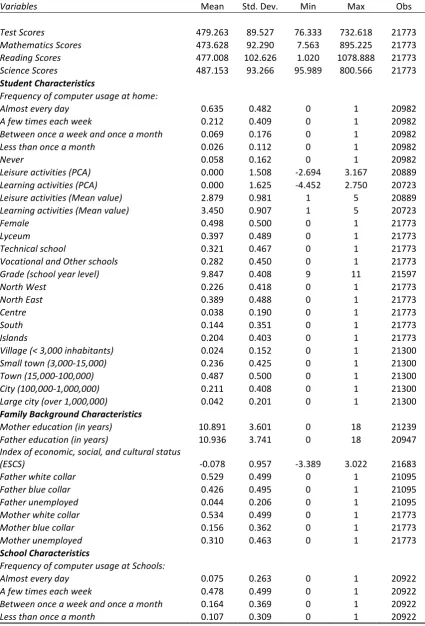
Table 1 presents descriptive statistics for the main variables used in the analysis. The mean
value of Test Scores is 479.26 with a standard deviation of 89.53. About 90% of Italian students have
at least one computer available to them at home. Based on a five-point scale measuring overall
frequency of use, the great majority of students (63%) reports daily computer usage at home while
about 31% of them use it between a few times each week and less than once a month. A little
minority of students (6%) never use the computer at home.
[Table 1 around here]
Females make up 50% of the sample. Students mainly came from three different types of
high schools: Lyceums (about 40%), Technical (32%) and Vocational/Other schools (about 28%)2.
Students living in the North-West constitute 23% of the population, those residing in the
North-East are 39% while 4% lives in the Centre, 14% in the South and 20% on the Islands3. Schools
are located in five different types of community: village or rural area (below 3,000 inhabitants) that
make up 2.4% of the sample, small town with 3,000 to about 15,000 inhabitants (24%), town with
15,000 to about 100,000 inhabitants (49%), city with 100,000 to about 1,000,000 inhabitants (21%)
and large city with over 1,000,000 inhabitants (4.2%).
Father education and Mother education represent the number of years of schooling of
parents. It is set at 0 for no educational qualification; 5 for elementary school; 8 for middle school; 11
for some high school; 13 for high school; 18 for university. The average number of years of parents
2
The Italian secondary school system can be described as tripartite, with an academic “generalist track” (Lyceum), a technically oriented education (Technical school) or a more labour market orientated track (vocational track).
3
schooling in the sample is 11. The ESCS index is derived from five variables related to the students’
family background: highest level of parental education, highest parental occupation, family wealth,
cultural possessions, and home educational resources. The mean value of the ESCS is -0.078.
As regards computer access of students at school, 7.5% reports daily usage, about 48% of
them use the computer a few times each week and 11% less than once a month. The average
number of computers per student available at school is 0.19 (roughly one computer every 5
students).
The average school size (given by the total number of boys and girls enrolled) is 662.83.
3. An Empirical Analysis of the Relationship between Computer Usage and Student
Achievement
In this Section we analyze whether the frequency with which students use the computer at home
and at school as well as the way in which students use the computer at home are related to their
academic achievement.
Our estimates are based on the following multivariate educational production function:
ε
β
β
β
β
β
β
β
β
+ +
+
+ +
+ +
+ +
=
∑
∑
= =
where is the Test Scores achieved by student i at school j, is a vector of individual
characteristics, and are two vectors of dummy variables describing the frequency of using
the computer at home and at school respectively, and
represent a measure of the way in which students use the computer at home,
is a vector of variables capturing family background characteristics, is a vector of school
Results of our estimations concerning the effects of the frequency and the way of computers
use at home on student achievement are reported in Table 2. In all equations sample weights
provided in the PISA dataset are used. The reported standard errors are robust to the
heteroskedasticity and corrected for the potential clustering of the residual at the school level.
[Table 2 around here]
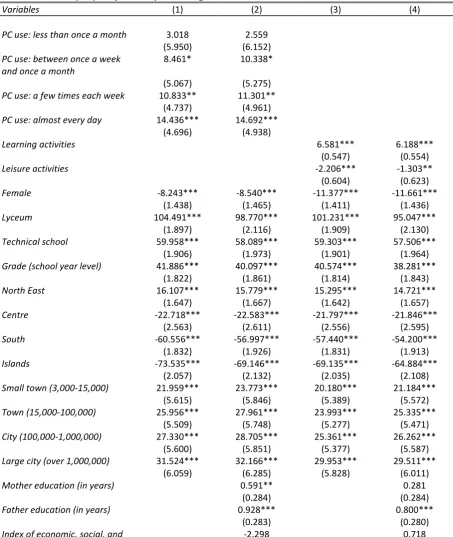
We investigate if students who report more frequent use of computers at home obtain
higher test scores than those who never use it. Column (1) shows the estimated coefficients in a
model in which we only use individual characteristics, macro-geographical variables and city size
dummies. From the estimates, it emerges that students achieve higher test scores the more often
they use the computer. Specifically, results show that students using the computer at home almost
every day perform much better (14.4) than those who never use it (reference group). The coefficient
is significant at the 1% level. Students using the computer a few times each week obtain higher test
scores than those who never use it (10.83) even if the impact on test scores is not as strong as those
of students using the computer every day. At the contrary, it seems that students who use the
computer at home less than once a month do not significantly differ from the reference category.
However, the fact that students achieve higher test scores the more often they use the
computer at home may simply reflect that more able students tend to use more frequently the
computer. In order to reduce the bias deriving from omitted variables, in our estimations we control
for detailed information on student abilities as well as for a wide range of individual characteristics
and family background.
As regards individual controls, it emerges that female students have lower educational
achievements. The difference with respect to male students amounts to 8.2 points. This difference
changes only slightly in the specifications including further controls. Students attending a Lyceum
(Scientific and Humanities High schools) perform much better (+104.49) than those coming from
Vocational and Other schools (reference group). Furthermore, students attending Technical schools
those of students in Scientific/Humanities schools (+59.96). The advantage of students attending
Lyceum may capture both an effect of student ability or family socio economic conditions (typically,
Italian students with better family background enrol in Lyceum). Moreover, students with a higher
High School level obtain a much better academic performance.
In column (1) we also control for macro-regional dummies and for the size of the cities. In
particular, geographical dummy variables may capture broader socio-economic conditions of
different regional labour markets. Individuals living in areas with a badly functioning labour market
(South and Islands in Italy) experience higher unemployment rate. The presence of this factor and
the distortions affecting labour markets (see De Paola and Scoppa, 2007) may discourage students to
invest in human capital. As expected, it emerges that students in Southern Italy perform significantly
worse than those in the North. Moreover, we control for City Size dummies to take into account the
fact that larger cities tend to be associated with a greater endowment of human capital and, as a
consequence, more prone to generate externalities favouring the accumulation of skills. From our
analysis it appears that the performance of students living in cities and metropolitan areas is
significantly better than those attending schools located in small towns.
In column (2), several controls accounting for family background are added. It is common
that students with better socio economic background tend to have better educational resources and
obtain higher academic outcomes. In fact, in our analysis the educational level (in years) achieved by
the parents of student is strongly positively related to the their educational performance. Besides,
the dummy variables accounting for parental occupational conditions (White collar/Blue collar
classification) have a strong and highly significant effect on student performance (the base category
is father/mother not employed).
In sum, our results show that, controlling for a wide range of individual characteristics and
socio-economic background, the more often students use a computer at home the higher the test
In columns (3) and (4) we investigate the effects of the specific uses to which computers are
taken at home. Specifically, we analyze (column 3) whether students differing in the way they use a
computer at home, that is, as learning or leisure device, achieve different academic outcomes.
It emerges that students engaging in educational activities with the help of the computer at
home achieve better learning results. This finding is probably due to the fact that using the computer
a home as educational device facilitate learning and therefore knowledge. Conversely, using a
computer for leisure purpose leads to worse results at school. Particularly, for these students the
computer probably plays an important role in entertainment meaning that an excessive use of it can
reduce time devoted to study outside of school. These results are in line with previous studies that
point out that excessive game playing, for example, is negatively related to school performance (e.g.,
Gentile, Lynch, Ruh Linder, and Walsh, 2004), whereas educational activities are related to better
learning outcomes (e.g., Wenglinsky, 1998; Fuchs and Woessmann, 2004). This pattern of results
holds once family characteristics are controlled for in column (4). It emerges a statistically significant
and sizable positive effect on student performance of using the computer at home as learning device
(+6.19) whereas, students using the computer at home for leisure activities achieve worse learning
outcomes (-1.30). Moreover, as robustness check, we compute the average values of the variables
measuring both the Learning Activities and the Leisure Activities in order to analyze how students
differ in their ways of using a computer at home. However, these different measures (mean values
and PCA) lead to very similar results therefore, in our estimations we merely include the two indices
based on the principal component analysis.
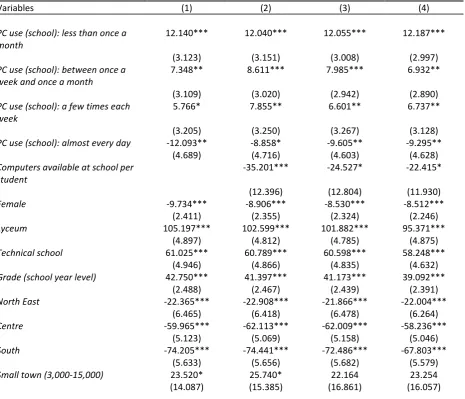
In Table 3 we estimate several specifications of the relationship between frequency of
computer usage at school and student performance. Specifically, we investigate if students who
report more frequent use of computers at school achieve higher test scores than those who never
use it. In addition we evaluate whether the availability of computers per student at school is related
to his/her performance.
By controlling for individual characteristics and geographical variables, column (1) shows that
the frequency of computer usage at school is related to students performance in a non-linear way. In
fact, we find that students using computers at school less than once a month perform much better
(12.14) than those who never use it (the reference category). However, students using the computer
few times each week perform worse than those using it less than once a month. More importantly, it
seems that students achieve even lower scores when they use computers at school almost every day
(-12.01 with respect to the reference category).
The negative effect of an excessive computer use at school on student test scores may reflect
the fact that, even if computerized instructions constitute a valuable input in the student learning
process, a high intensity of computer use at school may substitute alternative forms of teaching
instruction, thus producing negative effects on student performance (Fuchs and Woessmann, 2004).
The effects of the frequency of computer usage at school on student performance remain almost the
same once we control for school characteristics and family background (columns 3 and 4).
Column (2) adds to the first specification the variable on the number of computers per
student available at school. This variable is negatively related to student performance and the effect
remains throughout the other specifications that add school and family background control variables.
In the other specifications, we add as control variables a number of school characteristics such as
school size, class size and a variable capturing the quality of educational resources, since as shown in
other studies (Fuchs and Wossmann, 2004, among others), students enrolled at schools with a
greater endowment of resources tend to perform substantially better in terms of educational
achievement. However, our results of interest remain almost the same in all models: students who
use the computer at school every day perform worse than those who use it less frequently, and
hence a higher intensity of computer use at school leads to a negative effect on student
achievement. Furthermore, the mere availability of computers per student at school is negatively
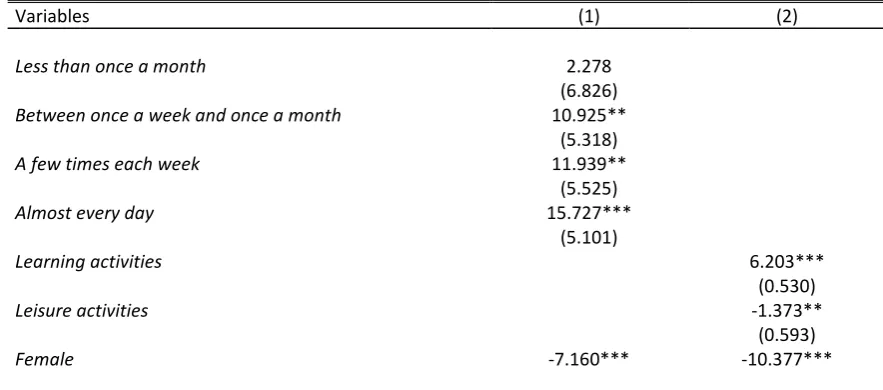
Finally, results reported in Table (4) are based on the most complete specification, which
controls for a wide range of individual characteristics, family background and school variables, to
investigate possible differences in student performance depending on how often a computer is used
both at home and at school.
[Table 4 around here]
In accordance with the previous findings, it emerges that student performance is higher as
the frequency of computer use at home increases. From our estimations it emerges that using the
computer almost every day leads to an increase on student outcomes of about 16 points. However,
this does not mean that computer use causes higher performance, but simply that there is a
relationship between the two variables. It could be that higher performance and the frequency of
computer use are the consequence of an omitted variable that is, for example, the higher ability of
student or his/her greater motivation. It is worthwhile to note that with data at hand, in our analysis
we partly capture prior ability of students by controlling for the type of High School attended, the
High School level, father and mother education, parental occupational, resources available at home,
and so on.
In contrast to the effects of computer use at home, the frequency with which students use
the computer at school seems to produce a negative effect on student performance. This effect
becomes negative and statistically significant when student use the computer at school almost every
day. Since it appears to be counterproductive using computers at school almost every day, results
suggest that the computer can be beneficial to student achievement if it is not conceived as a
substitute for conventional forms of teaching instruction.
In addition, students perform sizably and statistically significant better when they use the
computer at home for learning purpose. Conversely, it emerges that using the computer at home as
4. Concluding Remarks
In this study we have attempted to explore the effects of the frequency of computer use at home
and at school on the test scores of 15 years old students in Italy as reported in the PISA 2006 survey.
Specifically, we have investigated if secondary school students which frequently use the computer at
home perform better than those making a more limited use of it. In addition, in order to examine the
effectiveness of students computer use, we have also focused on the way in which students use the
computer at home and how this may affect their school performance. Finally, we have analysed if the
frequency of computer use at school has an impact on student performance.
Controlling for a wide range of individual variables, family background and school
characteristics, our results suggest that students using the computer at home almost every day
obtain higher test scores than those who never use it. Moreover, we find a significant positive
correlation between student academic achievement and an intense computer usage at home as
educational device. Notwithstanding the fact that, in the most complete specifications, we are
controlling for a host of factors which are correlated with student educational attainment, we find
evidence that student computer-related behavior at home plays an important role in predicting their
academic achievement. In particular, students using a computer at home almost every day increase
their test scores of about 16 points, significantly at the 1 % level. In addition, results suggest that
students differ in their academic performance depending on how they use the computer at home.
Whereas leisure activities do not benefit student achievement, the use of the computer for learning
purpose improves their school performance of about 6.5 points.
As regards other relevant findings of our investigation, it emerges that the frequency of
computer usage at school has a negative effect on student performance. Moreover it emerges that
the mere availability of computers per student at schools leads to lower academic achievement.
From a policy perspective, this analysis indicates that efforts should shift from providing
access to increasing the use of Information and Communication Technologies in ways that are
A limitation of this study is the cross sectional nature of PISA dataset that does not allow us to be
sure of the existence of a causal effect. In other words, the relationship between frequency of
computer use or specific types of software usage with academic achievement can not be taken as
complete evidence of the impact of computers on learning. For example, it is possible that omitted
factors related to the use of computers may indirectly influence educational performance. In order to
limit these problems in our empirical analysis we have controlled for a host of individual
characteristics, socio-economic background and school characteristics.
Despite these shortcomings, the analysis performed shows that it is not the use of computers
itself that influence the student performance, but the frequency of computer usage, the way in
References
Angrist, J. and Lavy, V. (2002). New Evidence on Classroom Computers and Pupil Learning. Economic
Journal 112 (482), 735-765.
Attewell, P. and Battle, J. (1999). Home Computers and School Performance. Information Society, 15,
1-10.
Borghans, L. and ter Weel, B. (2004). Are Computer Skills the New Basic Skills? The Returns to
Computer, Writing and Math Skills in Britain. Labour Economics, 11(1), 85-98.
Borman, G. and Rachuba, L. (2001). Evaluation of the Scientific Learning Corporation’s FastForWord
Computer-Based Training Program in the Baltimore City Public Schools. Report Prepared for the
Abell Foundation.
Bratti, M. Checchi, D., Filippin, A. (2007), Territorial Differences in Italian Students’ Mathematical
Competences: Evidence from PISA, Giornale degli Economisti e Annali di Economia, 3 (66),
299-335.
Checchi D. (2004), Da Dove Vengono le Competenze Scolastiche? L’indagine PISA 2000 in Italia” Stato
e Mercato, 72, 413-453.
De Paola, M. and Scoppa, V. (2007), Returns to Skills, Incentives to Study and Optimal Educational
Standards, Journal of Economics, 92 (3), 229-262.
Fuchs, T., and Woessmann, L. (2004). Computers and Student Learning: Bivariate and Multivariate
Evidence on the Availability and Use of Computers at Home and at School. CESifo Working Paper
1321.
Gentile, D., Lynch, P., Ruh Linder, J., and Walsh, D. (2004). The Effects of Violent Video Game Habits
on Adolescent Hostility, Aggressive Behaviors, and School Performance. Journal of Adolescence,
27, 5-22.
Kirkpatrick, H. and Cuban, L. (1998). Computers Make Kids Smarter – Right? Technos Quarterly, 7 (2).
Lupart, J., & Cannon, E. (2002). Computers and Career Choices: Gender Differences in Grades 7 and
Montanaro, P., (2007), La Qualità dell’Istruzione Italiana, Mimeo.
Oppenheimer, T. (1997). The Computer Delusion. Atlantic Monthly 280 (1).
Papanastasiou, E., Zembylas, M., and Vrasidas, C. (2003). Can Computer Use Hurt Science
Achievement? The USA Results from PISA. Journal of Science Education and Technology, 12,
325-332.
Rouse, C. and Krueger, A. (2004). Putting Computerized Instruction to the Test: A Randomized
Evaluation of a “Scientifically-based” Reading Program. Economics of Education Review, 23,
323-338.
Tramonte, L. (2004), Nell’Italia dei Quindicenni, un’Esplorazione delle Differenze Territoriali nelle
Competenze Alfabetiche Funzionali. Come si Modellano le Abilità nella Lettura Rilevate dalla
Ricerca OECD-PISA 2000 Secondo le Componenti Economiche, Culturali e Sociali del Background
degli Studenti”, University of Milan, Mimeo.
Wenglinsky, H. (1998). Does It Compute? The Relationship Between Educational Technology and
Achievement in Mathematics. Princeton, NJ: Educational Testing Service (ERIC Document
Reproduction Service No. ED425191).
Wittwer, J., and Senkbeil, M. (2008). Is Students’ Computer Use at Home Related to their
APPENDIX
Table 1. Descriptive statistics
Variables Mean Std. Dev. Min Max Obs
Test Scores 479.263 89.527 76.333 732.618 21773
Mathematics Scores 473.628 92.290 7.563 895.225 21773
Reading Scores 477.008 102.626 1.020 1078.888 21773
Science Scores 487.153 93.266 95.989 800.566 21773
Student Characteristics
Frequency of computer usage at home:
Almost every day 0.635 0.482 0 1 20982
A few times each week 0.212 0.409 0 1 20982
Between once a week and once a month 0.069 0.176 0 1 20982
Less than once a month 0.026 0.112 0 1 20982
Never 0.058 0.162 0 1 20982
Leisure activities (PCA) 0.000 1.508 -2.694 3.167 20889
Learning activities (PCA) 0.000 1.625 -4.452 2.750 20723
Leisure activities (Mean value) 2.879 0.981 1 5 20889
Learning activities (Mean value) 3.450 0.907 1 5 20723
Female 0.498 0.500 0 1 21773
Lyceum 0.397 0.489 0 1 21773
Technical school 0.321 0.467 0 1 21773
Vocational and Other schools 0.282 0.450 0 1 21773
Grade (school year level) 9.847 0.408 9 11 21597
North West 0.226 0.418 0 1 21773
North East 0.389 0.488 0 1 21773
Centre 0.038 0.190 0 1 21773
South 0.144 0.351 0 1 21773
Islands 0.204 0.403 0 1 21773
Village (< 3,000 inhabitants) 0.024 0.152 0 1 21300
Small town (3,000-15,000) 0.236 0.425 0 1 21300
Town (15,000-100,000) 0.487 0.500 0 1 21300
City (100,000-1,000,000) 0.211 0.408 0 1 21300
Large city (over 1,000,000) 0.042 0.201 0 1 21300
Family Background Characteristics
Mother education (in years) 10.891 3.601 0 18 21239
Father education (in years) 10.936 3.741 0 18 20947
Index of economic, social, and cultural status
(ESCS) -0.078 0.957 -3.389 3.022 21683
Father white collar 0.529 0.499 0 1 21095
Father blue collar 0.426 0.495 0 1 21095
Father unemployed 0.044 0.206 0 1 21095
Mother white collar 0.534 0.499 0 1 21773
Mother blue collar 0.156 0.362 0 1 21773
Mother unemployed 0.310 0.463 0 1 21773
School Characteristics
Frequency of computer usage at Schools:
Almost every day 0.075 0.263 0 1 20922
A few times each week 0.478 0.499 0 1 20922
Between once a week and once a month 0.164 0.369 0 1 20922
Never 0.177 0.381 0 1 20922
Computers available at school per student 0.195 0.181 0 1.769 20619
School size 662.831 419.982 9 2536 20810
Class size 24.931 9.731 13 52 21773
Quality of educational resources (index) 0.214 0.980 -2.639 2.135 21220 Data Source: PISA 2006.
Table 2. Determinants of Students Test Scores. Columns (1-2) Frequency of Computer Usage at Home. Columns (3-4) Way of Computer Usage at Home.
Variables (1) (2) (3) (4)
PC use: less than once a month 3.018 2.559
(5.950) (6.152)
PC use: between once a week and once a month
8.461* 10.338*
(5.067) (5.275)
PC use: a few times each week 10.833** 11.301** (4.737) (4.961)
PC use: almost every day 14.436*** 14.692***
(4.696) (4.938)
Learning activities 6.581*** 6.188***
(0.547) (0.554)
Leisure activities -2.206*** -1.303**
(0.604) (0.623)
Female -8.243*** -8.540*** -11.377*** -11.661***
(1.438) (1.465) (1.411) (1.436)
Lyceum 104.491*** 98.770*** 101.231*** 95.047***
(1.897) (2.116) (1.909) (2.130)
Technical school 59.958*** 58.089*** 59.303*** 57.506***
(1.906) (1.973) (1.901) (1.964)
Grade(school year level) 41.886*** 40.097*** 40.574*** 38.281***
(1.822) (1.861) (1.814) (1.843)
North East 16.107*** 15.779*** 15.295*** 14.721***
(1.647) (1.667) (1.642) (1.657)
Centre -22.718*** -22.583*** -21.797*** -21.846***
(2.563) (2.611) (2.556) (2.595)
South -60.556*** -56.997*** -57.440*** -54.200***
(1.832) (1.926) (1.831) (1.913)
Islands -73.535*** -69.146*** -69.135*** -64.884***
(2.057) (2.132) (2.035) (2.108)
Small town (3,000-15,000) 21.959*** 23.773*** 20.180*** 21.184***
(5.615) (5.846) (5.389) (5.572)
Town (15,000-100,000) 25.956*** 27.961*** 23.993*** 25.335***
(5.509) (5.748) (5.277) (5.471)
City (100,000-1,000,000) 27.330*** 28.705*** 25.361*** 26.262***
(5.600) (5.851) (5.377) (5.587)
Large city (over 1,000,000) 31.524*** 32.166*** 29.953*** 29.511***
(6.059) (6.285) (5.828) (6.011)
Mother education (in years) 0.591** 0.281
(0.284) (0.284)
Father education (in years) 0.928*** 0.800***
(0.283) (0.280)
[image:20.595.71.525.219.757.2]cultural status (ESCS)
(1.490) (1.486)
Father white collar 15.356*** 15.500***
(3.916) (3.967)
Father blue collar 14.377*** 14.786***
(3.917) (3.959)
Mother white collar 12.347*** 10.982***
(1.933) (1.905)
Mother blue collar 11.114*** 10.944***
(2.228) (2.214)
Constant -19.227 -37.673* -0.964 -6.779
(18.713) (20.000) (18.318) (19.463)
Observations 20391 19176 19934 18776
R-squared 0.451 0.459 0.461 0.470
Pseudo R-squared -113641 -106560 -110801 -104040
[image:21.595.69.535.369.768.2]Notes: Ordinary Least Squares Regressions. The dependent variable is Test Scores. Standard errors (robust to heteroskedasticity) are reported in parentheses. The standard errors are corrected for the potential clustering at the school level. The symbols ***, **, * indicate that coefficients are statistically significant, respectively, at the 1, 5, and 10 percent level. Sample weights are used. Data source: PISA 2006.
Table 3. Determinants of Students Test Scores. Frequency of Computer Usage at School.
Variables (1) (2) (3) (4)
PC use (school): less than once a month
12.140*** 12.040*** 12.055*** 12.187***
(3.123) (3.151) (3.008) (2.997)
PC use (school): between once a week and once a month
7.348** 8.611*** 7.985*** 6.932**
(3.109) (3.020) (2.942) (2.890)
PC use (school): a few times each week
5.766* 7.855** 6.601** 6.737**
(3.205) (3.250) (3.267) (3.128)
PC use (school): almost every day -12.093** -8.858* -9.605** -9.295**
(4.689) (4.716) (4.603) (4.628)
Computers available at school per student
-35.201*** -24.527* -22.415*
(12.396) (12.804) (11.930)
Female -9.734*** -8.906*** -8.530*** -8.512***
(2.411) (2.355) (2.324) (2.246)
Lyceum 105.197*** 102.599*** 101.882*** 95.371***
(4.897) (4.812) (4.785) (4.875)
Technical school 61.025*** 60.789*** 60.598*** 58.248***
(4.946) (4.866) (4.835) (4.632)
Grade(school year level) 42.750*** 41.397*** 41.173*** 39.092***
(2.488) (2.467) (2.439) (2.391)
North East -22.365*** -22.908*** -21.866*** -22.004***
(6.465) (6.418) (6.478) (6.264)
Centre -59.965*** -62.113*** -62.009*** -58.236***
(5.123) (5.069) (5.158) (5.046)
South -74.205*** -74.441*** -72.486*** -67.803***
(5.633) (5.656) (5.682) (5.579)
Small town (3,000-15,000) 23.520* 25.740* 22.164 23.254
Town (15,000-100,000) 26.825* 26.615* 20.383 21.970 (13.815) (15.039) (16.695) (15.914)
City (100,000-1,000,000) 28.805** 28.739* 20.057 21.048
(13.885) (15.166) (16.911) (16.149)
Large city (over 1,000,000) 33.591** 32.737** 24.119 24.230
(15.385) (16.565) (18.063) (17.196)
School size 0.014*** 0.014***
(0.005) (0.005)
Class size -0.424* -0.400*
(0.243) (0.233)
Quality of educational resources (index)
1.091 0.637
(2.106) (2.019)
Mother education (in years) 0.333
(0.307)
Father education (in years) 0.808**
(0.335)
Index of economic, social, and cultural status (ESCS)
0.393
(1.602)
Father white collar 14.155***
(5.072)
Father blue collar 13.571***
(4.884)
Mother white collar 11.472***
(1.883)
Mother blue collar 11.020***
(2.429)
Constant -11.514 7.030 13.771 2.161
(28.057) (28.666) (30.210) (30.801)
Observations 20329 19592 19480 18316
R-squared 0.453 0.456 0.460 0.467
Pseudo R-squared -113247 -109092 -108392 -101607
[image:22.595.74.516.574.769.2]Notes: Ordinary Least Squares Regressions. The dependent variable is Test Scores. Standard errors (robust to heteroskedasticity) are reported in parentheses. The standard errors are corrected for the potential clustering at the school level. The symbols ***, **, * indicate that coefficients are statistically significant, respectively, at the 1, 5, and 10 percent level. Sample weights are used. Data source: PISA 2006.
Table 4. Determinants of Students Test Scores.
Variables (1) (2)
Less than once a month 2.278
(6.826)
Between once a week and once a month 10.925**
(5.318)
A few times each week 11.939**
(5.525)
Almost every day 15.727***
(5.101)
Learning activities 6.203***
(0.530)
Leisure activities -1.373**
(0.593)
(2.228) (2.103)
Lyceum 94.192*** 92.865***
(4.902) (4.621)
Technical school 56.975*** 55.950***
(4.703) (4.394)
Grade(school year level) 38.187*** 36.499***
(2.429) (2.399)
North East 17.211*** 15.963***
(4.462) (4.305)
Centre -22.252*** -21.216***
(6.286) (5.960)
South -57.736*** -54.036***
(5.052) (4.904)
Islands -66.886*** -61.619***
(5.577) (5.179)
Small town (3,000-15,000) 23.139 20.774
(16.474) (14.809)
Town (15,000-100,000) 22.238 20.346
(16.324) (14.655)
City (100,000-1,000,000) 21.392 19.532
(16.554) (14.908)
Large city (over 1,000,000) 24.444 22.846
(17.575) (15.927)
Mother education (in years) 0.415 0.111
(0.303) (0.299)
Father education (in years) 0.889*** 0.832**
(0.335) (0.335)
Index of economic, social, and cultural status (ESCS) -1.616 1.087
(1.653) (1.655)
Father white collar 14.568*** 13.827***
(5.092) (5.111)
Father blue collar 13.607*** 13.590***
(4.921) (4.888)
Mother white collar 11.494*** 10.160***
(1.860) (1.857)
Mother blue collar 10.390*** 9.658***
(2.479) (2.440)
Less than once a month at school 12.730*** 13.443***
(3.015) (2.911)
Between once a week and once a month at school 7.419** 8.900***
(2.881) (2.860)
A few times each week at school 6.648** 7.058**
(3.086) (3.051)
Almost every day at school -8.008* -8.791*
(4.728) (4.893)
Computers available at school per student -23.183* -20.580*
(11.916) (10.962)
School size 0.014*** 0.012***
(0.005) (0.004)
Class size -0.430* -0.393*
(0.235) (0.229)
Quality of educational resources (index) 0.624 1.049
(2.038) (1.903)
Constant -10.364 14.012
(31.562) (29.553)
R-squared 0.467 0.476
Pseudo R-squared -100679 -97956