Munich Personal RePEc Archive
The Role of Consumption-Labor
Complementarity as a Source of
Macroeconomic Instability
Gliksberg, Baruch
University of Haifa
June 2010
Online at
https://mpra.ub.uni-muenchen.de/24816/
The Role of Consumption-Labor Complementarity as a
Source of Macroeconomic Instability
Baruch Gliksberg
University of Haifa
June, 2010
The equilibrium ramification of a balanced budget rule are scrutinized in a one sector
growth model augmented with investment frictions and a non-separable utility function
in consumption and leisure. Edgeworth-complementarity between consumption and
labor is formulated so as to generate a positive co-movement of consumption, output,
and hours worked, as found in the data. Calibration of the model to the U.S. economy
provides evidence that a balanced budget rule with a Taylor type monetary policy
induce determinate equilibria.
JEL Classification: C62, C63, E4, E52, E61, E62, E63.
Keywords: Fiscal-Monetary policy; Non-Separable Utility; Consumption-Labor
Complementarity; Endogenous Labor; Stabilization; Determinacy; Investment;
1. Introduction
It seems plausible that versions of business cycle models that exhibit a positive
co-movement between consumption and labor may also exhibit indeterminacies. A
noteable attempt to link between indeterminacies and the positive co-movement
between consumption and labor is found in Benhabib and Wen (2004). They show that
under indeterminacy, aggregate demand shocks are able to explain not only aspects of
actual fluctuations that standard RBC models predict fairly well, but also aspects of
actual fluctuations that standard RBC models cannot explain, such as the hump-shaped,
trend reverting impulse responses to transitory shocks found in US output [Cogley and
Nason (1995)] the large forecastable movements and comovements of output,
consumption and hours [Rotemberg and Woodford (1996)] and the fact that
consumption appears to lead output and investment over the business cycle.
Indeterminacy arises in their model due to capacity utilization and mild increasing
returns to scale. Subsequent literature, such as Linnemann (2008) and Meng and Yip
(2008), contributes to this literature by improving our intuition as to the causes of
indeterminacy.
In Linnemann (2008), equilibrium indeterminacy can arise in a neoclassical growth
model when the government continuously balances its budget through adjustments of
the income tax rate1. Linnemann (2008) puts emphasis on a steady state in which
leisure is constant although consumption may grow. In this case, complementarity
between consumption and employment emerges as a stabilizing mechanism. Meng and
Yip (2008) relax the restrictions commonly imposed on the magnitude of capital
externalities in one-sector models with Cobb-Douglas technology. They find that
indeterminacy can arise either if utility is separable in consumption and leisure and
1
there are negative capital externalities; or: utility is non-separable and the social
elasticity of production with respect to capital is greater than one. In addition, with
Cobb-Douglas technology they show that leisure must be a normal good for
indeterminacy to occur [that is, the presence of income effects on the demand for
leisure is a necessary condition for indeterminacy]. There is no restriction in meng and
Yip (2008) analysis on whether consumption and labor are complements or substitutes.
At this time the literature provide no clue as to the direction of causality where
equilibrium is indeterminate and consumption co-moves with labor, so it remains a
matter of faith. Either, as in Benhabib and Wen (2004) under indeterminacy, aggregate
demand shocks explain the large forecastable movements and comovements of output,
consumption and hours, or , complementarities between consumption and labor are
responsible both to indeterminacies a-la Benhabib and Wen (2004) and to the positive
co-movement found in the data. It should be noted however, that the assumption of
additive separability of utilities with respect to consumption and leisure has been
typically made more for convenience than from conviction. Basu and Kimball (2002)
and Kimball and Shapiro (2008) reject additive separability and arrive at the view that
the utility function exhibits complementarity between consumption and labor by
considering facts about lung-run labor supply. Hall (2008) and Raj (2006) also share
this view. Their view also points to predictions in the context of Benhabib and Wen
(2004). For example, complementarity between consumption and labor provide a
straightforward channel for monetary policy to cause an increase in output. When labor
and consumption are complementary, the increase in consumption is enough to cause
output to increase as long as interest and wealth effects are not too large.
Note that in most RBC models it is implicit that the government seeks to stabilize
fluctoations due to self fulfillinf expectations. In such a case, consumption-labor
complementarity can overturn policy outcomes.
This paper puts emphasis on characterizing policy rules that potentially subdue the
self fulfilling fluctutions that come to pass from the complementarity between
consumption and hours worked. It maintains, however, the assumption that the
consolidated government operates a balanced budget. In simple settings the conditions
under which monetary policy can lead to indeterminacy under a balanced budget
requirement are well understood: active interest rules within a balanced budget
requirement generate determinacy and passive rules generate indeterminacy. Prominent
papers in this literature include Benhabib et. al. (2001) [who discuss monetary policy
rules where money and consumption are Edgeworth complements and the policy
affects households allocation at the private level between financial assets and capital
assets via an arbitrage channel] and Huang and Meng (2007) [who consider an effect of
policy on households via the arbitrage channel and an effect on firms via a pricing
channel in a model with monopolistic competition and nominal price rigidity]. This
paper contributes to existing literature by considering an additional channel: a labor
channel, where consumption and labor are assumed Edgeworth complements.
Accordingly, it is assumed throughout that the utility function is non-separable in
consumption and leisure and, in line with Hall (2008), that consumption and labor are
complements. The upshot of this paper is that controlling the real rate of interest is a
necessary condition for the determination of expectations. The model calibrated to the
U.S economy provides evidence that: a) operating an interest rate rule such that the
expected real rate of interest is above its steady state level during booms and below its
operating an interest rate rule such that the expected real rate of interest is constant at
all times is sufficient to induce equilibrium determinacy; c) a non-monetary version of
the model is expected to exhibit indeterminacies as demonstrated in Meng and Yip
(2008)2.
The rest of the paper is organized as follows: section 2 illustrates a model with
endogenous labor-leisure choice where consumption and labor are Edgeworth
complements. This model is extended to include a concave investment technology and
a cash-in-advance constraint. The cash-in-advance constraint is introduced so as to
mimic the role of complementarity between consumption and money. Section 3
contains local stability analysis with the least amount of restrictions over the functional
forms of utilities and production technology. In section 4 long run elasticities and deep
structural parameters are calibrated to the U.S. economy. Results show that for a
plausible range of parameters, under a requirement that the consolidated budget is
balanced throughout, local-real-determinacy is ensured where monetary policy is
neutral or active. Section 5 concludes.
2
2. A Model with Endogenous Labor-Leisure Choice and Frictions in Investment
It is assumed throughout the paper that the consolidated government runs a balanced
budget within which the central bank operates an interest rate feedback rule. Dupor
(2001) and Benhabib et al. (2001) discuss the issue of local real determinacy in a
continuous time model where the monetary authority sets a nominal interest rate as a
function of the instantaneous rate of inflation. The policy considered here follows this
line and is also in one line with the forward-looking policy considered by
Schmitt-Grohé and Uribe (2007) and Carlstrom and Fuerst (2005) in their discrete-time
models3.
Money enters the economy via a cash-in-advance constraint on consumption.
Following Benhabib et. al (2002), and to avoid steady state multiplicity, attention is
restricted to equilibria with a strictly positive nominal interest rate. This approach
receives substantial support in Schmitt-Grohé and Uribe (2007)4. Finally, to keep the
focus on labor channel effects and to abstract from cost-channel effects it is assumed
throughout that nominal prices are flexible and that markets are perfectly competitive.
2.1. The Economic Environment
Households – The model is a continuous time, flexible price version of
Schmitt-Grohé and Uribe (2007) with endogenous labor-leisure choice and endogenous
investment. The economy is populated by a continuum of identical infinitely long-lived
3
As we know, the instantaneous rate of inflation in a continuous-time setting is the right-derivative of the logged price level and thus, the discret-time counterpart of a countinuous-time policy rule that sets the interest rate in response to the instanteneous rate of inflation is characterized by forward-looking policy that responds to expected future inflation.
4
households, with measure one. The representative household’s lifetime utility is given
by
dt L c u e
U t
) 1 , ( 0
− =
∫
∞ −ρ
where ρ>0 denotes the rate of time preference, c denotes consumption. It is assumed
that households are endowed with one unit of leisure. L and l =1− Ldenote labor and
leisure, respectively. u(c,l) is twice differentiable, strictly increasing in both arguments
and concave where consumption and leisure are Edgeworth substitutes ( ucl<0). We
also assume that ucc-ucluc/ul<0 and ull-uclul/uc<0 which implies that consumption and
leisure are normal goods. Apart from being plausible, this assumption is imperative in
order to give rise to indeterminacies a-la Meng and Yip (2008).
It is also assumed that consumption and money balances are Edgeworth complements.
To keep the analysis simple and tractable while maintaining the consumption-money
complementarity assumption, money enters the economy via a cash-in-advance
constraint on consumption5. In addition to money, households can store wealth in
government-issued non-indexed bonds and physical capital. Bonds pay a net nominal
interest of R>0. Capital is either utilized for production or consumed paying an
adjustment cost. The household’s budget constraint is therefore described as:
τ
π
π − + −
− = + +
+I b m (R )b m f(k,L) c
where I is the flow of investment, b is the real value of government bonds, m is the real
value of money balances, k is the stock of capital, τ is a real lump-sum tax and π is the
rate of inflation. Note that all variables are time-dependent (the time argument is
5
omitted to keep notation simple). Finally it is assumed that the function, f(k,L), is twice
differentiable, strictly increasing and displays a constant returns to scale production
technology. We further assume that factor markets are competitive, thus, production
factors are paid their marginal product. By defining a≡b+m as the real value of
non-capital wealth the household’s budget constraint becomes:
τ
π − + + − − − −
= R a Rm rk wL c I
a ( )
Where r and w denote capital rent and labor compensation, respectively. The
household’s consumption is then subject to the cash-in-advance constraint
∫
+
≤ =
T t
t
m ds s c T
F( ) ( ) . Normalizing T to 1 the CIA constraint can be approximated as:6
Finally, assuming that the stock of capital depreciates at a rate δ, the household’s
lifetime maximization problem becomes
m c
k I k
I c wL rk Rm a R a
t s
dt L c u e Max t
≤
− =
− − − + + − − =
−
∫
∞ −
δ
ϕ
τ
π
ρ
) (
) (
. .
) 1 , ( 0
With the following no-Ponzi-game condition
and where
ϕ
(I) is increasing and concave withϕ
(0)=0. This specification suggests that6
This version of CIA is similar to Rebelo andXie (1999). Formally, the cash-in-advance constraint is
∫
+
≤ =
T t
t
m ds s c T
F( ) ( ) . A Taylor series expansion gives = + T ( )+ 2
1 ) ( T )
(T c t 2c t
F and so (4)
can be interpreted as a first-order approximation. Finally, and without loss of generality to subsequent analysis, T is normalized to 1.
m
c≤
0
0 + =
∫ −π −
∞
→ e [a(t) k(t)]
Lim t
adjustments to the stock of capital are costly and that adjustment costs are increasing
with investment and convex7.
The household chooses sequences of {c,I,L,m} so as to maximize its lifetime utility,
taking as given the initial stock of capital k(0), and the time paths of τ,R, and π.
An optimal program must choose c,m,L and I so as to maximize the
current-value Hamiltonian
[
(
)
] [
(
)
]
(
)
)
1
,
(
1
u
c
L
R
a
Rm
rk
wL
c
I
I
k
m
c
H
≡
−
+
λ
−
π
−
+
+
−
−
−
τ
+
ϕ
−
δ
+
ξ
−
Thus,the necessary conditions for an interior maximum of the household’s problem are
ξ
λ
+= − ) 1 ,
(c L
uc
) ( '
1 I
ϕ
λ
=λ
) 1 , (c L u
w= l −
R
λ ξ =
ξ
≥
0
;
ξ
(
m
−
c
)
=
0
Where λt and t (in the current-value Hamiltonian the time subscripts are omitted to
simplify notation) are co-state variables interpreted as the marginal valuation of a unit
of financial assets and installed capital, respectively, and ξt is a Lagrange multiplier
associated with the CIA constraint.
Second, the co-state variables must evolve according to the law
7
]
[ + −R
=
λ
ρ
π
λ
δ ρ λ +( + ) −
= r
Since attention is restricted to steady states with non negative inflation targets, the
nominal rate of interest is positive near the steady state. As a result, equation (8)
implies that ξ, the Lagrange multiplier associated with the cash-in-advance constraint
in non zero. It then follows from (9) that m=c and from (8) and (5) that
) 1 ( ) 1 ,
(c L R
uc − =
λ
+ . The interpretation is simple: near a steady state with positivenominal interest rate holding money entails opportunity costs. Thus, equilibrium
amount of (real) money that minimizes the opportunity cost associated with money
holding while still satisfying condition (4) is m=c. Accordingly, the law of motion for
the real value of financial assets becomes
a =(R−π)a+rk + wL −c(1+R)−I −τ
and the law of motion for capital is
k I
k =ϕ( )−δ
We study equilibria close to the steady state and we assume that fiscal policy is passive
[according to Leeper (1991)], therefore, the transversality condition holds.
Let η denote the ratio between the two co-state variables, . Accordingly,
, and thus, substituting in equations (10) - (11) and rearranging yields the
evolution of η:
η
=−fk(k,L)+η
(R−π
+δ
)Equations (10), (13) – (14) fully describe the optimal instantaneous decision of the
representative household as it takes the time paths of τ, R, and π as given.
λ η≡
λ λ η λ
The Government
Following Benhabib et. al. (2001) it is assumed that monetary policy takes the form of
an interest-rate feedback rule whereby the nominal interest rate is set as an increasing
function of instantaneous inflation. Specifically, it is assumed that
) (π R
R=
Where R(π) is continuous, non-decreasing and strictly positive, and there exists a
steady-state,(π*), where π* >−ρ such that R(π*)= ρ+π*. It is further assumed that the
monetary authority reacts to an increase in the rate of inflation by increasing the nominal
rate of interest. That is, ( >0 ∂
∂
)
π
R *
π . Following the terminology of Leeper (1991), the
government operates under a passive fiscal policy and levy lump-sum taxs. It is assumed
that government disbursements include purchases and interest payments over the
outstanding debt. Thus, the consolidated government’s nominal budget constraint is
Pg+RB=M +B+P
τ
where B and M denote nominal stocks of bonds and money, respectively, P is the level
of nominal prices, and g denotes government purchases. The central bank imposes the
desired interest rate by controlling the price of riskless nominal bonds and exchanging
money for bonds at any quantities demanded at that price. In that sense, the nominal rate
of interest is exogenous and the M and B are endogenous. Simple algebraic
manipulations of equation (16) yield that a≡m+b evolves according to:
) ( )
(R a Rm g
a= −π − − τ −
Equilibrium – In equilibrium, the goods market, the factors market and the assets
describe a rational expectations equilibrium given the time paths of τ, R, and π as
(exogenously) given. Thus, our discussion will focus on whether the representative
agent can construct an isolated equilibrium trajectory in the (λ,η,k) space given a
predetermined level of k and a common knowledge with respect to the stance of
monetary policy.
Conjecture that an isolated equilibrium exists. Then, equations (18), (19) and (20)
describe instantaneous equilibrium in the goods market, labor market and the assets
market respectively:
) 18 (
g k I k c k L k
f( , (λ,η, ))= (λ,η, )+ (λ,η, )+
) 19 (
λ
η
λ
η
λ
η
λ
, , )) ( ( , , ),1 ( , , ))( ,
(k L k u c k L k
f l
L
− =
) 20 (
)) , , ( ( 1
)) , , ( 1 ), , , ( (
k R
k L k c uc
η λ π
η λ η
λ λ
+
− =
also, Equation (6) demonstrates that the rate of investment depends only on η . Thus,
) ( )
( '
1
η
ϕ
η
I II ⇒ =
=
2.2. Equilibrium Dynamics
Partially deriving equations (18)-(20) with respect to λ,η and k [appendix A.1] yields
(
)
) 1 , ( ) 1 , ( ) , ( ) 1 , ( ) , ( ) , ( ) 1 , ( ) 1 , ( ) , ( ) ( '' ) 1 , ( ) 1 , ( ) 1 , ( ) , ( ) ( )) 1 , ( ) 1 , ( ( ) 1 , ( ) , ( ) ( )) 1 , ( ) 1 , ( ( ) 1 , ( ) ( '' 1 ) ( )) 1 , ( ) 1 , ( ( 1 ; ) , ( , ) ( '' 1 , , ) ( '' 1 2 2 2 2 L c u L c wu L k f L c u L k f L k f L L c u L c wu L k f I L c u L L c u L c wu L k f w L R L c u L c wu L L c u L k f R L c u L c wu L L c u I R L c u L c wu L R L w L k f c I L w c L w c I I ll cl LL cl k kL k ll cl LL cl ll cl LL cl cc k cc k k cl cc cc cl cc k k k − + − − − + − = − + − − − = − + − − − = − + − − − − = − + − − − − = − + − − + + − = + = − = = − =λ
λ
λ
ϕ
η
λ
π
λ
π
π
λ
ϕ
η
π
π
λ
π
ϕ
η
ϕ
η
η λ π π η η π λ λ η η λ λ ηThus, the dynamics of all the variables in the economy can be described by (λ,η,k)
which evolve according to:
[
π
λ
η
π
λ
η
]
λ
η
π
λ
η
λ
η
τ
η
λ
η
λ
η
η
λ
λ
− − − = = = = ) , , ( ) , , ( ) , , ( , , ) , , ( ) , , ( ) , , ( ) , , ( k m k) ( R k a k) ( k) ( R a k H k k G k F where )] , , ( ) , , ( [ ) , ,( k k R ( k)
F λ η ≡λ ρ+π λ η − πλ η
] ) , , ( ) , , ( [ ) , , , ( ) , ,
(
λ
η
k ≡−f k L(λ
η
k) +η
Rπ
(λ
η
k) −π
λ
η
k +δ
G k
k I
k
H(λ,η, )≡ϕ( (η))−δ
and where the transversality condition is −0∫[ ( , , )− ( , , )] [ ( , , )+ ]=0 ∞
→ e a k k
Lim t ds k k) ( R
t
λ
η
3. Equilibrium and Local Real Determinacy
Linear models with infinite horizon generally admit infinitely many rational
expectations solutions. Consequently, some selection devices are needed to narrow the
set of applicable solutions. This paper emphasizes a selection device according to
Evans and Guesnerie (2005) who show that the saddle-path solution is bound to be
selected from a multiple of applicable solutions.
Definition - Equilibrium displays Local-Real-Determinacy (LRD) if there exists a
Saddle-Path stable solution in the(λ,η,k)space.8 Otherwise equilibrium displays
Non-LRD.
Local Real Determinacy
Equations (5), (7), (23)–(25) imply that in the steady state R(
π
*)=ρ
+π
*,δ
ρ
η
π
ρ
λ
+ = + + − = , ( , ) 1 ) 1 , ( * * * * * ** uc c L fk k L
,
ϕ
(I(η
*))=δ
k*, ** *
* ( ,1 )
λ
L c uw = l −
[asterisk
throughout denote steady state levels]. Also, a linear approximation of the dynamic
system near the steady state (
λ
*,η
*,k*) is obtained through the system
− − − − − − + − − − + − + − + − − − − − − − = * * * ) ( '' ) ( ' 0 ) 1 ( ) 1 ( ) 1 ( ) 1 ( ) 1 ( ) 1 ( 2 * * * * * * * * * * * * * * * * * * * * * * * * * * * * k k X A I I R L f f R L f R L f R R R k k k kL kk kL kL k η η λ λ δ η ϕ ϕ π η π η δ ρ π η π λ π λ π λ η λ π η π η λ π λ π η π λ πwhere A is the Jacobian of equations (23)-(25) andRπ* denotes
π π
∂ ∂R( )
at π*.
8
The solution of the characteristic equation of A depends on Rπ* that exhibits the stance
of monetary policy near the steady state. Note that
)
1
,
(
)
1
,
(
ˆ
1
)
1
(
)
(
* * * * * * 2 * * * * * * * * * * * * * * * 2 * * * * * 2 * * * * * * * * * * * * * * * 3 2 1 ) ( ' ' ) ( ' 0 * * ) ( ' ' 1 * 1 ) ( ' ' ) ( ' 0L
c
u
L
c
u
w
where
B
Det
R
R
B
Det
R
A
Det
cl cc k kL kk kL kL k cc k cc k kL kk kL kL k I I L f f L f L f L u f L u I L R I I L f f L f L f−
+
−
−
≡
−
−
=
−
−
=
=
− − − − − + − − − − + − − − − − − + − δ η ϕ ϕ δ ρ η ϕ δ η ϕ ϕ δ ρ π π π η λ η λ π π η λ η λ πλ
θ
θ
θ
And that * * * * * * * 3 21
θ
θ
( ) ( π 1)(η
π
ηλ
π
λ)ρ
ηθ
+ + =Trace A = R − − + − fkLLWhere
θ
i,
i
=
1
,
2
,
3
denote the eigenvalues of A. Thus, with one predetermined variable,a necessary condition for LRD is that *
1
(
ˆ
)
0
* 3 2 1<
−
−
=
Det
B
4. Solution, Calibration, and Computation
According to equations (5) and (7) the shadow real wage as seen by the household is
) 1 ( ) 1 , ( ) 1 , ( ) , ( R L c u L c u L c w c l + − − = .
Define the elasticity of the wage with respect to consumption when labor is held
constant as
c cc l cl u u c u u c c L c w L
c = −
∂ ∂ ≡ ) ln( )) , ( ln( ) , (
ζ
and the elasticity of intertemporalsubstitution for consumption s(c,L)and the consumption-constant elasticity of labor
supply h(c,L) by
c cc u u c L c
s( , ) ≡− 1 and c cl l ll u u L u u L L L c w L c
h ∂ =− +
∂ ≡ ) ln( )) , ( ln( ) , ( 1 .
Finally define (1 )
) 1 , ( ) 1 , ( ) , ( ) , ( R L c u L c u c L c L L c w L c c l + − − = ≡
ω
and note thatR L c uc + − = 1 ) 1 , (
λ
Since the Hessian
ll cl cl cc u u u u
is symmetric, the three elasticities,
ζ
(c,L) s(c,L)and) , (c L
h , plus ω(c,L)and λ determine all local first and second derivatives of the
function u(c,1−L)apart from overall scale of felicity which has no economic meaning.
Accordingly, simple algebra obtains
(
)
(
)
+ − + − = − = + − = = + = * * * * * * * * * * * * * * * * * * * * * * * * * * * * * ) 1 ( 1 ; 1 ; ) 1 ( ; ); 1 ( s R s h L w u s c s w u s c R u w u R u ll cl cc l cλ
ζ
ω
λ
λ
ζ
λ
λ
λ
where asterisk denote steady state levels9. A similar exercise obtains that
2 * * * * * * * 2 * * * * * * * * ; ; ; ) 1 ( ; 1 ) 1 ( L c f L k c f k c f k c f c
I k kk αω kL αω LL αω
α αω α ω α − = = − = − = − − + = 9
(proof in appendix A.2) and
(
)
2 2 * 2 * * * * * * * ) 1 ( ) 1 )( 1 ( ) 1 ( ) 1 ( 2 ) ( ' ' ; ) )( 1 ( ) ( ' ; ) ( − + − − + − − − − = + − = = ω α αω ω α δ ω α ρ α ϕ αω δ ρ α ϕ δ ϕ c k I c k I k I(proof in appendix A.3)
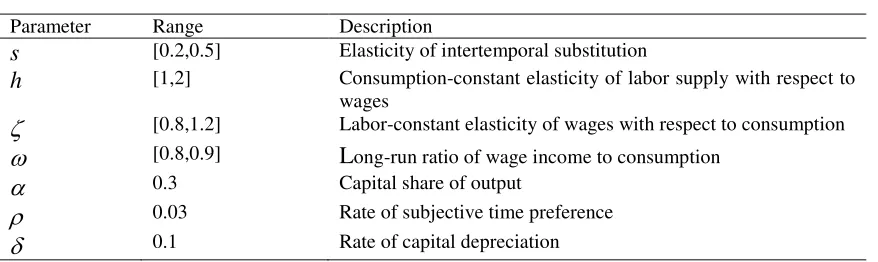
Where α,δ,ρ,ω,ζ,h,s are obtained from estimates of stationary time series.10
,
At this point, finding the restrictions on monetary policy so as to induce LRD is straight
forward: First, steady state levels uc*,ul*,ucc*,ucl*,ull*,
* * * * * , , ,
, fk fkk fkL fLL
I , ) ( ' ' ), ( ' ),
(I* ϕ I* ϕ I*
ϕ are substituted into equation (22) to obtain
* * * * * * * * * * , , , , , ,
, λ η λ η
π
λπ
ηπ
η c c ck L L Lk k
I that depend only on the long run estimate of
α,δ,ρ,ω,ζ,h,s . Then, steady state levels
) ( '' , , , , , , , , * * * * * * * * * * * I L L L c c c
Iη λ η k λ η k
π
λπ
ηπ
kϕ
are substituted into the Jacobian [image:18.595.94.533.514.645.2]matrix A.
Table 1 – Structural Parameters and Elasticities
Parameter Range Description
s [0.2,0.5] Elasticity of intertemporal substitution
h [1,2] Consumption-constant elasticity of labor supply with respect to wages
ζ
[0.8,1.2] Labor-constant elasticity of wages with respect to consumptionω
[0.8,0.9] Long-run ratio of wage income to consumptionα
0.3 Capital share of outputρ
0.03 Rate of subjective time preferenceδ
0.1 Rate of capital depreciation
10ϕ''(I)<0
. Thus, the values of α,δ,ρ,ω should be calibrated so as to ensure that ϕ''(I) is negative at the steady-state investment. Specifically,
αδ δ ρ δ ρ α ω ϕ − + + − < ⇔
<0 (1 )( )
) ( '
' I*
According to the theory, ω equals labor income divided by consumption expenditure.
Taking nominal wages and salaries from the U.S National Income Accounts and
dividing by nominal spending on non-durable consumption and services gives an
average ratio of 0.9. Basu and Kimball (2002) use the prices as perceived by consumer
so they define ω using after-tax wage. Thus they use
ω=0.8 as their preferred value. It
should be noted however, that in the present context, results are robust to
ω as long as
αδ δ ρ
δ ρ α ω
− +
+ −
<(1 )( ) which is essential to ensure that the investment technology is
concave. For that matter, and given the assumed values of α,ρ,δ, ω must be less than
0.91.
For all values specified in Table 1 Det(Bˆ)>0 which imply that the Taylor principle is
necessary to ensure local real determinacy. Furthermore, the upshot of explicitly
solving the characteristic equation of A for values of Table 1 is that an active policy
stance, Rπ* >1, induces two unstable eigenvalues and one stable eigenvalue and hence
local-real-determinacy. A neutral policy stance, Rπ* =1, brings about one stable
eigenvalue, one zero eigenvalue and one unstable eigenvalue and hence
local-real-determinacy. A passive policy stance, Rπ* <1, brings about two stable eigenvalues and
one unstable eigenvalue and hence equilibrium is Non-LRD11.
11
5. Conclusion
This paper considers local real determinacy (LRD) as a prerequisite for
macroeconomic stability. LRD was examined under a simple forward-looking interest
rate feedback rule and a passive fiscal-policy with non distorting taxation where both
labor supply and investment are endogenous. The focus is on labor market dynamics
that derive from complementarities between consumption and hours worked. The
model is specified so as to apply for a wide range of utilities through transformation
from ethereal expressions to long run elasticities.
The model gives rise to a labor market channel. This channel of monetary
policy, in an economy calibrated to the US economy, was found to act together with the
arbitrage channel of monetary policy. The Taylor principle is shown to induce LRD.
Furthermore, a neutral policy stance, such that the expected real rate of interest is
Appendix A A.1 L L c u c L c u L L k f L k f L L c u c L c u L L k f L L c u c L c u w L L k f R L L c u c L c u R L L c u c L c u R L L c u c L c u R c L w L k f I c L w c L w I I k ll k cl k LL kk ll cl LL ll cl LL k k cl k cc cl cc cl cc k k k ) 1 , ( ) 1 , ( ) ) , ( ) , ( ( ) 1 , ( ) 1 , ( ) , ( ) 1 , ( ) 1 , ( ) , ( ) ( ) 1 , ( ) 1 , ( ) ( ) 1 , ( ) 1 , ( ) ( ) 1 , ( ) 1 , ( 1 ) , ( ) ( '' 1 2 − − − = + − − − = − − − + − = = − − − = − − − − − − − = + = + + = = − =
λ
λ
λ
π
π
λ
π
π
λ
π
π
λ
ϕ
η
η η η λ λ λ π η π η η λ π λ λ η η η λ λ η A.2It is assumed throughout that a large number of firms, each of which produces a
homogenous commodity using a constant returns-to-scale production-technology,
operate in a competitive setup of markets for goods and factors. Accordingly,
L L k f k L k f L k
f( , )= k( , ) + L( , ) . And, the capital share of output is
α
Taking partial derivatives of both sides of f(k,L)= fk(k,L)k+ fL(k,L)L and
assuming the market clearing conditions for goods and factor markets, we obtain a set
of equations I c L k f k L L k f L k f L L c w L k f k L k f L k f L k f k L k f L L c w k L k f L k f LL kL LL k kk k k + = − = − = − − = = + = ) , ( ) , ( ) , ( ) , ( ) , ( ) , ( ) 1 ( ) , ( ) , ( ) , ( ) , ( ) , ( ) , (
α
α
α
Of which the solutions with respect to I and the partial derivatives of f are
2 * * * * * * * 2 * * * * * * * * ; ; ; ) 1 ( ; 1 ) 1 ( L c f L k c f k c f k c f c
I k kk αω kL αω LL αω
α αω α
ω
α =− = =−
− = −
− +
= where
* * * c L w ≡
ω
and asterisk denote steady state levelsA.3
A second order Taylor expansion of the investment technology ϕ(I):
2 * * * * * ) )( ( ' ' 2 1 ) )( ( ' ) ( )
(I =ϕ I +ϕ I I −I + ϕ I I −I
ϕ Specifically it is used to approximate
ϕ(0)=0.
Rearranging the Taylor expansion forϕ(0)=0
implies that2 * * * * * '( ) ( ) 2 ) ( '' I I I I
I ϕ ϕ
ϕ = − . Substituting in
αω δ ρ α ϕ δ
ϕ * * * *(1 *)( )
) ( ' ; ) ( c k I k
I = = − +
yields
(
)
References
Basu, S. and M. Kimball, 2002, Long-Run Labor Supply Elasticity and the Elasticity of
Substitution for Consumption, University of Michigan working paper.
Benhabib J., Schmitt-Grohé S., and Uribe M., 2001, Monetary Policy and Multiple
Equilibria, American Economic Review, 91,167-186.
Benhabib J., Schmitt-Grohé S., and Uribe M., 2002, Avoiding Liquidity Traps, Journal
of Political Economy, 110, 535-563.
Benhabib J. and Y. Wen, 2004, Indeterminacy, Aggregate Demand, and the Real
Business Cycle, Journal of Monetary Economics, 51, 503-530
Bennett R. L., R. Farmer, 2000, Indeterminacy with Non-Separable Utility, Journal of
Economic Theory 93, 118-143
Carlstrom , C.T. and Fuerst T.S., 2005, Investment and Interest Rate Policy: A Discrete
Time Analysis, Journal of Economic Theory, 123(1), 4-20.
Cogley T. and Nason, J., 1995. Output dynamics in real-business-cycle models.
American Economic Review, 85, 492–511.
Dupor, B., 2001, Investment and Interest Rate Policy, Journal of Economic Theory, 98,
Evans, G.W. and R. Guesnerie, 2005, Coordination on saddle-path solutions: the
eductive viewpoint- linear multivariate models, Journal of Economic Theory, 124,
202-229.
Feenstra, R.C., 1986, Functional Equivalence between Liquidity Costs and the Utility
of Money, Journal of Monetary Economics, 17 , 271-291
Gliksberg, B., 2009, Monetary Policy and Multiple Equilibria with Constrained
Investment and Externalities, Economic Theory, 41, 443-463
Hall, R., 2008,Aggregate Implications of Indivisible Labor, Incomplete Markets, and
Labor-Market Frictions, Journal of Monetary Economics, 55, 980-82
Huang, K. X. D. and Q. Meng, 2007, Capital and Macroeconomic Instability in a
Discrete-Time Model with Forward-Looking Interest Rate Rules, Journal of Economic Dynamics and
Control, 31(8), 2802-26.
Kimball, M. and M.D. Shapiro, 2008, Labor Supply: Are the Income and Substitution
Effects both Large or Both Small? NBER working paper series w14208.
Leeper, E.M., 1991, Equilibria under 'Active' and 'Passive' Monetary and Fiscal
Policies, Journal of Monetary Economics, 27, 129-147
Linnemann L., 2008, Balanced Budget Rules and Macroeconomic Stability with
Meng, Q. and C.K. Yip, 2004, Investment, Interest Rate Rules, and Equilibrium
Determinacy, Economic Theory, 23, 863-878.
Meng, Q. and C.K. Yip, 2008, On Indeterminacy in One-Sector Models of the Business
Cycle with Factor-Generated Externalities, Journal of Macroeconomics, 30, 97-110
Raj, C., 2006, A New Method of Estimating Risk Aversion, American Economic
Review, 96(5),1821-34.
Rebelo, S. andD. Xie, 1999, On the Optimality of Interest Rate Smoothing, Journal of
Monetary Economics, 43, 263-82
Schmitt-Grohé S., and Uribe M., 1997, Balanced-Budget Rules, Distortionary Taxes,
and Aggregate Instability, Journal of Political Economy, 105, 976-1000
Schmitt-Grohé, S. and M. Uribe, 2007, Optimal Simple and Implementable Monetary
and Fiscal Rules, Journal of Monetary Economics, 54, 1702-1725
Rotemberg, J. and Woodford, M., 1996. Real-business-cycle models and the
forecastable movements in output, hours, and consumption. American Economic