http://dx.doi.org/10.4236/am.2016.79087
How to cite this paper: Falode, O.A. and Chukwunagolu, V.S. (2016) Homotopy Analysis Solution to Radial Diffusivity Equa-tion of Slightly Compressible Fluid. Applied Mathematics, 7, 993-1004. http://dx.doi.org/10.4236/am.2016.79087
Homotopy Analysis Solution to Radial
Diffusivity Equation of Slightly
Compressible Fluid
Olugbenga Adebanjo Falode
*, Victor Sunday Chukwunagolu
Department of Petroleum Engineering, University of Ibadan, Ibadan, Nigeria
Received 27 January 2016; accepted 28 May 2016; published 31 May 2016
Copyright © 2016 by authors and Scientific Research Publishing Inc.
This work is licensed under the Creative Commons Attribution International License (CC BY). http://creativecommons.org/licenses/by/4.0/
Abstract
The salient significance of the solution of radial diffusivity equation to well testing analysis done in oil and gas industry cannot be over-emphasized. Varieties of solutions have been proposed to the radial diffusivity equation, of which the Van Everdingen-Hurst constant terminal rate solution is the most widely accepted and the others are approximate solution having their respective limi-tations. The main objective of this project, being its first application to oil and gas industry, is to use a new mathematical technique, the homotopy analysis method (HAM) to solve the radial diffu-sivity equation for slightly compressible fluid. In Using HAM, the Boltzmann transformation me-thod was used to transform the radial PDE to ODE, then a homotopy series was then constructed for the new equation with the linear boundary condition from the original radial diffusivity equa-tion of slightly compressible fluid and the final equaequa-tion then solved using computaequa-tion software Maple. The result gotten reveals that the homotopy analysis method gives good results compared to the Van Everdingen and Hurst Solution (Exact solution) and thus proves to be very effective, simple, and accurate when compared to other form of solutions. Hence from the results gotten, Homotopy Analysis Method can therefore be applied in solving other non-linear equations in the petroleum engineering field since it is simple and accurate.
Keywords
Homotopy Analysis Method, Boltzmann Transformation, Exact Solution, Diffusivity Equation
1. Introduction
Nonlinear partial differential equations are useful in describing the various phenomena in many disciplines.
Apart from a limited number of these problems, most of them do not have a precise analytical solution, so these nonlinear equations should be solved using approximate methods. In 1992, Shijun Liao employed the basic ideas of the homotopy in topology to propose a general analytic method for nonlinear problems, namely homotopy analysis method (HAM) and then modified it [1]. This method is now widely used to solve many types of non-linear problems. For example, Ayub [2] used HAM to determine an exact flow of a third grade fluid past a por-ous plate. Cherniha [3] used HAM to determine the Lie and non-lie symmetries of nonlinear diffusion equations with convection term. El-Tawi [4] used HAM to get a new application for solving stochastic quadratic nonlinear diffusion equation. Hayat et al. [5] used HAM to determine an exact flow of a third grade fluid past a porous plate. Khani et al. [6] used HAM for the solutions and efficiency of the non-linear fin problem in which he showed the efficiency of HAM. Abbasbandy [7] applied HAM to solve a generalized Hirota-Satsuma coupled KdV equation. HAM was also for a Class of Holling Model with the Functional Reaction. Other researchers have since employed HAM for solutions of seeming difficult scientific and engineering problems [8]-[11]. This method has been successfully applied to solve many types of nonlinear problems. This method doesn’t depend on size of parameters whether they are small or large and is valid for most nonlinear models. HAM is different from all previous numerical methods; it contains a certain auxiliary parameter h, which provides us with a sim-ple way to adjust and control the convergence region of solution series. The main goal of this paper is to find the approximate solution of the nonlinear radial diffusivity equation with convection term by the homotopy analysis method.
1.1. Radial Diffusivity Equation for Slightly Compressible Fluid
The Radial Diffusivity Equation is considered one of the most salient and widely used mathematical expressions in the Oil and Gas Industry. The equation is particularly applied to the analysis of well testing data. The use of this equation is to determine salient information or parameters during the testing analysis of a well and they in-clude; Initial pressure (p), permeability (k), mechanical skin factor (s), flow efficiency, productivity index etc. The equation is also used to investigate reservoir productivity.
To develop the radial diffusivity equation, some assumptions are assumed. These are:
• Formation is a homogenous and isotropic porous media of uniform thickness.
• Negligible gravity effect.
• Applicability of Darcy’s law.
• Pressure independent rock properties.
• Central well is perforated across the entire formation thickness. Hence; radial flow.
• Single phase flow is present in the reservoir.
• Small pressure gradient.
These assumptions are needed to combine the three (3) governing equations needed in deriving the radial dif-fusivity equation:
• The law of conservation of mass.
• Darcy’s law.
• Equation of state.
We consider a radial flow of fluid towards a well in a circular reservoir. Combining the conservation of mass and Darcy’s law for the isothermal flow of fluids of small and constant compressibility, a partial differential eq-uation is obtained that in field units simplifies to
2 2
2 1
0.000264 o
P P P c P
C
r r r kt t
r
µ
∂ + ∂ + ∂ = ∅ ∂
∂ ∂ ∂
∂ (1)
where it is assumed that compressibility, c, is small and independent of pressure, permeability, k, is constant and isotropic; viscosity, µ, is independent of pressure, porosity ɸ, is constant. The above equation is called the non-linear radial diffusivity equation and the term
0.000264
c kt
µ
∅is called the hydraulic diffusivity and is fre- quently denoted by η.
2) The dimensionless pressure, PD, must satisfy the following conditions; 3) The initial condition: PD
(
rD, 0)
=0 at tD =0 for all values of rD; 4) The constant rate inner boundary condition:1 D D D D r P r r = ∂ ∂ .
As stated above, the definition of the dimensionless radius is given as
D w
r r
r
= (2)
and
(
)
141.2 i D
kh p p
P
qBµ
−
= (3)
And dimensionless time is given as:
2 0.000264 D t w kt t c r
µ
=∅ (4)
Therefore, the Dimensionless radial diffusivity equation is given as: 2 2
2 1
D D D D
o
D D D D
D
P P P P
C
r r r t
r
∂ ∂ ∂ ∂
+ + =
∂ ∂ ∂
∂ (5)
When Co=0,
2
2 1
D D D
D D D
D
P P P
r r t
r
∂ + ∂ =∂
∂ ∂
∂ (6)
The above Equation (6) is the linear dimensionless radial diffusivity equation.
1.2. Current Solution to the Radial Diffusivity Equation
There are four solutions to Equation (6) (when Co=0) that are particularly resourceful in well testing:
1) Van Everdingen-Hurst constant terminal rate solution for bounded cylindrical reservoir.
2) The solution for an infinite reservoir with a well-considered to be a line source with zero wellbore ra-dius.
3) The pseudo-steady state solution.
4) The solution that includes wellbore storage for a well in an infinite reservoir.
a) Van Everdingen-Hurst Constant Terminal rate solution for Bounded cylindrical reservoir
Van Everdingen and Hurst developed two set of solution for the linear radial diffusivity equation namely, “the constant terminal pressure case solution” and “the constant terminal rate case”. In the constant terminal pressure case, the pressure at the terminal boundary is lowered by unity at zero time, kept constant thereafter, and the cumulative amount of fluid flowing across the boundary is computed as a function of the time. The constant terminal rate solution is explained explicitly below.
Constant Terminal Rate Solution
modified to cater for variable rate history.
In summary, Van Everdingen and Hurst solution to the Equation (6) requires two boundary conditions and an initial condition. A realistic and practical solution is obtained if we assume that
1) A well produces a constant rate, qB, into the wellbore (q refers to flow rate in STB/D at surface conditions, and B is the formation volume factor in RB/STB);
2) The well, with wellbore radius, rw is centered in a cylindrical reservoir of radius, re and that there is no flow across this outer boundary; and
3) Before production begins, the reservoir is at uniform pressure Pi.
The most useful form of the desired solution relates flowing pressure, Pwf at the sand-face to time and to re-servoir rock and fluid properties.
(
, 0)
0 D DP r = At tD =0 for all values of rD
1 1 D D D D r P r r = ∂ = − ∂ 0 D
P = As rD → ∞ for any value of tD.
The solution after applying the above initial and boundary conditions is expressed as follows;
(
)
(
)
( )
2 2
1
2 1 2 2 2
1 1
e
2 3
141.2 ln 2
4
n Dt
n eD D
wf i eD n
eD n n eD n
J r
t qB
P P r
kh r J r J
α
α
µ
α
α
α
− ∞ = = − + − + −
∑
(7)This solution is considered the exact solution to the radial diffusivity equation, but approximate solutions are used instead of this exact solution because of the cumbersomeness of the equation.
b) Pseudo-steady state solution for Bounded Cylindrical Reservoir
The solution here is simply a limiting form of the Van Everdingen-Hurst constant terminal rate solution (the exact solution), where the summation involving exponentials and Bessel functions is considered negligi-ble.
The solution proposed here to the linear radial diffusivity equation is expressed as; 3 141.2 ln 4 e wf w r qB
P P s
kh r
µ
− = − +
(8)
c) Solution for an infinite Reservoir with Line source well Assumptions made here are that;
1) A well produces at a constant rate, qB; 2) The well has zero radius;
3) The reservoir is at uniform pressure, pi, before production begins; and 4) The well drains an infinite area (i.e., that p → pi as r→ ∞).
Under these conditions, the solution to the radial diffusivity equation is; 2 948
70.6 t w
i i
C r qB
P P E
kh kt
φµ
µ −
= +
(9)
2. Basic Idea of Homotopy Analysis Method
To describe the main idea of Homotopy Analysis Method, the following differential equations are considered: Let U be a function of homotopy parameter q. Then,
( )
, 0N u x t = (10) where N is a non-linear operator, and u x t
( )
, is an unknown function and are temporal independent variable. For simplicity,The Construction of homotopy takes the form:
where q∈
[ ]
0,1 is the homotopy embedding parameter, is a non-zero convergence parameter, H x t( )
, is an auxiliary function(
H x t( )
, ≠0)
, L is an auxiliary linear operator, u0( )
x t, represent the initial guess of( )
,u x t (which satisfies the initial conditions) and U x t q
(
, ;)
is an unknown function of the independent variables x, t and q.In deriving the zeroth order deformation equation we set the homotopy Equation (10) equal to zero,
(
1−q)
φ(
y q;)
−P yo( )
=q H y N( )
φ(
y q;)
(12) whose solution transforms continuously with respect to q.When q = 0,
(
, ; 0)
o( )
, 0 U x t −u x t =
(13)
(
, ; 0)
o( )
U x t =u y (14)
Similarly when q = 1,
(
, ;1)
0N U x t = (15)
(
, ;1)
( )
,U x t =u x t (16)
Thus, as q varies from 0 to 1, the solution U x t q
(
, ;)
varies from the initial guess uo( )
x t, to the solution( )
,u x t .
The homotopy series is gotten by expanding U x t q
(
, ;)
using the Taylor series with respect q to gives;(
, ;)
o( )
, m1m( )
, mU x t q =u x t +
∑
∞=u x t q (17)where
( )
0 ; 1
! m
m m
q U t q u
m q =
∂ =
∂ (18)
If the auxiliary linear operator, the initial guess, auxiliary parameter and auxiliary function are properly chosen, the series Equation (16) converges at q = 1 and we get homotopy series solution;
( )
, o( )
, m1 m( )
,u x t =u x t +
∑
∞=u x t (19)which must be one of the solution of the original non linear equation N u x t
( )
, =0 and equation governing mu is called the mth-order deformation equation.
ForH x t
( )
, =1, mostly used in HAM Equation (12) becomes:(
1−q)
φ(
y q;)
−P yo( )
=q N φ(
y q;)
(20) Differentiating Equation (11) m times with respect to the embedding parameter q and then setting q = 0 and finally dividing them by m!, we have the so-called mth-order deformtion equation:( )
( )
{
um x t, −X um m−1 x t,}
=H x t R( ) (
, m um−1)
(21)
where
0 if 1
1 if 1
m
m X
m
≤
= >
(22)
and
(
1)
(
)
1 1(
)
0
, ; 1
1 ! m
i
m m m
q
N U x t q
R u
m q
−
− −
=
= −
∂ ∂
(23)
computation software like Mapple.
Application of Ham to Solving Non-Linear Radial Diffusivity Equation for Slightly
Comprssible Fluid
Also, transforming Equation (5) using Boltzmann transformation to ordinary differential equation for ease in solving, we have:
2
4 D
D r y
t
= (24)
Equation (5) then becomes;
2 2
2 1
0 y
D D D
o
P P P
C
y y y
∂ + ∂ + ∂ =
∂ ∂
∂ (25)
Initial condition
( )
0 at 0D
P y = y= (26)
Boundary conditions
(
)
0 closed D
P y
∂ =
∂ (27)
The Construction of homotopy for Equation (25) takes the form:
(
y q;) ( )
,P y0 , ,q(
1 q)
(
y q;)
P yo( )
q H y N( )
(
y q;)
φ = − φ − − φ
(28)
where q∈
[ ]
0,1 is the homotopy embedding parameter, is a non-zero convergence parameter, H y( )
is an auxiliary function(
H y( )
≠0)
, L is an auxiliary linear operator, P y0( )
represent the initial guess of( )
P y (which satisfies the initial conditions) and φ
( )
y q; is a function of homotopy parameter q. In deriving the zeroth order deformation equation we set the homotopy Equation (28) equal to zero,(
1−q)
φ(
y q;)
−P yo( )
=q H y N( )
φ(
y q;)
(29)whose solution transforms continuously with respect to q. When q = 0 ,
( )
y; 0 P yo( )
0φ − =
(30)
( )
y; 0 P yo( )
φ
= (31)Similarly when q = 1,
( )
;1 0Nφ y = (32)
( )
y;1 P y( )
φ
= (33)Thus, as q varies from 0 to 1, the solution
φ
( )
y q; varies from the initial guess P yo( )
to the solution( )
P y .The homotopy series is gotten by expanding
φ
( )
y q; using the Taylor series with respect q to gives;( )
;( )
1( )
mo m m
y q P y P y q
φ
= +∑
∞= (34)where
( )
(
;)
m m
( )
o( )
m1 m( )
P y =P y +
∑
∞=P y (36) which must be one of the solution of the original non linear equation N P y( )
=0 and equation governingm
P is called the mth-order deformation equation.
For H y
( )
=1, mostly used in HAM Equation (29) becomes;(
1−q)
φ(
y q;)
−P yo( )
=q N φ(
y q;)
(37) Therefore from Equation (7), the mth order deformation equation is derived as;( )
( )
{
Pm y −X Pm m−1 y}
=H y Z( )
m−1(
Nφ(
y q;)
)
(38)
The solution of the mth-order deformation Equation (37) is given as:
( )
1( )
( )
1 2( )
1( )
1( )
1
1 0
0 0
0
1
m m m m r m
m y y
Z m Z Z D Z Z
r
P y X P y H y P Co P y P y P y y y G y G
y
− − − − −
−
=
′′ ′ ′ ′
= + + + ∂ ∂ + +
∑
∫ ∫
(39)
According to the rule of solution expression Equation (39), the auxilliary function H y
( )
should be as follow( )
1H y =
( )
2
1( ) (0.68 0.68 0) (1 1.36 ln 1.36 )
D
P y = − C y + + y − y (40)
( )
(
)
( )
( )
(
)
2 2 2 2 3
2 0 0
2 2 2 2 2
0 0 0
0.3082666667 0.6165333333 0.30826666667
1.6048 1.6048 0.4624 0.4624 0.9248 ln 0.9248 ln D
P y C C y
C C y C y y
= − +
+ − + − + −
(41)
In this way, we derive PDm
( )
y for m=1, 2, 3, successively.3. Results and Discussion
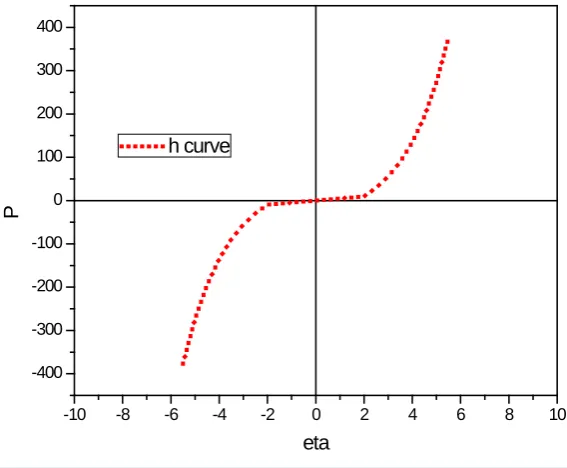
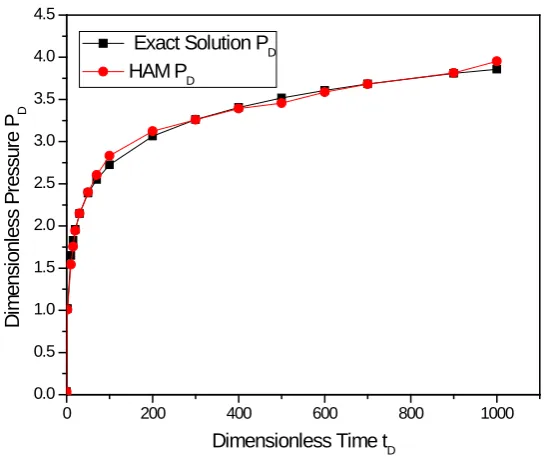
The analytical solution of the nonlinear diffusivity Equation (25) is obtained by using the Homotopy Analysis Method (HAM). The convergence parameter values for which the solution converges is shown in Figure 1. The obtained analytical solution is verified graphically in Figures 2-4 for negligible compressibility factor term in the parameters of the problem to show the behavior of the solution which satisfy the boundary conditions.
-10 -8 -6 -4 -2 0 2 4 6 8 10
-400 -300 -200 -100 0 100 200 300 400
h curve
P
[image:7.595.170.454.476.710.2]eta
0.0 0.5 1.0 1.5 2.0 2.5 3.0 0.0
0.5 1.0 1.5 2.0 2.5 3.0 3.5 4.0
P
[image:8.595.173.451.87.318.2]Lambda
Figure 2. Homotopy analysis method (Dimensionless pressure profile).
0 200 400 600 800 1000
0.0 0.5 1.0 1.5 2.0 2.5 3.0 3.5 4.0 4.5
Exact Solution PD HAM PD
D
im
ens
ionl
es
s P
res
sur
e P
D
Dimensionless Time tD
Figure 3. Plot of Exact and HAM Solutions of PD vs tD for an infinite radial
system (rD = 1).
As long as we choose h in this horizontal region −1.8≤ ≤ 1.8, our solution must converge to the actual solution of Equation (25) where h is the non-convergence parameter.
Evaluating Pd values against td from the HAM solution by substituting the
λ
= y. The HAM Pd−tdvalues compared with the Pd−td data used in validating the Van Everdigen and Hurst Laplace solution result in Dimensionless Pressure profile of Figure 2 for infinite radial system, constant rate at inner boundary (rD =1).
Figure 3 is the comparison of HAM to Van Everdigen and Hurst Solution for an infinite radial system (rD = 1). Homotopy Analysis Method solution was also used in solving for dimensionless pressure PDfor finite radial system with closed exterior boundary, constant rate at inner boundary (rD=200), and Table 1 shows the result
[image:8.595.177.452.345.574.2]0 2000 4000 6000 8000 10000 12000 4.0
4.2 4.4 4.6 4.8 5.0 5.2
D
im
ens
iol
es
s P
res
sur
e P
D
Dimensionless Time tD Exact Solution (PD)
HAM (PD)
Figure 4. Plot of Exact and HAM Solutions of PD vs tD for an infinite radial system (rD= 200).
Table 1. HAM and exact solution PD values at rD = 200.
tD Van Everdigen and Hurst
Exact Solution for (PD) Homotopy Analysis Method (PD) Absolute Error
1500 4.061 4.000 0.061
2000 4.205 4.200 0.005
2500 4.317 4.300 0.017
3500 4.498 4.478 0.020
4000 4.552 4.548 0.004
5000 4.663 4.655 0.008
6000 4.754 4.750 0.004
7000 4.829 4.820 0.009
9000 4.949 5.042 0.093
10,000 4.996 5.100 0.104
12,000 5.072 5.180 0.108
From Table 1, it seen that there is minimal error between the Van Everdigen and Hurst solution with that of the Homotopy Analysis Method. Figure 4 is a plot of Table 2, showing the plot of the Exact solution and the values gotten from the Homotopy Analysis Method against the dimensionless time at rD = 200.
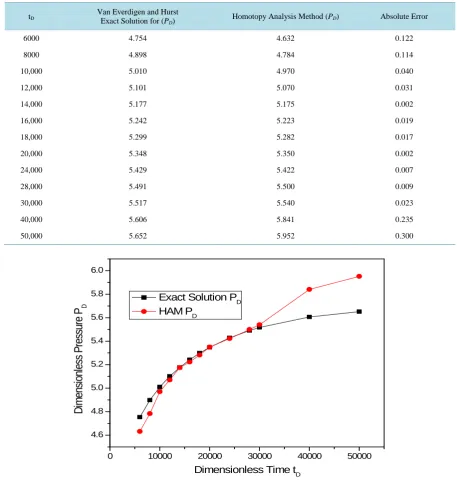
Furthermore, Homotopy Analysis Method solution gotten for the radial diffusivity equation was applied in getting the values of PDfor respective Dmensionless time tD values for rD= 300 for finite radial system with closed exteriorboundary and constant rate at inner boundary. Table 2 shows the solutions gotten using HAM, Van Everdigen and Hurst solutions against various dimensionless time tD values at rD = 300 and their respective absolute errors.
Also, from Table 1, it seen that there is minimal error between the Van Everdigen and Hurst solution with that of the Homotopy Analysis Method. Figure 5 is a plot of Table 2, showing the plot of the Exact solution and the values gotten from the Homotopy Analysis Method against the dimensionless time at rD = 300.
Table 2. HAM and exact solution PD values at rD= 300.
tD Van Everdigen and Hurst
Exact Solution for (PD) Homotopy Analysis Method (PD) Absolute Error
6000 4.754 4.632 0.122
8000 4.898 4.784 0.114
10,000 5.010 4.970 0.040
12,000 5.101 5.070 0.031
14,000 5.177 5.175 0.002
16,000 5.242 5.223 0.019
18,000 5.299 5.282 0.017
20,000 5.348 5.350 0.002
24,000 5.429 5.422 0.007
28,000 5.491 5.500 0.009
30,000 5.517 5.540 0.023
40,000 5.606 5.841 0.235
50,000 5.652 5.952 0.300
0 10000 20000 30000 40000 50000
4.6 4.8 5.0 5.2 5.4 5.6 5.8 6.0
D
im
ens
ionl
es
s P
res
sur
e P
D
Dimensionless Time tD Exact Solution PD
HAM PD
Figure 5. Plot of Exact and HAM Solutions of PD vs tD for an infinite radial system (rD= 300).
of the HAM in solving approximately the non-linear flow problem in the reservoir is evident. Also, Figures 2-4
show the accuracy of the Homotopy Analysis method when compared to the Van Everdingen and Hurst solution when the radial diffusivity equation solution used was linearized.
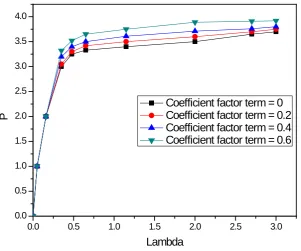
Figure 6 shows the comparison plot of non-linear radial diffusivity equation i.e. when compressibility factor and the pressure gradient are not negligible (≠0) and the linear radial diffusivity equation for slightly compressi-ble fluid. Therefore, we have:
0.0 0.5 1.0 1.5 2.0 2.5 3.0 0.0
0.5 1.0 1.5 2.0 2.5 3.0 3.5 4.0
Coefficient factor term = 0
Coefficient factor term = 0.2
Coefficient factor term = 0.4
Coefficient factor term = 0.6
P
[image:11.595.165.467.83.334.2]Lambda
Figure 6. Dimensionless pressure profile at different compressibility coefficient factor
term of 0, 0.2, 0.4 and 0.6.
4. Conclusions
In this work, an approximate but very accurate solution of a non-linear reservoir model with coefficient of square of pressure gradient Co was successfully obtained using a powerful analytic method called the homotopy analysis method. It was shown that:
1) The pressure distribution in the reservoir with coefficient of square of pressure gradient Co, can be accu-rately predicted with the HAM solution.
2) The freedom of choice of the auxiliary parameter h, gives way to adjust and control the convergence of the solution series, which can be considered as a fundamental difference between the homotopy analysis method and other existing methods such as the adomian decomposition method, homotopy perturbation method and variational iteration method.
3) The Homotopy Analysis method is a mathematical model that can be used to solve the non-linear radial diffusivity equation effectively.
It is then believed that the homotopy analysis method is an efficient and capable technique in handling a wide variety of engineering problems.
References
[1] Liao, S.J. (1992) The Proposed Homotopy Analysis Method Techniques for the Solution of Nonlinear Problems. Shanghai Jiao Tong University, Shanghai.
[2] Ayub, M.A. and Rasheed Hayat, T. (2003) Exact Flow of a Third Grade Fluid past a Porous Plate Using Homotopy Analysis. International Journal of Engineering Science, 41, 2091-2103.
http://dx.doi.org/10.1016/S0020-7225(03)00207-6
[3] Cherniha, R. and Servo, M. (1997) Lie and Non-Lie Symmetries of Nonlinear Diffusion Equations with Convection Term. Symmetry in Nonlinear Mathematical Physics, 2, 444-449.
[4] El-Tawi, M.A. and Hassan, H.N. (2013) A New Application of Using Homotopy Analysis Method for Solving Sto-chastic Quadratic Nonlinear Diffusion Equation. International Journal of Applied Mathematics and Mechanics, 9, 35- 55.
[5] Hayat, T. and Khan, M. (2005) Exact Flow of a Third Grade Fluid past a Porous Plate Using Homotopy Analysis. In-ternational Journal of Engineering Science, 56, 1012-1029.
perature-Dependent Thermal Conductivity and Heat Transfer Coefficient. Communications in Nonlinear Science and Numerical Simulation, 14, 3327-3338. http://dx.doi.org/10.1016/j.cnsns.2009.01.012
[7] Abbasbandy, S. (2007) The Application of Homotopy Analysis Method to Solve a Generalized Hirota-Satsuma Coupled KdV Equation. Physics Letters A, 361, 478-483. http://dx.doi.org/10.1016/j.physleta.2006.09.105
[8] Mahmoudi, Y. and Kazemian, E.M. (2013) The Homotopy Analysis Method for Solving the Kuramoto-Tsuzuki Equa-tion. World Applied Sciences Journal, 21, 1776-1781.
[9] Sajad, M., Hayat, T. and Asghar, S. (2006) On the Analytic Solution of the Steady Flow of a Fourth Grade Fluid. Phy- sics Letters A, 355, 18-26. http://dx.doi.org/10.1016/j.physleta.2006.01.092
[10] Van Everdingen, A.F. and Hurst, W. (1949) The Application of the Laplace Transformation to Flow Problems in Re-servoirs. Transactions of AIME, 186, 305-324.
[11] Chen, X.R. and Yu, J.J. (2013) Homotopy Analysis Method for a Class of Holling Model with the Functional Reaction.